Introduction
Psychosis is commonly associated with neuropsychological impairments (Mesholam-Gately, Giuliano, Goff, Faraone, & Seidman, Reference Mesholam-Gately, Giuliano, Goff, Faraone and Seidman2009) and degraded real-world functioning (Grant, Addington, Addington, & Konnert, Reference Grant, Addington, Addington and Konnert2001) that are evident early in the course of illness. Psychotropic medications target psychiatric symptoms (Robinson, Woerner, Delman, & Kane, Reference Robinson, Woerner, Delman and Kane2005), but can induce secondary neuropsychological impairments (Élie et al., Reference Élie, Poirier, Chianetta, Durand, Grégoire and Grignon2010; Reilly, Harris, Keshavan, & Sweeney, Reference Reilly, Harris, Keshavan and Sweeney2006), exacerbating existing deficits. These adverse effects limit treatment benefits and may serve as a deterrent to rehabilitation and recovery (Vinogradov et al., Reference Vinogradov, Fisher, Warm, Holland, Kirshner and Pollock2009).
All antipsychotic medications block D2-type dopamine receptors (Kapur & Seeman, Reference Kapur and Seeman2001), and some compounds also block muscarinic cholinergic receptors (Richelson & Souder, Reference Richelson and Souder2000). Both of these effects are known to have an adverse impact on neuropsychological functioning. In particular, higher striatal D2 receptor occupancy by antagonists disrupts motor speed and handwriting abilities in persons with schizophrenia (Kuenstler, Juhnhold, Knapp, & Gertz, Reference Kuenstler, Juhnhold, Knapp and Gertz1999; Yang et al., Reference Yang, Yeh, Chiu, Lee, Chen, Lee and Jeffries2004), consistent with the importance of the nigrostriatal dopamine pathway for motor functioning in schizophrenia (Farde et al., Reference Farde, Nordström, Wiesel, Pauli, Halldin and Sedvall1992) and Parkinson's disease (Lang & Lozano, Reference Lang and Lozano1998).
Higher serum anticholinergic levels are associated with a reduction in neurocognitive abilities, most notably within the memory domain (Strauss, Reynolds, Jayaram, & Tune, Reference Strauss, Reynolds, Jayaram and Tune1990; Vinogradov et al., Reference Vinogradov, Fisher, Warm, Holland, Kirshner and Pollock2009). Cholinergic signalling is involved in memory at various levels, including attention and working memory as well as delayed memory (Power, Vazdarjanova, & McGaugh, Reference Power, Vazdarjanova and McGaugh2003). The current research focuses on delayed memory, which has been well researched in the context of the cholinergic hypothesis of Alzheimer's disease. Indeed, delayed recall is among the most impacted cognitive functions in early Alzheimer's disease (Bäckman, Jones, Berger, Laukka, & Small, Reference Bäckman, Jones, Berger, Laukka and Small2005). Animal research suggests that memory consolidation is modulated by muscarinic cholinergic signalling in the basolateral amygdala, anterior striatum, and dorsal hippocampus (see Power et al., Reference Power, Vazdarjanova and McGaugh2003, for a review).
Antagonism of D2 receptors and muscarinic cholinergic receptors may have implications for psychosocial treatment interventions and recovery. For instance, in persons with schizophrenia higher serum anticholinergic activity is associated with an attenuation of the cognitive benefits achieved from a computerized retraining intervention (Vinogradov et al., Reference Vinogradov, Fisher, Warm, Holland, Kirshner and Pollock2009). Furthermore, any adverse effects from receptor antagonism might be particularly important to elucidate early in the course of illness when patients have little or no experience with the treatments and are forced to come to terms with their illness and its management.
An understanding of the adverse neurocognitive and motor impacts of psychotropic treatments is hindered by the variable pharmacological regimens individualized to patients. Neuropsychological functioning may be modified by the underlying pharmacodynamics of the medications and their dosages. Estimating these impacts is complex because patients may be treated with more than one antipsychotic medication as well as adjunctive compounds (e.g., anticholinergics). Complicating matters further is that the neuropsychological effects arising from receptor antagonism may be specific to given functions, rather than being global.
Minzenberg and colleagues (Minzenberg, Poole, Benton, & Vinogradov, Reference Minzenberg, Poole, Benton and Vinogradov2004) recently developed a clinically applicable standardized pharmacological index of anticholinergic potency that partially addresses these issues. This index quantifies the relative amount of muscarinic receptor antagonism for each antipsychotic and adjunct psychotropic medication, and allows anticholinergic load to be estimated across a range of medication regimens. In a chronic schizophrenia sample, anticholinergic load was associated with poorer verbal memory (Minzenberg et al., Reference Minzenberg, Poole, Benton and Vinogradov2004), as would be expected given prior associations between memory impairment and anticholinergic medications and serum levels (Ghoneim & Mewaldt, Reference Ghoneim and Mewaldt1975; Strauss et al., Reference Strauss, Reynolds, Jayaram and Tune1990; Sweeney, Keilp, Haas, Hill, & Weiden, Reference Sweeney, Keilp, Haas, Hill and Weiden1991). Recently, we reported additional support for the utility of Minzenberg's anticholinergic index by linking it to memory functioning in a quantitative review of schizophrenia studies (Thornton, Van Snellenberg, Sepehry, & Honer, Reference Thornton, Van Snellenberg, Sepehry and Honer2006).
The primary research aim of the present study is to ascertain whether neuropsychological abilities of persons with first-episode psychosis (FEP) vary as a function of anticholinergic and D2 receptor antagonism estimated using a readily available and inexpensive procedure that accounts for medication dose and polypharmacy. To achieve this aim we developed a novel index of D2 antagonist potency that is comparable to the pharmacological anticholinergic index developed by Minzenberg and colleagues (Reference Minzenberg, Poole, Benton and Vinogradov2004) in their study of chronic patients. Our approach is innovative in that it is the first to deploy two indices to estimate the relative antagonism of distinct receptor systems in individual patients on different medication regimens. This permits hypothesizing a specific pattern of associations and dissociations on the basis of theoretical understanding of the functioning of the receptor pathways. A secondary research aim is to extend and replicate the findings of Minzenberg and colleagues (2004) under optimal conditions. Specifically, the present research investigates an FEP sample consisting of participants who are less refractory to treatment and have a more limited exposure to antipsychotic medications. Consequently, they may be particularly reactive to any adverse effects arising from receptor antagonism at this critical point in their adjustment to psychosis. Such information is invaluable for patient management.
Our first hypothesis was that higher estimated dopamine D2 antagonist load from psychotropic medications would be associated with poorer motor functioning in FEP (Kuenstler et al., Reference Kuenstler, Juhnhold, Knapp and Gertz1999; Yang et al., Reference Yang, Yeh, Chiu, Lee, Chen, Lee and Jeffries2004), but would not be associated with delayed memory (Mehta, Hinton, Montgomery, Bantick, & Grasby, Reference Mehta, Hinton, Montgomery, Bantick and Grasby2005). Conversely, our second hypothesis was that higher estimated anticholinergic load from psychotropic medications would be selectively associated with poorer delayed verbal memory (Ghoneim & Mewaldt, Reference Ghoneim and Mewaldt1975; Strauss et al., Reference Strauss, Reynolds, Jayaram and Tune1990; Sweeney et al., Reference Sweeney, Keilp, Haas, Hill and Weiden1991). Although muscarinic antagonism reduces extrapyramidal symptoms (EPS; Arana, Goff, Baldessarini, & Keepers, Reference Arana, Goff, Baldessarini and Keepers1988), anticholinergic load was not expected to predict motor functioning in this FEP sample because patients taking low-dose antipsychotics typically have few clinically observable EPS (Kopala, Good, & Honer, Reference Kopala, Good and Honer1997) and anticholinergic medications do not improve motor functioning in the absence of EPS (Lines, Ambrose, Heald, & Traub, Reference Lines, Ambrose, Heald and Traub1993).
Methods
Participants and Procedures
The research protocol was approved by university and health authority ethics review boards and was in compliance with their regulations. Written informed consent was obtained from the participants after the procedures had been fully explained. Participants were recruited for a longitudinal study from an FEP program serving a catchment area population of 640,000 in the Vancouver area. All patients with FEP were referred to the program for care, and were approached to enter the study if they met study inclusion criteria. Assessments were made at baseline, at 6 months, and at 9–12 months. Cognition was evaluated at the baseline and 9- to 12-month time points.
For the present report, inclusion criteria were non-substance induced FEP, fluency in English, and no change in type of antipsychotic treatment (assessed by self-report and physician's notes) for at least 3 weeks before the 9- to 12-month follow-up assessment to avoid confounding effects of recent medication changes (Agid, Kapur, Arenovich, & Zipursky, Reference Agid, Kapur, Arenovich and Zipursky2003; Kinon et al., Reference Kinon, Chen, Ascher-Svanum, Stauffer, Kollack-Walker, Zhou and Naber2010). After the exclusion of two patients for severe hallucinations and lack of engagement during testing, 68 patients (66.2% male) met the inclusion criteria and completed the 9- to 12-month follow-up assessment session that was essential for the analyses. The FEP sample was 73.5% Caucasian, 7.4% Asian, 5.9% South Asian, 4.4% First Nations, and 8.8% other ethnicities. Additionally, 43 healthy volunteers (53.5% male), similar to the FEP group on estimated premorbid IQ, age, education, and gender (all ps > .05) completed the assessment sessions appropriate for neuropsychological comparison. The healthy sample was 62.8% Caucasian, 23.3% Asian, 7.0% South Asian, 0% First Nations, and 6.9% other ethnicities.
Patient diagnoses were made according to DSM-IV criteria based on the Structured Clinical Interview for DSM-IV and review of longitudinal clinical case notes by trained research clinicians (WGH, GWM, LCK) at a consensus conference. Careful inquiry was made into patterns of substance use at baseline, and at follow-up assessments. Twenty-five percent of the FEP sample and 14% of the comparison group met criteria for current abuse or dependence at the 9- to 12-month follow-up. Substances of abuse and/or dependence were alcohol for 12 FEP participants and 6 comparison participants, cannabis for 10 FEP participants and 2 comparison participants, and other street drugs for 5 FEP participants and 1 comparison participant. To rule out substance-induced psychosis, any patients with exposure to stimulant drugs at baseline were asked to return for a follow-up diagnostic interview after at least one month free of stimulants. Neuropsychological assessments were carried out by research assistants under the supervision of a clinical psychologist. Psychiatric symptom assessments and the movement disorder examination were completed by a research psychiatrist.
Measures
Participants were administered a comprehensive battery of standardized tests including measures of memory, motor functioning and intellectual abilities. Premorbid intellectual functioning was estimated at baseline with the North American Adult Reading Test (NAART; Blair & Spreen, Reference Blair and Spreen1989). Current IQ was estimated at baseline with the Kaufman Brief Intelligence Test (K-BIT; Kaufman & Kaufman, Reference Kaufman and Kaufman1990). The Positive and Negative Syndrome Scale (PANSS; Kay, Fiszbein, & Opler, Reference Kay, Fiszbein and Opler1987) estimated psychiatric symptom severity at baseline and follow-up. Factor-analytically derived positive and negative component scores (Lindenmayer, Bernstein-Hyman, & Grochowski, Reference Lindenmayer, Bernstein-Hyman and Grochowski1994) and depressive symptom scores (El Yazaji et al., Reference El Yazaji, Battas, Agoub, Moussaoui, Gutknecht, Dalery and Saoud2002) were calculated at the follow-up assessment. Level of functioning was indexed at baseline and at follow-up by the Social and Occupational Functioning Assessment Scale (SOFAS; American Psychiatric Association, 1994) and the Role Functioning Scale (Goodman, Sewell, Cooley, & Leavitt, Reference Goodman, Sewell, Cooley and Leavitt1993).
A delayed verbal memory index (z scores) was calculated by standardizing the mean of the California Verbal Learning Test, second edition (CVLT-II; Delis, Kramer, Kaplan, & Ober, Reference Delis, Kramer, Kaplan and Ober2000) Long Delay Free Recall and the Wechsler Memory Scale − III (WMS-III; Wechsler, Reference Wechsler1997b) Logical Memory Delayed Recall,Footnote 1 which showed a strong association in this sample (r = .47; p < .001). Specifically, the FEP group mean of CVLT-II Long Delay Free Recall raw scores was subtracted from each participant's corresponding raw score and the difference was divided by the group standard deviation. This standardized score was summed with a similarly standardized WMS-III Logical Memory Delayed Recall score, and then re-standardized to achieve a mean of zero and a standard deviation of one. A motor functioning index (z scores) was calculated by standardizing the mean of the Grooved Pegboard Test (Matthews & Klove, Reference Matthews and Klove1964) average completion time using the dominant and non-dominant hand, and the Extrapyramidal Symptom Rating Scale (ESRS; Chouinard, Ross-Chouinard, Annable, & Jones, Reference Chouinard, Ross-Chouinard, Annable and Jones1980) Parkinsonism score. The latter captures tremor, impaired gait/posture, postural instability, rigidity, reduced facial expression/speech, bradykinesia, and sialorrhea. The Grooved Pegboard Test and the Parkinsonism score showed an association that was of a medium to large magnitude (r = .35; p < .01). These two measures that use divergent methods to capture motor functioning were selected to maximize reliability and minimize the influence of method bias (Campbell & Fiske, Reference Campbell and Fiske1959). The motor functioning index was calculated using the same steps as for the verbal memory index. Verbal memory and motor functioning were evaluated at baseline and at the 9- to 12-month follow-up for both FEP and healthy comparison participants (mean = 10.14 months; SD = 2.00; alternate forms of the CVLT-II were counterbalanced). Higher index scores indicated better performance. This strategy of creating index scores based on multiple measures was selected to maximize the reliability of the variables and capture the targeted neuropsychological domains.
Data Analysis
Receptor load estimates
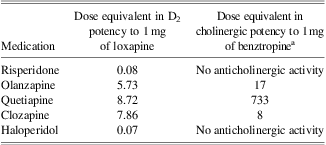
Forty-three participants were taking one, seven participants were taking two, and one participant was taking three medications contributing to anticholinergic or D2 load estimates. The primary medications that contributed to load estimates for the participants were antipsychotics. Additionally, benztropine and/or antidepressants contributed to anticholinergic load estimates for six participants. Anticholinergic load was estimated for each participant based on medication type and dose at the 9- to 12-month follow-up assessment and was achieved using the pharmacological index of the anticholinergic potencies of psychotropic medications (Minzenberg et al., Reference Minzenberg, Poole, Benton and Vinogradov2004; see Table 1). This index gives the dose of each medication that is equivalent in anticholinergic effect to 1 mg of benztropine. Each participant's medication dose was divided by the dose that is equivalent to 1 mg of benztropine to yield an anticholinergic load. Thus, anticholinergic load is expressed in a benztropine equivalent dosage that corresponds to the anticholinergic effect of the participant's medication. For participants taking more than one type of medication with anticholinergic effects, the anticholinergic loads of the different medications (including antipsychotics, antidepressants, and adjunctive treatments) were summed.
Relative D2 and cholinergic potencies of antipsychotic medications
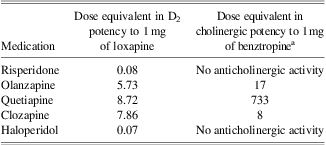
aMinzenberg et al., 2004.
Each participant's D2 antagonist load was estimated using an index of D2 potencies. Loxapine was chosen as a reference agent because of its affinity for both D2 and D1 receptors. The D2 antagonist load of risperidone, for example, was estimated as follows: the ratio of risperidone's affinity for D2 receptors and loxapine's affinity for D2 receptors was calculated, and each participant's dose of risperidone was divided by that ratio to yield an amount of loxapine that the participant's medication is equivalent to in D2 antagonism. D2 antagonist loads from multiple antipsychotic medications were summed.
The National Institute of Mental Health's Psychoactive Drug Screening Program (PDSP) Ki database was accessed to establish medication affinities (Ki represents the equilibrium dissociation constant for a receptor-ligand complex) for D2 receptors by referencing appropriate reports of studies using human cloned receptors and the radioligand [3H]raclopride (Burstein et al., Reference Burstein, Ma, Wong, Gao, Pham, Knapp and Brann2005; Seeman, Reference Seeman2001). The average Ki value across appropriate reports was taken (see Table 1).
Statistical procedures
Cognitive test scores of the healthy comparison group were contrasted with scores of the FEP participants receiving and not receiving antipsychotics using independent sample t tests and differences were calculated as standardized effect sizes. A series of hierarchical regression analyses was conducted to test the primary hypotheses that (1) higher anticholinergic load is associated with worse delayed verbal memory but is not associated with motor functioning, and (2) higher D2 antagonist load is associated with worse motor functioning but is not associated with delayed verbal memory. The 9- to 12-month follow-up time point was selected for these analyses because participant clinical status and medications were more stable compared to baseline. Independent-variable data points with absolute-value z scores greater than 3.29 were considered outliers and adjusted to the value of the highest non-outlying data point (Tabachnick, Reference Tabachnick2001). To identify background predictors of delayed verbal memory and motor functioning, scatter plots and zero-order correlations between the dependent variables and the following background variables were inspected: age, estimated premorbid IQ, positive symptoms, negative symptoms, depressive symptoms, gender, diagnosis, tobacco use, alcohol use, marijuana use, other street drug use (street drugs included crystal methamphetamine, cocaine, and ecstasy, but were represented by a single variable due to the low frequency of use reported in our sample), mood stabilizer status, and antidepressant medication status. Subsequently, hierarchical regression analyses were conducted in which background variables that were associated with the dependent variables (i.e., zero-order correlations of p < .10) were entered on Block 1. On Block 2 anticholinergic load and D2 load (log transformed to improve normality) were entered. Non-predictive background variables (p > .05) were not included in final models. To rule out other possible confounds, the final regression analyses were repeated, first excluding participants with a neurological history (seizures or head injury with loss of consciousness greater than 5 min; n = 4) and those taking buproprion (a dopamine reuptake inhibitor; n = 2) or benzodiazepines (n = 4), then including only participants taking antipsychotic medications (n = 51), and finally including only participants with a schizophrenia spectrum disorder diagnosis (n = 50).
Although this study used a hypothesis-driven approach, other cognitive domains were tested in our sample in addition to delayed verbal memory and motor functioning. We conducted an exploratory analysis for the interested reader who may wish to consider associations of anticholinergic and D2 load with other neuropsychological functions. The following measures were included to represent a range of cognitive functions: CVLT-II Trials 1–5, Rey-Osterrieth Complex Figure Test 30-minute recall (Spreen & Strauss, Reference Spreen and Strauss1991), Wechsler Adult Intelligence Scale − III (WAIS-III; Wechsler, Reference Wechsler1997a) Letter-Number Sequencing, Digit Span, and Digit-Symbol Coding, Cambridge Neuropsychological Test Automated Battery (CANTAB; Robbins et al., Reference Robbins, James, Owen, Sahakian, McInnes and Rabbitt1994) Rapid Visual Information Processing (RVP) A′ (sensitivity to targets) and Intra-Extra Dimensional Set Shift (IED) total errors adjusted, and the Controlled Oral Word Association Test (COWA, CFL; Benton & Hamsher, Reference Benton and Hamsher1978). Partial correlations were computed using raw scores, controlling for background variables that were associated with each cognitive measure (p < .05).
Results
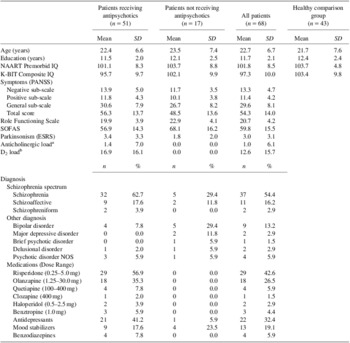
At the 9- to 12-month follow-up assessment, 51 FEP participants (75.0%) were taking antipsychotic medications. Thirty-two (47.1%) had smoked tobacco, 48 (70.6%) had used alcohol, 30 (44.1%) had used marijuana, and 12 (17.6%) had used other street drugs between the 6-month and 9- to 12-month follow-up assessments. Demographics, clinical information, and mean anticholinergic load and D2 load for the participants at follow-up are summarized in Table 2.
Demographic and clinical characteristics

Note. Clinical data were collected at follow-up excepting baseline IQs. K-BIT = Kaufman Brief Intelligence Test. NAART = North American Adult Reading Test. PANSS = Positive and Negative Syndrome Scale. SOFAS = Social and Occupational Functioning Assessment Scale. ESRS = Extrapyramidal Symptom Rating Scale.
aExpressed in mg benztropine equivalent; excluding the participant taking clozapine, mean (SD) for the patients receiving antipsychotics = 0.41 (0.59) and for all patients = 0.31 (0.54).
bExpressed in mg loxapine equivalent.
Neuropsychological Impairment
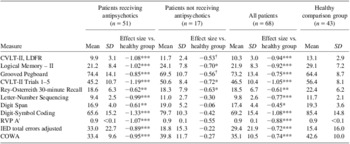
As shown in Table 3, preliminary analyses revealed that the FEP participants exhibited moderate to large magnitude neuropsychological impairments relative to the healthy comparison group, which were greater for the FEP participants who were receiving antipsychotic treatment. At the 9- to 12-month follow-up, better motor functioning (r = 0.27; p < .05) and stronger delayed verbal memory abilities (r = 0.29; p < .05) were associated with higher SOFAS scores of the patients, replicating the importance of neuropsychological abilities in predicting daily function in FEP (Milev, Ho, Arndt, & Andreasen, Reference Milev, Ho, Arndt and Andreasen2005).
Neuropsychological test results at 9- to 12-month follow-up

Note. CVLT-II, LDFR = California Verbal Learning Test – II, Long Delay Free Recall; RVP = CANTAB Rapid Visual Information Processing; IED = CANTAB Intra-Extra Dimensional Set Shift; COWA = Controlled Oral Word Association Test. Effects are based upon mean FEP versus healthy comparison group differences divided by the pooled SD; negative values represent poorer performance in the FEP group. Due to data loss, the minimum n for any measure in the FEP group (all patients) was 61 (Rey-Osterreith) and in the healthy comparison group n = 42 (CVLT-II and COWA).
†p < .10.
*p < .05.
**p < .01.
***p < .001.
Delayed Verbal Memory and Receptor Antagonism
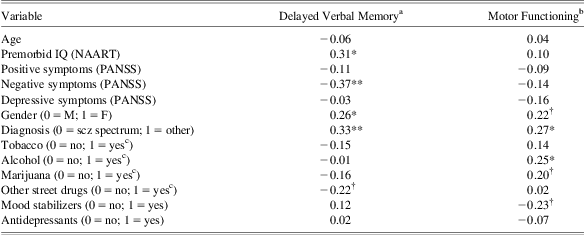
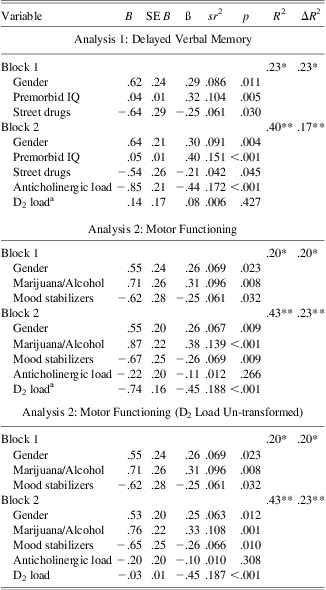
Background variables associated with delayed verbal memory of FEP participants included premorbid IQ, negative symptoms, gender, diagnosis, and use of street drugs other than marijuana (see Table 4 for Pearson's correlation coefficients between delayed verbal memory and all background variables examined). Hierarchical regression modeling of delayed verbal memory is reported in the top portion of Table 5. For this analysis, Block 1 accounted for 23% of the variance in delayed verbal memory. Higher premorbid IQ, female gender and not using street drugs were associated with better memory. Diagnosis and negative symptoms were not predictive and were dropped from the model. Block 2 accounted for an additional 17% of the variance in delayed verbal memory, with higher anticholinergic load predicting poorer memory (sr 2 = .17). D2 load did not predict verbal memory. The explanatory power of the Block 2 variables corresponded to a medium to large effect size, and the overall model's effect was large (Cohen, Reference Cohen1992). The regression results (anticholinergic load coefficient and variances accounted for by Block 2 variables and by the full model) were of comparable magnitude and remained significant at the p < .01 level when the analysis was repeated for participants with schizophrenia spectrum disorder only and when repeated to rule out possible confounds as described above. Notably, when we conducted a regression limited to the participants taking antipsychotic medications, the findings were confirmed (anticholinergic load ß = −.44; p = .001).
Pearson's correlations of background variables with delayed verbal memory and motor functioning in FEP participants
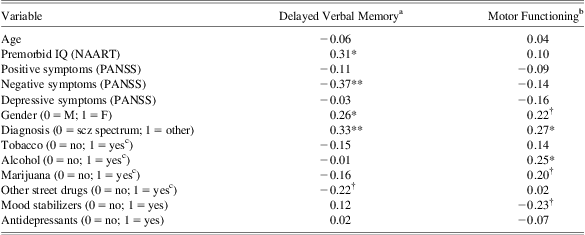
Note. Higher neuropsychological scores represent better performance. Higher symptom measure scores represent more severe symptoms. Marijuana and tobacco smoking status were not collected for one participant. PANSS data were not collected for one participant.
aIndex composed of California Verbal Learning Test – II Long Delay Free Recall and Wechsler Memory Scale – III Logical Memory Delayed Recall.
bIndex composed of time to complete grooved pegboard and the Extrapyramidal Symptom Rating Scale (Parkinsonism) score.
cAny use reported between the 6-month and 9- to 12-month assessments.
†p < .10.
*p < .05.
**p < .01.
Regression results for delayed verbal memory and motor functioning in 68 FEP patients

Note. Background variables associated with the dependent variable (p < .10; see Table 4) were entered in Block 1 of each analysis and were only retained in the final model (presented here) if they remained significant (p < .05). Street drugs include crystal methamphetamine, cocaine, and ecstasy.
aLog transformed.
*p < .01.
**p < .001.
Motor Functioning and Receptor Antagonism
Background variables associated with motor functioning of FEP participants included gender, diagnosis, marijuana or alcohol use (any use since the 6-month assessment), and mood stabilizers (see Table 4). Alcohol and marijuana were found to be associated with motor functioning to a similar degree and with effects in the same direction; as such, these were combined into a single dichotomous variable representing any use of either substance. The middle portion of Table 5 summarizes the hierarchical modeling of motor functioning (transformed D2 load data). Block 1 accounted for 20% of the variance in motor functioning. Female participants and participants who used marijuana or alcohol had better motor functioning, whereas participants who were taking mood stabilizers had poorer motor functioning. Diagnosis was not predictive and was dropped from the model. Block 2 variables accounted for an additional 23% of variance in motor functioning, with higher D2 load predicting poorer motor functioning (sr 2 = .19). Anticholinergic load did not predict motor functioning. The explanatory power of Block 2 variables corresponded to a medium to large effect size, while the overall model's effect was large (Cohen, Reference Cohen1992). The regression results (D2 load coefficient and variances accounted for by Block 2 variables and by the full model) were of comparable magnitude and remained significant at the p < .01 level when the analysis was repeated for participants with schizophrenia spectrum disorder only and when repeated to rule out possible confounds as described above. Notably, when we conducted a regression limited to the participants taking antipsychotic medications, the findings were confirmed (D2 load ß = −.37; p = .002). Repeating this regression with un-transformed D2 load produced similar results (see bottom portion of Table 5).
Additional Exploratory Analyses
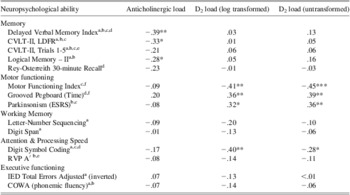
Exploratory analysis of the partial correlations between receptor antagonist loads and the cognitive performances that were not germane to our hypotheses are presented in Table 6 (partial correlations controlling for any associated background variables). In addition to the hypothesized associations, the Digit Symbol Coding subtest was associated with D2 load. As Digit Symbol Coding is primarily a measure of perceptual-motor speed (Strauss, Sherman, & Spreen, Reference Strauss, Sherman and Spreen2006), motor functioning was evaluated as a possible mediator of the association between D2 load and Digit Symbol Coding performance. The nonparametric bootstrapping method recommended by Preacher and Hayes (Reference Preacher and Hayes2004) was used, with 5000 resamples. Motor functioning was found to be a significant mediator (unstandardized indirect effect size 95% confidence interval −6.88 to −0.76). The ratio of the indirect effect to the total effect was 0.32 (95% confidence interval 0.07 to 0.77), indicating that the indirect effect comprises approximately one-third of the total effect.
Partial correlations between receptor antagonist loads and neuropsychological performances at 9- to 12-month follow-up in 68 FEP patients

Note. Any background variables correlated (p < .05) with each neuropsychological measure were controlled for. Covariates for each analysis were as follows: apremorbid IQ, bnegative symptoms, cdiagnosis, dgender, etobacco, falcohol. CVLT-II, LDFR = California Verbal Learning Test – II, Long Delay Free Recall; ESRS = Extrapyramidal Symptom Rating Scale; RVP = CANTAB Rapid Visual Information Processing; IED = CANTAB Intra-Extra Dimensional Set Shift; COWA = Controlled Oral Word Association Test. Due to data loss, the minimum n for any measure was 61 (Rey-Osterreith). IED scores were inverted to improve normality (higher scores represent better performance).
*p < .05.
**p < .01.
***p < .001.
Discussion
Consistent with prior work (Mesholam-Gately et al., Reference Mesholam-Gately, Giuliano, Goff, Faraone and Seidman2009), verbal memory and motor deficits were observed in FEP outpatients. These deficits were large, as indicated by effect size strengths, and meaningful, as evidenced by their associations with daily function. More generally, the deficits in verbal memory and motor functioning were representative of a global pattern of neurocognitive impairment that encompassed visual memory, working memory, attention and processing speed, and executive functioning. Importantly, medication regimens were selectively related to the neuropsychological impairments as hypothesized. Higher anticholinergic loads were associated with poorer delayed verbal memory but were unrelated to motor functioning. In contrast, higher D2 loads were associated with poorer motor functioning but were unrelated to verbal memory. Adjunctive medications contributed to anticholinergic load in six participants, but the adverse neuropsychological effects appeared principally related to antipsychotic medication.
This study partially replicates and extends prior observations suggesting load-related adverse effects of routine psychotropic treatments for patients with psychosis. Using the same anticholingeric index that we used, Minzenberg and colleagues (Minzenberg et al., Reference Minzenberg, Poole, Benton and Vinogradov2004) previously reported links between higher muscarinic antagonism and poorer memory in a chronic schizophrenia spectrum sample. The current finding from the application of the same anticholingeric index, and our complementary D2 antagonism index, illustrates a meaningful pattern of functional associations and dissociations in a less chronically ill sample who have limited treatment exposure. Consequently, the validity of practical and inexpensive (Minzenberg et al., Reference Minzenberg, Poole, Benton and Vinogradov2004) dose-based indices of receptor antagonism was extended by the current study. Pharmacological aspects of individual medication regimens were linked to distinct, theoretically associated dysfunctions.
These findings have practical implications for the management of persons with FEP. Modest variations in medication dosing are meaningfully related to differences in functioning. For instance, a benztropine equivalent dose that is 0.29 mg higher, equal to an additional 5 mg of olanzapine, is associated with poorer delayed verbal memory performance equal to 0.25 standard deviation units or 3.75 IQ-scaled points (after controlling for several other predictors). Additionally, our results suggest that persons taking the equivalent of 20 mg loxapine have worse motor functioning by 0.28 standard deviations compared to persons taking the equivalent of 10 mg of loxapine. Accordingly, a dosage of risperidone that is 2 mg higher (equivalent to 25 mg of loxapine) is associated with poorer motor functioning estimated to be 0.70 standard deviations in magnitude.
In addition to the hypothesized associations, exploratory analyses revealed an association between D2 load and performance on a measure of perceptual-motor speed (i.e., Digit Symbol Coding). Although mediation analysis indicated that this effect was partially attributable to the impact of D2 load on motor functioning, a direct effect of D2 load persisted. This suggests that beyond the motor aspects of Digit Symbol Coding, D2 load is associated with non-motor task components perhaps involving cognitive processing speed, working memory, or sequential processing.
Several limitations should be considered when evaluating the contribution of this study. One concern is that anticholinergic load and D2 antagonist load were estimated based on individual medication doses; thus, the impact on brain receptors was not directly measured. Nonetheless, we detected strong effects of comparable magnitude to findings based upon serum anticholinergic levels (Vinogradov et al., Reference Vinogradov, Fisher, Warm, Holland, Kirshner and Pollock2009). It is not routinely feasible to obtain direct measures of the impact of medications on brain receptors, and therefore empirically derived indices for estimating receptor antagonist loads are likely to be a valuable investigative tool.
Second, although our sample size was adequate for the detection of the effects observed, smaller effects may not have been detected due to our limited number of participants. Nonetheless, as noted above, the effects we detected appear comparable in magnitude to those observed in studies measuring serum anticholinergic levels.
A potential criticism of the work is that chlorpromazine equivalent (CE) dose, which has sometimes been viewed as an index of D2 potency (Minzenberg & Yoon, Reference Minzenberg and Yoon2011), could have been used as a practical alternative to the antagonist load predictors that were used. Indeed, CE dose is associated with EPS (Barr, Honer, Johnson, Wu, & Procyshyn, Reference Barr, Honer, Johnson, Wu and Procyshyn2010). Although this alternative was considered, CE dose was not included in statistical modeling because of its apparent redundancy with both anticholinergic load (Spearman's Rho = .71; p < .001) and D2 load (Rho = .70; p < .001) and the relative lack of redundancy between anticholinergic load and D2 load (Rho = .20; p > .10). Consequently, using anticholinergic load and D2 load as predictor variables is statistically advantageous (reduces multicollinearity) and facilitates the detection of more specific associations/dissociations.
A clear limitation of the study involves its non-randomized design. Although calculating receptor loads from naturalistically prescribed medications is practical for both researchers and clinicians, the correlational observations derived from this method cannot be presumed to be causal. Others have noted that illness severity could be a confounding factor, because more severe illness could cause participants to have both poorer neuropsychological functioning and higher medication doses (Minzenberg et al., Reference Minzenberg, Poole, Benton and Vinogradov2004).
Nonetheless, three lines of evidence suggest that the current findings are not driven by illness severity. First, we observed specific and dissociable effects (i.e., higher anticholinergic load was not associated with motor functioning, and higher D2 antagonist load was not associated with delayed verbal memory) that are not consistent with a general effect of illness severity on cognition. Second, illness severity indicators were investigated and statistically found to be non-contributory. Third, the analyses were repeated with only participants taking antipsychotic medications (i.e., excluding those who are not taking antipsychotics, perhaps because of less severe illness) and the findings were confirmed.
In summary, the current study supports the validity of Minzenberg and colleagues’ (Minzenberg et al., Reference Minzenberg, Poole, Benton and Vinogradov2004) anticholinergic load as a predictor of delayed verbal memory, and indicates that this effect generalizes to FEP patients. Furthermore, we developed a D2 antagonism index and applied it in conjunction with the anticholinergic potency index to demonstrate associations and dissociations that are consistent with the known adverse neuropsychological impacts of cholinergic (Ghoneim & Mewaldt, Reference Ghoneim and Mewaldt1975; Strauss et al., Reference Strauss, Reynolds, Jayaram and Tune1990; Sweeney et al., Reference Sweeney, Keilp, Haas, Hill and Weiden1991) and D2 antagonism (Kuenstler et al., Reference Kuenstler, Juhnhold, Knapp and Gertz1999; Yang et al., Reference Yang, Yeh, Chiu, Lee, Chen, Lee and Jeffries2004). Effect sizes were of clinically meaningful magnitude, and these selective load-related effects were demonstrated during the first psychotic episode, when such effects may be pivotal to medication adherence and other subsequent outcomes (Dunayevich et al., Reference Dunayevich, Ascher-Svanum, Zhao, Jacobson, Phillips, Dellva and Green2007). Receptor loads are relatively simple to estimate, and are an inexpensive alternative to laboratory measures of serum levels or brain receptor occupancy. The method of calculating receptor antagonist loads enables a variety of medications to be evaluated on common scales. The current transparent and empirically grounded anticholinergic and D2 indices allow analysis at the level of receptor blockade, independent of the type of medication, and, therefore, are particularly valuable in predicting the effects of polypharmacy.
In the future, parallel techniques may be used to elucidate specific and dissociable functional effects of other antipsychotic medication properties. Receptors known to be important for cognition, such as the D1 dopamine receptor and the 5-HT2A and 5-HT2C serotonin receptors may be of particular interest. Indices of α1 and α2 adrenergic potency have recently been developed using similar techniques (Minzenberg & Yoon, Reference Minzenberg and Yoon2011), but have not yet been used to evaluate links with cognition. Further research evaluating impact on such brain receptors is likely to generate key findings that will be beneficial for the investigation and treatment of neurocognitive deficits in psychosis.
Acknowledgments
This research was supported by a grant from the Canadian Institutes of Health Research (NET-54013), the BC Mental Health and Addictions Services, and the Michael Smith Foundation for Health Research. Portions of this work were previously presented in poster format at the 7th International Conference on Early Psychosis in 2010, at the 117th Annual American Psychological Association Convention in 2009, and at the 12th Biennial International Congress on Schizophrenia Research, Cognition Satellite Meeting in 2009.
Ki determinations were generously provided by the National Institute of Mental Health's Psychoactive Drug Screening Program, Contract # HHSN-271-2008-00025-C (NIMH PDSP). The NIMH PDSP is Directed by Bryan L. Roth MD, PhD at the University of North Carolina at Chapel Hill and Project Officer Jamie Driscol at NIMH, Bethesda MD, USA. For details please refer to the PDSP web site http://pdsp.med.unc.edu/ and click on “Binding Assay” or “Functional Assay” on the menu bar. We would also like to thank the staff of the South Fraser Early Psychosis Identification and Intervention unit.
Dr. Honer reports receiving consulting or advisory board fees from Novartis, Janssen and AstraZeneca. Dr. MacEwan reports receiving consulting or advisory board fees from AstraZeneca, Janssen, Eli Lilly and Novartis, receiving lecture fees from GlaxoSmithKline, as well as grant support from AstraZeneca. Dr. Procyshyn reports receiving consulting or advisory board fees, and lecture fees from AstraZeneca, BMS, Janssen and Pfizer. Dr. Kopala reports receiving advisory board fees from Bristol Myers Squibb and Pfizer Canada as well as grant support from AstraZeneca. Ms. Baitz and Drs. Thornton, Smith, Lang, and Barr report no competing interests.