From 15 November to 26 December 2004, a 30-episode drama, The Last Breakthrough, (Teen Ngai Hap Yee / Tianya xia yi 天涯俠醫)Footnote 1 (TLB) was broadcast on TVB in Hong Kong at 9.30 p.m. from Monday to Friday. Produced by Lam Chi Wah, it featured major stars, including Raymond Lam, Nick Cheung, Sonija Kwok, Leila Tong and Bosco Wong. Its ratings were not the best and it ranked only 15 out of 20 dramas in 2004.Footnote 2 Nevertheless, with 1.8 million viewers per episode in its first airing in Hong Kong, extensive syndication, and DVD rentals and sales, TLB is fondly remembered by many. It has found its way into the favourites list on several fans' posting sites and continues to elicit discussion and positive comments on the internet.Footnote 3 Such serial dramas are a staple of TVB's production output and the Hong Kong mediascape, as is the vibrant celebrity and fan culture surrounding them. What is unique about this production is that Africa was central to the storyline. Indeed, the Kenya Tourism Board collaborated on the production with the aim of increasing tourism from China to Kenya.Footnote 4
TLB appears to have been successful in that objective, given the correlation between positive fan web comments and increasing numbers of Chinese tourists to Kenya since it was originally broadcast, and then re-broadcast in other markets.Footnote 5 In addition to showing off major tourist attractions and amenities in Kenya, the series promulgates, often very consciously, a particular view on what the overall relationship between China and Africa is and should be, a relationship which I characterize as “enlightened humanitarianism.” This view is informed by an implied but unspoken critique of previous (such as Western) interventions in Africa, which in itself may reflect an appreciation for an also unspoken shared colonial past. As the drama unfolds, inherent contradictions of this humanitarian impulse are revealed, though perhaps not always in ways intended by the producers. Adding to the contradictions are older tropes regarding Africa that are also sprinkled throughout the series, some imported from the West and some from China's own history with the continent. The series attempts to portray an engagement with the continent of Africa in a progressive and learned way, but it does so at an ambiguous distance, with Africa as a needy if noble recipient of aid. The continent is certainly not an equal partner, and the humanitarian construct limits the range and variation in types of conflict and exchange that would occur with African social, economic and political entities were they political equals.
As the action in the series oscillates from Hong Kong to Kenya to Guangxi, the series does not simply portray an idealized relationship between China and Africa but also claims a place as a modernizing leader for Hong Kong both globally and within 21st-century China. Indeed, Africa becomes a device to explore the evolving relationship between Hong Kong and mainland China. Reinforcing this reading of the drama are the structured, parallel dilemmas, resolutions and redemptions in the three settings. In the end, the series asserts the agency and efficacy of Hong Kong, its people and institutions in emerging national and global orders – not as a domineering force, but as a wise, learned and resourceful partner. It is progressive in its understanding and empathy, but also more advanced within a modernization paradigm. The relationships envisaged are all collaborative but not equal. The Hong Kong-based characters are clearly the benefactors to a needy partner, providing an important service in the form of effective and efficient applied medical knowledge. What they gain in the exchange is personal redemption. The spiritual quality removes it from questions of material exchange and equality. Elements that might suggest more equal relationships, such as solidarity with Kenya based on a shared colonial past or an increased interdependence of Hong Kong's economy with mainland China, remain unspoken.
However, being a soap opera, the series can wade into these more murky waters through the guise of family, gender and sexual relations. There it can hint at other possibilities and trajectories in the relationships. In interesting ways, TLB both challenges and reaffirms cultural boundaries inherent in the relationships between Hong Kong and Africa, and Hong Kong and China.
Methodology
My intention in this article is to suggest that there is value in looking beyond policy, politics and economics of the China–Africa relationship, and turning to expressions in the realm of popular culture. The method I employ is primarily one of interpretative content analysis; in other words, it relies on my interpretation of the 23-odd hours of drama I viewed and of at least some fan responses. My “interpretative community”Footnote 6 derives largely from my training and work broadly in the field of African studies. The research only peripherally covers the potentially revealing details of production, research, story development and actor preparation. Hence, the agency of Kenyan production participants and Chinese directorial intention can only be surmised.Footnote 7 Furthermore, it does not explore how the arrangements made with Kenyan authorities and partners may have affected the series. Importantly, much of the context I provide regarding the production and reception of TLB relies on information posted on the internet, thus potentially over representing ideas, “facts” and opinions of those who have cyber access and actually post.Footnote 8 Hence the research does not systematically address the impact of the series on its initial intended audience or the larger diaspora of Hong Kong soap opera fans who have since consumed it around the world.Footnote 9 These are important aspects of a complete understanding of the relevance of this production, but are outside the scope here.
This article makes a partial contribution to understanding how the relationship between Hong Kong and China is structured within the television industry,Footnote 10 but does not explore the details of that industry, nor how that mediated dynamic affects relationships between “China” and the rest of the world, especially as these television series go into syndication throughout the global Chinese diaspora and beyond. In order to provide a theoretical orientation, I have drawn on work about popular culture and media in China,Footnote 11 but my analysis of TLB relies on my understanding of the audiovideo presentation crafted by the actors, directors and editors; my reading of body language and my appreciation of the soundtrack, including spoken intonations; and on English-language subtitles of the mainly Cantonese dialogue.Footnote 12 While my larger ambition is to compare the meaning and politics of the Chinese “gaze” on Africa with that of the Western “gaze,” the reality of my method has its limitations. These are not simply linguistic but turn back to the processes of power, authority, knowledge and truth-claims. Lydia Liu has eloquently highlighted the predicament encountered in such “multilayered” crossings in her book Translingual Practice: “translation [between east and west] is both impossible, but also a necessity.”Footnote 13 The layers are further convoluted by histories of exchanges, borrowings and influences between “China,” “Africa,” Hong Kong, Kenya, Britain, the United States and others. At multiple levels, therefore, this cross-cultural interpretation of the “text” contained within TLB may be idiosyncratic, but also will stand as an invitation to expand the discussion.Footnote 14
The following section consists of a short overview of the scholarship on Western media images of Africa and key issues that emerge from it. This is followed by background on the soap opera genre in Chinese-language television and where TLB fits within it. Finally, I provide a synopsis of TLB and an analysis of the drama itself.
Representations of Africa
Western media images of Africa are not static, but instead are complicated, nuanced and constantly transforming.Footnote 15 Kaspin observes, however, that the hegemonic myths held in the West about Africa persevere despite the collapse of the colonial empires that the myths supported decades earlier.Footnote 16 There is indeed a historical tendency towards representing Africa as an amorphous place with no history and without diversity. Africa is naturalized as the primitive (savage and/or noble), the wild, the exotic, the uncivilized, the unsaved, the backward. This notion serves to reinforce the cultural supremacy and civilized status of the West. Africa becomes less of a place than an image on which to write one's own history or assert one's own identity. Such a process of “othering” within media is not unique to Africa. Issues of race and “blackness,” though, do have a particular resonance, especially in the United States as it grapples with its history of slavery. Africa has always teetered between a place of danger (disease, savagery, corruption) and a place in need of salvation; hence, there is “the white man's burden” whether in the form of Tarzan or Bruce Willis.Footnote 17
In the contemporary world, Africa is the repository for disease, war, famine, poverty and corruption. From these evils Africa must now be saved, and many are willing to do so. Western politicians (Tony Blair, Bill Clinton), businessmen (Bill Gates) and celebrities (Bono, Brangelina, Madonna and Oprah) are particularly notable in their embrace of the cause of Africa. Laura Hubbard and Kathryn Mathers have examined how this humanitarian embrace of Africa came just at the height of American imperialism, and is more about the Western agents than Africa.Footnote 18 In 2008, with America's place in the global order rather less secure, Percy Hintzen argued that Africa now beckons as the place where through its “natural” entrepreneurship” the chaos of capitalism can be managed through campaigns such as Product Red. The celebrities in the summer 2007 Vanity Fair magazine edited by Bono speak of “the saving grace of Africa and to the continent's possibilities for humanity's redemption.” In this moralizing process, however, the particularity of African realities is erased.Footnote 19 As observed by Mathers, we need Africa to remain poor and abject in order to have a place to better ourselves.Footnote 20 As such, the diversity and specificity of African peoples, languages, histories and places, let alone the agency of Africans, become inconvenient circumstances at best. While other parts of the world also elicit this humanitarian impulse, it seems to be much easier to satisfy this urge on the “blank” canvas of Africa. Several Western television dramas that depict Africa, such as Daktari (1966–69), Born Free (1974) and The Flame Trees of Thika (1981) have done just this.Footnote 21 On the occasion of the 2005 DVD release of Flame Trees, Leslie Smith wrote: “Africa functions as a fantasy land, a tabula rasa designed to teach European adventurers to be more resilient, more enterprising, and more successful individualists. Africa is a spark to the imagination rather than an inhabited continent with millennia of history and cultures.”Footnote 22
This spark continues into the 21st century as African locales form the backdrop in reality TV shows including Survivor Africa, The Amazing Race and American Idol. Although reflecting increasing complexity and “enlightened diversity,” they still rely on the “old narratives of imperialist travel, appropriation, exploitation, and self-discovery, further reinforcing Western political economic dominance and Africa's inferiority.”Footnote 23 The grittiest dramatic depiction on American television of late is in seasons 9 (2002–03), 10 (2003–04) and 12 (2005–06) of ER, in which a few of the doctors go first to eastern Congo and later to Darfur, Sudan, where they confront tropical disease, wars, rebels, janjaweed militias and their own inner demons. A systematic analysis of ER's rendering of the African experience has yet to be done, and, true to the genre of multi-storyline dramas, the various episodes do present complex, nuanced and intertwined stories. However, despite the specificity of the wars and locations depicted and the presence of one African character, Makemba, over at least two seasons, Africa remains an exotic back-drop with brutal, but limited dimensionality.
How do the images of Africa in Western media compare to those within the Chinese media? Images in American media are clearly affected by the nature of the US engagement in the broader global arena. One can postulate that the Chinese media will also be affected by China's present role as a major player in the project(s) of globalization. The question presumes an analysis of the past, present and emerging relationship of China with the African continent – as a whole and in specific locales, industries and activities – as well as of China's role globally and the understanding of that role as reflected in the media. The depiction of Africa in popular Chinese film and television production is limited. In 1991 Crazy Safari (Feizhou heshang 非洲和尚), a film directed by Billy Chan Wui-Ngai, told the story of a Chinese vampire who falls from a plane into the Kalahari Desert. He and his keepers meet N!xau, the very same San actor from the South African Gods must be Crazy films. N!xau made two more Hong Kong films: Crazy in Hong Kong (Heung Gong wun fung kwong 香港也瘋狂, 1993) and An African Superman/The Gods must be Funny (Feizhou chaoren 非洲超人, 1994).Footnote 24 Like the original, these films extol the simple but resilient primitive character of N!xau. The first even vilifies fictional Zulu slavers much as the apartheid-era original does with African guerrillas. A 2000 12-part television drama from the mainland, Forever Africa (Yongyuan de Feizhou 永远的非洲), depicts medical missions in East Africa battling a highly infectious disease. The local people are more willing to work with the Chinese doctors than a French doctor because the Chinese respect local traditions and work closely with local people – a theme repeated in TLB. The French doctor attempts to buy patient participation while anticipating a Nobel Prize, revealing his selfish, capitalist motivations. Megan Ferry points out that this series is part nostalgic, explicitly looking back to the medical missions of the 1960s and 1970s, and part forward looking as it asserts “China's technological advancement and humanitarian presence in global flows.”Footnote 25
These instances are too few to indicate a pattern, yet it is not surprising that the Hong Kong comedies draw on an externally generated story, whereas the mainland drama is a vehicle for expressing the virtue of Chinese policies and values. By 2004, Hong Kong had been a part of China for seven years, and China had travelled farther down the road of engagement with Africa. It was in this climate that the TVB television drama The Last Breakthrough was conceived and produced. More serious then the N!xau films but lighter then Forever Africa, TLB strikes a balance in asserting an enlightened humanitarian engagement with Africa led by an empathetic, but decidedly modernized and worldly Hong Kong.
The Last Breakthrough: Dramatic Synopsis
TLB follows the lives of groups of doctors, nurses and medical personnel from Hong Kong as they work through their own challenges of love and life while serving disadvantaged communities. Much of this is accomplished through their stints with an international volunteer medical organization, Life Force, modelled on Médecins Sans Frontières which opened a Hong Kong office in 1994.Footnote 26 Medical missions take the characters to Kenya and the Guangxi region in mainland China. In Hong Kong itself, the focal point is the Dragon City (Lung Shing) Medical Centre, a non-profit (or not quite fully for-profit) clinic in Kowloon, dedicated to serving the local community. The clinic contrasts with the mainstream for-profit hospital, Grant Hill (Ling Siu), which serves a more middle class and wealthier clientele, but also provides services and procedures not available in Dragon City.
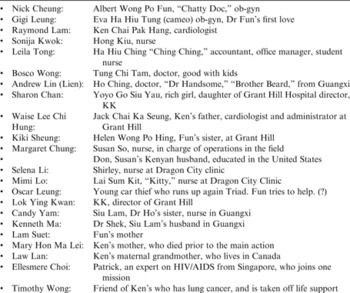
Cast and Characters of The Last Breakthrough, including Character Nicknames, Occupation and Origin or Back Story

The drama centres on the lives of two doctors, Dr Wong Po Fun (Nick Cheung), whose nickname is Chatty Doc, and Dr Ken Chai Pak Hang (Raymond Lam). At the start of the series, Fun is beginning a promising career as a heart surgeon practising at the cutting edge of technology at Grant Hill. His girlfriend, Hiu Tung (Gigi Leung), is committed to the more quotidian medical work of obstetrics, and regularly volunteers with Life Force. She loves Kenya and hopes that Fun can come with her in the future. When she returns to Hong Kong, Fun finally proposes marriage, but that very evening she is killed in a hit and run accident, dying in Fun's arms. In tribute to her, he visits Kenya and the Life Force mission. There, he helps a woman deliver a baby by the side of the road. Bringing life into the world, he finally understands Hiu Tung's passion. He abandons cardiology and becomes an obstetrician-gynaecologist. He also leaves his glitzy career at Grant Hill and dedicates himself to running the Dragon City clinic. Eight years later he is well loved by the neighbourhood and regularly volunteers with Life Force. He cannot forget Hiu Tung, however, and remains single, much to the chagrin of his parents with whom he lives.
Fun meets Hong Kiu (Sonija Kwok), a nurse, in a park where she is trying to cajole her little brother Kin to go to a clinic to treat his blood disorder. Kiu is immediately attracted to Fun. While he becomes involved in their lives, helping Kiu deal with Kin and with their mother who flees Kin's sickness, he rejects Kiu's interest in him. With Fun's encouragement, his friend and colleague at the clinic, Dr Ho Ching (Andrew Liem) falls in love with Kiu, but though she tries, she realizes she loves Fun and cannot be more than friends with Ho. Once Ho realizes this, he decides to remain in his home town in Guangxi, where Life Force has gone on a mission. Fun slowly realizes that he does love Kiu, but she will not accept him now unless he “courts” her, something which he does not quite understand. With her little brother cured (the bone marrow donor is the long-lost perpetrator of the accident that killed Hiu) and her mother now re-married and off with Kin to a new life in Singapore, Kiu decides to leave her job at Grant Hill to join Life Force full time. She leaves for Kenya. After several missteps, Fun and Kiu are eventually re-united in Kenya and become engaged. Trouble emerges soon as she is pregnant when they discover she has ovarian cancer. Against her obstetrician's advice (a woman) she chooses to carry the child. After a Caesarean section she goes into a coma for over a year. She only emerges upon hearing her daughter say “Mama.” The series ends with a brief scene of father, mother and daughter in Kenya looking towards Mount Kilimanjaro.
Interwoven into this story is Dr Ken Chai Pak Hang's journey from bitter arrogance to dedicated empathy. A child prodigy, he finished college at 16 and went to medical school in Canada where his maternal grandmother lives. He becomes a cardiologist like his father, Jack Chai Ka Seung (Waise Lee Chi Hung), but he is bitter and resentful, blaming Jack for his mother's death after a heart operation. Ken believes she lost the will to live because of her husband's infidelity with his girlfriend, Dr Helen Wong Po Hing (Kiki Sheung). Helen has remained Jack's girlfriend over the nine years since his wife's death, but Jack avoids marriage for fear of further angering his son.
Ken travels to Kenya as a tourist, crossing paths with Fun at Nairobi airport. There, in a quick action, he saves the life of a man having a heart attack. Fun is impressed and invites Ken to join Life Force. Ken refuses, being uninterested in charitable operations. However, a mix-up with their back-packs leads Ken to travel away from the game parks and tourist attractions to the Life Force mission on the border with Sudan. The consummate tourist, he snaps pictures of the local people. He fumbles into a cross-cultural faux pas when he returns a necklace dropped by a young woman he photographed. She and her companions claim that he must now marry her. He is rescued from this by Ha Hiu Ching “Ching Ching” (Leila Tong) with a kiss to prove to the locals that he is not available. Ken is smitten with Ching Ching. She is angry at his ignorance, and finds him arrogant and lacking empathy. To her, he is a spoiled rich kid. Back in Hong Kong, Ken continues to pursue Ching Ching, though she is not impressed. Instead, Yoyo (Sharon Chan), the daughter of KK (Lok Ying Kwan), the director of Grant Hill, and a patient with a serious heart condition, falls in love with Ken. Yoyo attempts to use her wealth, guiles and Ken's commitment to being a responsible doctor to lure him to her. Many episodes follow Ken as he learns the truth about his mother's death (she was the unfaithful one), forgives his father, accepts Helen (who happens to be Fun's sister), and slowly gains some humility and empathy by working both at Dragon City and for Life Force in Kenya.
Meanwhile Yoyo and Ching Ching improbably become friends. While Ken fends off the affections of Yoyo, Ching Ching suppresses her growing feelings for him when she realizes that Yoyo's obsession with him may be the only thing keeping her in treatment for her potentially fatal heart condition. She tells Ken that she has never had feelings for him and leaves for a long mission in Kenya. Just prior to this, Ken learns he has liver cancer. He hates the affects of chemotherapy, and without the love of Ching Ching he prefers to “live with respect,” working feverishly for his patients until his own death. Yoyo learns of the cancer and deciphers his choice, and though she still loves him, she knows he only will respond to Ching Ching. She gets a message to Ching Ching, who immediately returns to Hong Kong to persuade Ken to undergo treatment. He does and is cured, though they remain restrained in their relationship. After several mixed messages, more cancer, misunderstandings and interventions by friends, they finally declare their love. Ken thereupon leaves to travel the world to finish his process of self-transformation, promising that after a few years he'll come back to her and never leave. She completes her training as a nurse and goes to Kenya to take over the management of the Life Force mission from Susan (Margaret Chung) who has been running the local operations for years but is finally pregnant. After some time, Ching Ching and Ken meet in the field. Ken, it turns out, has been running a hospital in Loki. Their story ends there with the presumption that they are finally together.
The Last Breakthrough: Analysis
True to the soap opera genre, the twists and turns in the relationships of the characters are the major substance of TLB. Nevertheless, the series makes a conscious effort to model an enlightened engagement with Africa that embraces local knowledge and celebrates at least some local practices, counterpoising this to stances which are patronizing, disdainful, impatient and ultimately unsuccessful. Compassion and empathy win over selfishness and anger. Indeed, many of the fans are particularly drawn to the series by the location in Kenya and the back story about doctors dedicated to helping others.Footnote 27 Beyond just treating patients, the twin themes of finding meaning in life and changing one's life by helping the disadvantaged are repeated again and again. When Dr Ho returns from Guangxi for Fun and Kiu's wedding, no mention is made of the regret he feels for losing Kiu. Instead, he tells Fun that he is very busy in Guangxi, “but it is meaningful work. I wasted a lot of time before.” Fun tells him “we have all changed.”Footnote 28
After Yoyo finally accepts that Ken likes Ching Ching and not her, she moves back to the apartment she shares with Ching Ching and tells her: “It's okay. I've changed because of you. Your empathy has really had an impact on me. I don't want to be Daddy's headstrong moody pet anymore. I want to be like you. To think in other's shoes.”Footnote 29 When Fun asks Ken to be his best man, he notes that Ken was “arrogant – confident – but ignorant” when they first met in Kenya.Footnote 30 The work, whether at Dragon City, in Guangxi or in Kenya, provides meaning to the lives of the doctors and nurses transforming them into better people.
At the same time, the people and the locations that bring about this change are not left formless. Early on specificity is given to the first mission featured in Kenya: they are on the border with Sudan (though the actual location of the shoot is far from the border.) They are serving a very particular need, a measles epidemic among refugees. Some explanation for the plight of the refugees is given with a brief discussion of the civil war in Sudan.Footnote 31 They even “cross” the border and encounter a valiant rebel who dies as he tries to return to his comrades. At the same time, they assert their political neutrality, something which will be tested in Kenya and in Kowloon as Dr Fun also seeks to live by his inner moral compass of helping patients beyond just their medical needs.
The value of cultural competency in aid work is directly advocated. Several of the volunteers from Hong Kong have learned Swahili and can converse with the local staff and patients. There are repeated messages about the need to learn about the local culture and understand the traditions and motivations of the people. “If we don't learn the local language and culture, we will get in trouble” says Ching Ching to the arrogant Ken, there in Kenya as a tourist. Even more interesting, the series asserts a clear didactic point about ethnic and linguistic diversity in Kenya. In one scene, Ching Ching derides Ken for assuming that all the local people are alike when he encounters a group of Kenyans. She explains that this group, the Taita, are not the Maasai, and they have different customs and beliefs. At another point, Helen, Dr Fun's sister, speaks with her husband Jack about visiting her brother. Jack indicates a preference for the bright lights of South Africa. She dismisses him quickly, suggesting that Kenya may not be Sun City but it is also an interesting and beautiful place to visit. This emphasis on variation within Kenya and Africa features in several episodes and is a departure from the homogenized, generic visions often portrayed in American media representations of Africa.
The series also took a bold step by featuring an interracial and intercultural married couple, Susan and Don. He is from the local Maasai tribe and was educated in the United States. She is a nurse from Hong Kong and manages the Life Force clinic in Kenya where they met. While their story is not foregrounded, their interactions underscore the need for tolerance and compromise in all relationships, and especially intercultural ones. Susan chooses not to adapt to local or familial expectations of a Maasai wife. She and Don live away from his parents and they maintain their own apartment in Nairobi. They bicker over how best to respond to a situation presented by a local tradition, one which they both agree is detrimental to local women's health. Susan is frustrated with the low status given to women and wants Don to do more to change his community. He feels that confronting elders will not resolve the situation. Yet their commitment to each other and the larger goal is paramount, and they surmount these frustrations to emerge as the model couple of the series.
Given that anti-African riots in mainland China in the recent past were partly fuelled by apprehensions about Chinese women and African men, presenting the story of this interracial couple and mentioning others in the series does seem to be a statement about confronting fears and moving forward.Footnote 32 At the same time, Don's character and back story reveal some of the liberties taken in the production with regard to Kenyan reality. For instance, they allow for a little mix-and-match geography, since if the mission were on the border with Sudan, which is to the north-west of Kenya, it is unlikely that there would be Maasai groups living near by. Maasai tend to live in the south of Kenya, or across the southern border in Tanzania. By his body language and physique, the actor playing Don does not appear to be a Maasai, while the actor playing his brother, who gets married and has a child in the course of the drama, does appear to be – though I acknowledge that correlations of appearance and ethnicity are extremely problematic. The brother's wedding easily serves as a commercial for one of the highlights of the Kenyan tourist offerings, a Maasai ceremony.
Also, Don is portrayed as Muslim and is filmed praying with other men in one scene. While there are some Maasai Muslims, the community is not at all large. Was it an explicit decision to have the character a Maasai Muslim? As indicated earlier, the series mentions several different identity groups – such as the Taita and Somali refugees – in an effort to teach the audience about the diversity of Africa. However, other groups – Kalenjian, Kikuyu, Luo and Luhya – are never mentioned. As became all too clear in the post-election crisis of January 2008, these groups are central to Kenyan political and economic realities. No aid project can ignore them. They also represent a different Kenyan reality with respect to modernity, and do not fit the picture postcard of the tourist industry. A few scenes are in Nairobi presenting a sense of the “modern,” urban pace in Kenya, but overall the African scenes are set in rural areas and in the medical mission. Whether this was a choice determined by what the Hong Kong producers believe about Africa or by a sense of what tourists expect is unknown. Don's character to some extent reflects a stereotypical “modern,” contemporary, educated – and Westernized – Kenyan, but he is the only one. The series embodies a tension between fulfilling tourist desires and practising an enlightened, progressive humanitarianism.
TLB also grapples with the question of who and what is modern in Kenya, Hong Kong and mainland China. For instance, the doctors insist that births have to take place in clinics. Local knowledge practices won't suffice. They insist on the need to intervene with modern medicine. Some scenes in Hong Kong suggest, however, that they are aware of critiques of allopathic medicine. They gently have to confront patients in the Kowloon neighbourhood who cling to superstitions and patriarchal pride, including Dr Fun's own father who has diabetes. Chinese medicine is certainly not promoted in the series.
Underlying the modern/tradition dichotomies lies an ambivalence about the relationship of Hong Kong to mainland China. Beijing, Nanjing and other cities are never mentioned. However, a mission to deal with tuberculosis is organized to “Dongning village near Shilong town” in Guangxi, the home of the character Dr Ho or “Dr Handsome” as his patients like to call him. They go to a rural area that is startling in its beauty, probably Detian falls along the Sino-Vietnamese border, another picture-perfect tourist location.
There, Dr Ho's family is of the Zhuang 壮 ethnicity, living in traditional stone homes and dressing in “black” (indigo) homespun clothes. His father, mother and brother are farmer peasants. His sister has become a nurse. Dr Ho fled many years before when as a young doctor he could not cure the diabetes of his sister, then 12 years old, resulting in the amputation of her leg. He has to make amends with his father and brother who cannot forgive him. His sister, however, has, and eventually they bring the father and brother around.
As in Kenya, the doctors have to confront the “ignorance” of the locals. In addition, Dr Fun has to challenge the old doctor who treats the villagers like his children and does not have the most up-to-date medical experience. The confrontation is mild though, and eventually the old doctor agrees that he was wrong in his diagnosis of a young boy. Engaging in self-criticism, he accepts the young interlopers and chooses to retire. Dr Ho decides to stay and work in his own community, especially because he realizes that Nurse Kiu loves Dr Fun and not him. The Guangxi mission stands in for the relationship between Hong Kong and the mainland, and is not too different from the relationship with Kenya. There is even a colourful traditional wedding ceremony. Yet, no mention is made of the communist party, past or present, or of the colonial era in either case.
The championing of a humanitarian approach – the medical mission – permits the series to avoid a more critical and awkward confrontation with the realities of development and globalization, and specifically more complicated aspects of the China/Africa, Hong Kong/China relationship.Footnote 33 The story does not have to address business negotiations, mineral extraction operations or employee relations. The relatively short-term nature of the missions (one to two months), the level of education and the small number of volunteers from China mean the problems of accommodating a large group of Chinese expatriates, such as would be found on a construction site, do not exist.
There are African employees at the mission, but they are all nurses, drivers and other assistants – no trained doctors to challenge the Hong Kong doctors. The series also maintains a certain patriarchal balance – most of the doctors are men – with the key exceptions of Dr Fun's sister, Helen, and first love Hiu Tung. Women are nurses or office assistants. There is one other powerful woman, Amanda, KK's new wife. She in fact pushes Grant Hill towards an immoral choice (immoral by the standards of the characters) of embracing and advertising celebrity patients and starting a new profitable cosmetic surgery clinic at the expense of a GI/Heptology clinic.
While the series makes explicit attempts to model an enlightened approach to Africa through embracing linguistic and cultural competence, statements about the need to work oneself out of a job by building local capacity, suggesting interracial/intercultural marriages are possible, and challenging monolithic views and championing the diversity of peoples in Kenya, it squarely mirrors the Western relationship to Africa through humanitarianism. One needs Africa to become a better person, to become less arrogant and more empathetic (Ken), to get over lost loves (Fun), to abandon the spoiled rich kid syndrome (Yoyo), to find true love (Ching Ching), and to realize her true nature (Kiu). China needs Africa perhaps the way Hong Kong needs mainland China.
Conclusion
In many ways The Last Breakthrough follows tropes found in Western popular culture representations of Africa. Africa is portrayed as backwards with pockets of suffering that call for a humanitarian response and allow for personal redemption. This of course creates a lot of dramatic possibilities that fit within the soap opera genre. What seems to be different in this series is that there is a conscious effort to provide context. The narrative makes a point of giving some history, albeit schematic, superficial and in many cases misleading. Hence measles does not just appear but it is a consequence of war and the inability of the local community to access vaccines. There is also an attempt at specificity. Africa is not just one big amorphous place. There are countries, and within those countries there is variation. That not all Africans are the same becomes a point of minor conflict between characters allowing for personal growth and redemption. The series also makes the point that local knowledge is very important for successfully achieving the goals of the mission. Language knowledge is important as is familiarity with local social and cultural practices. One cannot do one's job well if one does not have this kind of local knowledge. There is also a clear advocacy of the need to work one's self out of a job. The point of volunteering is not to perpetuate one's own work but to help the other towards self-sufficiency. So this is an enlightened humanitarianism where agency is assumed in the other but has somehow been thwarted. The role of the outsider is to re-energize the local in the progress towards the promised land of modernity.
The story also deals with specific misconceptions and ignorance, emphasizing the valiant and worthy process of enlightenment. This ignorance may be represented by a lazy, arrogant joke by Ken about tigers, something Ching Ching confronts immediately. Or it could be fear and stigma around HIV/AIDS that the doctors and nurses gently battle with education. A very important misconception tackled is that of interracial relationships between African and Chinese. This is turned inside out, such that Susan and Don's relationship becomes the exemplar to others. Their relationship is not without its problems and the difficulties of cross-cultural understanding are highlighted. But with love, patience and understanding, they are able to resolve their conflicts. In this way, the series reveals an appreciation of the complexities of life.
One does not look to soap operas to provide a coherent underlying social theory of development, but they can symbolize beliefs about change. For TLB, the problem of poverty is not a political one, but one of acquiring technical knowledge and breaking through ignorance and superstition. Social economic cultural and political factors recede in importance. Knowledge is Enlightenment.
The progressive sensibility of the series falters as it embraces stereotypes and takes liberties with facts. Like so many others, they focus on the Maasai who are but a small proportion of the East African experience. There are also very few urban Kenyans portrayed. While some scenes do take place in Nairobi where one gets the sense of the modern vibrant city that it is, even there, visitors are likely to run into “primitive” Africans dressed in traditional clothing and carrying spears. Drawing again on Dikkoter, Sautman and Sullivan's research, it is not surprising that in addition to going to Kenya, the Life Force mission goes to Guangxi, China. In many ways, this location and the Zhuang ethnic group mime the experiences in Kenya. Peasants and minorities are also exotic and quaint, and the big colourful and musical scenes are the wedding ceremonies in costume being portrayed in each place. This series struggles with reasserting old stereotypes at the same time as it awkwardly but honestly tries to re-frame and change those stereotypes. In this way, it may be up to the viewer to remain either in comfortable separation from the worlds portrayed or to move to a more radical appreciation of equality, connectivity and responsibility. Still, it would take a more revolutionary portrayal to move beyond that towards an embrace of an even more complex world.
In the end, TLB represents a desire for change and progress, albeit in a simplistic, ahistorical and apolitical way. While it retains and sometimes awkwardly embraces the values of family, community, sacrifice and global empathy, it remains firmly marked by a capitalist and rationalist point of view. Compassion and understanding are allowed and background explanations about war and ignorance may be given. Poverty is a lack of knowledge and not, as in America, a lack of things. It is certainly not the result of power imbalances or inequitable distribution of productive resources. At this juncture, Hong Kong can stand as the bastion of rationalist development for China, and perhaps in turn China can lend a helping hand to Africa.