Introduction
Leaf litter input (hereafter litterfall input) is a key ecosystem process which connects aboveground primary production, belowground material cycling, and the decomposer community via nutrients and energy that support detrital food webs (Vitousek Reference Vitousek1984). Decomposition in terrestrial ecosystems maintains nutrient and carbon cycling and has a downstream impact on soil fertility and plant growth (Aerts Reference Aerts2006, Waring Reference Waring2012). The abiotic and biotic factors that influence decomposition play different roles at different spatial scales. For example, climate and litter quality are the main factors controlling decomposition at large spatial scales (Weedon et al. Reference Weedon, Cornwell, Cornelissen, Zanne, Wirth and Coomes2009, Zhou et al. Reference Zhou, Butenschoen, Barantal, Handa, Makkonen, Vos, Aerts, Berg, Mckie, van Ruijven, Hättenschwiler and Scheu2020, Kwon et al. Reference Kwon, Shibata, Kepfer-Rojas, Schmidt, Larsen, Beier, Berg, Verheyen, Lamarque, Hagedorn, Eisenhauer, Djukic, Kwon, Shibata, Kepfer-Rojas, Schmidt, Larsen, Beier, Berg, Verheyen, Lamarque, Eisenhauer, Djukic, Caliman, Paquette, Gutiérrez-Girón, Petraglia, Augustaitis, Saillard, Ruiz-Fernández, Sousa, Lillebø, Gripp, Lamprecht, Bohner, Francez, Malyshev, Andrić, Stanisci, Zolles, Avila, Virkkala, Probst, Ouin, Khuroo, Verstraeten, Stefanski, Muys, Gozalo, Ahrends, Yang, Erschbamer, Christiansen, Centre, Meredieu, Mony, Nock, Wang, Baum, Rixen, Delire, Piscart, Andrews, Branquinho, Jan, Vujanović, Adair, Crawford, Hornung, Groner, Lucot, Gacia, Lévesque, Benedito, Davydov, Bolzan, Maestre, Maunoury-Danger, Kitz, Hofhansl, Sutter, Lobo, Souza, Zehetner, Koffi, Certini, Pinha, González, Pauli, Bahamonde, Feldhaar, Jäger, Serrano, Verheyden, Bruelheide, Meesenburg, Jungkunst, Jactel, Kurokawa, Yesilonis, Halder, Quirós, Fekete, Ostonen, Borovská, Roales, Shoqeir, Probst, Vijayanathan, Dolezal, Sanchez-Cabeza, Merlet, Loehr, Oppen, Löffler, Alonso, Cardoso-Mohedano, Morina, Jiménez, Alatalo, Seeber, Kemppinen, Stadler, Kriiska, Meersche, Fukuzawa, Szlavecz, Gerhátová, Lajtha, Hoshizaki, Green, Steinbauer, Pazianoto, Dienstbach, Yahdjian, Williams, Brink, Rustad, Carneiro, Martino, Villar, Morley, Lebouvier, Tomaselli, Schaub, Glushkova, Torres, Graaff, Bauters, Mazón, Frenzel, Wagner, Didion, Hamid, Lopes, Apple, Mojses, Gualmini, Vadeboncoeur, Danger, Scherer-Lorenzen, Růžek, Isabellon, Musciano, Carbognani, Zhiyanski, Puşcaş, Barna, Ataka, Luoto, Alsafaran, Barsoum, Korboulewsky, Lecomte, Filippova, Hölzel, Ferlian, Romero, Pinto-JR, Peri, Turtureanu, Haase, Macreadie, Reich, Petřík, Choler, Marmonier, Ponette, Guariento, Canessa, Kiese, Kanka, Gatti, Martins, Ogaya, Georges, Gavilán, Wittlinger, Suzuki, Martin, Anja, Gogo, Schueler, Drollinger, Mereu, Wipf, Trevathan-Tackett, Stoll, Löfgren, Trogisch, Seitz, Glatzel, Venn, Dousset, Mori, Sato, Hishi, Nakaji, Jean-Paul, Camboulive, Spiegelberger, Scholten, Mozdzer, Rusňák, Ramaswiela, Enoki, Ursu, Cella, Hamer, Klaus, Cecco, Rego, Fontana, Piscová, Bretagnolle, Maire, Farjalla, Pascal, Zhou, Luo, Parker, Utsumi, Kominami, Kotroczó and Tóth2021), whereas the decomposer community and soil nutrient availability take important roles in the decomposition at local scales (García-Palacios et al. Reference García-Palacios, Mckie, Handa, Frainer and Hättenschwiler2016). Understanding how above- and belowground compartments interact is fundamental to foster a better understanding of decomposition in terrestrial ecosystems (Freschet et al. Reference Freschet, Cornwell, Wardle, Elumeeva, Liu, Jackson, Onipchenko, Soudzilovskaia, Tao and Cornelissen2013).
The hypothesis of home-field advantage (HFA) effect offers one of the best mechanistic explanations of how the interactions between plant litter and decomposers influence decomposition dynamics (Ayres et al. Reference Ayres, Dromph and Bardgett2006). Under this hypothesis, the decomposition rate is higher in sites with conspecific litter (i.e. home sites) than sites with heterospecific litter or without conspecific litter at all (i.e. foreign or away sites) (Gholz et al. Reference Gholz, Wedin, Smitherman, Harmon and Parton2000, Ayres et al. Reference Ayres, Dromph and Bardgett2006, Lin et al. Reference Lin, Pang, Fanin, Wang, Qian, Zhao, Yang, Mi and Ma2019). Despite theoretical and empirical support for the HFA hypothesis, this research field is relatively new, and divergent results have been reported in the related literature, with positive (HFA), negative (i.e. Home-field disadvantage-HFD), and neutral effects being observed in distinct ecosystems (Ayres et al. Reference Ayres, Steltzer, Berg and Wall2009a, Bachega et al. Reference Bachega, Bouillet, de Cássia Piccolo, Saint-André, Bouvet, Nouvellon, de Moraes Gonçalves, Robin and Laclau2016, Palozzi & Lindo Reference Palozzi and Lindo2017). This suggests a degree of idiosyncrasy and context dependence in this subject. Therefore, we referred to home-field effects (HF) as the general effect independently of the direction and HFA only for positive effects (higher decomposition at ‘home’ than ‘away’ sites).
The occurrence and magnitude of the home-field effect may depend on the dissimilarities of litter quality and litterfall amount among co-occurring species (Ayres et al. Reference Ayres, Steltzer, Simmons, Simpson, Steinweg, Wallenstein, Mellor, Parton, Moore and Wall2009b). The HFA hypothesis states that decomposers are specialized in the most abundant litter in a given site, which increases the decomposition efficiency in home sites (Li et al. Reference Li, Cui, Yang, Lan, Wang and Han2013, Perez et al. Reference Perez, Aubert, Decaëns, Trap and Chauvat2013). However, high resource specializations may require that the resources are abundant in both time and/or space. This effect increases the cost-benefit for detritivores by reducing search and handling time and has been treated as the ‘resource concentration’ effect (Charnov Reference Charnov1976, Hambäck & Englund Reference Hambäck and Englund2005). Otherwise, consumers will be less efficient in using specific resources in situations where the resource is overall diverse and/or individually rare (Hambäck & Englund Reference Hambäck and Englund2005, Lefcheck et al. Reference Lefcheck, Whalen, Davenport, Stone and Duffy2013). In this sense, higher litter diversity will imply in lower relative abundance of individual litter and may favour generalists instead of specialist decomposers, thereby weakening the prevalence of HF effects on decomposition (Cruz-Rivera & Hay Reference Cruz-Rivera and Hay2000). In fact, the occurrence of home-field effects in tropical environments has been rare (Freschet et al. Reference Freschet, Aerts and Cornelissen2012, Li et al. Reference Li, Cui, Yang, Lan, Wang and Han2013), which may be partially associated with the high vegetation diversity and heterogeneous litterfall phenological patterns (Sakai Reference Sakai2001, Vázquez & Stevens Reference Vázquez and Stevens2004) that favour generalist decomposers. Understanding the prevalence of home-field effects in tropical environments may require considering the balance between litter dominance and litter diversity since the occurrence and magnitude of the home-field effects can be influenced by the ratio between relative species and absolute litterfall input (Mooshammer et al. Reference Mooshammer, Wanek, Zechmeister-Boltenstern and Richter2014).
To our knowledge, the occurrence and/or magnitude of home-field effects have been evaluated by manipulating the absolute amount of a focal plant litter from its home or foreign sites, but not their relative amount (Veen et al. Reference Veen, Keiser, van der Putten and Wardle2018). Thus, it is still unclear whether and how the whole litter layer in the home site is influenced by the relative versus the absolute contribution of a focal plant litter. The relative litter input of species in natural communities varies in time and space depending on the plant community composition, species relative abundance, and species litterfall phenology (Zhang et al. Reference Zhang, Yuan, Dong and Liu2014). Therefore, both the relative and absolute litterfall input of a species may affect the occurrence and magnitude of home-field effects since the dominance of a litter in the community should be a suitable environment for decomposers to be specialized in.
Thus, we carried out an observational study in a tropical heath vegetation (i.e. Restinga) in northeastern Brazil to contribute to this discussion on tropical ecosystems. Restinga is a marginal habitat of the Atlantic Forest with distribution along most of the South American coast, formed by young and oligotrophic soils exposed to strong winds and high salinity (Oliveira-Filho Reference Oliveira-Filho2009). We tested whether the decomposition of the most common species in the studied Restinga, Myrcia ramuliflora (O.Berg) N. Silveira (Myrtaceae), varies along a spatial gradient of litterfall input (i.e. home sites) compared to away sites without the presence of conspecifics. We evaluated (1) whether and how the relative and absolute litterfall input of M. ramuliflora affect the occurrence and magnitude of home-field effects; and (2) whether and how much such effects also depend on soil nutrient availability and litter traits and diversity. We expected overall weak HFA effects on the decomposition because Restinga has many species with distinct litterfall phenological strategies, and this may decrease the specialization of detritivores. However, we predicted that the occurrence and magnitude of HFA effects on the decomposition may increase in response to both relative and absolute M. ramuliflora litterfall input.
Material and methods
Study area
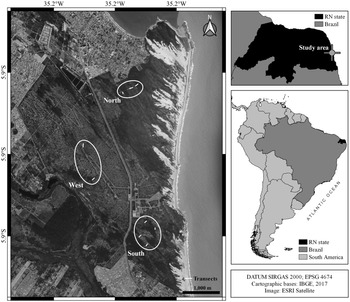
The study is part of a long-term research project that has been carried out in the Barreira do Inferno Launch Center, Rio Grande do Norte state, northeastern Brazil (Silva et al. Reference Silva, Souza, Jardim and Goto2015). The 19.6 ha study area contains well-preserved vegetation due to site-use restrictions. It is characterized by a tropical climate with a marked dry season (Peel et al. Reference Peel, Finlayson and Mcmahon2007). The mean annual temperature is 26 °C with low variability throughout the year. The rainfall is concentrated between March and August, with a mean annual rainfall of 1460 mm (Silva et al. Reference Silva, Souza, Jardim and Goto2015). The vegetation is predominantly shrub-arboreal and forest Restinga (Scarano Reference Scarano2002), and its composition is limited by harsh edaphic conditions such as well-drained and nutrient-poor sandy soils (Silva et al. Reference Silva, Silva and Souza2016). The average annual litterfall input of the overall vegetation in the studied system is 4.51 Mg ha−1 year−1, with Myrtaceae being not only the most abundant family as well as the one that contributes most to the litterfall input (Silva et al. Reference Silva, Souza, Jardim and Goto2015). Nine 100-m transects were established in the north, south, and west parts of the studied region, far enough from each other to increase the variation in soil and vegetation community aspects (Figure 1; Silva et al. Reference Silva, Souza, Jardim and Goto2015). Three to five 25-m2 plots were randomly distributed along each transect, totalizing 39 plots.
The geographical location of the study site at the Barreira does Inferno Launch Center, Parnamirim, RN/Brazil. The spatial distribution of the transects (lines) was distributed in three regions, North, South, and West (ellipses).

Estimation of litterfall input
To estimate the litterfall input, we installed six 0.125m² litter traps per plot (total 234) placed about 50cm above the litter layer. Litter traps consisted of plastic bowls with holes at the bottom to avoid rainwater accumulation. We monthly collected all senescent leaves in the litter traps from June/2016 to June/2017. Litter samples were oven-dried at 40°C for 72h until stable dried mass. We then separated the leaves by species and weighed them to balance accuracy nearest 0.001g. Because significant litter mass loss can occur through leaching inside litter traps when sampling periods are longer than two weeks (Taylor et al. Reference Taylor, Cleveland, Wieder, Sullivan, Doughty, Dobrowski and Townsend2017), we conducted a short experiment to evaluate species-specific litter mass loss for the 32 species that most contributed to litterfall along the sampling plots. This estimate was made twice a year during the middle of dry and rainy seasons (October and May, respectively). To do so, we used three litterbags per species with 3g of litter each and installed them inside litter traps across plots where the species was commonly found. We estimated the mass loss through leaching by constant decay per day (k). This estimate considered the mass loss and the time that the litter stayed in the traps, but since it was not possible to know exactly when litter fell into the litter traps, we assumed it to be half the time of the sampling interval, which was approximately 15 days on average.
To calculate the total litterfall input by species, including the litterfall input of M. ramuliflora, we summed the monthly contribution of litterfall for each species contained in the litter traps. The monthly contribution by plot was measured as the mean of the contribution of all the litter traps present in the plot. Then, the average monthly litterfall input was combined for 12 months and expressed in kg/m²/year. We calculated the absolute annual litterfall input of M. ramulifora as the total accumulated litter found in each plot. The relative annual litterfall input of M. ramuliflora was estimated by dividing the annual absolute litterfall input by the total annual community litterfall input per plot. The inter-annual differences in the litterfall input patterns in our study site were reduced due to the synchronous dynamic between litter production and rainfall regime (Silva et al. Reference Silva, Souza, Santiago, Gripp, Asato, Silva, Alencar and Caliman2020). This allowed us to compare the litterfall input (2016–2017) and the litterbag experiment (2018) between different years.
Home-field advantage experiment
M. ramuliflora was chosen due to its high relative regional frequency and abundance (15% of the total relative abundance across plots) (Silva et al. Reference Silva, Souza, Jardim and Goto2015), which guaranteed that the litterfall input from M. ramuliflora presented a high spatial variability regarding both its absence in some plots (i.e. away sites), as well as its absolute and relative amount across plots (i.e. home sites). This spatial variation among sampling sites regarding M. ramuliflora distribution allowed us to test how the contrasting contribution of the litterfall input of this species affects the occurrence and magnitude of the home-field effects.
We measured the litter decomposition of M. ramuliflora via litterbags with an area of 0.04 m² (0.2m × 0.2m) and 5-mm open mesh to allow access to macrofauna. We used approximately 3g of leaf litter per litterbag and distributed four replicates in each of the 39 plots (a total of 156 litterbags). The leaf litter used in the home-field effect experiment was collected to estimate the litterfall input (see details in: Estimation of litterfall input). The litterbags were placed on the field in October 2017 (the onset of more pronounced litterfall input) and removed after 371 days in November 2018. After being retrieved from the field, each litterbag was individually stored in paper bags, oven-dried at 45°C for 72 hours until the final mass was stable to the nearest 0.001g. We excluded 25 litterbags from further analyses due to the litterbag mesh rupturing that caused material loss, but they were all located in only one of the plots. Therefore, 131 litterbags distributed across 38 plots were used in our analyses.
Leaf litter decomposition was estimated by mass loss and calculated as the percentage of initial mass (%MR):
 $${\rm{MR}}\left( {\% \,{\rm{of}}\,{\rm{initial}}\,{\rm{mass}}} \right) = ({\rm{M}}f/{\rm{M}}i)\times100$$
where Mf is the final litter mass and Mi is the initial litter mass in each litterbag.
To evaluate the effect of litterfall input on the occurrence and magnitude of HF, we adapted the Decomposer Ability Regression Test (DART—Keiser et al. Reference Keiser, Keiser, Strickland and Bradford2014) adding the relative and absolute litterfall input of M. ramuliflora to the linear model. The DART model defines the HFA as the difference in decomposition rate among the plots to tease apart the effects of litter quality (i.e. differences in decomposition rate among the plots due to litter quality), ability (i.e. effects of local conditions and the functional capacity of decomposers), and HFA (hereafter HF effects; i.e. increase or decrease of decomposition rate in ‘home’ and ‘away’ plots, which could be associate to the specialization of decomposers). Litter, soil, and home are dummy variables equal to 1 or 0 indicating the presence or absence of litter species, soil community, or home combination, respectively. In our study, we ran two models adding the absolute or the relative litterfall input. Thus, the initial litter mass percentage (MR%) was a function of litter source (M ramuliflora), soil source (i.e. plot with or without conspecifics), ‘home’ combinations, and absolute or relative litterfall input of M. ramuliflora. Also, we weighted the number of plots with and without M. ramuliflora due to unbalanced experimental design.
In addition, we evaluated the occurrence and direction of home-field effects on a plot scale, since local conditions would affect both occurrence and magnitude of HF and the DART model could not sufficiently capture the HF properly on local scales (Keiser et al. 2014; Veen et al. Reference Veen, Freschet, Ordonez and Wardle2015b). As we only used one species, we adapted the home-field advantage metric (hereafter HFindex) of Ayres et al. (Reference Ayres, Steltzer, Simmons, Simpson, Steinweg, Wallenstein, Mellor, Parton, Moore and Wall2009b).
 $$HFindex = \displaystyle{{\left( {M{R_{with}} - M{R_{without}}} \right)} \over {M{R_{without}}}}$$
where
 $M{R_{with}}$
is the percentage of the initial mass of M. ramuliflora in ‘home’ plots with conspecifics, and
 $M{R_{without}}$
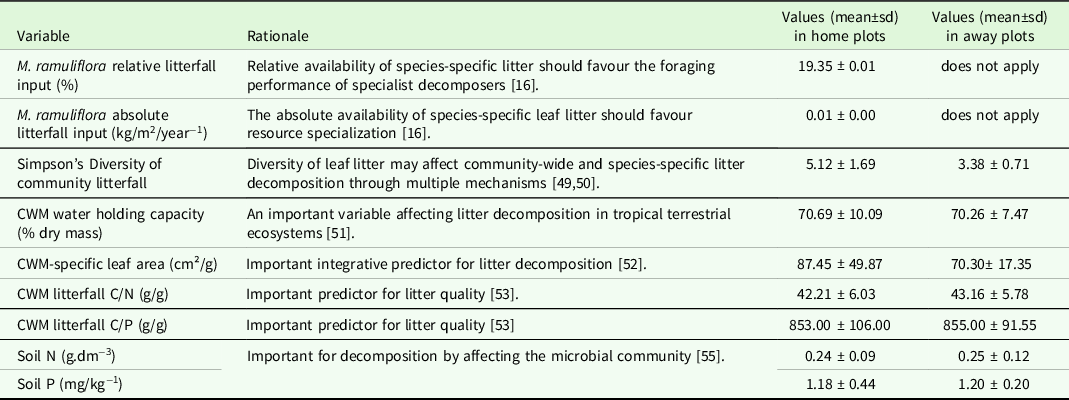
is the percentage of the initial mass of M. ramuliflora calculated among away plots without conspecifics. We compare the litter decomposition rate of M. ramuliflora between individual plots with the presence of conspecifics and all observations of the decomposition rate of M. ramuliflora from plots without conspecifics (N=18) in order to evaluate the occurrence and magnitude of the home-field effects (Table 1). To do so, for each ‘home’ plot we ran a bootstrapping method using 18 iterations (i.e. the total number of observations of the decomposition rate of M. ramuliflora from plots without conspecifics) to allow paired comparison of the litter decomposition rate between ‘home’ and ‘away’ plots. As we measured decomposition rate through remaining mass (% of initial litter), we multiplied the HFindex by −1 for positive and negative values indicate the occurrence of HFA and HFD effects, respectively.
Summary of all predictors used in this study to evaluate home-field effects on M. ramuliflora. Home and away sites depict plots with and without the presence of M. ramuliflora conspecifics, respectively

Predictor variables
We selected potentially important explanatory variables for litter decomposition and home-field effects based on previous studies encompassing soil variables, leaf litter traits, and taxonomy diversity (see details: Table 1).
Soil chemical analyses were performed for each plot through three random soil samples collected at 20cm below the substrate surface and then separated from organic matter in the laboratory (see Silva et al. (Reference Silva, Souza, Jardim and Goto2015) for further details on soil nutrient sampling and measurement). The soil total N and P (mg.g−1) were obtained according to (EMBRAPA/CNPS. 1997).
We measured total nitrogen (N) through acid digestion with Kjeldahl distillation, total phosphorus (P) through strong digestion and reaction with molybdate (Fassbender Reference Fassbender1973), and total carbon (C) through the Dry Combustion Method in CHN Automatic Analyzer in order to calculate litter C/N and C/P ratios for the chemical analysis of the litter. Water holding capacity (WHC) was measured according to (Makkonen et al. Reference Makkonen, Berg, van Logtestijn, van Hal and Aerts2013). Specific leaf area was measured according to (Pérez-Harguindeguy et al. Reference Pérez-Harguindeguy, Díaz, Garnier, Lavorel, Poorter, Jaureguiberry, Bret-Harte, Cornwell, Craine, Gurvich, Urcelay, Veneklaas, Reich, Poorter, Wright, Ray, Enrico, Pausas, de Vos, Buchmann, Funes, Quétier, Hodgson, Thompson, Morgan, ter Steege, Sack, Blonder, Poschlod, Vaieretti, Conti, Staver, Aquino and Cornelissen2013).
Similar to litterfall input, both functional and taxonomic properties were calculated annually at the community level (each plot). The litter functional traits (WHC, N, and P) were represented by their annual community weighted mean (CWM) (Kalogirou Reference Kalogirou2020) for the litterfall in each plot based on the mean for the summed up of the monthly values (July/2016 to June/2017), following:
 $$CWM = \mathop \sum \nolimits_{i = 1}^n {p_i}trai{t_i}$$
where n is the number of species in the plot, p is the proportion of species i in the total litter biomass, and trait is the value functional attribute of species i.
We also calculated the annual Simpson’s Diversity Index of the litterfall input as the sum of the monthly values (between July/2016 and June/2017) to quantify litter taxonomic diversity for each plot, following:
 $$D = 1/\sum \nolimits_{i = 1}^np{i^2}$$
where n is the total number of species in the plot and pi is the proportion of litterfall of species i in the plot.
Data analysis
The coefficient of variation (CV) was calculated to describe the general pattern of the variation in the litterfall input and decomposition rates of M. ramuliflora among the plots. Then, we compared their absolute values (i.e. module) by a paired t-test using the Holm-Sidak method due to heteroscedasticity conditions in order to test the differences in the magnitude between HFA and HFD.
Linear mixed models were used to evaluate how much each of the predictor variables (Table 1) affected the HFindex and specifically if the predictor effects were modulated by the direction (i.e. positive and negative). Due to the sampling design of this study, we tested for spatial autocorrelation among the plots using Moran’s test through the ‘lctools’ package (Kalogirou Reference Kalogirou2020), which indicated a spatial correlation (p<0.0001). We then accounted for plot identity as a random factor in all linear mixed models. To meet the analyses assumptions, the relative and absolute annual litterfall input of M. ramuliflora (kg/m²/year) were expressed as proportions and logit transformed using log(x)−log(1−x), and the soil total N and P concentrations were log-transformed (Supplementary: Figure 1 and Figure 2). DART regression analyses were performed in software SAS. The statistical analyses were performed in the R software program (Team R Development Core 2018), and graphics were produced in the GraphPad Prism version 7.04.
Results
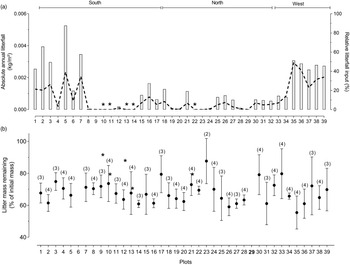
M. ramuliflora litter was observed in approximately 90% of the plots, and the absolute litterfall input ranged from 0.0018 to 0.0053kg/m²/year (Mean of 0.0012, Figure 2a). The relative litterfall input in the plots ranged from 0.58 to 48.96% (Mean of 11.07%; Figure 2a). The initial litter mass percentage (MR%) was 68% on average (ranging from 54% to 85%; Figure 2b), and unlike the high variation in the absolute and relative amount of litterfall input (CV=115.7% and 124.1%, respectively), the initial litter mass percentage varied little among plots (CV=9.88%).
The absolute annual litterfall (a, bars) and relative annual values (a, dotted line). The initial mass percentage (% MR) of M. ramuliflora along the sampling plots (b), with dots referring to the mean remaining mass and error bars to standard deviations. Numbers above bars indicate the sample size by the plot. Asterisks indicate plots without M. ramuliflora. We excluded plot 29 (bold) from the analyses due to the loss of all litterbags. See Figure 1 for the spatial distribution of sampling plots.

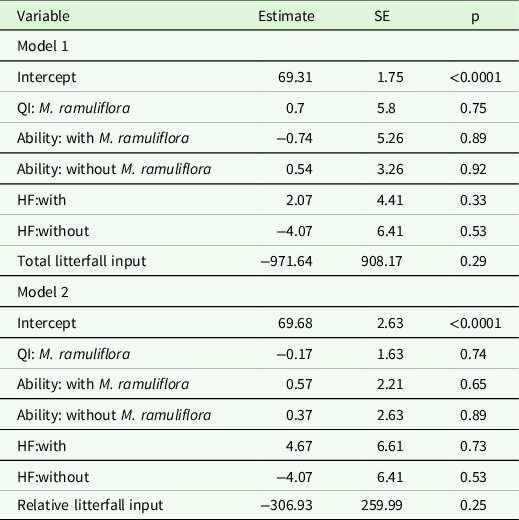
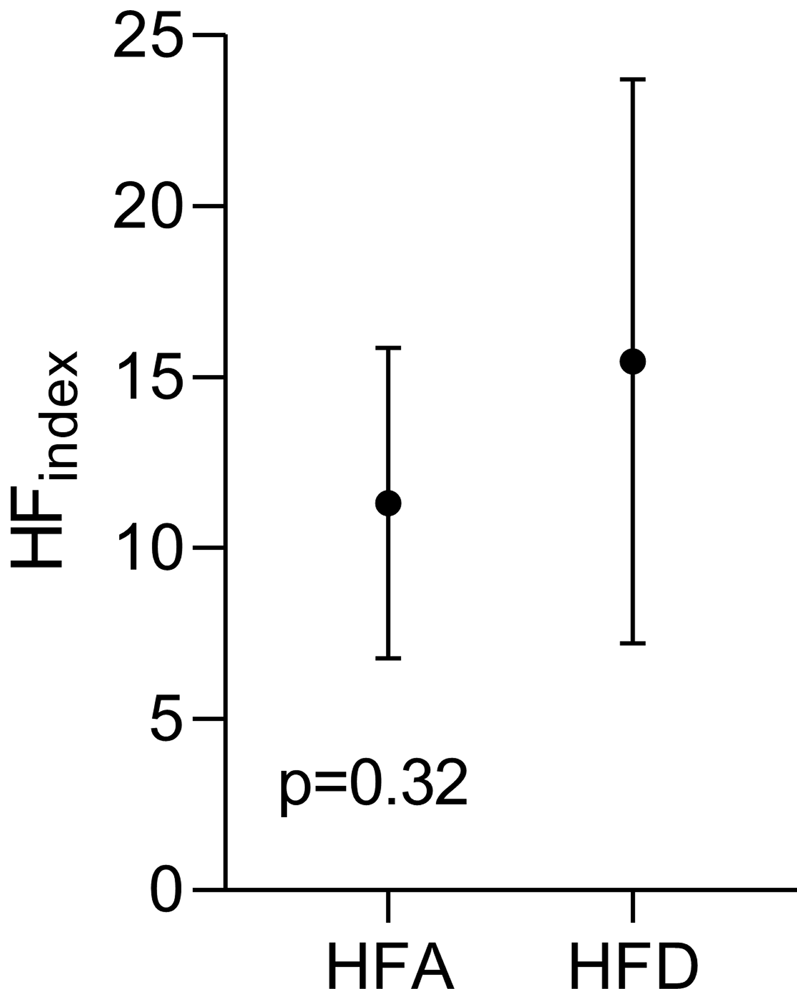
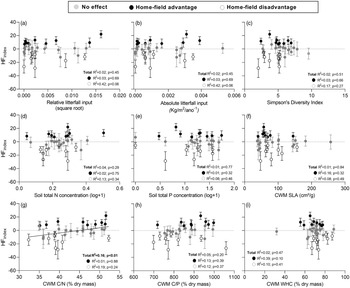
The decomposition rate of M. ramuliflora did not differ among ‘home’ or ‘away’ plots as well as it was not affected by the relative or absolute litterfall input (Table 2). To evaluate home-field effects at the plot scale, we observed combined effects of HFA and HFD. Regarding the occurrence, HFD effects were found in 25% of all plots, while HFA effects occurred in 28% of the plots. However, regarding the magnitude of the effects, irrespective of their direction, we did not observe differences in the magnitude between HFA (Mean of 11.32) and HFD (Mean of −15.46) effects (U-test = 25; p = 0.32; Figure 3). The magnitude of HF effects, in general, was explained only by the CWM C/N (R²=16%; Figure 4G). None of the other predictors (Relative and absolute litter inputs, Simpson’s diversity index, soil N and P contents, CWM of SLA, C/N, C/P, Water Holding Capacity) explained individually HFA or HFD (Figure 4).
Linear regression from DART model (Keiser et al. 2014). Quality index (QI) for M. ramuliflora (focal species). Ability for the soil communities in plots with and without M. ramuliflora. Home-field (HF) effects for the interaction between litter and soil combinations. To test the effect of litterfall input on HF effects, we adapted the DART model adding the absolute litterfall input (Model 1) and relative litterfall input (Model 2)

Differences in the magnitude between home-field advantage (HFA) and home-field disadvantage (HFD) for the relative decomposition effect in a tropical heath vegetation. Points represent mean, and whiskers represent standard deviation.

The home-field effects (HFindex; all y axes) in relation to (a) relative litterfall input, (b) absolute litterfall input, (c) Simpson’s Diversity Index, (d) soil total N concentration, (e) soil total P concentration, (f) CWM SLA, and (g) CWM C/N, (h) CWM C/P, and (i) CWM water holding capacity (WHC) for each plot with M. ramuliflora. Horizontal lines indicate the average effect between variables, and the variance indicates the 95% confidence interval. HFA and HFD are represented by black and white points, respectively.

Discussion
To our knowledge, this is the first study to evaluate how the relative and absolute litterfall input of a focal species may affect the occurrence and magnitude of home-field advantage (HFA) in a natural environment. Our results obtained from a tropical heath vegetation are in line with the idea of context dependence in HF effects mentioned by previous studies (Ayres et al. Reference Ayres, Steltzer, Berg and Wall2009a, Veen et al. Reference Veen, Freschet, Ordonez and Wardle2015b). We found variation in the direction of HF effects at the plot level, suggesting that factors at a local scale may be important for fully understanding the HFA. The HFA and HFD occurred at the same frequency and magnitude, and among all predictors tested only CWM C/N explained the general home-field effects.
The relative and absolute litterfall input were not important predictors of the occurrence of the home-field effects in Restinga. It has been discussed that the familiarity of decomposers with their resources seems to be a key aspect of the HF effects, and decomposer specialization depends on the historical contingencies and litter concentration (Palozzi & Lindo Reference Palozzi and Lindo2018). The absence of effect for litterfall input concentration on HF effects in our study could also be associated with local historical contingencies. The historical contingency or legacy effect indicates that contemporary decomposers are shaped by the past litterfall input, in addition to the actual abiotic factors (Strickland et al. Reference Strickland, Osburn, Lauber, Fierer and Bradford2009). For example, the microbial communities performed decomposition more effectively in places with litter familiarity (Keiser et al. Reference Keiser, Strickland, Fierer and Bradford2011, Freschet et al. Reference Freschet, Cornwell, Wardle, Elumeeva, Liu, Jackson, Onipchenko, Soudzilovskaia, Tao and Cornelissen2013). The weak niche-based organization of the vegetation community in Restinga, with biotic and abiotic filters not creating a marked species clustering, results in a high spatial niche overlap among the species (Silva et al. Reference Silva, Souza, Jardim and Goto2015, Reference Silva, Souza, Caliman, Voigt and Lichston2018). Thus, the community assembly in the studied Restinga might reflect few differences in the litterfall composition among the plots. In fact, our results evidence that the high variability in litterfall input among plots was not translated into a high litter decomposition variability, and the high litter similarity among species should explain the lack of litter diversity effect on HF effect results. Consensus has grown around the legacy effect as a potential mechanism for specialized decomposers (García-Palacios et al. Reference García-Palacios, Mckie, Handa, Frainer and Hättenschwiler2016) and consequently for the occurrence of the HFA (Austin et al. Reference Austin, Vivanco, González-Arzac and Pérez2014). It seems that the legacy effect for the tropical heath vegetation in northeastern Brazil has an important role in mediating the HF effects, which can be more important than litterfall input diversity.
Despite the similarity in environmental and soil characteristics between plots with or without M. ramuliflora, home-field effects (HFA and HFD) were found in 53% of plots. The litter quality dissimilarity among ‘home’ and ‘away’ plots could be one of the main factors mediating the occurrence of HF effects, independent of the direction, because it indicates the mean force of interactions between litter quality and the decomposer community (Veen et al. Reference Veen, Keiser, van der Putten and Wardle2018). Even abiotic dissimilarities between home and foreign sites seem to be important for home-field effects (Veen et al. Reference Veen, Freschet, Ordonez and Wardle2015b). We selected important predictors for home-field effects encompassing litter quality, nutrient availability, and abiotic conditions, but only CWM C/N predicted HF effects (although low R² = 16%). This may indicate that important variables for capturing differences between species and plots were not accounted for. Decomposition in tropical environments could be limited by energy, and therefore different carbon types (e.g. tannins and phenols compounds) can be more important to mediate the decomposition than nutrients (Hättenschwiler & Jørgensen Reference Hättenschwiler and Jørgensen2010), and consequently to predict HF effects. The harsh conditions in Restinga due to poor soils and high solar incidence (Silva et al. Reference Silva, Souza, Jardim and Goto2015) could lead to high nutrient resorption and high levels of secondary compounds accumulating in the litterfall during the senescence process (Close & McArthur Reference Close and McArthur2002, Tharayil et al. Reference Tharayil, Suseela, Triebwasser, Preston, Gerard and Dukes2011). Therefore, it is essential to consider important predictors at the local level, since context dependence is crucial for HF effects (Veen et al. Reference Veen, Fry, Ten Hooven, Kardol, Morriën and de Long2019). Future studies would benefit from measuring C-associated traits (e.g. lignin, tannin, and phenols), since carbon seems to be crucial to understanding decomposition in tropical environments (Coq et al. Reference Coq, Souquet, Meudec, Cheynier and Hättenschwiler2010, Hättenschwiler et al. Reference Hättenschwiler, Coq, Barantal and Handa2011).
Natural environments are complex, and a large number of species contribute to the litter layer in tropical ecosystems (Sakai Reference Sakai2001). The occurrence and direction of the HF effects in natural systems have not been completely unravelled, since the decomposition of the focal species would occur in a direct way, through the active choice of decomposers, or in an indirect way, in which the decomposition of focal species occur due to its similarity with other species present in the community (matrix quality) (Austin et al. Reference Austin, Vivanco, González-Arzac and Pérez2014, Veen et al. Reference Veen, Sundqvist and Wardle2015a). Local conditions in these environments can be important to mediate the litter-decomposers’ interaction (Gießelmann et al. Reference Gießelmann, Martins, Brändle, Schädler, Marques and Brandl2011). Environments with low litter quality, such as Restinga, require greater effort from decomposers (St. John et al. Reference John, Orwin and Dickie2011). Our results could indicate that decomposers seem to be adapted to refractory litter, and the choice of our focal species over other species is context-dependent on conditions at a plot level. Most studies have evaluated HF effects in extreme conditions, in which the litter quality difference between home and foreign sites is maximized (Ayres et al. Reference Ayres, Steltzer, Berg and Wall2009a, Strickland et al. Reference Strickland, Osburn, Lauber, Fierer and Bradford2009, Veen et al. Reference Veen, Freschet, Ordonez and Wardle2015b). Thus, experiments in dichotomous environments only represent extremes of the potential HF effects. This is evidenced in our study, where we had plots presenting positive, negative, and neutral HF effects, which can be associated with changes in microenvironments and/or decomposer communities (Vivanco & Austin Reference Vivanco and Austin2008).
HFA and HFD occurred in a similar frequency and magnitude, in which these effects may be associated with two factors, the differences in litter quality among ‘home’ and ‘away’ sites and the differences between the litter quality of the focal species and the mean litter quality in the matrix (i.e. plot level; Freschet et al. Reference Freschet, Aerts and Cornelissen2012). The preferential substrate use by the decomposers could occur when the focal species has a higher litter quality (e.g. low C/nutrient ratio) than the mean litter quality in the environment (Strickland et al. Reference Strickland, Osburn, Lauber, Fierer and Bradford2009, Veen et al. Reference Veen, Freschet, Ordonez and Wardle2015b). Otherwise, if the focal litter is similar to the mean quality in plots it could result in a higher decomposition rate due to the adaptation of decomposers (i.e. HFA). Our focal species has a high leaf litter trait similarity with the other species present in the plots (See supplementary: Variation in litter traits for the most abundant species), probably because the harsh conditions lead to high similarity in green leaves through the nutrient resorption during the senescence process, and consequently a high litter similarity (Aerts & Chapin III Reference Aerts and Chapin1999). In fact, the positive correlation between CWM C/N and the HF effects could reveal an important limiting factor for decomposers in Restinga. We observed HFA and HFD in plots with higher and lower CWM C/N, respectively. In high-quality plots (i.e. low CWM C/N), the higher M. ramuliflora decomposition in ‘away’ than ‘home’ sites could indicate a preferential substrate use to higher-quality litter than M. ramuliflora (Kuzyakov Reference Kuzyakov2002), while in low-quality litter plots (i.e. higher CWM C/N), M.ramuliflora could be more decomposed ‘home’ than ‘away’ plots for two reasons. First, due to the familiarity of decomposers with the focal species (i.e. HFA), or second, because in plots with more refractory litter M. ramuliflora has relatively a high litter quality, and therefore, is preferred for the decomposers (i.e. preferential substrate use). Thus, the occurrence of HFA and/or HFD depends on the factors at a plot level, specifically the relative litter quality between the focal species and the mean quality of the community in the plots. Our studies reinforce that the variability in factors at a local scale could be more important to explain and predict home-field effects than factors on large scales (Veen et al. Reference Veen, Freschet, Ordonez and Wardle2015b). Test HF effects in natural conditions could help us to better understand its role and influence on carbon and nutrient dynamics in a realistic way.
Conclusions
Our study extends the understanding of decomposition by adding a more realistic perspective on the home-field effect by accounting for the natural litterfall input gradient of a species. Furthermore, we have explored how natural spatial ecosystem trends commonly seen in most ecosystems worldwide could affect decomposition by using a tropical heath vegetation. The HFA and HFD occurred in 53% of the plots in a similar frequency and magnitude. The direction of HF effects seems to be linked to the relative litter quality of the focal species and the mean quality of litter present in the community. Our results suggest that detecting home-field effects in a natural environment is complex; thus, exploring factors at the local spatial scales might be relevant to disentangle decomposition mechanisms and help to trace a path that should be explored in decomposition studies, especially given the importance of high-diversity, tropical ecosystems to global ecological health.
Supplementary material
To view supplementary material for this article, please visit https://doi.org/10.1017/S0266467422000384
Acknowledgments
The authors thank the Brazilian Air Force, Captain Dentist Brisa de Oliveira Leite, First tenant Lidiane Simões Caceres, Captain Engineer Philipe Freire de Araújo Patrício, Aviator Cel. Paulo Junzo Hirasawa, Aviator Cel. Luiz Guilherme S. Medeiros, and Glauberto Leilson for authorizing access to the Barreira do Inferno Launch Center. We are thankful to Amarilys D. Bezerra, Átila D.E. Melo, Angélica A. Souza, Augusto César da Silva, and Morvan França for valuable help in the field. We are thankful to Jomar G. Jardim for his help in plant identification.
Financial support
Financial support was provided by CAPES through a PhD scholarship to Mery Ingrid Guimarães de Alencar and through a Master’s scholarship to Ana Elizabeth Bonato Asato and Gabriel Henrique Santos Silva and by Conselho Nacional de Desenvolvimento Científico e Tecnológico (CNPq) through a scientific initiation scholarship to Adriano Caliman. Financial support was provided by Fundação de Apoio à Pesquisa do Estado do Rio Grande do Norte (FAPERN) as well as by CNPq that provided research grants to Bruno T. Goto and financial support in the project (proc. 311945/2019-8).
Conflict of interest
The authors declare no conflict of interest.