In the past decade scholars who have analysed politicians’ policy strategies have emphasized the strategic importance of so-called ‘valence dimensions’ of voters’ evaluations of candidates and parties. Valence dimensions, a term first coined by Stokes,Footnote 1 refer to dimensions ‘on which parties or leaders are differentiated not by what they advocate, but by the degree to which they are linked in the public’s mind with conditions, goals, or symbols of which almost everyone approves or disapproves.’Footnote 2 Valence dimensions include such factors as parties’ and party leaders’ images with respect to honesty, competence, charisma and unity. These dimensions contrast with position dimensions such as tax policy, foreign policy and debates over immigration controls and abortion policy, on which ‘parties or leaders are differentiated by their advocacy of alternative positions.’Footnote 3
Political parties that are widely viewed as competent, trustworthy and united may enjoy election advantages that are not directly tied to the positions they stake out on positional dimensions, while parties with poor reputations along valence dimensions suffer electoral disadvantages. Extensive empirical research confirms the crucial importance of valence dimensions in shaping election outcomes.Footnote 4
Several recent spatial modelling studies explore the implications of valence dimensions for parties’ and candidates’ strategies along positional dimensions, some in the context of two-party elections and others in the context of multiparty elections.Footnote 5 To date, however, we are unaware of any such multiparty studies that consider the positional strategies of policy-seeking parties, i.e., parties that seek office in order to implement their desired policies rather than proposing policies in pursuit of office. That is what we present here. Specifically, we develop a spatial model of multiparty competition under proportional representation (PR) in a parliamentary democracy, in which the political parties vary in terms of their valence-related attributes, and where, moreover, the parties are uncertain, at the time they select their policy positions, about what their valence images will ultimately be on election day.
A crucial feature of our model is that the parties believe that the median parliamentary party (MPP) – i.e. the party that controls the median legislator along the unidimensional positional continuum – will dominate the post-election policy-making process. Our model represents a direct extension of Londregan and Romer’s two-candidate model.Footnote 6 As with our model, the Londregan–Romer model posits that the candidate who is supported by the median voter implements his pre-election policy proposal, and that, from the candidates’ perspectives, election-related uncertainty revolves entirely around voters’ valence considerations – that is, the candidates know the voter distribution with certainty but are unsure about voters’ comparative evaluations of the candidates’ valence-related attributes.Footnote 7 Also in common with our model, the Londregan–Romer model allows the candidates to differ in terms of their measured valence attributes.
Our assumption that the MPP controls policy outputs contrasts with alternative models of policy-making in parliaments – both theoretical and empirical – which emphasize the policy primacy of the parties in the governing coalition; the central importance of the formateur, i.e., the party charged with forming the government; or the dominance of the party with jurisdiction over the relevant government ministry.Footnote 8 Choosing between these competing models is difficult, because the empirical literature on the relationship between parties’ policy positions and government policy outputs is underdeveloped. McDonald and Budge, however, report empirical results from a study of twenty-one post-war democracies – which is to our knowledge the only extensive, cross-national, study that analyses the links between parties’ policy positions and government policy outputs.Footnote 9 These authors analyse government policy outputs in three areas – central government spending, social spending and international policy – and find more instances of statistically significant associations with the MPP’s position than with the position of the government or with that of the relevant government ministries, and that overall support for the MPP assumption is comparable to that for these alternative assumptions.Footnote 10
We explore several questions about policy-seeking parties’ positional strategies in proportional representation (PR) elections, when parties project a dominant policy-making role for the median parliamentary party. Is this political context likely to support a stable configuration of party positional strategies, and if so what are the characteristics of such positional configurations? How do parties adjust their positions in response to ebbs and flows in their valence images? And how do our conclusions about policy-seeking parties’ strategies compare with results on parties’ vote-seeking strategies? Our study produces three central conclusions.
First, we show that a Nash equilibrium configuration of positional strategies exists, given quite general assumptions about parties and voters. Secondly, with respect to parties’ positional dynamics, we show – using a combination of theoretical and simulation methods – that when a policy-seeking party’s valence image deteriorates (which may occur due to scandals, weak leadership or intra-party divisions), then the party has strategic incentives to moderate its positions, an effect we label the ‘centripetal valence effects result’. Conversely, we show that parties with enhanced valence images are motivated to shift to more extreme positions. We note that this result is similar to Londregan and Romer’s result on two-candidate elections.Footnote 11 Thirdly, we report computations of equilibrium configurations, and we show that, for realistic model parameters, these equilibria resemble the actual configurations that we observe in real world party systems in Israel, Germany, Spain and the Scandinavian countries. We also contrast our model and its implications for policy-seeking parties with results on vote-seeking parties recently reported by Schofield and Sened.Footnote 12 This discussion suggests that, counter-intuitively, policy-seeking and vote-seeking motivations can motivate similar sets of party strategies in multi-party elections.
Our findings have interesting implications for spatial modelling, for party strategies and for the connections between formal theory and behavioural voting research. With respect to spatial modelling, we show that the two-party models with valence dimensions and policy-seeking candidates developed by Groseclose and by Londregan and Romer can, with appropriate adjustments, be extended to multiparty elections in parliamentary democracies.Footnote 13 With respect to party strategies, numerical calculations suggest that under a range of assumptions, equilibrium positions are similar to the parties’ preferred positions, although contracted towards the centre. But we prove that parties with depressed valence attributes will slightly moderate their positions – a prediction that is contrary to predictions derived for vote-seeking parties contesting multiparty elections. Finally, and related to the previous point, our model highlights the fact that empirical voting research on valence issues is crucial for understanding party strategies.
Policy-seeking parties in multiparty elections under proportional representation: a valence-uncertainty model
Assumptions on Seat Allocations and Policy Outputs
We specify a model in which parties and voters locate along a one-dimensional positional continuum – which we label the ‘left–right policy continuum’ – and each voter supports the party that she prefers based upon her evaluations of the parties’ policy proximities and their valence attributes, using a decision rule that we specify below. Unlike plurality voting systems where candidates are selected from single-member districts, PR voting systems allocate seats in parliament in rough proportion to the parties’ vote shares. For simplicity we assume that parliamentary seat share is exactly proportional to vote share, i.e., that the PR system is perfectly proportional. We also assume that policy outputs are determined entirely by the parliament, an assumption that is best approximated in parliamentary democracies with unicameral legislatures. Among the parliamentary democracies that most closely approximate our model of unicameral policy dominance with a PR voting system are those of Israel, Spain, Italy, Austria, Portugal and the Scandinavian countries. Finally, we specify that the number of seats in the parliament is odd, so that there exists a single location for the median legislator.
In order to specify policy-seeking utilities for the parties, we must specify how the parties’ policy positions and their parliamentary seat shares – which by assumption are equivalent to their vote shares – influence policy outputs. Here we assume that there are K policy-seeking parties with preferred positions R 1,…, RK and policy positions (strategies) s 1,…, sK. We define the median parliamentary party (MPP) as the party that, together with all the parties with policy positions to its left, can form a majority and that can also form a majority if, alternatively, it is combined with all the parties with policy positions to its right.Footnote 14 We further assume that the parties project that following the election the MPP dominates the policy-making process and that it is constrained to implement its pre-election policy position.Footnote 15 Thus party k’s utility Uk for an election outcome is equivalent to its utility for the policy position of the MPP. Defining f(sj, Rk) as party k’s utility for party j’s policy position sj, where f(sj, Rk) is assumed to be concave and to peak at Rk,Footnote 16 it follows that for an election outcome:

Assumptions on Voters
We assume that voters’ party evaluations depend on their utilities for the parties’ policy positions, plus a valence component. Specifically, for each voter i with policy preference (ideal point) xi, the policy distance component of i’s evaluation of party j is given as ag(sj, xi), where g(sj, xi) represents i’s utility for party j’s position sj, and a is a non-negative parameter denoting the salience of the policy dimension relative to valence. We assume that for each voter i, g (sj, xi) is concave and peaks at xi. We assume no abstention.
The valence component of voter i’s evaluation of party j is assumed to be the same for all voters and has two components: the party’s measured valence characteristics, Vj, which the parties know at the time they select their policy strategies, and which we label the party’s ‘valence image’; and unmeasured characteristics εj, which the parties do not know at the time they choose their policy positions. Thus:

Our distinction between the measured and unmeasured components of valence plausibly captures the information environment party elites confront as they devise their strategies. At the time that parties commit to their policy strategies – which is typically well in advance of the election – political elites will have formed general impressions about the parties’ comparative valence images, based upon their contacts with constituents, opinion polls, media coverage and discussions with fellow elites. Such information forms the basis for the measured valence component, Vj. At the same time, this wealth of information – which may point in conflicting directions – plausibly leaves elites uncertain of the parties’ precise valence-related reputations. Moreover, elites are aware that parties’ valence images can be significantly affected by the election campaign that follows the selection of party strategies, and also by late-breaking scandals or crises.Footnote 17 The unmeasured valence component εj captures this uncertainty.
Note that our model specifies that voters prefer the party that offers the most attractive combination of policies and valence characteristics, so that a voter may prefer a party that is less attractive on pure policy grounds (relative to its competitors) if this party has strong valence-related characteristics along such dimensions as competence, integrity and unity. We assume that all voters vote sincerely.Footnote 18 The following remarks develop two important implications of our model, and also support our assumption of sincere voting:
Remark 1. When all individuals vote sincerely, then the party that is supported by the median voter will be the MPP.Footnote 19
Remark 2. The situation where all citizens’ votes reflect their sincere party preferences is also an equilibrium in outcome-oriented voters’ strategies, i.e., no voter can increase her utility for the election outcome by voting strategically for a party that does not offer the most attractive combination of policies and valence.Footnote 20
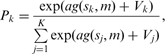
Finally, we assume that for each party j, the unknown component εj of voters’ valence evaluations is selected independently over parties from a type 1 extreme value distribution.Footnote 21 This assumption implies that voters’ choice probabilities can be represented via a logit function.Footnote 22 Specifically, the probability Pk that the median voter votes for Party k – which by Remark 1 is k’s probability of being the MPP – is given by the logit probability function:Footnote 23
and party k’s expected policy utility Uk is
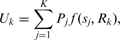
where m represents the median voter’s position.Footnote 24
Policy-seeking equilibrium in parliamentary elections: theoretical results
We now consider the existence and characteristics of equilibrium in policy-seeking parties’ strategies in parliamentary elections under PR, for the model of voting behaviour and government policy outputs developed in the previous section. We also explore comparative statics on how parties react to changes in their measured valence characteristics.
Existence and Characteristics of Policy-Seeking Equilibrium Strategies
The following theorem provides sufficient conditions for existence of a Nash equilibrium, i.e., a configuration of party strategies s 1,…, sK such that no party can increase its expected utility by unilaterally changing its policy position. Let I denote a closed bounded interval containing the voter ideal points and the party preferences Rk for k = 1,…, K. For k = 1,…, K, define the interval Ik = [Rk, m] if Rk≤ m and Ik = [m, Rk] if Rk ≥ m, where m is the location of the median voter. Note that Ik ⊆ I.
Theorem 1: Existence of Nash Equilibrium
If for each party k, k = 1,…, K, f(sk, Rk) is concave and peaks at Rk, and g(sk, m) is concave and peaks at m, then there exists a set of party strategies s* = (s 1*,…, sK*) ∈ I1 × I2 ×…× IK such that Uk (s*) is the maximum over Ik for each k, i.e., s* is a Nash equilibrium.
Outline of proof.Footnote 25 First, because f(sk, Rk) is concave and peaks at Rk, and g(sk, m) is concave and peaks at m, it can be shown that Uk is single-peakedFootnote 26 on Ik, i.e., on [Rk, m] or [m, Rk] and U = (U 1,…, UK) is continuous. Secondly, for each k, if the kth party’s utility functions f(x, Rk) and the median voter’s policy utility function g(x, m) are continuous and single-peaked around their ideal points, and if Uk peaks at sk given fixed xj ∈ I, j ≠ k, then sk lies in the closed interval between its preferred position Rk and that of the median voter m, i.e., sk ∈ Ik. The existence of the Nash equilibrium specified in Theorem 1 then follows from Theorem 5.3 in McCarty and Meirowitz’s recent book on political game theory.Footnote 27
In words, the theorem states that a Nash equilibrium is guaranteed provided that both voters and parties have concave policy utility functions that peak at their respective ideal points, as we assume in our model. These conditions are weak in the sense that they are satisfied by most commonly-used policy distance functions, including the linear and quadratic loss specifications. At equilibrium, each party k’s strategy lies in the policy interval bounded by its sincere policy preference Rk on one side and by the median voter position m on the other.
Comparative Statics: The Centripetal Effects of Valence Result
Theorem 1 establishes existence conditions for a Nash equilibrium. Under such an equilibrium, no party has incentives to shift its position while other parties remain fixed. If, however, a party’s valence image deteriorates, its electoral prospects are also diminished. A strategic move towards the median voter might be expected to help balance this loss, augmenting the party’s probability of being the median parliamentary party. The following theorem (which is proved in the Appendix) supports this intuition:
Theorem 2 (Centripetal Valence Effects)
Assume that the parties’ and voters’ policy loss utility functions f(sk, Rk) and g(sk, m) are single-peaked around their ideal points. Then for any party k whose optimal position sk* lies strictly between Rk and m, if the measured component Vk of the party’s valence image decreases (increases), party k improves its expected utility by shifting unilaterally toward (away from) the median voter’s position m, with all rival parties fixed at their optimal positions and their measured valence components held constant.
In words, the Centripetal Valence Effect result states that when parties enhance their valence images they then have policy-seeking incentives to shift unilaterally to more extreme positions (relative to the median voter), while parties whose valence images deteriorate are motivated to moderate their policies. We note that this result is similar to Londregan and Romer’s result on two-candidate elections.Footnote 28 However, when one party alters its position, the other parties can be expected to adjust theirs, with all parties moving to a new equilibrium. Explicit formulas for such changes in equilibrium have proved mathematically intractable, but numerical calculations (reported below) suggest strongly that when a focal party shifts its position due to a change in valence, the other parties move as well and move in the same direction as the focal party (some parties may remain fixed).Footnote 29 Thus, for example, if a leftist party loses valence and responds by shifting towards the median voter, i.e., to the right, then the other parties also shift to the right, if they move at all. Thus, relative to one another, optimal party positions change very little when one of them gains or loses valence, although the parties’ positions change relative to the position of the median voter.
Implications of the theory and simulation results
Equilibrium Configurations and Comparative Statics: Illustrative Examples
What do our theoretical results imply about party strategies for plausible election scenarios, and how do strategies differ for policy-seeking as opposed to vote-seeking motivations? Consider a situation in which there are two high-valence parties and one or more low-valence parties – a situation that obtains in many real-world party systems, including those of Germany, Israel, Spain, Britain, Norway and Sweden.
Assuming vote maximization, as does Schofield,Footnote 30 the two major parties – following Downsian arguments – will move towards the centre. Vote-seeking, low-valence (small) parties will then avoid the location of the major players, where they would compete for vote-share on valence alone and lose. Instead, they will seek a niche on the policy periphery, where their policy advantage among spatially radical voters can offset their valence disadvantage. Thus, Schofield shows that when parties maximize votes, low-valence parties have incentives to locate sharply away from the centre of the voter distribution, while high-valence parties typically have incentives to present moderate positions.Footnote 31 Schofield’s results thereby suggest that a weak valence image exerts a centrifugal force on vote-seeking parties, one that pulls them away from the centre of the voter distribution. Schofield and Sened report empirical applications to Israel demonstrating that an equilibrium in vote-maximizing strategies exists in which the two high-valence parties – Labor and Likud – present moderate policies, while the low-valence parties locate farther from the centre of the voter distribution.Footnote 32
When vote-maximizing motivations are replaced with the policy-seeking motivations that we analyse in this article, the parties face a trade-off. Each party attempts to balance policy and the probability of attracting the median voter – an effort that leads most parties to seek either centre-left or centre-right positions, i.e., positions that are neither in the ideological centre nor at the extremes.Footnote 33 The divergent properties of policy-seeking motivations were first studied by Wittman and have been extended to valence models by Londregan and Romer, and Groseclose.Footnote 34 The multiparty, valence-uncertainty model developed in this article is a generalization of these models.
At first glance Schofield’s results, compared to our own, seem to imply that valence considerations create diametrically opposite strategic incentives for vote-seeking parties compared to policy-seeking parties. However, this is only partly true. To grasp the connection between Schofield’s results and our Centripetal Valence Effects (CVE) theorem, we must consider both what the CVE theorem implies about party strategies and also what the theorem does not imply. The CVE theorem is a comparative statics result that states that, all other factors being equal, a policy-seeking party’s optimal strategy is to moderate its position unilaterally when its valence image deteriorates, and to shift to a more radical position when its valence image improves. However, the CVE theorem alone makes no predictions about the relative positioning of different parties, nor does it imply that low-valence parties will inevitably present moderate positions, because there is a crucial factor that is not equal: the parties’ sincere policy preferences. As we will indicate in our simulations below, movements in response to plausible changes in valence are small relative to the influence of the parties’ preferred locations. Typically, parties’ optimal strategies are similar to their preferred positions, but somewhat less radical. Accordingly, it can be rational, under the valence-uncertainty model, for a low-valence, policy-seeking party to present sharply non-centrist policies provided that it has non-centrist policy preferences; similarly, it can be rational for a high-valence party to present a moderate policy, provided that it has moderate policy preferences (indeed in this latter case policy moderation is invariably an optimal strategy).
Numerical Examples
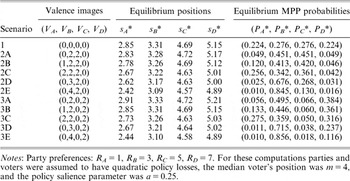
To investigate the optimal behaviour of all parties as their valence images change, we use numerical calculation for illustrative cases, because analytic analysis becomes intractable. For our illustrative calculations we consider four parties – labelled A, B, C and D – and we specify the conventional 1–7 scale, quadratic-loss utility for voters and for parties, and that the median voter’s position is m = 4 with the policy-salience parameter set to a = 0.25.Footnote 35Table 1 reports equilibrium strategies for several valence configurations of parties whose preferred policy positions are RA = 1, RB = 3, RC = 5, RD = 7. To clarify the results reported in the table, scenario 1 (presented in the top row) is a ‘generic’ scenario where the parties’ valence images are set to the equal values VA = VB = VC = VD = 0 (see column 2), and the table reports that for this scenario the equilibrium configuration is {sA* = 2.85, sB* = 3.31, sC* = 4.69, sD* = 5.15} (see columns 3–6) and the parties’ equilibrium probabilities of being the MPP are PA* = 0.224, PB* = 0.276, PC* = 0.276, PD* = 0.224 (see the far right column). Table 1 reports results for ten additional scenarios (scenarios 2A–2E and 3A–3E) – to be discussed in detail below – in which we vary the parties’ valence images.
Equilibrium Positions for Dispersed Party Preferences and Selected Valence Images

Notes: Party preferences: RA = 1, RB = 3, RC = 5, RD = 7. For these computations parties and voters were assumed to have quadratic policy losses, the median voter’s position was m = 4, and the policy salience parameter was a = 0.25.
The computations reported in Table 1 reveal three striking patterns. First, for all scenarios that were investigated, the parties’ optimal strategies at equilibrium are highly dispersed. Each party attempts to balance its policy preference with its likelihood of being the MPP, resulting in two groupings: two parties (A and B) who present moderate to sharply leftist positions, and two rightist parties (C and D) who present moderate to sharply rightist positions. Note that this grouping into opposing blocs occurs despite the fact that in our illustrative examples, the parties’ sincere policy preferences are evenly spaced along the Left–Right dimension. Secondly, the parties’ optimal positions vary only modestly as a function of their valence images, despite the fact that we vary these valence images dramatically across our examples, as is evident from the fact that each party’s equilibrium probability of being the MPP varies sharply between scenarios. Thirdly, note that in every scenario the parties with the most extreme policy preferences, A and D, present significantly more radical strategies than do the parties with moderate policy preferences (B and C), regardless of the parties’ relative valence images. The latter two patterns underline an important feature of policy competition under the valence-uncertainty model: namely, that for realistic model parameters, policy-seeking parties’ optimal strategies vary only modestly as a function of their valence images V – even though valence images have massive effects on the parties’ probabilities of being the MPP – while these policy strategies vary substantially as a function of the parties’ sincere policy preferences R.
Illustrative Example 2: Spatial competition with strong centre parties. In scenario 2A in Table 1, the parties’ sincere policy preferences are the same as in scenario 1, but their valence scores have been changed to VA = 0, VB = 2, VC = 2, VD = 0 (see column 2) – i.e. the two parties with moderate policy preferences (B and C) are assumed to have much stronger valence images than are the two parties with extreme preferences (A and D).Footnote 36 Scenario 2A thereby plausibly captures the strategic situation in Israel – in which the moderate, high-valence Labor and Likud parties compete in a party system that also features several small, radical, parties – and is also relevant to the Spanish party system, which features two large parties – the Spanish Socialist Workers’ party and the Peoples’ party – who are viewed as holding moderate policy preferences, along with smaller, more radical parties. In this scenario, the parties’ policy-seeking strategies are nearly identical to those for scenario 1. Once again the high-valence parties B and C present moderate equilibrium positions (sB* = 3.28, sC* = 4.72) that resemble their sincere policy preferences, and the low-valence parties A and D present more radical positions (sA* = 2.83, sD* = 5.17), although these positions are substantially more moderate than their sincere preferences.Footnote 37
The values in the rightmost column of Table 1 show each party’s probability of being the median parliamentary party (MPP) when all parties locate at their equilibrium positions; this shows that for scenario 2A the two radical, low-valence parties are extremely unlikely to be the MPP, so that the moderate, high-valence parties are overwhelmingly likely to control policy outputs following the election. This equilibrium configuration conforms well to the policy configurations that we actually observe in the Israeli and Spanish party systems – in which the major parties present moderate policies – and it illustrates the fact that, under the valence-uncertainty model, policy-seeking parties with poor valence images may nevertheless present sharply non-centrist positions – the same result that Schofield obtains for vote-seeking parties.
Why, in this illustrative example, do the high-valence parties present moderate positions while the low-valence parties present more radical policies? The moderate positioning by the high-valence parties B and C is due to the fact that these parties’ policy-seeking optima are quite similar to their sincere policy preferences; it would clearly be irrational for these parties to present positions that are more extreme than their sincere preferences, since this would simultaneously depress their chances of being the MPP and would oblige them to implement less desirable policies in the event they become the MPP. At the same time these parties do not moderate all the way to the centre, which is at some distance from their sincere preferences. The modestly more extreme positioning by the low-valence parties reflects a compromise between these parties’ sincere beliefs and their desire to be the MPP. Note first that at equilibrium the low-valence parties do in fact moderate their positions, relative to their sincere preferences; in fact, these low-valence parties actually compromise to a greater extent than do the centrist, high-valence parties, in the sense that at equilibrium the low-valence parties’ strategies are shifted much father away from their ideal points. However, because these low-valence parties hold extreme preferences, their strategic policy compromises still leave them presenting sharply non-centrist positions, compared to those of the moderate, high-valence parties.
Results when the parties’ valence images are varied. With the parties’ preferred positions fixed, we assess the Centripetal Valence Effect by varying the parties’ valence images, first of the far-left party A (scenarios 2B–2C), and then of the centre-left party B (scenarios 2D–2E). We see from Table 1 that as the valence image of either left-of-centre party improves the optimum strategies at equilibrium not only for the focal party but for all parties shift slightly to the left. (Similarly, if the valence of a right-of-centre party is increased, the optimum strategies of all parties shift right.) Intuitively, the party with enhanced valence has the leeway to move in its preferred direction; i.e., it trades away some of its increased likelihood of becoming the MPP for a more desirable policy position. When, say, a leftist party gains valence, parties to its right also move left to make up for their loss of valence relative to the focal party. This generalizes the finding in Adams, Merrill and Grofman for two-party contests:Footnote 38 the valence-advantaged party has the leeway to move to a more extreme location (towards its preferred policy position), while a valence-disadvantaged party becomes more moderate. Note, however, that in the examples presented in scenarios 2A–2E the parties’ equilibrium positions change only slightly even as their valence images (and thus their probabilities of being the MPP) vary wildly – perhaps the most interesting pattern in these examples. On a related note, in all of these examples the parties with the most extreme preferences (parties A and D) present the most extreme strategies, regardless of their valence images – results suggesting that parties’ optimal strategies are more strongly influenced by their sincere policy preferences than by valence-related considerations.
Overall, the computations presented in Table 1 suggest that, regardless of the parties’ valence images, parties that hold extreme preferences have policy-seeking incentives to present more radical policies than do parties with moderate policy preferences. These results appear consistent with the party strategies that we actually observe in PR-based parliamentary democracies such as Israel, Spain and Germany. Our computations also support our Centripetal Valence Effects (CVE) result, that parties are motivated to moderate their policy strategies when their valence images deteriorate, although we find that the magnitude of this effect is modest. The computations also suggest that parties display tendencies to cluster into left-wing and right-wing blocs at equilibrium.
Simulation Analysis
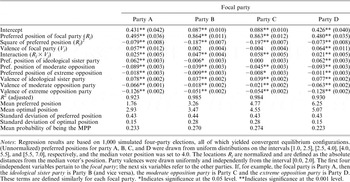
To substantiate the conclusions suggested by our illustrative examples, we simulated 1,000 four-party elections in which parameters were chosen randomly from a parameter space. Party valences were chosen independently from a uniform distribution on the interval from 0.0 to 2.0 and the preferred positions for party A, B, C and D were drawn from uniform distributions on the intervals [1.0, 2.5], [2.5, 4.0], [4.0, 5.5] and [5.5, 7.0], respectively, intended to represent strongly leftist, centre-left, centre-right and strongly rightist parties.Footnote 39 The parties’ preferred positions and their optimal strategies were normalized by taking the absolute distance from the median voter’s position, which was set to 4.0. Each party j’s optimal strategies were regressed on ten independent variables: the focal party’s (normalized) preferred position Rj; the square of this position (Rj)2, the party’s valence image Vj; an interaction term equal to the product of the party’s valence image and its preferred position, (Rj × Vj), as well as the preferred positions and the valences of each of the non-focal parties. The parameter estimates and standard errors from the regressions, along with other statistics, are presented in Table 2.
Regression Results for Simulated Data with (Normalized) Equilibrium Location of Focal Party as Dependent Variable

Notes: Regression results are based on 1,000 simulated four-party elections, all of which yielded convergent equilibrium configurations. (Unnormalized) preferred positions for party A, B, C, and D were drawn from uniform distributions on the intervals [1.0, 2.5], [2.5, 4.0], [4.0, 5.5], and [5.5, 7.0], respectively, and the median voter position was set to 4.0. The locations R j are normalized and are defined as the absolute distances from the median voter’s position. Party valences were drawn uniformly and independently from the interval [0.0, 2.0]. The first four independent variables pertain to the focal party; the next six variables refer to the other parties. If, for example, the focal party is Party A, then the ideological sister party is Party B (and vice versa), the moderate opposition party is Party C and the extreme opposition party is Party D. These terms are defined similarly for each focal party. *Indicates significance at the 0.05 level. **Indicates significance at the 0.001 level.
First, we note that the estimated coefficient on each variable, except for the valence of the two centrist parties B and C (and some of the preferred positions for non-focal parties), is significant at the 0.001 level, and collectively these parameters explain over 90 per cent of the variance in the parties’ optimal positions. In particular, the coefficients on the policy preference variables (i.e. the Rj and (Rj)2 terms) are both significantly different from 0, indicating that parties’ preferred positions strongly influence their optimal strategies independently of valence. Furthermore, the highly significant positive coefficient on the policy preference term, Rj, combined with the negative coefficient on the squared term, (Rj)2, implies that as parties’ sincere policy preferences become more radical their strategies become more radical, but at a diminishing rateFootnote 40 – a result that substantiates our illustrative examples, in which the equilibrium strategies of parties with extreme preferences were modestly more radical than the strategies of moderate parties, resulting in groupings of rival pairs of parties on the left and the right. In fact, the mean optimal positions of the respective parties noted in Table 2 indicate that the mean distance between the optimal strategies of the two centrist parties B and C (1.08) is about twice the mean distance between the two leftist parties A and B (0.54) or the two rightist parties C and D (0.52), despite the fact that by simulation design, the mean preferred positions of the parties are equally spaced.
Secondly, although the estimated coefficient on the parties’ valence images Vj are significant only for the two peripheral parties A and D, valence also influences the parties’ optimal positions via its interaction with the focal party’s preferred position (the (Rj × Vj) variable), so that – for any party not at the median – its optimal strategy becomes more extreme as its valence increases, as is predicted by the CVE result (Theorem 2). Moreover, the tendency of the optimal strategy of the focal party to be more extreme when the party’s valence image is strong increases as the party’s preferred position becomes more extreme.Footnote 41
Thirdly, the significantly negative coefficients for the policy preferences of the opposition parties (as well as positive coefficients for the preference of the ideological sister party when the focal party is A or D) indicate that, ceteris paribus, the focal party’s optimal strategy moves in concert with the preferred positions of the other parties. Thus, for example, if rightist parties come to prefer more right-wing policies, a focal leftist party should move strategically to fill the gap. And, given that parties’ optimal strategies sj shift in tandem with their preferred positions Rj, these coefficient estimates on rival parties’ preferred positions imply that parties’ equilibrium positions tend to shift in tandem, i.e. that when one party shifts its position to the left or right because its preferred position has changed (perhaps due to changes in the composition of the party leadership), then the other parties can be expected to follow suit by shifting their policies in the same direction as the focal party. Furthermore, the coefficients for the valence of the other parties shows that as the valence of the opposition parties increases (or when the valence of the ideological sister party decreases), a focal party takes a more moderate optimal position. This tendency to move strategically towards a valence-advantaged opponent on the opposite side of the median voter is in agreement with the findings of Adams, Merrill and Grofman for two-party elections when uncertainty revolves – as we assume here – around the valence advantage.Footnote 42
These parameter estimates thereby support two key conclusions that were earlier suggested by our illustrative examples: namely, that parties’ optimal strategies are strongly related to their sincere policy preferences and to their valence images. In particular, the significant coefficients of the valence and interaction terms support the Centripetal Valence Effect, indicating that parties’ optimal strategies become more extreme as their valence images improve.
Extensions and connections to empirical research
The central testable real-world implication of our model revolves around the centripetal valence effects (CVE) result, that policy-seeking parties will moderate their policies when their valence images deteriorate, but radicalize their positions when their images improve. Although we are unaware of any empirical research that directly measures parties’ valence images in parliamentary democracies, Somer-Topcu reports empirical tests of the CVE hypothesis on the policy strategies of parties in ten East and Central European party systems over the period 1990–2002.Footnote 43 Using economic variables in conjunction with parties’ governing status as proxy measures of changes in parties’ valence images, and using the Comparative Manifesto Project codings of parties’ policy programmes to estimate policy shifts,Footnote 44 Somer-Topcu reports findings that consistently support our CVE result: namely, she finds a statistically significant tendency for parties to moderate their policy programmes in situations where their valence images (as estimated via proxy variables) deteriorate, and that this tendency grows stronger the more sharply parties’ valence images decline (the latter finding is in line with the conclusions suggested by our Monte Carlo simulations). Somer-Topcu also finds that parties tend to shift to more radical policies when their valence images improve, and that this tendency is strongest when parties’ valence gains are estimated to be largest. These empirical findings appear to support our CVE prediction, although Somer-Topcu emphasizes that policy moderation for parties in the government is subject to confounding factors, such as the necessity of compromise to achieve policy results. Hence definitive confirmation of the CVE hypothesis awaits further delineation of valence images.
An additional testable implication of our model revolves around the pattern suggested by our numerical computations, namely that when one party unilaterally shifts its position to the left or right, the other parties in the party system can be expected to respond by shifting their policies in the same direction as the focal party. Empirical research by Adams and Somer-Topcu, on parties’ policy shifts in twenty-five post-war party systems, identifies patterns in line with the pattern predicted by our model: namely, the authors find that when a party or parties shift their policy positions at the current election, then the other members of the party system tend to shift their positions in the same direction at the subsequent election.Footnote 45
Theoretically, as we noted in the introduction, our specification that the median parliamentary party (MPP) controls policy outputs is a strong assumption, one that conflicts with alternative models of policy making which emphasize the policy primacy of the parties in the governing coalition; the central importance of the formateur, i.e., the party charged with forming the government; and the dominance of the party with jurisdiction over the relevant government ministry. While empirical research by McDonald and Budge (discussed earlier) supports our MPP assumption, we make no claim that our model constitutes the preferred approach to analysing parties’ policy-seeking strategies in parliamentary democracies, and indeed we hope to extend our approach to incorporate additional influences on policy outputs, particularly those relating to the most obvious alternative policy model: that in which all governing parties (not merely the MPP) influence policy making. Here we note two patterns – one empirical and the other pertaining to our computational results – that suggest that our conclusions on party strategies under the MPP model plausibly extend to more general models of policy outputs that include a role for governing parties. Empirically, Van Roozendaal reports that the median parliamentary party was a member of the government in over 80 per cent of the cabinets in fifteen post-war parliamentary democracies, a finding which suggests that policy-seeking parties who believe that being in government will enhance their policy influence have strong incentives to be the median parliamentary party.Footnote 46 Theoretically, our computational finding that parties coalesce into rival blocs at equilibrium suggests that parties who believe that the MPP will determine policy outputs tend to pursue strategies that will also make them attractive coalition partners, i.e. we do not observe MPP-motivated parties adopting excessively radical strategies, that would make them unacceptable coalition partners to the moderate parties on their side of the ideological continuum. This again suggests that the policy-seeking strategies that are optimal under the MPP assumption will resemble the strategies that parties would employ in a more general model, which includes a policy-making role for all parties in the government.
Conclusion
We have developed a spatial model of policy-seeking parties contesting multiparty parliamentary elections under proportional representation (PR), in which the parties differ in terms of their measured valence attributes and where, moreover, they are uncertain about the electoral impact of valence issues. The key assumption in our model – which represents a direct extension of Londregan and Romer’s two-candidate model to the multiparty contextFootnote 47 – is that party elites believe that the median parliamentary party will control government policy outputs. In both the multiparty and two-party models, the utility of a party is a weighted mean of its utilities for the declared positions of the parties, where the weights are the probabilities that each party wins the vote of the median voter. In the two-party case, the party who wins the median voter receives a majority of the vote and hence controls the government. In the multiparty case under PR, the party who attracts the median voter is the median party in parliament, and by our assumption controls governmental policy outputs.
We have shown that our multiparty, valence-uncertainty model motivates sincere voting, and that it supports a Nash equilibrium for party strategies under fairly general conditions. Numerical calculations suggest strongly that the configuration of equilibrium strategies under policy-seeking motivations resembles the configuration of the parties’ sincere preferences, but these strategies are more moderate than the preferred positions, especially for those parties with extreme policy preferences. These calculations also suggest that, for realistic model parameters, the computed equilibria resemble the configurations that we observe in real-world party systems in Israel, Germany and Spain. This effect tends to encourage a number of parties to locate in either centre-left or centre-right positions. The model generates a prediction that we label the ‘Centripetal Valence Effects’ hypothesis: namely, that parties whose valence images deteriorate have policy-seeking motivations to moderate their policies, compared with valence-advantaged parties. In addition, our numerical calculations support the prediction that when a focal party or parties shift their policy strategies, we should observe rival parties responding by shifting their policies in the same direction. Empirical research by Somer-Topcu and Adams supports these predictions.
Our model could be extended to encompass additional complications, such as restrictions on party positioning; uncertainty over the location of the median voter; the possibility of biased valence effects that tend to help the left or the right systematically; politicians with mixtures of expressive and instrumental policy motivations; and variable turnout in the electorate.Footnote 48 In addition, it would be useful to compare how parties’ strategic incentives in our model differ from their incentives in models which employ alternative assumptions about policy outputs, such as the policy primacy of the formateur or the primacy of the governing parties. Finally, it would be interesting to extend our approach to multiparty elections held under plurality rule.Footnote 49
In this article, we have analysed the strategies of policy-seeking parties in parliamentary democracies with PR voting systems and a policy-dominant median parliamentary party. We find that such a model is likely to support a stable configuration of party policy strategies, and that it generates a non-obvious hypothesis: namely, that as parties’ non-policy related valence images improve, they can be expected to adopt more radical policy platforms.
Appendix: Proof of the centripetal valence effects theorem
Theorem 2 (Centripetal Valence Effects)
Assume that the parties’ and voters’ policy-loss utility functions are single-peaked around their ideal points. Then for any party k whose optimal position sk* lies strictly between Rk and m, if the measured component Vk of the party’s valence score decreases, party k improves its expected utility by shifting unilaterally towards the median voter’s position m, with all rival parties at their optimal positions and their measured valence components held constant.Footnote 50
Proof. We assume, without loss of generality, that Rk < m. For sk = sk*, then  , i.e.,

Thus, solving for  and simplifying, we obtain
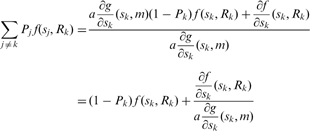
for sk = sk*.
Now, suppose that Vk, the measured component of Party k’s valence score, increases from Vk to Vk′ = Vk + ε (where ε > 0). This in turn increases Pk, the probability that k is the median party from Pk to Pk′ = Pk + p, where p > 0 because of the form of Equation 2:
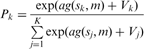
We show that when Party k is located at its optimal position sk = sk* for Vk, it must be the case that  for sk = sk* and Vk′ = Vk + ε, i.e., party k can increase its expected utility Uk by shifting unilaterally to the left of sk*, away from the median voter’s position.
Because the independence-of-irrelevant-alternatives property applies to the probabilities Pj′ (where Pj′ is the probability that a party j ≠ k will be the median party following the exogenous increase in Vk), there is a δ,0 < δ < 1, such that  for all j ≠ k. It follows that

Solving for δ and substituting in  yields
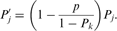
Following the exogenous increase in Vk , the derivative  , evaluated at sk = sk*, is given by

.
By Equation A1, when 
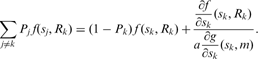
Substituting this equality into Equation A2 and rearranging terms yields

for  evaluated at sk = sk*. Since
 is negative for Rk < sk* < m,
 , evaluated at sk = sk*, is negative as well. Therefore, Party k can increase its expected utility Uk by shifting unilaterally to the left of sk*, away from the median voter’s position. This completes the proof of Theorem 2.
 and U(x 0) > U(x). (This is a special case of strict single-peakedness.) Note that if U is concave and peaks at x 0, then U is strictly increasing on the left of x 0 and strictly decreasing on the right, i.e., if x 1 < x 2 ≤ x 0, then U(x 1) < U(x 2) and if x 0 ≤ x 1 < x 2, then U(x 1) > U(x 2).
 , where
 .