In democratic societies, administrative reorganization – changes to the size, scope, number and independence of public agencies – influences how easily the public can hold government accountable for policy making. In high political accountability systems like the United Kingdom, governments have the incentive and the ability to implement a mass reorganization, which affects many agencies across many issue domains in a compact time period. What explains how the government decides to dispose of agencies in mass reorganizations? We address this question by developing a theory of government accountability through mass reorganization and assess it using novel data about recent independent agency reforms in Britain. In doing so, we fundamentally challenge the existing literature’s focus on organizational survival rather than the more fundamental political questions of democratic accountability in the modern state.
The American-centric literature on administrative reorganizations focuses on the political choice to terminate individual agenciesFootnote 1 and programs.Footnote 2 Mass reorganizations present governments with incentives that may be different from those faced when agencies are reorganized case by case. Furthermore, this literature largely focuses on the time an agency endures until it is shuttered altogether, arguing that termination (the closure of an agency) ‘is the ultimate act of political control and can be cleanly observed.’Footnote 3 Mass reorganizations reveal diverse ways in which agencies’ functions can be recast, with different impacts on the political costs of administrative agency and different consequences for government accountability. What has been called termination is a multifaceted choice, and closing an organization is not an ultimate act of controlling it: its functions will persist either inside or outside of government.
Our empirical context is a single mass reorganization. After the 2010 general election, the British coalition government set out to honor the Conservative Party manifesto pledge to ‘curtail the quango state’.Footnote 4 This mass reorganization of non-departmental public bodies (NDPBs or quasi-autonomous, non-governmental organizations, quangos) provides the setting for our study.Footnote 5 We study 403 independent agencies included in a reorganization plan from December 2011, enabled by the Public Bodies Act of the same month. The British media dubbed the plan the ‘bonfire of the quangos’ and expressed ‘shock and awe at the names of tinder for the civil pyre’.Footnote 6 Using a sequential logistic regression framework, we model the political construction of this plan. Our analysis reveals the importance of partisan policy conflict, transparency in operations and size on the disposition of agencies. Comparing these results with a logistic regression analysis of the binary decision to close an agency examined in the prevailing literature shows how the failure to consider the full range of choices masks essential elements of politics, and in particular, all influence of conflict in party policy positions between the government and its predecessor or the current opposition.
In the next section, we offer an analytic description of the choices facing governments in mass reorganizations as well as their consequences for accountability. We then compare this choice structure to the analytic framework in the agency termination literature, showing a variety of incompatibilities. Our attention then turns to sketching a theory of mass reorganizations that centers on accountability and the political costs of administrative agency. We next derive and test several hypotheses from this theory. We provide a fuller discussion of the data and our method of examining the government’s decision to shift accountability toward or away from elected politicians. Our results are presented and discussed before concluding with their implications.
GOVERNMENT CHOICES IN MASS REORGANIZATIONS
We are interested in the politics of constructing mass reorganization plans, and this requires an analytic statement of how choices in such plans differ from binary actions to either terminate an agency or keep it in operation. Creating independent agencies implies reducing political control over two things: selecting policy goals and choosing the means of implementing them. That is, the agency can choose policies without interference from politicians, and can implement mechanisms to achieve policies without restrictions imposed by the politician.Footnote 7 This has direct implications for accountability, the maintenance of which is central to public administration.Footnote 8 Decisions about agency independence are crucial, because ‘effective accountability necessitates the identifiability, within the government as a whole, of a particular group who can be held jointly answerable for whatever is done or not done.’Footnote 9
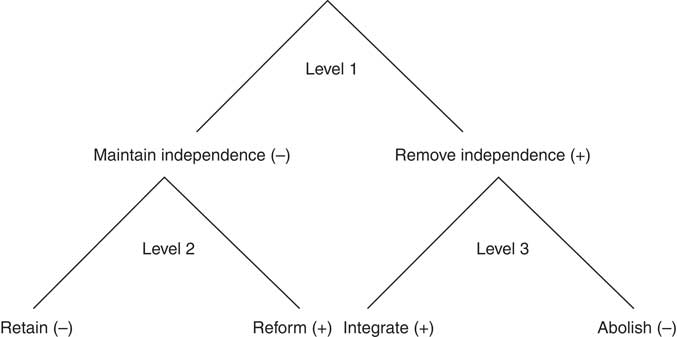
Figure 1 depicts the alternatives that government might select for each agency included in a plan. The impact of the choice to increase (+) or decrease (–) the government’s accountability for agency policy making associated with the alternative is shown in parentheses. At level 1, the government chooses between retaining the agency’s independence, reducing its identifiability with the agency’s policy-making activities and removing its independence, thus increasing accountability for policy making in the agency’s domain. While this is an important analytic distinction, the choice made here has implications for what else can be done in the reorganization.
The mass reorganization decision Note: The structure of the government’s choice is depicted in three levels. Level-1 choices are analytically prior to level-2 and -3 choices.

If the agency remains independent, the government faces a level-2 choice of whether to retain or reform its structure or formal organization. If the government makes alterations, it can claim credit for them and increase its identifiability with agency policy making. We define reform as some type of alteration: either a merger with another independent agency or reform of the existing agency.Footnote 10 Retention means that the structure of the agency remains unchanged.Footnote 11 Where the choice is to remove independence, functional disposition becomes the level-3 consideration. Integrating the functions of a previously independent agency into a cabinet department or other organization subject to political control through ministerial oversight creates a direct link to the government through ministerial responsibility, identifying the government with policy. Once part of a department and no longer at arm’s length, the function has neither goal nor means independence from the minister.Footnote 12 Abolishing the function, which may mean that it is transferred out of government, breaks the link between government and policy, reducing accountability.Footnote 13
It is crucial to observe that reaching choices about structure and function requires a (level-1) choice regarding independence.
The definition of what constitutes termination in the prevailing (largely American) literature provides a key contrast to the multiple alternatives evident in mass reorganizations. Termination of administrative agencies in this literature usually means a transfer of functions to another agency.Footnote 14 Importantly, then, terminations are not final functional dispositions, but reorganizations as we define them with coincident consequences for accountability.Footnote 15 A binary approach to defining termination suits duration modeling.Footnote 16 Yesilkagit employs competing risks analysis to avoid pooling the hazards of merging, replacement and ‘pure termination,’ which he defines as ‘program termination,’Footnote 17 and Berry, Burden and Howell use a similar strategy to study program termination.Footnote 18
Carpenter and Lewis add a learning component to agency durability, showing evidence that termination really entails the evaluation of the agency by the politician.Footnote 19 They argue with evidence that any risk that the agency will fail to fulfill its mission or drift away from it can only be perceived after the agency begins doing its job.Footnote 20 Thus, termination is akin to sanctioning in accountability discussions, where the hazard of closure is low until an evaluation can be made.Footnote 21
All of this is different in mass reorganizations, in which the politician considers independence and accountability relationships across a large span of governance tasks. In contrast to the duration approach, we would expect political motivations for reorganization decisions to have different ‘signs and significance’ when mass reorganization is on the agenda. We cannot assume that the government targets the same agencies as it would individually, over their lifespans or even between governments of different partisan composition. While it is possible to interact changes in government with predictors, the choice structure of mass reorganization cannot easily be considered in a duration model. Furthermore, this approach assumes that the end will come for an agency, while the function (if not the agency) may be very difficult to eliminate or outsource.
To summarize, the prevailing literature leaves two important aspects of mass reorganizations understudied. First, we know little about the trade-offs within the lower levels of the reorganization decision as depicted in Figure 1. When termination is imagined as a binary choice, these details are lost. Secondly, the government may have different incentives in a case of mass – as opposed to incidental (case-by-case) – termination; in this case, terminating agencies is the policy, not the consequence of another policy. This makes the accountability of administrative policy making a paramount issue. This literature provides a helpful frame for our expectations as we formulate hypotheses; we now turn to this effort.
A THEORY OF MASS REORGANIZATION
Mass reorganization alters the governance framework for administrative agencies both across a range of policy areas and within a limited span of time. We argue that the chosen agency arrangements distribute accountability. That is, accountability is a consequence of structural choice that politicians might value on its own, independently of particular policy or outcome preferences. When the implementation of policies is studied one by one, as in the literature on agency termination, accountability may seem subservient to the minimization of the costs of administering public policies. We argue that when politicians choose structures for a variety of policy-making areas, as in mass reorganization, the government’s accountability portfolio becomes an important source of their motivation.Footnote 22
Horn catalogues four types of costs that politicians and constituents face in structural choices about agencies.Footnote 23 First, bargaining costs over policy design rise as agreement among politicians and organized interests becomes more difficult; secondly, commitment costs increase with the ease by which subsequent coalitions can overturn legislation; thirdly, agency costs increase as administrators become unable or unwilling to effectuate policies as envisioned by politicians; and, fourthly, uncertainty costs increase when (risk-averse) constituents have less certainty about the benefits and costs that a policy offers them. A politician’s structural choices include the degree of delegated authority, agency organization, administrative procedures, monitoring mechanisms and personnel systems, and Horn contends that the politician makes these choices to minimize the transactions costs discussed above.Footnote 24
Independent agencies shift costs because they make governments less identifiable, and agency personnel more identifiable, with policy choices.Footnote 25 They can reduce bargaining costs vis-à-vis the stakeholder groups their work most impacts. Such agencies engage in arm’s-length decision making that reduces commitment costs by making it harder for politicians to over-ride their policy actions, but this comes at the expense of agency costs. Independent agencies can also increase uncertainty costs because independence makes it less clear to stakeholders and the public how agency policy making reflects the government’s policy programme and manifesto commitments. Consequently, the independent agency as a structural choice shapes all four of Horn’s cost categories.Footnote 26
Electoral systems generate different levels of identifiability as well. When compared with the American separation of powers, high identifiability in Britain means that governments systemically face high commitment costs in policy making.Footnote 27 Independent agencies work against this in particular policy domains by placing implementation at arm’s length from politicians.Footnote 28 This loss of identifiability for policy making can be offset by the benefits of expert decision making.Footnote 29 Scholars frequently have studied how policy-making independence buttresses a politician’s credible commitment to policy or procedural promises to constituents and organized interests by tying his or her hands.Footnote 30 Another appeal of independent agencies as a cost reduction mechanism is blame shifting: if the agency makes choices that voters or organized interests may not like, its structural independence creates distance between politicians and relevant policy decisions.Footnote 31 Under either rationale, independence decreases the politician’s accountability for choices made by the agency and makes political control more difficult.Footnote 32
To construct a series of hypotheses that we test in the context of the 2011 mass reorganization in Britain, our starting point is partisan conflict. Berry et al. provide an analogy between the costs and benefits that are important to reorganization decisions: ‘a person who inherits an old house [who] must decide whether to accept the house as it currently stands, to begin minor or major renovations, or to tear down the house and build a new structure’.Footnote 33 In the UK, the analogy is not quite right because the relative (the prior incumbent party) has not really died, but occupies the opposition front bench. For this reason, we examine two types of conflict.
First, the current government may have disagreements with its predecessor over issues related to the specific mission of the administrative agency. We call this type of disagreement ‘mission implementation conflict’.Footnote 34 This type of disagreement is similar in spirit to that Berry et al. envisioned, yet our argument is more nuanced.Footnote 35 As we have discussed, three important reasons for making agencies independent (and attenuating government accountability for policy making) are blame shifting,Footnote 36 credible commitmentFootnote 37 and expert decision making.Footnote 38 Returning to the decision tree in Figure 1, we claim that when government makes its independence (level-1) decision, both credible commitment (Hypothesis 1a) and blame shifting (Hypothesis 1b) predict independence as more likely, because each is a rationale for making arm’s-length delegations. Credible commitment (Hypothesis 1a) in a pure form would keep the body and its hand-tying intact as a structural choice (level 2) to reduce commitment and subsystem bargaining costs. Alternatively, blame shifting (Hypothesis 1b) would allow for altering the agency’s structure and processes to buttress insulation and reduce agency costs. If the agency is not kept independent, the stronger commitment facilitated by the government’s functional disposition (level-3) choice under both credible commitment (Hypothesis 1a) and blame shifting (Hypothesis 1b) arguments is to assume responsibility and increase identifiability.
Shifting blame from the political principal as a rationale for delegation to independent agencies leads to a somewhat different expectation. If the agency is kept independent, blame shifting is associated with some structural alteration (level 2) because the government can claim credit for reforming the agency, while still maintaining its independence. This allows the governmentto keep at arm’s length those policy or administrative decisions with which it disagrees or which may have politically unpalatable consequences. In the independence (level-1) and functional disposition (level-3) elements of the reorganization decision, our expectations are similar to those under the credible commitment hypothesis (Hypothesis 1a). In sum, we test competing theoretical predictions about behavior that emerges largely due to the motivation behind the government’s structural choice either to retain or to reform an agency, hypotheses that are only distinguishable by the government’s subsequent decision upon retaining independence to reform or leave an agency ‘as is’ (level 2).
Hypothesis 1a (Mission implementation conflict: credible commitment): Ideological disagreement between the current and prior government regarding the mission of the agency is associated with (level 1) independence, (level 2) retention and (level 3) integration.
Hypothesis 1b (Mission implementation conflict: blame shifting): Ideological disagreement between the current and prior government regarding the mission of the agency is associated with (level 1) independence, (level 2) alteration and (level 3) integration.
A second form of political conflict that can influence mass reorganization happens because independent agencies make policies in broad domains over which parties contend for voter support. We call this policy domain conflict. We test the claim that conflict with the current opposition party in the larger policy area in which the agency operates has an impact on the reorganization decision. Lewis describes a risk of termination for agencies that have political opponents in power.Footnote 39 Discussing programme support, Corder finds that governments are likely to support programmes created by other governments that share their preferences.Footnote 40 Delegation of policy-making authority is a make-or-buy choice,Footnote 41 and the informational (expertise), blame shifting, bargaining and commitment cost reduction benefits of agency policy making must outweigh increases in agency and uncertainty costs.Footnote 42 As policy domain conflict increases, we expect the government to withdraw independence (level 1) given increasing bargaining costs with key interests and stakeholders. At the same time, withdrawing independence is not very costly given the difficulty (high costs) of maintaining commitment in British government. We also test the claim that abolishing the agency (level 3) is more likely because maintaining independence incurs high commitment costs, as noted, and agency costs from policy drift increase with this type of conflict (given that the agency can be directly influenced by interests and stakeholders). Unlike Hypotheses 1a and 1b, we expect no effect on the structural choice (level 2) because to reach that decision, the government has already chosen to accept the higher agency costs (avoiding subsystem bargaining). We can test Hypothesis 2 at the other decision points in our structured model (levels 1 and 2).
Hypothesis 2 (Policy domain conflict): Ideological disagreement between the current government and the opposition in the policy domain of agency operations is associated with (level-1) responsibility and (level-3) termination.Footnote 43
Beyond considerations of policy conflict, accountability depends in part on the extent to which individual voters and organized interests can use information about the performance of administrative actors. Political principals value transparency and take steps to increase it.Footnote 44 Transparent procedures for agency action reduce private information about the means and even goals behind agency action. The literature on central bank independence provides an important example, as pegging interest rates makes commitments clear as well as comparable to past announcements of those rates.Footnote 45 Because transparency clarifies electoral evaluation, we expect more transparent agencies to be brought into government. Transparency thus works in favor of accountability by reducing agency costs and uncertainty costs, which implies that the government would remove independence (at level 1) and integrate the function of the agency into a department under direct ministerial responsibility when making its decision about functional disposition (level 3).Footnote 46 That is, transparency makes it easier for both politicians and voters to know what an agency is doing. Therefore, the government has the incentive to keep the agency within reach.
Hypothesis 3 (Transparency): Agency rules that make their operations more transparent are associated with (level-1) responsibility and (level-3) integration.
These transparency claims relate to a hypothesis regarding the disposition of advisory bodies, which are collections of experts that provide independent advice to policy makers in government. Termination studies have given them little consideration; for instance, Lewis excludes such bodies from his data.Footnote 47 Doherty argues that advisory bodies serve informational and political control functions.Footnote 48 Moffitt advances Carpenter’s reputational argument by claiming that advisory bodies enhance publicity about agency expertise.Footnote 49 Advisory bodies reduce the cost of information gathering and expertise acquisition, while raising the (political) cost of not doing those things well.Footnote 50 Moffitt argues that in the presence of inter-branch policy conflict, legislators and the US president are more likely to require agencies to have advisory committees.Footnote 51 She sees these as participation requirements, and, elsewhere, as a ‘pathway for publicity’ for cabinet departments.Footnote 52 The informational argument works in favor of accountability because the information that advisory bodies provide reduces agency costs as well as uncertainty costs; the government would be expected to remove independence at level 1 and to integrate the agency’s function into a department at level 3. As with Hypothesis 3, the government’s choice after accepting independence reveals little about informative advice (that is, it makes no level-2 prediction).
Hypothesis 4 (Informative advice): Advisory bodies are associated with (level-1) responsibility and (level-3) integration.
A long line of literature on independent agencies in Europe claims that politicians use advisory body appointments to reward political allies. This suggests bodies represent a locus of patronage for incumbent parties for the great and the good.Footnote 53 Because governments have different allies, we should expect these agencies to have no changes to their structure (level 2) if kept independent (level 1) and simply re-staffed. If the threshold choice is to remove independence (level 1), we expect that the functional disposition choice would be termination (level 3) and the later creation of new patronage vessels that suit their allies better. Our patronage hypothesis therefore expects the opposite structure (level 2) and functional disposition (level 3) choices as compared with Hypothesis 4 (Informative Advice).
Hypothesis 5 (Patronage): Advisory bodies are associated with (level-1) responsibility, (level-2) retention and (level-3) termination.
By focusing on a more complex decision structure, we generate hypotheses that cannot be distinguished with a binary perspective on termination. We now describe our data sources, measurement strategies and statistical method for estimating the impacts of our independent variables at the three stages of the government’s reorganization decision.
DATA AND METHODS
Reports from the British government describe the characteristics and disposition of each NDPB. We include the 403 NDPBs mentioned in the Cabinet Office Public Bodies reports of 2009, 2010 and 2012 that have a clear outcome in the revised 2011 reorganization plan.Footnote 54 A number of NDPBs mentioned in at least one of the reports are not included in our sample because they fell under the jurisdiction of one of the devolved governments (Scotland, Wales, Northern Ireland). In rare cases, the government still listed the NDPB as ‘under consideration’ or did not provide sufficient data to allow us to include it in the analysis.Footnote 55 The reorganization plan assigned sufficient NDPBs to each of our four categories to analyze the entire decision tree represented in Figure 1. The government retained nearly half of the NDPBs: 197 of 403. It reformed seventy-eight, meaning that 68 per cent of NDPBs fall into the ‘maintain independence’ branch in Figure 1. Of the remaining 32 per cent, the government integrated the functions of seventy-one NDPBs into existing government agencies and abolished the agency and the function in fifty-seven cases.
Two coding schemes are combined to develop our policy conflict measures. The Comparative Manifestos Project (CMP) has produced widely used left-right measures in fifty-six areas from a content analysis of party manifestos.Footnote 56 The UK Policy Agendas Project created substantive categorizations of policy topics based on the content analytic scheme developed for the United StatesFootnote 57 to form nineteen major and 225 minor topics.Footnote 58 In our cross-walking procedure, we coded each agency into the CMP and Policy Agendas schemes separately based on the description of their mandate from the Public Bodies report and additional information on their websites.
Using this categorization, we develop two measures of conflict using the CMP measures, which capture the percentage of quasi-sentences – portions of a sentence dealing with a single topic – in the manifestos of the Labour, Conservative and Liberal Democrat parties for the general elections of 2005 and 2010. We measure the coalition government’s position with a weighted average (by 2010 seat share) of the positions of each coalition partner. An alternative strategy is that of Quinn, Bara and Bartle,Footnote 59 who code the coalition agreement and find that across twenty-six CMP topics, the document is much closer to the Liberal Democrats’ position than that of the Conservatives. That document contains far fewer topics and was the product of both interparty and intraparty bargaining, so we utilize the richer manifestos as sources of underlying ideological positions.
To assess the credible commitment and blame-shifting hypotheses, we construct two measures. For a given agency in policy domain i, our measure of Policy Domain Conflict is the absolute difference between the coalition and opposition (Labour Party) positions in area i as drawn from their 2010 election manifestos, that is, |P G,i,2010–P LAB,i,2010|. This measure captures policy conflict in the agency’s policy area in current party platforms. Mission Implementation Conflict in mission category j requires conflict with the prior government’s position, so we employ the absolute difference in CMP measures for the coalition government in 2010 and the Labour Party in 2005 when it won its last general election, |P G,i,2010–P LAB,i,2005|.
From the 2009 Public Bodies report, we draw our measures for Transparency and Advisory Body, both indicator variables. We use the 2009 measures to capture the pre-reform properties of the bodies. If the agency either holds public meetings or keeps public minutes of those meetings, the indicator for Transparency takes a value of 1 and is 0 otherwise. To address the patronage and informative advice hypotheses, we employ an Advisory Body indicator that takes a value of 1 if designated by the Cabinet Office as an advisory body in the Public Bodies report, and 0 otherwise.
Several control variables are included in the models. Dates of agency creation are drawn from Public Bodies reports, agency webpages and reports, as well as legislation. To control for learning about an agency’s success or failure in carrying out its policy-making mandate,Footnote 60 as well as the notion in Kaufman that agencies created by prior governments are ‘tools of, and monuments to, the predecessors just vanquished at the polls’,Footnote 61 we create indicator variables of agency creation under the premierships of Gordon Brown (June 2007–May 2010) and Tony Blair (May 1997–June 2007). These variables take values of 1 if an agency was created during the relevant period, and 0 otherwise.Footnote 62 The inclusion of both of these variables in the model compares them to all agencies founded earlier.Footnote 63
The agency termination literature reviewed above finds that age, beyond predecessor effects and organizational size, decreases termination hazard. We measure Age as the number of years between the creation of the agency and the 2011 reorganization plan. We follow James et al. by employing Staff Size as a proxy for many potential concepts of agency size, which is measured using the number of full time equivalent (FTE) staff, specifically by log(1+Number of FTEs).Footnote 64 A substantial number of NDPBs (N=198) have no FTEs of their own, borrowing from their parent departments or using part-time appointments only; a No Employees indicator is included for this condition that takes a value of 1 when the agency has zero FTEs per the Public Bodies reports, and 0 otherwise.
The NDPB reorganization took place within other changes to the structure of government. Some of the Cabinet departments changed names and portfolios. NDPBs associated with departments undergoing such reorganizations are likely to be adapted, even on a basic level of administration, and so we would expect to see a higher alteration probability at level 2 for them and anticipate that their independence could also be impacted at level 1. Drawing from departmental webpages, we include an indicator Parent Department Reformed that takes a value of 1 if the Cabinet department that sponsors the agency was reorganized by the coalition, and 0 otherwise.
Finally, we include an indicator for the Government Operations Policy Agendas topic, which captures a wide range of administrative functions rather than substantive policies. While government and opposition are polarized in this domain, the meaning of policy conflict is different here. The domain does not have a clear distributive character and incorporates certain core functions of government that require credibility (for example, review of public appointments). We expect that agencies in this domain are more likely to be left independent at level 1.
The statistical model we employ is essentially a sequence of logistic regressions that follows the decision tree in Figure 1. A formal specification is included in the Appendix. Our assumption is that the government decides about responsibility (independence) before the lower-level decisions to retain or reform, integrate or abolish. Separate logistic regressions for each decisionFootnote 65 assess the decisions to remove independence, to reform if kept independent or to abolish if not kept independent.
We impose a reasonable sequential structure to the reorganization decision to allow a sophisticated analysis of the choice while acknowledging the estimation challenges. Any analysis of this problem must grapple with the independence of irrelevant alternatives (IIA) assumption. For instance, if one removes the alternative of integration with a politically controlled organization from the government’s alternative set, one might reasonably expect a lot of structural reforms to agencies. Some alternative models do not require the IIA property or the sequential structure; unfortunately, those models use alternative specific information to estimate similarity among alternatives, information that is unavailable in this context.Footnote 66 We cannot provide well-defined measures of what values relevant variables would have been on the reform road not taken. Consider the number of employees in a reformed NDPB, which theoretically ranges from zero to many thousands. For a large agency, similarity between the reform and abolish alternatives would depend on how many employees the agency would have in the reform case.Footnote 67
To study mass reorganization in duration models, one must interact a temporal indicator for an agency’s inclusion in the event with all other independent variables. This is the logical consequence of the constraints imposed by the costs in our theory. How a government would choose which agency to terminate should be different if the government intends to terminate only a single agency. This suggests that the study of a single point in time, with the ability to add meaningful controls that are context appropriate, provides a useful perspective.Footnote 68 Of course, the field could benefit from further research in this area extending these insights into other times, places and institutional settings.
RESULTS AND DISCUSSION
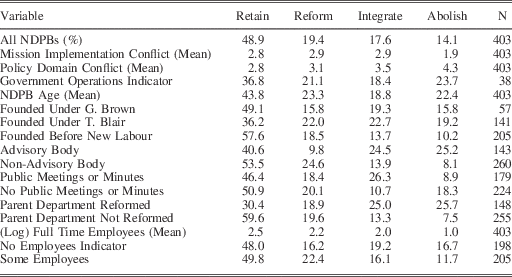
Table 1 shows differences in the mean values of the hypothesized variables by outcome. The first row presents the percentage of agencies in each decision category. Given our decision structure, it is important to note the large differences within pairs at levels of independence, comparing retain or reform to integrate or abolish. For example, among advisory bodies, considerably more are retained than reformed, although roughly equal proportions are integrated or abolished. There are similar trends in some of the other variables. Following the prevailing literature in defining these actions appears problematic in this setting, even when simply examining descriptive statistics.
Selected Descriptive Statistics Used in the Model

Note: Continuous variables are listed by the mean within each of the four outcomes. For categorical variables, the percent of each category with the specific outcomes is listed, as well as the number of bodies.
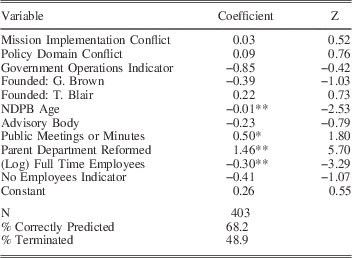
Table 2 shows the consequences of considering termination as a binary choice using the broadest possible definition of termination: the agency experienced a change in its form, portfolio or status as an independent agency. This model is comparable to the independence (level-1) component of the sequential logistic model presented in Table 3. Logistic regression model results displayed in Table 2 reveal relatively weak effects and little predictive power because the ‘termination’ alternative contains several very different types of outcomes for which we have already offered opposing theoretical predictions.
Logit Regression Model Using a Binary Definition of Termination

Note: Termination takes a value of 0 if the agency is retained without changes and 1 if it is altered in any way. Significance **0.05; *0.01.
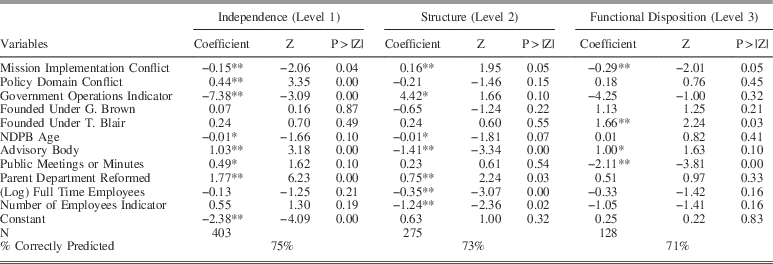
The Sequential Logit Model of Agency Disposition

Note: This model estimates the three levels of choice in the mass reorganization decision depicted in Figure 1. Significance: **0.05; *0.10.
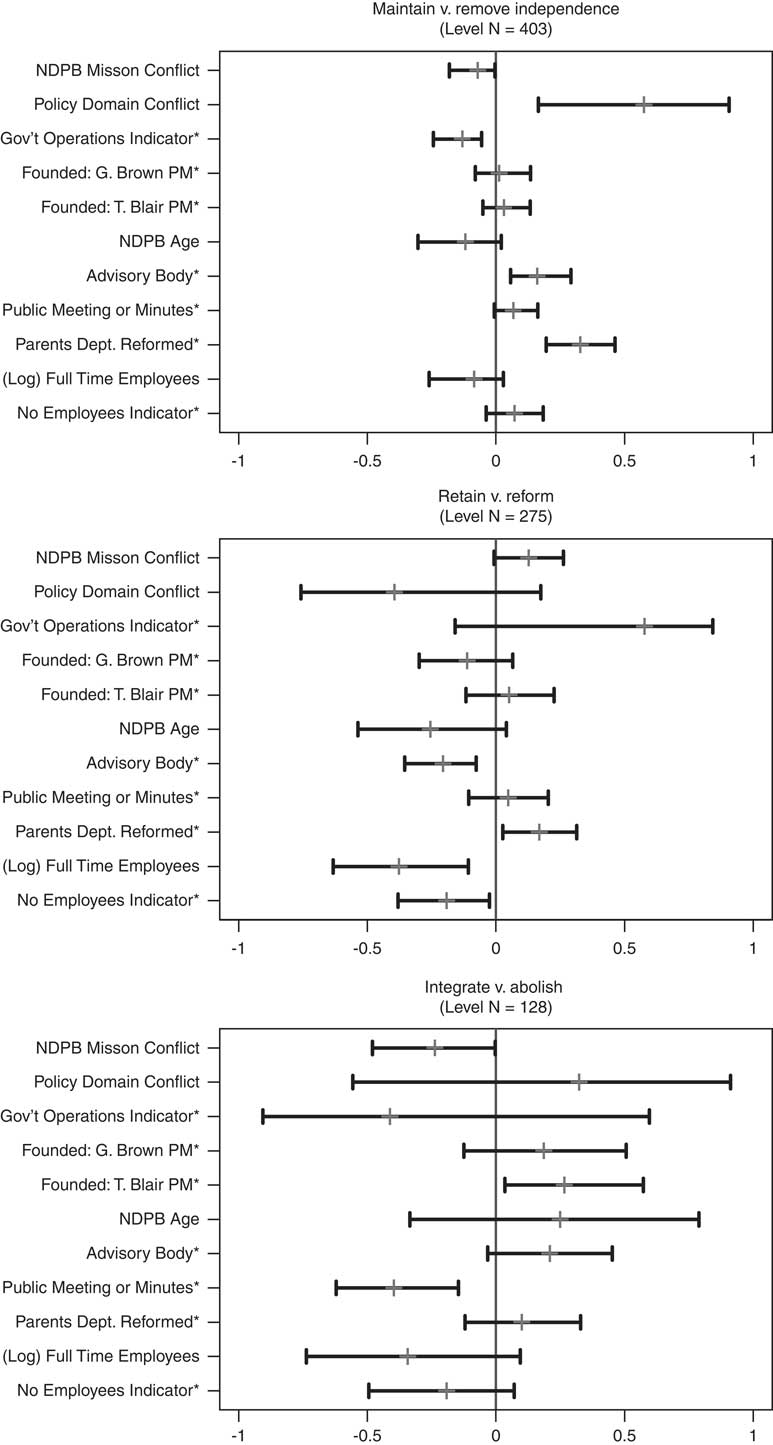
Table 3 presents the results from our preferred specification of the sequential logistic regression model, while Figure 2 displays first differences for each variable computed relative to a hypothetical agency that has the median characteristics for all other variables. For illustration, our model correctly predicts the outcome (functional abolition) for the Government Hospitality Advisory Committee for the Purchase of Wine; our model suggests that this organization faced a 77 per cent chance of losing its independence and a 75 per cent chance of being abolished rather than integrated. This example highlights the importance of the sequential model; if the agency retained independence, it faced only a 12 per cent chance of structural reform. Most organizations with similar characteristics did not survive, and those that the government did decide to keep independent may have performed relatively well or were tasked with an important function. Thus the government was very unlikely to make structural alterations (level 2) or to reach the decision about functional disposition after termination (level 3). An agency with the properties of the UK Film Council, discussed in detail in the Appendix, had a 55 per cent chance of losing its independence (this did, in fact, occur). Had the agency survived, it was also more likely to have been structurally reformed (level 2), again with a 55 per cent chance. Nevertheless, abolition over integration (the actual outcome) was quite unlikely; the agency only had a 13 per cent chance of abolition (level 3).
First differences for the sequential logit model Note: First differences are computed with other variables set to their medians; horizontal lines represent 95 per cent confidence intervals. Table 3 and accompanying text also highlight effects at the 90 per cent level of statistical significance.

For our mission implementation conflict measures, a claim of blame shifting suggests a positive effect on alteration, while credit claiming suggests a negative influence. Our results comport with this hypothesis (1b). For an agency with other characteristics held at median levels for the sample, mission implementation conflict at the 25th percentile increases the probability that the government will take responsibility (level 1) by 2 percentage points, decreases the probability of structural reform (level 2) by 5 percentage points, and increases the probability of abolition as a means of functional disposition (level 3) by 9 percentage points. Shifting to the 75th percentile in mission implementation conflict has correspondingly opposite, but larger, effects. In the US separation-of-powers context, Lewis observes that termination is more likely when congressional and presidential ideologies are similar.Footnote 69 In our setting, ideological conflict between the new government and the mission of an independent agency leads to less responsibility, more reform and more integration.
Turning to our policy domain conflict measure, we find evidence of most, but not all, hypothesized effects. The responsibility decision comports with our hypothesis, but the functional disposition prediction of termination (level 3) materializes only when policy domain conflict is measured via the partisan creation indicator. Regarding the independence choice (level 1), increasing policy domain conflict from the median to the 75th percentile corresponds to an increase of 4 percentage points in the probability that the government will take responsibility for the agency’s functions. While our finding that Blair-era agencies are more likely to have their functions abolished than integrated into a Cabinet department is consistent with the termination findings in the United States, our view of reorganization as a multilevel choice problem produces new insights when compared with Lewis’s finding that an agency created under a president of the opposite party has a lower chance of survival than one created under a co-partisan.Footnote 70
An indicator of public meetings or minutes addresses our transparency hypothesis, and the result supports our prediction of responsibility and integration. The effects are quite large for functional disposition (level 3); a more transparent but otherwise median-valued NDPB is 39 percentage points less likely to be abolished than integrated. There is considerable theoretical and empirical interest in transparency,Footnote 71 which is often seen as part and parcel of accountability.Footnote 72 While transparency reduces agency costs in such arguments, our results suggest an important nuance in the story: as those costs are reduced, so is the need for (and advantage from) blame shifting and credible commitment. Relatedly, our argument and supporting results suggest that patronage reduces agency costs, and allows governments to focus on reducing Westminster’s high commitment costs through arm’s-length policy making. We also observe that advisory bodies are associated with responsibility, retention or termination, which is consistent with patronage (rather than informational) incentives. Understanding the effects of these different mechanisms for reducing agency costs is an interesting theme for future theoretical and empirical studies.
We also find results for the advisory bodies that are consistent with the existing literature on this particular mass termination.Footnote 73 What is novel is the power of the patronage structural incentive to either retain an agency without change or to abolish its functions.Footnote 74 For otherwise equivalent bodies, an advisory body is 33 per cent less likely to be reformed (rather than retained) and 23 per cent more likely to be abolished (rather than integrated into a politically controlled organization). These results suggest that the concept of advisory bodies as informative advisors developed in the US contextFootnote 75 does not increase our understanding here.
Some control variables meaningfully influence the government’s reorganization decision. Agencies in the area of government operations are less likely to lose their independence; additionally, these organizations are much more likely to be structurally reformed (level 2). Furthermore, NDPBs in a reformed parent department were much more likely to be abolished or reformed in some way. We also find some weak age effects consistent with expectations of durability in the literature and the reorganization we study;Footnote 76 nevertheless, these are not significant in the choice between integration and abolition. Agency size comports with a ‘too big to fail, too small to care’ effect, though it is only significant in the structural (level-2) choice.
Our results are robust to a variety of specifications; the Appendix provides detail about the alternative specifications we have considered. We estimated a model limited to our theoretical variables and another measuring mission implementation conflict using a combination of the 2005 and 2010 Labour platforms with substantively robust results. To assess the potential impact of a more delayed learning component as postulated by Carpenter and Lewis,Footnote 77 we included indicators for the creation of an agency under New Labour versus the Conservative governments of Margaret Thatcher and John Major with a robust finding of the Blair-era effect mentioned above, but no evidence of delayed learning.
CONCLUSION
Mass reorganizations transform government accountability in ways that existing literatures in political science and public administration have ignored. We offer a theory of mass administrative reorganizations that focuses on the fundamental problem of accountability for policy making. Our findings reveal that agency termination is not a binary choice, but a complex structural one with critical consequences for political accountability. By viewing mass reorganization as a sequence of choices, we argue with evidence that choices about independence, agency structure and functional disposition have different impacts on the political costs of administrative policy making. Importantly, our study suggests that focusing on the organizational question of termination, the overwhelming approach of the extant literature, yields ambiguous political implications.
Our results uncover a politics of mass reorganizations that balances several well-researched phenomena – policy conflict, patronage and transparency – in establishing a regime of administrative accountability to government. Each of these rationales has different implications, and our study advances the literature on structural politics.
Our research design reveals the importance of the fit between statistical modeling strategies and the context of reorganizations. Our sequential approach treats the accountability consequences as political outcomes in an appropriate way, while highlighting key issues. This modeling strategy and the behavior it exposes reinforce our claim that politics has different influences during mass reorganizations; researchers cannot expect that governments will target the same agencies in such periods as they would individually over time.
Future research opportunities might be stimulated by our observation that under regimes of larger mission implementation conflict, independence appears to be associated with agency costs that are lower than commitment costs, while policy domain conflict produces agency costs that outweigh commitment costs. Perhaps this is due to differences in incentives between Westminster and separation-of-powers systems and how those incentives shape agency independence and political control. It might also be the case that measuring policy conflict within domains, rather than reducing it to a left-right dimension, is important for understanding responsibility in administrative states. While efforts in the American context have focused on unidimensional ideology,Footnote 78 multidimensional measures may lead to better understandings of structural politics.
While our analysis focuses on decision making during a relatively rare event, our findings add to an overall portrait of agency politics – even when mass terminations are not at issue. Mass terminations do not just happen; parties choose to include them as part of their election platforms and post-election policy agendas. Governments in high-accountability systems that choose not to reframe the government’s accountability portfolio must not find a need for the rearrangements we observe here. Governments in systems with more veto players, like the United States, would struggle to make these kinds of trade-offs in the face of high bargaining costs. Given the interest of the American literature in the rare events of specific agency terminations, our results suggest that scholars should seek to understand how governments use alternative means to accomplish similar accountability ends across political systems. More generally, our theoretical approach is only a beginning, and we hope that it will stimulate rigorous efforts to better understand the structural politics of governments’ accountability portfolios.