Introduction
Parasitoid wasps can act as biocontrol agents in agroecosystems to suppress the populations of insect pests together with many other control methods, such as insecticides application. It is well-known that insecticides can cause direct lethal effects or some other sublethal effects on the life history traits of parasitoid wasps, such as development, longevity, mating, and oviposition behavior, as well as offspring sex ratio (Desneux et al., Reference Desneux, Decourtye and Delpuech2007). Insect parasitoids can easily encounter insecticides through direct exposure to spray droplets or spray residues on crop foliage (Jepson, Reference Jepson1989; Desneux et al., Reference Desneux, Wajnberg, Fauvergue, Privet and Kaiser2004), resulting in impaired pest control performance of parasitoid wasps.
Insect parasitoids have long been considered as an excellent model system to develop and or verify theoretical models in behavioral ecology (Godfray, Reference Godfray1994; Wajnberg, Reference Wajnberg2006). Once emergence, female adult parasitoids activate searching for hosts. However, most of their host insects are not uniformly distributed over the habitat, but tend to occur in discrete patches with different densities in the environment. The parasitoid females, therefore, must divide their foraging time between these distinguishing patches to maximize the number of offspring that they can produce during their adult life (Godfray, Reference Godfray1994). Thus, it is speculated that strategies allocating patch residence time made by foraging parasitoid females are of great importance to obtain high fitness consequences. However, little data are available on the sublethal effects of insecticides on patch-leaving strategy in parasitoids. A clear understanding of the potential effects of insecticides on patch-leaving decisions in parasitoids is essential for their effective utilization in pest control strategies.
Up to now, several theoretical models have been proposed to predict the optimal strategy that foraging female wasps should adopt to allocate their patch residence time. The marginal value theorem (MVT) argues that the parasitic wasps should give up a patch when the instantaneous rate of fitness income within the current patch drops below the average rate that can be achieved in the environment (Charnov, Reference Charnov1976; Wajnberg, Reference Wajnberg2006). Based on it, this model and its subsequent modifications also predict that females should spend more time on patches of higher quality (McNair, Reference McNair1982). Therefore, many parasitoid females have been predicted to develop proximate, rule-based behavioral strategies which are consistent with the goal-based optimal patch time allocation (van Alphen et al., Reference van Alphen, Bernstein and Driessen2003; Wajnberg, Reference Wajnberg2006; Sheng et al., Reference Sheng, Feng, Meng and Li2014). Several factors impact patch quality and thus affect the patch-leaving decisions of parasitoid females. Among these, host density is a key indicator reflecting patch quality, and many female wasps would generally spend more time staying in patches of high host density (Wajnberg, Reference Wajnberg2006; Morgan et al., Reference Morgan, Thebault, Seymour and van Veen2017; Louâpre et al., Reference Louâpre, Le Lann and Hance2019).
Besides host density, the feature behavior of foraging female wasps also influences their decision making regarding patch residence time. A female parasitoid usually enters a host patch with an initial responsiveness (or tendency) level, and its tendency to leave increases with time and oviposition until a threshold is reached (Waage, Reference Waage1979; Sheng et al., Reference Sheng, Feng, Meng and Li2014). Each oviposition event increases the current level of responsiveness, thus prolonging the total patch residence time. This proximate mechanism, called the ‘incremental effect’, has been observed in many insect parasitoids (Waage, Reference Waage1979; Wajnberg, Reference Wajnberg2006). By contrast, a decremental effect has been reported in some parasitic wasps of the families Trichogrammatidae or Aphidiidae. In this scenario, each oviposition decreases the responsiveness level, leading to reduced patch residence time (Iwasa et al., Reference Iwasa, Higashi and Yamamura1981; Wajnberg et al., Reference Wajnberg, Gonsard, Tabone, Curty, Lezcano and Colazza2003; Wajnberg, Reference Wajnberg2006). During a complete foraging process, parasitoid females usually visit more than one host patch, and they can glean information from patch to patch and learn the distribution of host resources among the patches. Then, they can estimate the overall quality of these patches and adjust their foraging strategies accordingly (Louâpre et al., Reference Louâpre, van Baaren, Pierre and van Alphen2011). Interestingly, many parasitoid females decrease their current patch residence time after visiting the same quality patches (Wajnberg, Reference Wajnberg2006). Therefore, previous patch-visiting experiences significantly influence the current patch residence time.
Meteorus pulchricornis (Hymenoptera: Braconidae) is a solitary endoparasitoid of various lepidopteran pests, such as the tobacco cutworm Spodoptera litura and the cotton bollworm Helicoverpa armigera (Sheng et al., Reference Sheng, Feng, Meng and Li2014, Reference Sheng, Liao, Zheng, Zhou, Xu, Song, He, Zhang and Wu2017; Mateo, Reference Mateo2018; Zhang et al., Reference Zhang, Zhang, Shao, Xing, Wang, Liu, Li, Oforia, Tu, Wang, Sheng and Wu2019). Spodoptera litura is one of the most destructive pests of soybean, cotton, and vegetable crops in eastern China (Hong and Ding, Reference Hong and Ding2007) and has recently heavily damaged mulberry trees in China (Sheng et al., Reference Sheng, Wang, Zhang, Liu, Yan, Shao, Zhou, Wu and Wang2021). In the soybean field, it can be attacked by M. pulchricornis at a rate of 20–30% when the application of pesticides is limited (Zhang et al., Reference Zhang, Meng and Li2012). In our previous studies, we investigated the patch foraging behavior of M. pulchricornis females, and demonstrated that numerous factors, including host density, host distribution, and the presence of predators within the patch, impact the patch-leaving strategy of M. pulchricornis (Sheng et al., Reference Sheng, Feng, Meng and Li2014, Reference Sheng, Meng, Wu and Li2015). However, the effect of exposure to commonly used insecticide on its patch departure rule remains unknown.
O, O-diethyl O-(alpha-cyanobenzylideneamino) phosphorothioate (phoxim) is an effective organic phosphorus insecticide, and is widely used in the control of lepidopteran pests in agriculture and forestry (Wang et al., Reference Wang, Gu, Wang, Sun, Wang, Jin, Shen and Li2013). Phoxim mainly targets acetylcholinesterase and inhibits its activity, leading to the accumulation of acetylcholine in the postsynaptic membrane and the eventual death of pests (Shang et al., Reference Shang, Shao, Lang, Hua and Zhang2010; Li et al., Reference Li, Hu, Tian, Xu, Ni, Wang, Shen and Li2016). In this study, we evaluated the effect of direct exposure to phoxim, which is a commonly used insecticide in mulberry fields, on the patch residence time allocation by M. pulchricornis females. The following hypotheses were tested: (1) phoxim exposure has an impact on the patch residence time of M. pulchricornis females and (2) phoxim also influences offspring fitness. The information obtained from this study improves our understanding of behavioral mechanisms of parasitic wasps under insecticide stress and promotes the use of parasitoids as biological control agents for pest control.
Materials and methods
Insect culture
A thelytokous colony of M. pulchricornis was obtained from rearing S. litura larvae collected in mulberry fields at the campus of Jiangsu University of Science and Technology in the city of Zhenjiang, Jiangsu Province, China, and maintained using S. litura as hosts in the insectary [26 ± 2°C, 60–80% relative humidity, and photoperiod of 14:10 (L: D) h]. A 10% honey solution was supplied via cotton lines to adult parasitoids once a day (Sheng et al., Reference Sheng, Meng, Wu and Li2015). Due to the higher parasitism efficiency made by 6- to 8-day-old M. pulchricornis adults and elimination of the effect of experience on foraging behavior, virgin female wasps at this stage were used in this study. The larvae of S. litura were collected from mulberry fields and reared in the insectary on an artificial diet (Shen and Wu, Reference Shen and Wu1995). Adult moths were fed with a 10% saccharose solution and provided with paper strips as a substrate for egg deposition in organza-covered cages (20 × 20 × 30 cm) (Sheng et al., Reference Sheng, Meng, Wu and Li2015).
Experimental setup and sample preparation
Phoxim (99.0%) was purchased from Sigma-Aldrich (USA). According to our previous bioassays, the 30% lethal concentration (LC30) of phoxim treatment for M. pulchricornis was 3.48 mg l−1 (Sheng et al., Reference Sheng, Wang, Zhang, Liu, Yan, Shao, Zhou, Wu and Wang2021). Therefore, 3.48 mg l−1 phoxim was used as insecticide treatment here. Briefly, phoxim was dissolved in acetone (analytical grade) to prepare the working solution and 1 ul of LC30 of phoxim was topically applied onto the mesonotum of wasps by using a microsyringe (Zhenhai Instrument Co., Ltd, China) after they were mildly anesthetized on ice for 20–30 s. Subsequently, the still living wasps were used for analysis. Female wasps treated with 1 ul acetone (analytical grade) were taken as control.
Phoxim exposure and host density were crossed according to a 2 × 3 factorial design. Female wasps prefer to parasitize the 3rd instar S. litura larvae (Yang et al., Reference Yang, Meng and Li2011); therefore, host larvae in this stage were used to test the effect of phoxim on parasitism. The factor ‘phoxim treatment’ in the behavioral test was set up with and without exposure to phoxim in parasitoids, respectively. Phoxim exposure was set up with and without exposure to insecticide, and 10, 20, and 30 3rd instar S. litura larvae per patch were taken as three levels of host density. Behavior observation was conducted in a transparent plastic box (d = 10 cm, h = 9.5 cm). One piece of mulberry leaf (d = 9 cm) was placed at the bottom of the box with an agar layer. The observation arena is restricted in the box, especially on the circular mulberry leaf which carries the host larvae. Most of the feature behavior of female wasp occurred on the leaf. Therefore, the leaf was taken as the patch. We moved 20 host larvae onto the leaf patch 0.5 h prior to the experiment. Behavior observations were started after female wasps were released into the box. The patch residence time was defined as the total time from entering the patch to leaving it. When the tested female wasps occasionally returned to the patch within 10 min after leaving it, the short excursions off the patch were still included within the same patch visit. When the wasp landed on the wall or lid of the box and did not return to the patch within 2 h, this replication was terminated. For each treatment, 20 females were tested. The trials were conducted at room temperature (24–26°C). Since the M. pulchricornis females show a distinct circadian rhythm in adult activity (Nishimura et al., Reference Nishimura, Fujii, Sakamoto and Maeto2015) and our preliminary test indicates that they keep active when encountering their hosts during the daytime, the experiments were conducted at daytime (generally from 8:00 to 12:00 AM and 2:00 to 5:00 PM).
Covariates
Many variables can have consequences on the parasitoid's patch-leaving tendency. The biology of M. pulchricornis and some factors assumed to be important in patch-leaving models were taken into account (Sheng et al., Reference Sheng, Feng, Meng and Li2014). The description of the covariates selected and the way they were recorded are provided in table 1.
Covariates tested for their effects on patch-leaving tendency

Fitness of the offspring wasps
To test whether insecticide exposure and host density have impacts on the fitness of offspring of foraging females, all offspring were collected from each treatment and their main fitness correlates were compared, including development duration (duration from eggs to cocoons and duration from cocoons to adult emergence), longevity, and adult body size (in terms of hind tibia length).
Data analysis
The Cox proportional hazard model (Cox model) was used to test the effects of fixed (phoxim treatment and host density) and time-dependent numerous covariates on the patch-leaving tendency. This model estimates the hazard rate at time t, which can be interpreted biologically as a tendency to leave the patch. The hazard rate h(t) at time t in the patch is given by:

where h0(t) is the baseline hazard function to leave the patch depending only on the time spent on it when all covariates zi are set to zero, and βi is the regression coefficient that gives the relative contributions of the n covariates zi(t). If the expression exp{∑βiz i} is lower than one, the patch-leaving tendency is reduced, resulting in an increase of the residence time, whereas a hazard ratio greater than one increases this tendency, resulting in a decrease of the residence time (Cox, Reference Cox1972; Sheng et al., Reference Sheng, Feng, Meng and Li2014). To estimate the influences of testing covariates on the patch-leaving tendency, the likelihood ratio test was used to assess the effects of individual variables and their possible two-way interactions (Collett, Reference Collett1994). The adequacy of the final fitted model was assessed by residual plots (Wajnberg et al., Reference Wajnberg, Rosi and Colazza1999; Outreman et al., Reference Outreman, Le Ralec, Wajnberg and Pierre2005). Generalized linear models were used, with Poisson errors and log link function, to analyze the number of oviposition, the durations from eggs to cocoons, and the durations from cocoons to emergence. The Kruskal–Wallis (K-W) test was applied to detect significant differences in hind tibia length of offspring wasps affected by insecticide treatment and host density. Longevity data were also analyzed by the Cox model. All data analyses were performed in the R statistical software (R Development Core Team, 2014).
Results
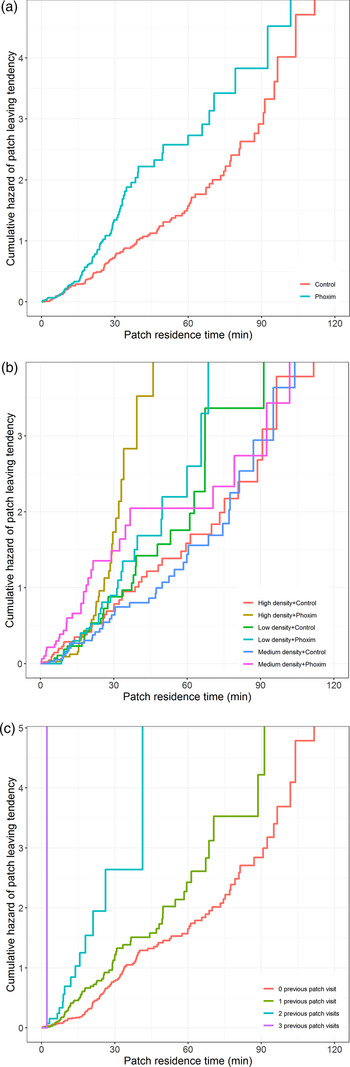
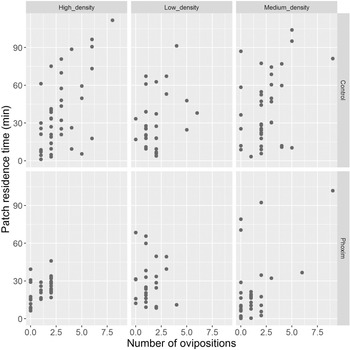
During the complete patch foraging behavior observations, 52 female wasps performed only one patch-exploring process, while 68 wasps exhibited more than one patch-foraging practice (fig. 1). Therefore, re-visiting to the patch is a notable behavioral characteristic and previous patch visits by female wasps were taken into account of patch-leaving tendency as a covariate (table 1). Among the five covariates tested for their influence on the patch-leaving tendency, phoxim treatment, sting, and previous patch visits had a significant effect. The other two covariates examined, host density and host rejection, had no significant impacts on the patch-leaving tendency according to the likelihood ratio test and were thus not considered in the final Cox model. Phoxim-treated M. pulchricornis females significantly shortened their patch residence time compared to control cohorts (likelihood ratio test, χ2 = 4.53, d.f. = 1, P = 0.033, fig. 2a, table 2). Interestingly, host density, which was a general parameter reflecting patch host density, had no effect on the patch-leaving tendency of M. pulchricornis females (likelihood ratio test, χ2 = 1.19, d.f. = 2, P = 0.28, fig. 2b, table 2). The number of previous patch visits also promoted female wasps to increase their patch-leaving tendency (likelihood ratio test, χ2 = 15.15, d.f. = 3, P < 0.001, fig. 2c, table 2). The host sting behavior, indicating an oviposition event, also influenced the patch residence time. As the female wasps stung more host larvae, they stayed longer within the current patch (likelihood ratio test, χ2 = 23.83, d.f. = 1, P < 0.001, fig. 3, table 2). Host rejections also did not influence the female wasps' patch-leaving decisions (likelihood ratio test, χ2 = 1.82, d.f. = 1, P = 0.18, table 2). None of the interactions between the above covariates affected patch-leaving tendency.
Frequency of the number of previous patch visits in foraging M. pulchricornis females.

Cumulative leaving tendency (hazard functions) of M. pulchricornis in response to phoxim treatment (a), host density and phoxim treatment (b), and the number of previous patch visits (c). For each treatment, 20 female wasps were tested.

Effects of the number of oviposition, phoxim treatment, and host density on patch residence time in M. pulchricornis. For each treatment, 20 female wasps were tested.

Estimated regression coefficient (β) of a Cox proportional hazard model for effects of tested covariates on the patch-leaving tendency of Meteorus pulchricornis foraging

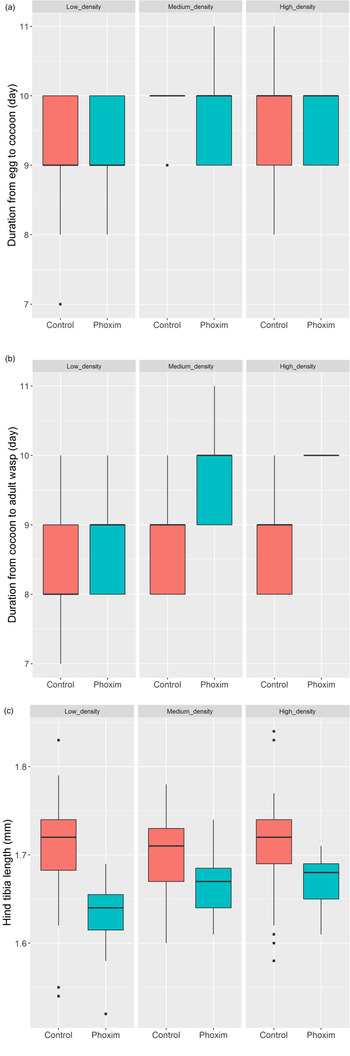
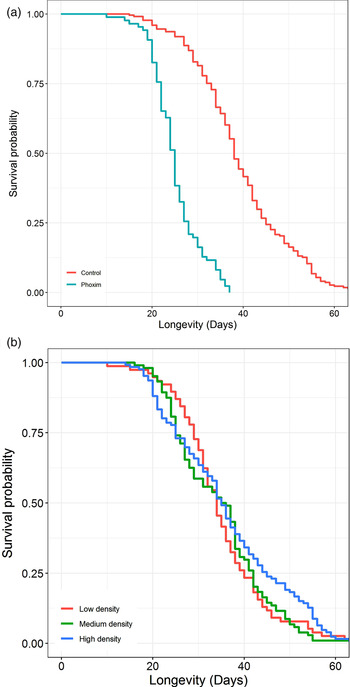
Beyond the patch-leaving decisions, phoxim treatment had great impacts on oviposition behavior and offspring fitness. The number of sting behaviors was lower in phoxim-treated groups than in the control (χ2 = 40.50, d.f. = 1, P < 0.001, fig. 4), while host density did not significantly affect the occurrence of this behavior (χ2 = 2.01, d.f. = 1, P = 0.15, fig. 4). A marginal statistically significant difference of interaction between the two covariates was observed (χ2 = 3.49, d.f. = 1, P = 0.062), suggesting a slight trend that the two covariates may have impacts on the oviposition behavior of parasitic wasps but depending on each other. Neither insecticide exposure (χ2 = 0.025, d.f. = 1, P = 0.87) nor host density (χ2 = 1.79, d.f. = 2, P = 0.41) influenced on the duration from eggs to cocoons in offspring (fig. 5a); there was no interaction between these two covariates. Insecticide exposure significantly affected the duration from cocoon to adult emergence (χ2 = 1.79, d.f. = 1, P = 0.41, fig. 5b), while host density did not show such effect (χ2 = 1.89, d.f. = 2, P = 0.39, fig. 5b). These factors also did not interact with each other to have impacts on these durations (χ2 = 1.19, d.f. = 2, P = 0.559). Offspring body size, in terms of hind tibia length, did not differ significantly among various host density patches (K-W test, χ2 = 4.53, d.f. = 2, P = 0.10, fig. 5c), but varied among maternal wasps treated with phoxim (K-W test, χ2 = 76.89, d.f. = 1, P < 0.001, fig. 5c). Survival analysis revealed that both phoxim treatment and host density affected offspring longevity (likelihood ratio test, phoxim treatment: χ2 = 153.07, d.f. = 1, P < 0.001; host density: χ2 = 7.82, d.f. = 2, P < 0.05, fig. 6), and they independently affected offspring longevity without interaction (χ2 = 4.50, d.f. = 2, P = 0.11).
Effects of phoxim exposure and host density on the total number of oviposition in M. pulchricornis. For each treatment, 20 female wasps were tested. For each box, the upper border represents the upper quartile and the lower border represents the lower quartile of the data. The horizontal line within the box represents the median of the data (the median and upper quartile were overlapped in the first box and the median and lower quartile were overlapped in the second and the third box). The two ends of the vertical line represent the minimum and maximum values of the data, respectively. Outliers are plotted as points.

Effects of phoxim exposure and host density on durations from eggs to cocoons (a), from cocoons to adult wasps (b) and hind tibia length (c) in M. pulchricornis offspring. For each treatment, 20 female wasps were tested. For each box, the upper border represents the upper quartile and the lower border represents the lower quartile of the data. The horizontal line within the box represents the median of the data (in fig. 5a, the median and lower quartile were overlapped in the first and the second box and the median and upper quartile were overlapped in the fourth, fifth, and sixth box; in fig. 5b, the median and lower quartile were overlapped in the first box and the median and upper quartile were overlapped in the second, third, fourth, and fifth box). The two ends of the vertical line represent the minimum and maximum values of the data, respectively. The single horizontal line represents all the values of the data were equal. Outliers are plotted as points.

Effects of phoxim exposure (a) and host density (b) on longevity in M. pulchricornis offspring. (a) Eighty-six offspring wasps were collected from the phoxim treatment group and 221 offspring wasps were collected from the control group. (b) Seventy-seven offspring wasps were collected from the low-density treatment, 104 offspring wasps were collected from the medium-density treatment, and 126 offspring wasps were collected from the high-density treatment.

Discussion
The impacts of insecticides on parasitoid wasps have been widely investigated. However, studies regarding their effects on foraging behavior strategy, such as patch-leaving decisions and oviposition behavior, are scarce. It is necessary to evaluate the side effects of insecticides on several biological parameters and the behavior of parasitic wasps prior to the use of them as biological control agents for pest control in IPM strategies that include both components (insecticides and parasitoids).
In this study, we demonstrated a negative effect on the patch residence time of foraging M. pulchricornis females after they were treated with phoxim, a commonly used insecticide in agroecosystems. Compared to untreated wasps, phoxim-treated M. pulchricornis females significantly shortened their patch residence time. Conversely, Desneux et al. (Reference Desneux, Wajnberg, Fauvergue, Privet and Kaiser2004) reported that two hymenopterous parasitoids of aphids, Aphidius matricariae (Haliday) and Diaeretiella rapae (McIntosh), spent a comparable amount of time after they were exposed to different sublethal doses of deltamethrin. The difference between our results and those reported by Desneux et al. (Reference Desneux, Wajnberg, Fauvergue, Privet and Kaiser2004) could rely on differences in the exposure method, as these authors applied the insecticide in the inner surface of the glass tube, whereas we treated the parasitoids directly instead. The authors argued that deltamethrin molecules did not alter the functions necessary for host-handling behavior, or the surviving insects were less susceptible, or the levels of toxic molecules in surviving parasitoids were too low to induce nervous disorders. Previous studies investigating patch-leaving decisions revealed that age, egg load, mating, and other status-related factors impact the female's patch-leaving tendency (Michaud and Mackauer, Reference Michaud and Mackauer1995; Thiel and Hoffmeister, Reference Thiel and Hoffmeister2004; Goubault et al., Reference Goubault, Outreman, Poinsot and Cortesero2005; Wajnberg, Reference Wajnberg2006). Despite this, female wasps undergoing patch foraging after insecticide exposure have received a meager attention. It is well known that insecticides have a side effect (either physiological or behavioral) beyond the lethal effect on parasitoids; however, the effect of direct insecticide exposure on patch time allocation needs to be examined in a broad range of parasitoid species. More importantly, based on the present indoor results, it is quite necessary to pay attention to the side effect of phoxim on behavioral traits of M. pulchricornis, especially for the patch-leaving decision, when it is released to the mulberry fields to control S. litura. In other words, it should be avoided to use parasitoid wasps together with the insecticides.
An important finding of the present study was that phoxim exposure can reduce or even deactivate the effect of patch quality, which was in terms of host density on the patch-leaving decisions of adult M. pulchricornis. It is well accepted that host density can remarkably affect the foraging parasitoids' patch-leaving decisions; in general, patch quality increases with host density, and female wasps would spend more time in it (Wajnberg, Reference Wajnberg2006). This rule has been demonstrated in many foraging parasitoids, and our previous study also found that M. pulchricornis spent more time in patches with a high density of S. litura larvae (Sheng et al., Reference Sheng, Feng, Meng and Li2014). Yang et al. (Reference Yang, Meng and Li2011) also found that M. pulchricornis females can distinguish the differences of host density (0, 5, 10 and 30 host larvae per patch, respectively) among the patches that consisted of 3rd instar Spodoptera exugia larvae and spent more time on high host density patches. In the present study, however, when foraging M. pulchricornis females were treated with a sublethal dose of phoxim, host density did not have an effect on the patch-leaving tendency after fitting the Cox model, suggesting the wasps did not use host density as a reliable cue for making patch-leaving decisions. Phoxim, which belongs to the organophosphorus insecticides, targets the nervous system in insects (Wang et al., Reference Wang, Gu, Wang, Sun, Wang, Jin, Shen and Li2013). Almost all behavioral decisions of parasitoids are eventually made and/or modulated by their nervous system, including the patch-leaving decision. Therefore, phoxim exposure easily disrupts the behavioral regularity, leading to abnormal behavioral responses. Furthermore, a sublethal dose of insecticide treatment also impairs large-scale aspects of female wasp physiology, resulting in an unhealthy status for parasitoids. The most important assumption of classical patch foraging theories or hypotheses, such as MVT and its subsequent improvements or modifications, is that female wasps have the ability to evaluate the average quality of patches in the foraging habitat. To achieve this, wasps are predicted to glean the information during foraging and to learn the features of their habitat. Given that the nervous system was impaired, they can easily fail to effectively or accurately handle information related to the patches. Nevertheless, the present study only tested patch quality in terms of host density, and more indicators of patch quality, such as host instar or proportion of healthy hosts (van Alphen et al., Reference van Alphen, Bernstein and Driessen2003; Wajnberg, Reference Wajnberg2006), need to be validated in future researches.
As a classic measurement of patch-leaving tendency in parasitoids, the oviposition event greatly impacts the patch time allocation strategy of female M. pulchricornis. Each oviposition prolongs the patch residence time, which was in line with the ‘incremental mechanism’ proposed by Waage (Reference Waage1979). Indeed, a positive relationship between host density and host encounter rate can be expected, and a density-dependent effect results in a significant decrease in the tendency to leave the present patch (Driessen and Bernstein, Reference Driessen and Bernstein1999). A well-accepted explanation is that high host density can give strong cues, such as host trace chemicals or host kairomones, for the foraging females (Waage, Reference Waage1979; van Alphen et al., Reference van Alphen, Bernstein and Driessen2003; Wajnberg, Reference Wajnberg2006). However, our Cox model fitting revealed that host density no longer impacted the patch-leaving decision of M. pulchricornis, and we speculate that phoxim exposure may disrupt the ability of information gleaned, especially of chemical perception. Alternatively, for M. pulchricornis females, each new oviposition may provide an impressing hint which informed the wasps that other hosts remain to be discovered within the current patch, and in response, they must increase their foraging time correspondingly. This result was consistent with our previous behavior test on healthy M. pulchricornis females foraging in a complex hierarchical structure environment, in which they also experienced incremental mechanisms (Sheng et al., Reference Sheng, Feng, Meng and Li2014). Therefore, we argue that oviposition, which was an undergoing behavioral variable, still plays an important role in the patch-leaving decision making of parasitic wasps after they were treated with phoxim.
Similarly, another behavior variable, the number of previous patch visits, also had an impact on the patch residence time. With the increase of patch visit number, M. pulchricornis females significantly shorten their next patch residence time. Several previous studies have also demonstrated that successive visits to one or several patches have a negative effect on the patch residence time of female wasps when they forage within the current patch (Wang and Messing, Reference Wang and Messing2003; van Baaren et al., Reference van Baaren, Boivin and Outreman2005; Wajnberg, Reference Wajnberg2006). For example, female Aphidius rhopalosiphi decrease their patch residence time after visiting another or the same patch more than once (Outreman et al., Reference Outreman, Le Ralec, Wajnberg and Pierre2001, Reference Outreman, Le Ralec, Wajnberg and Pierre2005). A possible explanation is that a parasitoid might recognize places it has visited before, based on visual cues, or it may respond to chemical cues that had been deposited by itself (Outreman et al., Reference Outreman, Le Ralec, Wajnberg and Pierre2005). For insurance, marker pheromone can be left by parasitoid wasps after they parasitized hosts and can be recognized once they encountered the host again (Stelinski et al., Reference Stelinski, Boina and Meyer2010). Beyond this view, giving up the later patch earlier can avoid superparasitism to optimize the foraging time among the visited patches, as well as the progeny.
Oviposition strategy is closely related to patch time allocation decisions. Although there is substantial evidence of the impacts of insecticide exposure on the oviposition strategy of parasitoid wasps, it yet receives less attention under the behavioral framework of patch foraging. Similar to patch residence time allocation, the number of oviposition was greatly affected by phoxim exposure. This result was in line with the findings of previous studies which demonstrated that insecticides harm the progeny production of female parasitoids. For example, Desneux et al. (Reference Desneux, Wajnberg, Fauvergue, Privet and Kaiser2004) revealed that females of the aphid parasitoid Aphidius ervi showed a significantly lower oviposition behavior compared with the controls after exposure to the LD20 of lambda-cyhalothrin. Although more hosts were available within the foraging patch, female M. pulchricornis did not oviposit more eggs into the host. For healthy wasps, an increased host number indicates a higher-quality patch, leading to a higher progeny only if they contain sufficient egg loads, and this improved oviposition situation provides the foraging wasps with an impression that there are still more hosts that can be attacked. Of course, this cognition is based on an accurate estimate from the overall information gleaned for the current host patch. Thus, we speculate that phoxim treatment altered their information integration, which was similar to their patch time allocation strategy. Another possible cause for this result may be due to the impaired effect of phoxim exposure on the inner physiology. For instance, neurohormones of the central nervous system have relevant action on the molt and juvenile hormones, which are both related to development and reproduction events in insects (Kruger et al., Reference Kruger, Mena, Lahr, Johnson and Ewer2015). Therefore, we speculated that phoxim may have affected the reproductive system of female M. pulchricornis due to the fact that it targets the nervous system. A comparable number of oviposition among patches with different host densities may be attributed to a certain portion of healthy eggs that can be laid after phoxim treatment. If this argument makes sense, future physiological tests should be conducted to validate the effect of phoxim exposure on the reproductive system of female M. pulchricornis.
To further analyze the effect of phoxim exposure on the fitness of offspring derived from foraging maternal wasps, we collected all the cocoons that successfully emerged from their hosts and tested their development time, body size, and longevity of the offspring. The results indicate that durations from cocoon to adult wasps, body size of offspring, and longevity of offspring were all negatively affected by phoxim treatment. This result confirmed that M. pulchricornis females surviving phoxim exposure, however, produced more offspring with low fitness correlates, suggesting that the sublethal effect of phoxim was transgenerational in M. pulchricornis. Previous studies have demonstrated sublethal effects of insecticide on the next generation of parasitoids, depending on the species of parasitoid and the categories of insecticide (Desneux et al., Reference Desneux, Decourtye and Delpuech2007). Despite this, knowledge of the effects of insecticides on the progeny fitness of parasitoids should be elucidated for their successful utilization. The negative effects of phoxim on the oviposition behavior and on the offspring fitness in M. pulchricornis envisage that the use of phoxim in mulberry fields would pose a great threat to M. pulchricornis females, reducing their parasitism efficiency on S. litura.
Conclusions
In conclusion, the present results showed that as a biological control agent, the parasitoid M. pulchricornis is negatively affected by the commonly used insecticide phoxim. According to the side effects of phoxim on the patch time allocation strategy, oviposition behavior, and offspring fitness in M. pulchricornis, it is reasonable to conclude that phoxim may jeopardize the role of M. pulchricornis in controlling its host pests.
Acknowledgments
We are grateful for the assistance of Dr Jincheng Zhou at Shenyang Agricultural University for the data analysis and Miss Xiaorui Zhang at the Jiangsu University of Science and Technology for insect rearing. We also appreciate Dr Richard A. Herman for improving the writing of the revised manuscript.
Financial support
This study was supported by the Key Research and Development program (Modern Agriculture) of Zhenjiang City (NY2019021), the National Natural Science Foundation of China (31500312), the Postgraduate Research & Practice Innovation Program of Jiangsu Province (SJCX20_1492), and the Special Fund for China Agriculture Research System (CARS-18).
Conflict of interest
None.