INTRODUCTION
Bovine babesiosis is a tick-borne disease (TBD) of cattle that in Mozambique is caused by the protozoan parasites Babesia bigemina and Babesia bovis transmitted by ticks of the genus Ripicephalus, subgenus Boophilus (Uilenberg, Reference Uilenberg2006). It is of great veterinary importance in many areas of the world as it causes severe economic losses due to decreased production, mortality, and the costs of control and therapeutic intervention (Bock et al. Reference Bock, Jackson, de Vos and Jorgensen2004). Although the information on TBDs in Mozambique requires an urgent update, they are still considered the main cause of morbidity and mortality of cattle in trypanosome-free regions of the country. Two epidemiological studies on bovine Babesia spp. in Mozambique have recently been published. In one study, antibodies to B. bovis were detected in 39% of cattle in a serological survey conducted in Tete Province (Alfredo et al. Reference Alfredo, Jonsson, Finch, Neves, Molloy and Jorgensen2005); in the other, a new semi-nested hot-start PCR method was used for the detection of bovine Babesia infections in field samples from cattle on a farm in Maputo Province (Martins et al. Reference Martins, Pedro, Caldeira, do Rosário, Neves and Domingos2008). Although the new semi-nested hot-start PCR showed improved detection over a nested PCR method (Figueroa et al. Reference Figueroa, Chieves, Johnson and Buening1993), both methods indicated infection rates of more than 80% for both B. bigemina and B. bovis in 117 randomly collected samples from apparently healthy cattle (Martins et al. Reference Martins, Pedro, Caldeira, do Rosário, Neves and Domingos2008). These results imply that at least parts of the Maputo Province region of Mozambique, can be considered endemic for bovine babesiosis. Here we report the detection of bovine Babesia spp. parasites by means of the semi-nested hot-start PCR on another 4 farms also located in Maputo Province. In addition, we used the reverse line blot (RLB) assay to determine other haemoparasites in the genera Babesia, Theileria, Anaplasma and Ehrlichia in the cattle on these farms (Gubbels et al. Reference Gubbels, de Vos, van der Weide, Viseras, Schouls, de Vries and Jongejan1999; Schouls et al. Reference Schouls, van de Pol, Rijpkema and Schot1999; Bekker et al. Reference Bekker, de Vos, Taoufik, Sparagano and Jongejan2002).
MATERIALS AND METHODS
Cattle
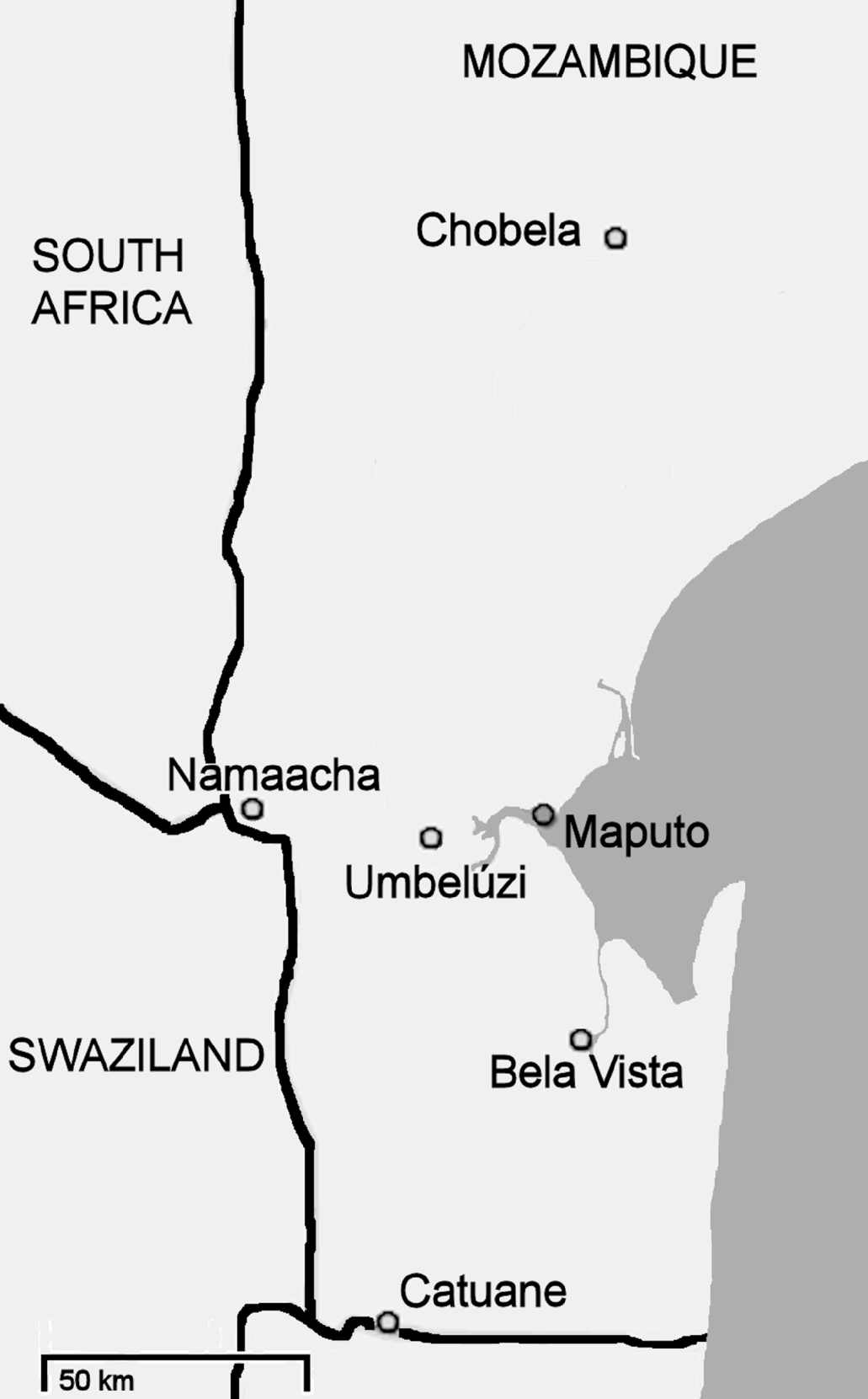
Blood samples were collected randomly during 2007 from apparently healthy cattle at 5 localities in the province of Maputo, Mozambique (Fig. 1): 77 samples in July from cattle near Bela Vista, Matutuine District; 117 samples in September near Umbelúzi, Boane District; 95 samples in October at Catuane, Matutuine District; 93 samples in October at Chobela, Magude District; and 95 samples in November at Namaacha, Namaacha District. The cattle at Umbeluzi were Friesians and those on the other farms were Nguni and Nguni crosses. The results obtained from the cattle at Umbelúzi were partly included in a previous publication (Martins et al. Reference Martins, Pedro, Caldeira, do Rosário, Neves and Domingos2008), but have been reproduced here for completeness sake. Approximately 2–4 ml of blood was collected from the coccygeal vein into ethylenediaminetetraacetic acid (EDTA)-buffered vacutainer tubes. Samples were kept at 4°C during transportation to the laboratory at the Veterinary Faculty, Maputo, and thereafter stored at −20°C.
Map of the locations in Maputo province, Mozambique where samples were collected.

DNA extraction
DNA extraction was performed as described previously (Martins et al. Reference Martins, Pedro, Caldeira, do Rosário, Neves and Domingos2008). Briefly, whole blood was washed with phosphate-buffered saline (PBS), centrifuged, and the resultant pellet of cells was lysed overnight in an appropriate buffer with Proteinase K, at 56°C.
Hot-start PCR and semi-nested hot-start PCR
With minor changes, hot-start PCR was performed separately for each Babesia spp. as described previously (Martins et al. Reference Martins, Pedro, Caldeira, do Rosário, Neves and Domingos2008). Hot-start PCR reaction mixtures (20 μl) contained 0·025 U of DyNAzyme™ II Hot Start DNA polymerase (Finnzymes Oy, Espoo Finland), 1× reaction buffer, 0·5 μm of each of the primers F1 and R1, each pair separately for every Babesia spp. (Martins et al. Reference Martins, Pedro, Caldeira, do Rosário, Neves and Domingos2008), 200 μm of each dNTP, and 2 μl of DNA. Hot-start PCR was carried out for 40 cycles: 30 s of denaturation at 94°C (10 min in the first cycle to activate the hot- start polymerase), 30 s of annealing at 68°C, and 45 s of extension at 72°C. Negative samples in the first hot-start PCR were subjected to semi-nested hot-start PCR, using the same procedures as for the first PCR, but with the inner reverse primers R2 substituting R1, and 1 μl of the products of the first PCR as template. PCR products were examined in ethidium bromide-stained agarose gels.
Reverse line blot assay
The PCR products that were later hybridized with the probes in the RLB membrane were amplified with 2 sets of primers. A fragment of 460–540 bp of the 18S SSU rRNA gene spanning the V4 region was amplified with primers for the identification of Babesia and Theileria species as described by Gubbels et al. (Reference Gubbels, de Vos, van der Weide, Viseras, Schouls, de Vries and Jongejan1999). A PCR product of 492–498 bp fragment of the 16S rRNA gene spanning the V1 region was amplified using primers and used for the identification of Anaplasma and Ehrlichia species as described by Bekker et al. (Reference Bekker, de Vos, Taoufik, Sparagano and Jongejan2002). Primers were obtained from Isogen Life Science (Maarsen, The Netherlands). PCR amplification was performed in a 25 μl reaction volume consisting of 2·5 U Taq DNA polymerase (Invitrogen, USA), 1× PCR buffer, 50 pmol of each primer, 200 μm of each dNTP and 2·5 μl of the template DNA with an automated cycler (I-Cycler, Bio-Rad) for 50 cycles: 10 cycles at 94°C for 20 s, starting with 67°C for 30 s, and 72°C for 30 s, with a 2°C decrease of the annealing temperature every second cycle (touchdown) until the annealing temperature reached 59°C; and 40 cycles at 94°C for 20 s, 57°C for 30 s, and 72°C for 30 s. The RLB assay is based on a reverse hybridization where the specific probes are immobilized to a solid support and the sample is denatured and subsequently allowed to hybridize with the biotin-labelled probes. The RLB membrane with 34 species-specific amino-linked oligonucleotide probes from Isogen Life Science (Maarssen, The Netherlands) was hybridized with the PCR products according to the method described by Nijhof et al. (Reference Nijhof, Penzhorn, Lynen, Mollel, Morkel, Bekker and Jongejan2003). Each membrane was used for a maximum of 10 times.
Cloning of 18S ribosomal RNA genes
The partial Babesia spp. 18S rRNA genes were amplified by PCR. A PCR product with the expected size of approximately 430 bp was obtained with primers specific for Babesia spp. (Hilpertshauser et al. Reference Hilpertshauser, Deplazes, Schnyder, Gern and Mathis2006). A longer PCR product with approximately 790 bp was amplified using primers 5-22F and 793-772R (Birkenheuer et al. Reference Birkenheuer, Levy and Breitschwerdt2003). The PCR products were cloned into the plasmid vector pCR2.1 (Invitrogen), and positive clones were sequenced at STAB Vida (Oeiras, Portugal). Eleven unique sequences obtained in this study were submitted to GenBank under Accession nos. FJ869895 to FJ869905. Multiple nucleic sequence alignment between 18S rRNA genes was performed using ClustalW (Thompson et al. Reference Thompson, Higgins and Gibson1994), followed by manual editing in Bioedit (Hall, Reference Hall1999) and phylogenetic relationships constructed and visualized by the MEGA4 program (Tamura et al. Reference Tamura, Dudley, Nei and Kumar2007).
RESULTS
Semi-nested hot-start PCR
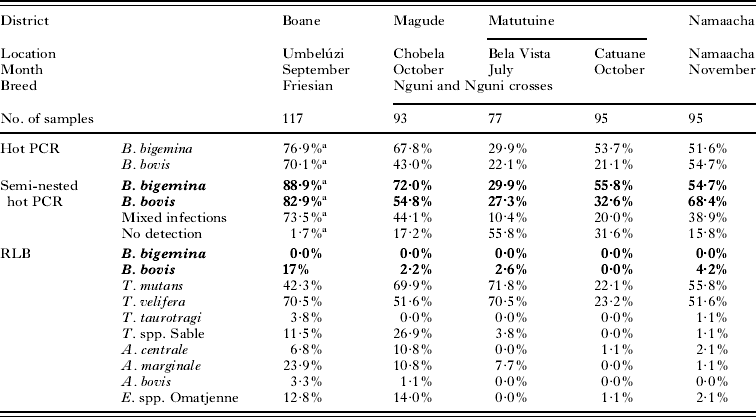
Detection levels of Babesia species differed considerably on the 5 farms. Babesia bigemina detection by the semi-nested hot-start PCR varied between a minimum of 30% and a maximum of 89%, with an overall detection level of 61%. The detection of B. bovis varied between 27% and 82%, with an overall frequency of 53%. Only on the Namaacha farm was B. bovis detected at higher levels than B. bigemina. A high proportion of the herds on the 5 farms were infected with both parasites (37%) and only 25% of the 477 samples were negative for infection with bovine babesiosis. The semi-nested hot-start PCR improved detection over the first hot-start PCR by 2% for B. bigemina and by 11% for B. bovis.
Reverse line blot assay
In addition to B. bovis the RLB hybridization assay identified 8 species of haemoparasites belonging to 4 genera in the cattle in the Maputo Province region (Table 1). B. bovis was detected on 4 of the 5 farms, but at much lower percentages than obtained by the semi-nested hot-start PCR. B. bigemina was not detected by the RLB assay. Anaplasma bovis and Theileria taurotragi were detected on only 2 farms, whereas the other haemoparasites detected were more widely distributed. Of these, the most frequently detected species were T. velifera and T. mutans, present in 54% and 52% of the samples.
Prevalence of cattle haemoparasite infections in Maputo province, Mozambique

a From Martins et al. (Reference Martins, Pedro, Caldeira, do Rosário, Neves and Domingos2008).
18S ribosomal RNA gene sequence analysis
Six 381 bp length sequences of the B. bigemina 18S rRNA gene were obtained from samples collected at Chobela farm (Chobela 1–6 with GenBank Accession nos. FJ869900 to FJ869905). The most divergent of the Mozambican isolates, Chobela1, was amplified from 2 samples, and exhibited 99% identity with several previously submitted sequences in a BLAST search. The isolates Chobela2, Chobela3 and Chobela4 are 99% identical with a B. bigemina isolate identified in China (GenBank Accession no. AY603402). Chobela5 and Chobela6 are both 99% identical with isolates from Kenya (GenBank Accession no. EF458200) and Argentina (GenBank Accession no. EF458191). An alignment with the B. bigemina 18S ribosomal RNA gene sequences and the B. bigemina RLB probe was constructed (Fig. 2). All the sequences from the Mozambican B. bigemina isolates differ in 3 base pairs with the species-specific probe used in the RLB assay.
Alignment of worldwide Babesia bigemina 18S rRNA gene sequences with the respective species-specific RLB probe. GenBank Accession nos. are provided next to the locations of isolates.

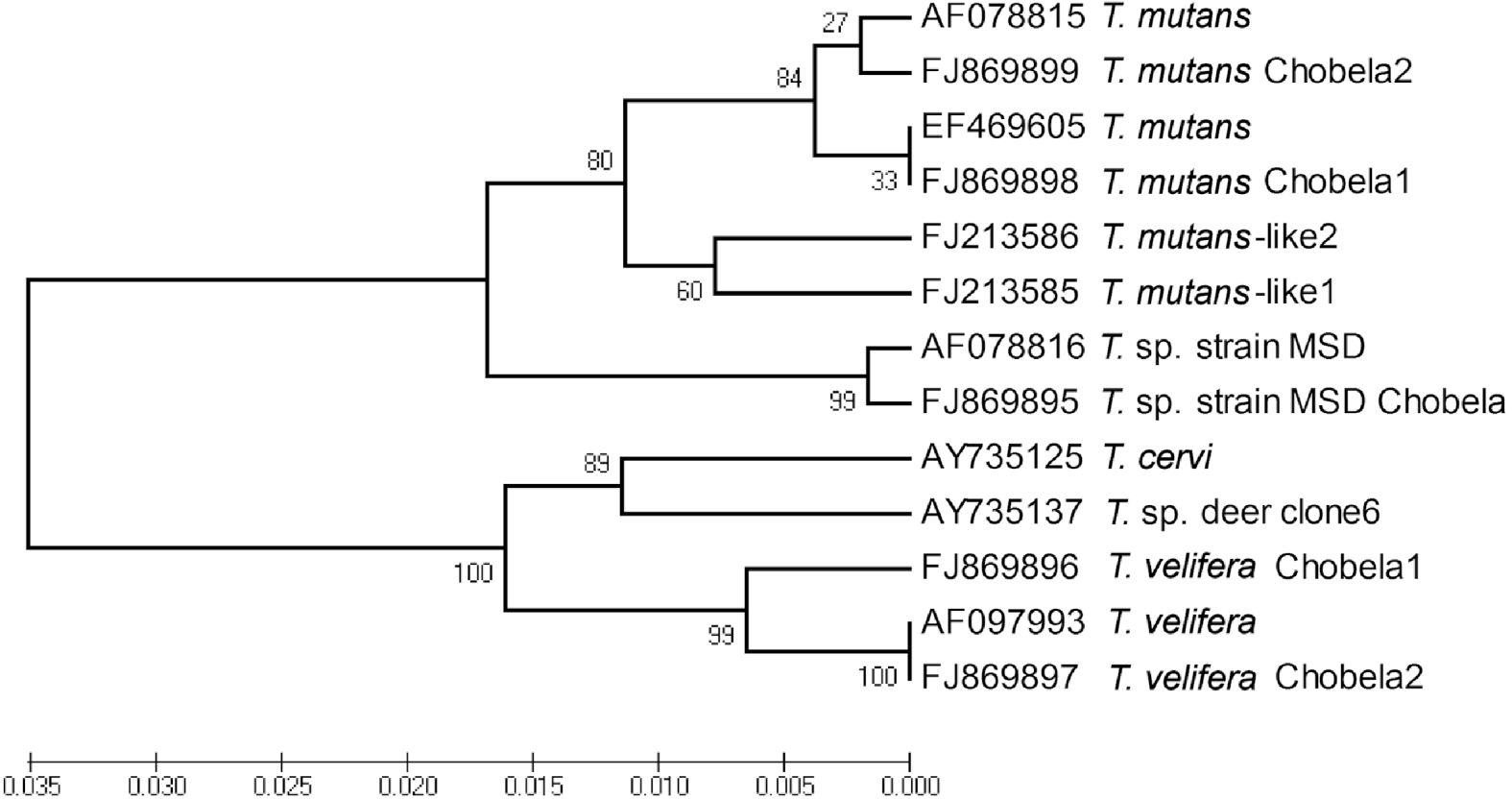
Although the primers used were specific for Babesia spp., several sequences of Theileria spp. were also amplified and cloned. Theileria sp. MSD/Chobela (GenBank Accession no. FJ869895), amplified from 2 samples, is 99% identical with Theileria sp. ‘strain MSD’ from South Africa (GenBank Accession no. AF078816). Two similar isolates, T. velifera Chobela1 and Chobela2 (GenBank Accession nos. FJ869896 and FJ869897), show 99% identity with T. velifera from Tanzania (GenBank Accession no. AF097993). Two other homologous isolates, T. mutans Chobela1 and Chobela2 (GenBank Accession nos. FJ869898 and FJ869899), are 99% identical with T. mutans from Kenya (GenBank Accession no. AF078815). A phylogenetic tree was constructed using the Theileria spp. sequences (Fig. 3).
Phylogenetic tree inferred from 18S rRNA genes. Tree constructed using the UPGMA method (Sneath and Sokal, Reference Sneath and Sokal1973), with superimposed bootstrap values (Felsenstein, Reference Felsenstein1985). GenBank Accession nos. provided next to sequence names.

DISCUSSION
The reliability of the semi-nested hot-start PCR assay used in this study was validated in an earlier study (Martins et al. Reference Martins, Pedro, Caldeira, do Rosário, Neves and Domingos2008) in which it was compared with that of a previously described nested PCR (Figueroa et al. Reference Figueroa, Chieves, Johnson and Buening1993). The nested PCR used in that study detected B. bigemina parasites in 77% and B. bovis parasites in 78% of 117 cattle. The hot-start PCR detected these parasites in 77% and 70% of these animals, while the semi-nested hot-start PCR detected B. bigemina in 90% and B. bovis in 82%. A small number of animals that were positive with the nested PCR tested negative with the semi-nested hot-start PCR and vice versa (Martins et al. Reference Martins, Pedro, Caldeira, do Rosário, Neves and Domingos2008), but the overall high prevalence of infection revealed by both assays was sufficiently close to validate the reliability of the latter.
In the present study the prevalence of asymptomatic carriers and the geographical distribution of bovine Babesia spp. infections are reported for cattle in Maputo Province, comprising an area of 26 058 km2. This province shares borders with Swaziland and South Africa, the latter being one of the main sources of imported cattle.
Both B. bigemina and B. bovis, were detected by the semi-nested hot-start PCR at high frequency in cattle at 4 localities and at lower frequency at the 5th. Infection with B. bigemina varied between 30% and 89%, and infection with B. bovis between 27% and 82%. Since the 5 farms are geographically separated, we conclude that these Babesia spp. are endemic to at least a very large part of the Maputo Province region of southeast Africa. However, the differences in the frequency of infection do imply that transmission is not of uniform intensity throughout the province.
The higher prevalence of infections with Babesia spp. on the Umbelúzi farm may be related to cattle breed. The European Friesian breed farmed at Umbelúzi is considered more susceptible to Babesia spp. infection than the African Nguni breed and Nguni crosses (Bock et al. Reference Bock, Jackson, de Vos and Jorgensen2004) that were present at the other localities. Although the overall frequency of infection with both Babesia spp. was greater than 50% in Maputo Province, both were present in approximately only 30% of the cattle on the farm at Bela Vista. The relative humidity is higher at Bela Vista than on the other farms since it is more coastal and located in the delta of the Maputo River. Higher relative humidity contributes positively to the activity and longevity of ticks as it prevents desiccation (Sutherst and Bourne, Reference Sutherst and Bourne2006). However, this would appear to be contrary to what was observed with the infection frequency. A factor that may contribute to the lower frequency of Babesia parasites at Bela Vista is that trypanosomosis is currently present on the farm, and the main drug used against Trypanosoma spp., namely diminazene aceturate, also shows activity against babesia species (Mamman et al. Reference Mamman, Aliu and Peregrine1993; Zintl et al. Reference Zintl, Mulcahy, Skerrett, Taylor and Gray2003).
Samples were collected in late July (winter) at Bela Vista and the infection frequency was low, while the collections at other localities were performed more than a month later (spring to early summer) and the infection frequencies were considerably higher. In an extensive survey conducted on the species composition of ticks infesting domestic animals in Maputo Province, only Ripicephalus (Boophilus) microplus and no Ripicephalus (Boophilus) decoloratus were collected (de Matos, Reference de Matos2008). Both species attain peak numbers during the early spring (Nyangiwe and Horak, Reference Nyangiwe and Horak2007) and, if infected, could result in increased infection rates with Babesia spp. during spring compared to winter when few ticks are present. Furthermore, winters in southern Africa are dry and, by spring, free-ranging domestic stock are often severely undernourished thus leading to immunosuppression and a possible recrudescence of existing infections of Babesia spp., or increased susceptibility to new infections.
Only at Namaacha was B. bovis (68%) detected at a higher frequency than B. bigemina (55%). Namaacha is located at a moderate altitude (approximately 600 metres above sea level), with lower temperatures than the other farms that are at sea level. This may contribute to a major change in tick challenge and in consequence with Babesia spp., but further studies are needed to confirm this hypothesis.
Acute cases of babesiosis due to B. bovis exhibit lower parasitaemias than those associated with B. bigemina (Shkap et al. Reference Shkap, Leibovitz, Krigel, Hammerschlag, Marcovics, Fish, Molad, Savitsky and Mazuz2005), and in the carrier or persistent state the parasitaemia associated with B. bovis can decrease to below 10−8% (Calder et al. Reference Calder, Reddy, Chieves, Courtney, Littell, Livengood, Norval, Smith and Dame1996). In our study, samples were collected from apparently healthy animals and consequently it is likely that the majority of samples that tested positive are from carrier cattle. Endemic stability to babesiosis is present on farms on which the majority of calves become infected while still protected by maternal antibodies and become premune without developing babesiosis (Mahoney and Ross, Reference Mahoney and Ross1972). It was also found that the antibody response was not the factor determining the development of the primary parasitaemia and calves are also protected by the so-called ‘inverse age resistance’ (Christensson, Reference Christensson1987). Infection of these calves in later life boosts their immunity and may contribute to their carrier status (Mahoney and Ross, Reference Mahoney and Ross1972). Blood smears taken from such cattle will contain very few if any piroplasms and are hence of virtually no value towards confirming a diagnosis (De Vos and Potgieter, Reference De Vos, Potgieter, Coetzer, Thomson and Tustin1994). The high frequency of infection coupled with the absence of disease despite probable multiple re-infections because of the complete absence of tick control during the past 10 years points to a state of endemic stability in the herds sampled.
Our results, indicate that the semi-nested hot-start PCR exhibited greater sensitivity than the first hot-start PCR in the detection of Babesia spp. infection. Moreover, it improved the sensitivity of detection of B. bovis (11%) more than that of B. bigemina (2%). The latter finding appears to confirm previous indications that B. bovis is present at lower parasitaemias in the carrier state, since the more sensitive semi-nested hot-start PCR improves its detection.
The other haemoparasites detected in high frequency by the RLB were T. mutans (52%) and T. velifera (54%). Similar results were obtained by Oura et al. (Reference Oura, Bishop, Wampande, Lubega and Tait2004) in a survey conducted in Uganda. In that study, bovine Babesia spp. were also detected at low levels, 2% for B. bigemina and 0% for B. bovis. In our study, B. bovis was detected in 0%–17% by the RLB while, despite the high frequency of detection by the semi-nested hot-start PCR, B. bigemina was not detected at all.
Gubbels et al. (Reference Gubbels, de Vos, van der Weide, Viseras, Schouls, de Vries and Jongejan1999) demonstrated that there was no PCR competition in the RLB assay between genomic DNA of B. bovis and T. annulata. However, many field samples are much more complex than this with several haemoparasites present at the same time, and in varying proportions. In the present study we detected 5 species belonging to the genera Babesia and Theileria in the same host. Therefore, PCR competition may, in part, explain the lower sensitivity of the RLB assay compared do the semi-nested PCR, but our results also indicate another explanation at least for the detection of B. bigemina, as sequences from the 18S rRNA gene revealed that none of the Mozambican isolates were identical to the primer described by Gubbels et al. (Reference Gubbels, de Vos, van der Weide, Viseras, Schouls, de Vries and Jongejan1999), which is used to identify B. bigemina in the RLB assay. All the sequences obtained in this study show 3 mismatches with the oligonucleotide RLB probe, and this number of mismatches is sufficient to prevent the annealing of the probe in the RLB assay (Molano et al. Reference Molano, Meijer, Morré, Pol and van den Brule2004; Nindl et al. Reference Nindl, Köhler, Gottschling, Forschner, Lehmanna, Meijer, Snijders and Stockfleth2007). Isolates from China (GenBank Accession no. AY603402), Kenya (GenBank Accession no. EF458200) and Argentina (GenBank Accession no. EF458191) are identical to the Mozambican isolates in the probe region. Recently Petrigh et al. (Reference Petrigh, Ruybal, Thompson, Neumann, Moretta, Wilkowsky, Draghi, Echaide, de Echaide and Farber2008) reported the development of a new probe that allowed for the detection of all Argentinean isolates studied, in contrast to the old probe that failed to detect organisms in half of the samples.
The phylogenetic tree inferred from the Theileria spp. 18S rRNA genes illustrates the taxonomic separation between the T. mutans and T. velifera groups. None of the T. mutans isolates was identical to the isolates from Kenya (Chae et al. Reference Chae, Allsopp, Waghela, Park, Kakuda, Sugimoto, Allsopp, Wagner and Holman1999) or Sudan (Salih et al. Reference Salih, El Hussein, Seitzer and Ahmed2007). This may be explained by micro-heterogeneity where minor nucleotide sequence differences occur in homologous regions of the gene (Chae et al. Reference Chae, Allsopp, Waghela, Park, Kakuda, Sugimoto, Allsopp, Wagner and Holman1999). In this study, a Chobela isolate (GenBank Accession no. FJ869895) with a 99% identity with Theileria sp. ‘strain MSD’ (GenBank Accession no. AF078816) was identified, isolated from cow blood in South Africa (Chae et al. Reference Chae, Allsopp, Waghela, Park, Kakuda, Sugimoto, Allsopp, Wagner and Holman1999). These isolates are distinct from T. mutans, and T. mutans-like1 and 2 isolated from the African buffalo (Syncerus caffer). Further studies are needed to clarify the identity and extent of the geographical distribution of this distinct Theileria sp. ‘strain MSD’. T. velifera clusters with the benign parasite of deer, T. cervi, and another Theileria sp. isolated from deer. The isolates of T. velifera identified in this study are not identical to the previously reported sequence from Tanzania (Gubbels et al. Reference Gubbels, de Vos, van der Weide, Viseras, Schouls, de Vries and Jongejan1999), reflecting the micro-heterogeneity characteristic of Theileria spp., and also observed in this study for T. mutans.
The results presented in this study show that multiple infections with several species of cattle haemoparasites are common in Maputo Province and that bovine Babesia spp. are endemic in this region, and also suggest high variability in the frequency of infection within species in the field.
ACKNOWLEDGEMENTS
We would like to recognize Dr Sónia Centeno Lima from Instituto de Higiene e Medicina Tropical, Portugal, for her technical assistance in the implementation of the RLB assay in Mozambique. We would also like to thank Professor Ivan Horak, Department of Veterinary Tropical Diseases, University of Pretoria, for critical reading of the manuscript.
FINANCIAL SUPPORT
This work was supported by the Fundação para a Ciência e a Tecnologia (FCT), Portugal under POCI2010 and the European Social Fund (T. M. M., Ph.D. grant number SFRH/BD/19059/2004).