Introduction
In recent years, with increasing ‘black swan’ events fluttering in the global economy, there has been a growing interest in exploring the role of leadership in dealing with change, uncertainty, and the challenge of collaboration in organizations (Owens & Hekman, Reference Owens and Hekman2012; Rego et al., Reference Rego, Owens, Yam, Bluhm, Cunha, Silard and Liu2019). Accordingly, leader humility has recently emerged as an increasing focus since it could help leaders deal with and cope with challenges and problems by acknowledging their own limitations and avoiding unrealistic decisions and behaviors, recognizing others' unique values, fostering high-quality relationships with others to address the challenges together instead of engaging in zero-sum games (Cortes-Mejia, Cortes, & Herrmann, Reference Cortes-Mejia, Cortes and Herrmann2022; Morris, Brotheridge, & Urbanski, Reference Morris, Brotheridge and Urbanski2005). Leader humility is defined as an interpersonal characteristic of leaders that ‘emerges in social contexts that connotes (a) a manifested willingness to view oneself accurately, (b) a displayed appreciation of others’ strengths and contributions, and (c) teachability’ (Owens, Johnson, & Mitchell, Reference Owens, Johnson and Mitchell2013, p. 1518). As Lazlo Bock, Google's former human resources senior vice president, emphasized, humility is one of the important qualities of talented leaders in today's business environment. Bock highlighted that humility can promote cooperation to accomplish complex tasks and achieve the team's ultimate goals for the whole organization (Bock, Reference Bock2015). After completing their tasks, leaders should step back and give others opportunities to shine. Besides, to ensure long-term progress, everyone should be humble with new knowledge and new things (Prime & Salib, Reference Prime and Salib2014). Prior studies have demonstrated its beneficial impact on subordinates' performance (Ou, Waldman, & Peterson, Reference Ou, Waldman and Peterson2018; Owens & Hekman, Reference Owens and Hekman2016; Rego et al., Reference Rego, Owens, Leal, Melo, Cunha, Gonçalves and Ribeiro2017; Wang, Owens, Li, & Shi, Reference Wang, Owens, Li and Shi2018), organizational citizenship behavior (OCB) (Qin, Liu, Brown, Zheng, & Owens, Reference Qin, Liu, Brown, Zheng and Owens2021), creativity (Hu, Erdogan, Jiang, Bauer, & Liu, Reference Hu, Erdogan, Jiang, Bauer and Liu2018), (un)ethical behavior (Owens, Yam, Bednar, Mao, & Hart, Reference Owens, Yam, Bednar, Mao and Hart2019), and (un)constructive deviance (Qin, Chen, Yam, Huang, & Ju, Reference Qin, Chen, Yam, Huang and Ju2020; Zhang, Li, & Liu, Reference Zhang, Li and Liu2021).
However, little attention has so far been paid to exploring the other-oriented motivational essence of leader humility. First, while the potential role of motivation has been reiterated in the humility literature (e.g., Mao, Chiu, Owens, Brown, & Liao, Reference Mao, Chiu, Owens, Brown and Liao2019; Rego et al., Reference Rego, Owens, Leal, Melo, Cunha, Gonçalves and Ribeiro2017; Zhang, Li, & Liu, Reference Zhang, Li and Liu2021), there remains little empirical evidence demonstrating these functional consequences directly (see Silard, Miao, & Owens, Reference Silard, Miao and Owens2021 for an exception) (Ou, Tsui, Kinicki, Waldman, Xiao, & Song, Reference Ou, Tsui, Kinicki, Waldman, Xiao and Song2014), as well as the mediating role of followers' motivations in how leader humility impacts followers' other-oriented behaviors. Nevertheless, the role of other-focused instead of self-focused motivation is highlighted in demonstrating the conceptual importance of expressed humility (Bharanitharan, Lowe, Bahmannia, Chen, & Cui, Reference Bharanitharan, Lowe, Bahmannia, Chen and Cui2021; Owens & Hekman, Reference Owens and Hekman2012, Reference Owens and Hekman2016; Owens, Johnson, & Mitchell, Reference Owens, Johnson and Mitchell2013). Besides, the ignorance of other-oriented motivations in the humility literature might cover up subtle yet meaningful nuances which are likely to be linked with functional outcomes. However, work motivation, which reflects the direction, intensity, and durability of the individual's actions in the organization, usually plays an important role in personal skill development, career, and resource allocation (Kanfer, Frese, & Johnson, Reference Kanfer, Frese and Johnson2017).
Second, most studies implying the functioning of motivations are based on more self-oriented motivational ways like power-related motivation (Lin, Chen, Tse, Wei, & Ma, Reference Lin, Chen, Tse, Wei and Ma2019; Morris, Brotheridge, & Urbanski, Reference Morris, Brotheridge and Urbanski2005), ‘can do’ or ‘safe to’ motivation (Bharanitharan, Chen, Bahmannia, & Lowe, Reference Bharanitharan, Chen, Bahmannia and Lowe2019; Mao et al., Reference Mao, Chiu, Owens, Brown and Liao2019). It still lacks further theoretical development as well as empirical investigation of the other-oriented motivational effect of leader humility. Accordingly, our understanding of leader humility's other-oriented essence is still limited in several fundamental ways.
Third, scant attention has also been paid to the role of different types of other-oriented motivations. Yet, different motivations may be induced by the same trigger simultaneously at first but would lead to different important outcomes (i.e., Grant & Shandell, Reference Grant and Shandell2022; Halbesleben & Bowler, Reference Halbesleben and Bowler2007; Halbesleben, Bowler, Bolino, & Turnley, Reference Halbesleben, Bowler, Bolino and Turnley2010). Hence, the ignorance of further exploring the influences of different motivations may impede the more profound understanding of humility as a valuable characteristic.
Exemplifying transparently, making others' strengths salient, influencing the interaction norms and task-work functioning of groups through the leaders' own social modeling, as well as hoping that their modeling could spread contagiously to subordinates are considered to be representative features of leader-expressed humility (Owens & Hekman, Reference Owens and Hekman2012, Reference Owens and Hekman2016; Rego et al., Reference Rego, Owens, Leal, Melo, Cunha, Gonçalves and Ribeiro2017). Based on these features, the current research proposes that the perspective of social learning, which captures an individual's process of observing and emulating credible role models to guide their behaviors and perceptions of others in their surroundings (Bandura, Reference Bandura1977, Reference Bandura1986; Frazier & Tupper, Reference Frazier and Tupper2018), is appropriate to help understand how and why humble leaders can facilitate their subordinates to strive to transcend their own interest, and to concern for the benefit of others and collective goals (Bolino & Grant, Reference Bolino and Grant2016; Mo & Shi, Reference Mo and Shi2017; Penner, Dovidio, Piliavin, & Schroeder, Reference Penner, Dovidio, Piliavin and Schroeder2005; Silard, Miao, & Owens, Reference Silard, Miao and Owens2021). Besides, since humble leaders often express attitudinal and behavioral cues about thinking of others and taking others' values into account (Fasbender, Burmeister, & Wang, Reference Fasbender, Burmeister and Wang2020; Frazier & Tupper, Reference Frazier and Tupper2018), we propose that adopting a social learning lens could help depict the spillover and normative other-focused consequence of leader humility (Grant & Patil, Reference Grant and Patil2012). Moreover, as an interpersonal characteristic that is expressed in a social context, leader humility is much easier to be noticed by employees during their frequent interactions (Lin et al., Reference Lin, Chen, Tse, Wei and Ma2019). Then, since humility is a valuable quality (Owens, Rowatt, & Wilkins, Reference Owens, Rowatt, Wilkins, Cameron and Spreitzer2011), employees tend to be motivated by leader humility, viewing their leaders' humble behaviors as desirable and appropriate (De Cremer, van Dijke, Schminke, De Schutter, & Stouten, Reference De Cremer, van Dijke, Schminke, De Schutter and Stouten2018; Wood & Bandura, Reference Wood and Bandura1989), enabling the functioning of the social learning process (Bandura, Reference Bandura1977).
This research chooses employee voice behavior as a potential representative outcome of the other-oriented impact of leader humility. Previous research has identified some psychological factors like identification (Li, Liang, Zhang, & Wang, Reference Li, Liang, Zhang and Wang2018), sense of power (Lin et al., Reference Lin, Chen, Tse, Wei and Ma2019), trust and self-efficacy for voice (Bharanitharan et al., Reference Bharanitharan, Chen, Bahmannia and Lowe2019), relational energy (Ma, Wu, Jiang, & Wei, Reference Ma, Wu, Jiang and Wei2019), psychological empowerment (Jeung & Yoon, Reference Jeung and Yoon2018), and voice role-conception (Li, Li, Fu, & Ullah, Reference Li, Li, Fu and Ullah2019) as the underlying mechanisms linking leader humility and employee voice. In recent years, voice has received much attention as a form of OCB and has been shown to actively affect all aspects of organizational development (Morrison, Reference Morrison2011, Reference Morrison2014). Due to the fact that the interpersonal expression of concerns or pointing out wrongdoings may bring risk and potential harm to the incumbents, employees who initiate such behavior are likely to hold other-oriented motivations (e.g., Bolino & Grant, Reference Bolino and Grant2016; Heaphy, Lilius, & Feldman, Reference Heaphy, Lilius and Feldman2022; Maynes & Podsakoff, Reference Maynes and Podsakoff2014; Van Dyne, Ang, & Botero, Reference Van Dyne, Ang and Botero2003). From an other-orientated motivational perspective, we set up a conceptual linkage between leader humility and employee voice for three reasons. First, expressed humility and speaking up are both manifested in interpersonal situations, and both emphasize the importance of social interaction. According to definitions, humility is an interpersonal characteristic, while voice is essentially a discretional form of interactive expression that emphasizes interpersonal interaction (Bashshur & Oc, Reference Bashshur and Oc2015; Maynes & Podsakoff, Reference Maynes and Podsakoff2014). Second, both of them reflect the character of the bottom-up process to a certain extent. Leader humility is considered a ‘bottom-up leadership,’ or the process of ‘leading from the ground’ (Owens & Hekman, Reference Owens and Hekman2012). Likewise, employee voicing behavior is often regarded as a typical kind of upward communication, reflecting the bottom-up process of opinion expression (Bashshur & Oc, Reference Bashshur and Oc2015; Morrison, Reference Morrison2014). Third, the teachability feature of humility is generally considered to afford others a sense of openness to voice (Owens, Johnson, & Mitchell, Reference Owens, Johnson and Mitchell2013), and humble leaders are more likely to encourage members to express their concerns about leaders' decisions (Owens & Hekman, Reference Owens and Hekman2012).
Thus, drawing on the tenets of social learning theory and combining a motivational approach, the primary purpose of this study is to examine how leader humility can influence subordinates' other-oriented motivations and to uncover how humble leaders influence subordinates' different forms of voice through triggering different other-oriented motivations (i.e., prosocial motivation and organizational concern motivation). Specifically, in this study, we focus on the motivational impacts of leader humility on both supportive and challenging voice (Burris, Reference Burris2012; Maynes & Podsakoff, Reference Maynes and Podsakoff2014; Morrison, Reference Morrison2014), since the classification is also more conducive to clarifying their different effects and functions on performance and the future development of the organization (Chamberlin, Newton, & Lepine, Reference Chamberlin, Newton and Lepine2017).
This research has three primary contributions. First, it contributes to the literature on leader humility by broadening the understanding of its effects on employees' different other-orientated motivations. While some studies have implied the role of humility on motivation, few have empirically tested this relationship. Moreover, existing studies have not differentiated and compared the different degrees of the influence of leader humility on different motivations. However, there are different other-oriented motivations, which can lead to largely different behaviors and consequences (Kanfer, Frese, & Johnson, Reference Kanfer, Frese and Johnson2017). Furthermore, the current research adopts a nuanced motivational approach to unpack the black box of how leader humility impacts employees' different forms of voice behavior. Based on social learning theory, through investigating how leader humility could cultivate different motivations and different voice, the research reveals a more nuanced and complex picture of the essence of the bottom-up, interpersonal, and spillover influence of leader humility, responding to calls for more detailed insights about expressed humility (Owens, Johnson, & Mitchell, Reference Owens, Johnson and Mitchell2013).
Second, we contribute to the motivation literature by identifying that leader humility is an important antecedent of employees' other-oriented motivations (prosocial or organizational concern motivations). Furthermore, it is worth noting that leader humility affects employees' different motivations to different degrees, and the mediation effects of different motivations for outcomes differ significantly, reflecting the characteristics of leader humility.
Third, this research also contributes to the voice literature. We not only expand the motivational predictors of voice but further echo to calls for more work on discovering its impacts on different forms of voice (i.e., challenging voice and supportive voice, Li et al., Reference Li, Liang, Zhang and Wang2018; Lin et al., Reference Lin, Chen, Tse, Wei and Ma2019). Since Maynes and Podsakoff (Reference Maynes and Podsakoff2014) suggest that the overly conclusive focus will narrow down the scope and content of voice, this study examines the effects of leader humility on employees' supportive and challenging voice through a motivational mechanism and finds out the significant predictive power of these two forms of voice, thereby providing more detailed future directions in exploring voicing behaviors in the workplace, as well as delineating the conceptual connections between leader humility and employee voice.
Conceptual background and hypotheses development
Leader humility
Since humility emerges in social interactions and is recognized by other people, it is one of the interpersonal characteristics (Owens & Hekman, Reference Owens and Hekman2012). It reflects a willingness to see oneself accurately, an appreciation for the values and strengths of others, and a willingness to be taught (Chiu, Owens, & Tesluk, Reference Chiu, Owens and Tesluk2016; Owens, Johnson, & Mitchell, Reference Owens, Johnson and Mitchell2013). Leader-expressed humility will be perceived by their subordinates through their daily social interactions in the workplace. Specifically, humble leaders are willing to collect feedback and evaluation about themselves from employees, valuing the opinions and contributions of subordinates and being willing to learn from them modestly.
Leader humility, social learning theory, and motivational perspective
The core tenet of social learning theory is that human psychological states and behavior are influenced by the observation of environmental stimuli (Bandura, Reference Bandura1977). Though some research has inferred the social modeling effect of leader humility through enhanced social learning, few studies have taken this theory as a perspective. Besides, a detailed understanding of what kind of qualities subordinates can learn from humility is lacking. Due to the salient and attractive characteristics of leader humility mentioned above, employees tend to observe and take attitudinal and behavioral cues from leader-expressed humility (Frazier & Tupper, Reference Frazier and Tupper2018). Through vicarious learning, people emulate and learn from role models to guide their behaviors (Bandura, Reference Bandura1986; Wood & Bandura, Reference Wood and Bandura1989). Because of leaders' formal roles, power, and high status in organizations (De Cremer et al., Reference De Cremer, van Dijke, Schminke, De Schutter and Stouten2018; Rego et al., Reference Rego, Owens, Leal, Melo, Cunha, Gonçalves and Ribeiro2017), employees usually regard their leaders as credible role models (Lord, Day, Zaccaro, Avolio, & Eagly, Reference Lord, Day, Zaccaro, Avolio and Eagly2017). In this way, since humble leaders set positive role models for them and highlight the importance of caring for and valuing others around them, employees are likely to learn vicariously and strive to internalize the positive perceptions and altruistic attitudes toward others in their surroundings that their supervisors hold (Bandura, Reference Bandura1986; Frazier & Tupper, Reference Frazier and Tupper2018).
In the current research, combining the OCB and voice literature, we adopt a motivational approach and propose that leader humility is likely to induce both subordinates' prosocial motivation, which is more person-focused and shows employees' desire to expend effort to benefit specific individuals (Grant, Reference Grant2008a), and organizational concern motivation, which is more organization-focused and reflects employees' desire to benefit the organization in general (Rioux & Penner, Reference Rioux and Penner2001). This framework aligns with Williams and Anderson's (Reference Williams and Anderson1991) categorization of organizational citizenship behavior directed at individuals (OCBI) and organizational citizenship behavior directed at the organization (OCBO). On the one hand, these two motivations are regarded as independent predictors that promote their engagement in citizenship to help other people and the organization (Grant & Mayer, Reference Grant and Mayer2009; Klotz, Bolino, Song, & Stornelli, Reference Klotz, Bolino, Song and Stornelli2018; Rioux & Penner, Reference Rioux and Penner2001; Takeuchi, Bolino, & Lin, Reference Takeuchi, Bolino and Lin2015). On the other hand, they are all under the conceptual umbrella of other-oriented or social motivation (Bolino & Grant, Reference Bolino and Grant2016). Then, combining social learning theory and motivational perspective, other-oriented motivations promoted by the role modeling effect of leader cues (i.e., leader humility) are likely to direct subordinates' OCB (Grant & Mayer, Reference Grant and Mayer2009; Kanfer, Frese, & Johnson, Reference Kanfer, Frese and Johnson2017; Kim, Van Dyne, Kamdar, & Johnson, Reference Kim, Van Dyne, Kamdar and Johnson2013).
Role of prosocial motivation in the effect of leader humility
Prosocial motivation highlights the importance of paying attention to interpersonal context, reflecting employees' desire to make efforts to benefit others (Grant, Reference Grant2008a). Individuals with high prosocial motivation are more concerned about others and are willing to work hard to improve their well-being (Bolino & Grant, Reference Bolino and Grant2016). Klotz et al. (Reference Klotz, Bolino, Song and Stornelli2018) highlight that prosocial motivation is more person-concerned, which is more related to the altruism and courtesy parts of OCB. Likewise, Rioux and Penner (Reference Rioux and Penner2001) found that the altruism dimension strongly correlates with prosocial value motives. Therefore, we propose that leader humility positively relates to employees' prosocial motivation.
First, as an interpersonal characteristic, employees will receive social cues from their humble leaders in a social environment to appreciate the value of others during social interactions, and thus they will pay more attention to the welfare of others through the observational learning process (Bandura, Reference Bandura1977; Owens & Hekman, Reference Owens and Hekman2016). In this process, the humble leader creates a role model who cares about, values others, and asks others for advice. Employees will observe and imitate through the social learning processes to produce similar values for others, and be more motivated to emulate their leaders to value others' benefit and hard work (Silard, Miao, & Owens, Reference Silard, Miao and Owens2021; Wood & Bandura, Reference Wood and Bandura1989).
Second, humble leaders usually encourage the social learning process by spotlighting the positive social cues of others and modeling teachability (Owens & Hekman, Reference Owens and Hekman2012). Through vicarious learning from their leaders, employees are more likely to transcend their interests and engage in considering the sake of others (Bandura, Reference Bandura1986; Silard, Miao, & Owens, Reference Silard, Miao and Owens2021). At the same time, humility will provide employees with stronger moral efficiency and empower employees with prosocial motivation (Owens et al., Reference Owens, Yam, Bednar, Mao and Hart2019).
Third, humble leaders are likely to form high-quality relationships with subordinates, promoting the employees' willingness to collaborate and share information (Ou et al., Reference Ou, Tsui, Kinicki, Waldman, Xiao and Song2014). In order to further maintain and promote better relationships, employees are more likely to generate a higher level of desire and effort to benefit others (Wang et al., Reference Wang, Owens, Li and Shi2018). For example, Chiu, Balkundi, Owens, and Tesluk (Reference Chiu, Balkundi, Owens and Tesluk2022) found that employees with humble leaders are committed to providing necessary assistance to other people around them. Thus, we state that:
Hypothesis 1: Leader humility is positively associated with employee prosocial motivation.
On this basis, this research proposes that leader humility will positively affect employees' challenging and supportive voice by triggering their prosocial value motivation. Challenging voice refers to those suggestions aimed at improving the situation and achieving functional changes while actively challenging, correcting, and changing the status quo (Van Dyne & LePine, Reference Van Dyne and LePine1998). In addition to this kind of voice, Burris (Reference Burris2012) also pointed out the prevalence of ‘supportive voice’ in the workplace, which refers to the behavior that employees actively participate in the decision-making process to express their opinions to support and maintain existing policies and practices. Van Dyne, Ang, and Botero (Reference Van Dyne, Ang and Botero2003) have also confirmed the existence of such a form of voice aiming at being supportive of the status quo.
By setting a humble role model, which induces followers to engage in the social learning process, including mimicking prosocial behaviors and regarding them as appropriate (Wood & Bandura, Reference Wood and Bandura1989), leaders can help create a high-quality relational environment in the workplace (Chiu, Owens, & Tesluk, Reference Chiu, Owens and Tesluk2016). The process reflects the engagement of leaders in behavioral modeling to establish or maintain prosocial norms in the workplace (Grant & Patil, Reference Grant and Patil2012).
Supportive voice reflects relational qualities since they help maintain interpersonal connections with others through promoting cooperation and building social capital (Newton, Chamberlin, Maupin, Nahrgang, & Carter, Reference Newton, Chamberlin, Maupin, Nahrgang and Carter2021). Besides, leader humility makes employees realize that their abilities and values are appreciated by others and feel more capable of impacting others through their efforts. Hence, they are more likely to have positive relational connections between their contributions and influence on others (Grant, Reference Grant2008b). Moreover, supportive voice encourages others to share their perspectives and endorse everyone's ideas, which are conceptually relevant to leader humility's focus on appreciating others (Newton et al., Reference Newton, Chamberlin, Maupin, Nahrgang and Carter2021). Employees are willing to deepen positive relationships with others by offering support (Chiu, Owens, & Tesluk, Reference Chiu, Owens and Tesluk2016) since others value them and tend to avoid unfavorable evaluations of their abilities and values (Elliot & Harackiewicz, Reference Elliot and Harackiewicz1996). As a result, employees are more likely to produce more supportive voice behaviors for the benefit of others, like preserving social functioning and accommodating others' viewpoints (Maynes & Podsakoff, Reference Maynes and Podsakoff2014; Newton et al., Reference Newton, Chamberlin, Maupin, Nahrgang and Carter2021). Therefore, employees will be motivated to conduct actions to avoid threats and undermine the status quo, so that they will make more supportive suggestions (Burris, Reference Burris2012).
Hypothesis 2a: Employee prosocial motivation mediates the positive association between leader humility and supportive voice.
At the same time, prosocial motivations triggered by leader humility may also promote employees' challenging OCB (Grant & Mayer, Reference Grant and Mayer2009). First, since humble leaders tend to be introspective and accurately appraise their strengths and weaknesses (Morris, Brotheridge, & Urbanski, Reference Morris, Brotheridge and Urbanski2005), through vicariously learning their leader-expressed humility, employees are more likely to view the status quo precisely (Kelemen, Matthews, Matthews, & Henry, Reference Kelemen, Matthews, Matthews and Henry2022). Therefore, they are clearer and more sensitive to what needs to be improved. Second, employees will notice that humble leaders deliver messages to them about valuing their strengths and ideas, as well as asking for their advice and feedback, which will enable employees to have higher self-efficacy and psychological safety to speak up (Owens et al., Reference Owens, Yam, Bednar, Mao and Hart2019; Parker, Bindl, & Strauss, Reference Parker, Bindl and Strauss2010). Third, in the intimate interpersonal environment created by humble leaders, employees are more likely to take perspectives of others and learn about others' needs, thus feeling obligated to spend the effort to challenge the status quo and strive for a better future (Fasbender, Burmeister, & Wang, Reference Fasbender, Burmeister and Wang2020). Focusing on the relationship with and interests of others will also encourage employees to think about how to improve the existing situation so that both the incumbents and others can reap greater benefits in the future. Therefore, employees are more likely to engage in challenging voice (Detert & Burris, Reference Detert and Burris2007; Rego et al., Reference Rego, Owens, Yam, Bluhm, Cunha, Silard and Liu2019). Thus, we also posit that:
Hypothesis 2b: Employee prosocial motivation mediates the positive association between leader humility and challenging voice.
Role of organizational concern motivation in the effect of leader humility
Unlike prosocial motivation, organizational concern motivation reflects the participant's desire to work hard with pride and commitment to the organization (Rioux & Penner, Reference Rioux and Penner2001). Klotz et al. (Reference Klotz, Bolino, Song and Stornelli2018) distinguish this kind of motivation from prosocial motivation or self-oriented motivations by highlighting its focus on benefiting firm performance in general, showing the sportsmanship and civic virtue parts of OCB motives. Similarly, Rioux and Penner (Reference Rioux and Penner2001) found that the conscientiousness dimension is more related to organizational concern motives.
Since leaders are often regarded by employees as representatives of the organization (Frazier & Tupper, Reference Frazier and Tupper2018; Zhang & Chen, Reference Zhang and Chen2013), their openness to feedback about the organization or themselves and valuing others' strengths can express their posture of taking their responsibility and obligation to the whole organization, especially for negative events or mistakes (Zapata & Hayes-Jones, Reference Zapata and Hayes-Jones2019), thus setting credible and attractive models for employees (Bandura, Reference Bandura1986; Mayer, Aquino, Greenbaum, & Kuenzi, Reference Mayer, Aquino, Greenbaum and Kuenzi2012). Therefore, through the social learning process, employees are more likely to prioritize the collective interest of the organization and emulate their humble leaders to regulate their attitudes and behaviors, regarding paying attention and expending effort to benefit the organization as appropriate, which is related to organizational concern motivation (Bandura, Reference Bandura1986; Klotz et al., Reference Klotz, Bolino, Song and Stornelli2018).
Besides, by highlighting the value and strength of others in the organization, humble leaders may also cultivate employees to be concerned with the strength and advantages of the whole organization (B, Lowe, Bahmannia, Cui, & Chen, Reference B, Lowe, Bahmannia, Cui and Chen2021). Eisenberger, Stinglhamber, Vandenberghe, Sucharski, and Rhoades (Reference Eisenberger, Stinglhamber, Vandenberghe, Sucharski and Rhoades2002) also mentioned that leader's support is often the primary contributing factor for employees to feel supported by the entire organization. Therefore, employees will have a high organizational commitment to improve the organization (Chiu, Owens, & Tesluk, Reference Chiu, Owens and Tesluk2016; Owens & Hekman, Reference Owens and Hekman2012), and their organizational concern motivations are more likely to be stimulated. Thus, we propose that:
Hypothesis 3: Leader humility is positively associated with employee organizational concern motivation.
At the same time, Rioux and Penner (Reference Rioux and Penner2001) found that organizational concern motivation is closely related to organization-oriented OCB like voice behavior (Kim et al., Reference Kim, Van Dyne, Kamdar and Johnson2013). Therefore, the research also proposes that organizational concern motivation will mediate the relationship between leader humility and subordinate voice.
Under the guidance of humble leaders, employees are more likely to generate high organizational concern motivation, appreciate and learn from the values and strengths in the organizations, and in turn, become more motivated to offer their functional suggestions for organizational development (LePine & Van Dyne, Reference LePine and Van Dyne1998; Morrison, Reference Morrison2011). Therefore, employees are more likely to bring about suggestions or advice to support the status quo or defend underlying threats or risks that may damage the development of the organization (Burris, Reference Burris2012). Furthermore, employees influenced by humble leaders are likely to speak up in supportive ways to maintain the warmth in the organization (Fiske, Cuddy, & Glick, Reference Fiske, Cuddy and Glick2007; Newton et al., Reference Newton, Chamberlin, Maupin, Nahrgang and Carter2021). Likewise, supportive voice is found to be a helpful tactic to respect others, enhance cooperative norms in the team, and preserve harmony in the organization (Newton et al., Reference Newton, Chamberlin, Maupin, Nahrgang and Carter2021).
Hypothesis 4a: Employee organizational concern motivation mediates the positive association between leader humility and supportive voice.
By observing and emulating their humble leaders, employees tend to accurately estimate the status quo of the whole organization and assume their strength and teachableness as a premise. Since humble leaders often model teachability (Owens & Hekman, Reference Owens and Hekman2012), subordinates are more likely to be encouraged to express challenging voice, devoting their competence to the organization with ease and confidence (Bandura, Reference Bandura1986; Fiske, Cuddy, & Glick, Reference Fiske, Cuddy and Glick2007; Newton et al., Reference Newton, Chamberlin, Maupin, Nahrgang and Carter2021). Zhang, Li, and Liu (Reference Zhang, Li and Liu2021) found that leader humility can be constructive to deviance like rule-breaking to benefit the organization, offering indirect evidence for the current research. Besides, considering their organization as a whole other-oriented target to benefit, employees with humble leaders are also apt to express ideas, information, or opinions that focus on promoting functional change in the organization (Heaphy, Lilius, & Feldman, Reference Heaphy, Lilius and Feldman2022; Maynes & Podsakoff, Reference Maynes and Podsakoff2014). Thus, with organizational concern motivation to bring about positive changes in organizations, employees are also likely to conduct challenging voice.
Hypothesis 4b: Employee organizational concern motivation mediates the positive association between leader humility and challenging voice.
Comparison between the two motivational mechanisms of leader humility
As mentioned above, leader humility might be linked with employees' two different other-oriented motivations, which influence subsequent supportive and challenging voice behavior. The dual-process model reveals a more detailed and comprehensive mechanism of leader humility's other-focused impact. Employees might engage in other-oriented OCB (two forms of voice behavior in this study) because of the desire for prosocial values (i.e., they are interpersonally focused and care about contacts with other individuals) or organizational concern (i.e., which means they are organizationally focused and fully involved with the organization) (Klotz et al., Reference Klotz, Bolino, Song and Stornelli2018; Takeuchi, Bolino, & Lin, Reference Takeuchi, Bolino and Lin2015). Although they share some common characteristics, it is necessary and important to compare and distinguish the effects of the two mediating paths. On the one hand, exploring employees' different kinds of desires to benefit from different targets provides a nuanced picture of the mechanism of leader-expressed humility (Owens, Johnson, & Mitchell, Reference Owens, Johnson and Mitchell2013). On the other hand, different types of OCB motivations might also differ in influencing organizations and individuals (Klotz et al., Reference Klotz, Bolino, Song and Stornelli2018).
According to its definition, the leader-expressed humility is more embodied as an interpersonal characteristic conceptually that reflects prosocial qualities of leadership that emerge within a social context (Owens, Rowatt, & Wilkins, Reference Owens, Rowatt, Wilkins, Cameron and Spreitzer2011; Silard, Miao, & Owens, Reference Silard, Miao and Owens2021). Besides, there is indirect evidence that humility is more widely considered to reflect interpersonal warmth in relations (Bharanitharan et al., Reference Bharanitharan, Lowe, Bahmannia, Chen and Cui2021), while also reducing interpersonal misunderstandings and retaliations (Chiu et al., Reference Chiu, Balkundi, Owens and Tesluk2022). In other words, leader humility is more likely to foster subordinates' general concern for others in daily social interactions, which are broader and maybe not restricted to benefit the interests of only a specific organization under particular circumstances. That may explain why humility is usually acknowledged as a general moral or ethical quality (Owens et al., Reference Owens, Yam, Bednar, Mao and Hart2019; Silard, Miao, & Owens, Reference Silard, Miao and Owens2021; Smith & Kouchaki, Reference Smith and Kouchaki2018). The prosocial nature of humility reflects the obedience to widely held social norms (Umphress & Bingham, Reference Umphress and Bingham2011). Meanwhile, Rioux and Penner (Reference Rioux and Penner2001) found that prosocial value motives have a stronger influence on OCB like helping behavior than organizational concern motives. Similarly, this study also proposes that the effect of leader humility on triggering employees' prosocial motivation is stronger than organizational concern motivation, and thus prosocial motivation also has a stronger mediating effect on the influence of leader humility on both supportive and challenging voicing behavior.
Thus, we propose that:
Hypothesis 5a: Compared with employee organizational concern motivation, prosocial motivation has a stronger mediating effect on the relationship between leader humility and supportive voice.
Hypothesis 5b: Compared with employee organizational concern motivation, prosocial motivation has a stronger mediating effect on the relationship between leader humility and challenging voice.
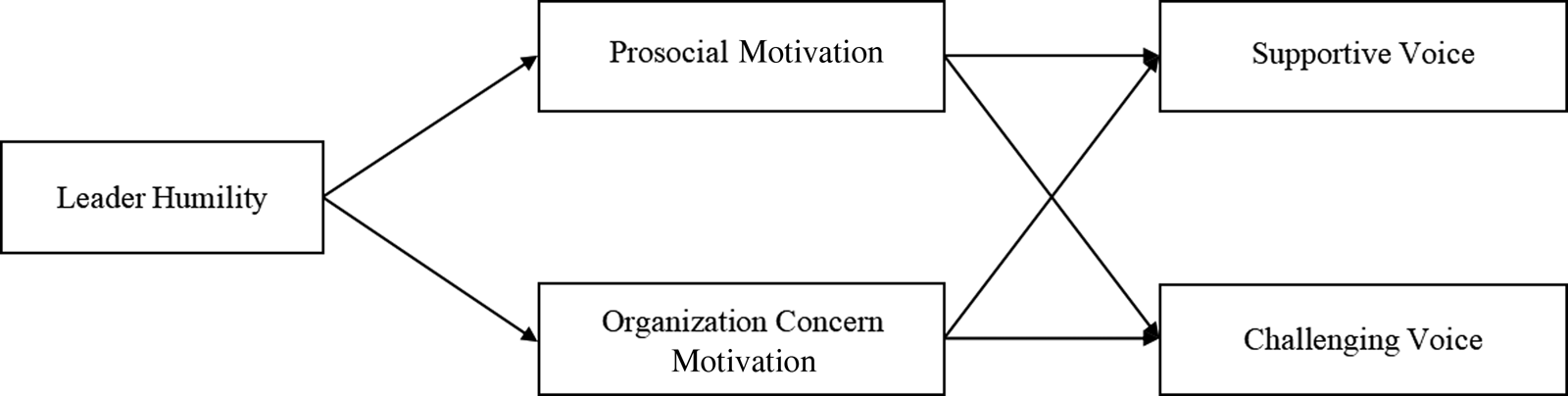
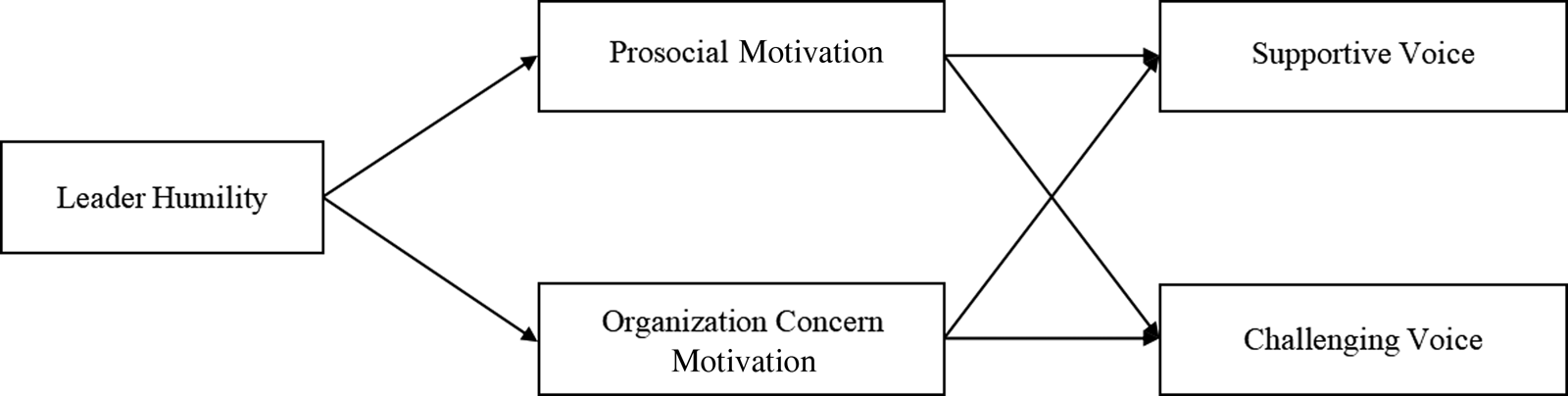
Figure 1 summarizes the theoretical framework.
Theoretical model.
Methods
Sample and procedure
In our study, we used a snowball sampling technique with online surveys to collect the data (Heckathorn, Reference Heckathorn1997). Given the potential threat of common method variance (Podsakoff, MacKenzie, & Podsakoff, Reference Podsakoff, MacKenzie and Podsakoff2012; Podsakoff, MacKenzie, Lee, & Podsakoff, Reference Podsakoff, MacKenzie, Lee and Podsakoff2003), we invited the leader–employee dyad to participate in our study, collecting data from different sources (i.e., employees and leaders). Following previous studies which adopted similar techniques (e.g., Meyer, Hsiao, Viglione, Mihura, and Abraham, Reference Meyer, Hsiao, Viglione, Mihura and Abraham2013), our acquaintances were considered the initial respondents. We contacted our acquaintances, explained the purpose of the research and data collection procedure, and invited them to take part in our survey. If they agreed to participate, we first sent the online links to an online platform (http://www.wjx.cn/) through email, Wechat, text message, etc., depending on how we connected with them at first, and then asked them to invite other appropriate working people (leaders or employees) to fill in the survey. Thus, if the contacts were leaders, they were asked to randomly choose one employee to rate and also invite that employee to participate in the employee survey. If contacts were employees, we asked the contacts to invite other appropriate full-time working personnel (i.e., direct leaders) to participate in our research following the abovementioned procedures. The online link page always included three pieces of information: a cover letter, a leader's version survey link, and an employee's version survey link. Our contacts needed to choose their roles either as leaders or followers of the participant and fill in the corresponding survey. Once completed, another link for their counterparts would be created for them to share. A unique identification code was also created automatically by the platform to match the responses of both parties. To enhance data quality, we clearly elaborated our research purposes and detailed procedures in the cover letter of the online surveys. Voluntariness and anonymity were guaranteed, and the data analysis results were assured by the researchers only for academic use. In addition, the random unique identification code created by the online survey platform also ensured anonymity. Each participant would receive a 5 RMB reward upon completion. The initial respondents would receive another 5 RMB reward once their counterparts completed the survey for their successful invitation.
To be specific, employees were asked to evaluate their internal motivations (including prosocial motivation and organizational concern motivation) regarding the reasons for speaking up, the perceived level of direct supervisor's leader humility, and demographic information (i.e., gender, age, education, position), while leaders were invited to rate their employees' frequency of both supportive voice and challenging voice.
In around 3-week data collection, we received 258 and 210 responses from employees and leaders, respectively. After matching the responses, the final valid sample consisted of 152 leader–employee dyads. According to a priori analysis using G*Power (Erdfelder, Faul, & Buchner, Reference Erdfelder, Faul and Buchner1996), following Cohen's suggestion (Reference Cohen1988), the necessary sample size regarding medium effect size, moderate α, and three predictors was in regression analyses is 119 (Faul, Erdfelder, Buchner, & Lang, Reference Faul, Erdfelder, Buchner and Lang2009), indicating our 152 dyads could exert adequate statistical power. Among all employees, 55.90% were females, 55.30% had bachelor's degrees, 71.10% acted as front-line employees, 27.60% aged from 26 to 30 years old, and 32.90% aged from 31 to 40 years old. As for the leaders in the dyads, 35.5% were females, 44.1% were aged between 31 and 40 years old, 84.2% had bachelor's or higher degrees, and 49.3% reported themselves as middle-level managers, while 11.1% were high-level managers.
Measures
Given that all materials were in Chinese, the standard translation and back-translation procedures were followed (Brislin, Reference Brislin1986). Also, for all measures, a 7-point Likert scale was used, ranging from 1, strongly disagree, to 7, strongly agree.
Leader humility
Leader humility was measured with a 9-item scale developed by Owens, Johnson, and Mitchell (Reference Owens, Johnson and Mitchell2013). We asked the employees to evaluate their direct leaders' level of humility. A sample item included ‘My direct leader shows appreciation for the unique contributions of others.’ The reliability for leader humility was .96.
Prosocial motivation
Prosocial motivation was measured with 10-item of the corresponding dimension from Citizenship Motives Scale developed by Rioux and Penner (Reference Rioux and Penner2001). Adapting to our research, we asked the employees to indicate why they actively report related concerns, ideas, problems, or suggestions to their leaders. Sample items include ‘Because I am concerned about other people's feelings’ and ‘Because it is easy for me to be helpful.’ The reliability for prosocial motivation was .93.
Organizational concern motivation
Organizational concern motivation was measured with 10-item of the corresponding dimension from Citizenship Motives Scale developed by Rioux and Penner (Reference Rioux and Penner2001). Same with measuring prosocial motivation, employees indicated the extent to which they actively report related concerns, ideas, problems, or suggestions to their leaders regarding ‘Because I care what happens to the company’ and ‘Because I am committed to the company.’ The reliability for organizational concern motivation was .90.
Supportive voice and challenging voice
Employee voice was rated by leaders with the 6-item scale developed by Burris (Reference Burris2012), which contains two subscales of supportive voice and challenging voice (three items each). In terms of supportive voice, a sample item included ‘The employee speaks up and encourages others to get involved in issues that affect the organization.’ In terms of challenging voice, a sample item included ‘The employee speaks up to me with ideas to address other employees’ needs and concerns.’ In our study, the reliabilities for supportive voice and challenging voice were .81 and .84, respectively.
Control variables
To eliminate possible influence of demographic variables on voice, several employees' demographic variables were included as control variables. We controlled for employee's gender (0 = female; 1 = male), age (1 = 18–25 years old; 2 = 26–30 years old; 3 = 31–40 years old; 4 = 41–50 years old; 5 = 51–60 years old), education level (1 = middle school degree; 2 = vocational school degree; 3 = high school degree; 4 = junior college degree; 5 = bachelor degree; 6 = graduate degree), position level (1 = frontline employee; 2 = low-level manager; 3 = middle-level manager) because these demographic variables have been argued to affect perceptions of social interactions and behavioral outcomes (e.g., Ng & Feldman, Reference Ng and Feldman2010).
Results
Descriptive statistics and preliminary analyses
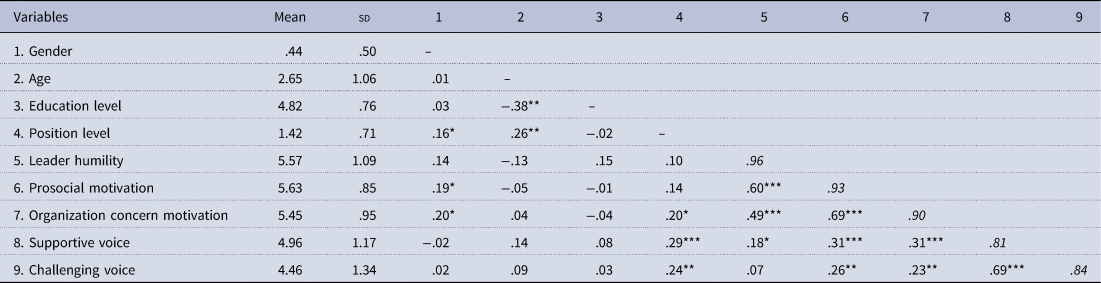
Table 1 presents descriptive statistics, including means, standard deviations, correlations, and reliabilities of the focal variables. Results show that leader humility was positively associated with prosocial motivation (r = .60, p < .001) and organization concern motivation (r = .49, p < .001). Meanwhile prosocial motivation was positively associated with both supportive voice (r = .31, p < .001) and challenging voice (r = .26, p < .01); and organization concern motivation was positively associated with both supportive voice (r = .31, p < .001) and challenging voice (r = .23, p < .01). These provided preliminary support for the hypotheses.
Means, standard deviations, correlations, and reliabilities
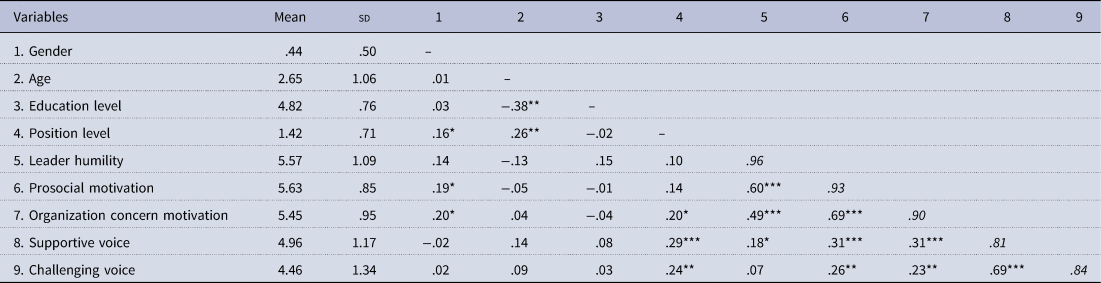
Notes. N = 152. sd, standard deviation. Cronbach's alpha values for the variables are shown in italics along the diagonal. For gender, female = 0, male = 1. For age, [18, 25] = 1, [26, 30] = 2, [31, 40] = 3, [41, 50] = 4, [51, 60] = 5. For education level, middle school degree = 1, vocational school degree = 2, high school degree = 3, junior college degree = 4, bachelor degree = 5, graduate degree = 6. For position, frontline employee = 1, low-level manager = 2, middle-level manager = 3.
*p < .05, **p < .01, ***p < .001.
Preliminary analyses
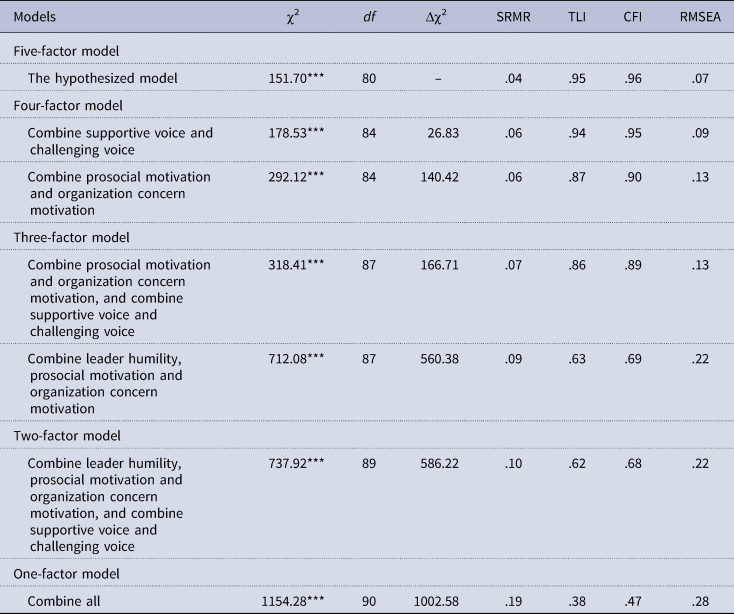
Next, in order to test the empirical distinctiveness of our measures and the hypotheses, we employed a two-step procedure structural equation modeling of confirmatory factor analyses (CFA) and path analysis with Mplus 7.4 (Muthén & Muthén, Reference Muthén and Muthén2012). To examine the empirical distinctiveness of the measures of the focal constructs – which included leader humility, prosocial motivation, organization concern motivation, supportive voice, and challenging voice, we performed CFA with all items as indicators. As the ratio of the sample size to the total number of items influences overall model fit, we parceled our construct items to reduce the number of parameters and improve model fit (Little, Rhemtulla, Gibson, & Schoemann, Reference Little, Rhemtulla, Gibson and Schoemann2013). We utilized the item-to-construct-balance approach to parcel each construct into three items (Williams, Vandenberg, & Edwards, Reference Williams, Vandenberg and Edwards2009). The results, which are shown in Table 2, demonstrated that the hypothesized five-factor model had adequate fit with modifications (χ2(80) = 151.70, p < .001; SRMR = .04, TLI = .95, CFI = .96, RMSEA = .07). This model also provided a significant improvement in the chi-square value over all the alternative models. Thus, the focal variables were empirically distinct.
Results of CFA
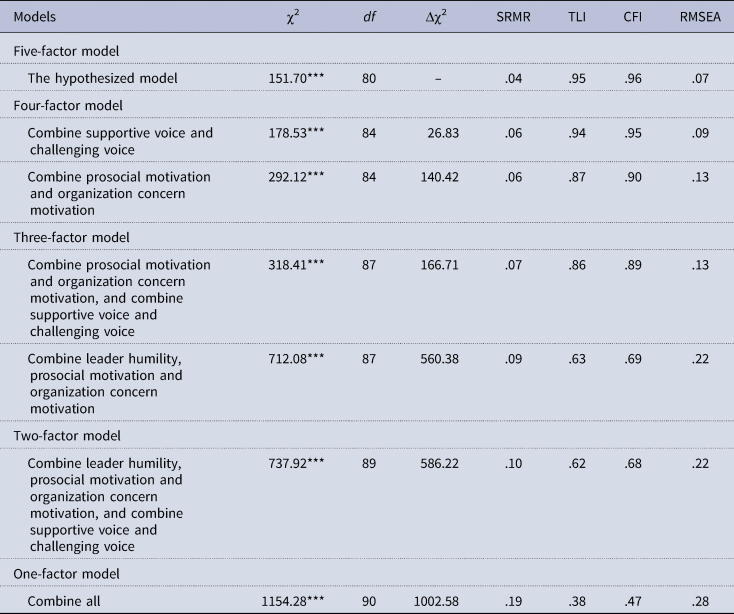
SRMR, standardized root-mean-square residual; TLI, Tucker–Lewis index; CFI, comparative fit index; RMSEA, root-mean-square error of approximation.
Note. Δχ2 was compared with the hypothesized five-factor model (hypothesized model).
*p < .05, **p < .01, ***p < .001.
Provided the acceptable fit indices of the hypothesized measurement model, we proceeded to compute the variable means by averaging the corresponding items, and we used these composites in testing our hypotheses.
Hypotheses testing
We conducted path analysis to test our hypotheses. All the regressions were conducted controlling for the variables of employee gender, age, educational level, and position level.
Tests of main effects
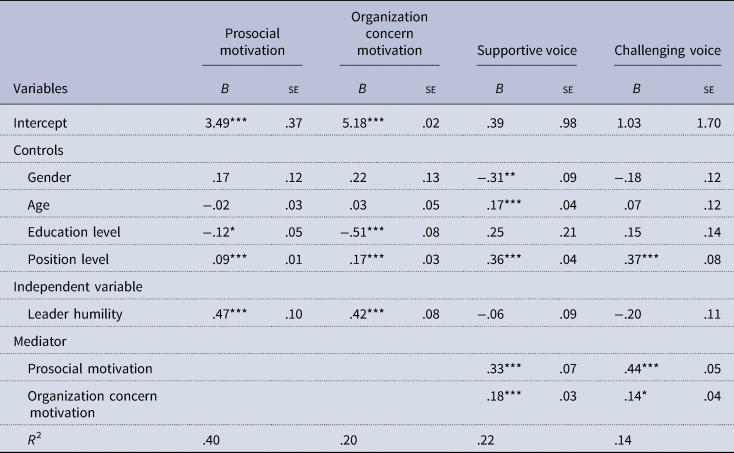
Hypotheses 1 and 3 propose that leader humility is positively related to employee prosocial motivation (hypothesis 1) and organization concern motivation (hypothesis 3). The results displayed in Table 3 indicated that leader humility was positively associated with employee's prosocial motivation (β = .47, standard errors [se] = .10, p < .001) and organization concern motivation (β = .42, se = .08, p < .001). Thus, hypotheses 1 and 3 were both supported.
Path analysis results
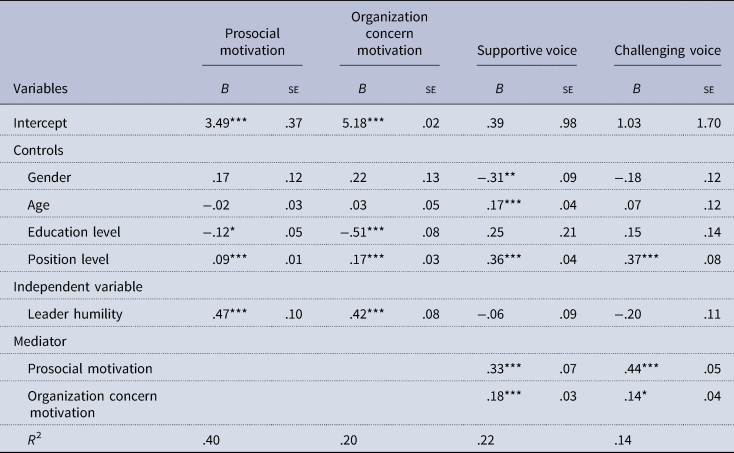
Note. N = 152. Statistics reported are unstandardized regression coefficients and se.
*p < .05, **p < .01, ***p < .001.
Tests of mediation effects
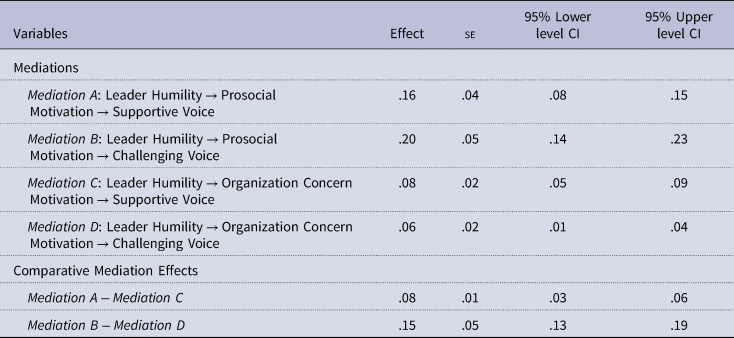
Hypotheses 2a, 2b, 4a, and 4b propose the mediation effects of employees' motivations in the relationships between leader humility and their two forms of voice behavior. With 1,000 times bootstrap for construct 95% bias-corrected confidence intervals (CIs), and controlling for employee's demographic variables, results in Table 4 indicated that employee's prosocial motivation significantly mediates the positive association between leader humility and (a) employee's supportive voice (indirect effect = .16, se = .04, 95% CI = [.08, .15]) and (b) employee's challenging voice (indirect effect = .20, se = .05, 95% CI = [.14, .23]). Also, employee's organization concern motivation significantly mediates the positive association between leader humility and (a) employee's supportive voice (indirect effect = .08, se = .02, 95% CI = [.05, .09]) and (b) employee's challenging voice (indirect effect = .06, se = .02, 95% CI = [.01, .04]). Thus, hypotheses 2a, 2b, 4a, and 4b were all supported.
Path analysis results for mediation with bootstrap method (1,000 times)
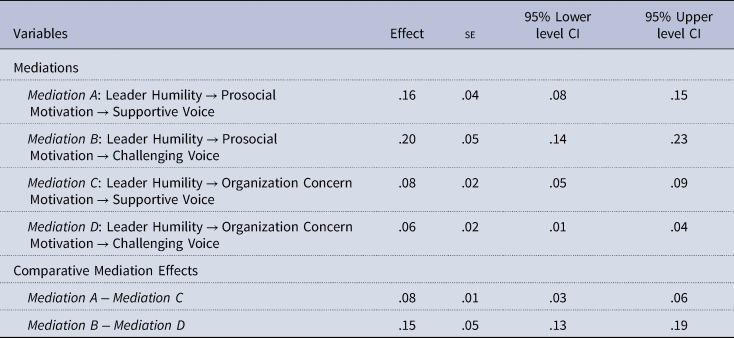
Note. N = 152.
Tests of multiple mediation effects
Hypotheses 5a and 5b argue the stronger mediation effect of prosocial motivation (compared with organization concern motivation) in directing the influence of leader humility on both supportive voice and challenging voice. The results in Table 4 show that as for supportive voice, the comparative mediation effect of prosocial motivation was significantly stronger than organization concern motivation (comparative indirect effect = .08, se = .01, 95% CI = [.03, .06]). Meanwhile, as for challenging voice, the comparative mediation effect of prosocial motivation was also significantly stronger than organization concern motivation (comparative indirect effect = .15, se = .05, 95% CI = [.13, .19]). Thus, hypotheses 5a and 5b were supported.
Discussion
Previous studies have argued that leader humility is an important quality that can influence various outcomes of employees in the workplace (e.g., Owens, Johnson, & Mitchell, Reference Owens, Johnson and Mitchell2013; Qin et al., Reference Qin, Liu, Brown, Zheng and Owens2021; Wang et al., Reference Wang, Owens, Li and Shi2018). However, while the other-oriented and motivational influence of humility has been implied in many studies, empirical support is limited. Integrating the tenets of social learning theory and motivational perspective as our theoretical framework, this study established conceptual linkage and provided empirical support for the dual other-oriented motivational model that connects leader humility with different forms of employee voice. Results showed that leader humility could drive prosocial motivation and organizational concern motivation of their subordinates, and both prosocial and organizational concern motivation mediate the influence of leader humility on employees' supportive and challenging voice. Furthermore, compared with the mediating effects of employees' organizational concern motivation, our findings reflect that employees' prosocial motivation plays a stronger and more significant mediating role.
Overall, these findings help provide a more fine-grained understanding of the positive social influence of leader humility on employees and shed light on overlooked subtle yet meaningful nuances by positing the dual-process model. These findings contribute significantly to existing research on leader humility, motivation, and voice.
Theoretical contributions
First, we contribute to the literature on humility by investigating and testing the other-oriented motivational effects of leader humility on employees, advancing our understanding of the underlying broader social influence of leader humility which goes beyond just self-interests (Ou et al., Reference Ou, Tsui, Kinicki, Waldman, Xiao and Song2014, Reference Ou, Waldman and Peterson2018; Owens & Hekman, Reference Owens and Hekman2012). By observing and learning from their humble leaders who care and acknowledge the value and ability of others in interpersonal communication, are willing to listen to and learn from others, and convey the message of appreciation to others (Mao et al., Reference Mao, Chiu, Owens, Brown and Liao2019), employees' desire to expand their efforts to help both individuals and their organizations can be stimulated (Bolino & Grant, Reference Bolino and Grant2016). The dual-process model in this study is among the first ones to link other-oriented motivations of followers with leader humility empirically, aligning with the argument that leader humility will enact a self-transcendent contagion (Silard, Miao, & Owens, Reference Silard, Miao and Owens2021). Since motivation is critical in explaining individual behavior (Grant, Reference Grant2008a), it is necessary and important to explore how leader humility can influence subordinates' different voice behaviors by stimulating their motivations. Besides, investigating such underlying mechanisms is also considered to be a principal part of constructing and testing theories in the management and organizational literature (Colquitt & Zapata-Phelan, Reference Colquitt and Zapata-Phelan2007). In addition to demonstrating the conceptual as well as empirical distinctiveness of the prosocial and organizational concern motivational contagion process of leader humility, this study is also among the first ones to try to further compare the mediating effects of different other-oriented motivations in explaining why leader humility can enhance subordinates' supportive as well as challenging voice. Hence, this study develops a more detailed account of the other-focused mediating approach of leader humility on subordinates' behavior, sharpening our knowledge of the prosocial contagion of expressed humility (Silard, Miao, & Owens, Reference Silard, Miao and Owens2021; Zhang, Li, & Liu, Reference Zhang, Li and Liu2021).
Second, this paper also enriches the literature on motivation. As a prevalent leadership style, leader humility is proved in this study to be an important antecedent of employee other-oriented OCB motivations, including both prosocial and organizational concern motivations (Rioux & Penner, Reference Rioux and Penner2001), consisting of the arguments that leadership is a source of context-based motivation (Kanfer, Frese, & Johnson, Reference Kanfer, Frese and Johnson2017; Latham & Pinder, Reference Latham and Pinder2005). Combining the core tenets of social learning theory, the research depicts how these two different other-serving motivations of subordinates can be shaped by leaders' expressing humility, and how these motivational forces can then drive employees' supportive and challenging voice (Grant & Mayer, Reference Grant and Mayer2009). Since jobs and the workplace nowadays have become increasingly social, prosocial motivation, which is likely to build mutually supportive connections with others, has emerged as a significant concern among organizational scholars (Crocker, Canevello, & Brown, Reference Crocker, Canevello and Brown2017; Grant & Shandell, Reference Grant and Shandell2022). For example, communal and other-concern motivations are found to facilitate effective team cooperation and thus benefit team performance (Hu & Liden, Reference Hu and Liden2015). The current research follows the recommendation of recent burgeoning research and extends the exploration of different sources and targets of social motivation (Grant & Shandell, Reference Grant and Shandell2022). Furthermore, the dual-process model and the comparison of the effects also paint a more complicated picture of social motivation that considers taking the interests of others into account and fulfilling one's duties and obligations to the organization. Aligning with prior research, the study also supports the notion that it may be premature to conclude that different types of OCB motivations have the same effects (Klotz et al., Reference Klotz, Bolino, Song and Stornelli2018). Specifically, we found that prosocial motivation plays a more important mediating role in explaining how humble leaders can promote both supportive and challenging voice behavior, reflecting the interpersonal and other-oriented nature of leader humility.
Third, we also advance voice research by responding to the call for more research on considering the motivational influence of humility on both challenging and supportive voice (Chamberlin, Newton, & Lepine, Reference Chamberlin, Newton and Lepine2017). Distinguishing different forms of voice helps clarify the impact of specific expressions on performance in the workplace and also puts forward the exploration of different antecedents of voice (Klaas, Olson-Buchanan, & Ward, Reference Klaas, Olson-Buchanan and Ward2012). Therefore, we contribute to the voice literature by exploring the role of leader characteristics and employees' motivational states in influencing the content and quality of different forms of voice behavior (King, Ryan, & Van Dyne, Reference King, Ryan and Van Dyne2019). Newton et al. (Reference Newton, Chamberlin, Maupin, Nahrgang and Carter2021) mention that extant research often overlooks supportive voice. However, both challenging and supportive voices are highly influential in workplace interactions (Burris, Reference Burris2012; Carnevale, Huang, Crede, Harms, & Uhl-Bien, Reference Carnevale, Huang, Crede, Harms and Uhl-Bien2017; Newton et al., Reference Newton, Chamberlin, Maupin, Nahrgang and Carter2021). Likewise, Maynes and Podsakoff (Reference Maynes and Podsakoff2014) argue that voicing behavior, under some circumstances, does not necessarily challenge the status quo. Thus, adopting the supportive-challenging classification of workplace voice would not only enrich the follow-up studies in this vein but also be valuable for both future research and management practice.
Managerial implications
This study also provides some practical insights for managers. The research highlights the functional role of leader humility in triggering subordinates' motivations and OCB in the workplace. Since leaders often act as role models and disseminators of the organization, employees can feel motivated to consider others around them and have more positive extra-role behaviors under the guidance of humble leaders. In order to create a harmonious, supportive, and caring organizational environment in which employees actively speak up and participate in promoting organizational changes, it is rewarding for leaders to cultivate and express their humility. Furthermore, our study provides evidence suggesting the underlying role of motivation in promoting voice. Trying to serve others and be constructive to the group creates a pivotal inner power for employees to sacrifice personal benefits and endure potential risks. Thus, encouraging contextual factors that could nourish ‘good soldiers’ is important to long-run organizational development.
Limitations and directions for future research
Although our research has several notable merits, such as adopting supervisor–subordinate dyads design to reduce common method bias, the current study also has limitations that should be noted, which we believe will also suggest avenues for future research.
First, there might be bidirectional explanations of the relationship between leader humility and employee voice, due to the possibility that leaders may express more humility to those who provide more suggestions. We cannot rule out this potential reverse causality with the current research design. However, our theoretical rationale based on social learning theory and the motivational perspective provides a valid argument against this possibility (Kelemen et al., Reference Kelemen, Matthews, Matthews and Henry2022). Previous studies have provided sufficient evidence that followers' motivation can be affected by leaders' characteristics or relationships, which then, in turn, impact their actions (Bandura, Reference Bandura1986; Kanfer, Frese, & Johnson, Reference Kanfer, Frese and Johnson2017), providing us with a solid theoretical background in making inferences about the relationships. However, we still encourage future research to employ alternative research designs like field or lab experiments to draw conclusions of causality.
Second, the data collection technique would have inherent shortcomings, such as a potentially biased sample with self-selected participants. However, we took measures to control the data collection process to strengthen its objectiveness and voluntariness by making clear statements about our research purpose and procedure and providing monetary incentives. Noteworthily, as previous research indicated, the snowball sampling method appears to be common in management research (e.g., Meyer et al., Reference Meyer, Hsiao, Viglione, Mihura and Abraham2013) and allows us for diversity in terms of organization type, company, and even sectors, and thus can enhance the generalizability of our research (Kausel, Culbertson, & Madrid, Reference Kausel, Culbertson and Madrid2016). We encourage future studies to use other sampling methods to collect data and examine our hypotheses.
Third, the current research has not taken the contextual factors or the boundary conditions under which the motivational impact of leader humility exists or becomes stronger or weaker into account. Future research is encouraged to conduct more investigations in exploring its moderators. For example, certain individual attitudinal factors such as need for competence and relatedness may affect the strength of relationships for those with higher motivation (Van den Broeck, Ferris, Chang, & Rosen, Reference Van den Broeck, Ferris, Chang and Rosen2016). Besides, how employees perceive and attribute leader humility matters (Oc, Daniels, Diefendorff, Bashshur, & Greguras, Reference Oc, Daniels, Diefendorff, Bashshur and Greguras2020; Qin et al., Reference Qin, Chen, Yam, Huang and Ju2020), thus leader humility's hypothetical role in promoting employees' motivation is open to question. Moreover, the current research does not directly consider the interactional effect between leader humility and employee humility. Future research could investigate whether humble leaders and humble employees are perfect matches for management and performance.
Conclusion
Leader humility has a profound impact on building high-quality relationships and promoting collaborations in organizations. Drawing on social learning theory and taking a motivational perspective, we develop a dual-path model that illustrates the other-oriented motivational impact of leader-expressed humility, revealing how leader humility promotes employee supportive and challenging voice through triggering both the desire to benefit others and the desire to benefit the overall organization. Through highlighting the interpersonal and other-focused essences, our research provides nuanced insights into the leader humility literature. We hope that this emphasis will inspire more research to further explore the valuable role of leader humility in creating a harmonious workplace.
Financial support
This study was supported by the Humanity and Social Science Foundation of Ministry of Education of China (No. 21YJC630178).
Conflict of interest
The authors declare that the research was conducted in the absence of any commercial or financial relationships that could be construed as a potential conflict of interest.
Qiwei Zhou is an assistant professor in the Department of Business Administration, Management College, Ocean University of China, China. Her research interests include leadership, organizational behavior, human resource management, and digital transformation.
Keyu Chen is a doctoral candidate in the Department of Leadership and Organization Management, School of Economics and Management, Tsinghua University, China. His research interests include interpersonal process, leadership, and organizational behavior.