INTRODUCTION
Greater yam (Dioscorea alata) is grown predominantly under tropical conditions and has been grown in India since ancient times. It is currently cultivated in the states of Orissa, Andhra Pradesh, Kerala and Tamil Nadu, and the North Eastern states. The bulk of yam cultivation is confined to homesteads while commercial cultivation is practised in some parts of Orissa, Andhra Pradesh and Kerala.
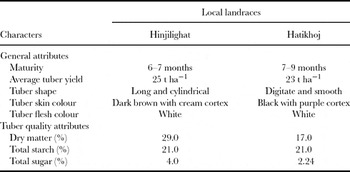
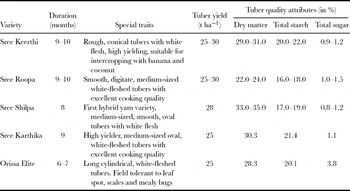
Greater yam plays a crucial role in the food and nutritional security of geographically, socially and economically disadvantaged people of Orissa. This state occupies an important place owing to its wide genetic variability, diversified consumption patterns and religious beliefs associated with the yams. The demand for yam tubers is high during the planting season (May–June) and the festival season (October–December), and the tuber price goes as high as US$0.40–0.45 per kg. Yam farmers in Orissa grow local landraces mostly for household consumption. Some of the popular landraces and their characteristics are given in Table 1. Despite their popularity, the local landraces are poor yielders (15–20 t ha−1) due to their low genetic potential. Realizing the need to enhance yam productivity, the Central Tuber Crops Research Institute, Thiruvananthapuram, India, and its Regional Centre (RCCTCRI) in Bhubaneswar, have developed six improved yam varieties. The improved yam varieties and their salient characteristics are given in Table 2. The poor adoption of improved yam varieties is a major concern for tuber crop research managers since substantial resources have been invested in yam improvement. Further, lack of awareness and shortage of planting materials are not serious problems since the Department of Horticulture, Government of Orissa and RCCTCRI, Bhubaneswar, have conducted extensive outreach programmes in Orissa over the past five years and also supplied an adequate quantity of planting materials for the farmers.
Characteristics of two popular local landraces of greater yam (D. alata) cultivated in Orissa, India.

Salient features of greater yam varieties released by Central Tuber Crops Research Institute, Thiruvananthapuram, India.

Adapted from Abraham et al. (Reference Abraham, Edison, Unnikrishnan, Sheela, Vimala, Sreekumari and Naskar2006).
In general, the traditional crop breeding programmes have focused on developing varieties that produce high yields under improved crop management conditions. However, the farmer participatory studies conducted in India (Anantharaman and Ramanathan, Reference Anantharaman and Ramanathan2002) and in Benin (Zannou et al. Reference Zannou, Richards and Struik2006) revealed that farmers demanded yam varieties possessing special attributes, such as adaptability to soils and culinary quality, besides high yield and disease resistance. Such multi-attribute varietal preferences of the farmers are influenced by the production systems under which yams are cultivated (Anantharaman and Ramanathan, Reference Anantharaman and Ramanathan2002). So, it is essential to identify the farmers' preferred yam varietal attributes across production systems so that new varieties can be developed incorporating these characters.
The purpose of this study was to identify what varietal attributes of greater yam the farmers preferred most and also to assess the influence of production systems (subsistence and commercial) on these preferences in order to redefine breeding objectives to maximize the utility of improved varieties.
MATERIALS AND METHODS
Study area
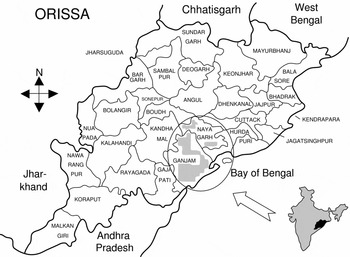
This study was conducted in Ganjam and Nayagarh districts of Orissa state (Figure 1). Since these districts encompass the bulk of the yam-growing areas of the state, they were chosen purposefully for this study. Orissa state is located between the latitudes of 17°49′N and 22°34′N and longitudes 81°27′E and 87°29′E. Orissa is predominantly an agricultural state: 85% of its total population lives in rural areas and about 65 % of the total workforce depends on agriculture (Directorate of Agriculture & Food Production, 2006). The selected districts received an average annual rainfall of 1363 mm falling mainly in the months of June to September and the mean monthly temperature ranges from 19 °C to 42 °C. A variety of crops like rice, maize, ground nut, sugar cane, oil seeds, finger millet, yams, sweet potato, taro and pulses are grown in these districts.
Map showing major yam growing districts of Orissa.

Data collection
Data collections were conducted during March–June 2008 in four stages. Initially, the yam production systems in Ganjam and Nayagarh districts were identified, and then farmers' preferences for yam varietal attributes were collected and were subsequently ranked by the farmers. Finally, culinary quality of yam tubers was assessed through sensory evaluation. A separate set of farmers (representing an individual production system) participated in each the four stages of data collection.
Identification of yam production systems
The production system analysis was conducted in four villages in the yam tracts of Ganjam and Nayagarh districts (two villages for each district). The villages were carefully chosen after detailed discussion with officials from Directorate of Horticulture, Government of Orissa, and scientists of RCCTCRI, Bhubaneswar, who had previous experience in working with yam farmers in the selected districts. Data were collected through a combination of observational methods and key informant interviews. At the beginning, transect walks were undertaken across each village to analyse the agro-ecological conditions, cropping patterns, etc. This was followed by the key informant interviews with those who had ten years experience in yam cultivation and were willing to participate in the study. Ten key informants (8 men, 2 women) from each selected village described yam cultivation practices followed in their locality. Secondary data on agro-climatic and soil conditions of the villages were collected from the Directorate of Horticulture, Government of Orissa.
Identification of farmers' preference for varietal attributes
The farmers' preferences for varietal attributes were identified through Focus Group Discussion (FGD). Two FGDs were conducted with a total of 20 randomly selected farmers comprising ten farmers in each production system (8 men, 2 women). The farmers' responses were elicited through a standardized question route. At the beginning of each FGD, the farmers were asked to list desirable yam varietal attributes, which were further analysed to identify the most desirable ones. Initially, the farmers identified 17 varietal attributes as desirable traits for an improved yam variety, which were reduced to 11 during the subsequent discussions.
Ranking of varietal attributes
A ranking exercise was conducted with 30 randomly selected farmers from each production system (24 men, 6 women). During the exercise, a chart displaying 11 yam varietal attributes (identified through FGD) was shown to each farmer, and he/she was asked to rank these attributes by placing stones against each attribute. The rank 11 was assigned to the most preferred attribute while rank 1 was given to the least preferred. This reverse order of ranking was used to make data amenable for multiple comparisons among the attributes during the statistical analyses.
Sensory evaluation
Assessment of the culinary quality of the new breeding lines through sensory evaluation is essential to ensure acceptability of new yam varieties (Otegbayo et al. Reference Otegbayo, Aina, Asiedu and Bokanga2006). To identify the sensory attributes which determine acceptability of cooked yam tubers, a consumer evaluation session was conducted with 42 randomly chosen farmers (32 men, 10 women). Tubers of two popular yam landraces, Hinjilighat and Hatikhoj, were cut into pieces of 50 g weight and boiled in water for 20 minutes. After the introductory session conducted to familiarize panellists with the sensory evaluation procedure, the samples were served individually to each respondent for culinary quality evaluation. The consumers evaluated culinary quality of the boiled yam tubers in terms of the sensory characters such as appearance, colour, texture, odour and taste on a specifically constructed 9-point hedonic scale (1 = dislike extremely, 5 = neither like nor dislike and 9 = like extremely). The consumer panellists also indicated their acceptability of each sample on a nominal scale (1 = acceptable and 0 = not acceptable).
Data analysis
Data on farmers' ranking of varietal attributes were subjected to non-parametric statistical analyses using the Kendall coefficient of concordance (W) and Friedman analysis of variance. The Kendall's W indicated the agreement among farmers in the ranking of varietal attributes. Generally, the value of W ranges between 0 and 1, where 1 designates perfect concordance, and 0 indicates no agreement or independence of samples (Conover, Reference Conover1999). The Friedman analysis of variance was performed to establish significant differences among farmers' rankings among the varietal attributes. This test determines whether the rank totals for each parameter differ significantly from the values, which would be expected by chance. An extension of the Friedman test (Conover, Reference Conover1999) was used for multiple comparisons of different ranks to identify the relative importance of each attribute. To identify differences in ranking of varietal attributes by farmers of each production system, the Mann–Whitney U test was performed.
The sensory evaluation data were subjected to binary logistic regression to assess the effect of each sensory attribute on consumer acceptability while statistically controlling other attributes (Hosmer and Lemeshow, Reference Hosmer and Lemenshow1989). During the analysis, the logistic regression parameters were estimated through the forced entry method. All the statistical analyses were carried out using statistics software SPSS (SPSS software for Windows release 10.0; SPSS Inc., Chicago, IL, USA).
RESULTS AND DISCUSSION
Yam production systems
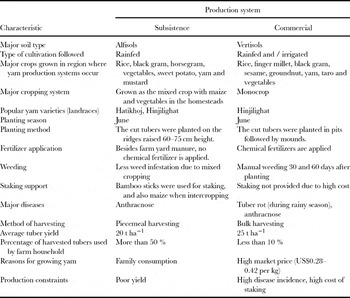
The two yam production systems, subsistence and commercial, were identified using the criteria: (i) the agro-climatic and soil conditions under which yams are cultivated, and (ii) the proportion of harvested yam tubers retained for own use, i.e. for seed and /or consumption. The chief characteristics of the two production systems are described in Table 3.
Characteristics of greater yam production systems in Orissa, India as indicated by farmers.

In the subsistence system, the yams were grown in Alfisols of sandy loam texture. These soils were acidic (pH: 4.5–5.8) and relatively infertile due to their small organic matter content (0.32%). Available N (205 kg ha−1) and P (10.5 kg ha−1) were relatively low while K content was of medium status (185 kg ha−1). Under the commercial system, the yams were cultivated in deep Vertisols with an effective soil depth extending to more than 100 cm. The soil pH was neutral to alkaline (8.0–8.5) with a more favourable fertility status than the Alfisols (available N 285 kg ha−1, P 13.4 kg ha−1 and K 212 kg ha−1).
Under the subsistence system, the yams were grown mainly in homesteads as a mixed crop with maize and vegetables. In this system, the farmers stored more than 50% of the produce either for household consumption or as seed material for the next season. In contrast, the commercial farmers stored less than 10% of their produce for seed and food needs. In the subsistence system, although low input management conditions prevailed, bamboo staking was provided. In contrast, commercial farmers adequately irrigated and fertilized their yam crop but avoided staking owing to its higher cost. Since yams were raised as a monocrop in the commercial production system of Orissa, the weed infestation was relatively higher than in the subsistence system. Whereas, piecemeal harvesting was widely followed in the subsistence system, the crop was harvested in bulk by the commercial farmers.
This study showed that both two subsistence and commercial yam production systems are found in Orissa. Similar production systems were reported by Anantharaman and Ramanathan, (Reference Anantharaman and Ramanathan2002) and Ramanathan et al. (Reference Ramanathan, Anantharaman, Sheela, George, Naskar, Nedunchezhiyan, Rajasekhrara Rao, Sivakumar, Ray, Misra and Mukherjee2006) in Kerala state, India. As in the present study, Nedunchezhiyan et al. (Reference Nedunchezhiyan, Byju and Naskar2006) in Orissa reported that the commercial yam producers in Orissa avoided staking due to its laborious nature and high cost.
The farm women contributed significantly to yam cultivation in both systems. In the subsistence system, the women members of the farm family performed over 90% of the work in yam cultivation including seed selection, planting, fertilization, staking, weeding, harvesting and storing tubers. Similarly, Krishnapillai (Reference Krishnapillai2005) reported that yam cultivation in poor households of Yap Island, Federated States of Micronesia, was primarily carried out by the women farmers. In contrast, the women's role was restricted to only 10% and confined to manual weeding in the commercial systems of Orissa.
Identification of desirable varietal attributes
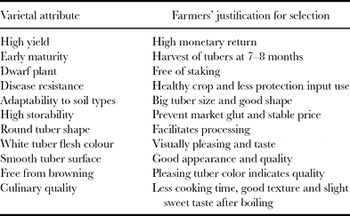
In the FGD, the farmers initially identified 17 varietal attributes as desirable traits for an improved yam variety. They include high yield, round tuber shape, faster growth, pest and disease resistance, early maturity, high storability, brown skin colour, white tuber flesh colour, rose tuber rind colour, high starch content, dwarf plant, adaptability to wide range of soil types, free from browning after cutting, smooth tuber surface and culinary quality. During discussion, the appropriateness, relevancy and feasibility of each attribute were discussed. Eleven varietal attributes were finally chosen for further ranking. Selected attributes along with farmers' justification for their inclusion are given in Table 4.
Eleven varietal attributes of greater yam preferred by the farmers.

Preference for varietal attributes
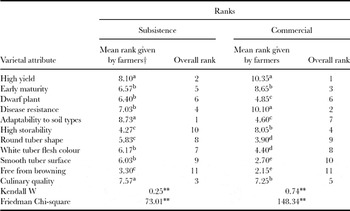
The mean rank and overall ranks of the varietal attributes in each of the production systems are shown in Table 5. In the subsistence production system, the farmers ranked the ‘adaptability of the yam variety to various soil types’ ahead of other attributes. The subsistence farmers also preferred the ‘high yield’, ‘culinary quality’, ‘disease resistance’ and ‘early maturity’ as favourable attributes. The attributes such as ‘high storability’ and ‘free from browning after cut’ were least preferred. Under the commercial production system, the farmers chose ‘high yield’ and ‘disease resistance’ as the important varietal attributes. ‘Early maturity’, ‘high storability’ and ‘culinary quality’ were equally preferred. As for the subsistence system, the attribute ‘free from browning’ was least preferred by the commercial farmers.
Mean ranks and agreement coefficients of yam varietal attributes.‡

† Rank order reversed (1: least preferred; 11: most preferred).
‡ Values followed by same letter indicates no significant difference among those attributes (p < 0.05).
** Significant at 1% level (p < 0.01).
Analysis of the ranked varietal preferences of the subsistence and commercial production systems yielded Kendall's W values of 0.25 and 0.74, respectively (Table 5). Both W coefficients were significant at the 0.01 level indicating that the farmers applied the same standards in ranking varietal attributes in the two production systems. The highest degree of agreement was obtained for commercial farmers while the subsistence farmers exhibited a lower level of agreement across the ranks, although W was significant. Past studies have established that the convergence (uniformity in the preferences) of varietal preference criteria was closer in the market-oriented production systems, whereas the subsistence farmers exhibited a wide divergence (differences in the preferences) in their varietal preferences, mainly due to their diverse production goals (Courtois et al. Reference Courtois, Bartolome, Chaudhary, McLaren, Misra, Mandal, Pandey, Paris, Piggin, Prasad, Roy, Sahu, Sahu, Sarkarung, Sharma, Singh, Singh, Singh, Singh, Singh, Singh, Sinha, Sisodia and Takhur2001).
A Friedman analysis of variance (ANOVA) test was conducted to determine whether farmers assigned different ranks for the 11 varietal attributes in each system. The results indicated that there was a differential rank ordered preference for subsistence yam farmers [χ2 (10) = 73.01, p < 0.01] (Table 5). A post-hoc comparison of the rank ordered preferences for the 11 attributes indicated that no significant difference was observed among ‘adaptability to soil types’, ‘high yield’ and ‘culinary quality’ (p < 0.05). Since the farmers ranked these attributes relatively high among others, yam breeders should understand their importance in the subsistence production system and use them as primary breeding objectives in yam improvement programmes. The attributes of ‘disease resistance’, ‘early maturity’, ‘white tuber flesh colour’, ‘dwarf plant’ and ‘smooth tuber surface’ also exhibited uniformity in preference (p < 0.05). The attributes ‘round tuber shape’, ‘high storability’ and ‘free from browning’ were also similarly ranked (p < 0.05).
The analysis of ranks of commercial farmers indicated that there was a significant differential rank ordered preference of varietal attributes [χ2 (10) = 148.34, p < 0.01]. The post-hoc multiple comparison of the attribute ranks (Table 5) indicated that the farmers assigned similar importance to ‘high yield’ and ‘disease resistance’. Thus, a breeding programme for commercial yam farmers should focus on maximizing yield while improving disease resistance. There was no significant difference observed among ‘early maturity’, ‘high storability’ and ‘culinary quality’ (p < 0.05). The preference for ‘dwarf plant’ and ‘adaptability to wide range of soil types’ was similar and the attributes ‘white tuber flesh colour’, and ‘round tuber shape’ were equally ranked (p < 0.05). The least preferred characters ‘smooth tuber surface’ and ‘free from browning’ were also similarly ranked (p < 0.05).
The present study revealed that the farmers demanded varieties with good consumption characters (round tuber shape, high storability, white tuber flesh colour, free from browning, smooth tuber surface and culinary quality) besides high yield and disease resistance. These results are consistent with the findings of Anantharaman and Ramanathan (Reference Anantharaman and Ramanathan2002), who reported that the tribal farmers of Kerala used varietal attributes like high yield, good cooking quality, tuber shape, tuber size, adaptability and storage as criteria for evaluating the yam varieties. Zannou (Reference Zannou2006) also reported that the yam farmers of Benin in West Africa screened improved varieties based on their adaptability to soil types, resistance to drought as well as pests and diseases, earliness, possibility of storing and pounding roots, and higher market price. Similar results were recorded by Vernier and Dansi (Reference Vernier, Dansi, Nakatani and Komaki2000) among farmers of Benin.
Differences in varietal preferences
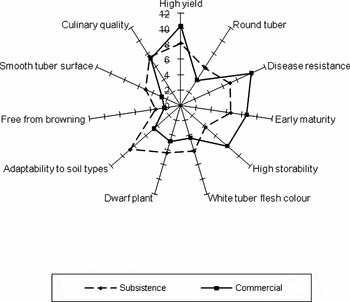
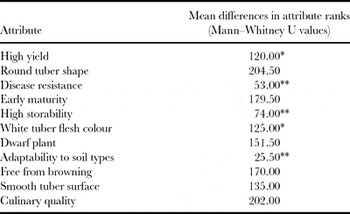
The graphical depiction of the rank order of attributes revealed that the varietal preferences of farmers in the two systems were dissimilar (Figure 2). The radar chart indicates wider differences in the ranks of ‘adaptability to soil types’, ‘high storability’ and ‘disease resistance’. Moderate differences were observed in the ranks of ‘early maturity’, ‘high yield’, ‘round tuber shape’, ‘white tuber flesh colour’ and ‘dwarf plant’, while attributes like ‘free from browning’, ‘smooth tuber surface’ and ‘culinary quality’ exhibited only a small difference. To test whether the attribute-wise ranks of both systems were significantly different, the data were subjected to a Mann–Whitney U test (Table 6). The mean ranks of ‘disease resistance’, ‘high storability’ and ‘adaptability to soil types’ differed significantly (p < 0.01) which indicated the wider variations in the farmers' preferences between the two production systems. The attributes ‘high yield’ and ‘white tuber flesh colour also differed significantly but to a lesser extent (p < 0.05). ‘Round tuber shape’, ‘early maturity’, ‘dwarf plant’ and ‘culinary quality’ were similarly ranked in both the production systems. Past studies also established that the crop production systems could influence varietal choices of the farmers (Anantharaman and Ramanathan, Reference Anantharaman and Ramanathan2002; Ramanathan et al. Reference Ramanathan, Anantharaman, Sheela, George, Naskar, Nedunchezhiyan, Rajasekhrara Rao, Sivakumar, Ray, Misra and Mukherjee2006; Vernier and Dansi, Reference Vernier, Dansi, Nakatani and Komaki2000).
Radar chart showing mean ranks of varietal attributes at two production systems of Orissa, India (11 – most preferred; 1 – least preferred).

Mean differences in ranking of yam varietal attributes by farmers of subsistence and commercial production systems.

* Significant at 5% level (p < 0.05).
** Significant at 1% level (p < 0.01).
In the commercial yam system, the main production objective was to maximize tuber yield with minimal expenditure. The commercial farmers of the study area suffered yield loss to the extent of 40% due to diseases like yam anthracnose in unstaked cultivation (Nedunchezhiyan et al. Reference Nedunchezhiyan, Byju and Naskar2006). So, they demanded varieties which produce reasonably good yield even under biotic (anthracnose) and abiotic (drought) stresses. Besides, the commercial farmers sold over 90% of their produce immediately after harvest due to perishability of the tubers, and purchased seed materials from other sources in the next season. Hence, they demanded varieties with high storability, which could assure them remunerative price during the off-season (May–June and October–December). On the other hand, the subsistence farmers grow yams in relatively infertile Alfisols, and as a consequence, the tuber yield was relatively lower than the commercial system. So, they demanded varieties which can produce stable yield in the major soil types of the production system. Since the subsistence farmers cultivated yams mainly to meet their household food needs, they stored over half of the harvested tubers. Consequently, they had higher preference for consumption characters like ‘culinary quality’ and ‘white tuber flesh’ than the commercial farmers. This study envisages that the yam breeding efforts should give equal emphasis to consumption characters along with the traditional breeding targets like the ‘high yield’ and ‘disease resistance’. The farmers of both production systems ranked varietal attributes of ‘round tuber shape’, ‘early maturity’, ‘dwarf plant’, ‘free from browning’, ‘smooth tuber surface’ and ‘culinary quality’ on an equal footing (Table 6).
Sensory evaluation
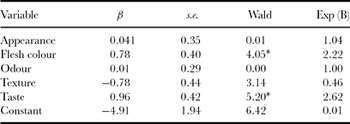
The sensory evaluation data of five parameters (appearance, flesh colour, texture, odour and taste) were subjected to binary logistic regression. The logistic model correctly predicted the number of farmers falling under each of the two culinary quality acceptability categories (acceptable: 23; not acceptable: 14) with an accuracy of 88%. In addition, the smaller values of –2 log-likelihood statistic (21.67), significant model chi-square statistic (31.45) and non-significant Hosmer and Lemeshow goodness-of-fit statistic (13.55) indicated that the model has successfully predicted the culinary quality acceptability. The R2 (coefficient of determination) estimates (Cox and Snell R2 = 0.46 and Nagelkerke R2 = 0.62) indicated that approximately 46% and 62%, respectively of the variance in the sensory data which determined the culinary quality acceptability, could be predicted from the linear combination of the five sensory variables (Field, Reference Field2000). In this model, the coefficients of the colour and taste attributes of the yam tubers (Wald) were significant at the 5% level indicating their influence in predicting the culinary quality acceptability (Table 7). The exponential odds ratio of taste (2.62) indicated that the probability of a panellist liking taste and accepting the culinary quality of a cooked yam sample is approximately three times higher than for those who did not like the taste. In sensory terms, taste is a major indicator of sweetness of the tubers after cooking (Nindjin et al. Reference Nindjin, Otokoré, Hauser, Tschannen, Farah and Girardine2007). Consequently, this finding has wide implications for the yam breeding programme as the improved varieties had lower total sugar content (0.8–1.5%) (Table 2) compared with the local landraces (2.24–4.0%) (Table 1). Similarly, the odds of liking the flesh colour (2.22) and accepting the culinary quality are approximately two times higher than for those who did not prefer colour. These results are consistent with the findings of Vernier and Dansi (Reference Vernier, Dansi, Nakatani and Komaki2000), who reported that the Benin farmers weighed the organoleptic quality of yam tubers as the most important criterion for choosing improved white yam varieties. Studies conducted by Anantharaman and Ramanathan (Reference Anantharaman and Ramanathan2002) and Ramanathan et al. (Reference Ramanathan, Anantharaman, Sheela, George, Naskar, Nedunchezhiyan, Rajasekhrara Rao, Sivakumar, Ray, Misra and Mukherjee2006) also corroborated this view. These results show that the breeders need to look into the quality aspects of tubers too while evolving new yam varieties.
Logistic regression coefficients of culinary quality acceptability.

Symbols and abbreviations used in the column headings:
β: coefficients in the logistic regression equation.
s.e.: standard error of the coefficients.
Wald: Wald statistic.
Exp (B): proportionate change in odds.
* Significant at 5 % level (p < 0.05).
Implications for yam breeding
Although this study focused on a relatively small number of farmers, the results have wider implications. It demonstrated that the production system characters influenced the varietal choices of the farmers.
Yam breeding programmes worldwide have traditionally focused on economic characteristics such as yield and disease resistance, which were found to be the major attributes of commercial systems. In this investigation, it was found that the commercial farmers suffered yield loss due to anthracnose; however, no released variety was found to be resistant to this disease (Table 2). Besides, the commercial farmers preferred the yam varieties with high storability. Studies conducted at RCCTCRI revealed that the improved yam varieties could not be stored for a long time in local conditions in Orissa due to high incidence of dry rot disease (Nedunchezhiyan et al. Reference Nedunchezhiyan, Byju and Naskar2006). However, the local landraces were relatively free from this disease. Under the subsistence system, the yam farmers demanded varieties which can produce stable yield across the soil types. However, no released variety could cater to this need (Table 2). Contrary to wider belief, the consumption characteristics like tuber shape, colour and taste also determined farmers' choice of the yam varieties. Similarity in the ranking of the varietal attributes of round tuber shape, early maturity, dwarf plant, free from browning and smooth tuber surface show the convergence of farmers preferences among the two production systems.
The information about the relative importance of varietal attributes in each system and their convergence/divergence across the production systems, can guide our plant breeders in identifying potential adopters and planning their breeding efforts to develop varieties which suit their requirements. This approach also can help breeders to identify general and specific ‘recommendation domains’ as well as the ‘consumer segments’ towards which extension efforts should be directed to achieve desired impact. When a yam variety is intended for a large geographical area comprising of two or more production systems, the breeders can retain convergent attributes, and incorporate divergent attributes based on the importance they place on each production systems. If adopted, this ‘need-based segmentation approach’ can maximize the utility of the yam varieties thus enhancing their chances of adoption.
Acknowledgements
The authors thank Dr B. Parasar, Professor, Department of Extension Education, Orissa University of Agriculture & Technology, Bhubaneswar, India and Dr S. K. Naskar, Head, Regional Centre of Central Tuber Crops Research Institute, Bhubaneswar, Orissa, India for providing valuable suggestions and extending necessary facilities for carrying out this work.