Introduction
Dementia is an umbrella term used to describe the clinical manifestation of underlying brain pathology resulting in progressive decline in cognition, behavior, and independent functioning (McKhann et al., Reference McKhann2011). Dementia affects not only an individual but also those close to them. Family members play an important role in the everyday care and support of people with dementia. Research exploring family experiences of dementia acknowledges the physical, emotional, and social effects of caregiving (Lyman, Reference Lyman1989; Kitwood and Bredin, Reference Kitwood and Bredin1992; Harris, Reference Harris2010). Such research also offers an insight into gaps in clinical services, particularly those relating to diagnosis and intervention.
While most research with family members explores experiences post-diagnosis, there are a number of reasons to focus attention on the pre-diagnostic phase. Family members are often the first to recognize early signs of dementia and to seek a diagnosis (Eustace et al., Reference Eustace2007; Bunn et al., Reference Bunn2012; WHO, 2012; Chrisp et al., Reference Chrisp, Tabberer and Thomas2013). Time from symptom onset to seeking a diagnosis ranges from 2.4–3 years across dementia syndromes (Boise et al., Reference Boise, Morgan, Kaye and Camicioli1999; Speechly et al., Reference Speechly, Bridges-Webb and Passmore2008; Chrisp et al., Reference Chrisp, Thomas, Goddard and Owens2011). This represents a significant period during which family members observe and make inferences about changes. Symptoms manifest differently depending on an individual's personality and often the separation between person and disease is indistinct (Burns and Iliffe, Reference Burns and Iliffe2009). In diagnostic settings, family members are key informants, providing information on the onset of signs and symptoms and describing how the condition manifests in the person with dementia. In this way, the pre-diagnostic phase and caregivers’ interpretation of symptoms determines the early diagnostic information healthcare professionals receive.
The indistinct boundary between dementia symptoms and pre-morbid personality causes uncertainty for families, even post-diagnosis. Paton et al. (Reference Paton, Johnston, Katona and Livingston2004) found that common dementia symptoms were often interpreted by families as reflecting pre-morbid personality, depression, physical illness, medication, or denial. Attributing symptoms to longstanding personality affects family attitudes to the person with dementia; indeed, many caregivers report believing that challenging behaviors in dementia are under conscious control (Paton et al., Reference Paton, Johnston, Katona and Livingston2004; Quinn et al., Reference Quinn, Jones and Clare2016). As a result of such beliefs, Quinn et al. (Reference Quinn, Jones and Clare2016) suggest that families may disregard information inconsistent with their experience of dementia in their family member. The difficulty distinguishing between personality and symptoms is perhaps a consequence of the subtlety of early signs and the slow, insidious onset of dementia. By focusing on this pre-diagnostic period, we can explore how families make sense of the onset of changes, and how this contributes to later ideas about dementia.
At present, the qualitative research exploring family perspectives on the pre-diagnostic phase of dementia is fragmentary, with available studies varying in focus (e.g. carer burden, barriers to diagnosis) and sample (e.g. diagnosis type, age of onset, relationship to person with dementia). We aimed to synthesize qualitative research exploring family members’ experiences of the pre-diagnostic phase of dementia, as a means of identifying gaps in the research and informing clinical practice.
Method
Search strategy
We adopted a comprehensive search strategy, using the SPIDER method developed by Cooke et al. (Reference Cooke, Smith and Booth2012) to define the search terms. The SPIDER method is tailored to qualitative or mixed-method research questions to ensure maximum retrieval of relevant research. The chosen search terms reflect the SPIDER acronym, with terms related to sample (i.e. family), phenomenon of interest (i.e. dementia and pre-diagnosis), evaluation (i.e. experience of families), and research type (qualitative or mixed method). The following databases were searched via institutional access on January 8th 2016: Medline, EMBASE, PsycINFO, CINAHL, and Web of Science. We also consulted an information specialist to help maximize the efficacy of the search across different databases and optimize sensitivity to locating qualitative research. No limits were placed on the range of years surveyed. The chosen search terms are presented in Table S1 (available as supplementary material attached to the electronic version of this paper at http://journals.cambridge.org/IPG).
Table 1 summarizes inclusion and exclusion criteria. Qualitative research was defined in line with the Cochrane Collaboration definition, by both the techniques used (e.g. in-depth interviews) and the methodological and theoretical approaches to study design and data analysis (e.g. phenomenology) (Noyes et al., Reference Noyes, Popay, Pearson, Hannes, Booth, Higgins and Green2011). Participants were family members of a person who had been diagnosed with a type of dementia. We excluded studies with mixed samples, including health professionals or people with dementia, unless family perspectives could be clearly distinguished from other participants’ views. Pre-diagnosis was defined as the period from the initial onset of symptoms up to the formal diagnosis; studies covering broader periods were included provided this was distinct from post-diagnostic experiences. For practical reasons, we included only English language publications. Conference abstracts, editorials, and syntheses of data published elsewhere were excluded, as these did not provide sufficient primary evidence for inclusion.
Inclusion and exclusion criteria

Qualitative studies are often poorly indexed in databases and thus supplementary search strategies are imperative to a comprehensive search (Noyes et al., Reference Noyes, Popay, Pearson, Hannes, Booth, Higgins and Green2011; Sandelowski, Reference Sandelowski and Cooper2012). The following supplementary strategies were used: hand searching key journals; searching reference lists; citation tracking; researchers’ personal bibliographies; and internet (Google) search. This ensured that unpublished studies originally identified in forms such as conference abstracts were identified in other published forms where possible (e.g. books, theses, and materials from voluntary/government organizations).
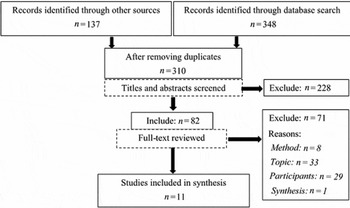
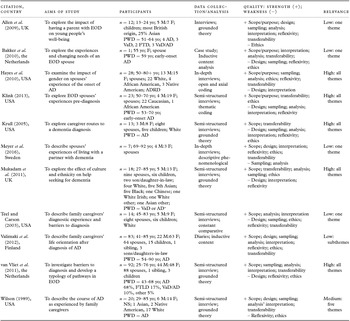
Figure 1 depicts a flow chart of the search. The database search yielded 348 papers with 137 papers from supplementary searches. After removing duplicates, 310 papers remained. Titles and abstracts were then screened, leaving 82 full-text papers for review. One reviewer (KR) used a template to determine if an article met inclusion criteria, and to record reasons for exclusion. Where paper eligibility was unclear for any reason, consensus from two raters was required. Overall, principal reasons for exclusion were 33 for topic, 29 for participants, 8 for method, and 1 for synthesis of primary research. Table 2 outlines the characteristics of the 11 papers included in the final sample.
Flow chart of search strategy.

Characteristics of the included studies

Key: PWD = People with dementia; yo = years old; M = male; F = female; AD = Alzheimer's dementia; ADRD = Alzheimer's disease and related disorders; FTD = frontotemporal dementia; FTLD = frontotemporal lobar degeneration; VaD = vascular dementia; VaD/AD = mixed dementia; EOD = early-onset dementia.
*Diagnosis type established by personal correspondence with first author.
Appraisal of study quality
We decided a priori to include studies of any quality in the synthesis to avoid the exclusion of valuable evidence due to methodological weakness (Barbour, Reference Barbour2001). Papers included in the final sample were appraised for overall quality to assist in contextualizing the way the findings were produced (Noyes et al., Reference Noyes, Popay, Pearson, Hannes, Booth, Higgins and Green2011). Despite much debate, there is no current consensus on how to evaluate the quality of studies for qualitative synthesis (Mays and Pope, Reference Mays and Pope1995; Barbour, Reference Barbour2001; Walsh and Downe, Reference Walsh and Downe2006; Dixon-Woods et al., Reference Dixon-Woods2007; Sandelowski, Reference Sandelowski2015). The framework established by Walsh and Downe (Reference Walsh and Downe2006) was chosen, as it covers a broad range of criteria, allowing for a detailed appraisal of quality. An overview of this framework and how it was applied to the included studies can be found in Table S2.
In addition to quality, the themes produced by each study were rated high, medium, or low for relevance to the aim of the synthesis. Thus, for studies that covered a broader period than pre-diagnosis (e.g. diagnosis, post-diagnosis), only the themes relating to pre-diagnosis were included. For example, only one of five themes was extracted from the study by Allen et al. (Reference Allen, Oyebode and Allen2009) because the remaining themes pertained to the post-diagnostic period. High indicated 100% of themes were relevant, medium indicated that more than 50% of themes were relevant, and low indicated less than 50% of themes were relevant. Table 2 provides an overview of the quality and relevance of each study.
Procedure
There are multiple methods for conducting qualitative synthesis; the choice of method is primarily dependent on the purpose (Cooke et al., Reference Cooke, Smith and Booth2012). We chose thematic synthesis as this matched the purpose of integrating information to inform practice (Thomas and Harden, Reference Thomas and Harden2008). Thematic synthesis involves three stages: (1) line-by-line coding of text; (2) organization of codes into descriptive themes; and (3) interpretation into analytical themes, which are driven by the research aim (Thomas and Harden, Reference Thomas and Harden2008). These techniques use constant comparison to ensure analysis remains grounded in the data.
The included papers were reviewed prior to coding. Following Thomas and Harden (Reference Thomas and Harden2008), we considered relevant data to include all text labeled as “results” or “findings,” including both summary findings and verbatim quotes. This included 171 verbatim quotes across studies (Range: 1–43). Data were entered verbatim into NVivo10 for Windows (QSR, 2012). The three stages of analysis were documented in an audit trail, including memos and records of decisions made in determining themes.
Line-by-line coding was completed by a single reviewer (KR) and resulted in 24 codes. All lines from the findings, both quotes and summary data, were coded. Each coded line was revised for consistency by a second reviewer (HC). The two reviewers independently grouped codes into themes and were instructed to look for similarities and differences. Both reviewers (KR and HC) are from the same discipline (psychology) and have experience in qualitative research. Themes were discussed until consensus was reached, resulting in nine descriptive themes. These were summarized and reviewed a final time by two authors (KR and VA) for clarity and consistency.
Many of the included studies produced a substantive grounded theory. Of these, most adopted a temporal (stage) model, exploring the progression from first noticing change to receiving a diagnosis. This temporal framework influenced the development of descriptive themes in this analysis, which often related to the timing of noticing changes. For example, the descriptive themes included “realization,” “information seeking,” and “diagnosis.”.
As per Thomas and Harden (Reference Thomas and Harden2008), the final, analytical stage involved returning to the research question and purpose of the review; that is, to understand family members’ experience of pre-diagnostic dementia as a means of informing practice. Recurrent higher order themes were discovered across the descriptive themes, including instances of convergence and divergence within themes. For the analytic themes, the more relevant pattern was a cyclical process with four components, which are described as separate themes in the results. These four themes did not map one-to-one with the descriptive themes. Rather, the analytic themes reflected common processes that recur during the pre-diagnostic phase and, as such, certain descriptive themes were relevant to more than one analytic theme. The interpretation of analytical themes was a collaborative process, involving independent analysis by two reviewers (KR and HC) followed by discussion; this was done repeatedly until the final higher order themes sufficiently captured the descriptive themes while being relevant to the purpose of the review.
Results
Profile of included studies
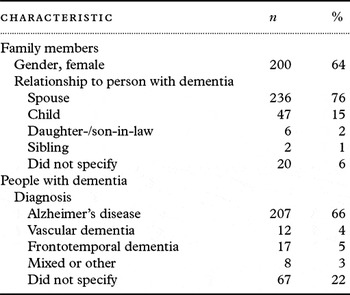
Eleven primary research studies, published between 1989 and 2016, were included in the synthesis (Table 2) (Wilson, Reference Wilson1989; Teel and Carson, Reference Teel and Carson2003; Krull, Reference Krull2005; Allen et al., Reference Allen, Oyebode and Allen2009; Bakker et al., Reference Bakker, de Vugt, Vernooij-Dassen, van Vliet, Verhey and Koopmans2010; Hayes et al., Reference Hayes, Zimmerman and Boylstein2010; Mukadam et al., Reference Mukadam, Cooper, Basit and Livingston2011; van Vliet et al., Reference van Vliet2011; Valimaki et al., Reference Valimaki, Vehvilainen-Julkunen, Pietila and Koivisto2012; Klink, Reference Klink2013; Meyer et al., Reference Meyer, McCullough and Berggren2016). The main characteristics of the participants are presented in Table 3.
Characteristics of participants – family members and persons with dementia

Overall, the samples included a total of 311 family members of people with dementia, ranging in age from 13 to 92 years; one study did not report age (Krull, Reference Krull2005). The sample was predominantly female and spouses of a person with dementia. Most studies mentioned ethnicity of participants but differed in their choice of terms (e.g. White vs. Caucasian). Overall, most participants were White/Caucasian and samples were predominantly homogeneous except one, where the focus was on cross-cultural family experience with dementia (Mukadam et al., Reference Mukadam, Cooper, Basit and Livingston2011). Where reported, the age of people with dementia ranged from 43 to 90 years. The main diagnosis was Alzheimer Disease (AD) though several studies did not report dementia type (Teel and Carson, Reference Teel and Carson2003; Hayes et al., Reference Hayes, Zimmerman and Boylstein2010; Meyer et al., Reference Meyer, McCullough and Berggren2016). Most studies did not outline how they established the accuracy of the diagnosis.
Five studies were conducted in the USA (Wilson, Reference Wilson1989; Teel and Carson, Reference Teel and Carson2003; Krull, Reference Krull2005; Hayes et al., Reference Hayes, Zimmerman and Boylstein2010; Klink, Reference Klink2013), two each in the Netherlands (Bakker et al., Reference Bakker, de Vugt, Vernooij-Dassen, van Vliet, Verhey and Koopmans2010; van Vliet et al., Reference van Vliet2011) and the UK (Allen et al., Reference Allen, Oyebode and Allen2009; Mukadam et al., Reference Mukadam, Cooper, Basit and Livingston2011), and one each in Finland (Valimaki et al., Reference Valimaki, Vehvilainen-Julkunen, Pietila and Koivisto2012) and Sweden (Meyer et al., Reference Meyer, McCullough and Berggren2016). Bakker et al. (Reference Bakker, de Vugt, Vernooij-Dassen, van Vliet, Verhey and Koopmans2010) and van Vliet et al. (Reference van Vliet2011) came from the same parent study but the participants were drawn from separate study arms. The studies’ aims related to three areas as follows: barriers/facilitators to diagnosis, family experiences of dementia onset, and family members’ needs or well-being. The most common data collection method was semi-structured interview and the dominant analysis type was grounded theory, used in 5 of the 11 studies. Another two studies used methods derived from grounded theory (constant comparative method, open and axial coding) but did not explicitly label it as grounded theory. Of the remaining studies, two used content analysis, one thematic analysis and another descriptive phenomenological analysis. These details can be seen in Table 2.
All studies met the quality criteria of clear scope and purpose, appropriate data collection methods, and incorporation of participants’ perspectives into interpretations. General weaknesses included rationale for the chosen analysis, definition of sampling strategy or inclusion criteria, and consideration of reflexivity and ethics. More details about the quality of included studies can be found in Table S2.
Five studies ranked high for relevance (Krull, Reference Krull2005; Hayes et al., Reference Hayes, Zimmerman and Boylstein2010; Mukadam et al., Reference Mukadam, Cooper, Basit and Livingston2011; van Vliet et al., Reference van Vliet2011; Klink, Reference Klink2013), one medium (Wilson, Reference Wilson1989), and five low (Teel and Carson, Reference Teel and Carson2003; Allen et al., Reference Allen, Oyebode and Allen2009; Bakker et al., Reference Bakker, de Vugt, Vernooij-Dassen, van Vliet, Verhey and Koopmans2010; Valimaki et al., Reference Valimaki, Vehvilainen-Julkunen, Pietila and Koivisto2012; Meyer et al., Reference Meyer, McCullough and Berggren2016). Of the studies meeting the least quality criteria, relevance was high; of the low relevance papers, quality was high overall. Only one paper did not contribute to all four analytic themes (Meyer et al., Reference Meyer, McCullough and Berggren2016). Papers that contributed to the bulk of the analysis were better quality and higher in relevance. Papers lower in quality and relevance tended to contribute predominantly to a single analytic theme.
Synthesis of findings
A single over-arching process was distilled from the analysis, namely that of sense-making. Sense-making is a cyclical process that people engaged in throughout the pre-diagnostic period. Four analytic themes were extracted as central components of this process of sense-making: (1) the nature of change; (2) appraisal of change; (3) reactions to change; and (4) the influence of others. These components were identified throughout the descriptive themes and were connected to one another via the higher order process of sense-making.
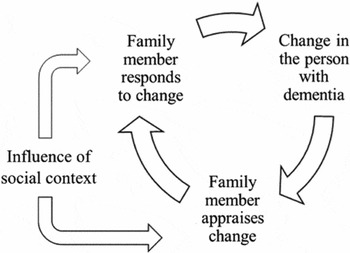
The process of sense-making begins with family members noticing changes in the person with dementia. Family members then appraise the significance of such changes. This leads to a response or reaction, reflecting the family members’ coping strategies. Both appraisals and responses to change are influenced by social network. This process recurs as the illness progresses until the point at which changes are deemed significant enough to seek medical help. Figure 2 presents a model of the interaction between these themes, which will each be explored in turn.
Model of the interaction between sub-components of the sense making process.

The nature of change
Across all studies, family members reported “changes” in their loved ones in two ways: changes in daily activities or cognitive, behavioral, and/or neuropsychiatric signs. This is consistent with the phenomenological conceptualization of dementia within established diagnostic criteria and reflects the pattern of changes often extracted during an informant interview to aid diagnostic reasoning.
Changes in daily activities included housework, hobbies, work, finances, and especially driving. Driving changes often related to the quality of driving, with reports of accidents and traffic violations (e.g. speeding, tailgating). This is reflected in the following quote from Klink (Reference Klink2013):
He had an accident which was his fault, caused because he went through a traffic light. He could not recall why. This is not acceptable due to the fact that he has worked for over 35 years either as a policeman or a fireman/paramedic.
At home, there was difficulty cooking, neglect of household responsibilities, less engagement in conversation, or less interest in hobbies. Work problems were common, although these were not always known to family members until after a crisis, as this quote from Hayes et al. (Reference Hayes, Zimmerman and Boylstein2010) demonstrates:
She just wouldn't quit working. She loved to [work]–she was a retail clerk. She loved to go to work. She loved people. . . So, uh, her immediate boss called me one morning and said, “I think you'd better come in. She has been half the morning trying to get a tape in her cash register.
Families described such events as marked contrasts to former proficiency in these tasks.
Neuropsychiatric symptoms and behavioral changes were mentioned for different reasons. Neuropsychiatric symptoms (e.g. paranoia, suspiciousness, delusions) were noted for their oddness, as this quote from Wilson (Reference Wilson1989) illustrates:
She would get violent and then she forgot everything. She'd go into a tizzy because she couldn't find her hairbrush. All the time it was sitting in front of her. We thought she was nuts.
In contrast, behaviors (e.g. disinhibition, withdrawal, loss of interest) were described in terms that reflected the effect on relationships (e.g. hurtful, aggressive, argumentative), as exemplified by the following quote from Klink (Reference Klink2013):
So it was a very petulant, sort of immature [behavior]. . .So I subsequently became extremely frustrated, angry, and then finally after being frustrated and angry for a long time, I just acquiesced.
The most common cognitive changes related to memory, including repetitiveness, disorientation, misplacing things, or forgetfulness. One spouse, quoted by van Vliet et al. (Reference van Vliet2011), describes noticing memory changes in her husband with young-onset AD:
My husband became forgetful, forgetting appointments or where he put his keys. He did not just forget things, but he wasn't even capable of imagining places where he could have left his keys.
There were infrequent mentions of other cognitive changes (e.g. language), but memory symptoms were by far the most common. Overall, these signs indicate the primary symptoms of AD, reflecting the composition of the sample.
Appraisal of change
Once changes were noticed, family members were tasked with appraising the significance of changes. The cognitive processes family members go through to accommodate changes constituted a prevailing theme across studies, reflecting much of the progressive aspect of dementia. Changes are appraised as more significant as they increase in severity and regularity.
The ambiguity of the early changes was a consistent theme. Initial changes were described as a vague sense that something was “not right.”. Some experienced insecurity about observations, particularly women (Hayes et al., Reference Hayes, Zimmerman and Boylstein2010). These early appraisals of change were often benign or treatable, with explanations such as stress and fatigue commonly used. For example, one spouse recalls his initial thoughts when he noticed his wife changing:
I first thought my wife was too busy at work (van Vliet et al., Reference van Vliet2011).
Major life events (e.g. retirement) were considered as explanations. Others considered a known or undiagnosed medical condition such as a brain tumor, sleep apnea, or stroke.
Prior experience with dementia, especially within the family, assisted better recognition of early signs. Others applied pre-existing ideas about normal ageing, as this quote illustrates:
I knew something was not right. I thought well, it's just her age (Krull, Reference Krull2005).
Naturally, this reasoning was not common in young-onset dementia studies.
As the disease progresses, initial explanations may no longer fit. Family members then re-evaluated and adjusted their appraisals to incorporate new changes. As one caregiver said:
When it first started I thought it might have been just that he was under a lot of pressure at work. Then he started drinking heavily and staying out late, and I thought maybe it was another woman (Klink, Reference Klink2013).
At some point, family members come to appreciate the seriousness of changes. Across studies, this realization was characterized in one of two ways: worsening of symptoms or a single significant event. The first resembles a threshold effect, typified by phrases like, “I started adding things up,” “then there was more and more,” or “I began to suspect that there was something more serious” (Wilson, Reference Wilson1989).
This is contrasted to a single event that highlights the significance of changes. These events might involve safety (e.g. getting lost), physical health (e.g. hospitalization), or a break from routines (e.g. holiday, retirement). One spouse recalls a moment that cemented a growing sense of something changing:
[One day] she went shopping [at] about 5:00 [o'clock] right in the middle of heavy traffic, but she didn't like traffic, so in her own words, she just turned where the traffic was the least. She thought, “Well, I'll see something [that I recognize],” but she didn't. She got to 155 [street] and she called me and she was really panicked. She had no idea where she was. At that point I knew we had a major problem. (Hayes et al., Reference Hayes, Zimmerman and Boylstein2010)
Such single events act as a catalyst, in the sense that it does not change the outcome (reaching a threshold) but speeds up the reaction.
After diagnosis, family members reframe their appraisals of changes. The progression of change is only fully appreciated in hindsight. As quoted in Wilson (Reference Wilson1989):
(changes) . . .come about so slowly that you don't add them up together until you look back.
This theme best captures the progression of dementia, from early ambiguity to post-diagnosis reframing, and may serve as a framework for family members’ narratives of this phase.
Reactions to change
The appraisal of significance informs the family member's reaction to change. These reactions are an attempt to cope with the change and include both behavioral and emotional reactions.
Reactions are often influenced by cultural-, social-, or gender-based norms about marriage, parenting, or family roles. van Vliet et al. (Reference van Vliet2011) provide an example of marriage values:
I noticed a certain strain between us and the input in the relationship was not equal anymore. But after several years of marriage you think you can get through it.
Relationship strain was a common consequence. Family members, particularly spouses, reported feeling angry, annoyed, frustrated, and hurt. Behavior changes could be seen as petulant or deliberate. This caused discord within relationships. Without an explanation for the behavior change, spouses considered ending the relationship, as this quote from Bakker et al. (Reference Bakker, de Vugt, Vernooij-Dassen, van Vliet, Verhey and Koopmans2010) demonstrates:
I thought: If you are not ill, I will leave you. . .it could have ended in a divorce.
This was not a universal experience, and in this case, was influenced by disruptive behavior such as irritability and lack of initiation and low level of awareness of the person with dementia.
Pre-existing relationship dynamics can also play a part. For example, willingness to talk about changes with the affected person may influence how family members respond to change. Mukadam et al. (Reference Mukadam, Cooper, Basit and Livingston2011) quotes a daughter speaking about her devoted father:
He didn't want to say anything because he was too frightened in case he lost her trust, you know, you have that lovely thing when you're married don't you?
Considering pre-morbid relationship dynamics alongside the nature of symptoms (e.g. disruptive behavior, low awareness) is relevant to understanding marital discord in the pre-diagnostic phase.
Lack of awareness or acknowledgement from the person with dementia about the changes led to frustration and irritability, but also prompted family members to assume more responsibility. Family members often reported compensating for the person with dementia, by taking over driving, parenting, cooking, and other tasks. This sometimes occurred in concert with the person's attempts to conceal changes, though more often it was for safety reasons, as this quote from Mukadam et al. (Reference Mukadam, Cooper, Basit and Livingston2011) describes:
He was walking around with sums of money and had lots of different papers. . . so he was making himself vulnerable. . . we realized that there was something that just needed to be addressed.
Help-seeking almost always involved a family member taking initiative, by whatever means necessary. As quoted in Wilson (Reference Wilson1989), one spouse says:
I finally got her to the doctor by lying to her.
Reactions to diagnosis highlight this moment as a critical turning point in family members’ ability to cope with change. Diagnosis mended strained relationships as family members could understand that hurtful actions or words were due to the illness. Diagnosis also validated family members’ experiences. As quoted in Valimaki et al. (Reference Valimaki, Vehvilainen-Julkunen, Pietila and Koivisto2012):
. . . it confirmed that my suspicions had been correct.
Not all reactions were positive, with some family members left frustrated by diagnostic delay. Some found the diagnosis too blunt, others not direct enough. This often related to preparedness – those who were certain something was wrong felt relieved, while those who were not expecting it to be dementia felt shocked.
Influence of others
Information from others influenced how family members appraised and responded to change. These outside influences can come from the person with dementia, family, friends, acquaintances, strangers, or health professionals.
The degree to which the person with dementia could understand or discuss changes was an important point of difference. In instances where the person was open about changes, this created unity with family members. In the opposite case, family members noted a self-protective tendency for the person to conceal their symptoms. As the wife of a man with young-onset dementia said:
That period was very tiring for me because I could not convince anyone that something was wrong. My husband, a giant of a man, knew very well how to manage in specific situations, so nobody noticed anything. He could really fool people (van Vliet et al., Reference van Vliet2011).
Even where this is a symptom of the dementia, the effect is the same – the family member must manage independent of the person with dementia.
Family members could be enlightened by one another's reflections and observations. van Vliet et al. (Reference van Vliet2011) quote one husband as saying:
After my sister-in-law pointed out my wife suffered from memory problems, I noticed that she forgot more appointments than she used to. My wife always was a forgetful person, so these problems were not obvious to me before.
Some participants consulted with other family members before acting; a lack of understanding or agreement from other family members could be tempering or invalidating.
Non-family – friends, acquaintances, strangers – sometimes unexpectedly approached family members with concerns. This spontaneous input often served as an imperative to seek help.
Most help-seeking began with contacting a primary care physician. Most reported experiences of primary care were negative, likely in part because these were more salient than a positive experience. One family caregiver recalls:
At first our doctor would tell her, ‘You don't have Alzheimer's; you've just got a memory problem’. . . and he'd tell her that every time we'd go (Teel and Carson, Reference Teel and Carson2003).
Many patients received treatment for depression or other mental health diagnoses, particularly in young-onset (under 65 years) populations (Bakker et al., Reference Bakker, de Vugt, Vernooij-Dassen, van Vliet, Verhey and Koopmans2010; van Vliet et al., Reference van Vliet2011; Klink, Reference Klink2013):
The neurologist concluded my mother suffered from post-traumatic stress disorder, so he advised us not to worry and not to pay attention to the memory problems. My sister and I managed to do that until we began to worry again (van Vliet et al., Reference van Vliet2011).
As van Vliet et al. (Reference van Vliet2011) point out, while psychiatric diagnoses are the most common misdiagnoses, some also represent accurate co-morbidities.
Delays were common, irrespective of referral pathway, with family members often feeling dismissed or judged. Klink (Reference Klink2013) quotes one caregiver who said:
. . . we were talking months and months of doctors not listening.
Indirect language on the part of the healthcare professional was common when conveying diagnosis, including terms such as “old age,” “deterioration of the brain,” and “senile” (Wilson, Reference Wilson1989; Teel and Carson, Reference Teel and Carson2003).
Teel and Carson (Reference Teel and Carson2003) note several family members feeling that doctors were reluctant to disclose the diagnosis:
It seems like the whole medical profession, all they want to do is talk around this — they don't want to come out and tell you this is it.
After receiving the diagnosis, family members could access appropriate care, advice, and financial support, again supporting the notion of diagnosis as a turning point.
As evidenced above, the extent to which other people's ideas of change are congruent or incongruent with family members’ experience determines the effect of social influence. Congruence begets confidence, while incongruence can increase uncertainty or bring to attention something unnoticed.
Discussion
This qualitative synthesis provides an overarching model of sense-making, with four analytical factors to describe the caregiver's experience of the pre-diagnostic phase of dementia: (1) the nature of change; (2) appraisal of change; (3) reactions to change; and (4) the influence of others. This model describes a recurrent process by which family members make sense of changes throughout the pre-diagnostic period.
These broad factors provide the beginnings of a more holistic theory of the onset of dementia from the perspective of family members. Such a theory would need to account for both the cyclical nature of sense-making and the progressive course of dementia. In addition, factors such as social support, pre-existing beliefs, symptom type, coping strategies, relationship type, and experience with help-seeking are all likely to influence the process of sense-making. Establishing the relationships and interactions between these variables will yield a comprehensive, multi-factorial model.
This concept of sense-making has been discussed in previous work in dementia. Robinson et al. (Reference Robinson, Clare and Evans2005) interviewed couples where one partner has dementia and found a similar process of sense-making, cycling between minimizing symptoms, and gradually realizing something is changing. This model presents diagnosis as a turning point and thereafter people can begin adjusting to these changes (Robinson et al., Reference Robinson, Clare and Evans2005; Pesonen et al., Reference Pesonen, Remes and Isola2013). This notion of a turning point is supported by the literature in this synthesis. Robinson et al. (Reference Robinson, Clare and Evans2005) describe sense-making as a joint process for couples; this, however, does not entirely account for cases where the person with dementia has incomplete awareness of the changes and the partner must act alone. Further research may consider the theoretical implications of the interaction between the process of sense-making and the full spectrum of awareness, from partial to complete (Clare et al., Reference Clare2012).
Limitations
With the comprehensive search strategy employed in this review, we can draw preliminary conclusions. The difficulties of locating qualitative research, however, make it possible that relevant publications were overlooked. We attempted to compensate for this by adopting supplementary search strategies. Our intentionally specific inclusion and exclusion criteria may have led to the exclusion of papers that discussed relevant themes; for example, many studies including mixed samples of people with dementia and their family were excluded because they did not adequately distinguish between their experiences. Indeed, this may account for the finding of sense-making as an independent process rather than a joint process, as found by Robinson et al. (Reference Robinson, Clare and Evans2005). Finally, in order to include papers that were highly relevant, we included studies which confirmed the diagnosis of dementia via participant self-report. This introduces the possibility that some people with dementia did not have a formal diagnosis.
With respect to the state of knowledge identified by this review, there was a range of methodological weaknesses identified in the current literature, suggesting that research has not yet captured a complete representation of this pre-diagnostic phase. Study samples were mixed in terms of dementia subtype, relationship to the person with dementia, and age of onset. There were some observable differences between these. Later-onset dementia, for example, was appraised as normal ageing, while younger onset participants were more likely to have received initial psychiatric diagnoses. Relationship strain was most commonly described by spouses, particularly in the young-onset samples. It was difficult to draw conclusions regarding the effect of dementia subtype as the majority diagnosis was AD, and this dominated the resulting analysis, potentially missing subtle differences experienced by carers of people with other forms of dementia. Thus, there are clearly gaps in the current literature that limit the development of a comprehensive model.
Clinical implications
There are several themes emerging from the present review that can inform clinical practice in the dementia field. First, there are implications for timeliness of diagnosis. Family members reach a threshold after which the changes are deemed significant enough to warrant medical attention. A single event can act as a catalyst to reach this threshold faster, as can social support. It is plausible that public education around the experience of dementia onset can act as the aforementioned catalyst, prompting people to seek a diagnosis earlier than they might otherwise.
Second, consideration of this sense-making process has implications for the delivery of diagnosis. Prepared caregivers found diagnosis a relief, while those who were less prepared felt it was too direct. For those who are “across the threshold,” directness may be a relief but for those still hoping that this is benign and treatable, it may be upsetting. This also has ongoing implications relating to post-diagnostic care. Indeed, dementia symptoms are often interpreted by family as reflecting pre-morbid personality or transient factors (e.g. depression, physical illness, medication). These misinterpretations can even continue post-diagnosis, which leads to misattributions of intentionality (Paton et al., Reference Paton, Johnston, Katona and Livingston2004; Quinn et al., Reference Quinn, Jones and Clare2016). There are thus clear clinical benefits for taking notice of how family members make sense of changes and where they are in this sense-making process.
Last, better understanding of family members’ experiences of the pre-diagnostic period can inform interventions. These results suggest the level of awareness of the person with dementia influences the degree of burden and discord in the relationship. Knowing how people have responded to early changes can give insight into their coping strategies and, with further research, could be used to detect risk of later burden. Indeed, diagnosis may be an appropriate point for intervention, with one study finding 50% of caregivers had clinically significant levels of subjective burden at diagnosis, which predicted higher subjective burden at 12-month follow-up (Brodaty et al., Reference Brodaty, Woodward, Boundy, Ames, Balshaw and Group2014). Caregivers’ characteristics, including coping strategies, contribute to perceived burden, and predict depression better than the objective care needs of the person with dementia (Schoenmakers et al., Reference Schoenmakers, Buntinx and Delepeleire2010; Zucchella et al., Reference Zucchella, Bartolo, Pasotti, Chiapella and Sinforiani2012). Therefore, susceptibility to burden may be understood through exploration of pre-diagnostic sense-making at the point of diagnosis.
Future directions
Future research exploring differences between dementia subtypes might clarify the relevance of symptom type to the process of sense-making, particularly changes in awareness. Furthermore, exploring homogeneous samples of spouses promises much in elucidating the relationship challenges of the pre-diagnostic phase. The spousal relationship is a different type of relationship than any other: it is more intimate, it is entered by choice, and it can be ended more definitively than a blood relationship. In addition, future research could focus on establishing the relevance of coping styles and pre-existing beliefs to the way people process changes. This could inform future interventions for family members at risk of burden or psychological distress.
Conclusions
This study synthesized qualitative research looking at family members’ experience in the pre-diagnostic phase of dementia. Four analytic themes were extracted, contributing to an overarching theme of sense-making. This review has preliminary implications for clinical practice and ongoing theory development, and represents a first step towards characterizing family members’ experience of the onset of dementia. The literature is not without limitations, the foremost being the dominance of AD. Understanding diversity with respect to subtype, demographics, relationship type, or other characteristics requires future research with homogeneous samples, allowing comparison of how individual differences interact with sense-making. This will inform a client-centered approach to timely, accurate, and supported diagnosis and caregiver interventions.
Conflict of interest
None.
Description of authors’ roles
K. Rogers formulated the research question, designed the study, collected the data, and wrote the paper. H. Coleman assisted with data analysis. V. Anderson, A. Brodtmann, and D. Darby supervised all aspects of the research. All authors reviewed the paper, and have seen and approved the final copy.
Acknowledgments
This research was conducted as part of a research higher degree at The University of Melbourne. K. Rogers is supported by a Bethlehem Griffiths Research Foundation postgraduate scholarship and an Australian Government Research Training Program Scholarship. H. Coleman is supported by an Australian Postgraduate Award and an Australian Government Research Training Program Scholarship.
Supplementary material
To view supplementary material for this article, please visit https://doi.org/10.1017/S1041610217000862