Introduction
Genetically modified (GM) plants; where genetic engineering techniques have been used to change genetic material, constitute an increasingly significant portion of the crops available on the feed market. Agricultural biotechnology has produced a great many new varieties of GM plants in the past 20 years. Following the first commercial release of GM plants in 1996, the proportion of GM crops has expanded rapidly and, in 2010, 134 million hectares of transgenic crops were grown globally (James, Reference JAMES2011). The most common GM plants are those with enhanced agronomic traits, namely herbicide-tolerant crops and those protected against common pests (James, Reference JAMES2011). These are known as first-generation transgenic plants.
Feed materials from first-generation GM plants are substantially equivalent to the materials produced from conventional, parental plant lines, in their chemical composition is more or less identical. Therefore, their use in animal nutrition usually has no detrimental effect on either the nutritive value of the diet or the performance indices obtained. Initial experiments with transgenic feeds, conducted on different species of animals, namely rats, broiler chickens, dairy cows and fish, showed that herbicide-tolerant, GM soybean meal had no negative influence on animal organisms, measured as growth and basal performance parameters (Hammond et al., Reference HAMMOND, VICINI, HARTNELL, NAYLOR, KNIGHT, ROBINSON, FUCHS and PADGETTE1996). The nutritional safety for animals of first-generation GM feed materials has since been proved in numerous studies; the materials have been found to have no detrimental effect on performance, quality of animal origin products, namely meat, eggs and milk, the digestibility of nutrients or the health status of poultry, pigs and cattle (Flachowsky et al., Reference FLACHOWSKY, CHESSON and AULRICH2005; Flachowsky et al., Reference FLACHOWSKY, AULRICH, BOHME and HALLE2007; Flachowsky, Reference FLACHOWSKY2010).
However, it ought to be emphasised, that although GM plants have been used as feed for years and a number of studies have proved their nutritional safety for animals, they still raises emotional public discussion, especially in EU countries. The main controversies, important for safety aspects of use GM feeds and inducing public discussion, are the potential and unknown, long-term effects of transgenic DNA and expressed protein on the animal and, indirectly, through products made from animals fed GM crops, on human health. Public concerns have been raised about long-term influence of GM plants on the environment, for instance the risk of gene transfer to non-targeted plants and the creation of ‘super weeds’.
In recent years, intensive experimentation using genetic engineering methods has resulted in the introduction of new biosynthetic pathways into plants and the production of several transgenic crops with substantial changes in chemical composition; these are referred to as second-generation GM crops. The main objective of such transgenesis is to improve the nutritional properties of plants and, hence, of feed materials, by increasing the levels of desirable substances, for example, essential amino acids and fatty acids, or decreasing the quantity of harmful compounds, e.g. phytate, in the seeds. Clearly, in contrast to the first-generation transgenic plants produced, the use of these GM plants as feed materials can have a positive impact on animal production. This article reviews and discusses the results of studies where transgenic plants with enhanced nutritional properties have been evaluated as feed materials for poultry.
Transgenic plants with improved phosphorus availability
Plants contain significant amounts of phosphorus; however, the main storage form of P in crops is phytic acid, as phytate salts, namely myo-inositol 1, 2, 3, 4, 5, 6 - hexakisphosphate. Phosphorus bound in phytates is poorly utilised in the gastrointestinal tract of monogastric animals owing to its poor solubility, high dietary Ca concentration and the lack of sufficient endogenous phytase activity. Undigested phosphates excreted in poultry and pig manure can accumulate in the soil and water, which may, in turn, lead to water eutrophication, thus becoming an important source of phosphorus pollution. The literature data shows that around 60-80% of P in cereals and extracted meals occurs in phytate form (Nelson et al., Reference NELSON, FERRARA and STORER1968). Therefore, to obtain optimal performance, animal diets must be supplemented with the more available inorganic feed phosphates and/or feed enzymes, namely phytase, which lead to an increase in feed costs in poultry and pig production. In addition, as a reactive anion, phytic acid forms insoluble salts with zinc and other divalent and trivalent cations, resulting in the reduced bioavailability of trace minerals for monogastric animals (Sebastian et al., Reference SEBASTIAN, TOUCHBURN and CHAVEZ1998). For these reasons, the development of crops with an increased available P content has been an important goal for several biotechnology projects and there the feed industry is expressing a progressive interest in modification of this kind.
In recent years, genetic engineering methods (mutagenesis) have been applied to produce crops with reduced concentration of phytates. An important example of such a modification is provided by the mutant maize hybrid. Termed ‘high available phosphorus (HAP) maize’, it was developed using the lpa-1 allele of the maize LPA1 gene, which reduces the synthesis of phytic acid in the seeds. In a study conducted on laying hens, HAP maize containing 0.27% total P and 0.17% non-phytate P (NPP) was compared to conventional, near isogenic maize containing 0.25% total P and only 0.05% NPP (Ceylan et al., Reference CEYLAN, SCHEIDELER and STILBORN2003). On the basis of the results obtained, including the lower amount of total P in the excreta of the hens fed the diet with HAP, as compared with those fed conventional maize, the authors concluded that the HAP maize required less dicalcium phosphate supplementation in comparison to conventional maize, while supporting equal laying performance (Ceylan et al., Reference CEYLAN, SCHEIDELER and STILBORN2003). The possible use of GM HAP maize as a source of available P for layers was evaluated in the study carried out by Snow et al. (Reference SNOW, DOUGLAS, BATAL, PERSIA, BIGGS and PARSONS2003). Egg production, egg mass, feed intake, feed efficiency and tibia ash for 57-69-week-old hens fed a diet with 65% HAP maize, supplemented with only 0.04% inorganic P did not differ from hens fed diets made with conventional corn, supplemented with 0,35% inorganic P to contain 0,45% available P. Only average egg weight from hens fed the HAP maize diet decreased. The HAP diet resulted in a much lower total P content in excreta in comparison with the control diet. The authors concluded that HAP maize contained more available P for layers than conventional maize and that only a small quantity of supplemental inorganic P was needed in order to maintain optimal laying performance (Snow et al., Reference SNOW, DOUGLAS, BATAL, PERSIA, BIGGS and PARSONS2003). Corresponding results were obtained in studies with broilers, where it was demonstrated that the P in HAP maize was more available than in conventional maize and that diets based on HAP maize, with low levels of supplemental inorganic phosphates, allowed optimal production indices to be supported, while significantly decreasing the concentration of P in excreta (Li et al., Reference LI, LEDOUX, VEUM, RABOY and ERTL2000; Waldroup et al., Reference WALDROUP, KERSEY, SALEH, FRITTS, YAN, STILLBORN, CRUM and RABOY2000; Yan et al., Reference YAN, KERSEY, FRITTS, WALDROUP, STILBORN, CRUM, RICE and RABOY2000).
Similar methods were used for the modification of the most important legume crop in poultry nutrition, the soybean, which normally contains a high level of phytates. Soybean meal produced from low-phytate soybean (LPSBM) contained 0.13-0.16% phytate P, as opposed to the 0.34-0.37% in conventional soybean meal, as well as 0.38-0.39% non-phytate P, in comparison with the 0.11-0.28% in the conventional meal (Dilger and Adeola, Reference DILGER and ADEOLA2006; Powers et al., Reference POWERS, FRITZ, FEHR and ANGEL2006). Sands et al. (Reference SANDS, RAGLAND, WILCOX and ADEOLA2003) reported that P bioavailability in LPSBM for broiler chickens was 12 to 16 percentage points higher than in conventional SBM. In another study on broilers, a higher true P retention was observed for LPSBM (77%) than for conventional SBM (60%) (Dilger and Adeola, Reference DILGER and ADEOLA2006). The results of an experiment carried out on ducks indicated that the energy and digestible essential amino acid contents were higher in LPSBM than in normal SBM (Adeola, Reference ADEOLA2005). Correspondingly, LPSBM introduced to the diets for pigs, simultaneously with low phytic maize, resulted in improved P digestibility and a decrease in the P excreted in manure (Powers et al., Reference POWERS, FRITZ, FEHR and ANGEL2006; Hill et al., Reference HILL, SUTTON and RICHERT2009).
Similarly, low-phytate barley mutants have been developed. Salarmoini et al. (Reference SALARMOINI, CAMPBELL, ROSSNAGEL and RABOY2008) reported lower P excretion for chicks fed a diet based on low-phytate barley than for those given conventional barley and suggested that using low-phytate barley can reduce P waste by more than 50%. The results of a study on broilers (Linares et al., Reference LINARES, BROOMHEAD, GUAIUME, LEDOUX, VEUM and RABOY2007) proved that not only P, but also Zn availability in low phytic barley was increased. The substitution of low-phytic barley for normal barley, which comprised 60% of the diet, resulted in an increase in Zn retention and the concentration of Zn in chick tibias and toes (Linares et al., Reference LINARES, BROOMHEAD, GUAIUME, LEDOUX, VEUM and RABOY2007).
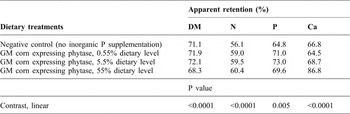
The second way in which genetic engineering methods are applied to improve P availability in crops is transgenesis, resulting in the expressing of transgenic phytase, the enzyme hydrolysing phytate bonds, in the seeds. Furthermore, owing to the beneficial effect of phytase on microelement availability (Swiatkiewicz et al., Reference SWIATKIEWICZ, KORELESKI and ZHONG2001), it is not only the amount of P excreted, but also that of other minerals which can be reduced in this way. The efficiency of GM maize in expressing the Escherichia coli-derived phytase gene was studied in an experiment conducted on broiler chicks (Nyannor and Adeola, Reference NYANNOR and ADEOLA2008). The results obtained showed that the beneficial effects on body weight gain, feed conversion and tibia mineralisation for transgenic maize phytase and the control, microbial phytases, added at the same level of 3630 FTU/kg to a low P and Ca diet, were no different. The use of an increasing dietary level of transgenic maize, at 0.55, 5.5 and 55.5%, linearly increased dry matter, P, Ca and N retention (Table 1). The authors of the resultant paper concluded that the Escherichia coli phytase expressed in GM maize was as efficacious as the commercial, microbial phytase in P- and Ca-deficient broiler diets and would thus minimise the need for supplemental dietary P (Nyannor and Adeola, Reference NYANNOR and ADEOLA2008). In subsequent work, they demonstrated that increasing the addition of GM maize expressing E. coli phytase to a broiler diet linearly and quadratically elevated phytase activity along the gastrointestinal tract, with a concomitant linear and quadratic decrease of phytic acid P content in digesta, and led to a degradation of the cell walls of digesta in the proventriculus and gizzard (Nyannor et al., Reference NYANNOR, BEDFORD and ADEOLA2009). The results of an in vitro experiment using the Caco-2 cell model demonstrated that the expression of transgenic phytase, simultaneously with transgenic ferritin, in GM maize resulted in a significant increase in the bioavailability of iron (Drakakaki et al., Reference DRAKAKAKI, MARCEL, GLAHN, LUND, PARIAGH, FISCHER, CHRISTOU and STOGER2005). E. coli, phytase transgene has been incorporated into rice. The nutritional safety of GM rice thus transformed was proved in an experiment on rats (Cheng-Chih et al., Reference CHENG-CHIH, CHIEH-HSIEN, CHI-SHENG, CHIEN-KU and HAU-YANG2008).
Effect of GM corn expressing an E. coli-derived phytase gene on apparent retention of nutrients in broiler chickens (adapted from Nyannor and Adeola, Reference NYANNOR and ADEOLA2008).

Likewise, soybean was genetically transformed using the Aspergillus niger phytase transgene. In their experiment conducted on broilers, Denbow et al. (Reference DENBOW, GRABAU, LACY, KORNEGAY, RUSSELL and UMBECK1998) compared the efficacy of providing phytase as either a recombinant protein in GM soybean or as a commercial feed preparation. On the basis of such indices as performance, P retention and excretion, toe ash and tibia shear force, they indicated that phytase provided as transformed soybeans gave a similar positive effect to that provided by commercial phytase supplement (Denbow et al., Reference DENBOW, GRABAU, LACY, KORNEGAY, RUSSELL and UMBECK1998). The same A. niger phytase gene was successfully introduced into tobacco and the supplementation of broiler diets with these GM tobacco seeds had a beneficial influence on P availability (Pen et al., Reference PEN, VERWOERD, VAN PARIDON, BEUDEKER, VAN DEN ELZEN, GEERSE, VAN DER KLIS, VERSTEEGH, VAN OOYEN and HOEKEMA1993). Similarly, a GM wheat expressing the Aspergillus niger phytase encoding gene phyA was successfully produced (Brinch-Pedersen et al., Reference BRINCH-PEDERSEN, HATZACK, STOGER, ARCALIS, PONTOPIDAN and HOLM2006).
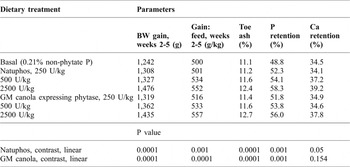
The Aspergillus ficuum phytase gene was expressed in GM canola. The seeds of the transformed canola were used in a study carried out on broiler chickens and weanling pigs (Zhang et al., Reference ZHANG, KORNEGAY, RADCLIFFE, DENBOW, VEIT and LARSEN2000a; Reference ZHANG, KORNEGAY, RADCLIFFE, WILSON and VEIT2000b) in order to compare their efficacy with Natuphos, a commercial source of phytase. On the basis of performance, bone ash and the retention of P and Ca (Table 2), the authors demonstrated that there were no differences in the potentiality of both sources of phytase studied to enhance the utilisation of P in maize-soybean based diets (Zhang et al., Reference ZHANG, KORNEGAY, RADCLIFFE, DENBOW, VEIT and LARSEN2000a; Reference ZHANG, KORNEGAY, RADCLIFFE, WILSON and VEIT2000b).
Effect of GM canola expressing Aspergillus ficuum phytase gene on performance toe ash and mineral retention in broiler chickens (adapted from Zhang et al., Reference ZHANG, KORNEGAY, RADCLIFFE, DENBOW, VEIT and LARSEN2000a).

Transgenic plants with an increased levels of essential amino acids
In terms of farm animal requirements, most grains do not provide a balanced source of protein owing to deficiencies in one or more of the essential amino acids. Lysine, methionine and tryptophan receive the most attention, because their concentration is deficient both in cereals (Lys, Trp) and legume seeds (Met) (Ufaz and Galili, Reference UFAZ and GALILI2008). To achieve optimal performance, there is a need for their supplementation in poultry diets. Genetic engineering methods have been successfully adopted in order to enhance the content of essential amino acids. The application of biotechnology to the development of GM crops with an increased level of limiting amino acids provides an alternative to the direct addition of supplemental amino acids in poultry diets and, by achieving a better balance of dietary protein, can reduce N excretion into the environment.
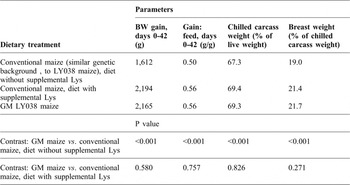
Genetically modified high lysine maize (LY038) was developed by the insertion of the cordapA gene from Corynobacterium glutamicum, a common soil bacteria, into the maize genome (Lucas et al., Reference LUCAS, TAYLOR, HARTNELL, NEMETH, GLENN and DAVIS2007). The transgenic enzyme expressed in LY038 maize confirms the enhanced production and accumulation of free lysine in the germ of the kernel. The nutritional efficiency of LY038 maize was evaluated in a study on broiler chickens (Lucas et al., Reference LUCAS, TAYLOR, HARTNELL, NEMETH, GLENN and DAVIS2007). The grain from the GM maize contained significantly more lysine in comparison with conventional maize, at 0.360 vs. 0.255%, respectively, and had a higher concentration of crude protein and several other amino acids. The experimental diets contained approximately 60% maize and, in the case of the conventional maize diet, were either not supplemented, or was supplemented with L-Lys HCl, at 0.1% of the diet. The body weight gain, feed conversion and carcass yields of broilers fed GM, high Lys-based diets were similar to that of the chickens fed conventional maize, L-Lys HCl supplemented diets, but were significantly better in comparison to that of the chickens fed conventional maize diets without the Lys addition (Table 3). There were no unexpected effects of LY038 maize on health status or mortality. The authors indicated that the bio-efficacy of Lys in GM LY038 maize did not differ from that of the Lys in conventional maize supplemented with L-Lys HCl, and that LY038 maize can thus be considered as wholesome, and, owing to the higher concentration of Lys, more nutritious in comparison with conventional maize (Lucas et al., Reference LUCAS, TAYLOR, HARTNELL, NEMETH, GLENN and DAVIS2007). Correspondingly, Taylor et al. (Reference TAYLOR, GEORGE, HYUN, NEMETH, KARUNANANDAA, LOHRMANN and HARTNELL2004) reported that the performance of broilers fed a diet based on GM high lysine maize was similar to those fed a diet with conventional maize supplemented with L-Lys. The other GM line of high lysine maize, produced by a transgenic gene insertion that leads to the expression of a lysine-feedback-insensitive aspartokinase in the grain, was evaluated in an experiment conducted on pigs (O'Quinn et al., Reference O'QUINN, NELSSEN, GOODBAND, KNABE, WOODWORTH, TOKACH and LOHRMANN2000). The results obtained showed that the amino acids and energy in transgenic maize were well digested by the pigs, which offers the potential for reducing the amount of supplemental Lys needed in other farm animal diets (O'Quinn et al., Reference O'QUINN, NELSSEN, GOODBAND, KNABE, WOODWORTH, TOKACH and LOHRMANN2000). The results of a more recent model study on rats demonstrated that GM high lysine maize, produced by the insertion of a transgene from potatoes and used at high dietary concentration, had no adverse effect on the rats and was as safe as conventional maize (He et al., 2009).
Effect of GM high lysine maize (LY038) on performance and carcass characteristics of broilers (adapted from Lucas et al., Reference LUCAS, TAYLOR, HARTNELL, NEMETH, GLENN and DAVIS2007).

Experiments with monogastrics have further the proven the high nutritional value of other GM maize lines, modified for increased concentration of limiting amino acids (Douglas et al., Reference DOUGLAS, PETER, BOILING, PARSONS and BAKER2000; Guthrie et al., Reference GUTHRIE, APGAR, GRISWOLD, LINDEMANN, RADCLIFFE and JACOBSON2004; Pedersen et al., Reference PEDERSEN, BOERSMA and STEIN2007). One of the controversies, which is significant in terms of the safety aspects of using GM feeds, is the possibility that the transgenic DNA will transfer to animal tissues and will have negative effects on humans consuming meat, milk and eggs. Determining the fate of transgenic Escherichia coli DNA from GM maize with enhanced amino acids in the system of pigs, Beagle et al. (Reference BEAGLE, APGAR, JONES, GRISWOLD, RADCLIFFE, QIU, LIGHTFOOT and IQBAL2006) reported that it was effectively degraded in the gastrointestinal tract and that fragments of transgenic DNA were found only in the stomach and, to a lesser extent in the ileal digesta, but were not detected in the large intestine, white blood cells, plasma, liver, or muscle samples.
Genetic engineering methods were applied to produce a high protein soybean which contained considerably more crude protein and essential amino acids in comparison with conventional soybeans. In an experiment carried out on caecectomised cockerels, Edwards et al. (Reference EDWARDS, DOUGLAS, PARSONS and BAKER2000) evaluated the nutritional value of meals processed from GM high protein soybean. The results demonstrated that the meal produced from the GM soybeans, which, as was shown in the balance trial, contained more digestible Lys, Met, Tre and Val, had a higher level of metabolisable energy than conventional soybean meal (Edwards et al., Reference EDWARDS, DOUGLAS, PARSONS and BAKER2000).
The narrow-leafed lupin (Lupinus angustifolius) was genetically modified to express methionine-rich sunflower albumin. The methionine content in the grain of conventional lupins is low, at approximately 2 g/kg, while transgenic lupins contains as much as 4.5 g/kg. A study on broiler chickens indicated that the supplemental methionine required in diets containing 25% lupin meal can be reduced by 0.6 g/kg if GM high-methionine lupins are used instead (Ravindran et al., Reference RAVINDRAN, TABE, MOLVIG, HIGGINS and BRYDEN2002). There were no differences in the digestibility of the amino acids; however, the metabolisable energy of GM lupin seeds, at 10.2 MJ/kg, was considerably higher than the ME of conventional seeds, at 9.4 MJ/kg, which may be related to the reduced content of soluble non-starch polysaccharides in the GM seeds (Ravindran et al., Reference RAVINDRAN, TABE, MOLVIG, HIGGINS and BRYDEN2002).
Rice (Oryza sativa) has been genetically modified by the expression of the transgene OASA1D, which resulted in an increased concentration of free tryptophan in the seeds (Wakasa et al., Reference WAKASA, HASEGAWA, NEMOTO, MATSUDA, MIYAZAWA, TOZAWA, MORINO, KOMATSU, YAMADA, TERAKAWA, T and MIYAGAWA2006). The nutritive value of this GM rice, containing 50% more Trp than conventional rice, was evaluated in an experiment on chickens (Takada and Otsuka, Reference TAKADA and OTSUKA2007). The experimental diets contained 55% conventional rice grains for the control group or 55% GM high Trp grains. Body weight gain and feed efficiency (FCR) in the chickens fed the diet containing GM rice were similar to those fed the control diet supplemented with crystalline Trp, but were higher than in the group fed the un-supplemented control diet. On the basis of the results obtained it was concluded that the nutritional value of GM high Trp rice was similar to that of conventional rice supplemented with crystalline tryptophan (Takada and Otsuka, Reference TAKADA and OTSUKA2007). More recently, the OASA1D transgene was introduced into soybean (Glycine max) in order to increase the accumulation of free Trp in the seeds.
Transgenic feeds and fatty acids
The composition of the fatty acids of lipids in oilseed plants has mainly been modified using genetic engineering methods for industrial purposes, rather than being linked directly to their feed value. For example, the DP-3O5423-1 soybean has been genetically modified by the insertion of the gm-fad2-1 gene fragment, which resulted in greater concentrations of oleic acid by suppressing the expression of the endogenous FAD2-1 gene, which encodes an n-6 fatty acid desaturase enzyme that catalyzes desaturation of 18:1 to linoleic acid (McNaughton et al., Reference McNAUGHTON, ROBERTS, SMITH, RICE, HINDS, SANDERS, LAYTON, LAMBS and DELANEY2008). Such modifications can be particularly desirable for food applications, because the oil produced from the DP-3O5423-1 soybean has a better oxidative stability, which contributes to improved frying performance. The safety and nutritional value of processed meal, hulls and oil from 305423 soybean plants were determined in a feeding experiment conducted on broiler chickens (McNaughton et al., Reference McNAUGHTON, ROBERTS, SMITH, RICE, HINDS, SANDERS, LAYTON, LAMBS and DELANEY2008). There were no significant differences in the body weight gain and feed efficiency, or in the mortality and organ carcass characteristics between the birds fed diets containing processed fractions from the 305423 soybeans and those fed diets using conventional soybeans. On the basis of these results, it was concluded that 305423 soybeans were nutritionally equivalent to non-modified control soybeans with a comparable genetic background (McNaughton et al., Reference McNAUGHTON, ROBERTS, SMITH, RICE, HINDS, SANDERS, LAYTON, LAMBS and DELANEY2008). More recently, the GM DP-3O5423-1 soybean, containing an increased concentration of oleic acid and a reduced level of linolenic and palmitic acid in the grain, was evaluated in an experiment on Hy-Line hens (Mejia et al., Reference MEJIA, JACOBS, UTTERBACK, PARSONS, RICE, SANDESRS, SMITH, IIAMS and SMITH2010). The results obtained proved that hens fed diets formulated with DP-3O5423-1 GM soybean meal had similar body weight, hen-day egg production, egg mass, feed intake and feed conversion similar to those fed with near isoline conventional soybean meal. Likewise, egg quality parameters were similar regardless of the soybean meal source. The authors concluded that egg production and the egg quality from hens fed diets containing transgenic DP-3O5423-1 soybean meal was no different from the performance of hens fed diets with the control, conventional, near-isoline or commercial soybean meals (Mejia et al., Reference MEJIA, JACOBS, UTTERBACK, PARSONS, RICE, SANDESRS, SMITH, IIAMS and SMITH2010).
Similarly to soybean, rapeseed has been genetically modified to improve its technological properties. A GM myristic acid-rich rapeseed has been produced by the insertion of a acyl-thioesterase gene. The nutritional value of the full-fat meal of this GM rapeseed was assessed in a study carried out, but only on growing-finishing pigs (Bohme et al., Reference BOHME, RUDLOFF, SCHONE, SCHUMANN, HUTHER and FLACHOWSKY2007). In the GM rapeseed, the myristic and palmitic acid contents were greatly enhanced, at the expense of oleic acid concentration. The concentrations of crude nutrients, minerals and amino acids in the GM and the conventional seeds were within the range of natural variance; however, the glucosinolate concentration increased from 12.4 µmol/g in the parental plant to 19 µmol/g DM in the GM plant (Bohme et al., Reference BOHME, RUDLOFF, SCHONE, SCHUMANN, HUTHER and FLACHOWSKY2007).
Extensive research into changing oilseed plant composition to achieve an enhanced concentration of nutritionally high-value, long chain polyunsaturated fatty acids n-3 (LC PUFA n-3) and, recently, the genes encoding desaturases and elongases enzymes from microbes have been successfully expressed in oilseed plants (Truksa et al., Reference TRUKSA, VRINTEN and QIU2009; Venegas-Caleron et al., Reference VENEGAS-CALERON, SAYANOVA and NAPIER2010). The main objective of such transgenesis was to increase the content of stearidonic (SDA, C18:4, n-3), eicosapentaenoic (EPA, C20:5 n-3) and docosahexaenoic acids (DHA, C22:5 n-3). The LC PUFA n-3 play important roles in a number of aspects of health whilst simultaneously being deficient in the human diet. To date, no work has been published containing data from feeding studies conducted on farm animals on the use of seeds or oils from GM plants modified for enhanced concentration of LC PUFA n-3, which is probably connected with the fact that such GM plants are mainly produced as a dietetic food for human, not animal, nutrition.
Transgenic feeds and biologically active substances
A high β-glucan content and low metabolisable energy concentration means that barley is less likely to be used as a feed component of poultry diets. The results of a study carried out on chickens showed that the malt of GM barley expressing a thermo-tolerant Bacillus β-glucanase, when added to a barley-based diet, significantly reduced the number of bird-adherent sticky droppings and provided a body weight gain similar to the corn-based control feed (von Wettstein et al., Reference VON WETTSTEIN, MIKHAYLENKO, FROSETH and KANNANGARA2000). The objective of a subsequent study on chickens was to evaluate the feasibility of using mature GM barley grain containing transgenic β-glucanase as a feed addition and to compare diets containing GM grain to those containing a commercial β-glucanase-based product (von Wettstein et al., Reference VON WETTSTEIN, WARNER and KANNANGARA2003). No negative effect on weight gain was noted when the diet contained 39 g/kg transgenic barley grain and 581 g/kg non-transgenic barley instead of maize. The comparison, using a transgenic grain supplement with the addition of a commercial enzyme preparation yielded equal performance in the birds fed a barley-based diet. The authors concluded that a barley-based diet with a small addition of GM grain expressing β-glucanase can provide an alternative to a maize-based diet for broilers, especially in areas where maize cannot be grown for climatic reasons (von Wettstein et al., Reference VON WETTSTEIN, WARNER and KANNANGARA2003).
Canadian researchers developed a GM potato line capable of expressing β-glucanase from Fibrobacter succinogenes (Armstrong et al., Reference ARMSTRONG, INGLIS, McALLISTER, KAWCHUK and CHENG2002). The enzyme can be found in concentrations as high as 0.05% of the fresh tuber weight, with a specific activity of 3013 U/mg β-glucanase. The objective of a study conducted on broiler chickens was to evaluate this GM potato as a source of β-glucanase in barley-based chicken diets (Baah et al., Reference BAAH, SCOTT, KAWCHUK, ARMSTRONG, SELINGER, CHENG and McALLISTER2002). Including this at 0.6 kg/t as a source of β-glucanase in barley-based diets for broiler chickens significantly improved feed conversion by 8.8% and, at 1.2 kg/t, significantly reduced ileal digesta viscosity by 42%. However, performance parameters were significantly worse compared to the control group, where the chickens were fed a barley-based diet supplemented with a commercial β-glucanase preparation. The authors concluded that improved level and activity of expression is required in the transformed potato in order for it to have potential as an enzyme additive to barley-based diets (Baah et al., Reference BAAH, SCOTT, KAWCHUK, ARMSTRONG, SELINGER, CHENG and McALLISTER2002).
Rice has been genetically modified by introducing transgenes expressing human lactoferrin (LF) and lysozyme (LZ) in the grain. These are active substances with antibacterial and immune-stimulating properties. Two experiments have been carried out in chickens to evaluate the efficacy of GM LF or LZ rice as a substitute for antibiotics in poultry diets (Humphrey et al., Reference HUMPHREY, HUANG and KLASING2002). In the first experiment, the birds fed a diet with 5% LF + 10% LZ rice had a significantly better FCR and thinner lamina propria in the duodenum than those fed with 20% conventional rice. In the second experiment, chicks fed a diet with 10% LZ + or 5% LF + 10% LZ rice had a significantly lower feed intake and a significantly better feed efficiency than those fed with 15% conventional rice. In this study, the effect of GM rice was shown to be similar to that of the antibiotics used in the experiment, namely bacitracin + roxarsone, because, in comparison with the control group, both the diet containing GM rice and the diet containing antibiotics increased the villous height in the duodenum, decreased the thickness of the lamina propria of the ileum and reduced the number of leukocytes (Humphrey et al., Reference HUMPHREY, HUANG and KLASING2002). These results indicated the potential of GM LF and LZ rice as a substitute for antibiotics in broiler diets (Humphrey et al., Reference HUMPHREY, HUANG and KLASING2002). More recently, the nutritional quality of another line of GM rice expressing the human lactoferrin gene (LF rice) was evaluated in experiments conducted on pigs and rats (Hu et al., Reference HU, LI, PIAO and YANG2010). The authors concluded that, in line with the results of the digestibility experiments, the nutritional quality of LF rice is superior to that of conventional rice (Hu et al., Reference HU, LI, PIAO and YANG2010).
Conclusions
When used as feed materials, genetically modified plants with enhanced nutritional properties may provide poultry producers with several benefits. These include among others, the beneficial effect on performance parameters and economic efficiency of poultry production, where GM plants increase the concentration of limiting amino acids, and express transgenic enzymes. In the case of GM plants with an enhanced available P content, pollution problems can be reduced, and health status of animals may be improved, as seen in the instance of GM plants with transgenes expressing antimicrobial substances.