The degree to which a citizen trusts government has a wide variety of important effects in a political system (for a recent review, see Citrin and Stoker Reference Citrin and Stoker2018). For example, political trust affects political opinions. Those who are distrusting are more likely to think ill of current political leaders (Hetherington Reference Hetherington1998; Wroe, Allen, and Birch Reference Wroe, Allen and Birch2013). They are more likely to support antigovernment reforms, such as public referenda (Bowler, Donovan, and Karp Reference Bowler, Donovan and Karp2007) or legislative term limits (Karp Reference Karp1995). They are less likely to support policies that entail personal risk or sacrifice, such as social welfare programs or military action (Hetherington and Husser Reference Hetherington and Husser2012). They are more supportive of civil liberties (Davis and Silver Reference Davis and Silver2004).
Political trust also affects voters’ choices in elections. Studies find that higher levels of trust increase voting for candidates from the incumbent party in presidential elections (Citrin Reference Citrin1974; Hetherington Reference Hetherington1999; Jones Reference Jones2020) and parliamentary elections (Bélanger and Nadeau Reference Bélanger and Nadeau2005; Pattie and Johnston Reference Pattie and Johnston2001) and for the majority party in congressional elections (Jones Reference Jones2020). Distrusting voters are more likely to support insurgent parties (Bélanger Reference Bélanger, Zmerli and Van der Meer2017) and candidates (Hetherington Reference Hetherington1999; Peterson and Wrighton Reference Peterson and Wrighton1998), including the candidacies of Bernie Sanders and Donald Trump in the 2016 presidential primary elections (Dyck, Pearson-Merkowitz, and Coates Reference Dyck, Pearson-Merkowitz and Coates2018).
Political trust even affects citizen compliance with the law. These effects are found not only for specific illegal actions, such as avoiding taxes (Alm and Torgler Reference Alm and Torgler2006; Levi Reference Levi1988; Scholz and Lubell Reference Scholz and Lubell1998; van Deth Reference van Deth, Zmerli and Van der Meer2017), falsely claiming government benefits (Marien and Hooghe Reference Marien and Hooghe2011), or avoiding military service (Levi Reference Levi1997), but also for willingness to obey laws more generally (e.g., Jones Reference Jones2015; Tyler Reference Tyler2006).Footnote 1
Given the many attitudes and behaviors that can be predicted by one's level of trust in government, it is important to understand what characteristics of individuals lead to greater or lower levels of trust. One set of characteristics that have been hypothesized to explain political trust are one's personality traits. To date, this work has been limited to the “Big Five” personality traits (Mondak and Halperin Reference Mondak and Halperin2008). However, recent research has shown that other personality factors, specifically the gendered factors of masculinity and femininity, also affect political attitudes (McDermott Reference McDermott2016).
Also included in trust research is the potential effect of individual sex, although research has come up short in demonstrating any effects of sex on trust. At first glance, a relationship between sex and political trust seems intuitive. After all, men and women have been shown to differ from one another across many other political opinions and behaviors, including the much-discussed “gender gap” in voter preferences, issue positions, ideology and partisanship (e.g., Whitaker Reference Whitaker2008), political knowledge and interest (Verba, Burns, and Schlozman Reference Verba, Burns and Schlozman1997), and political participation (Burns Reference Burns2007; Burns, Schlozman, and Verba Reference Burns, Schlozman and Verba1997; Dalton Reference Dalton2008; Gallego Reference Gallego2007; Norris Reference Norris2002; Paxton, Kunovich, and Hughes Reference Paxton, Kunovich and Hughes2007; Schlozman, Burns, and Verba Reference Schlozman, Burns and Verba1999; Schlozman et al. Reference Schlozman, Burns, Verba and Donahue1995).
It is somewhat surprising, then, to find that scholars have been unable to uncover any systematic differences between men and women when it comes to political trust. Summarizing his search on differences in marginal trust levels in the United States, Alford (Reference Alford, Hibbing and Theiss-Morse2001, 38) concludes, “Is there a gender gap in trust? The answer is no.” This null finding has been replicated in individual-level studies in the United States (Lawless Reference Lawless2004) and in comparative studies (Schyns and Koop Reference Schyns and Koop2010). Perhaps this is the reason that in two recent large edited volumes on trust, not one of the total 58 chapters specifically discusses the relationship between gender and political trust (Uslaner Reference Uslaner2018; Zmerli and Van der Meer Reference Zmerli and Van der Meer2017).
But the fact that biological sex does not appear to affect political trust does not necessarily mean that gender is irrelevant to understanding it. In recent years, society has come to understand that there are aspects of gender that are not perfectly correlated with biological sex. One such aspect is gendered personalities—masculinity and femininity. Many men have personality traits that would commonly be described as feminine, many women have traits that would commonly be described as masculine, and, more generally, most people actually possess some mixture of these two sets of traits (e.g., Donnelly and Twenge Reference Donnelly and Twenge2017; McDermott Reference McDermott2016). Further, recent research has demonstrated that many of the attitudinal and behavioral differences previously found between men and women are actually better explained by differences in levels of masculine and feminine traits than by biological sex (McDermott Reference McDermott2016). Building upon this research and on the research into the Big Five personality traits and trust, this article brings this new approach to the study of trust.
In this study, we hypothesize that feminine personality traits should contribute to higher levels of trust in government, as individuals who are higher in these traits are more communal and therefore more likely to have faith in what government does. In an analysis of original survey data collected for this purpose, we find that gendered personalities do matter to levels of trust. Specifically, femininity affects trust across a host of political measures, from general government trust to trust in specific government institutions—the higher one's level of feminine personality traits, the more politically trusting one is. Masculine personality traits, on the other hand, have no clear logical relationship to faith—or lack of faith—in government, and therefore masculinity has no effect on political trust.
PERSONALITIES AND POLITICS LITERATURE
Because personality is at the core of human nature, studies of the connection between personality and politics are nearly as old as the discipline of political science, and they are useful for understanding both the governing and the governed. In examining the governed, one subset of this long-standing literature that has received considerable attention during the past decade is the work done on the political correlates of the Big Five personality traits. This research shows that several of these traits have effects on a wide variety of political attitudes, including partisanship, ideology, internal efficacy, external efficacy, and dogmatism (Mondak and Halperin Reference Mondak and Halperin2008).
Of particular relevance to this study, at least two of the Big Five personality traits have consistently been shown to affect political trust. Those rating high on openness to new experiences exhibit lower political trust, while those rating high on agreeableness exhibit higher political trust (e.g., Anderson Reference Anderson2010; Mondak and Halperin Reference Mondak and Halperin2008).Footnote 2 More recent research has replicated these original findings using alternative data from national (Cawvey et al. Reference Cawvey, Hayes, Canache, Mondak and Uslaner2018) and international (Mondak, Hayes, and Canache Reference Mondak, Hayes, Canache, Zmerli and Van der Meer2017) surveys. Additionally, the former study finds some evidence that higher emotional stability may be associated with higher political trust, and both find some evidence that higher extroversion may be associated with lower political trust. Reviewing all research to date on this topic, Mondak, Hayes, and Canache (Reference Mondak, Hayes, Canache, Zmerli and Van der Meer2017, 153) draw the general conclusion that “variation in levels of political trust reflects the importance of personality.” These findings offer some promise that other personality dimensions might also prove effective in helping explain political trust. Because personalities are believed to be either hereditary or formed in the very early stages of socialization, they are causally prior to attitudes such as government trust that are typically formed later.
While the literature on Big Five personality traits has received considerable attention of late, there are other personality-based frameworks with similarly rich histories of helping to explain social and political phenomena. One of these is the literature on gendered personalities. As early as 1936, scholars argued that masculine and feminine traits were central to an individual's psyche (Terman and Miles Reference Terman and Miles1936). With the development of the Bem Sex Role Inventory (BSRI: Bem Reference Bem1974) in the 1970s, this research became regularized and rigorous, demonstrating that the two gendered personality factors—greater or lesser femininity, greater or lesser masculinity—help explain a diverse array of attitudes and behavior. Gendered personalities (and the BSRI measure specifically) are based on traditional ideas of what was once considered desirable for men and women in society. Masculinity is made up of traits such as “dominant” and “leadership ability,” while feminine personality traits include the caring aspect of social life traditionally ceded to women, such as “compassionate” and “tender.”Footnote 3 While it is clear that society has moved past expecting men and women to hold tightly to these respective traits, these personality dimensions are still relevant to social life. Gendered personalities help explain, for example, attitudes toward sex and romance (Thompson and O'Sullivan Reference Thompson and O'Sullivan2012), toward the workplace (Gartzia and van Engen Reference Gartzia and van Engen2012), and toward physical and mental health (Mahalik, Good, and Englar-Carlson Reference Mahalik, Good and Englar-Carlson2003), among many other attitudes. These studies demonstrate that while masculinity and femininity may now be somewhat free from the confines of sex-specific traits, they are still important dimensions in our personality structures that can help explain relevant attitudes and behaviors.
Research into where and when these personalities develop shows that a substantial portion is the result of heritable factors. In a twin study of high school seniors, for example, Lippa and Hershberger (Reference Lippa and Hershberger1999) use various measures of masculinity, femininity, and gendered behaviors and find that anywhere from one-third to one-half of these traits are genetically linked. Additionally, they find that the degree of heritability is largely the same for men and women. This role of nature, while substantial, nevertheless allows for a good deal of nurture. For example, the broad societal contexts of an era can impact the aggregate levels of each type of gendered personality in the public (Donnelly and Twenge Reference Donnelly and Twenge2017; Twenge Reference Twenge1997). Also, reciprocal effects of individuals’ life choices on gendered personalities can occur, although research suggests this may be more true for masculine than for feminine traits. For example, using a panel study, Abele (Reference Abele2003) finds that both masculine and feminine traits in college graduates affected future career and family roles, with some reciprocal effects of these roles on masculine traits but no reciprocal effects on feminine traits.
Despite the long-standing and still-burgeoning interest in gendered personalities in social and cultural life, similar interest has not been paid to gendered personalities in political life. The primary exception to this is McDermott (Reference McDermott2016), who analyzes how gendered personalities influence political preferences and activity. She finds that not only do gendered personality factors matter in forming political attitudes and behaviors, but also they help explain away some of what was once thought to be caused by differences in sex, such as the traditional “gender gap” in voting behavior, in which men have been seen to vote much more Republican than women. McDermott demonstrates that once the effects of masculinity—which increases Republican preferences and attitudes—and femininity—which increases Democratic preferences and attitudes—are controlled for, the effects of biological sex largely disappear.
These findings are important to our question in this article in two ways. First, they provide reason to believe that gendered personalities may have relevance to the concept of political trust, despite the lack of research to date. If gendered personalities matter to politics, then it is reasonable to assume they could matter to political trust. Second, they help explain why, though many researchers have thought sex should matter to political trust, analyzing these effects through the use of biological sex as the measure of the causal variable may have turned up null results. If sex is merely a statistical artifact of the effects of gendered personalities, then existing research into sex and political trust may have been misguided.
GENDER AND TRUST: HYPOTHESIS
While gender, at least in the form of biological sex, has been tested as an influence on trust in the past, little reasoning has been advanced for why it should matter. As with many demographic variables, it could play an atheoretical role in models (e.g., Alford Reference Alford, Hibbing and Theiss-Morse2001). But just because existing studies have not yet posited any convincing logic about why gender might be expected to affect trust, this does not mean there is no reason to believe it should. In fact, when thought about in terms of gendered personalities, a solid logic for a connection to government trust presents itself in the form of the concept of communal ties.
Since the early days of gendered personality research, masculinity has been thought of as a set of agentic traits, while femininity captures more communal aspects of an individual's personality (Bakan Reference Bakan1966). Masculine personalities are the independent doers, while feminine personalities are those who form connections with neighbors, friends, and families. From a sociological perspective, involvement with one's community is a strong correlate of trust, according to a seven-society study by Delhey and Newton (Reference Delhey and Newton2003). Those who are willing to get involved with their communities are more trusting of society generally. Similarly, from a more economic perspective of social capital, involvement in community promotes such investment—social capital—in the system and trust in it (Brehm and Rahn Reference Brehm and Rahn1997). In other words, those who are predisposed to communal tendencies are more trusting. Since feminine personalities are, by definition, communal and caring, we should expect that feminine personalities are more trusting, generally, than nonfeminine personalities.
In turn, we also know from existing research that social trust can translate into trust in government institutions. Rothstein and Stolle (Reference Rothstein and Stolle2008) show that the more socially trusting individuals are, the more likely they are to have confidence and trust in government. Similarly, Keele (Reference Keele2007) finds that in a time-series analysis, decreases in social capital generally, and interpersonal trust specifically, produce corresponding decreases in aggregate levels of trust in government. This is the final step in our logic of positive effects of femininity on trust in government. Given that feminine personalities are more communal, such individuals can logically be expected to have more social trust and, accordingly, be more trusting of government and its institutions.
There are also other more directly political reasons to believe that femininity may affect government trust. As this article's introduction briefly alludes to, research finds that trust in government is associated with higher support for social welfare programs (Hetherington and Globetti Reference Hetherington and Globetti2002; Rudolph and Evans Reference Rudolph and Evans2005) and a more liberal policy mood (Chanley, Rudolph, and Rahn Reference Chanley, Rudolph and Rahn2000). Separately, McDermott (Reference McDermott2016) finds that feminine personalities are more liberal and in favor of social welfare. So, while the full chain of causal links has yet to be investigated, it certainly seems plausible that one reason for the demonstrated relationship between a feminine personality and support for welfare/liberalism might be that femininity, as a driver of prosocial welfare attitudes, affects trust, which, in turn, produces these policy views (or vice versa).
Both of these lines of reasoning lead us to our hypothesis: feminine personality traits have a positive impact on individual levels of government trust. Individuals with more feminine personality traits trust government more than individuals who possess fewer feminine traits.
Arguing that femininity affects trust does not also mean by default that masculinity affects trust in any way. Masculinity and femininity are not diametrically opposed personality factors on a single dimension. Rather, they exist as two separate personality dimensions. In fact, most adults possess roughly equal combinations of the two factors, including more than half of Americans who have either higher than median levels of both or lower than median levels of both (those typed “androgynous” and “undifferentiated,” respectively; McDermott Reference McDermott2016Footnote 4). As a result, we do not assume that a positive relationship between femininity and trust signals any corresponding relationship between masculinity and trust. And given that masculinity is made up of instrumental rather than communal traits, there is little reason to expect that there is such a relationship. Research shows that agentic personalities are more likely to decide on their own whether to trust government elements rather than to systematically lean one way or another (Dunn Reference Dunn and Gambetta2000). Additionally, research into culture and trust demonstrates that while masculine cultures may use different criteria than feminine cultures to develop trust in institutions (such as e-commerce: Hallikainen and Laukkanen Reference Hallikainen and Laukkanen2018), they are not inherently more or less trusting. As a result, we do not posit any effect of masculinity on government trust.
DATA AND METHOD
We test our hypothesis using data collected from a Mechanical Turk (MTurk) survey of U.S. residents conducted on October 14, 2016, among 1,022 respondents. Workers were paid $1.50 in exchange for their time taking the survey, which averaged 5 minutes. Amazon's MTurk population of workers is not a national probability sample. Our MTurk sample is whiter, more male, younger, and somewhat better educated than the general public (see Table A1 in the appendix in the supplementary material online for demographic comparisons to U.S. Census Bureau figures). Academics have nevertheless found that using unrepresentative populations to test relationships between variables can be valuable (e.g., Yeager et al. Reference Yeager, Krosnick, Chang, Javitz, Levendusky, Simpser and Wang2011). Specifically, in an analysis of existing studies measuring MTurk characteristics, Paolacci and Chandler (Reference Paolacci and Chandler2014, 186) write, “research assessing MTurk on dimensions universally relevant to researchers supports the idea that worker samples are reliable” (see also Weinberg, Freese, and McElhattan Reference Weinberg, Freese and McElhattan2014). A study comparing MTurk samples to a benchmark American National Election Studies (ANES) sample found that both samples responded similarly to attitudinal questions, leading the researchers to report that MTurk “does not present a wildly distorted view of the U.S. population” (Berinsky, Huber, and Lenz Reference Berinsky, Huber and Lenz2012, 361).
Convenience samples can be especially useful for establishing early relationships in areas in which established research has yet to be conducted, as in the case of femininity and trust. In fact, research in psychology has long survived on such samples—though more often from undergraduate student populations—for testing hypotheses. This examination is similarly an early attempt to test for a connection that shows explanatory promise, using a population shown by researchers to outperform student population samples in their reliability and validity (e.g., Berinsky, Huber, and Lenz Reference Berinsky, Huber and Lenz2012).
Our dependent variables are based on traditional survey measures of trust in different components of the U.S. government. As our central measure, we use the standard ANES general government trust question: “How much of the time do you think you can trust the government in Washington to do what is right?” The response options range on an ordinal scale from 1 (“hardly ever”) to 4 (“almost all of the time”). We also include measures based on a question asked regularly over time by the Gallup Poll: “How much trust and confidence do you have at this time in . . .” This question format was used to ask respondents about the executive and legislative branches, Democrats in Congress, and Republicans in Congress, for a total of four additional, specific government trust questions. We asked this variety of questions to provide a stringent test for our hypothesis that femininity positively affects trust in government. With these questions we can ensure that effects, if found, are robust not only across government and institutions but also across parties in government. Existing research demonstrates that individuals’ levels of trust not only are based on attitudes toward the political system generally, but also respond to the parties in control of the branches (e.g., Keele Reference Keele2005). For this reason, we need to test that the effect is not party dependent but rather is consistent across institutions regardless of party control. The institution-specific questions are also measured in four categories, with options ranging from “none at all” (trust and confidence) to “a great deal.” Finally, as a further test, we also created an additive trust index combining the four specific institutional trust questions (then dividing by four), to help control for any idiosyncrasies in the individual trust measures. We use ordinal logistic regression to analyze the individual trust measures, and ordinary least squares (OLS) for the trust index.
To measure gendered personalities, we employ the frequently used and well-established short form of the BSRI (Bem Reference Bem1974). The measure asks respondents to rate themselves on a series of 20 characteristics, 10 of which measure masculine traits and 10 of which measure feminine traits (Table A2 in the appendix contains the relevant trait measures with their descriptive statistics). Each trait is measured on a 1–7 scale indicating how often respondents believe it is true about themselves (“never or almost never” to “always or almost always”). The trait responses are added together and divided by 10 for two additive indices ranging from 1 to 7 (alphas of 0.94 and 0.89 for femininity and masculinity, respectively). The femininity index operationalizes our hypothesis variable. For comparative purposes, we also test for effects of masculinity.
Masculinity and femininity as measured by the BSRI are two distinct personality constructs, as has been shown repeatedly in confirmatory factor analyses. To ensure that we are also measuring these two elements, we conducted a factor analysis and found two distinct factors. Femininity loaded onto the first factor and explained 36% of the variance, with factor loadings ranging from 0.63 to 0.85. Masculinity loaded onto the second factor, explaining an additional 24% of the variance, with factor loadings from 0.36 to 0.82. These results are comparable to those found in other studies (see McDermott Reference McDermott2016, 40). The two indices are positively correlated at 0.14 because, as mentioned previously, the majority of the population falls either above or below the median on both measures.
We also include control variables in our model that have been shown to affect trust or political attitudes generally (descriptive statistics on all variables are included in Table A3 in the appendix). Party and ideology are each measured with 5-point ordinal variables ranging from strongly Democratic/liberal to strongly Republican/conservative respectively. Presidential approval, a frequent control variable in trust models, is captured using an Obama favorability variable, ranging from 1 (“extremely unfavorable”) to 7 (“extremely favorable”).Footnote 5 While we do not argue that presidential favorability and presidential job approval are the same thing, the variable does end up capturing the same positive effects that approval traditionally captures as can be seen in the analysis below. For this reason, we believe it is an adequate, if imperfect, surrogate as a control. Education is a 7-point variable ranging from less than a high school education to advanced degree. Race and sex are captured by dummy variables for white and woman, respectively. Age consists of six categories, divided by decades. Finally, political involvement is measured with a question about how frequently the respondent talks with family and friends about politics, as a five-category variable spanning from never to every day.
The analysis will proceed in two stages. First, we perform simple bivariate tests of the baseline correlation between each of the gender and sex variables and the various measures of trust in government. Next, we see whether the hypothesized effect of femininity continues to hold true after controlling for other political and demographic variables.
ANALYSIS
Before looking into the effects of gendered personalities on government trust, we first examine whether the literature's mixed, at best, findings regarding the effect of the more common operationalization of gender—biological sex—are replicated in our data. Table 1 contains correlations for each dependent trust variable with the woman variable to test for possible effects. While correlation is not ideal for ordinal variables, we use it for comparison's (with femininity) sake. The table also contains correlations for the femininity index and the dependent variables. The first row shows that being a woman, as opposed to a man, has a significant effect on only three out of six measures—trust in the legislative branch, trust in Democrats in Congress, and the trust index. In three of the six cases, including the overall measure of trust in government in Washington, sex has no significant effect. This evidence is largely consistent with existing research, which has found only mixed results when measuring gender as biological sex.
Correlations between sex, femininity and government trust

* p < .05 (two-tailed).
We now turn to how gendered personalities fit into the picture. As an initial cut at the data, Table 1 also presents the bivariate correlations between each of the dependent variables and the femininity variable. In this simple bivariate test, femininity is significantly correlated with five out of six measures of trust in government, including the key general trust measure. Only in the case of the executive branch is the result statistically unreliable, although it is in the correct, positive direction. It is also noteworthy how much larger the correlations between femininity and trust are than those among sex and trust. Not only is femininity more consistent, it is substantially larger. Additionally, masculinity shows no relationship with trust, as expected.
Including other predictor variables as controls in full regression models does not change the consistency of the effects of femininity. Table 2 presents the general government trust model in the first column—how often one trusts the government in Washington to do what is right. As hypothesized and found in the correlations, femininity has a positive and statistically significant effect on general governmental trust. In fact, it is one of only three variables in the model that has any significant impact, with the others being ideology and presidential favorability. Illustrating that masculinity is not simply the obverse of femininity, this other dimension of gendered personalities—for which we had no theoretical expectations—has no significant effect on governmental trust. The variable for biological sex—woman—is also insignificant, just as it was in the bivariate analysis. Overall, the multiple regression results provide strong evidence that individuals with high levels of feminine personality traits are more trusting of the federal government.
Effects of femininity on trust and confidence in government actors

* p < .05 (two-tailed); standard errors in parentheses.
Knowing that femininity contributes to Democratic leanings (McDermott Reference McDermott2016), these results beg the question of whether the femininity effects on general government trust are a result of partisan artifact because the government was headed by Democratic president Barack Obama at the time of the survey, or whether they are indeed the result of feminine individuals trusting government more. While the first model's controls for partisanship, ideology, and presidential favorability should help to allay these concerns, our alternative measures of the dependent variable allow us to go even further. We can test for effects of femininity on trust in specific segments of government that are each associated with one party or the other. Specifically, the second through sixth columns of Table 2 present controlled tests for effects on trust in the executive branch, which was controlled by Democrats in 2016, on the legislative branch, which was controlled by Republicans, on each party's contingent in Congress and on the overall trust index.
Even with these alternative versions of the dependent variable, the results are strikingly consistent with the central hypothesis. Femininity has a consistently positive effect on trust, and this effect is statistically significant in every case except one. In the executive branch model, femininity is positive, as expected, but not statistically significant. Only presidential favorability and age are significant in this model. Given that those two variables alone explain more than 50% of the variance in the dependent variable, it is not too surprising that no other variables have statistically reliable impacts.Footnote 6 Femininity is, however, still in the correct direction (as in the simple correlation). Reviewing the results of all the models in Table 2, femininity is the only predictor other than presidential favorability that has a statistically significant effect in at least five of the six models.
Just as noteworthy is the consistent impact femininity has on trust within the legislative branch, across both trust in Democrats in Congress and trust in Republicans in Congress. At the same time that the control variables for party identification and for ideology switch signs across these two models in accordance with the partisanship of the group being asked about, the sign for femininity stays positive for both, as expected. Given this consistency in the coefficients for femininity, its effects are clearly due to the nature of femininity—presumably its communal nature—rather than to its partisan—Democratic—nature.
Regarding the biological sex variable, the results in these models largely confirm the mixed bivariate findings. Sex is significant and positive in three of the six total models, although now significantly affecting trust in Republicans in Congress rather than Democrats. The greater consistency of the effects of the femininity variable compared to the sex variable again calls into question the wisdom of trying to capture effects of gender using a measure of biological sex, as done in previous research. What matters is not being female, per se, but rather being communal in nature—one's gendered personality.Footnote 7 While this personality profile is something that is more common in women than men, it is by no means a set of traits exclusive to women (McDermott Reference McDermott2016, 53). In fact, in our data, 41% of men score above the mean on femininity, falling either into a largely feminine profile (13%) or the androgynous category (28%).
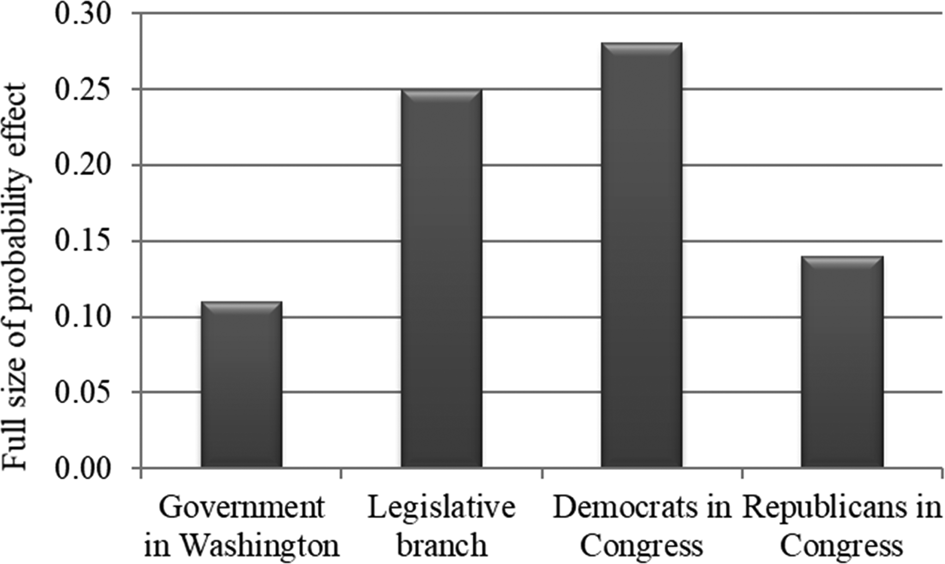
Now that we know femininity has an effect on government trust, the question becomes how much of an effect it has. Comparing a typical individual with the highest as opposed to the lowest levels of femininity (with all other variables held constant at their means), we use the estimates from Table 3 to derive specific probabilities of generally trusting (categories 4 or 3) or distrusting (categories 2 or 1) each aspect of government, Figure 1 shows that femininity can produce large shifts in trust in government. For example, for respondents with no feminine traits the probability of trusting Democrats in Congress is only .21; for those with the highest possible levels of feminine traits, with all other variables held constant at their means, the probability increases to .49, a 28-point difference. The effect on trust in the legislative branch is 25 total points. Smaller effects are found for Republicans in Congress at .14 and Washington generally at .11. It is important to keep in mind that not only the question wording, but also the wording of the response options is different for the general Washington question than for the other four questions, thereby affecting the comparability of the effect sizes. Even the smallest shift, however, still moves the probability of trusting government by more than 10 points. In other words, the effects are not only statistically significant, but also substantial—respondents with feminine personalities are more trusting of all of the institutions of government tested here than are those with nonfeminine or less feminine personalities. Given how little trust there generally is in the government in the modern day (e.g., Citrin and Stoker Reference Citrin and Stoker2018), any positive shift should be noteworthy.
Probability effect sizes of femininity on trust in government actors.

DISCUSSION
Trust in government is a phenomenon long studied as an important political attitude. We have shown in this article that there is at least one new way of looking at what influences trust—gendered personalities. While others have studied personality effects on trust before, this has traditionally been done only in the framework of the Big Five literature. Our results demonstrate that other aspects of personalities are also important in explaining patterns of trust.
Our results also help inject new life into the notion that gender should matter to trust, a proposition that has been made in the past, but perhaps framed in the wrong way. Previous studies looked at gender as a question of biology rather than psychology, resulting in inconclusive results. This analysis demonstrates decisively that gender matters not because of any biological predisposition among women to trust government, but instead because feminine personalities are more caring and communal, and those with communal personality traits are more likely to trust government.
Future research into gender as a social construct may prove useful not only to the study of governmental trust, but also to political attitudes and behavior more generally, and the study of gender and politics more specifically. We know that gender is not the same thing as sex, and yet political science research predominantly treats them as interchangeable.Footnote 8 Whether it is examining typical gender divides like the partisan gender gap (McDermott Reference McDermott2016) or examining discrepancies from a nontraditional research perspective, such as men and masculinity rather than solely focusing on women (e.g., Bjarnegård and Murray Reference Bjarnegård and Murray2018), research that takes a fresh approach to the distinction between sex and gender has so far proven fruitful and could continue to do so. For example, future research could investigate the impact of a voter's masculinity and/or femininity on how they view candidates of either sex, or how they react to political messages, or a host of other possibilities. Another avenue for future research in this area would be how masculinity and femininity vary in political candidates and officeholders. Existing research has found that a variety of behaviors within government are affected by Big Five traits (e.g., Ramey, Klingler, and Hollibaugh Reference Ramey, Klingler and Hollibaugh2017). It seems likely that politicians’ actions could be similarly influenced by their gendered personalities.
As outlined in the introduction, the literature has found myriad political attitudes and behaviors that appear to be driven by an individual's level of trust in government. But if trust in government is itself a product of an individual's level of femininity—as the results here strongly indicate—this means that in many, if not all, of these studies, political trust is perhaps more accurately modeled not as an independent variable, but rather as an intervening variable, transmitting the underlying effects of femininity to the particular political attitude or behavior. A prime example of this would be the apparent relationship between higher political trust and greater support for social welfare programs (Hetherington and Globetti Reference Hetherington and Globetti2002; Rudolph and Evans Reference Rudolph and Evans2005), as discussed earlier. McDermott (Reference McDermott2016) has already shown that femininity increases support for social welfare, and the present study shows that femininity affects trust. In this light, future research should investigate how much of the effect of femininity on social welfare attitudes is direct, how much is mediated through trust, and what proportion of the trust effect is really a function of femininity? Similar studies could be performed to investigate the role of femininity, through political trust, on other attitudes mentioned in the introduction, such as support for incumbents or third-party candidates, support for antigovernment reforms, and compliance with the law.
In turn, the fact that gender could be one of the underlying drivers behind the demonstrated effects of political trust has potentially important implications for real-world politics. For example, incumbent parties who wish to boost their support in the public may find a more receptive audience among those with feminine personalities. This is because these with feminine traits are more likely to trust government (as shown here), and those who trust government are more supportive of incumbent parties (Citrin Reference Citrin1974; Hetherington Reference Hetherington1999). Recognizing this, incumbent parties might decide to tailor their policy positions or rhetoric specifically to appeal to those with feminine personalities.
The results presented here may also have relevance to the well-documented phenomenon of declining trust in American government. Research shows that trust has been largely on the decline for the past 30 years (Citrin and Stoker Reference Citrin and Stoker2018). It is worth noting that aggregate levels of femininity have also been in decline for the past 30 years. As gender roles have changed in society, women have become significantly less traditionally feminine—as measured by the BSRI—over time (Donnelly and Twenge Reference Donnelly and Twenge2017). Men have also become less feminine, although not significantly so. If femininity is indeed on the decline in society, even just within one sex, it could help explain declining rates of governmental trust over the same period.Footnote 9 We do not have the data to test this proposition here, but future research into this question seems warranted and could inform our broader understanding of how social dynamics affect aggregate levels of public trust.
As with any study there are, of course, caveats to our findings. The first is that we are testing our hypothesis with data taken from MTurk, a nonprobability sample. While the consistency of the effects argues for robustness, there could be an inherent bias that is making this population react differently to trust than a representative sample would. To address this, we must wait for further opportunities for conducting similar tests among different populations. Additionally, femininity did not matter in one of the five models tested. While we still believe that the results demonstrate impressive consistency, one could find fault with the single null result. Again, only more investigation into femininity's effects—research we believe is warranted based on our findings—can address this.
SUPPLEMENTARY MATERIAL
To view supplementary material for this article, please visit https://doi.org/10.1017/S1743923X20000720