




No CrossRef data available.
Article contents
Is impairment in set-shifting specific to frontal-lobe dysfunction? Evidence from patients with frontal-lobe or temporal-lobe epilepsy
Published online by Cambridge University Press: 01 July 2005
Abstract
Frontal-lobe epilepsy (FLE), temporal-lobe epilepsy (TLE), and matched-control subjects were administered the Trail Making Test (TMT) of the Delis-Kaplan Executive Function System (D-KEFS; Delis et al., 2001), which assesses set-shifting on a visuomotor sequencing task. Results indicated that patients with FLE were impaired in both speed and accuracy on the switching condition relative to patients with TLE and controls. The two patient groups did not differ from controls on the four baseline conditions of the test, which assess visual scanning, motor speed, number sequencing, and letter sequencing. In addition, seizure-related variables (i.e., age of seizure onset, duration of epilepsy, and seizure frequency) failed to correlate with set-shifting performance in patients with FLE. These results suggest that patients with FLE can be reliably distinguished from those with TLE and control subjects on set-shifting as measured by the DKEFS TMT. (JINS, 2005, 11, 477–481.)
Keywords
Information
- Type
- BRIEF COMMUNICATION
- Information
- Journal of the International Neuropsychological Society , Volume 11 , Issue 4 , July 2005 , pp. 477 - 481
- Copyright
- © 2005 The International Neuropsychological Society
INTRODUCTION
Set-shifting refers to the ability to switch mental sets fluently between two or more concepts or actions in order to process and respond to stimuli or situations in different ways (Eslinger & Grattan, 1993). One of the most common instruments used for assessing set-shifting has been the Trail Making Test (TMT), which has been found to be impaired in a variety of patients with frontal-lobe damage and/or frontostriatal dysfunction, including frontal-lobe lesions (Stuss et al., 2001), Parkinson's disease (Tamura et al., 2003), and schizophrenia (Zalla et al., 2004). In many cases, visuomotor switching deficits differentiate patients with frontal-lobe damage from those with more posterior lesions (Ettlin et al., 2000). In addition to patient studies, functional neuroimaging research has demonstrated increased activation specific to the prefrontal cortex, especially the left-prefrontal region, in healthy controls performing the set-shifting condition of a TMT (Moll et al., 2002). Together, these data provide evidence for a key role of the prefrontal cortex in mediating visuomotor set-shifting.
While some studies have found that deficits in visuomotor set-shifting are specific to frontal-lobe damage (Ettlin et al., 2000), other investigators have reported such impairments in patients with posterior brain lesions and widespread cerebral dysfunction, including cerebellar damage (Malm et al., 1998) and Alzheimer's disease (Baillon et al., 2003). Thus, it remains unclear whether impairments in visuomotor set-shifting are specific to frontal-lobe dysfunction or whether they are nonspecific and can result from more posterior or widespread brain dysfunction.
At least two general problems have beset this area of research. First, the assessment instruments that are often used to assess set-shifting tend to tap multiple component skills (i.e., psychomotor speed; sequencing) that are not easily dissociated from the higher level demands of the task. For example, Exner et al. (2002) reported impaired performances on the traditional TMT in patients with FLE and TLE; however, the two patient groups were impaired on both Parts A and B of the test, suggesting that deficits in motor speed, number sequencing, or number-letter switching could have contributed to the patients' low scores on Part B. In other words, many of the measures used to assess set-shifting do not afford methods for parsing the higher level switching function of the tests from the more basic component abilities that may also be tapped by the tests.
Second, many studies evaluating visuomotor set-shifting in patients with frontal-lobe dysfunction have failed to include adequate control groups for comparison. For example, many studies have compared patients with frontal-lobe damage to healthy controls, but have failed to include a “nonfrontal” patient comparison group (Radant et al., 1997). In these studies, it is difficult to know whether or not deficits in set-shifting are due to frontal-lobe dysfunction specifically or to brain damage in general, regardless of the site of the damage. Although some studies have compared patients with FLE to those with “nonfrontal” involvement, they have often failed to match the two patient groups on relevant demographic and disease-related variables that may contribute to impairments in set-shifting (Exner et al., 2002; Helmstaedter et al., 1996). This is especially important in studies of patients with FLE and TLE where factors such as age of seizure onset, seizure frequency, and the duration of illness are known to be associated with impairments on some measure of cognitive functioning (Jokeit & Schacher, 2004; Upton & Thompson, 1997).
In the current study, we attempted to address these past shortcomings in two general ways. First, we employed a measure of set-shifting on a visuomotor sequencing task that affords an empirically based method for parsing the higher level switching ability from the more fundamental component skills also tapped by the task. Second, we assessed set-shifting in patients with FLE and TLE who were well matched on important demographic (i.e., age and education) and disease-specific (i.e., age of seizure onset, illness duration, and seizure frequency) characteristics and compared them to an age- and education-matched healthy control group.
Based on the existing research on set-shifting and frontal-lobe functioning, we hypothesized that, relative to patients with TLE and healthy controls, patients with FLE would exhibit deficits in visuomotor set-shifting that are not accounted for by impairments in more basic component skills required by this task. In particular, we hypothesized that, relative to normal control participants and TLE patients, patients with FLE would show an increased time to completion and greater number of set-loss errors on a number-letter switching task. We also predicted that group performances would not differ on the four baseline conditions of this task that are designed to assess visual scanning, motor speed, number sequencing, and letter sequencing.
METHOD
Participants
Participants in this investigation were 23 patients with FLE, 20 patients with TLE, and 23 healthy controls. All patients were recruited from the University of California, San Diego, Epilepsy Center and diagnosed as FLE or TLE by a board-certified neurologist with expertise in epileptology. Patients were diagnosed as FLE or TLE based on evidence from sleep-deprived electroencephalography (EEG) or video EEG telemetry, clinical history, and neuroimaging. Neuropsychological tests were not used in the diagnosis of the patient groups. The sample of FLE participants consisted of 12 patients with right unilateral FLE, ten with unilateral left FLE, and one patient with bilateral FLE. Of the FLE group, 15 patients showed structural lesions on computed tomography (CT) or magnetic resonance imaging (MRI) (7 right, 7 left, and 1 bilateral), whereas the remaining eight FLE patients exhibited no identifiable structural lesion (4 right, 3 left, and 1 bilateral; see Table 1).
Etiology/risk factors and lesion location for patients in the left and right FLE groups with structural lesion on MRI/CT

The sample of TLE patients consisted of eight patients with unilateral right TLE, 11 with unilateral left TLE, and one with bilateral independent TLE. The TLE patients had evidence of mesial temporal sclerosis (MTS) but without evidence of other temporal lobe pathology on MRI. Thus, all patients showed neuronal cell loss in the hippocampus without evidence of extra-temporal pathology.
Twenty-three healthy participants were randomly selected from the D-KEFS normative database to serve as the control group, after filtering for similar age, education, and gender. Table 2 displays the demographic characteristics for the control and patient groups. In addition, estimated IQ (Wechsler Test of Adult Reading; WTAR; Wechsler, 2001), self-reported depression score (Beck Depression Inventory-Second Edition; Beck-II; Beck, 1996), and epilepsy features were obtained for the FLE and TLE patient groups.
Demographic characteristics, epilepsy features, and neuropsychological performances for the FLE, TLE, and control groups (standard deviations are in parentheses)

One-way analysis of variances (ANOVAs) revealed no significant differences among the three groups in age [F[2,65] = .03; p > .05, η2 = .03] or level of education [F[2,65] = .11; p > .05; η2 = .04]. A 3 × 2 χ2 did not reveal any differences among the three groups in gender distribution (χ2 = 1.5, p > .05). Independent t-tests were also conducted between the FLE and TLE groups and revealed no reliable differences in age of seizure onset [t[41] = .82; p > .05; d = .04], seizure duration [t[41] = .99; p > .05, d = .02], self-reported seizure frequency [t[41] = .78; p > .05; d = .25], self-reported depression [t[41] = .78; p > .05; d = .24], or estimated IQ [t[41] = .53; p > .05; d = .15].
Materials and Procedure
The D-KEFS TMT was used to assess number-letter set-shifting in the current study. Unlike the traditional TMT that includes only two conditions (i.e., Part A and Part B), the D-KEFS TMT includes five conditions that afford a process analysis of the component skills of this task, including (1) visual scanning; (2) number sequencing; (3) letter sequencing; (4) number-letter switching; and (5) motor speed. On the D-KEFS TMT, the number-letter switching condition is similar to “Part B” of the traditional TMT. The other four conditions assess four fundamental component skills that allow the examiner to assess empirically whether a deficient score on the switching condition is related to a higher level deficit in set-shifting or to one or more impairments in an underlying component skill (Delis et al., 2001). This is particularly important since deficits in any one of these components skills could result in an impaired performance on the number-letter switching condition and may be erroneously attributed to impaired set-shifting.
RESULTS
Set-shifting was assessed by analyzing both (1) time to completion and (2) number of set-loss errors in the number-letter switching condition across the three participant groups. An indication of effect size (η2) is reported for each significant main effect and interaction. Cohen's “d” is reported for significant t-tests and pairwise comparisons as an indication of change in standard deviation units between groups (Cohen, 1992). Greenhouse-Geisser adjusted values are presented for multivariate analyses with greater than two degrees of freedom in the numerator.
Figure 1 shows performances for the FLE, TLE, and control groups across the five conditions. A 3 (Group: FLE vs. TLE vs. controls) × 5 (Condition: visual scanning, motor speed, letter sequencing, number sequencing, and number-letter switching) repeated measures ANOVA revealed a main effect of condition, [F[4,248] = 14.26, p < .01, η2 = .69] and a main effect of group [F[2,62] = 5.4, p < .01, η2 = .15]. These main effects, however, were mediated by a significant group by condition interaction [F[8,248] = 9.0, p < .01, η2 = .23], indicating that the pattern of performances across conditions differed among the groups. One-way ANOVAs in each of the five conditions revealed that the only group difference occurred in the switching condition [F[2,65] = 9.8, p < .01, η2 = .22]. Follow-up comparisons using Tukey's HSD tests revealed that the FLE group was significantly slower in the number-letter switching condition than the TLE group (p < .05; d = .65) and the healthy controls (p < .01; d = 1.35). There was no significant difference between the TLE group and healthy controls in their time to complete the switching condition (p > .05; d = .40).

Time to completion in seconds for the FLE, TLE, and control groups across the five D-KEFS TMT conditions. Error bars represent the standard error of the mean.
The total number of set-loss errors in the switching condition was also analyzed. Due to the small number of mean errors committed by participants and the positively skewed distribution in the overall sample, nonparametric procedures were used to compare set-loss errors among the groups. Results revealed that the number of set-loss errors was significantly different among the groups (Kruskal-Wallis χ2 = 16.05, df = 2, p < .001). Follow-up comparisons with Mann-Whitney U tests revealed that the FLE group committed more set-loss errors than the TLE group (z = 2.95, p < .01) and the healthy controls (z = 3.44, p < .01; mean set-loss errors = 1.26, 0.25, and 0.13, respectively). The TLE group and the controls did not differ significantly in the number of set-loss errors they produced (z = .243, p > .05). As a further attempt to explore mechanisms of impairment, we also examined the number of sequencing errors in the switching condition. A one-way ANOVA did not reveal any significant differences in the number of sequencing errors among the groups (Kruskal-Wallis χ2 = 1.46, df = 2, p > .05; mean sequencing errors; FLE = 0.48, TLE = 0.30, and controls = 0.30). Taken together, these data suggest that the FLE group displayed impaired set-shifting relative to the TLE group and controls as measured by both speed and accuracy in the switching condition. The three groups failed to differ in the four baseline conditions that assess the basic component skills of the task.
Correlational Analysis
In order to determine if any of the demographic (i.e., age and years of education), psychological (i.e., estimated IQ and depression), or seizure-related (i.e., age of seizure onset, illness duration, and seizure frequency) variables were related to performances in set-shifting in our FLE patients, Pearson or Spearman correlations were conducted within the FLE patient group. Correlational analysis did not reveal any significant relationships between the age of seizure onset, illness duration, or seizure frequency with either of our two measures of set-shifting in the switching condition (i.e., time to completion or set-loss errors). In addition, neither measure was related to estimated IQ or level of self-reported depression. However, there was a moderate negative correlation between years of education and time to completion on the switching condition (r = −.425, p < .05), indicating that the lower their education level, the longer it took for the FLE patients to complete the task.
DISCUSSION
The most important finding in the study was that patients with FLE were impaired relative to the TLE and control groups on the switching condition of the D-KEFS TMT task. In addition, the two patient groups were not impaired relative to the control participants on any of the baseline conditions. These findings indicate that the FLE group's impairment in set-shifting was not related to deficits in one or more of the basic component skills tapped by this task. The results are consistent with findings from other studies investigating patients with frontal-lobe damage and provide additional evidence for the role of prefrontal cortex in cognitive set-shifting ability (Eslinger & Grattan, 1993; Moll et al., 2002). Another important finding in the present study was that the patients with TLE and healthy controls failed to differ across all conditions of the task, including the switching condition. These results provide evidence that (1) deficits in set-shifting may be relatively specific to frontal dysfunction, and (2) that set-shifting or “switching” deficits can distinguish patients with FLE versus TLE.
Unlike studies of patients with TLE suggesting that age of seizure onset, duration of epilepsy, and severity of seizures predict performances on many neuropsychological measures (Exner et al., 2002; Lespinet et al., 2002; see also Motamedi & Meador, 2003, for a review), we did not find any relationships between these seizure-related variables and set-shifting performance in patients with FLE. Our findings are consistent with existing research on FLE suggesting that executive functions are not consistently related to age of seizure onset (Upton & Thompson, 1997).
Despite support for our primary hypothesis that deficits in set-shifting are present in patients with frontal-lobe dysfunction (e.g., FLE) but not in those with temporal-lobe dysfunction (e.g., TLE), several limitations should be considered in this study. First, it remains to be determined whether or not damage to other nonfrontal brain regions may result in similar set-shifting deficits. For example, Posner et al. (1984) found that patients with focal parietal lesions were impaired in attentional set-shifting. On the other hand, other investigators have failed to find evidence of set-shifting deficits in patients with parietal damage (Eslinger & Grattan, 1993). Second, it is possible that differences in etiology rather than frontal-lobe versus temporal-lobe dysfunction contributed to group differences in set-shifting. Although we cannot rule out this possibility, cognitive performances tend to be influenced more by location of frontal-lobe dysfunction rather than etiology of frontal-lobe dysfunction (Exner et al., 2002). Unfortunately, subgroup analyses of etiology within epilepsy were not possible in the present study given the small n values within subgroups. Finally, although we describe the impairment in our FLE as a general deficit in set-shifting, it is possible that their impairment is task specific (i.e., on a visuomotor sequencing task) and would not generalize to other tasks with different set-shifting demands. Studies of both focal-lesion patients and individuals undergoing functional neuroimaging using a variety of cognitive tasks promise to increase our understanding of the cerebral organization of set-shifting and other executive functions.
ACKNOWLEDGMENTS
This project was supported by an Epilepsy Foundation Research Fellowship Award (C.R.M.) through the generous support of the American Epilepsy Society and Milken Family Foundation and a NIMH Training Grant T32-MH18399 (C.R.M.). Dr. Delis is a co-author of the D-KEFS and receives royalties for the instrument.
References
REFERENCES
Baillon, S.,
Muhommad, S.,
Marudkar, M.,
Suribhatla, S.,
Dennis, M.,
Spreadbury, C.,
Munro, D., &
Lindesay, J.
(2003).
Neuropsychological performance in Alzheimer's disease and
vascu-lar dementia: Comparisons in a memory clinic population.
International Journal of Geriatric Psychiatry,
18(7),
602–608.Google Scholar
Beck, A.
(1996).
Beck Depression Inventory
(2nd ed.).
San Antonio, Texas:
The Psychological Corporation.
Delis, D.C.,
Kaplan, E., &
Kramer, J.H.
(2001).
Delis-Kaplan Executive Function System: Examiner's
Manual.
San Antonio, Texas:
The Psychological Corporation.
Eslinger, P.J. &
Grattan, L.M.
(1993).
Frontal lobe and frontal-striatal substrates for different forms of
human cognitive flexibility.
Neuropsychologia,
31(1),
17–28.Google Scholar
Ettlin, T.M.,
Kischka, U.,
Beckson, M.,
Gaggiotti, M.,
Rauchfleisch, U., &
Benson, D.F.
(2000).
The frontal lobe score: Part 1: Construction of a mental status of
frontal systems.
Clinical Rehabilitation,
14,
260–271.Google Scholar
Exner, C.,
Boucsein, K.,
Lange, C.,
Winter, H.,
Weniger, G.,
Steinhoff, B.J., &
Irle, E.
(2002).
Neuropsychological performance in frontal lobe epilepsy.
Seizure,
11,
20–32.Google Scholar
Helmstaedter, C.,
Kemper, B., &
Elger, C.E.
(1996).
Neuropsychological aspects of frontal lobe epilepsy.
Neuropsychologia,
34,
399–406.Google Scholar
Jokeit, H. &
Schacher, M.
(2004).
Neuropsychological aspects of type of epilepsy and etiological
factors in adults.
Epilepsy and Behavior,
5,
S14–S20.Google Scholar
Lespinet, V.,
Bresson, C.,
N'Kaoua, B.,
Rougier, A., &
Claverie, B.
(2002).
Effect of age of onset of temporal lobe epilepsy on the severity and
the nature of preoperative memory deficits.
Neuropsychologia,
40(9),
1591–1600.Google Scholar
Malm, J.,
Kristensen, B.,
Karlsson, T.,
Carlberg, B.,
Fagerlund, M., &
Olsson, T.
(1998).
Cognitive impairment in young adults with infratentorial
infarcts.
Neurology,
51(2),
433–440.Google Scholar
Moll, J.,
de Oliveira-Souza, R.,
Moll, F.T.,
Bramati, I.E., &
Andreiuolo, P.A.
(2002).
The cerebral correlates of set-shifting: An fMRI study of the trail
making test.
Arq Neuropsiquiatr,
60(4),
900–905.Google Scholar
Motamedi, G. &
Meador, K.
(2003).
Epilepsy and cognition.
Epilepsy and Behavior,
4,
S25–S38.Google Scholar
Posner, M.I.,
Walker, J.A.,
Friedrich, F.J., &
Rafal, R.D.
(1984).
Effects of parietal injury on covert orienting of attention.
Journal of Neuroscience,
4(7),
1863–1874.Google Scholar
Radant, A.D.,
Claypoole, K.,
Wingerson, D.K.,
Cowley, D.S., &
Roy-Byrne, P.P.
(1997).
Relationships between neuropsychological and oculomotor measures in
schizophrenia patients and normal controls.
Biological Psychiatry,
42(9),
797–805.CrossRefGoogle Scholar
Stuss, D.T.,
Bisschop, S.M.,
Alexander, M.P.,
Levine, B.,
Katz, D., &
Izukawa, D.
(2001).
The trail making test: A study of focal lesion patients.
Psychological Assessment,
13(2),
230–239.Google Scholar
Tamura, I.,
Kikuchi, S.,
Otsukki, M.,
Kitagawa, M., &
Tashiro, K.
(2003).
Deficits of working memory during mental calculations in patients
with Parkinson's disease.
Journal of Neurological Science,
209(1–2),
19–23.Google Scholar
Upton, D. &
Thompson, P.J.
(1997).
Age at the onset and neuropsychological function in frontal lobe
epilepsy.
Epilepsia,
38,
1103–1113.Google Scholar
Wechsler, D.
(2001).
Wechsler Test of Adult Reading.
USA:
Psychological Corporation.
Zalla, T.,
Joyce, C.,
Szoke, A.,
Schurhoff, F.,
Pillon, B.,
Komano, O.,
Perez-Diaz, F.,
Bellivier, F.,
Alter, C.,
Dubois, B.,
Rouillon, F.,
Houde, O., &
Leboyer, M.
(2004).
Executive dysfunction as potential markers of familial vulnerability
to bipolar disorder and schizophrenia.
Psychiatry Research,
121(3),
207–217.Google Scholar

Etiology/risk factors and lesion location for patients in the left and right FLE groups with structural lesion on MRI/CT
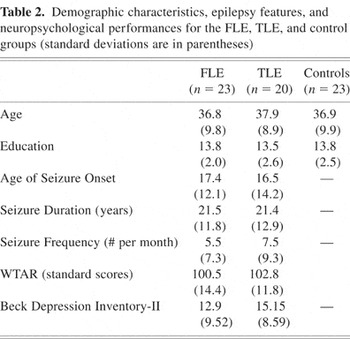
Demographic characteristics, epilepsy features, and neuropsychological performances for the FLE, TLE, and control groups (standard deviations are in parentheses)

Time to completion in seconds for the FLE, TLE, and control groups across the five D-KEFS TMT conditions. Error bars represent the standard error of the mean.
 You have
Access
- 40
- Cited by