INTRODUCTION
The linguistic subfields of morphosyntax and pragmatics are both closely involved in nominal reference. The determiner–noun combination that a speaker uses for reference depends on the speaker's and listener's knowledge about the referent and on whether a referent is new or given in the current discourse. For example in English, an indefinite determiner indicates newness and cannot be used for referents that are already given in the discourse. In that case, a definite noun (or personal pronoun) is used (see example 1).
(1) I saw a popstar yesterday. *A popstar/the popstar/he was on the train.
In language acquisition, therefore, children must not only learn to use determiners, but also the pragmatic discourse conditions under which these forms can be used.
Research on the interaction between the (morpho)syntax and pragmatics of reference in language acquisition has found that up until at least six years of age children experience difficulties in several aspects of pragmatic language use, such as taking into account the listener's perspective (Kail & Hickmann, Reference Kail and Hickmann1992). However, early sensitivity to the morphosyntax–pragmatics interface has also been demonstrated for two-year-olds, for example in the field of encoding topics or referents given in discourse (De Cat, Reference De Cat2004; Serratrice, Reference Serratrice2005). The current study will also address the morphosyntax–pragmatics interface in early child language. We will focus on how children who are in the process of acquiring the determiner system of their language (i.e. between 2 ; 0 and 3 ; 3) use indefinite and definite determiners in relation to various pragmatic discourse factors. These pragmatic factors have cognitive underpinnings (for example the ability to distinguish whether something is new or given). Developmental differences in such cognitive abilities are not to be expected between children acquiring different languages. However, the rate of acquisition of the determiner forms is known to vary between languages. This may impact on the acquisition of form–function associations. This study will examine the morphosyntax–pragmatics interface in languages in which the acquisition of determiners is known to proceed at different rates: Dutch, English and French. Moreover, in the adult system of these languages, determiner use and the associations between morphosyntactic forms and pragmatic functions differ to some extent. These differences may also affect the course of acquisition of the morphosyntax and pragmatics of reference. Generally, this study considers whether children use indefinite and definite determiners differently in relation to various pragmatic discourse factors and if so, how. First, the adult systems of the three languages are described and earlier acquisition results discussed. After giving an outline of the method used, a brief analysis of the input to the children is presented in order to indicate the strength of the association between form and function as evidenced to the children and to examine possible differences between the languages. Subsequently the children's rate of determiner acquisition is compared between the three languages and their form–function association analyzed. The discussion focuses on the impact of the cross-linguistic differences.
Form–function combinations
General introduction
Speakers can make use of several different nominal forms to refer to the same (type of) entity. In the following discussion, the focus will be on form–function associations of indefinite determiners, definite determiners and attributively used demonstrative pronouns.Footnote 1 Other nominal forms, such as bare nouns or nouns preceded by other types of determiners are termed ‘other nouns’ and will only be quantified for purposes of comparison.
The definite-demonstrative and indefinite determiners are differently used for pragmatic functions. Consider the hypothetical examples in (2):
(2a) I want to buy a new skirt, so I'll go shopping and see if I can find one tomorrow.
(2b) I want to buy a new skirt. I have seen one I want in the high street.
(2c) Why don't you wear the new skirt that you bought in London? You haven't worn that skirt for a long time.
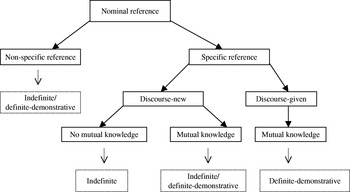
The examples in (2a–c) show that in reference to ‘skirt’ speakers can use the nominal phrase a skirt, but also the skirt or that skirt. The type of determiner used by the speaker depends on the specificity and familiarity of the referent to speaker and/or hearer and on the discourse status of the referent. The pragmatic discourse factors that influence determiner use are outlined in Figure 1. Although not necessarily psychologically real, Figure 1 can be seen as a decision tree of binary choices between opposing pragmatic discourse functions resulting in the choice for a particular morphosyntactic form.
Combinations of discourse pragmatic factors and morphosyntactic forms (dashed arrows and boxes) for nominal reference in adult language.

The first distinction is between non-specific reference and specific reference, based on whether the speaker (presumably) does not have or does have a particular entity in mind. Specificity is thus interpreted as a pragmatic notion in this research and not as a semantic one (Lyons, Reference Lyons1999: 173). For example, in (2a) the discourse context indicates that the speaker does not (yet) have a particular skirt in mind and thus is not referring to a specific skirt. This is termed non-specific reference and is determined from the perspective of the speaker, for whom the entity is not (yet) specific. Non-specific reference is usually indicated with an indefinite determiner, although definite-demonstrative determiners and other nouns, such as bare mass nouns, can also be used (Lyons, Reference Lyons1999: 169).
In example (2b), the discourse context indicates that the speaker has an actual skirt in mind that she wants to buy. The referent is thus specific to the speaker. Figure 1 shows that for specific reference, determiner choice depends on the discourse status and information status of the referent. A referent that is specific to the speaker but mentioned for the first time in the current discourse is termed discourse-new. The choice of the determiner then depends on the assessment of mutual knowledge of the referent to both speaker and hearer. If there is no mutual knowledge (NMK), an indefinite determiner must be used to indicate the newness of the referent to the hearer. If on the other hand, the referent is mutually known (MK) to speaker and hearer, a definite-demonstrative determiner can be used felicitously, such as in the first reference to ‘skirt’ in example (2c). Referents that have already been mentioned before in discourse are termed discourse-given here. These referents are mutually known to speaker and hearer on the basis of their previous mention in the discourse. Reference to discourse-given entities is often achieved by means of pronouns. In terms of nominal devices, which are the focus of the current study, however, nouns with definite-demonstrative determiners must be used to indicate givenness (see the second reference to skirt in (2c)).
Determiner use and form–function combinations in Dutch, English and French
As we mentioned in the Introduction, there are morphosyntactic differences in the adult systems of Dutch, English and French with regard to obligatory use of determiners and also in form–function combinations. Indefinite plurals and mass nouns are expressed by means of a (grammatical) bare noun in Dutch and English (both Germanic languages). In French (a Romance language) nouns are always preceded by a determiner. This language uses an indefinite plural determiner (example 3c) and a partitive determiner for mass nouns (example 4c) where Dutch and English use bare nouns (examples 3a–b and 4a–b).Footnote 2
(3a) I bought books, because there was a sale at the bookstore.
(3b) Ik heb boeken gekocht, want de boekhandel hield uitverkoop.
(3c) J'ai acheté des livres/*livres, parce qu'il y avait des soldes dans la librairie.
(4a) Do you want beer, wine or orange juice?
(4b) Wil je bier, wijn of sinaasappelsap?
(4c) Tu veux de la bière/*bière, du vin/*vin ou du jus d'orange/*jus d'orange?
The possible forms of indefinite and definite-demonstrative determiners in each of the three languages are set out in Table 1.
Determiner forms in adult Dutch, English and French

The languages pattern more or less similarly in the way indefinite and definite-demonstrative determiners are used for the pragmatic discourse functions from Figure 1 in reference. In general, the indefinite determiner indicates newness, whereas the definite-demonstrative determiner indicates givenness. The latter form, however, can also be used for non-specific reference in Dutch, English and French, as is shown in (5a–c).
(5a) The new computer that we are going to buy must be much faster than our old one.
(5b) De nieuwe computer die wij gaan kopen moet veel sneller zijn dan onze oude.
(5c) Le nouvel ordinateur qu'on achètera doit être beaucoup plus rapide que l'ancien.
As well as the fact that French requires a determiner more strictly than Dutch or English, there are also some differences in the form–function associations. First, in a colloquial narrative style in English, speakers can use a demonstrative determiner to introduce a not mutually known referent at the beginning of a story, as in example (6) from Givón (Reference Givón, Gernsbacher and Givón1995: 66). It is not clear if this is possible in Dutch and French.Footnote 3
(6) There is this guy I've been going with for near three years. Well, the problem is that he hits me […].
A second difference lies in the use of indefinite versus definite determiners in generic constructions. These often receive a non-specific interpretation, since generics do not refer to specific individuals but to kinds. Lyons (Reference Lyons1999: 192) claims that the definite determiner has a much wider range of generic usage in French than in English. Especially plural generic noun phrases tend to take the definite determiner in French (7c), whereas they tend to be indefinite in English (7a) and Dutch (7b).
(7a) Dutch students always have a job on the side.
(7b) Nederlandse studenten hebben altijd een bijbaantje.
(7c) Les étudiants néerlandais ont toujours un petit boulot.
The adult grammars show some clear form–function associations and some cross-linguistic differences. If an input driven model of language acquisition is assumed (Tomasello, Reference Tomasello2003), one would expect children to express non-specific reference mainly by means of indefinite determiners. A language specific pattern might be found for French children. The distinction between specific-discourse-new or specific-discourse–given referents would probably be expressed by restricting the use of indefinites to discourse-new referents and by not using them for given referents, which are expressed by means of nouns with a definite-demonstrative determiner. To our knowledge, the strength of the form–function association has not yet been investigated in the spontaneous input to young children. This will be taken up in the current study.
Developmental studies
The acquisition of determiners from a morphosyntactic point of view has been widely studied in Dutch, English and French. The earliest forms in all three languages appear to be filler syllables produced before nouns and phonetically realized as schwa. These are often considered to be proto-determiners and are analyzed as the first realized determiners (Veneziano & Sinclair, Reference Veneziano and Sinclair2000). Most development seems to take place between the ages of two and three, but there appear to be differences between the three languages. On the basis of studies of single languages and comparative studies, Dutch appears to be slower than English and English slower than French (Abu-Akel & Bailey, Reference Abu-Akel, Bailey, Howell, Fish and Keith-Lucas2000; Chiercha, Guasti & Gualmini, Reference Chiercha, Guasti and Gualmini2001; Van der Velde, Jakubowicz & Rigaut, Reference Van der Velde, Jakubowicz, Rigaut and Lasser2002; Van der Velde, Reference Van der Velde2003; Bassano, Maillochon & Mottet, Reference Bassano, Maillochon and Mottet2005). These cross-linguistic differences in determiner acquisition have been associated with various factors, such as a preferred metric template, the morphological properties of the determiner set and the input frequency of determiners (cf. Gerken, Reference Gerken1994; Kupisch, Reference Kupisch, van Kampen and Baauw2004). This last point will be considered in the current study. The relationship between the differences in speed of development and the acquisition of the pragmatic properties of determiners has not yet been investigated.
The acquisition of the pragmatic properties of determiners has been studied in a wide range of languages, but most often in narratives (cf. Hickmann, Reference Hickmann2003). The results from these studies indicate that children seem to master some pragmatic properties of determiners relatively late. For example, up until at least six years of age, they still erroneously use definite determiners in discourse-new-NMK contexts. In spontaneous language, Roelofs (Reference Roelofs1998) reported 35 percent errors in discourse-new-NMK contexts in four-year-olds, reducing to 11 percent in eight-year-olds. The category of discourse-given showed hardly any errors in four-year-olds.
Children acquiring Dutch, English and French start to use determiners around the age of two. The use of determiners is intrinsically connected with pragmatic functions and therefore the investigation of the interaction between the acquisition of these forms and their pragmatic functions can and should start at around two years, as in this study. The cross-linguistic design of the current study also enables investigation of the possible early influence of the target language.
Studies of the development of socio-cognition and prelinguistic communication suggest that infants develop the cognitive concepts necessary for the pragmatic functions of determiners even before the age of two. For example, in dishabituation experiments, four- to six-month-old infants distinguish between stimuli that are, for them, novel or familiar (Roder, Bushnell & Sasseville, Reference Roder, Bushnell and Sasseville2000). At around twelve to fourteen months, children are also aware of what is new for others, even if it is not new for the children themselves (Tomasello & Haberl, Reference Tomasello and Haberl2003). The acquisition of a full Theory of Mind takes much longer. Understanding that others' minds are separate from one's own seems to take at least until age four (Ruffman & Perner, Reference Ruffman and Perner2005). It is not clear whether children use these cognitive concepts for the pragmatic functions of determiners as soon as they begin to use the forms and whether they do this in different ways across languages.
Just a few studies have focused on the joint acquisition of the morphosyntax and pragmatics of determiners. The work on the non-specific/specific distinction of determiners in spontaneous speech and experiments suggests that two- and three-year-old children are sensitive to this distinction. In English, French and Italian it has been shown that children associate indefinite determiners with non-specific reference (Abu-Akel & Bailey, Reference Abu-Akel, Bailey, Howell, Fish and Keith-Lucas2000; Kupisch, Reference Kupisch, Gaerts and Jacobs2005; Schaeffer & Matthewson, Reference Schaeffer and Matthewson2005). The same association can be predicted for Dutch children.
As shown in Figure 1, determiner choice for reference to specific entities depends on the referent being new or given to the current discourse and, for specific referents that are new, also on whether the referent is mutually known between speaker and hearer. Studies on preferred argument structure in several languages have shown that two-year-old children reflect the first aspect in their language production although they do not necessarily display an adult pattern of form–function combinations. At this age children drop subjects and objects when they are given, but use full (nominal or pronominal) forms for new referents (Clancy, Reference Clancy, Sohn and Haig1997; Serratrice, Reference Serratrice2005; Guerriero, Oshima-Takane & Kuriyama, Reference Guerriero, Oshima-Takane and Kuriyama2006). These findings indicate that young children distinguish between new and given in their choice of linguistic forms. This distinction might then also be made in their choice between indefinite and definite-demonstrative determiners, as the results here will hope to clarify. Children acquiring Dutch, French or English might associate indefinite determiners with discourse-new referents and disassociate them with discourse-given referents. The latter function might then be associated with definite-demonstrative determiners, although the input is not a completely reliable cue here, since definite-demonstrative determiners are also allowed for discourse-new-MK referents.
As mentioned above, various studies on language production in narratives have found that children have trouble in applying MK and NMK in determiner production until a late age. However, these studies do not only investigate the children's ability to refer, but necessarily include their increasing ability to narrate a story (Wigglesworth, Reference Wigglesworth1990). Children seem better able to take the interlocutor's knowledge into account in spontaneous speech than in picture-based narratives (Roelofs, Reference Roelofs1998). Since this study investigates spontaneous speech, some sensitivity to others' knowledge is therefore expected.
Finally, differences in the application of morphosyntactic forms to pragmatic discourse functions have been found between children acquiring various languages. Hickmann (Reference Hickmann2003) found related differences in this aspect between children learning English, French, German or Chinese at the ages of four and five years. These differences were related to the form–function associations in the target languages. It is plausible that differences will also be found earlier, assuming that the structure of the target language is of influence in this area of acquisition. According to Tomasello (Reference Tomasello2003), the relative frequency with which children hear language structures plays a large role in the speed of acquisition. It is not clear yet how this might apply to the form–function associations under investigation here. In the adult grammars, indefinite and definite determiners are both used for different pragmatic functions, making the distributional form–function cue in the input less reliable.
In sum, in the adult systems of determiner use in Dutch, English and French pragmatic functions are clearly associated with particular determiner forms. The pragmatic functions are related to the non-specific/specific distinction, the new/given contrast and the assessment of mutual knowledge. On the basis of previous research we can assume that the cognitive basis for the first two distinctions is present from an early age, before the age of two years. The correct assessment of mutual knowledge, however, takes longer to develop to an adult level, far past three years. The production of determiners starts also around the age of two years, but this varies between the three languages under study, with the French children being more advanced in their acquisition than the English and the Dutch. The question is whether children immediately associate the determiners they produce with their correct pragmatic function. Second, are the children with a quicker acquisition of determiners also quicker in associating form and function? More specifically, the analyses in the current study will focus on the questions:
(i) Do children acquiring Dutch, English or French distinguish between non-specific/specific reference, new/given in discourse and the presence/absence of mutual knowledge in the use of indefinite and definite-demonstrative determiners?
(ii) Do differences in the speed of acquisition of determiners influence form–function combinations for determiners in children acquiring Dutch, English or French?
In answering the two research questions, we will also consider whether there are any language-specific patterns in the form–function associations for determiners in children acquiring Dutch, English or French.
METHOD
Subjects and data
The data were taken from the CHILDES database (MacWhinney, Reference MacWhinney2000). Three languages are compared: English, Dutch and French. The data needed to satisfy the following criteria:
(i) The transcripts had to include speech from both conversational partners, as this allows us to track the diverse pragmatic factors (non-specific reference, discourse-given, discourse-new-MK and discourse-new-NMK) and to analyze the input.
(ii) The transcripts needed to be already coded for external, non-linguistic events and context information to facilitate the coder's analysis of the pragmatic factors. Video-recordings of the conversation would have facilitated the interpretation even more. Unfortunately, these tapes did not exist for all CHILDES data or were not available through CHILDES at the time of coding. Therefore, videos have not been used in this research.
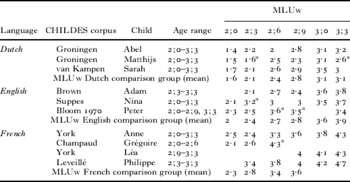
Data from three English, three Dutch and four French children were analyzed (see Table 2). For each child the data were analyzed every three months between 2 ; 0 and 3 ; 3, that is at six data points across the age range. For one English child (Adam) and one French child (Philippe) there were no data available before 2 ; 3. Since there was no third French child available in CHILDES whose data covered the total age range 2 ; 0–3 ; 3, a mixed longitudinal-cross-sectional design was used to obtain enough data on French. Grégoire's data range from 2 ; 0–2 ; 6 and Léa's data range from 2 ; 9–3 ; 3 (see Table 2). All children are from well-educated parents (college or university degrees) and from (upper-)middle-class families. For each child a sample of input language of a (grand)parent and/or an investigator was analyzed at the ages of 2 ; 3 and 3 ; 3.
Longitudinal data used for the study with MLU in words of subjects per age point compared to comparison group of children per language

notes: a=cases in which the MLUw lies further than 1 s.d. from the norm group.
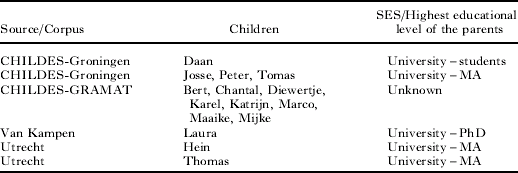
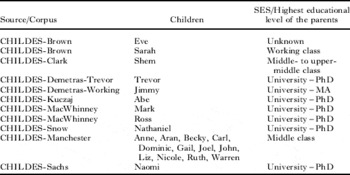
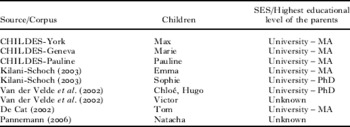
Since a small number of children was studied, it was important to know that the children per language fell within the normal range of general linguistic development. For each language, the subjects' MLU in words (MLUw) were therefore compared to the MLUw of a larger group of children of the same age and, as far as possible, with parents with the same educational level as the subjectsFootnote 4 (see the Appendix for details of the comparison groups). All of the children were comparable to the norm group, although occasional age points showed an MLUw just more than 1 s.d. from the norm (see Table 2).
In the analysis of nominal reference in this study, the children were compared on the basis of age and not MLUw, since it is commonly agreed that cross-linguistic comparisons based on MLUw are problematic, given the differences between languages in morphological complexity. Moreover, determiners are part of the MLUw count and a dependent variable here. A comparison based on MLUw would thus be circular.
Analysis
For each child a sample of 600 utterances was analyzed in order to achieve a similar amount of discourse diversity across the different children. For some subjects, there was no recording available at exactly the target age or there were too few utterances or references available in the recording. In that case, as many additional data as needed were used from recordings made within one month before or after the target age. In no case were there more than five weeks between the different samples of one child for a particular target age. For the analysis of the input, 300 utterances of input language from the samples of each child were coded at 2 ; 3 and another 300 at 3 ; 3. The same analysis procedure was used for the child and adult utterances.
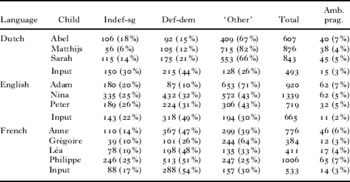
Nominal references were selected from the utterance sample. References were excluded if they occurred in singing, partly uninterpretable utterances, unfinished utterances and imitations. Furthermore, for the study reported here, only nominal references to persons, concrete objects and substances were analyzed. Generic locations such as (in) the kitchen or at home were excluded. Nouns referring to persons/objects that are part of a (fixed) verbal construction, such as going by car or aller en voiture, were also excluded. Nouns phrases in such constructions show idiosyncratic behaviour with regard to the presence and type of determiner. The total proportion of such excluded nominal references is less than 5 percent in these data. In all cases, the number of nominal references obtained per child per age point was more than 70; in 80 percent of the recordings, the number was more than 100 (see Table 3).
Overview of total number of nominal references

notes: Indef-sg=noun with indefinite singular determiner; Def-dem=noun with definite-demonstrative determiner; ‘Other’=other nominal forms; Total=total number of nouns; Amb. prag.=number of nouns analyzed as pragmatically ambiguous.
The nominal references were analyzed morphosyntactically as well as pragmatically. The morphosyntactic analysis focused on the noun and type of determiner used, whereby the main contrast was between singular indefinite and definite-demonstrative determiners. The choice for singular indefinites was made for comparability since only French has plural indefinites marked on the determiner. A category ‘other’ contains grammatical (e.g. sugar/suiker) and ungrammatical bare nouns (e.g. *ø chair/*ø stoel/*ø chaise), indefinite plurals (e.g. chairs/stoelen/des chaises), possessive (e.g. my chair/mijn stoel/ma chaise), numeral (e.g. two chairs/twee stoelen/deux chaises) and partitive determiners (e.g. du sucre), as well as genitives (e.g. daddy's chair/papa's stoel) and fillers (e.g. ə stoel/ə chaise).Footnote 5 The form of the French singular indefinite determiner (un/une) and the numeral ‘one’ are identical; on the basis of the context the decision was made as to which category the form belonged. Partitive determiners only occur in French and genitives only in English and Dutch. In English, filler syllables that occur before nouns cannot be distinguished from the indefinite article and therefore could not be excluded. This introduces a bias for the English data. The English children might use the indefinite determiner differently from the French and Dutch children at least in the early stages, i.e. when the definite determiner has not yet been fully acquired. In the results section, we will return to this point. Table 3 gives the total numbers of indefinite, definite-demonstrative determiners and ‘other’ nouns produced by each subject. These data form the basis of all further analyses.
Nominal references were also analyzed for their pragmatic function in the context of the conversation between the child and a (grand)parent and/or investigator. Surrounding discourse and contextual annotations were used in the analysis of pragmatic functions. References that were ambiguous between different pragmatic functions were excluded from further analysis. This category was always less than 10 percent of the data (see Table 3).
The pragmatic factors outlined in Figure 1 served as the basis for the pragmatic analysis. The pragmatic function of labelling was, however, added to the analysis, since in child language, utterances that predicate class membership or in which the speaker names or identifies a specific entity occur frequently. Labelling often appears after a wh-question from the interlocutor and occurs in a predicating or existential construction (example 8). In this study, single word utterances that are not elaborations from a previous utterance or elaborated upon in subsequent utterances by the same speaker are also classified as labelling (example 9).
(8) Labelling in a predicating construction after wh-question (Peter, English, 2 ; 3)
inv: And what's this thing called?
chi: It's a see+saw.
(9) Labelling as a single word utterance (Matthijs, Dutch, 2 ; 3)
mot: Ga [/] ga Evelien maar helpen.
‘Just go and help Evelien.’
chi: Kachel.
‘Stove.’
act: Banging with hands on stove.
inv: Wat is er met de kachel?
‘What's the matter with the stove?’
Following Figure 1, references were then coded for whether they referred to a non-specific or specific referent. Typical examples in which the referent is not specific for the speaker include proposals to construct something, reference to one instance out of many (example 10) or statements that apply to all instances of a certain class, including generics (example 11).
(10) Non-specific reference: one cookie out of many (Abel, Dutch, 3 ; 0)
chi: Arjen moet ook een koekje.
‘Arjen must also (get) a cookie.’
(11) Non-specific reference: all instances of the intended class (Philippe, French, 2 ; 6).
chi: Comme le camion il faisait du bruit l' avion.
‘Like the truck, it makes a noise, the airplane.’
fat: Comme le camion seulement?
‘Only like the truck?’
fat: Pas plus?
‘Not more?’
chi: Oui, comme les motos aussi, comme les voitures, comme les autobus, comme les autocars.
‘Yes, like the motorcycles too, like the cars, like the buses, like the coaches.’
It is important to note that errors in expressing non-specific reference are not always clear. That is, if in example (10) the child had used a definite determiner instead of an indefinite, a specific reading would have automatically arisen. Since it is feasible that the child has one specific cookie out of many in mind, the child was given the benefit of the doubt in such cases and the referent was analyzed as specific (cf. Schafer & de Villiers (Reference Schafer, de Villiers, Howell, Fish and Keith-Lucas2000) on this problem in experiments eliciting non-specific reference).
If reference was analyzed as specific, it could then be coded as discourse-new or discourse-given (see Figure 1). References made by interlocutor(s) are taken into account in this evaluation. Thus, if the child mentions a referent for the first time but this referent has already been mentioned by the interlocutor, the child's reference is coded as discourse-given. Likewise, if the speaker refers back to an entity already mentioned by him/herself, this is also coded as discourse-given (example 12).
(12) Specific discourse-given reference: definite determiner (Nina, English, 2 ; 3)
chi: That's food.
chi: The food fell all off.
Referents that are specific and new in discourse can be either MK or NMK between the interlocutors. Referents are coded as MK if they are present in the physical context of the conversation or if they are shared or world knowledge. This includes uniqueness (the sun), part–whole relations (wheels of a car) and inclusiveness (the cashier at the supermarket). Referents that are NMK require an indefinite determiner to indicate unfamiliarity to the listener (Clark & Marshall, Reference Clark, Marshall, Joshi, Sag and Webber1981). Discourse-new MK referents can be introduced by means of an indefinite or definite-demonstrative determiner (see examples 13 and 14 respectively). Discourse-new NMK referents require the use of an indefinite determiner. An example of the incorrect use of the definite determiner in this context is given in (15).
(13) Specific discourse-new referent MK: indefinite determiner (Léa, French, 2 ; 9)
(Watching and commenting on the video of a wizard.)
chi: T(u) as vu?
‘Did you see?’
chi: Il a une grosse barbe.
‘He has a big beard.’
(14) Specific discourse-new referent MK: definite determiner (Léa, French, 2 ; 9)
(Léa is playing in the sink with soap.)
chi: xxx.
grm: Comment dis tu?
‘What did you say?’
chi: Je veux laver les mains de la poupée.
‘I want to wash the puppet's hands.’
(15) Specific discourse-new referent NMK erroneously with definite determiner (Peter, English, 2 ; 9)
chi: Lot a money!
inv: Where'd you get it?
chi: Downstairs.
inv: From whom?
inv: Who gave it to you?
chi: The man.
inv: What man?
chi: Downstairs.
inv: The one that sits at the desk?
The data were coded by the first author. To determine the reliability of the coding scheme, 10 percent of the child data were coded independently by a trained research assistant. The mean percentage of agreement between the two coders was 81 percent for pragmatic functions and 98 percent for morphosyntactic forms.
Statistical analysis
The focus of the statistical analysis will be on the use of indefinite, definite-demonstrative and ‘other’ nouns for the five pragmatic functions of non-specific, labelling, discourse-given, discourse-new MK and discourse-new NMK. Per age point, Pearson's chi-square tests were carried out with a significance level of p<0·05. Separate age points were combined if 20 percent or more of the cells at individual age points had expected counts of less than five, since the statistical power of the chi-square test is drastically reduced in such cases (Agresti, Reference Agresti1996). The contingency coefficient C was calculated to indicate the strength of the significant effect. If C is between 0·10 and 0·25, the association is weak. A moderate association ranges between 0·25 and 0·50. Associations over 0·50 are strong. Significant chi-square values were further examined by using the adjusted standardized residual (abbreviated as asr in this article). The asr provides information about which variables contribute to a significant chi-square for tables that are larger than two by two. This was used here to examine the association or dissociation between the morphosyntactic forms and pragmatic functions. More specifically, the asr indicates how a particular form is used for a particular pragmatic function relative to other forms for that function and also relative to how this particular form is used for other functions. As such, it indicates if a particular form is associated with one or more pragmatic functions and/or dissociated with others. If the number of cells is large, as in this research, asr scores between 2 and 3 are seen as major contributors to the overall (significant) chi-square value. Therefore, only asr scores higher than 2·5 are reported.
RESULTS
Adult input to children
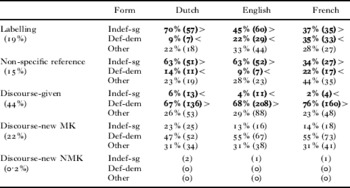
Table 4 shows the use of morphosyntactic forms for pragmatic functions in the adult input to the children in the three languages. First, the proportion of the five pragmatic functions is given for all three languages taken together, since this was not different across languages. Thus labelling, for example, constitutes 19% of all pragmatically analyzable nominal references in all the Dutch, English and French input together. The pragmatic function of discourse-new NMK hardly occurs at all in the input (<1%) and so cannot be analyzed separately for form–function associations. As discussed earlier, a strong association with indefinites is expected for this category on the basis of the adult grammar. The few discourse-new NMK references were collapsed with discourse-new MK in the statistical analyses.
Form–function combinations in the adult input

notes: Raw figures are given in brackets. Bold indicates that this cell is a major contributor to the significant chi-square value for form–function combinations per language. The > indicates that adjusted standardized residual is greater than 2·5 and that the morphosyntactic form is more strongly associated with this function than other forms and more strongly with this function than with other functions. The < has the opposite interpretation.
Per language, the combinations of the five pragmatic functions are shown with indefinite singular determiners, definite-demonstrative determiners and the general category of ‘other nouns’. As discussed earlier, this category includes grammatical and ungrammatical bare nouns, indefinite plurals, possessive, numeral and partitive determiners as well as the genitive construction. Table 4 shows, for example, that in Dutch, the pragmatic function of labelling is strongly associated with the use of an indefinite singular determiner (70% of the cases), and dissociated with definite-demonstrative (9%) or ‘other’ (22%) nouns. The figures in bold designate form–function combinations that have a strong association (indicated with>) or strong dissociation (indicated with<) compared to the expectation based on equal distribution of the forms over all pragmatic functions (asr calculation). It is important to recall that the asr does not only take into account the distribution of forms within one particular function, but also the distribution of a particular form over all other functions. The use of indefinite determiners in French, for example, is strongly associated with labelling, whereas definite-demonstrative determiners are dissociated with this function, even though the percentage of use for labelling itself hardly differs between the two forms. Since the definite-demonstrative determiner over all functions is more often used for discourse-given referents than for labelling, there is a dissociation between definite-demonstrative and labelling and an association between indefinite determiners and labelling.
It is clear from Table 4 that in every language there is a strong association between the use of morphosyntactic forms for particular pragmatic functions (Dutch: χ2(6, N=478)=175·51, p<0·001, C=0·52; English: χ2(6, N=644)=221·01, p<0·001, C=0·51; French: χ2(6, N=519)=116·25, p<0·001, C=0·43). This overall effect is caused by largely similar form–function associations across the three languages. Indefinite determiners are strongly associated with labelling and non-specific reference and dissociated with discourse-given references in all languages. Definite-demonstrative determiners are also used for labelling and non-specific reference, but they are dissociated with these functions, since they are most strongly associated with discourse-given referents (figures in bold, Table 4). Although the category of discourse-new does not contribute to the overall effect, the use of the three forms within this pragmatic function is not equal. The adults in all three languages use significantly more definite determiners than indefinite or ‘other’ nouns for MK (Dutch: χ2(2, N=111)=10·22, p=0·006; English: χ2(2, N=121)=32·45, p<0·001; French: χ2(2, N=132)=34·68, p<0·001).
Despite the fact that the overall pattern of form–function associations is similar in the three languages, there are also clear differences. In labelling, the Dutch adults use more indefinite determiners than the English (χ2(2, N=215)=13·06, p=0·001, C=0·24) and the French (χ2(2, N=177)=23·13, p<0·001, C=0·34). For non-specific reference, the French adults use more definite or ‘other’ nouns than the English (χ2(2, N=161)=14·51, p=0·001, C=0·29) and the Dutch adults (χ2(2, N=160)=13·39, p=0·001, C=0·28).
If an input-driven model of language development is adopted, these figures create expectations for children's acquisition. First, children seem to receive little positive evidence on how to express discourse-new NMK referents, since this pragmatic function is infrequent (see Discussion). The patterns of associations and dissociations between forms and functions in the adult languages might influence the (speed of) acquisition of the morphosyntax and pragmatics of determiners. In all three languages, children should learn to use indefinite determiners mainly for labelling and non-specific reference and to some extent for discourse-new referents but not for discourse-given referents. Definite-demonstrative determiners are used for discourse-given and discourse-new MK referents. We would also expect language specific patterns: the English and French children might associate definite-demonstrative determiners more strongly with labelling than the Dutch. Moreover, the French input contains more evidence for the use of definite-demonstrative determiners for non-specific reference than the Dutch and English input, so the children might learn this more quickly.
Children's acquisition of determiners
Before we can investigate the form–function associations in the children, it has to be clear when the children acquire determiners. As was obvious from the discussion of previous literature, differences have been observed in the speed of acquisition of determiners in Dutch, English and French, and our results confirm this.
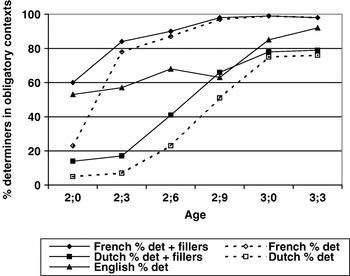
The use of determiners was analyzed in obligatory contexts. Filler syllables before nouns were also registered for Dutch and French but not for English, since, as discussed earlier, filler syllables that occur before nouns cannot be distinguished from English indefinite determiners. Not counting filler syllables as determiners in this analysis would make the comparison between the three languages biased in favour of the English children. Figure 2 shows that the inclusion of fillers mainly affects the earliest data, i.e. at 2 ; 0 and 2 ; 3.
Percentage of realized determiners (and fillers) in obligatory contexts in child language.

Dutch children lag behind on the production of determiners and fillers compared to both the English and the French children (Figure 2). All language-pair contrasts are significant. The French children use determiners and fillers significantly more frequently than the Dutch children at all ages investigated (2 ; 0: χ2(1, N=490)=113·48, p<0·001, C=0·43; 2 ; 3: χ2(1,=794)=348·61, p<0·001, C=0·55; 2 ; 6: χ2(1, N=820)=227·40, p<0·001, C=0·47; 2 ; 9: χ2(1, N=745)=127·84, p<0·001, C=0·38; 3 ; 0: χ2(1, N=745)=88·36, p<0·001, C=0·33; 3 ; 3: χ2(1, N=674)=62·10, p<0·001, C=0·29). The French children also use determiners more frequently than the English children at all ages, except 2 ; 0 (2 ; 3: χ2(1, N=975)=79·56, p<0·001, C=0·28; 2 ; 6: χ2(1, N=1036)=76·71, p<0·001, C=0·26; 2 ; 9: χ2(1, N=792)=144·54, p<0·001, C=0·39; 3 ; 0: χ2(1, N=815)=58·96, p<0·001, C=0·26; 3 ; 3: χ2(1, N=923)=14·51, p<0·001, C=0·12). The English children use determiners significantly more frequently than the Dutch children at almost all ages except 2 ; 9 (2 ; 0: χ2(1, N=537)=92·37, p<0·001, C=0·38; 2 ; 3: χ2(1, N=893)=140·43, p<0·001, C=0·37; 2 ; 6: χ2(1, N=882)=59·73, p<0·001, C=0·25; 3 ; 0: χ2(1, N=708)=4·53, p=0·03, C=0·08; 3 ; 3: χ2(1, N=809)=26·54, p<0·001, C=0·18).
As discussed earlier, the language levels of the children included in this study are comparable to a norm group. The differences found here are not due to any of the subjects being extremely delayed or advanced in their overall linguistic level.
An analysis of the input was carried out in order to indicate the reliability of the frames offered for determiner use. All determiner-like elements that precede nouns are analyzed as a possible cue here. This includes indefinite singular and definite-demonstrative determiners, but also possessive and numeral determiners as well as indefinite plural and partitive determiners in French and genitives in English and Dutch.
From Table 5 it is clear that French input is more consistent in the use of nouns with determiners (almost 100%) than the English (90%) and Dutch (86%) input. The differences between the language pairs are significant: Dutch–English (χ2(1, N=1148)=5·35, p=0·02, C=0·07); Dutch–French (χ2(1, N=1026)=78·06, p<0·001, C=0·27); and English–French (χ2(1, N=1188)=52·18, p<0·001, C=0·21).
Frequency of grammatical and ungrammatical bare nouns versus nouns with a determiner in the input

notes: Raw figures are given in brackets.
The input thus reflects the same variation as the children's acquisition rate. The patterns of use in the input seem to play a highly relevant part in explaining the differences in the rate of acquisition of determiners.
Form–function combinations in child Dutch
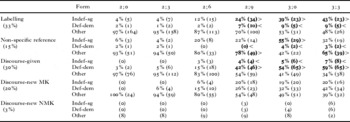
On the basis of the input (Table 4), we would expect the Dutch children to associate labelling and non-specific reference mainly with indefinite determiners. Specific discourse-new MK and discourse-given reference should be associated with definite-demonstrative determiners. It is already known that the Dutch children produced very few determiners before 2 ; 6 (Figure 2). Only from age 2 ; 9 onwards are the numbers of determiners produced large enough to use the chi-square test. Prior to that age, no associations or dissociations could be investigated. As Table 6 shows, significant form–function interactions were found at ages 2 ; 9, 3 ; 0 and 3 ; 3 (2 ; 9: χ2(8, N=420)=76·50, p<0·001, C=0·39; 3 ; 0: χ2(8, N=348)=96·77, p<0·001, C=0·47; 3 ; 3: χ2(8, N=321)=84·98, p<0·001, C=0·46).
Form–function combinations in Dutch child language

notes: Raw figures are given in brackets. Bold indicates that this cell is a major contributor to the significant chi-square value for form–function combinations per language. The > indicates that adjusted standardized residual is greater than 2·5 and that the morphosyntactic form is more strongly associated with this function than other forms and more strongly with this function than with other functions. The < has the opposite interpretation.
A largely similar pattern of form–function associations is found at all these ages (2 ; 9–3 ; 3). As expected, labelling is strongly associated with the use of indefinite determiners. Definite determiners are dissociated with this function and with non-specific reference. Instead of the expected indefinite determiners, the children associate non-specific reference strongly with ‘other’ nominal forms, which include many grammatical and ungrammatical bare nouns, at 2 ; 9 and 3 ; 3. An association with the expected indefinite determiner is growing.
Discourse-given referents are, again as expected, strongly associated with definite-demonstrative determiners: there is a dissociation between indefinite determiners and discourse-given referents. Moreover, indefinite and definite-demonstrative determiners are used contrastively for discourse-given and discourse-new at all ages: 2 ; 9 (χ2(2, N=213)=17·04, p<0·001, C=0·27); 3 ; 0 (χ2(2, N=236)=16·09, p<0·001, C=0·25); and 3 ; 3 (χ2(2, N=207)=11·68, p=0·003, C=0·23). The Dutch children are thus able to distinguish between newness and givenness of referents in discourse in their use of determiners at least as early as 2 ; 9. The category of discourse-new alone does not contribute to the overall significant effect (see Table 6, no bold figures). Unlike the adults, the children do produce NMK references, but not many. However, the form–function associations do not differ significantly between discourse-new MK and discourse-new NMK references (χ2(2, N=316)=0·12, p=0·94, age points 2 ; 9–3 ; 3 combined). Within the category of discourse-new NMK, the Dutch children do not yet show differentiation in their use of morphosyntactic forms (χ2(2, N=41)=3·71, p=0·16, age points 2 ; 9–3 ; 3 combined). Indefinite nouns are expected for this function and the use of definite-demonstrative determiners leads to errors. Within the category of discourse-new MK, the Dutch children use significantly more ‘other’ nouns (χ2(2, N=275)=32·39, p<0·001, age points 2 ; 9–3 ; 3 combined). At 2 ; 9 these are still mainly ungrammatical bare nouns or nouns preceded by a filler (38 percent of total for function), but by 3 ; 0 and 3 ; 3, the children have started to use more indefinite plurals and possessives.
The Dutch children are starting to show adult-like form–function associations from 2 ; 9, but a more detailed comparison indicates that the children have not yet reached an adult level. That is, the children use fewer indefinite determiners and more ‘other’ nouns (i.e. ungrammatical bare nouns) than the adults in labelling (χ2(2, N=136)=10·94, p=0·004, C=0·27) and non-specific reference (χ2(2, N=141)=10·94, p<0·001, C=0·39). They also use more indefinites for discourse-given referents than the adults (χ2(2, N=323)=12·22, p=0·002, C=0·19). The latter is an erroneous form–function combination. There are no differences between the children and the adults in the frequency of forms for discourse-new MK references at 3 ; 3.
To conclude, the Dutch children express non-specific and specific reference differently by means of determiners from the moment that they produce sufficient forms to carry out a statistical analysis. Moreover, the difference between new and given in discourse is also made in determiner use from an early age, since there is a dissociation between indefinite determiners and discourse-given referents. The indefinite is to some extent used for discourse-new. The Dutch children do not yet distinguish between MK and NMK, since they do not differentiate between the use of indefinite and definite-demonstrative determiners for these functions. Compared to the input, it is clear that the children's form–function associations are largely similar to those of adults, although the children have not yet reached the adult level of frequencies of forms for most functions by 3 ; 3.
Form–function combinations in English
The input to the English children shows an association between indefinite determiners and labelling/non-specific reference. Definite-demonstrative determiners are associated with the function of discourse-given. Definite-demonstrative determiners are more frequently used for discourse-new than indefinite determiners. The English adults use more definite-demonstrative determiners in labelling than the Dutch adults. This is, however, not clearly reflected in the children's use of definite-demonstrative determiners for labelling (Table 7). As with the Dutch children, they use this form infrequently for labelling and non-specific reference.
Form–function combinations in English child language

notes: Raw figures are given in brackets. Bold indicates that this cell is a major contributor to the significant chi-square value for form–function combinations per language. The > indicates that adjusted standardized residual is greater than 2·5 and that the morphosyntactic form is more strongly associated with this function than other forms and more strongly with this function than with other functions. The < has the opposite interpretation.
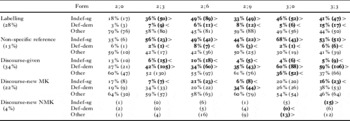
From 2 ; 3 onwards, the numbers of indefinite and definite-demonstrative determiners produced are large enough to apply statistical tests. The form–function associations are significant at all age points between 2 ; 3 and 3 ; 3 (2 ; 3: χ2(8, N=531)=141·84, p<0·001, C=0·46; 2 ; 6: χ2(8, N=576)=106·08, p<0·001, C=0·39; 2 ; 9: χ2(8, N=468)=97·30, p<0·001, C=0·42; 3 ; 0: χ2(8, N=441)=188·91, p<0·001, C=0·55; 3 ; 3: χ2(8, N=564)=151·22, p<0·001, C=0·46).
The children can be seen to link morphosyntactic forms to pragmatic functions from an early age and in an adult-like pattern. That is, at all ages the children associate labelling and non-specific reference strongly with indefinite determiners. Definite-demonstrative determiners are strongly associated with discourse-given and indefinite determiners show a dissociation with this function at all ages. Overall, the children use indefinite determiners significantly more often for discourse-new than for discourse-given referents (χ2(2, N=1548)=69·69, p<0·001, C=0·21, age-points 2 ; 3–3 ; 3 combined). The dissociation is less strong at the early ages. This might be related to the impossibility of distinguishing fillers from indefinite determiners in English at early ages. Forms that in fact are underspecified determiners are perceived and analyzed as indefinites in English.
There is no clear expectation for a particular form for discourse-new MK. In the children's language, there is a tendency for an association with definite-demonstrative determiners and dissociation with indefinites. Unlike the Dutch children, the English use the morphosyntactic forms differently over discourse-new MK and discourse-new NMK (χ2(2, N=672)=16·83, p<0·001, C=0·16, age points 2 ; 3–3 ; 3 combined). Indefinite determiners are more often used for NMK than for MK, indicating that some sensitivity to this difference is developing, despite continuing errors of using definite-demonstrative determiners for NMK. For MK the category ‘other’ is quite large and includes many ungrammatical bare nouns in the early stages (20 percent) and nouns with a possessive determiner (18 percent) in the later stages. Interestingly, the English adults also use 20 percent of possessive determiners in MK.
The English-speaking children thus show an adult-like pattern of form–function associations from 2 ; 3. It takes another year, however, before the children have reached the adult level in the frequency of forms for most functions. At this age there are no significant differences between the children and adults in form–function combinations for labelling (χ2(2, N=247)=3·65, p=0·16), non-specific reference (χ2(2, N=178)=3·13, p=0·21) and discourse-given (χ2(2, N=488)=4·23, p=0·12). In discourse-new MK, the children use fewer definite-demonstrative determiners and more nouns from the category ‘other’ than the adults (χ2(2, N=261)=8·18, p=0·017).
In conclusion, the English children differentiate between non-specific/specific reference and discourse-new and discourse-given in determiner use from an early age. The distinction between MK and NMK is developing. The children associate indefinite determiners more strongly with NMK than definite-demonstrative determiners, but also make the error of using a definite determiner for this function. Like the Dutch children, the English children show an adult-like pattern of form–function associations and dissociations from an early age. It takes until 3 ; 3, or later, to reach an adult level of frequencies of forms for functions.
Form–function combinations in French
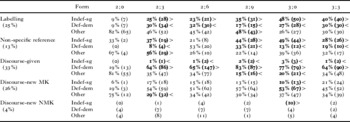
In the French input form–function associations are overall similar to the ones found in Dutch and English. However, definite-demonstrative determiners are more frequently used for labelling and non-specific reference. Table 8 shows that as soon as the statistical analysis can be carried out (from 2 ; 3 onwards), there are clear form–function associations in the French children's language (2 ; 3: χ2(8, N=425)=83·58, p<0·001, C=0·35; 2 ; 6: χ2(8, N=501)=60·19, p<0·001, C=0·33; 2 ; 9: χ2(8, N=380)=114·50, p<0·001, C=0·48; 3 ; 0: χ2(8, N=446)=138·28, p<0·001, C=0·49; 3 ; 3: χ2(8, N=416)=84·55, p<0·001, C=0·41).
Form–function combinations in French child language

notes: Raw figures are given in brackets. Bold indicates that this cell is a major contributor to the significant chi-square value for form–function combinations per language. The > indicates that adjusted standardized residual is greater than 2·5 and that the morphosyntactic form is more strongly associated with this function than other forms and more strongly with this function than with other functions. The < has the opposite interpretation.
The form–function associations have largely the same pattern as in the input. That is, the French children associate indefinite determiners strongly with labelling, with a dissociation of definite-demonstrative determiners with this function. The same pattern is found for non-specific reference at most age points. However, compared to the Dutch and English children, the French children make relatively more use of definite-demonstrative determiners for labelling and non-specific reference, as do the French adults in the input.
Discourse-given referents are strongly associated with the definite-demonstrative determiner at all age points. Definite-demonstrative determiners are also the most frequently used forms for discourse-new MK (χ2(2, N=576)=146·57, p<0·001, age points from 2 ; 3–3 ; 3 combined). The children do, however, also distinguish between discourse-new and discourse-given in determiner use: indefinite determiners are significantly less frequently used for given than for new referents at all age points (2 ; 3: χ2(2, N=259)=19·11, p<0·001, C=0·26; 2 ; 6: χ2(2, N=370)=32·70, p<0·001, C=0·29; 2 ; 9: χ2(2, N=228)=19·24, p<0·001, C=0·28; 3 ; 0: χ2(2, N=249)=22·21, p<0·001, C=0·29; 3 ; 3: χ2(2, N=263)=28·87, p<0·001, C=0·31).
The French children do not differentiate their use of morphosyntactic forms for MK and NMK at 2 ; 3 χ2(2, N=125)=3·11, p=0·21) and 2 ; 6 (χ2(2, N=144)=2·78, p=0·25). They do, however, significantly differentiate between MK and NMK at 3 ; 0 (χ2(2, N=146)=22·80, p<0·001, C=0·37), despite the quite frequent error of using a definite determiner for NMK. At 2 ; 9 and 3 ; 3, there were not sufficient data to carry out the analysis.
A cross-linguistic comparison indicates that the French children use more definite-demonstrative determiners in labelling and non-specific reference than the Dutch and the English children; this pattern was also found in the input. Moreover, the French children have reached the adult-like frequency of determiner use for discourse-new-MK at 2 ; 6 (χ2(2, N=254)=0·51, p=0·77) and for discourse-given at 2 ; 9 (χ2(2, N=317)=2·40, p=0·30). Labelling and non-specific reference are at an adult-like level of frequency of forms at 3 ; 0 (χ2(2, N=200)=2·56, p=0·28; χ2(2, N=171)=3·98, p=0·14).
To conclude, the differential use of indefinite and definite-demonstrative determiners for discourse-given indicates that the children differ between new and given in determiner use from an early age. Moreover, by showing an association between indefinites and non-specific reference and a dissociation of this function with definite-demonstrative determiners, the French children demonstrate that they also make a difference between non-specific and specific reference. The distinction between MK and NMK is emerging in these children. In addition, the French children's form–function associations show strong similarities with the input language from a very early age, also on more subtle levels, as in using definite-demonstrative determiners for labelling. Before the end of the period under investigation, they have reached adult levels of the associations of forms within most pragmatic functions, but not for mutual knowledge.
DISCUSSION
This study has examined the acquisition of reference to persons and objects with indefinite and definite-demonstrative determiners by children acquiring Dutch, English and French. In the adult grammars of these languages and in the input to children there are strong associations and dissociations between the determiner types investigated and three pragmatic factors: non-specific/specific reference, new/given in discourse and familiarity of the referent between interlocutors (MK/NMK). The goal of this study was to examine if and how young children take account of these pragmatic dimensions in using indefinite and definite-demonstrative determiners in the period in which they are in the process of acquiring the determiner system of their language, that is at two and three years of age. The study also considered if differences in the speed of acquisition of determiners and differences in the pragmatic use of determiners between languages have an influence on children's form–function associations. In this discussion, we will focus on the role of the input, the timing of acquisition of form–function associations and cross-linguistic differences.
The results on the development of the determiner system confirmed previous findings on the Romance–Germanic difference (cf. Chiercha et al., Reference Chiercha, Guasti and Gualmini2001). As expected, the French children are fastest in acquiring the determiner system. Brown's (Reference Brown1973) 90 percent criterion is reached between 2 ; 6 and 2 ; 9 in French. The English children attain the 90 percent criterion between 3 ; 0 and 3 ; 3, whereas the Dutch children are even slower, having not yet attained this criterion by 3 ; 3. A difference in rate of determiner acquisition between Dutch and English has not been reported before. The difference in determiner development in the three languages is clearly related to the frequency of determiners in the input. Bare nouns are scarcely evidenced in the French input; they are more frequent in Dutch than in English. The French children thus have a strong cue in the input about the necessity for an element that must precede nouns. In English and Dutch, this cue is less strong, which seems to affect the speed of determiner development (cf. Kupisch, Reference Kupisch, van Kampen and Baauw2004). Although input is clearly relevant for determiner development, it may not be the only factor. It is possible that the preferred metrical template and other morphological properties of the target language also contribute.
All pragmatic functions investigated (see Figure 1) are present in discourse between children and adults from 2 ; 0 onwards, but their frequency differs. Discourse-new NMK is barely used by the children and occurs even less frequently in the input. Conversations between familiar adults and children are apparently not conducive to the use of this function, since the interlocutors have too much shared experience. The association of the indefinite determiner with NMK seems to be developing slowly, as was expected from the literature. Conversations with interlocutors with less shared experience might provide a more challenging learning situation for this function, for example through the occurrence of breakdowns in the conversation (Tomasello, Conti-Ramsden & Ewert, Reference Tomasello, Conti-Ramsden and Ewert1990). The pragmatic function of discourse-given, on the other hand, is very frequent in both the child and adult language investigated. This pragmatic function provides evidence for the association of definite-demonstrative determiners and dissociation with indefinite determiners. This association is learned relatively quickly. This suggests quite plausibly that children need frequent contexts involving the expression of pragmatic functions to build up the appropriate form–function associations.
In all languages, indefinite determiners are strongly associated with labelling and non-specific reference in the input. There is a dissociation of this form with discourse-given referents, which are associated with definite-demonstrative determiners. For discourse-new MK there are no clear associations or dissociations, but definite-demonstrative determiners are most frequently used. It is important to note that there are no one-to-one form–function combinations in the input. All forms can be used for more than one function in these languages. The cue reliability to the children is, therefore, not optimal.
As soon as statistical analyses can be carried out, however, adult-like form–function patterns can be found for the children in all languages for labelling, non-specific reference and discourse-given reference. Across these three functions, if a determiner is used, it generally tends to be used for the correct pragmatic function. These results indicate that the children distinguish between non-specific and specific reference from an early age. This confirms results from earlier studies of three-year-olds for English (Schaeffer & Matthewson, Reference Schaeffer and Matthewson2005), and extends this finding to Dutch and French and to younger children: two-year-olds.
The acquisition of determiner use for the new/given distinction is more complex to interpret. For discourse-new MK the patterns of association and dissociation are not clear. A dissociation between the indefinite determiner and discourse-given referents can be seen from the moment that the statistical analysis could be carried out in all languages. This could, however, be interpreted as a reflection of the non-specific/specific distinction, and not the new/given distinction. On the other hand, when looking at the specific references only, we see that the children use indefinite determiners more frequently for discourse-new than for discourse-given referents in all three languages. This indicates that the children really are differentiating new from given. The figures indicate that the dissociation between indefinite determiners and discourse-given is less strong for the English children at the early ages, compared to the Dutch and French children. This finding is most likely related to the impossibility of distinguishing filler syllables before nouns from indefinite determiners in English.
There is little evidence for the differential use of determiners according to the presence/absence of mutual knowledge. The Dutch children do not seem to distinguish between MK and NMK in determiner use. The English and French children show some developing sensitivity, since they associate indefinite determiners more strongly with NMK, especially at the later age points. However, they still make many errors. The speed of acquisition of the determiner seems of influence here.
Although we can see adult-like patterns of association and dissociation for the non-specific/specific and new/given distinctions from an early age in all languages, this does not necessarily imply that the children have reached adult levels in terms of the frequency of form use for particular functions. This takes until the later ages, and even later than 3 ; 3. There seems to be a relation between reaching this adult level and the age at which the children reach the 90 percent criterion of determiner use in obligatory context. Where there are differences, the children produce a larger number of ungrammatical bare nouns (in the category ‘other’), which reduces as children acquire the determiner system of their language.
The children's form–function associations are clearly influenced by cross-linguistic differences in the input. In the Dutch input, there is an association between labelling and indefinite determiners and a dissociation with definite-demonstrative determiners. This is reflected in child language: the Dutch children hardly use definite-demonstrative determiners for this function. For non-specific reference, the association with indefinite determiners is weakest in adult French: they use more definite-demonstrative determiners in this function than the Dutch and English adults. This is also reflected in the French children's use of determiners for non-specific reference; they use more definite-demonstrative determiners than the Dutch and English children. This might be related to the much wider range of usage of definite determiners in generic reference in French than in English and Dutch (Lyons, Reference Lyons1999: 192).
Finally, we asked the question as to what extent the differences in the speed of determiner development influence pragmatics in form–function associations. The results show that despite differences in the speed of determiner development, the children evidence adult-like form–function associations once they start to use a determiner for the functions of specificity and new/given in discourse, but not for mutual knowledge. Errors that occur in NMK can be interpreted as the result of a lack of perspective-taking skills, which are part of the developing Theory of Mind. Considering the remarkable lack of input on this function, it is highly likely that the children also lack morphosyntactic insight into the use of determiners for this pragmatic function.
Previous work had indicated that the cognitive basis for non-specific/specific and new/given is present before two years of age. Nevertheless, the question remains: What knowledge of pragmatic functions is present at the stage where the children are omitting many determiners? This could be further investigated by conducting comprehension experiments with children under two years of age. Furthermore, could it be the case that determiner omission is related to pragmatic functions in some way? The children might associate ungrammatical bare nouns more strongly with particular pragmatic functions. For example, they might avoid making a choice between an indefinite or definite-demonstrative determiner for pragmatic functions that are not strongly associated with one of these forms in the input, most notably discourse-new MK. Alternatively, children might associate ungrammatical bare nouns with givenness in discourse, as they do with dropped subjects and objects (Guerriero et al., Reference Guerriero, Oshima-Takane and Kuriyama2006). This would lead to the use of ungrammatical bare nouns for discourse-given referents.
Finally, in this study form–function associations were investigated independent of the surrounding semantic and syntactic context. Pine and Lieven (Reference Pine and Lieven1997) have already suggested that there are lexical and syntactic influences on the early morphosyntax–pragmatics interface in determiner use. They found that the choice for an indefinite or definite determiner is partially lexically specific and also bound to specific syntactic environments. These in turn might be linked to certain pragmatic functions, for example the more frequent use of the indefinite determiner in discourse-new MK with the syntactic construction have got in English, as in example (16). Certain modal contexts such as got to or want might also be associated with certain pragmatic functions, in particular non-specific reference.Footnote 6
(16) Use of indefinite determiner in specific syntactic context (Peter, English, 2 ; 6)
inv: Oh, I see, which one's the daddy?
act: Peter points to larger horse.
inv: Why.
chi: It's got a long neck.
We conclude that morphosyntactic and pragmatic development interact strongly in the acquisition of determiners. Children differentiate between the expression of different pragmatic functions in determiner use from an early age for non-specific/specific and new/given in discourse. There is also evidence for early sensitivity to language-specific patterns of form–function associations. Different aspects of the pragmatics of nominal reference develop at different rates, mutual knowledge being slower. The acquisition of form–function associations seems to be related to the development of the determiner form.
APPENDIX
All available CHILDES data from children that were not used as subjects in this study were used in the comparison groups. Per child, the CLAN program MLU was run on all transcripts available at the target age. The mean MLUw per target age was included as the MLUw for comparison. If no data were available at the target age, data within five weeks before or after the target age were included. For French, CHILDES did not contain enough data to create a comparison group of a reasonable size (i.e. around ten children). Additional data on MLUw development were collected from corpora not available through CHILDES. The MLUw values were obtained either by personal communication of the researcher who had collected the corpus (for the children Sophie, Emma and Tom) or from reference to the MLUw values in publications. In the last case, the children were only included in the comparison group after consulting the main authors of the respective publication citing the MLUw values and after determining the method of MLU calculation, which was in CLAN (children Chloé, Hugo and Victor) or using a method that resembled the CLAN method (Natacha).
Comparison group for MLUw development of the Dutch subjects
Comparison group for MLUw development of the English subjects

Comparison group for MLUw development of the French subjects