Introduction
Ethnic diversity and its tolerance are a matter of great pride in Ulan-Ude, the capital of Buryatia in the Russian Federation. Locals frequently mention it in conversations with visitors, sometimes adding an always impressive but rarely consistent number of nationalities residing in Buryatia, usually ranging between one and two hundred. Among nearly half a million of Ulan-Ude’s population, Buryats comprise over a third, Russians over a half, and others the considerable remaining share. To a large extent, these seemingly idealizing narratives of accommodating diversity in fact correspond with observable reality. Compared to a number of multi-ethnic regions both within Russia and in other parts of post-Soviet Eurasia, where ethnic and religious conflicts, sometimes violent ones, have cropped up in a number of places, Buryatia has been largely quiet. In their narratives of peaceful coexistence and cosmopolitanism, locals thus take particular pride in contrasting their situation to that of the Caucasus or parts of Central Asia, seemingly having preserved the Soviet tenets of the “friendship of nations” (Rus. druzhba narodov).
In recent decades, however, modes of diversity and identity have been far from stable in Buryatia, as elsewhere in the post-Soviet region. Ethnic and national revivals have meant a rethinking of belonging, as well as forms of its expression. In turn, this has led to shifts in ways of relating to others, be it in dominant discourses of cosmopolitanism or in actual practices of everyday coexistence across lines of ethnic and religious difference. One important arena in which such negotiations have prominently taken place is the urban space. Across Eurasia, tangible and discoursive attempts of reshaping belonging have been numerous, from new monuments to returning pre-Soviet placenames, novel styles of architecture, and restored heritage sites. The present article thus explores how the ethnic revival in the urban space coexists with deep-rooted ideas and practices of accommodating difference in multi-ethnic Ulan-Ude.
Struggles to refashion the urban environment following tendencies of ethnic, religious, and national revivals would seem to render many post-Soviet cities “contested cities,” a term suggested by Setha Low (Reference Low1996). Examples of this could be monument removal in Tallinn (Smith Reference Smith2008), restoring a prominent mosque in Kazan (Kinossian Reference Kinossian2012), or efforts to “rebrand” Yerevan (Ter-Ghazaryan Reference Ter-Ghazaryan2013), Astana (Danzer Reference Danzer2009), or Ulan-Ude (Breslavsky Reference Breslavsky2012a). And while in many cases the term “contested city” is indeed fitting, this article aims at complicating this concept, exploring the space between contestation and inclusivity in post-Soviet practices of urban placemaking. Focusing on two locations in the city of Ulan-Ude, the article reveals recent tendencies of indigenization in its material and discoursive space. At the same time, both instances reveal inclusivity as much as contestation, fluidity as much as revision. Contributing to the growing literature on urban placemaking and identity in the region, this article cautions against a simplistic reading of post-Soviet changes in urban identity, pointing instead to the elasticity of urban space that may enable a rethinking of the city within existing local frameworks of diversity and inclusivity.Footnote 1
Ulan-Ude: History, Diversity, & Identity
The city now known as Ulan-Ude was established in 1666 by Russian Cossacks as they made their way east in Russia’s conquest of Siberia. A wooden tax-collecting post was built on a hill near the intersection of the rivers Selenga and Uda, the latter giving the name of the city. Verkhneudinsk, as the town was soon named, shortly lost its significance as a military defense outpost (Minert Reference Minert1983, 23) and transformed into a city of commerce in the 18th century as it was located on important transport and trading routes (Breslavsky Reference Breslavsky2012b, 25–26). Up to the end of the 19th century the city was expanding only moderately as the population was growing very gradually; it reached 8,086 in 1897, in the first census of the Russian Empire (Breslavsky Reference Breslavsky2012b, 11). Then with the construction of the Trans-Siberian railway at the turn of the century, the town grew sharply, reaching 20,500 in 1923 (Zhimbiev Reference Zhimbiev2000, 48). Demographically, it was predominantly Russian, with Buryats comprising less than 1% of the urban population in the 1860s (Minert Reference Minert1983, 10–11).
The Soviet period was the time when the city gained a more substantial Buryat population: from 28 Buryats, or 0.13% of the population after the establishing of the Buryat-Mongolian Autonomous Soviet Socialist Republic in 1920s, to around 10% in the 1930s (Minert Reference Minert1983, 87). Soon after Verkhneudinsk became the capital of the newly formed region in 1923, many jobs in the city became available to Buryats with the policies of korenizatsiia, a set of nationalities policies, and Buryat urban migration continued. As Zhimbiev argues (Reference Zhimbiev2000, 47), the first significant step in the transition of Verkhneudinsk from being a Russian trading city into a Buryat city was in 1934, when it was renamed Ulan-Ude, ulaan standing for “red” in Buryat. This was part of a larger nation-building project for ethnic minorities in the Soviet Union: an accordingly named territory for each titular nationality, hence the name of the capital city in their language.
The city continued to expand throughout the 20th century, also absorbing surrounding Buryat villages (Zhimbiev Reference Zhimbiev2000, 110). The spread of internal passports in the countryside increased urban migration yet again in the 1970s and 1980s, as it added to the mobility of rural inhabitants, combined with the abolition of strict regulations against moving from villages to cities (Zhimbiev Reference Zhimbiev2000, 111). As the city expanded, new urbanites were primarily in one of two groups: either ethnic Russians from regions further West or ethnic Buryats from the surrounding countryside. While many Buryats took up white collar jobs in Ulan-Ude, newcomer Russians mostly worked in the many new factories in and around the city (Chakars Reference Chakars2014). Altogether, urban migration was one of the defining social phenomena in Buryatia in the 20th century: its urban population increased more than 17 times over the Soviet century (from 20,500 in 1923Footnote 2 to 361,700 in 1991Footnote 3). Furthermore, the portion of urban population in Buryatia, which includes several smaller towns, went up from 9.2% in 1923 to 60.4% in 1991 (Jonutytė Reference Jonutytė2019, 74). The process of urban migration has continued in the post-Soviet period with the population of Ulan-Ude reaching 430,550 in 2016.Footnote 4
As most urban newcomers up to the 1960s were ethnically Russian, Ulan-Ude was turning into a primarily Russian city both in terms of the majority demographically and the way it was experienced by locals. New Buryat urbanites in the 1960s and 1970s, as many informants recounted, were moving into an environment that they felt to be hostile and antagonistic. Due to the abovementioned occupational differences between Buryats and Russians, the two ethnic groups were somewhat divided in the areas of the city where they resided. These ethnic divisions and antagonisms were recounted to me by many middle aged and elderly informants and also supported by Caroline Humphrey’s (Reference Humphrey1983, 33) observations from the 1960s and 1970s. In the 1950s, urban gangs began to form around ethnic lines, and it was newcomer Buryats who were few in the city and therefore exposed to the violence of unwelcoming Russian urbanites.Footnote 5 However, soon ethnicity as the defining principle of urban gangs decreased in importance and started to represent the area of the city where they were based instead. Today, such gangs exist to a much lesser extent, but have become a notorious urban legend. Overall, ethnic divisions in the city are much less rigid nowadays, even though they do remain relevant to some extent in everyday life.
Post-Soviet Ulan-Ude: Redefining the City
Up to the 1930s, Ulan-Ude was overwhelmingly Russian not only demographically but also in terms of its cityscape. While some Buryat-inspired aesthetics were added to the urban environment in the 1930s in line with Stalin’s nationalities policies as well as over the remaining Soviet period, this did not much affect the perception and experience of the city as hostile to Buryats. As Zhimbiev (Reference Zhimbiev2000, 94) argues, the identity of the city started to transform in the early 1990s, while the built environment has only been changing more visibly since the 2000s. Szmyt (Reference Szmyt2014) refers to this process as the “indigenization” of Ulan-Ude. It takes place not only demographically, but also on several different levels that I discuss below: in the material and social cityscape, in the commercial sphere, discoursively, and through reinterpretations of history.
Over the last several decades, the predominantly Soviet cityscape of Ulan-Ude has acquired more varied architecture, monuments, and decorations, much of it with Buryat elements. The city has been peppered with monuments dedicated to characters from Buryat mythology, a number of bus stops acquired Oriental-style upward-pointed roofs, and several prominent buildings and many ordinary ones were built in an abstractly “Asian” style. Yurts – previously an uncommon sight in Ulan-Ude – have mushroomed in the city as souvenir shops and cafes. Not least, Buddhist temples have changed the architectural feel of the city: at least a dozen of them are clearly visible across the city, while many more are located in outwardly indistinguishable buildings. Given the tenacious link of Buddhism and Buryat identity, they too contribute to the indigenization of the city. Rinpoche Bagsha – the biggest Buddhist temple in Ulan-Ude – is monumental, prominently located on a hilltop overlooking the city, visible from many spots in the urban area. These temples have an affective materiality that my informants referred to, soothing and inspiring them, while also providing a sense of pride in Buryat culture and history. This urban transformation is ongoing, but by the mid-2010s, Buryat and Mongolian food, souvenir shops and other businesses, decorations and architectural elements had become so ubiquitous in the city that one could hardly imagine Ulan-Ude as a hostile environment to Buryat culture, as the elderly would have it. In fact, many in the younger generation today are not even aware of the previously “Russian” character of the city.
The post-Soviet opportunities in the commercial sphere have been greatly significant in the urban renewal of Ulan-Ude. While in some Siberian cities new shops and advertising were experienced as disorienting and fragmenting the cityscape (Oushakine Reference Oushakine2009, 18–21), in Ulan-Ude locals mostly view them in a positive light. Souvenir and tailor shops of Buryat traditional costume have been opened in the city, as have cafés and restaurants of Buryat-Mongolian and other Asian food. As Szmyt (Reference Szmyt2014, 214) notes, the city authorities support the folk character of such businesses. He describes an American-style restaurant that was to be opened in the center of the city, to be named “Elvis” in 2009. However, under pressure from local authorities, it was renamed “Nomad’s Path,” while keeping the image unchanged.
Food has also been key in the post-Soviet transformation of the city. Buuza – large meat dumplings – are now served in most cafés in Ulan-Ude, a food of choice for festivities and everyday meals of many Buryats. They are now deemed an inseparable part of Buryat cultural heritage, but as I learnt from my informants, these dumplings were nowhere near as popular several decades ago and there were only a handful of buuza cafés in the 1990s. Similarly, the abundance of decorations and events related to Buryat festivals are very noticeable in Ulan-Ude, much of which is also a recent development. Sagaalgan, the Buryat-Mongolian Lunar New Year, is a series of festivities that last several weeks with a series of Buddhist rituals, but also includes visiting family and friends and exchanging gifts. While open celebrations of Sagaalgan were prohibited in the Soviet years, its first day is now a public holiday in Buryatia. In the weeks preceding the festivities, popular Buryat songs are played through loudspeakers in the city, decorations of the year-animal of the lunar calendar are put up, and advertising campaigns using Sagaalgan symbols are widespread. These and other public celebrations of Buryat culture add to the wider changes in the city in terms of both its materiality and social space.
The past is also a subject of redefinition in Buryatia. A fairly commonplace interpretation of local history that I heard a number of times during my fieldwork, including from tour guides and at the History Museum of Buryatia, was that Ulan-Ude, contrary to common knowledge, was in fact one of the oldest cities in Russia. This claim was made on the basis of the Ivolga archaeological site (Rus. Ivolginskoe gorodishche), which was a fortified settlement of Xiongnu (Rus. Khunnu) peoples between the third century BC and the first century AD. Even though the city did not survive and the descent of the Buryats from the Khunnu has not been proven, there is an urban legend that Ulan-Ude is a continuation of this historical city and thus not only among the oldest cities in Russia, but also a “Buryat” and an “Asian” one. While this myth is sometimes recounted with a smile acknowledging that it is far-fetched, it can be seen as another attempt to challenge the Russian origins of the city, thus reimagining it and claiming belonging (see also Szmyt Reference Szmyt2014, 211–212).
Closely intertwined with ethnic identity, Buddhism also plays a significant role in the redefinition of the city, as was evident in a Buddhist oboo ritual organized by an urban temple. Oboo rituals take place once a year in June, and are dedicated to local spirits and deities. Oboo sites are distinguished by a heap of stones, and while the rituals were initially conducted by shamans, today many are performed by lamas in Buryatia. Before the ritual began, the leading lama explained to the participants that the hill on which it took place had previously been a site of worship for the Buryats before Russians arrived to the region. “These lands have always been Buryat,” the lama stated, and explained that it was important to sustain the traditions of Khori Buryat tribes that resided here before the Russians.
Indigenization of Ulan-Ude: Sufficient Space for Everyone?
Such changes in Ulan-Ude in the urban space and public culture have been discussed as “indigenization” (Szmyt Reference Szmyt2014) or “re-Buryatization” (Krist Reference Krist2009, 140), highlighting the increasingly “Buryat” character of the city. Breslavsky (Reference Breslavsky2012a) tracks the ways in which the city has gradually been reimagined as an essentially Buryat, Asian, and Oriental one. He argues that through various means such as promotional publications and websites, Ulan-Ude is being rebranded as a “city with an Asian soul,” which is an effort to overcome the provinciality bestowed upon it by Soviet modernist ideology. While apparently stemming from local cultural and administrative elites, it is now widely supported on various levels from grassroots actors to administrative authorities. Breslavsky highlights that such redefinition is “an ethno-cultural project rather than an ethno-political one” (Reference Breslavsky2012a, 313) and that it is “completely devoid of any hint of political separatism” (299).
This case of redefining the city and its space is not unique, but can be seen in the wider context of post-socialist urban transformations. Alexander Diener and Joshua Hagen (Reference Diener and Hagen2013) point to three main themes in urban transformations across the region: (1) a general tendency towards crafting selective national identities and reinterpreting history; (2) construction of homogenizing identities and exclusion of minorities and “Others” in these revisions; and (3) changing forms of regional and global integration in this process. Similar tendencies are also noticeable in the changing urban space of Ulan-Ude: not only has the city undergone a Buryat indigenization, but the process has also resulted in a homogenization of Buryat identity. While a particular home district within Buryatia used to be more relevant, the overarching Buryat identity is increasingly the main point of identification, as my local interlocutors observed. Quite clearly, too, this rebranding of the city is happening not just within the local or Russian context, but also with China, Mongolia, and other regional and global contexts in sight. However, the case of Ulan-Ude differs from the cases discussed by Diener and Hagen in that exclusion does not seem to play a large role in its urban regeneration. Instead of being reformative, disruptive, and ostracizing, it has instead been of an additive, accommodating nature. In what follows, I explore this seeming inclusivity in two case studies.
The first one is the central square of the city – the Soviet square, which hosts a gargantuan head of Lenin – famously the largest one in the world. In some post-socialist cities, the urban transformation has been dialectical and blunt in the confrontation of Soviet, socialist, and/or Russian vestiges: they were removed to mark a clear break from the old period and make space for new, ideologically more appropriate monuments and architecture (Williams Reference Williams2008; Ter-Ghazaryan Reference Ter-Ghazaryan2013). In others, the post-socialist urban renewal has been more controversial with a wide range of opinions and emotive reactions, including nostalgia for socialist heritage and resistance to its removal (Ochman Reference Ochman2010; Cummings Reference Cummings2013). On this scale, post-Soviet urban developments in Russia appear on the latter end of the spectrum: while some Soviet monuments have been removed and streets have been renamed, others remained untouched, with locals expressing mixed feelings in many cases (Forest and Johnson Reference Forest and Johnson2002; Gill Reference Gill2005). The case of Ulan-Ude does not fall comfortably into such categorizations: Ulan-Udensians mostly appraise the Soviet architectural and monumental heritage approvingly or neutrally; the topic of Soviet aesthetic heritage has rarely come up in public life. This is partly because the prevailing attitude to the Soviet past is more positive in Buryatia compared to many other post-Soviet areas. Many in Ulan-Ude hold the Soviet monuments and architecture dear, and their removal is by and large an irrelevant idea. To the contrary, a new Soviet-style monument of Lenin was recently erected in a village in Buryatia.Footnote 6
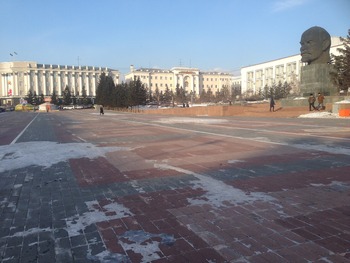
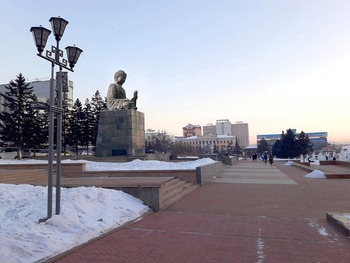
Among the main sights of Ulan-Ude is the gigantic Lenin’s head in the very center of the city (see figure 1). In my time there, I barely heard any overt criticism of this statue or calls to remove it, and many urbanites are quite proud of this monument. However, in recent years, several suggestions of this kind have cropped up in the local media as well as the social media. The main concern nonetheless is not so much the eradication of Soviet vestiges as it is a debate over the foremost representational object on the main square of the city. Most significantly – albeit half-jokingly – there was a suggestion in a popular local social media group to replace Lenin’s monument with a statue of the Buddha. “Each time I go by the Soviet square [where Lenin’s head stands], it occurs to me that the main monument in the central square of the capital of Buryatia should look more or less like this,” suggested the anonymous author (in Sagan Reference Sagan2017, see figure 2). This caused an uproar on the local internet with both positive and negative reactions. To quote one critical commentator:
Don’t you touch Lenin, this is your and my closest history. There are many places where your suggested monument could be erected. Heck, it’s all about destroying or replacing. Your parents lived with this symbol all their lives and it is not up to you to blather about its replacement.
(Sagan Reference Sagan2017)The Soviet Square in Ulan-Ude, 2016.

The Suggested Alternative Statue for the Soviet Square in Ulan-Ude.
Source: vk.com/an0nim_o3 2017.

As the commentator suggests, there is sufficient space in the city to accommodate commemoration sites and heritage of various kinds, and indeed much of the urban change is happening not at the expense of the existing sites but is complementing them. Buryat-Buddhist and Soviet elements, too, are not mutually exclusive to one’s identity, but often co-exist. Local wedding traditions reflect this tendency. On the wedding day, newlyweds and their entourage visit several significant places in the city to take pictures and drink sparkling wine. Russians usually visit the monument dedicated to the victims of the Second World War while Buryats go to Rinpoche Bagsha Buddhist temple, but both also stop by the Soviet square and the Lenin’s head (Szmyt Reference Szmyt2014, 214–5). This shows the continuing relevance, and a rather positive attitude towards Soviet heritage, as well as the aggregate nature of identity in Buryatia today. Rather than selectively deleting imprints of certain historical periods from it as is common in post-Soviet contexts, Buryat identity combines elements of various times and regimes. Moreover, the urban renewal has not radically erased the past not least because Russians still reside in the city and constitute at least half of the urban population. Since what is “Russian” and what is “Soviet” have in many ways merged due to the distinctive position of Russia(ns) in the Soviet Union (Oushakine Reference Oushakine2009), a challenge to Soviet heritage would also in some ways be one to Russian Ulan-Udensians. The fluidity and flexibility of the urban space has therefore been favorable towards the social cohesion of the two dominating ethnic groups.
Indigenization of Ulan-Ude: Buryat but Not Just
The second case study that might be read as a kind of indigenization of urban space is a building of a prayer wheel (Bur. khurde, Rus. molitvennyi baraban) in the city center. A prayer wheel is a Buddhist religious object that doubles as a decorative feature due to its beautiful bright colors and ornamental exterior. Prayer wheels are usually located in temple territory, but can sometimes be found outside of it – one has long been located outside Ulan-Ude airport, and another one was recently erected elsewhere in the city center.
Lama Samdan, a prominent Buryat lama who studied in a Tibetan monastery in India, initiated its construction, which was finally brought to completion in 2016 after a long and complicated campaign. Initially, the lama had planned to build it in a square next to the Second World War memorial – a site that also hosts a tank and a mural dedicated to local soldiers. The project was to be funded by the city as it was intended as both a religious object and a decoration of the urban space. Eventually, however, the prayer wheel ended up as a donations-based project carried out mainly by volunteers. A recurring theme throughout the work gatherings that motivated many participants to contribute money, time and labor was the felt need for more Buddhist and Buryat presence in Ulan-Ude. While some highlighted one aspect or the other, to most, Buddhist and Buryat aesthetics go hand in hand.
In an interview, the organizer recounted how he came up with the idea for the project after returning to Ulan-Ude from India. He was met, as he put it, not just by the ever-shining sun and grumpy locals, but also by the massive head of Lenin, an odd symbol of the city:
I thought, something is lacking here … You look elsewhere in Russia, all cities are analogous: dilapidated, factories are closed, dismantled and suchlike. And then I was lucky enough to go to Kalmykia [a Buddhist region in the European part of Russia], Elista [its capital]. And there I saw “City Chess” [a large expensive complex built for chess competitions] that creates a good mood in the city. In the city center – and they live in the West – all beautiful colors of Buddhism: pagodas, pavilions. Ohh, I was inspired by that, my soul was touched.
After returning to Ulan-Ude, the lama held on to the idea, waiting for others to initiate something of the kind. Since no one did, he himself started fundraising and organizing the construction of the khurde. This took several years and despite many promises was not financially supported by the local authorities. Worse still, they were unhelpful even in securing a place for it and did not approve of the lama’s proposal to build the khurde next to the Second World War memorial; the reasons for this are unknown. This place was chosen not only because of its central location but also because of the surrounding memorial, aiming to generate positive energy in the site related to suffering, and contribute to accumulating karmic merit for Ulan-Ude urbanites. Lama Samdan reflected on this location:
From the city center, a charge of positive energy will spread through the surrounding space. The positive energy would spread everywhere [Rus. chtoby pozitiv shеl vezde i povsyudu] [ … ] [There were Stalinist] repressions and so on … Where an Orthodox church stands nearby, there used to be a burial ground. All this now has to be charged with positive energy. At first I wanted to build it under the tank [in the Second World War Memorial site] where elderly people gather and play chess. Something was missing there, and I decided it was a khurde.
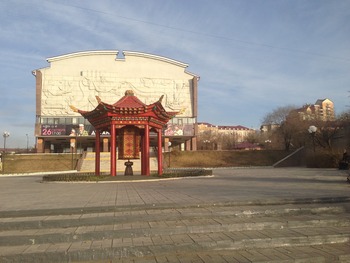
The ultimate location of the prayer wheel was not far from the one initially suggested, in front of the Buryat Drama Theater (see figure 3). While also central, it is less prominent, being surrounded by a major road and thus only with difficulty accessible to pedestrians. Rumors have it that this location was suggested because of its proximity to the Buryat Drama Theater, which is already marked with ethnicity, so the two were supposedly to make up a “Buryat” ensemble, rather than opening up new spaces of such kind. Nearby, across the road, is the Svyato-Troitskii Orthodox Christian church, but there is no particular juxtaposition between the two, at least partly due to the separating road and fence. It certainly seems that none was intended, either, at least based on many conversations with organizers and participants of the project, media accounts, and interviews; such a reading also never came up when discussing the prayer wheel with other Ulan-Udensians.
The Prayer Wheel in Front of the Buryat Drama Theater, 2019.

The lama explained that a prayer wheel filled with Buddhist sutras will order the essential elements (fire, water, earth, wind, space) and when turned, it will not only put one in touch with the universe and nature but also balance out one’s karma as well as that of the city. This was especially important in places such as the one initially suggested and the current location of the khurde, both near places related to war and death. Expressed in a variation of tantric ideas, the project thus aims at both this-worldly goals related to the image and the materiality of the city as well as soteriological goals – to improve locals’ collective and individual karma. Moreover, it was important to Lama Samdan that the khurde would also have an affective presence in the city. When walking by, people could spin it and balance their elements, but also calm down and be charged with positive energy, finding refuge there amidst the city bustle. It is both visual and architectural forms as well as physical actions that these Buddhist structures afford (such as circumambulation or spinning the wheel) that local Buddhists highlighted as having a powerful impact in the city.
As in much of the post-Soviet region, in Buryatia, too, religion is seen as going hand in hand with ethnicity. Buddhism being the dominant religion amongst Buryats, its religious objects are taken by many also to be “Buryat” objects, pointing to the presence and prominence of this group. At the same time, most local Buddhists agree that the services and infrastructures of their religion – temples, rituals, expertise – should be and are available to anyone in need. An ambiguous situation thus emerges where Buddhist objects are read predominantly as Buryat ones in terms of representation (just like in the example of the Soviet square Buddha above), at the same time not being exclusive to this group in terms of use. The prayer wheel attracts some attention of passers-by who spin it and sometimes take pictures when passing, especially when going to the Buryat Drama theater, in front of which it stands. Just like other Buddhist objects in the city, it is predominantly – but not just – Buryats who engage with it, but it is available to and meant for all to use.
What Does Indigenization Mean for Ulan-Ude?
The significance of the prayer wheel – as of many other Buryat-Buddhist structures, including, potentially, the desired Buddha statue on the Soviet square – in the city is thus threefold. First, they are objects of religious significance that assist in attaining soteriological goals individually and communally. Second, they have an affective presence in the city: their ability to soothe people or inspire them was often highlighted by Buryat informants. Third, Buddhist objects in the city have the capability of demonstrating the presence – and strength – of religion and Buryat culture more broadly, both locally and to outsiders.
The last point is especially relevant and requires some elaboration. Why is it that Buryats are concerned with sufficient tangible representation in the city? And why now? To some extent, this is part of a broader ethnic and religious revival that has been ongoing in much of the post-Soviet region (Holland Reference Holland2015; Laruelle, Reference Laruelle2007; Peers Reference Peers2015). At the same time, it seems that outward forms of expression of Buryat culture have indeed intensified during the last decade or so. One of the main reasons for that has to do with sovereignty, both cultural and political. Over the last several decades, Russia has been increasingly centralized, amounting to an “authoritarian revival” (Bernstein Reference Bernstein2013, 2). There has been concern in Buryatia and elsewhere in Russia over efforts to undermine the autonomy and identity of some of its regions, particularly where a significant part of the population is not ethnically Russian. Closest to Buryatia, a crucial point in this process was the dissolution of Aga and Ust-Orda Buryat Autonomous Okrugs into their surrounding administrative regions, Zabaikalsky Krai and Irkutskaya Oblast’ correspondingly, both predominantly Russian. This is a part of a larger shift in Russia today to centralize power, amalgamate regions (Rus. ukrupnenie) and arguably also to further break up the political and cultural autonomy of minority ethnic groups (for a more detailed discussion, see Graber and Long Reference Graber and Long2009). Apart from curbing local political and cultural sovereignty, cultures and religions of Buryats and other minority ethnic groups have often been marginalized, Orientalized, and distanced in Russian public life more broadly (Jonutytė Reference Jonutytė2020).
Further, many speak of a new wave of Russification of the non-Russian populations, as institutional support for not just local sovereignty but also local languages is rapidly diminishing. The Buryat language is rarely used in formal settings apart from several token phrases, and there is limited support for cultural or media production in it. The standing of the Buryat language has deteriorated over the last decades as it is no longer a compulsory subject in schools, and ever fewer schools even offer it as an elective course. Overall, while interest in the Buryat language seems to have grown over the recent years, it has received little formal support.
Bearing in mind the history of repressions of much of Buryat ways, but also the ethnic revival within its political restraints today, many urban Buryats express regret and embarrassment over having little knowledge of the Buryat language and traditions. Not least, the recent influx of Mongolian visitors due to a visa waiver has provided an occasion for locals to reflect upon this felt loss and counteract it – such as by increasing the visibility of the Buryat presence in the city. Several informants mentioned the embarrassment they felt about their city being “not Buryat enough” when facing visiting Mongolians. Be it before Mongolian visitors or not, others spoke of Ulaanbaatar – or, like Lama Samdan above, Elista in Kalmykia – as better examples of ethnic and religious representation in urban space. Buddhist architecture featuring prominently in the city hence not only reflects the fact that many Buryat-Buddhists live there, but it aims to proactively and visibly demonstrate it.
This sheds light on why the revival of Buddhism is significant to many Buryat-Buddhists today not only as a restored right to practice religion, but also as a reclaiming and a revival of Buryat identity more generally. Through indigenizing their titular city and outwardly showing their strong presence and prosperity, the Buddhist building projects, together with other elements of the urban renewal, are reclaiming the positive value of identifying as a Buryat, and are demanding outside recognition of such transformation. In other words, the changes in the city are part of a larger effort of recentering not just the Buddhist world (see Bernstein Reference Bernstein2013), but also recentering Russia and the wider region. This is all the more pertinent as Buryatia is marginal in all the main regions that Buryats generally identify with. In Russia, they are an ethnic minority. In the Buddhist world, they are atypical since they are part of a Christian-majority country. In the Mongolian cultural region, they are looked down upon by the more numerous and visible Khalkha Mongolians (see Bulag Reference Bulag1998).
Indigenization as Contestation?
The attempts of “Buryatization” of Ulan-Ude described above would seem to point to a “contested city.” As Setha Low (Reference Low and Low1999, 10–11) has it, it is a city that is a site of struggle over social reproduction. This struggle can take place in an organized, active manner (Banck and Doimo Reference Banck, Doimo, Schuurman and Naerssen1989; Brumann Reference Brumann2012), or in a vague, indirect manner (O’Connor Reference O’Connor1990; Bossak-Herbst Reference Bossak-Herbst and Nas2011), not least in discoursive revisions of the city (Azaryahu Reference Azaryahu1997; Gill Reference Gill2005). It is through “spatializing culture,” that is, through “locating social relations and social practice in space, both physically and metaphorically” (Low Reference Low and Low1999, 11; see also Low Reference Low2017) that Low suggests such contestations can be explored. In the case of Ulan-Ude, contentions over the city indeed seem to occur prominently in spatial forms such as sacred spaces, memorial statues, and public celebrations, and also discoursively in the city’s promotional materials and publications, as I outlined above. However, although the shifting political and cultural landscape likely played a part in the recent urban changes, I argue below that the seeming contestations should not be read as direct confrontations – or, as Breslavsky (Reference Breslavsky2012a, 313] put it not as an “ethno-political” project – but should instead be seen in the local field of ideas and practices of coexistence.
This new, prominent identity of the city would seem to undermine other narratives and forms of urban belonging, notably complicating the previously “Russian” image of the city. This is particularly so since Buryats constitute at most about half of Ulan-Ude’s population despite being the titular nationality and thus claiming the representational spaces, especially as of late, as discussed above. However, despite the fact that the recent increase in the indigenization of the city is likely a pushback against diminishing sovereignty, this would be an incomplete story as these urban contestations curiously are inclusive to all Ulan-Ude urbanites, rather than being confrontational. I develop on this seeming paradox below.
Ethnic diversity and inclusion in Ulan-Ude today very much follow from previous models of coexistence in the Russian empire and especially the Soviet Union. Here, diversity in ethnicity (and to some extent religion) was formally recognized, and it was an important part of the governance of the population (Hirsch Reference Hirsch2005; Martin Reference Martin2001). The model of coexistence of course changed over time. While the early Soviet internationalism envisioned national identities withering away as class identity prevailed, that of the Stalinist period saw inclusion as a coming together of distinct – but “friendly” – socialist nations. A “rootless” model of cosmopolitanism was starkly rejected, while difference and boundaries were reaffirmed. In fact, the differences among the Soviet and other socialist nationalities were celebrated, having boiled them down to standard, safe and acceptable forms of folklore and the like. This way, the celebration of difference rendered it safe, politically neutral, as each nationality occupied its designated room in the “communal apartment” (Slezkine Reference Slezkine1994) of Soviet nationalities.
This model of “friendly” coexistence has been especially relevant in multi-ethnic regions like Buryatia: ethnic difference here is readily recognized but not deemed a threat or a line dividing sociality. Here, locals happily acknowledge standard forms of expression of ethnic and religious difference – as long as they take recognizable and widely accepted forms such as religious festivals, folk costumes, monuments, and the like. Just like a room in the “communal apartment,” so in the urban space Buryats, Russians, Evenki and others can therefore make claims to representation that will by and large be recognized as legitimate. These models of managing diversity have again started to shift in post-Soviet Russia, where, as discussed above, local political and cultural autonomy has declined. Since changing policies do not immediately translate into transformed ideas and practices of cosmopolitanism on the ground, shifts in the latter will only be noticeable with time.
Justine Buck Quijada observes what she calls a “hospitality genre” (Reference Quijada2019, 82) in Buryatia today, which portrays local history as a series of neighborly arrivals, rather than as a story of conquest and colonization. This genre of history and sociality borrows much from Soviet multiculturalism but also portrays a particular kind of inclusiveness: distinctly local, steeped in deep history, and positioned against “the Russian national center represented by Moscow,” but at the same time allowing for “contemporary coexistence by reducing the room available for narratives of colonialism” (Quijada Reference Quijada2019, 83). This is indeed a popular local discourse, reflected not just in conversations and formal speeches as Quijada observes, but also to a large extent in the urban space of Ulan-Ude. Here, a futuristic building imitating an Evenki chum faces a Soviet period building of a museum, adorned with Buddhist architectural elements, while nearby stands a Russian triumphal arch that commemorates tsar Nikolay II’s visit to the city. However, the “hospitality genre” does little to explain the more recent indigenization of the urban space of Ulan-Ude, as well as other processes of “re-Buryatization” (Krist Reference Krist2009, 140) of the public and private space locally, such as the growing interest in the Buryat language despite the institutional constraints.
The answer to this conundrum of both hospitality and indigenization, both inclusivity and contestation lies in the very nature of urban space. Capacious and elastic, it allows for everyone to have their own room in the “communal apartment” of the city, or, as commentators suggested in regard to the Soviet square, Ulan-Ude is spacious enough for everyone’s monumental representation. Owing in large part to local, Soviet-derived ways of accommodating diversity, Buryat claims over the cityscape are thus recognized as legitimate rather than as threatening the status quo. The city here may be understood as an “amalgamation” (Martinez Reference Martinez2018, 136), that is, as simultaneously accommodating elements of different historical periods and cultural meanings. While this coexistence may become problematic at some point and to some group, it is generally an affordance of the urban space to host spatial, ideological, and other kinds of diversity within it.
Further, the urban space simultaneously allows for inclusivity and contestation as its elements can be interpreted in different ways. This speaks to the ambiguity of symbols within those forms of representations, which allows for cohesion as different actors may recognize the same monument in varying ways while equally supporting it (Kertzer Reference Kertzer1988). Alexander Danzer (Reference Danzer2009) argues that in changing post-Soviet landscapes, individual biographies shape how people read symbols within them – a significant aspect in this process is one’s ethnic identity. In the prayer wheel case, too, variously positioned individuals highlight its different aspects – some its religious value, others its ethnic representation – all approving it in the meantime.
Much scholarship on post-Soviet cities highlights contestation as the defining feature of recent urban changes in the region: imprinting the city with the national identity of the dominant group, wiping out Soviet heritage, and rethinking local history through architecture and urban planning (Smith Reference Smith2008; Williams Reference Williams2008; Kinossian Reference Kinossian2012; Ter-Ghazaryan Reference Ter-Ghazaryan2013). Diener and Hagen, for instance, claim that “the overt ‘nationalization’ of urban space is one of the most striking features of the post-socialist urban milieu” (Reference Diener and Hagen2013, 489). As Alexander Danzer puts it, “urban space is used as a means of the narration of history and the creation of a national heritage by the nationalizing state” (Reference Danzer2009, 1574). What the Ulan-Ude case demonstrates, however, is that such a reading undermines an important caveat of post-Soviet urban changes. Indigenization of the urban space or, for that matter, other forms of imprinting ethnic or national identities onto it, do not necessarily imply the city is “contested,” with a new singular identity dominating it and driving it towards a “nationalization.” While they may be read in such a way from outside, it is important to pay attention to local models of coexistence and representation. For one thing, one should not undermine narratives of Soviet cosmopolitanism that remain pertinent in a significant part of the post-Soviet world, particularly in multi-ethnic contexts.Footnote 7 For another, acknowledging the elasticity, flexibility, and multivalence of the urban space is important. Not only may it allow for coexistence of multiple identities without direct contestation, but it may also enable a different interpretation of the same elements.
Conclusions
Cities today have become prime sites for negotiating belonging as well as claiming space and representation. These processes have been especially pertinent in post-Soviet Eurasia, where across the continent, the rethinking of identity has taken various spatial and discoursive forms in the urban space, often digging through layers of history and forging affective bonds through placemaking (Cummings Reference Cummings2013; Köppen Reference Köppen2013; Wanner Reference Wanner2016). Such claim-making and its legitimation takes place in the context of preexisting, historically and politically shaped frameworks of inclusivity and, in diverse areas, cosmopolitanism. In Ulan-Ude, as the material above demonstrates, particular historically formed understandings of cosmopolitanism and belonging shape the ideas of who has the right to be represented in the urban space. Thus, as Ulan-Ude continues to undergo indigenization, thereby suggesting a case of a “contested city,” it is equally important to understand what such contestations mean and how they are understood in the local context. In particular, the Ulan-Ude case demonstrates that seeming contestations in the urban space may in fact be emically seen as legitimate claims to a room in the “communal apartment” of peaceful coexistence of different ethnic groups. The Ulan-Ude case can thus be seen as a cautionary tale of reading resistance and conflict too directly into post-Soviet urban change. At the same time, since the policies and practices of the Russian state have been changing as of late to undermine local sovereignty, shifts in ideas and practices of coexistence are likely foreseeable. As urban transformations continue across the post-Soviet region, discoursive and material urban space is a fruitful arena to explore the kinds of cosmopolitanism and its limits in changing – and increasingly diverse – post-socialist societies.
Acknowledgements
I would like to especially thank my interlocutors for sharing their time and stories with me, as well as colleagues in Buryatia for discussions and feedback on my research topics. This research was part of the Buddhist Temple Economies in Urban Asia research group at the Max Planck Institute for Social Anthropology, and I thank the head of the group Christoph Brumann, as well as colleagues Saskia Abrahms-Kavunenko, Beata Świtek, and Hannah Klepeis for their engagement with my work, which contributed much to its improvement. I am also grateful to the anonymous reviewers for their helpful comments.
Funding Statement
Part of the fieldwork for this article was funded by the Max Planck Institute for Social Anthropology.
Disclosures
None.