An estranged homecoming
‘What? Another medicine peddler? Beat it! Holy Mama! Thief! That bitch is stealing away all my money! (Switching to a North Korean accent.) Well, comrade, what the heck did you come all this way for? You can't even sell medicine around here anymore. You're gonna fake marriage to a farmer and wring money from his pocket and run away, right?!’Footnote 1
These lines are spoken by a character called Leper from a scene in Line 1, a popular and culturally significant South Korean play directed by legendary folk musician Min-ki Kim. Premiering in 1994, its portrayal of 1990s urban Seoul ran for fifteen years. The lines above are spoken to Angel, a young ethnic Korean woman from Yanbian, China, who is being accused of a crime that she did not commit.
Apart from her accent, which sounded North Korean to me, I did not find Angel to be all that strange when I, a first-year in college, saw Line 1 in the summer of 1996. In appearance she did not differ from the other Korean characters onstage or from the other Koreans in the audience. However, I could not help wondering to myself, is Angel Chinese or Korean? If Angel is supposed to be Chinese, how come she speaks fluent Korean? And why does mainstream South Korean society stigmatize her as a potential criminal? Most importantly, I wondered, who is she?
The major themes and episodes of Line 1 are related to Angel's journey along Seoul's Subway Line 1 and the acquaintances she makes there. She functions as a narrator who witnesses and delivers the story from the outer frame of the play. Although at the beginning of the play she suffers ill treatment from mainstream South Korean society, by the time the show concludes she is warmly accepted by those who at first shunned her. Through the appearance of this ethnic Korean Chinese in Line 1, I first encountered the concept of Korean diaspora as well as its people – those who had left the Korean peninsula, and who had eventually returned, or whose descendants had ‘returned’, to their motherland. Vaguely I realized that they are both similar to and different from ‘us’ – native-born South Koreans. This reaction was typical in South Korea in the mid-1990s: most people were confused, poorly informed, and even suspicious about who ‘they’ really were.
The term ‘Korean diaspora’ refers to Koreans who escaped the atrocities that shook the Korean peninsula during the first half of the twentieth century, such as Japanese colonial aggression (1910–45), exploitive labour conditions after the Second World War, and the Korean War (1950–3) and its aftermath, which included the division of the nation into North and South. Most of these people scattered across north-east China, Central Asia, Japan and the Americas. Today, the Korean diaspora includes the second and third generations of these populations in exile. Most distinctively, since an Act on Immigration and Legal Status of Overseas Koreans was passed in 1999, it also includes the thousands who have returned to South Korea from all of these places.Footnote 2 Most individuals came back for the economic opportunities ‘home’ offers; for its part, the South Korean government has learned to depend on the cheap labour they provide.Footnote 3
Although its origins stretch back more than a hundred years, the concept of a Korean diaspora remains closely tied to contemporary social issues as well as to the effects of coloniality and modernity in the regional contexts of greater East Asia. As life in the present-day struggles with histories that cannot easily be resolved, human experiences of colonial modernity are enfolded within domestic affairs that, in turn, influence the structure as well as the expression of desires and identities that are both nationalistic and regional. On a personal level, memories and specific incidents in the Korean diasporic experience live on among these descendants of exiled populations. More broadly, their nationality, identity, roots and repatriation remain disputed in South Korea, where racial homogeneity is taken for granted as a matter of national consensus and where the returnees are treated as minority populations.
Precisely defining Korean diaspora therefore remains challenging. Although these populations can be classified according to location, choosing appropriate designations for each group is complex because the circumstances of and reasons for their original relocations vary widely.Footnote 4 Despite the complex cultural and physical locations of diasporic identities, South Korean academic research, as well as both public and everyday discourses on Korean diaspora, tends to depend on dualisms and oversimplifications.Footnote 5 Generally, ethnic Koreans descended from exiles are categorized according to binaristic distinctions between the national (minjok) and transnational (talminjok), territorial and de-territorial, Korean nationality and diasporic citizenship, homogeneity and difference. This framework not only discards the complex identities of diasporic people but also dismisses the diversity that has resulted from specific groups’ relationships with their disparate residential locations.
For instance, the Russian Koryoin (literally ‘a person from Koryo’ – a Korean appellation of Korea used from AD 918 to AD 1392) entered Siberia as early as the 1860s. During the 1920s, their numbers dramatically increased in what was by that time the Soviet Union, as destitute peasants escaped Japanese colonialism at home. Forced migrations of Koryoin from 1926 to 1937 relocated almost the entire population of ethnic Koreans (approximately 200,000 people) from Siberia to the Kazakh and Uzbek territories. Stalin initiated these mass relocations because he feared that ethnic Koreans (who, at the time, were officially subjects of the Japanese Empire, an avowed enemy of the Soviet Union) were spying for Japan. In Central Asia, they were forced to work on primitive collective farms and in factories and mines, where thousands died of starvation and disease. After the dissolution of the Soviet Union in the early 1990s, many descendants of Koryoin began returning to South Korea. Today, their ethnic communities thrive in various urban centres as they pursue better financial opportunities and enjoy freedom from the racial discrimination they reportedly experienced in Russian society.Footnote 6 However, as assimilated minorities in Central Asia, few grew up speaking Korean. Thus they face linguistic and cultural barriers as well as anti-communist prejudice from some members of mainstream South Korean society.
Similarly, the Joseonjok (literally, ‘clan of Joseon’ – another pre-annexation name for Korea) date back to the early twentieth century, when many fled to China to escape Japanese colonial oppression, with some joining the Korean Independence Movement. As members of one of the fifty-six ethnicities officially recognized by the Chinese government, most Joseonjok reside in the Yanbian Korean Autonomous Prefecture. Unlike the Koryoin, therefore, their youth are being raised in an ethnic Korean cultural environment and even attend Korean schools. They are fluent in both Korean and Mandarin, but their school curriculum differs from the way schooling is conducted ‘back home’. As a result, for Jung-kyong Suh, Joseonjok tend to be treated as undesirables in their ethnic homeland and even to be stereotyped as criminals: ‘prejudice marks them as people from a poor, underdeveloped, Communist country’ and therefore as unworthy of Korean ethnic identity.Footnote 7
Complicated estrangements between ethnic and residential affiliations form the basis of the dual and multiple identities claimed by most members of Korean diasporic populations who now reside in South Korea. This complexity, which is quite unfamiliar to most members of mainstream South Korean society, has also created an ongoing condition of estrangement between the returnees and local-born Koreans. Minority status is affirmed throughout the histories of Koryoin, Joseonjok and Zainichi (descendants of ethnic Koreans in or from Japan), as well as of Korean descendants in the Americas.Footnote 8 The complicated relationships between all these groups and present-day South Korea continue to underscore their minority status in the land of their ethnic origin. Deprived of a secure sense of home, even after they have returned, they remain in a state of exile and displacement.
Almost twenty years have passed since I came across the Joseonjok character of Angel in Line 1. In the intervening years, I found few theatrical performances that significantly dealt with the theme of Korean diaspora – until, in 2013, I became closely involved with Movement Dang-Dang's An Eternal Parting, a South Korean movement piece or ‘docu-performance’. This performance actively attempted to visualize the history and the figures of Korean diaspora to provide an opportunity for native-born South Koreans to know and understand who these people are. Its creators endeavoured to initiate a new discourse of Korean diaspora in the current South Korean context – but in so doing they revealed some inadvertent contradictions in how such a discourse might be conceived. These complications are the focus of my discussion of An Eternal Parting.
Performing Korean diaspora: ‘a docu-performance for the marginalized’
There were two versions of An Eternal Parting. The premiere in 2011 dealt with the issue of Korean diaspora by mainly representing the story of Koryoin in Siberia in the 1930s.Footnote 9 An updated version in 2013 extended beyond this frame to unfold the notion of Korean diaspora within the larger context of Korean modern history, and included representations of Joseonjok, Zainichi and early Korean settlers in Hawaii and Mexico. These histories, which are little known or discussed in South Korea, comprised a rare theme for representation in a theatrical performance. An Eternal Parting showcased these diasporic figures’ traumas of forced relocation and the experiences of their descendants in current South Korea. It questioned both the degree to which these populations participate in current South Korean sociopolitical affairs and how they are simultaneously accepted and marginalized within their so-called motherland. The performance endeavoured to introduce how these diasporic figures, despite their disparate backgrounds, localities, mindsets and ages, have come to share not only historical spaces and times but also attitudes towards the question of national affiliation.
To this end, An Eternal Parting attempted to decipher and call into question fixed ideas about ethnic roots, origins and Korean-ness, and about the various signifiers in official narratives of home. Or, to phrase it more affirmatively, the work sought to reconstruct the official concept of Korean nationalism and the unifying myth of Korean national and racial homogeneity by representing the figures of Korean diaspora through performance. Accordingly, the performance posed pointed questions to its audiences: who are these people? How can non-diasporic South Koreans understand their minority status in both the land of their ethnic origin and their particular places of residence? How did they become visible yet invisible, in their homeland as well as in the imaginations of their ethnic brethren?
In accordance both with the complexity of these themes and with the experimental approach of the company, Movement Dang-Dang, An Eternal Parting did not pose these questions using a linear narrative construction, a single coherent plot, or preconceived roles or characters. Rather, as a multi-genre movement piece, it consisted of fragments of individual scenes composed of dances, non-verbal movements and revues. Scenes were arranged to show cross-sections of time frames, historical situations, generation gaps and geographical dislocations. Movement Dang-Dang's founder and leader, Min-jung Kim, advertises the company as unconventional in terms of its production and staging processes. Its rehearsal practices often consist of improvisations and experiments initiated by the performers themselves.Footnote 10 In the case of An Eternal Parting, the resulting production mostly consisted of scene fragments that were the finalized versions of rehearsal-period improvisations, enacted by solo performers or groups of two or three. Movement, speech and dance were supplemented by audiovisual materials and texts that were projected onto a large screen installed centre stage.
As an aesthetic strategy for fragmenting a conventionally singular and monolithic ideology of Korean nationalism, this use of nonconformist performative devices appeared effective. Conceived as a ‘docu-performance’ to allow the performance and its actors to intervene sharply in the status quo, this formalistic quality reflected the broader theatre-making objectives and intentions of Movement Dang-Dang and Min-jung Kim. Originally trained in modern dance, Kim initiated the group in 1998 as a performance group called Dokripmanse (Hail to Independence) with So We Wanted to Live Again like That, a multi-genre dance performance. Dokripmanse was restructured as Play Dance Group Dang-Dang in 2003 and adopted its current name in 2007. Almost all of Kim's work consists of fusions of dance and theatre that address sociopolitical issues and contradictions in present-day South Korea. On 15 June 2013, for example, it created a flash mob at Seoul City Plaza for Refugee Week, an event conceived by a human rights organization to draw attention to the labour conditions of migrant-cum-refugee workers (mostly from South Asia) and their overall quality of life in South Korea. In conjunction with the flash mob, Kim created Sowae (Alienation), a multi-genre performance project whose 100-plus performers expressed their own opinions about ways to improve conditions experienced by marginalized, underprivileged migrant workers and refugees.Footnote 11
Despite these political commitments on the part of its artists, and the experimental form that An Eternal Parting took, I would argue that the show – with unintentional irony – strengthened a limited idea of nationalism that emphasizes the myth of unifying Korean ethnicity by employing long-fixed notions of homogeneous Korean nationhood. By examining the two versions of An Eternal Parting, I intend to show how some of the key moments in the performance actually contradicted the very argument the group had wanted to advance. The discourse of national identity in South Korea is so strong and restrictive that the artists were not able to effectively surmount it in their performance techniques, and thus were constrained in their ability to provide a more revitalizing projection of how diasporic Koreans might participate in the nation.
The lure of homogeneous nationhood
Both the 2011 and 2013 versions of An Eternal Parting represented the idea of Korean diaspora through the contemporary, albeit unfamiliar, theme of social banishment, along with the more familiar traumas of modern Korean history. Interpretations of such history as a sad trajectory of disintegration were reborn onscreen and through the performers’ bodies, and audiences were invited to engage with them emotionally.
The premiere version of An Eternal Parting largely represented the forced relocation of the early Koryoin in the 1930s, and their hardships on the kolkhoz (collective farms). The actors constructed space via gestures and props on an almost bare stage, bolstered by audiovisual devices, lighting and sound effects. In one scene, gestures of sowing by small groups of performers gradually became a solemn, ritualistic dance. The solidarity among these Koryoin labourers heightened and then collapsed onto an emotive plane full of pathos; that is, the dance that represented the labourers’ vigorous agricultural work also non-verbally represented their endurance under the banner of a unified Korean ethnic identity. Figuratively, the seeds they were sowing became their Korean roots, and their actions ways of continuing their Korean lineage and heritage.
The next scene, also non-verbal, suggested a celebration amongst family and neighbours. The same labourers are gathered in a room, at a table filled with Korean food, wearing their ‘best outfits’ – a vague combination of hanbok (traditional Korean attire) and local (Kazakhstani) clothing. As the Koryoin eat, drink and chat, they seem to be having a great time with their shared sense of Korean culture. When one starts up an old children's song on her accordion, the rest get up to dance. The nostalgic melody is intended to bind the dance and the performers/Koryoin to the remote past and to allow them to express the agony of their displacement and homesickness in present-day South Korea.
Such stereotypical assumptions of Korean-ness and heritage (through images of hanbok and the nostalgic tunes of an old song) fail to transcend the traditional and official meaning of nationalism. The above scenes, and others in the first third of the performance, align the notion of ethnic Korean heritage among these figures (via food, dance and music) with Korean-ness as their sole, ultimate commonality. Such representations are based on historical documents about early Koryoin, who in spite of terrible hardships did try to keep their heritage and culture alive. Yet these scenes, which appear to have been choreographed to arouse nationalistic sentiments by binding past and present with familiar rhetoric, owe more to imagination than to history.
The idea of the pre-eminence of Korean ethnicity and the importance of nationalistic sentiments is further developed in the next scene, which represents Viktor Tsoi (1962–90). Born to a Koryoin father and a Russian mother, Tsoi was a revered Soviet musician and songwriter. As the leader of the band Kino, he was recognized as a pioneer of Russian rock; even today, his fan base remains devoted across the former Soviet Union. An Eternal Parting foregrounds Tsoi's half-Korean ethnic background and reinterprets his status as a tragic hero (he died in a car accident) through traditional nationalistic rhetoric. Immediately after the kolkhoz party scene, a live performance of Kino's hit song ‘Blood Type’ (‘Gruppa krovi’) is projected onto a second screen upstage.Footnote 12 The performance appropriates Tsoi's legendary aura through his mythical designation in the programme notes as a ‘proud Korean’, as well as through the appearance of a young male actor, wearing a clean white tae kwon do uniform with a black belt, who enacts solemn, disciplined tae kwon do movements against the backbeat of the rock song. The onscreen image of Tsoi, and the actor posing in front of it, tacitly overlap as the song reifies Tsoi's Korean background. That is, the performance insinuates an ethnic (blood) lineage from Tsoi to the young martial artist through this particular scenic arrangement, and reclassifies and realigns Tsoi's transnational fame to the single fact of his Korean ethnic background. Meanwhile, the scene implicitly conflates Tsoi's early death with the displacement and hardship of the early Koryoin settlers, further reiterating the limited framework that defines Korean diaspora as solely and overtly traumatic.
These kinds of limitation to the performance were not for want of trying on the part of the artists, who had sincerely endeavoured to understand and embody the history of the Korean diaspora. During the creative process of the 2013 version, the actors attempted to link historical aspects of Korean diaspora with present-day Korean contexts by interviewing descendants of Koryoin, Joseonjok and Zainichi Koreans residing in and around Seoul. They also tried to build personal connections with ethnic Koreans by learning their languages, accents and songs.Footnote 13 As befitting a docu-performance, the performers strove to gather accounts, in the tellers’ own voices, of their lives in Seoul as descendants of exiles.
Accordingly, about halfway through the performance, and with the rest of the stage empty, excerpts from these interviews were screened. These short testimonials mainly concern their subjects’ experiences of living in Seoul, thoughts and views about the concept of national identity or the notion of Korean-ness, and how they relate to present-day South Korea. In a language class for repatriated Koryoin, a middle-aged woman states, in faltering Korean, ‘I like everything that is Korean and have grown up listening to arirang’ (an ancient Korean folk song generally recognized as the unofficial national anthem, imbued with so-called unique ethnic traits). Upon request, she then sings a few lines. In another clip, a group of middle-aged women recall playing traditional Korean games while growing up in Kazakhstan. Despite their nostalgia, however, they deny wanting to claim a single national identity. Instead, as one of them says, life in South Korea consists of ‘working hard . . . and granting a better future to my children’. Next, a third- or fourth-generation biracial (half-Korean, half-Russian) woman who has lived in Seoul for a long time says, in fluent Korean,
Although I lived far away from South Korea, away from my ethnic origin, I used to think I am somehow closely related to my homeland . . . I hope to achieve a good career and raise my living standard. I haven't seriously thought about what my true national identity is, nor do I want to strictly pin myself down.Footnote 14
These filmed interviews prove that some descendants of Korean diaspora, situated in present-day South Korea, aspire to attain a personal Korean dream that is free from fixed notions of nationality or ethnicity.
But the next onstage scene presents a counterargument that pulls the Koryoin interviewees back into a conventional domain where they are once again in search of a nationalistic origin. A small group of performers marches onto the stage, loudly chanting in unison:
-
ka, na, da, ra, ma, ba, sa (the first seven consonants of the Korean alphabet);
-
ichi, ni, san, shi, go, roku, sichi, hachi (numbers from one to eight in Japanese);
-
il, yi, sam, sa, oh, yuk, ch'il, pal (numbers from one to eight in Korean);
-
yi, er, san, si, wu, liu, qi, ba (numbers from one to eight in Chinese);
-
odin, dva, tri, chyetirye, pyat′, shest′, syem′, vosyem′ (numbers from one to eight in Russian);
-
wo (‘I’ in Chinese);
-
ni (‘you’ in Chinese);
-
mama, papa (cross-linguistic terms for ‘mother’ and father’);
-
(pause)
-
na (‘I’ in Korean);
-
nuh (‘you’ in Korean);
-
uri (‘us’ in Korean);
-
omoni (‘mother’ in Korean);
-
aboji (‘father’ in Korean);
-
(with slower and more careful enunciation, repeated three times): na . . . nuh . . . uri . . . omoni . . . aboji.
These rudimentary words, which babies learn when they first start to speak, represent the dominant languages used in the Korean diaspora: Korean, Japanese, Chinese and Russian. At first, the chant is meant to show how the exiles’ primary language was either contaminated or lost. But with the last five words, the performers suddenly lower their vocal tone and slow their movement tempo. These shifts suggest that, despite the loss of mother tongue due to border crossings that took place generations ago, somehow these migrants have found their way back home and regained both their linguistic and their ethnic origins. The final phrase in Korean, na, nuh, uri, omoni (I, you, us, mother), not only indicates the scene's ultimate goal of identifying and bonding diasporic figures within an essential and unchanging Korean identity, but also counters the interviewees’ comparatively flexible ideas about Korean heritage and national identity.
This revelation is called into question in the next interview clip, which features a young Zainichi who has lived in South Korea for quite some time. In perfect, accent-free Korean, she confesses, ‘I don't want to categorize myself into a definite nationality . . . Frankly speaking, this would be the most honest expression that a diasporic figure like me could project in today's circumstance’. But again, the necessity of recognizing fluid national identity is overshadowed in the scene that follows. A male performer impersonating a Zainichi walks onstage carrying a bundle of tae kwon do uniforms wrapped in taekukki (the Korean national flag). Facing the audience, he changes into his tae kwon do uniform and says something in Japanese (not meant to be understood by audience members who don't speak Japanese). Just then, an actress impersonating a Koryoin walks onstage. Holding an open package of plants, she addresses the audience with a few Russian phrases (unintelligible to audience members who have no command of Russian). As the two stand parallel to each other, the man demonstrates basic tae kwon do movements and the woman, showing the plants to the audience, says in Korean, ‘Every time I take the root of a shepherd's purse I can smell something special in there . . . shepherd's purse, especially its roots, captures the scent of Korea. For me, it's the scent of my home town’. She then sings an old children's folk song, ‘Dongmudul-a onora bommaji kaja’ (Come On, Friends, Let's Go Out and Greet the Spring Season). Soon after she stops singing, her counterpart stands motionless, firmly facing the audience, and solemnly states in accented Korean: ‘Although I look and sound like a Japanese . . . this heart (pointing to his chest), the blood flowing in here, is that of a genuine, pure Korean. No matter what, I am a true Korean at heart’.
These consecutive scenes impose abundant, nostalgic expressions of the concept of home onto the Korean national territory on behalf of these diasporic figures. Thus they suggest a method of national embodiment that is both rigid and traditional; the performance seemingly sidelines the interview clips that themselves sideline or dissolve national categorization. In such moments of disjunction, the core theme of the performance wavers between progressive and regressive ideas of nationhood. The performance's transgressive and resistant potential becomes a deceptive dichotomy in which diasporic figures are either tragic icons or creative, futuristic symbols of multicultural diversity. When the actors’ onstage embodiments clash with audiovisual representations, hegemonic performances of nationhood and patriotism override progressive subject matter. As the performance equates the former with the concept of home, it moves closer to the mainstream point of view that it was supposed to disrupt.
Korean nationalism: South Korean centrism
How is it that a performance that set out with the explicit agenda of complicating and pluralizing Korean national identity instead ended by reasserting its inflexible homogeneity? In my view, the gap between Movement Dang-Dang's original goal for An Eternal Parting and the most strident of the performance's actual representations is best explained through the unique location and significance of nationalism within the South Korean context. In addition, the gap between the assumptions of nationalism held by returning exiles and those of domestic audiences who have enjoyed uninterrupted residency in the homeland can be explained by the former group's lack of familiarity with the centrality and hegemony of nationalistic discourse. Thus the contradiction that is apparent in the performance itself is derived less from the nature of national identity per se (which the exiles have honoured through cultural practices) than from the historical circumstances (seen, in hindsight, as inevitable) that led to the construction of nationalism in South Korea as an exclusive, pervasive and specialized phenomenon.
The doctrine of South Korean nationalism functions as an unseen but pervasive and inescapable force in people's daily lives. Nationalism has also been systematically augmented through government propaganda, the national history curriculum and various commemorative events. Pivotal incidents in modern Korean history, in particular the Japanese colonial occupation, the Korean War and the resulting division of the nation, have intensified and transformed the characteristics of South Korean nationalism.Footnote 15 The colonial occupation rendered nationalism a desperate, indisputable and indispensable way for Koreans to pursue their dream of a sovereign nation state. People's sense of nationalism, awakened by the occupation, was both intensified and distorted by the civil war and the subsequent partition of South and North Korea from 1953 onwards. As a result of partition, not only was a centuries-old sense of brotherhood suddenly converted into tension and hostility, but also the South Korean government began to actively utilize threats from North Korea for political purposes. For example, the national trauma of the Korean War was maintained as a major historical reference point, and also as evidence of current and future risk. The government also explicitly manipulated the rhetoric of nationalism as a term that referred to South Korea only.Footnote 16 Technically, such a strategy is meant to maintain antagonism and tension vis-à-vis North Koreans, who as citizens of a totalitarian state are officially excluded from the ‘nationality equals identity’ framework. Another strategic tool involves a strong sense of national consensus that dates from the immediate aftermath of the Korean War. This can easily be interpreted as a demonstration of patriotism and, eventually, becomes a rigid, exclusionary rationale that hinders interactions with people with different cultures and ethnicities outside the boundary of South Korea.
Nevertheless, as a complex and popular formation, nationalism has been embraced by national subjects and supported by the government, elites, activists and progressives alike. Nationalism remains appealing because South Korea's economic success has continued under its policies, and because it has been used in the past to create a sense of patriotic unity among activists, students and liberal intellectuals in response to the Japanese occupation, national partition and a succession of military governments. Unfortunately, this phenomenon, as the feminist sociologist Hae-joang Cho Han argues, ‘produced a society with only grand state power and patriarchal families, but no citizens or autonomous individuals . . . [this] social system worked efficiently to replicate “identical-ness” among people, placing them in a state of non-differentiation’.Footnote 17 Within this ideological framework, which centres upon government and propounds a strict alignment between a unifying concept of ‘nation’ and ‘ethnicity’, no room exists for people who claim more complicated, multi-layered identities.
Moreover, nationalism in South Korea has been formulated and developed together with the goals of modernization. The original conception of national consensus centred on the essential goal of overcoming South Korea's status as an underdeveloped nation, to the point of including, as Cho Han argues, ‘the left-wing intellectuals who had been active in the minjung [people's democratic] movement in the 1980s [but] did not really oppose the market-first policies’.Footnote 18 Notwithstanding their differing ideological positions, a wide swath of social strata (including elites, conservatives and progressives) eventually shared the goal of establishing South Korea as a powerful nation. Thus nationalism or nationalistic consensus in South Korea became an important source of motivation and inspiration across social sectors, but particularly for ordinary citizens.Footnote 19
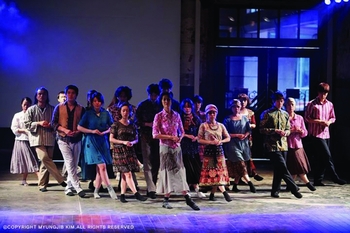
Without question, nationalist discourse hinders the spontaneous development of alternative opinions in South Korea, not to mention imaginative interpretations of national identity and nationhood. The struggle to formulate such interpretations is well illustrated by An Eternal Parting, which aims to show how such a strong and limiting idea of homogeneous national identity can be deconstructed via disparate images of diversity. By the finale, all twenty-one performers are onstage (see Fig. 1), representing multiple subjects: early migrants, their descendants who currently reside in South Korea, and contemporary South Koreans who are unfamiliar with either the existence or the demands of complex identities. But then, all uniformly raise their hands and count down from three to one on their fingers, as if to say: ‘We are one, finally back together at last; we have arrived home’. The effect is a sea of Korean nationhood – the many, the same and the different, all moving harmoniously under the unifying ideal of oneness. Evidently, everybody returns to the homeland, eventually, and finds peace of mind. In any case, An Eternal Parting’s ultimate return to an aesthetic, wholesome value of oneness makes me question whether the performance has achieved its attempt to imagine multiple, disparate ways of being Korean.
All twenty-one performers dancing in unison in the finale of An Eternal Parting. Photograph courtesy of Myungjib Kim.

Departure: making multiple identities in a land of diversity
So far, I have argued that, despite their intentions to the contrary, Movement Dang-Dang fell foul of the pull of nationalist aesthetics and ideas. But must such an ideology always succeed? In my view, a small portion of the second version of An Eternal Parting did achieve its stated goal of demonstrating the rootless as well as the malleable, hybrid and complicated nature of Korean diaspora. About halfway into the show, an abbreviated dance piece, ‘Arirang Nolki’ (Playing Arirang), was projected onto a screen at centre stage. The short video featured Seol-jin Kim, a young Korean professional dancer, who recorded it in a hotel room in Bogotá, Colombia, while on tour, and uploaded it to YouTube. Originally trained as a modern dancer in Seoul and currently working with a Brussels-based company, Peeping Tom, Kim casually moves to arirang tunes in the style of pansori, an ancient Korean folk music form usually imbued with profound sorrow and despair.Footnote 20
Seol-jin Kim fools around with the tune by improvising dance moves next to an unmade bed in his dingy hotel room. Watching it, I felt a sense of distance due to the innate clash of his popping style with the heart-wrenching pansori melodies. In combination, the physical setting of the video and its transitory nature (Colombia is far indeed from South Korea) doubly dislocate the dancing subject. Beneath its playful surface, ‘Arirang Nolki’ solidly demonstrates what Michael Billig has termed a ‘banal nationalism’ in which ‘nationhood is near the surface of contemporary life [and] operates with prosaic, routine words which take nations for granted’.Footnote 21
This snippet revealed to me the possibilities of playing with ideas of nationality and ethnic heritage through arirang, which has been widely endorsed as embodying essential qualities of Korean-ness. As materialized in the form of music and dance, in this context national identity constituted an idea of performative ordinariness; through his use of arirang as a ‘plaything’, Seol-jin Kim performed an individual expression of national identity that was neither traditionally collectivist nor ideological. The conflation of arirang, which is heavily loaded with ethnic and national traits, with Kim's urban, light-hearted, slick dance style downplayed or even teased the solemn, collectivist implications of official nationalism.
Ultimately, however, despite this small but remarkable achievement, various contradictions in An Eternal Parting ended up depicting a society that cannot be free of the incessant allure of conventional nationalism, which ironically reallocates the intended deconstructive argument within the mainstream notion of national boundary. Since the turn of the new century, the demography of South Korea has undergone rapid and enormous transformation as growing numbers of migrant labourers, multicultural families and tourists have altered the country's sociocultural composition. This new age of the transnational demands new discussions and raises new questions about the ethnically and culturally marginalized populations who not only are conspicuously present but also are important members of present-day South Korean society. That neither the issue of race nor any discussion of the racial or ethnic Other has been granted the status of discourse in South Korea is due in part to the official nationalist ideology – which, although phantomlike, is firmly based on both the myth and the supposedly proven virtue of racial homogeneity.
As An Eternal Parting attempted to physically demonstrate this intricate web of unresolved, contradictory questions of diaspora or nationhood, it does prove that the issues and phenomena of Korean diaspora do not only exist as an epistemological conundrum; they also physically connect the lives of people from different sectors of society. Such gaps show, in turn, how the issues of ethnic Others, and of racial diversity itself, are still too unfamiliar and intangible to be fully articulated in South Korea. Still, the production shifted the fragmented memories of those who were parted from their places of origin(s) into the audience's field of vision. One hopes that discourse on minorities or a more diverse concept of nationhood can gradually take hold as well.