Introduction
The simultaneous insertion of ventilation tubes during tympanoplasty is carried out with the aim of providing prolonged middle-ear ventilation and preventing recurrent atelectasis.Reference Elluru, Dhanda, Neely and Goebel1, Reference Duckert, Makielski and Helms2 The routine post-operative use of eardrops to help prevent ventilation tube obstruction has been described, but cannot be applied in a similar manner to post-tympanoplasty grommets as the ear canal remains packed with dressings for several weeks post-operatively.Reference Arya, Rea and Robinson3
Methods
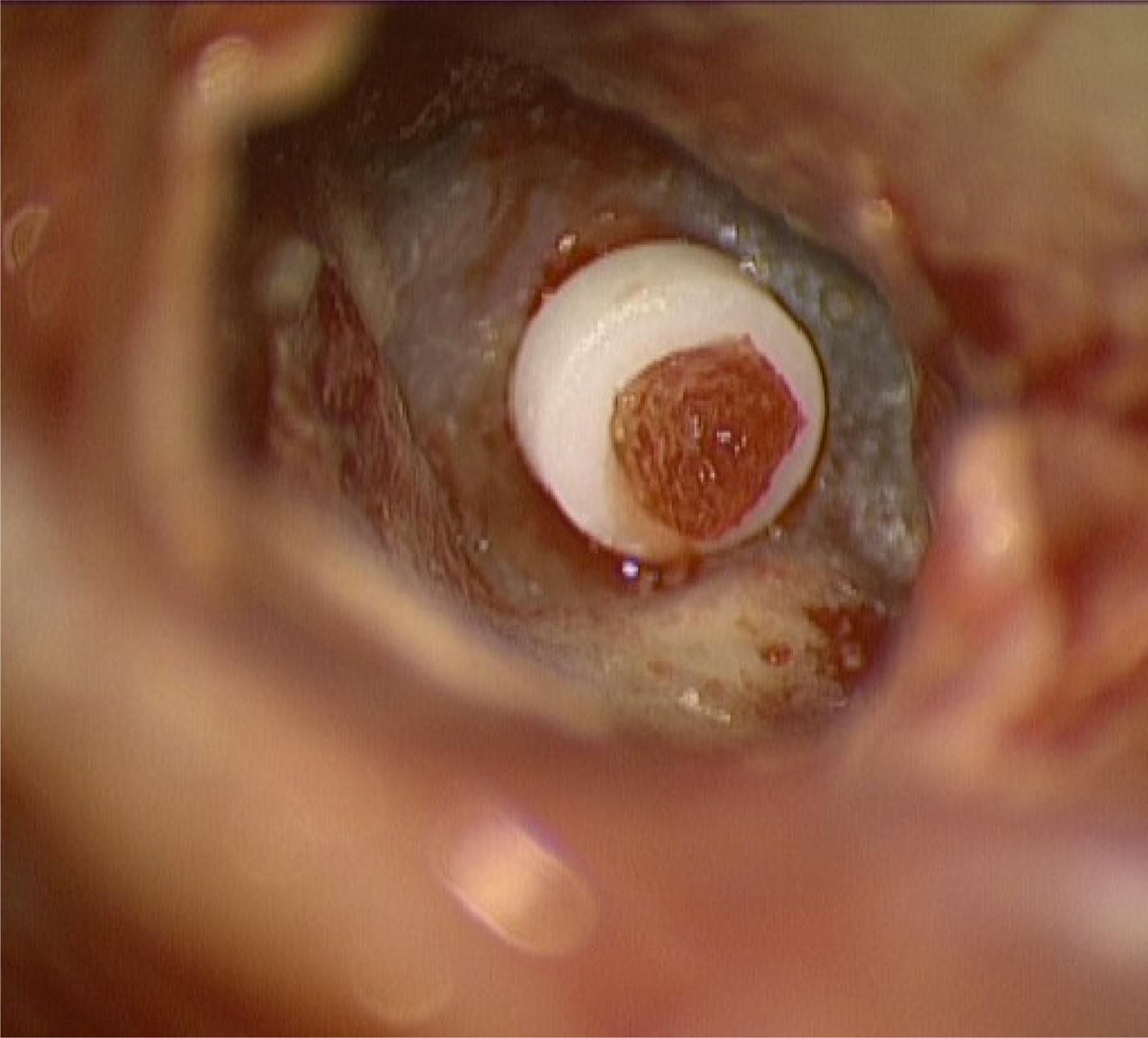
Surgery followed our standard departmental procedure. Before the grommet was inserted, a thin sliver of Gelfoam® (Pfizer Inc., New York, NY, USA) was introduced into the lumen of the grommet using a pair of crocodile forceps and/or a microelevator. The length of the Gelfoam sliver measured just longer than the actual length of the grommet, i.e. the tips of the Gelfoam sliver were just visible from either end of the grommet lumen (Figure 1). The ear canal was then packed with dressings for two weeks. At the first post-operative clinic visit, the dressings were removed and the patient was given two weeks of eardrops, as is standard practice at our institution after dressing removal for post-operative ears.
Photograph of post-tympanoplasty ventilation tube inserted into the anterior part of the right tympanic membrane, with the Gelfoam sliver positioned within the lumen, before the ear canal is packed. Note how the tips of the Gelfoam sliver are just visible from either end of the grommet lumen.

We have used this method for many years in more than 50 cases and have had very few problems with post-tympanoplasty grommet obstruction. The absorption time of Gelfoam generally varies from 7 days to 6 weeks depending on the amount used, the site of use and the degree of saturation with blood or other fluids.4 We suggest that the Gelfoam sliver prevents intraluminal grommet obstruction initially and then liquefies sufficiently by the time of dressing removal at two weeks such that eardrops help to wash away any residual Gelfoam material.
Conclusion
Only one other technique that prevents post-tympanoplasty grommet obstruction has been described in the literature. In that technique, a modified venflon cannula was inserted into the grommet lumen peri-operatively and then pulled out in the clinic setting after removal of the canal dressings.Reference Javed, Devesa and Bottrill5 We feel that our method represents an improvement, since there is no need to manipulate the grommet at all, which is important in those uncooperative with aural care, e.g. in younger children or in patients with learning difficulties.