What determines preferences for international legal cooperation? What determines how decision makers prefer to design or whether they aspire to ratify international treaties? Answers to these questions have focused on the types of problems that decision makers seek to manage through collective action,Footnote 1 domestic politics,Footnote 2 culture,Footnote 3 and the structure and cost of interstate bargaining.Footnote 4 Some also point to the costs of entry and accountability as selection mechanisms, suggesting that formal enforcement mechanisms diminish (or at times, augment) the will to join treaties.Footnote 5 Underlying much of this important scholarship are two assumptions: (1) that decision makers in the same situation will reason through the same trade-offs to arrive at similar conclusions about cooperation because context, structure, and institutions determine their preferences for cooperation; and (2) that different decision makers are similarly equipped to process large amounts of information, weigh costs and benefits far into the future, and act according to high levels of strategic reasoning.
Yet there are circumstances where individual political elites working within similar institutions, cultures, and contexts espouse radically different policy strategies. Writing in the middle 2000s, Carla Hills, the US Trade Representative under President George H.W. Bush, believed that the failure of the World Trade Organization's (WTO) Doha Round was attributable, in part, to lack of awareness by the US public of what was at stake for the country.Footnote 6 Susan Schwab, working in the same job for a president of the same party (the elder Bush's son, George W. Bush) and reflecting on the same challenge—whether or not (and how) to cooperate on Doha—at about the same time believed that Doha's troubles lay chiefly with the challenge of negotiating with more than 150 countries across so many issues.Footnote 7 From Hills's perspective, a strategy for crafting more effective trade agreements required a more active public relations effort at home; for Schwab, it required reducing the complexity of international bargaining. Why did two elites—each able to have substantial influence over what their government did in international trade relations—believe in such different policy strategies when so many of the other factors that characterized the situation were the same? One possible answer is that Hills and Schwab are very different types of decision makers, with different approaches to making the judgments needed to address the same policy challenges. This possibility arises not just with clearing the gridlock over Doha but in an array of pivotal decisions that lead to tangible outcomes in the design of international institutions and choices such as when to threaten and wage war.
The central hypothesis we explore in this article is that certain behavioral traits of the people tasked with making international cooperation decisions help to explain their preferences for negotiating and joining international agreements. We relax the assumptions widely used in standard international relations theories, allowing our decision makers to vary in their behavioral traits. And we map that variation onto their stated preferences for cooperation in the context of an international trade agreement. Different types of people in the same situation may prefer to approach political decision-making tasks and reason through trade-offs in materially different ways.
We are hardly the first to suggest that behavioral traits could influence how people reason through political choices germane to international relations. It is well understood that people's attitudes, emotions, and even biology shape decisions that are typical of foreign policy.Footnote 8 Indeed, for years scholars of foreign policy have focused on individual elites—for example, Presidents John F. Kennedy's and Barack Obama's inexperience was thought to make each of them initially unable to form and implement foreign policy opinions independent of military advisers.Footnote 9 Scholars of presidential decision making have suggested that the methods for weighing evidence and making decisions adopted by individual leaders shaped how their administrations functioned, with a large impact on policy outcomes—including on matters of foreign policy.Footnote 10 In the realm of security studies, scholars have noted that traits such as overconfidence may make elite decision makers prone to error, leading to misperceptions, accidental wars, and other unfavorable foreign policy outcomes.Footnote 11 The study of behavioral psychology, however, has not made as much headway into the accepted canon of research on international institutions.
Our contribution is to measure, in a partially controlled setting, two key personality traits of decision makers—patience and strategic reasoning—and assess how subjects reason through foreign policy decisions related to trade cooperation. We do that with a large sample of university students, which affords the opportunity of statistical power, as well as a smaller sample of elite policy-makers, including former members of Congress, high-level political appointees and civil servants in the US government, and senior business strategists at leading American firms. By studying both populations using identical experimental instruments, we explore not just how behavioral traits relate to policy preferences for trade cooperation but also help reveal how nonelite samples may differ from real policy elites.Footnote 12 Our work thus offers a benchmark for explaining how individual behavioral traits might influence decision makers' preferences for treaty design and participation. It also offers a framework for exploring when and how nonelite samples might reveal insights about elite decision making relevant to international relations.Footnote 13
First, we develop the theoretical intuition that measured levels of patience and strategic skills might influence how a decision maker reasons through particular treaty negotiation and ratification decisions. After outlining the study design, we report results from the university student sample. The higher statistical power of that sample allows us to show with reasonable confidence that our subjects' preferences regarding treaties depended—in part and possibly a lot—on their traits, quite apart from the context of the problems they were charged with solving. Behavioral traits may also have an effect on preferences of the same magnitude as some of the factors that have dominated international relations theory such as the presence of formal enforcement mechanisms—an institutional design feature that has been prominent in scholarly debates over the membership and effect of international agreements. We then turn to the elite sample, which is smaller but allows us to see if the patterns observed with nonelites are also evident in a population of people who actually reason through similar policy decisions for a living. Finally, we explore some of this work's implications for the study of international relations, including the behavior of agents in international negotiations and the question of where individual decision makers can inform real-world policy decisions in international relations.
How Behavioral Traits May Shape Preferences for Cooperation
Much of formal international cooperation starts with the design of international agreements that states join through ratification. Designing and joining an international treaty depends on a large number of decisions that come with trade-offs. We focus on the trade-offs involved with two decisions that correspond with topics that have attracted special attention by scholars of international organization: bargaining complexity and enforcement.Footnote 14 In addition to scholarly interest, policy-makers also behave as if these actions are important—something revealed by the huge literatures on how these factors affect the ratification process.Footnote 15
The first decision we investigate involves how many parties decision makers prefer to invite to the negotiation. Scholars have explored how the number of parties in a negotiation affects the complexity of bargaining and the prospects for cooperation.Footnote 16 To measure how decision makers in our study managed a common trade-off involving the numbers of participants, we asked subjects to choose how many countries should be involved in the negotiation of a trade agreement. The survey included explicit instructions noting that while adding more countries to the negotiations would further their country's aim of having the agreement cover the largest fraction of world trade, the extra voices would also make bargaining more complicated and introduce additional risks that the content of the agreement would be diluted.Footnote 17 Responses were recorded in a category from 1 to 4, with each category increasing the number of countries invited to negotiate the treaty.Footnote 18
The second choice we investigate involves the decision to ratify a trade agreement. A long-standing, central concern for scholars of institutions is whether and how international cooperation requires formal enforcement mechanisms such as dispute resolution procedures, and whether those mechanisms encourage or deter participation.Footnote 19 To measure how the presence of enforcement affected subjects' willingness to join a trade agreement, we randomly assigned subjects to one of two experimental conditions. In each condition the description of the trade agreement was the same except for one sentence that indicated whether the treaty included a formal enforcement mechanism.Footnote 20 We designed the survey to trigger subjects to weigh alternative policy options with the goal of maximizing the net national benefits from the trade agreement. We explicitly framed the decision to join the treaty as a situation where joining is a strategic complement. That is, states benefit more from joining and abiding by the agreement if other countries do the same. However, we did not specify just how much other states would actually benefit or whether some states might still have a dominant incentive to violate the agreement. In this type of strategic situation, cooperation can still be an equilibrium strategy even without enforcement, but enforcement makes it more certain that no state has a dominant strategy to free-ride—this additional certainty makes joining more attractive.Footnote 21
Our central hypothesis is that certain behavioral traits of the decision makers tasked with making international cooperation choices help to explain their preferences for both of these decisions. The burgeoning research in experimental psychology and behavioral economics shows that people have many distinct behavioral traits (or dispositions), some of which can drive their social and strategic performance.Footnote 22 By “behavioral trait,” we are simply referring to a behavioral tendency that, at a given point in time, is stable across similar types of decisions (in contrast to a state that often refers to emotional or other fleeting responses to a situation). For example, people who are patient are more willing to wait for greater rewards across a number of scenarios.
Scholars in the fields of cognitive psychology and behavioral economics have developed techniques for measuring a large number of traits and have explored a myriad of ways these traits might associate with individual and collective behavior. Eighteen traits in particular have commanded substantial empirical research.Footnote 23 Several of those traits have already spread into the American politics subfield of political science where scholars have probed how “agreeableness” or “conscientiousness” affect the mass public's political attitudes and civic engagement.Footnote 24 In principle, any trait that affects perception and reason might, in turn, affect how decision makers reason through trade-offs in international relations. Although such possibilities are interesting and could frame a research agenda for the long term, there is almost no research (to our knowledge) linking these measured behavioral traits to the reasoning and decisions typical of foreign policy. Thus, as a starting point, we have focused on traits that are highly likely to have a measurable impact on how decision makers choose among the trade-offs that are typical of one of the most central areas of foreign policy—international trade—where important decisions revolve around the design and adoption of international legal agreements. We focus on two traits—patience and strategic reasoning. We reveal how these traits affect outcomes but future research might explore other traits as well.
First is patience. International relations theorists have long known that one of the key functions international institutions perform is to lengthen the shadow of the future.Footnote 25 Institutions facilitate reciprocity and provide information that helps players become confident that the long-term benefits from repeated interaction will arise. Indeed, while international relations theorists disagree about a lot, this cooperation-enhancing role of the shadow of the future is one theory that commands widespread acceptance. At the level of individual elites who make policy decisions, patience is a trait that has the potential to affect the shadow's length. Patient people have lower discount rates—they are more willing to wait for larger benefits that accrue in the distant future rather than seize smaller but more immediate gains.
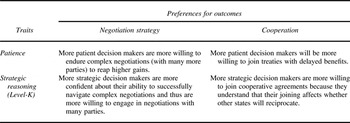
International cooperation frequently involves sacrificing payoffs that are immediate for benefits that are delayed. Faced with that particular trade-off, patience could affect a person's preferences related to international cooperation in at least two ways. First, patience could affect how a decision maker prefers to pursue treaty negotiations when tasked with negotiating a treaty. Different bargaining strategies can substantially influence the length of negotiations and their prospects for success. For instance, including more countries in negotiations could potentially bring greater benefits in the long run because agreements would engage a larger share of the world economy; patient people are less concerned by the risk that negotiations might drag on and delay the benefits of cooperation.Footnote 26 Thus, our first hypothesis is that patient people in our study will be more willing to prefer complex negotiations, involving more countries and higher payoffs, even though they are made aware that doing so may delay the completion or scope of negotiations. Less patient subjects will prefer to invite fewer parties to the bargain.
Second, when tasked with the decision whether to join an international treaty, a decision maker's patience could affect whether s/he views the commitment favorably, especially in situations of time inconsistency when participation within the institution entails proximate costs but yields the possibility of large yet more remote benefits.Footnote 27 We anticipate that the type of person who is generally willing to wait for higher payoffs—a patient person—will prefer to engage in international cooperation, and join the treaty, more so than the impatient type who seeks more immediate gratification.
Our arguments about patience, applied in this study for the first time (to our knowledge) to international treaty cooperation, have a strong counterpart in formal models of international bargaining. Powell noted that many bargaining models are sensitive to assumptions about how much states value future payments.Footnote 28 More patient states are more willing to bargain for longer periods of time to secure peace rather than immediately secure a less valuable outside option. Leventoğlu and Tarar formalized this argument, showing that whether or not a negotiated settlement is attainable in many models of bargaining under incomplete information depends on the bargainers' patience.Footnote 29 These insights could also inform decision makers' preferences for cooperation where the rewards are more favorable trade agreements instead of the peaceful division of a prize.
Strategic reasoning is another behavioral trait that could influence how a decision maker reasons through these particular trade-offs. Economic theory distinguishes between choices that are game theoretic (that is, strategic) versus those that are simply decision theoretic. Strategic decisions are characterized by multiple decision makers, each faced with choices whose consequences depend also on others' choices. By contrast, decision-theoretic problems may depend on variables that are uncertain but they do not depend on the choices of other decision makers. Obviously, this distinction refers to ideal types, since many decisions combine game-theoretic and decision-theoretic elements. In this article we focus on game-theoretic choices because they usually require actors to form a clear and accurate picture of other people's incentives and choices and because many aspects of international cooperation have game-theoretic attributes.
For decades, scholars have known that most areas of international relations are steeped in strategy.Footnote 30 How a state behaves depends on what it expects other countries to do and on the vulnerability that each state has to others defecting. The application of these insights, which has been the province of game theory,Footnote 31 depends in part on the strategic reasoning of decision makers—that is, the extent to which they anticipate how their counterparts will respond in a bargaining situation and adjust their own response accordingly. Research in behavioral game theory suggests that there is wide variation in how people respond to strategic problems.Footnote 32 This is especially true when people initially play a game.Footnote 33 In these situations, individuals have not had time to form clear expectations for how others will play the game, and often make decisions about their own best move using simple nonequilibrium models of other players.Footnote 34 For example, some individuals may simply model their opponent as an actor who chooses randomly, and others may act as if their opponent always best-responds to random play, even when doing so is not an equilibrium strategy.
Given the central role for strategic interaction at the international level, strategic reasoning is a logical place to observe whether individual behavioral traits could affect policy preferences for international trade cooperation. This heterogeneity in strategic reasoning could have substantial implications for how people reason through the value of different forms and levels of international cooperation. Many elements thought to be important to the design and operation of international law—such as reciprocity—rely on the assumption that decision makers engage in high levels of iterated, strategic thinking. The preference to ratify and thus be bound by an agreement may depend partly on whether other states will also join and comply; policy-makers in those others states, as well, face a similar interdependent choice. Decision makers who treat the decisions of others as independent or random may be less likely to prefer joining an agreement because they do not fully consider the benefits from cooperation due to reciprocity. By contrast, those who realize that their decision to join an agreement will amplify the incentives for other countries to do the same may be more favorable toward joining. In fact, Jervis has pointed out that a key factor underlying uncooperative behavior during the Cold War may have stemmed from individual decision makers failing to anticipate how others would respond to their own actions.Footnote 35 A similar idea has been posited by recent studies in neuro-economics that show that more strategic reasoners are more cooperative in iterated assurance games because they better anticipate other players' incentives to cooperate in response to their own cooperation.Footnote 36 Thus, our third hypothesis is that we expect people whose behavioral traits include higher levels of strategic reasoning will be more favorable about joining a treaty.
It can also be difficult to anticipate and best respond to the actions of a large and diverse group. Strategic actors especially may be more willing to engage in more complex negotiations than less strategic actors. Compared with nonstrategic actors who act without regard to what others will do, strategic decision makers act as if they are also better able to foresee and best respond to the actions of others. They may therefore be more confident in their ability to navigate negotiations involving a wider array of actors. Thus, we also expect subjects whose behavioral traits include deeper levels of strategic reasoning will prefer more complex treaty negotiations—willing to negotiate with more countries whose interests must be represented and whose actions must be predicted. Table 1 summarizes our argument.
Hypotheses

Study Design
Because we aim to explore the relationship between two behavioral traits and structured choices about international treaty cooperation in different situations we asked both our university and elite subject pools to participate in a survey experiment in two parts. One part asked them to self-report how they would respond to different scenarios and choices about an international trade agreement given the specific trade-offs we outlined earlier.Footnote 37 The other part asked subjects to play a battery of behavioral economic games from which we elicited information about behavioral traits. We also asked a standard set of demographic questions that collect information about age, sex, and political party identifiers.
Both the survey questions and behavioral games in our university study were administered as part of a larger omnibus study where subjects participated in a number of short surveys and experimental tasks contributed by different researchers. The order in which subjects participated in each task was randomized to avoid any potential order effects. We report the questions and games relevant to the current article only.Footnote 38
We conducted our university study during fall 2010 and winter 2011 at the Rady School of Business's behavioral computer lab, located on the University of California San Diego (UCSD) campus. A total of 509 participants were recruited from university classes in the Political Science Department, as well as two first-year masters courses at UCSD's School of International Relations and Pacific Studies. Students were compensated for participating in the study by receiving extra credit in the class from which they were recruited. All participants also had the chance to win monetary rewards from a lottery whose value depended on how they and other respondents played the experimental games in the study. Instructions for both the games and the survey were presented to subjects on computers in the lab using Qualtrics survey software. The entire enterprise was approved and overseen by UCSD's Human Research Protections Program.
Measuring Behavioral Traits
To measure the two behavioral traits studied here we rely on behavioral games rather than traditional survey-based measures for two reasons. First, unlike traditional surveys that ask subjects to categorize their own traits—say, by rating their own level of patience—behavioral games are based on a mathematical model of economic behavior, giving researchers a common baseline against which to compare subjects' behavior.Footnote 39
Second, unlike traditional surveys, the games used in this survey force subjects to make decisions linked to tangible outcomes (real monetary stakes) and thus are probably a more accurate elicitation of underlying traits. This is especially important when studying factors like patience that are considered socially desirable and thus may be prone to biased self-reporting.Footnote 40 The average monetary stakes that subjects faced in our experiments were quite small because a lottery (for $100) paid only a small number of subjects. However, other studies have shown that similarly small incentives are adequate for eliciting accurate responses,Footnote 41 even when decisions were elicited with a single prize.Footnote 42 Furthermore, a number of studies have reliably found a link between behavior in lottery-incentivized games and real-world political behavior.Footnote 43
Patience
To measure how much subjects value the future—that is, their level of patience—we adapted a “choice game” introduced by Coller and Williams.Footnote 44 We refer to this game as a time-discounting task to more intuitively evoke the game's purpose. Past studies have linked behavior in this task to real-world behavior, such as savings ratesFootnote 45 and voting behavior.Footnote 46
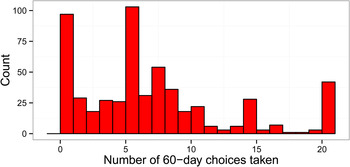
In our study (and in others using this task), our subjects were asked to make twenty different choices between a $100 prize that would be paid to them within thirty days after taking the study and a variable, larger prize that would be paid within sixty days. For each subject, a measure of patience is the number of sixty-day choices. (Additional discussion of how these choices relate to discount rates is in the online appendix.)
Figure 1 shows the distribution of time-discounting choices made by subjects in our study, which is similar to choices found in many other studies.Footnote 47 The modes at the extremes indicate that many subjects either always chose one option or always chose the other. Heuristics also generated some modes—for instance, the large spike at five corresponds to subjects switching when the sixty-day choice moves above $110—a result similar to that in other studies.Footnote 48
Distribution of patience in the college student sample

Strategic reasoning
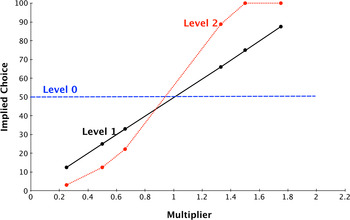
The game most frequently used to study a subject's depth of reasoning in games is the beauty contest, originally implemented by Nagel.Footnote 49 In this game, N players are asked to pick a whole number between 0 and 100 (inclusive). The winner of the game is the player who picks a number closest to the population average multiplied by a number M. If M is less than 1, the unique equilibrium strategy is for all players to guess 0; when M exceeds 1, the unique equilibrium is for all players to guess 100. For example, imagine a version of the game where the multiplier is 2/3. A player starts with a conjecture that other players choose numbers such that the average is 50. The player should then select 33 as his own choice since this is the closest number to 2/3's the group average. Other rational players know this; they, too, choose 33. But if everyone chooses 33, then the original player's best pick is 22 (2/3 of 33). At infinite iteration the best choice is 0. To characterize the number of rounds of strategic reasoning used by subjects we rely on Stahl and Wilson's “Level-K” model. In this model Level-0 players are nonstrategic; they play a random strategy. Level-1 players best respond to average Level-0 play by picking 50 × M—a choice that reflects one round of iteration. Level-2 players best respond to Level-1 players by picking 50 × M^2—two rounds of iteration—and so forth. Although it is possible for players to iterate to an infinite number of levels, most strategies are found to correspond to 1 or 2 steps of iterated reasoning at most.Footnote 50
Level-K measurements are not just an assessment of the player's skill at iterative strategic thinking but also their expectation of what others will do when facing the same choices.Footnote 51 If Henry Kissinger thought all other players were mere randomizers then his best choices would be Level-1, but if he thought his opponents were Kissingerian in strategic skill his Level-K would be much higher. Thus, we measure how strategically individuals tend to act, not necessarily their strategic capability.
Most importantly, however, our results do not strongly depend on particular assumptions about why certain individuals tend to act more or less strategically. Our key assumption is only that this tendency is partially preserved across different decisions and this assumption has been supported by recent studies that show how subjects' level of strategic reasoning frequently persists across different types of strategic interactions.Footnote 52 Thus, while our measure may reflect both subjects' cognitive ability, as well as their beliefs about other players, it is also quite plausible that players who act more strategically in the beauty-contest games we employ also act more strategically in other decision-making domains, such as decisions about international cooperation.Footnote 53 This is especially likely given the finding that subjects' measured Level-K behavior is particularly stable when it is elicited through multiple games,Footnote 54 which is the method employed here.
In order to identify the level of reasoning typically employed by a subject in our study, we followed Coricelli and Nagel by having each subject play multiple beauty-contest games, each with a different multiplier.Footnote 55 Unlike single games, this approach creates a fingerprint that better identifies a player's typical depth of reasoning in the game. Figure 2 shows the patterns of choices that Levels 0, 1, and 2 would make across each of the six games. As one can see, Level-0 players should consistently play a random strategy across all games, on average choosing 50. Level-1 players best respond to this by multiplying 50 by the game's multiplier, creating a linear strategy profile across games. Level-2 and higher players will play numbers that are nonlinear in the multiplier.
Expected Level-K responses across six beauty-contest games

University subjects were told that we would pick one game at the end of the academic quarter, and pay the winner of that game $100. Elite subjects were told that a winner would be chosen and paid at the conclusion of the study. In both cases it was made clear to subjects that they were playing against their peers. Following Coricelli and Nagel, for every choice in every game we calculated which level had the lowest squared error. We labeled players as Level-2 if they had four or more of their six choices that were closest to the choice played by an archetypical Level-2 player such as in Figure 2.Footnote 56 As with Coricelli and Nagel, we do not calculate levels higher than 2. Thus Level-2 players in our data actually represent “Level-2 or higher.” We labeled players as Level-1 if four or more of their choices were closest to a Level-1 or greater. We labeled remaining players as a Level-0.
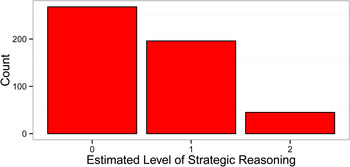
Figure 3 shows the frequency of subjects estimated to be in each category. Most subjects in our study are either categorized as Level-0 players, who act randomly with respect to their payoffs or Level-1 players who best respond to random play. A small fraction is categorized as Level-2 or higher. The relative size of each group is consistent with what Bosch-Domènech and colleagues found for experiments in classrooms and laboratory settings.Footnote 57 In sum, only a few of these subjects act in a highly strategic manner.
Distribution of Level-K reasoning in the college student sample

Although a number of studies have used the beauty-contest game to study strategic reasoning, we believe we are the first to try and connect results in this game to behavior in a separate decision-making domain, such as the design and joining of international agreements.
Results
Negotiation Complexity
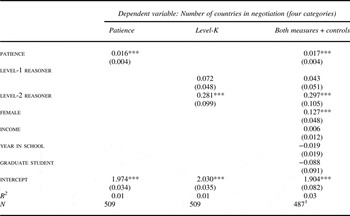
We now look at how our sample of university subjects' patience and strategic reasoning are related to their preference for negotiating with more countries.Footnote 58 Table 2 reports three linear models, each regressing subjects' responses (1-4) onto our measures of behavioral traits.Footnote 59 The first set of results regresses subjects' choices on their measured level of patience.Footnote 60 The second set regresses subjects' choices on their measured level of strategic thinking, with Level-0 thinkers as the omitted category. The third set reports a regression that includes both measures, plus a number of standard demographic controls including the subject's years of postsecondary education (ranging from 1 to 7), gender (coded 1 for female), family income in the year before they entered college (coded on a scale from 1 to 9, with each number representing an interval of income),Footnote 61 and a dummy variable indicating subjects who were in graduate school. The third regression includes fewer subjects because some subjects did not report their family's income.
Behavioral traits and tolerance for complexity in negotiations

Notes: Standard errors in parentheses are White's robust standard errors. *** p < .01; ** p < .05; * p < .1.
1. This regression has fewer observations because some subjects did not report their family's income.
We find that both patience and strategic thinking are positively and significantly related to the number of countries a subject decides to invite to the negotiations. Subjects who made more sixty-day choices in our time-discounting task invited more countries to the negotiations. The most patient subjects chose an average category number that was 0.32 categories higher than the least patient subjects.
Level-2 thinkers, who act as if they are particularly strategic responders, were also more likely to invite more countries compared with both Level-0 thinkers (who act randomly in the beauty-contest game) and Level-1 thinkers (who also act unstrategically, essentially treating other players as a random variable). Level 2 thinkers, by contrast, chose an average category number that was 0.28 categories higher than Level-0 subjects, and 0.21 categories higher than Level-1 subjects.
We also find that women in this sample (59 percent of the university population and 21 percent of the elites) were more inclined to prefer negotiations in large numbers, though we have no explanation for why.
The Decision to Join a Treaty
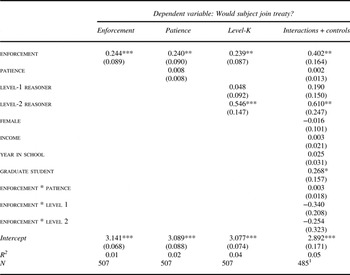
Subjects' willingness to join a negotiated trade agreement depended on an enforcement mechanism as well as subjects' patience and strategic reasoning. The first model in Table 3 reports the effect of enforcement by itself. Subjects randomly assigned to the treatment in which the treaty included an enforcement mechanism were about 5 percent more likely to prefer to join the treaty.Footnote 62 The presence of an enforcement mechanism is a boon to cooperation in this sample of decision makers.
Decision to join trade agreement

Notes: Standard errors in parentheses are White's robust standard errors. *** p < .01; ** p < .05; * p < .1.
1. This regression has fewer observations because some subjects did not report their family's income.
The second model reports that patience had no appreciable effect on subjects' propensity to join. This result, contrary to our hypothesis, may reflect that joining decisions arise at a single moment in time for which the treaty's attributes (its costs and benefits as well as its design, such as enforcement) play a much larger role in determining whether individuals favor membership. It may also reflect that although the question specified that some benefits would be realized only later in time it did not specify a time delay for all of the treaty's benefits. Thus, while we would expect patience to play a role, the effect may have been diluted by other considerations.
The third model reports that more strategic subjects (those measured to be Level-2 reasoners) were, on average, 11 percent more likely to join the trade agreement. As we report in the supplementary information,Footnote 63 subjects' comments reflected the intuition that strategic reasoners are more cooperative in iterated assurance games, with more strategic reasoners arguing that joining would make it more desirable for other countries to do the same. This effect is about two times the effect of adding enforcement to a trade agreement, and thus suggests that behavioral traits such as strategic thinking can exert a substantial influence on decision makers' preferences for cooperation relative to the presence of enforcement deemed important by much of the literature. We cannot guarantee that this relative effect size would hold outside the lab. A host of factors may change it. However, we interpret this effect as evidence that behavioral traits can have a relatively large impact on such preferences relative to variables more commonly considered by international relations scholars. It provides a baseline for future research, which might consider how other factors make behavioral traits more or less relevant to actual elite decision making.
The fourth model in Table 3 shows that these findings are robust to the addition of demographic controls. It also shows that behavioral traits do not reliably interact with the presence or absence of an enforcement mechanism. That is, the behavioral traits that we measure have an effect on the preference to join that is largely independent of whether the agreement includes a credible enforcement mechanism.
In addition to collecting quantitative evidence, we also asked subjects to comment on their decisions and reasoning processes.Footnote 64 Subjects who were classified as nonstrategic (measured as a Level-1 reasoner) typically focused on how their country individually benefited from the treaty's provisions, or acted as though other countries' decisions were exogenous. Meanwhile, strategic (Level-2) reasoners were more likely to comment on how their decision might influence the decisions of other countries.
Elite Decision Makers
Because laboratory experiments in political science, psychology, and economics often use convenience samples of university students,Footnote 65 there is always a question of external validity, especially on matters such as voting on Congress or negotiating treaties that are exclusively the domain of elite decision makers who are difficult to engage in survey and experimental research.
To our knowledge, there are no experimental studies of elite political decision makers that measure the behavioral traits of patience; moreover, the literature on elite strategic behavior is only suggestive.Footnote 66 One study has surveyed the existing literature comparing university students with people in the general population across a number of laboratory games.Footnote 67 That study finds that differences tend to be minor and quantitative, not qualitative. That is, the same player traits exist in each population, and are simply distributed differently. The few studies that have focused on behavioral traits in depth find similar results.Footnote 68 Nonetheless, it is possible that there will be some differences. For example, there may be selection effects that influence which individuals ultimately occupy elite roles. Careers in international law and business typically have long trajectories, and patient people who highly value future success may be disproportionately represented in these careers. And, we might hope, elites who have become leaders charged with the responsibility of brokering and managing international cooperation should be more advanced strategic thinkers.Footnote 69 Similarly, elites gain practical experience on the job, and that experience might affect their choice of heuristics and other mechanisms for decision making even if they do not affect underlying behavioral traits. Through such mechanisms there may arise differences in the distribution of behavioral traits and related decision-making skills across elite and nonelite populations.
To evaluate whether actual policy elites with experience in the field of international trade cooperation (such as the people who have actually negotiated major trade agreements) are differently affected by our treatment or the traits we have measured, we have developed a unique sample of high-ranking government and business elites (n = 92), including former members of US Congress, their senior staff, top US trade negotiators, senior executives in firms whose operations are exposed to international trade, and civil servants in federal and state government. We built the sample through professional contacts and then expanded the sample with personal introductions. The overall response rate was almost 20 percent.Footnote 70 In the online appendix for this article, we report demographic summaries for the sample. Because it was not possible to survey these elites in our lab, we had elite subjects participate over the Web using the Qualtrics platform between April 2011 and January 2013. They participated in the identical time-discounting task and beauty-contest game and answered the identical question about whether or not they wanted to join a treaty. The elite sample is made up of individuals with an average age of fifty-two who have an average of twenty-one years' experience in business or government strategy. Like our university sample, this population is a convenience sample recruited through professional networks. Therefore, we cannot say that this sample's measured traits or question responses are representative of all professionals in the area of international trade and negotiation. However, we can examine how sensitive our findings are to whether individuals come from a convenience sample of university students or from a convenience sample of individuals with directly relevant experience. Our elite sample is necessarily much smaller than our university sample because these professionals are much busier than university students, as well as harder to contact and convince. It is therefore more difficult to recruit these individuals in large numbers.
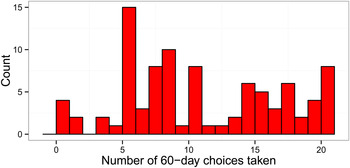
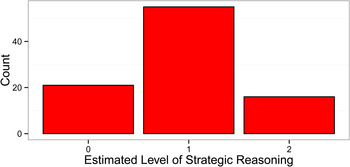
The measured patience and Level-K reasoning of elites in our sample appear in Figures 4 and 5. As one might expect, elites differ from university students in their distribution of patience and strategic reasoning. Figure 4 shows an elite distribution that is, on average, more patient than university students. This difference is statistically significant (Wilcoxon rank sum test p-value = 1.8 × 10⁻⁶). Figure 5 shows that elites in our sample also display a higher level of strategic reasoning, with more individuals categorized as Levels 1 and 2, and many fewer categorized as Level-0 reasoners (Wilcoxon rank sum test p-value = 4.94 × 10⁻⁶). We do not attempt to explain here why elites differ from university students—although elsewhere we have explored what little is known about this question through a survey of the existing research in cognitive psychology and behavioral economics.Footnote 71 However, despite these differences there is still substantial overlap in both distributions. Furthermore, differences in the distribution of traits do not substantially change the relationship between those traits and the preferences that individuals have for treaties.
Distribution of patience in the elite sample

Distribution of Level-K reasoning in the elite sample

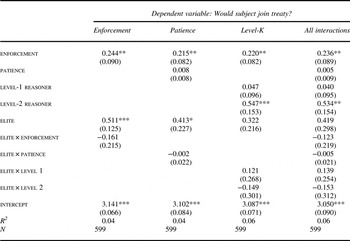
Table 4 displays results similar to those of Table 2, pooling both university student and elite responses to our question of whether or not to join a trade agreement. In the first three columns we look for whether there is an interaction between an individual's elite status and our treatment (column 1), their level of patience (column 2), or their Level-K reasoning (column 3). Column 4 includes all three interaction terms. Again, the results in Table 4 point in the same direction as the university-only sample in Table 2. Patience does not affect an individual's decision to join the treaty, and there is not a significant interaction between patience and being an elite. Likewise, Level-2 reasoners are still more likely to join the treaty, and there is not a significant interaction between this effect and elite status.
Decision to join trade agreement pooling elite and university student samples

Notes: Standard errors in parentheses are White's robust standard errors. *** p < .01; ** p < .05; * p < .1.
Thus, at least within our sample, we cannot reject the hypothesis that traits affect elites' preferences for treaties in the same manner they affect university students.Footnote 72 Moreover, the effect of the enforcement treatment is still positive. The elites in our sample clearly did not view the presence of an enforcement mechanism as a deterrent to joining the treaty. To the contrary, enforcement significantly changed their views, making formal legal cooperation more desirable.
Discussion
Together, these findings suggest that (1) our sample of elites is on average more patient and strategic than our sample of university students, and (2) that the relationship between both traits and both pools of subjects' preferences for international trade cooperation is relatively consistent across samples. Even though elites and university students differ, patience and strategic reasoning do not have a substantially different effect on elites' preferences to join the treaty. An analogy from American politics helps to illustrate the point: consider the well-known relationship between age and voter turnout.Footnote 73 Elites will be older than university students, but the relationship between age and turnout is the same for both groups—older elites are more likely to vote than younger elites, just as older university students are more likely to vote than younger students. Our findings suggest that elites, who are more strategic and patient, prefer to negotiate in greater numbers and to join treaties more than university students do. In other words, real political elites are more favorable to large-scale cooperation.
Our findings have important implications concerning theoretical assumptions surrounding individual strategic behavior. First, the fact that elites, unlike university students, are predominantly Level-1 players may be quite important for theories in international relations. Level-1 players are strategic in the sense that they best respond to both the rules of the game and to what other players could potentially do. International relations theories that apply to political decision makers of the type in our sample may be on firmest ground when they assume that decision makers purposefully and carefully make choices with respect to what other decision makers might do, avoiding strategies that are strictly dominated. However, either because of limited cognition or strategic uncertainty, most political elites we sampled do not behave like equilibrium thinkers who act according to common knowledge rationality. Thus, theories that rely on the assumption that these kinds of elites will reliably reasonFootnote 74 their way toward a particular equilibrium of a game may benefit from checking whether their results would differ if decision makers acted as Level-1 players. This is especially important when an interaction occurs relatively infrequently, such that decision makers are less likely to learn their way toward a particular equilibrium. As an example, formal models of Level-K behavior have found that Level-1 actors are more likely to be influenced by cheap-talk signals,Footnote 75 and such limited strategic reasoning could help explain puzzling phenomena in international relations, such as why cheap talk appears to work both in the real world, as well as in controlled laboratory experiments.Footnote 76
Second, as with previous studies,Footnote 77 our findings suggest that relying on university subjects can bias the results of studies in international relations. In the strategic choice we studied (of whether or not to join a trade agreement), more strategic individuals are more cooperative, and relying solely on university students (who are, on average, less strategic than elites) would systematically underestimate leaders' willingness to join trade agreements. In other strategic settings where cooperation is not a strategic complement, more strategic individuals can actually have a higher threshold for acting cooperatively—in these scenarios, studies using university students could have the opposite bias, overestimating actors' propensity to cooperate.
Our findings represent a first step in more precisely identifying how policy elites are different from a university student sample, and potentially allow researchers to correct for some of the biases that can arise from studying university students as proxies for elite behavior. For example, the effect of Level-K reasoning—at least in our study—appears to be the same in both populations. This finding opens up a potential alternative to producing highly costly elite samples such as we have done in this study. Researchers could reweight or match a university student sample such that they look more like elites on theoretically relevant dimensions, such as strategic reasoning or patience. That approach would require administering games to elicit each player's Level-K type (which will add a few additional minutes onto a survey) and then use the results to calibrate findings to elite characteristics. Despite this inconvenience, such an approach could allow scholars to better generalize findings from students or other nonelite samples (which are much easier to obtain and less costly to survey) to the policy elites who predominately make decisions in international relations.
Preferences to Political Outcomes
This article is about how different behavioral traits shape the preferences of individuals, not the ultimate outcomes of international cooperation such as the level of international trade or actual trade cooperation. Thus, it is a first step in untangling how behavioral traits could shape international relations decisions. For many foreign policy decisions, however, decision makers work in teams and are embedded in bureaucracies, both of which can mute the causal link between any single person's preferences for cooperation and real-world policy outcomes. Nonetheless, individual preferences for cooperation and their determinants are important to study for at least four reasons, and may help to shed light on some actual political decisions that affect international relations.
First, scholars long ago noted that the people sitting at the negotiation table and those who make decisions to join agreements can have substantial autonomy on their own—they are not merely perfect agents for underlying interests and structures.Footnote 78 They have personal styles, opinions, and predilections, as well as formal and informal permissions and job flexibility, which give them degrees of independence from their principals.Footnote 79 This agency slack creates room for behavioral traits to matter, and—where slack is present—makes it unlikely that governmental decisions are completely determined by external circumstances, such that any set of agents would do the same thing in the same situation.
Second, within collective decision-making processes more generally, there is already evidence that individuals can sometimes have a large effect on agendas and decision-making procedures.Footnote 80 For instance, when the talks that eventually led to the creation of the WTO dragged past their deadline and were stuck in gridlock, the chief of the negotiating process, Arthur Dunkel, took control by creating a single negotiating text (the Dunkel Draft) that, with very few revisions, countries finally accepted.
Third, the importance of individuals in group reasoning depends on the kind of reasoning involved. When the decisions to be made have clear evaluation criteria—for example, equilibrium reasoning—groups behave systematically more rationally than individuals.Footnote 81 For those kinds of tasks, group outcomes may not be particularly sensitive to the exact composition of the group because members of the group that do not grasp the concepts are likely to follow the reasoning of group members who do. In contrast, when group decision making requires judgmental tasks where outcomes hinge on weighing uncertainty, human values, perceptions of strategic opponents, and other criteria for which there are no obvious correct answers then groups do not demonstrate appreciable gains compared with individuals. In these cases, the behavioral traits of the group members can have a large effect on outcomes.Footnote 82 Many of the grand decisions in international relations are of this second, judgmental, type. For example, policy-makers in the United States and several other countries are currently focused on creating small trade pacts—a decision based on the judgment that such agreements allow for progress in opening trade and will not cause undue harm by discriminating against the WTO and efforts to strengthen global trade institutions. That judgment is based on assessments of how many highly uncertain factors will unfold in the future rather than the result of any iron-clad laws about how trade policy will exactly unfold. Although more work is needed to understand how individual personality affects collective decision making on tasks relevant to international relations, the existing research preliminarily suggests that the characteristics of the people in the room—even when decisions are made in groups by established bureaucracies—can have a large impact on the outcome of committee decisions.
Fourth, key decisions in the design and implementation of international agreements often take place in small groups where a few decision makers have inordinate influence. In crafting a round of trade talks, a small group of decision makers—usually drawn from the most powerful countries and the secretariat of the WTO—make the final decision about topics to place on the agenda. The successful resolution of trade talks usually hinges on the efforts of a few negotiators—often the Director General of the WTO himself—to craft a final negotiating text from many different competing proposals. That text reflects political and perhaps also behavioral decisions about which elements of a trade agreement are most and least important. And decisions about ratification in important countries such as the United States require a deal that is crafted with the authority of a few leaders in the executive and legislative branches. Such decisions often take place in the context of a crisis or with a looming deadline that concentrates minds and, for efficiency, shrinks the number of people in the room.Footnote 83 This pattern is hardly unique to trade. In most other areas of complex international cooperation the final deals reached are the work of a few people—for example, brokering the main agreement at the 2009 Copenhagen Conference were the heads of state from just five countries with few other individuals sitting around the table.Footnote 84 To be sure, decision-making institutions such as bureaucracies matter for international affairs, but at pivotal moments perhaps individuals also matter.
Although understanding the determinants of decision makers' heterogeneous preferences for international cooperation may help to shed light on variations in some actual political decisions, there may also be circumstances where we should expect decision makers to produce highly similar policy choices despite very different personal dispositions and skills. For example, where policy decisions are highly constrained by circumstances—such as when implementing agreements that have already been crafted in detail or managing a crisis that affords little room to maneuver—institutions and context may matter a lot more than whether decision makers with widely varied backgrounds and personality traits prefer different outcomes. This may help explain, for example, the (highly controversial) musings that presidents as different as George W. Bush and Barack Obama are actually quite similar in important matters of economic policy (for example, managing weak banks) and international security (for example, escalation in Afghanistan).Footnote 85 Our claim is not that decision makers' behavioral traits always drive their foreign policy decisions but rather that traits may in some circumstances have a role to play in shaping how people reason through choices about international cooperation.
Conclusion
Facing the same situation and placed in the same decision-making role, our subjects' behavioral traits reliably correspond to differences in their views on international cooperation. We conclude by looking at three implications for the study of international cooperation.
First, existing research in international relations has reflected on what happens if states are more or less patient or strategic. Our study complements this literature by suggesting that states may depend on the patience and strategic reasoning of the individuals making the key decisions about cooperation. Research on the micro-level sources of decision makers' preferences would help identify why cooperation processes are, at times, far from perfectly optimal or functional to the strategic problem at hand. The evidence from our study suggests that these behavioral traits could have an influence on decision makers' preferences that is equal to or larger than other factors that have attracted intense scholarly attention, such as enforcement of agreements.
Second, work of this type might help shed light on principal-agent (P-A) relationships in international relations. In the tradition of P-A frameworks, it is assumed that when there is slack between the underlying principal and the agents the agents pursue their own interests—seeking to gain privately at the expense of serving the principal's goals.Footnote 86 Although that behavior may be important in some settings, the work here suggests agency slack might operate in other ways as well. At critical junctions in negotiations—when there are a few agents in the room and where the outcomes reflect in large measure their judgment—these factors could prove to be very important and also amenable to systematic study.
Third, this work suggests an agenda for research that links the revolution in methods and insights from behavioral economics and cognitive psychology to the study of international relations, including institutions. A full description of that agenda is beyond this article, but one promising direction suggested by our research is the potential for using convenience samples to study at least some of these phenomena. Our article suggests that the relationship between strategic reasoning and joining a cooperative trade agreement is robust to whether one uses a convenience sample of undergraduates or elites. It is quite plausible that this is not the only area in international relations where decision-making traits are distributed differently, but do not function differently. When this relationship holds, scholars of international relations could sample from the part of a student population that most closely approximates the traits of actual policy-makers, leading to research that is more likely to have external validity.
Supplementary material
Replication data are available at http://dx.doi.org/10.1017/S002081831400023X.