Almost 30% of births in the developed world are by cesarean section (C-section), making this an extremely common procedure performed in almost every hospital.Reference Osterman and Martin 1 Surgical site infections (SSIs), including both incisional infection and endometritis, are a leading cause of morbidity following C-section.Reference Brown 2 – Reference Hillan 4 This procedure is associated with increased mortality, higher rehospitalization rate, longer length of stay, and greater healthcare costs.Reference Deneux-Tharaux, Carmona, Bouvier-Colle and Breart 5 – Reference Olsen, Butler, Willers, Gross, Hamilton and Fraser 9 The rate of SSI following C-section ranges from 3% to 15%, depending on the surveillance method and patient population.Reference Olsen, Butler, Willers, Devkota, Gross and Fraser 10 According to the 2009 National Healthcare Safety Network (NHSN) report, the pooled risk-adjusted mean rates of SSI after C-section from 2006 to 2008 were 1.5%, 2.4%, and 3.8%, depending on the presence and number of risk factors.Reference Edwards, Peterson and Mu 11
Clinical trials have revealed ways to reduce SSI rates after C-section based on the risk factors for developing an SSI; many SSIs are preventable with proper perioperative preparation and surgical technique.Reference Alanis, Villers, Law, Steadman and Robinson 12 – Reference Tran, Jamulitrat, Chongsuvivatwong and Geater 17 However, wide variation in clinical practice exists because techniques employed in C-section often depend on the clinical situation and the surgeon’s preference.Reference Dahlke, Mendez-Figueroa, Rouse, Berghella, Baxter and Chauhan 18 A comprehensive synthesis based on evidence-based techniques will help to increase the consistency and frequency with which clinicians employ best practices to reduce SSI after C-section.Reference Hofmeyr, Novikova, Mathai and Shah 19
In this analysis, we systematically reviewed the results and quality of systematic reviews and meta-analyses regarding the impact of practices designed to reduce SSI rates among women undergoing C-section. These findings highlight strategies that provide a strong evidence base for reducing SSIs after C-section.
Methods
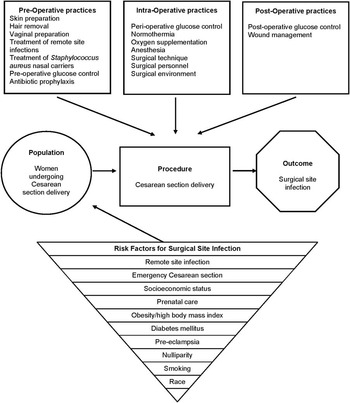
The protocol for our systematic review was based on the Methods Guide for Effectiveness and Comparative Effectiveness Reviews from the Agency for Healthcare Research and Quality (AHRQ). 20 The analytic framework of this review is shown in Figure 1.
Analytic framework for systematic review.

Data Sources and Selection
Two members of our study team searched PubMed and the Cochrane Database of Systematic Reviews for systematic reviews and meta-analyses of interventions to reduce the rate of SSIs among women undergoing C-section in the United States, as either a primary or secondary outcome. We used the Center for Disease Control’s NHSN’s definition of SSI, which is stratified by superficial incisional SSI, deep incisional SSI, and organ/space SSI.Reference Horan, Andrus and Dudeck 21 To review the most recent data, the study search was limited to English-language articles published between January 1, 2000, and May 1, 2014. Eligible comparators included placebo, no treatment, or standard of care. We included reviews of women undergoing C-section among other surgical populations if the data were separately identifiable. The reviewers screened articles identified in our search by title and abstract for subsequent full-text review of eligibility, and reference lists of pertinent systematic reviews or meta-analyses were used to identify additional reports. We did not attempt to identify unpublished articles or contact study authors. The full PubMed search strategy is shown in Table 1.
PubMed Search Strategy

NOTE. mh, mesh; tiab, title and abstract.
Data Extraction and Quality Assessment
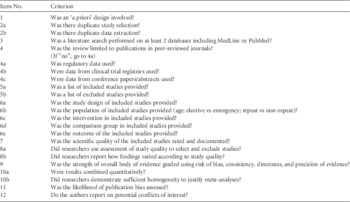
Two reviewers independently extracted data from the included review articles (ie, including the interventions, outcomes, and strength of evidence) and independently assessed the quality of the reviews using standardized data collection tools. The quality of included reviews was determined using a modified version of the Assessment of Multiple Systematic Reviews (AMSTAR) tool.Reference White, Ip and McPheeters 22 Modifications to the AMSTAR tool were made to clarify the quality assessment criteria and standardize the analysis (Table 2). A third party resolved discrepancies between the 2 reviewers to reach a decision that all 3 authors endorsed.
Modified Version of the Assessment of Multiple Systematic Reviews Quality Assessment Tool

The reviewers classified the strength of evidence as “strong” or “weak” based on the conclusions by the authors of the original article, taking into account the original authors’ assessment of the amount of evidence, sample sizes, study designs, and potential risk of bias in the studies. The quality assessment criteria from the modified AMSTAR tool were classified as either “major” or “minor.” The 4 major quality assessment criteria included duplicate data extraction (criterion 2b), a literature search performed on at least 2 databases (criterion 3), a list of included studies (criterion 5a), and the rating and documentation of the scientific quality of included studies (criterion 7). The other 8 criteria in the modified AMSTAR tool were classified as minor quality assessment criteria.
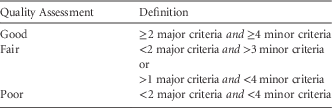
To determine whether a review met the minor quality assessment criteria regarding characteristics of the included studies (study design [6a], intervention [6c], comparison group [6d], and outcome [6e]), we used the following system: “yes” if all included studies in the review satisfied the criterion; “some” if at least 1, but not all, studies in the review satisfied the criterion; and “no” if none of the included studies satisfied the criterion. When determining whether a review met the minor quality assessment criterion concerning the population of the included studies (criterion 6b), we used the following system: “yes” if most included studies reported ≥2 of 3 population variables (eg, age, elective vs emergency C-section, and primary vs repeat C-section); “some” if at least 1 study, but not all, reported >1 of the population variables; and “no” if none of the included studies reported >1 of the population variables. When determining whether a review met the minor quality assessment criteria regarding grading the strength of evidence of the included studies (criterion 9), we used the following system: “yes” if the grading addressed the risk of bias, consistency, directness, and precision of evidence; “some” if the grading addressed only 3 of those 4 domains of the evidence; and “no” if the grading addressed <3 of those 4 domains of evidence. The use of a random-effects model in the analysis was sufficient to satisfy the minor criteria for combining results quantitatively (criterion 10a). The overall quality of the review was determined using the definitions outlined in Table 3.
Grading System for Overall Quality Assessment of Included ReviewsFootnote a

a Any quality assessment major or minor criteria that were classified as “yes, unknown” or “some” were counted as equivalent to “yes” when tabulating an overall rating for the review.
Results
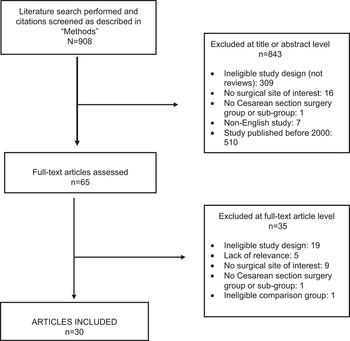
The search identified 908 citations, of which 65 full-text articles were further reviewed after title and abstract screening. A total of 30 review articles met the inclusion criteria for the final analysis (Figure 2).Reference Haas, Morgan Al Darei and Contreras 23 – Reference Mackeen, Berghella and Larsen 45
Study search flow diagram.

Data Extraction Results
The interventions, outcomes, and strength of evidence from each article as assessed by its authors are outlined in Supplementary Table 1. Four articles reviewed preoperative cleansing techniques to reduce SSIs. A total of 10 articles reviewed the use, type, and timing of antibiotic prophylaxis to reduce SSIs, and 23 articles reviewed different intraoperative surgical techniques to reduce SSIs, including incision type, skin and uterine incision closure, and placenta removal. Of all the articles we reviewed, 5 articles reviewed the use of drains to reduce the occurrence of SSIs, 1 article reviewed SSI outcome related to venous thromboembolism prevention, and 2 articles reviewed the use of supplemental oxygen to reduce the occurrence of SSIs.
Based on our quality assessment, 25 review articles were graded as good quality (83%) and 5 articles were graded as fair quality (17%). No articles received a poor quality rating.
The majority of the 30 review articles met our 4 major quality assessment indicators: (1) duplicate and independent data extraction (63%), (2) a literature search performed on at least 2 different databases (93%), (3) a list of included studies (93%), and (4) the rating and documentation of the quality of included studies (63%). Most articles provided an a priori design (60%), performed duplicate and independent data selection (60%), combined results quantitatively (87%), and reported potential conflicts of interests (60%). Studies published outside of peer-reviewed journals comprised (63%) of the total reviews, and most of those (84%) used data from both clinical registries and conference papers and/or abstracts. Most articles included descriptions of the design (93%), intervention (87%), outcomes (87%), and comparison group (63%) in the included studies. Half of the articles justified meta-analyses on the basis of an assessment that included studies were similar enough to merit combining their results quantitatively.
Fewer than half of the review articles included a list of excluded studies (47%) or graded the strength of the overall body of evidence using at least 3 of 4 domains (ie, risk of bias, consistency, directness, and precision of evidence; 40%). Only 23% of review articles included either some or any important information about the study populations (eg, age, primary vs repeat C-section, or elective vs emergent C-section). Articles rarely reported how findings varied with study quality (13%) or assessed the likelihood of publication bias (23%). Only 1 article (3%) used study quality as an eligibility criterion.
Strength of Evidence of Intervention and Quality Assessment Synthesis
Only 22 of the 77 distinct interventions (29%) were classified as having “strong” strength of evidence by the authors of the article. Most of the interventions (71%) were classified as having a “weak” evidence base by the original authors of the article.
Among the review articles that met our criteria for good quality, 13 practices were classified as having “strong” strength of evidence by the authors. Of these, interventions in 10 good-quality articles were shown to be effective in reducing SSI rates. These interventions included preoperative vaginal cleansing, perioperative antibiotic prophylaxis, and several surgical techniques: (1) Joel-Cohen was superior to Pfannenstiel incision; (2) suture closure of skin was superior to staple closure; (3) suture closure of subcutaneous tissue with thickness >2 cm was superior to nonclosure; and (4) cord traction was superior to manual removal for placental delivery.
Four interventions with strong evidence in good-quality articles did not significantly reduce the risk of developing an SSI relative to their comparator: (1) the use of multiple vs single doses of perioperative antibiotics; (2) the use of systemic vs lavage administration of perioperative antibiotics; (3) the choice of perioperative antibiotics, whether ampicillin or a cephalosporin; and (4) the use of subcutaneous drains. A good-quality article with strong evidence also showed that the disruption of the muscle beds increased the risk of SSI, and this risk was equivalent to that associated with Pfannenstiel incision.
Four interventions were shown to be effective in reducing SSIs rates with strong evidence by the authors of the articles, but the review articles were rated as having only fair quality in our quality assessment. These included the use of perioperative antibiotic prophylaxis (as mentioned above, a good-quality article also found strong evidence on the effectiveness of this intervention); antibiotic prophylaxis administration before surgical incision compared to after cord clamping; delivery of placenta with cord traction compared to manual removal; and the use of subcutaneous drains in women with subcutaneous tissue thickness >2 cm.
Multiple interventions reported in good-quality articles were equally as effective in reducing the occurrence of SSIs, and notably had weak strength of evidence: the administration of prophylactic antibiotics prior to surgical incision compared to after cord clamping (as mentioned above, a fair quality article found strong evidence on the effectiveness of this intervention); the use of extended-spectrum penicillin compared to cephalosporin antibiotics; the use of third-generation cephalosporin compared to aminopenicillin antibiotics; the use of extended-spectrum antibiotics compared with narrow-spectrum antibiotics; the use of suture closure of the skin compared with staple closure (as mentioned above, a good-quality article found strong evidence on the greater effectiveness of suture closure compared to staple closure); nonclosure of the visceral peritoneum compared with closure of the visceral and parietal peritoneum; and use of subsheath drains compared with subcutaneous drains.
Discussion
We used a structured process and systematic methods to identify evidence-based practices that have been shown to reduce the occurrence of SSIs among women undergoing C-section. In summary, this overview demonstrates a robust evidence base for the effectiveness of the following practices to reduce SSIs: preoperative vaginal cleansing, perioperative antibiotic prophylaxis, the Joel-Cohen surgical incision, suture closure for both the skin and subcutaneous tissue >2 cm, and cord traction for placenta delivery. Surprisingly, no systematic reviews among women undergoing C-section have addressed the effectiveness of hair removal or skin preparation in reducing SSIs, although these interventions have been assessed in other surgical populations.Reference Webster and Osborne 46 , Reference Tanner, Woodings and Moncaster 47 While the majority of review articles included in this analysis were of good quality, only ~50% of the interventions from good-quality articles had strong strength of evidence of effectiveness as assessed by the original authors of the article, suggesting the need for robust studies on the safety and effectiveness of pre-, intra- and postoperative interventions to reduce SSIs.
Our review has important strengths and limitations. Given the variation in practice and opinions, importantly, 2 independent reviewers identified reviews for inclusion, extracted data, and performed quality assessment analyses, which minimized the risk of bias. Our protocol was based on the Methods Guide published by AHRQ, and we used a modified AMSTAR tool for quality assessment, both of which are well-validated tools for analysis. 20 , Reference White, Ip and McPheeters 22 Our study was limited by the fact that all included reviews were published in English, and we only included interventions that had been assessed in North America, so our findings may not be generalizable to the global community. However, this decision was based on the desire to assess interventions that have been implemented in North American populations and to formulate recommendations that are relevant to these populations. We limited our study search to PubMed and the Cochrane Database for Systematic Reviews because those are the best sources for identifying systematic reviews. Although we did not search other databases or look for nonpublished literature, it is unlikely that we missed a high-quality systematic review of the topic. Lastly, we did not assess the clinical heterogeneity of the studies included in the reviews, or the impact that varying study designs may have had on the outcomes measured.
Efforts to reduce SSI rates among women undergoing C-section should use interventions supported by compelling evidence of their effectiveness in high-quality studies, including preoperative vaginal cleansing and the use of perioperative prophylactic antibiotics. This study also highlights the need for further research on the effectiveness of other techniques to reduce SSI rates among women undergoing C-section, particularly on the timing of prophylactic antibiotic administration, intraoperative surgical techniques, and postoperative wound care. Cesarean deliveries are among the most common surgical procedures in the United States, with more than 1 million procedures performed each year.Reference Hall, DeFrances, Williams, Golosinskiy and Schwartzman 48 These procedures offer a unique surgical challenge, as obstetricians must strive to reduce the risks for both mother and child. Because of the desire to choose the physician and time of delivery, the frequency of C-section births is increasing in this otherwise healthy population. Hence, there is an obligation to balance patient desires with evidence-based techniques to reduce SSI rates in this population of women and for physicians to employ best practices to protect the safety of mothers and neonates.
Acknowledgment
Financial support. No financial support was provided relevant to this article.
Potential conflict of interest. All authors report no conflict of interest relevant to this article.
Supplementary material
To view supplementary material for this article, please visit http://dx.doi.org/10.1017/ice.2015.116