That Indonesia was a vibrant part of the ancient Buddhist world is well known from foreign (mainly Chinese) written sources, and from the almost unanimously wordless testimony of Buddhist monuments and sculptures, found at many sites in Sumatra, Kalimantan (Borneo), Java and Bali. Of the written (Sanskrit) vectors of Buddhism – revealed texts, doctrinal works, commentaries, ritual manuals – that must once have existed, only an infinitesimally small fraction have been transmitted into the present in the form of very scarce texts, mainly in Old Javanese language, preserved on Bali.Footnote 1
Written sources that have hardly been exploited thus far to gain a greater understanding of some aspects of the history of Buddhism in Indonesia exist in the form of Buddhist texts inscribed on stone and metal surfaces, which were better able to withstand the ravages of time than the palm-leaf manuscripts used by learned Buddhists in ancient times. The contents of these inscriptions are almost invariably taken from scriptural sources, that is, they are (citations from) texts that were considered to have been uttered by the historical Buddha Śākyamuni or other beings holding equal or almost equal authority, such as direct disciples of Śākyamuni, or other Buddhas and even Bodhisattvas. The majority of such inscriptions are constituted, as elsewhere in the Buddhist world, by specimens of the Pratītyasamutpādagāthā (i.e. the ye dharmāḥ formula).Footnote 2 Other examples of such pithy verses (gāthās) are, however, also attested, and some of them are of interest for the history of Buddhist literature.Footnote 3 There are also, besides these very common and less common gāthās, a substantial number of inscriptions belonging to the class of texts to which the names mantra and dhāraṇī apply.
The existence of these mantra and dhāraṇī inscriptions in Indonesia has not as yet played any role whatsoever in the study of Indian and pan-Asian Buddhism. One may consult any of the seminal studies on Indian dhāraṇīs that appeared in the 1980s and 1990s,Footnote 4 and find plentiful references to dhāraṇīs transmitted in various parts of the Buddhist world at greater or smaller remove from the historical heartland of Buddhism in India – Sri Lanka, China, Korea, Japan, Afghanistan, and especially Tibet;Footnote 5 but Indonesia is never mentioned. This seems to be a loss as much for the study of the history of pan-Asian Buddhism, as it is for the study of Indonesian cultural history.
I hope to show in this contribution that the Indonesian dhāraṇī inscriptions have much to offer as comparative material for the historian of Indian and pan-Asian Buddhism because the diversity of dhāraṇī texts attested in Indonesian inscriptions seems substantial,Footnote 6 because the types of objects bearing these inscriptions often help our understanding of the contexts in which these texts were used, and because the information about archaeological context is in several cases sufficient to shed extra light on the texts and the artefacts on which they are inscribed. Simultaneously I hope to show that engagement with Buddhist literature which has not been preserved in Indonesia, as well as with the scholarly study of Buddhist texts and artefacts found elsewhere in Asia, cannot be ignored if our aim is to understand the function and meaning of Buddhist artefacts found in Indonesia. This might seem to be a self-evident point, but in Indonesia epigraphy is the preserve of archaeologists, who tend to be sent into the field without serious training in Sanskrit, let alone Buddhist studies. The result is that none of the interesting dhāraṇī inscriptions unearthed in recent decades have been properly published,Footnote 7 and that the significance of these artefacts has had very little impact on archaeological and historical research.
There are exceptions, which can usefully be mentioned here by way of introduction to the main study. The late Indonesian scholar Boechari has published transliterations of Buddhist mantra and dhāraṇī material, frequently with the modest admission that he did not feel competent to interpret the data, and had to defer to specialists in Buddhist studies for that task. The challenge posed by his 1982 publication (reprinted in Boechari 2012: 575–86) of a lengthy dhāraṇī inscription engraved on a lead-bronze strip excavated near Borobudur was more recently taken up by Hudaya Kandahjaya, who drew the following conclusions (2009: 2, with table 1 on p. 4):
Given Boechari's readings, it appears that some of the lines in this inscription correspond with verses preserved in a Balinese stuti called the Nava-Kampa, or “The Nine-Fold Tremble”. So far, the origin of the Nava-Kampa versesFootnote 8 is unknown. But some lines of this stuti can be found in a number of dhāraṇīs. Of particular interest, the Susiddhikara-sūtra, a text known from the Chinese translation of 726, includes phrases parallel to those at the beginning of the Nava-Kampa. Moreover, the Nava-Kampa seems to suggest that after recitation there would be brought about perfection in all actions (sarva-karma-siddhi-karam āvartayiṣyāmi), which is somewhat in line with the title and purpose of the Susiddhikara-sūtra. Thus, it looks that the kind of dhāraṇīs represented by the Nava-Kampa originated in the cycle or family of this sutra.Footnote 9
A few years later, Boechari published an article on ritual deposits from Candi Gumpung (1985a = 2012: 453–65), a shrine in the temple complex of Muara Jambi in Sumatra. The names of maṇḍala deities inscribed on numerous leaves of gold are not mantras, but nevertheless deserve to be mentioned here, for they are evidence of the spread to Indonesia of Mantranaya BuddhismFootnote 10 with its focus on rituals involving maṇḍalas, of which we will encounter other traces in the present study. The material attracted the attention of Max Nihom (Reference Nihom1998), who elucidated it from the perspective of his knowledge of Indo-Tibetan Buddhist literature.
I will not enter here into the issue of a possible distinction between the terms mantra and dhāraṇī, and will use them with a considerable amount of overlap, as do the original Buddhist texts in which we encounter them. It is important, however, to make clear that together they represent a text type that is quite clearly different, in form and content, from the class here called gāthā. Unlike gāthās, which use metrical form and no bīja syllables, perhaps the clearest marker of mantras and dhāraṇīs is the circumposition of oṁ … svāhā/phaṭ. It is common in the Indonesian secondary literature for all Buddhist texts cited in inscriptions indiscriminately to be referred to as mantra.Footnote 11 And it must be admitted that the boundaries between these categories were blurred even among ancient Indonesian Buddhists. The common conjunction of the Pratītyasamutpādagāthā with texts that are clearly dhāraṇīs, and the existence of an abbreviated form of the famous gāthā as oṁ ye te svāhā,Footnote 12 are clear indications of this. As previous scholars have emphasized, this blurring of categories can be explained as resulting from the fact that these different categories of Buddhist literature could be put to use in the same way. It is because of this overlap between gāthās, on the one hand, and dhāraṇīs/mantras on the other, in the epigraphical record, that both categories are covered in the selection of material presented in this study.
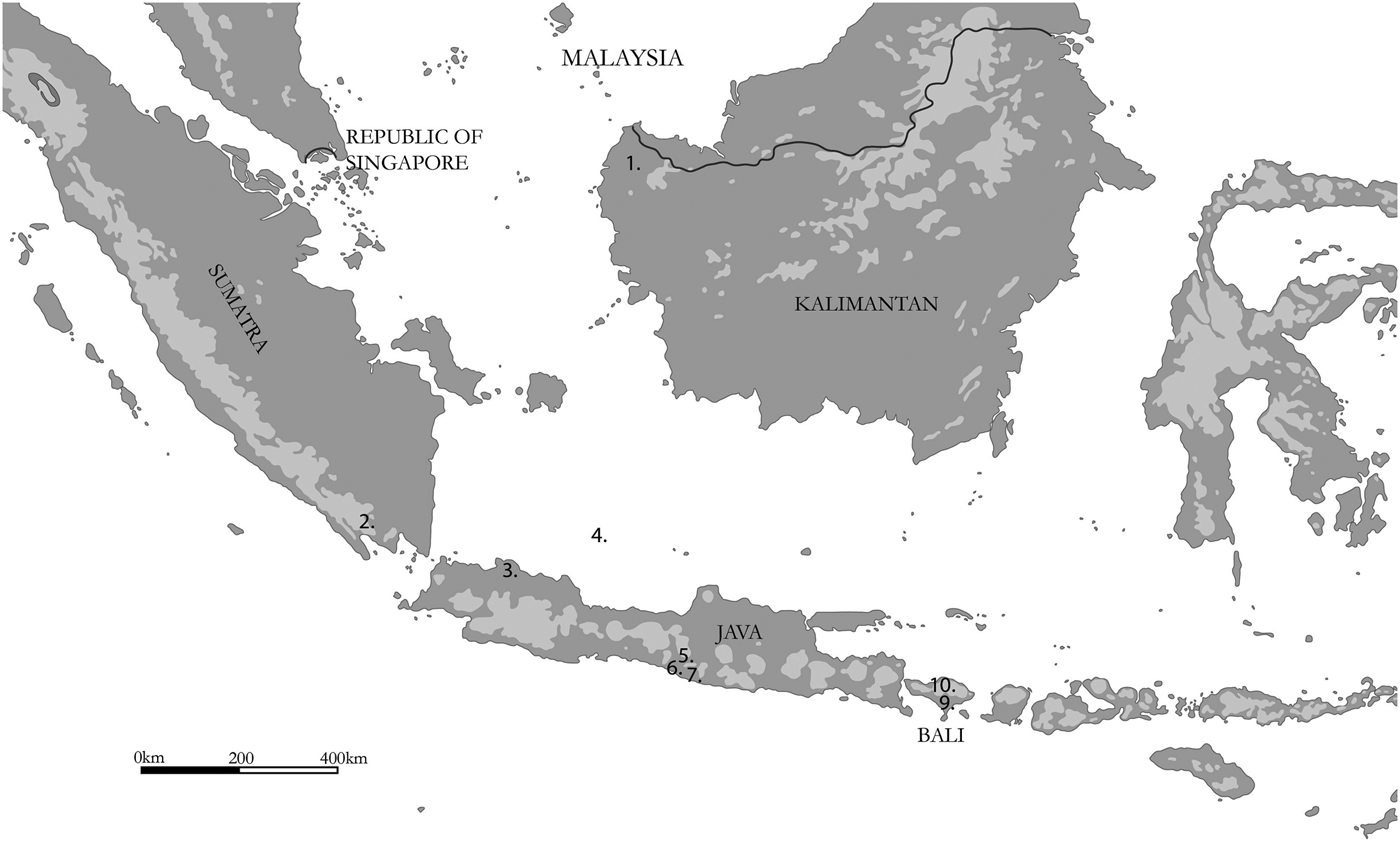
This material comprises inscriptions recovered from Sambas in west Borneo, from a shipwreck on the bottom of the Java sea off the northern coast of Java, from the southern tip of Sumatra, from central Java, and from Bali, thus covering a substantial part of the textual and geographical depth and breadth of ancient Buddhism in the Indonesian archipelago (see map, Figure 1). While most of the material is published here for the first time, some has been published previously but without identification of source texts. Indeed, use of modern computerized text corpora in many cases allows pinpointing of the textual sources of such inscriptions. The proper identification of the source text (or at least of close parallels) is, in turn, often of considerable help in determining accurate readings of these documents, some of which have come to us in very poor physical condition.
Map by Véronique Degroot. The numbers refer to the sections of this article.

The material presented here is the result of rather unsystematic data gathering on this type of inscriptions during the years 2008 to 2012. It does not pretend to offer anything like exhaustive coverage of all of the Indonesian inscriptions whose texts might be classified as Buddhist mantras or dhāraṇīs. I have omitted cases for which there is no specific reason to assume that they are Buddhist,Footnote 13 cases for which I lack any reliable reading or reproductions allowing me to verify existing readings,Footnote 14 and cases which have already been prepared for publication elsewhere.Footnote 15
1. Silver foil inscription from Sambas, West Kalimantan
In the annual report of the Archaeological Service in the Dutch East Indies (Oudheidkundig Verslag, OV) for the year 1948, in §6 dealing with “Discoveries”, we find an entry on Sambas (West Borneo, now West Kalimantan province), which reads (p. 13):Footnote 16
In 1939 an earthenware jar was found, standing on a bronze leaf and covered by a bronze discus, in the ground on the bank of the eponymous river.Footnote 17 The jar was damaged during excavation and contained 18 small statues, among which 8 in gold, the remaining ones in silver and bronze, of Buddhas and Bodhisattvas, and a censer in bronze, in the form of a house. Right after the report of the discovery these objects disappeared, but they resurfaced after the war, now in the possession of Mr. Tan Yeok Song, President of the South Seas Society at Singapore, who had bought them and secured them in the Oversea Chinese Bank. At this time only 7 golden and 2 silver statues, besides the censer, remain. Mr. Tan offered a provisional publication, accompanied by photos, of this collection (Preliminary Report on the Discovery of the Hoard of Hindu Religious Objects, near Sambas, West Borneo, Singapore 1948).Footnote 18
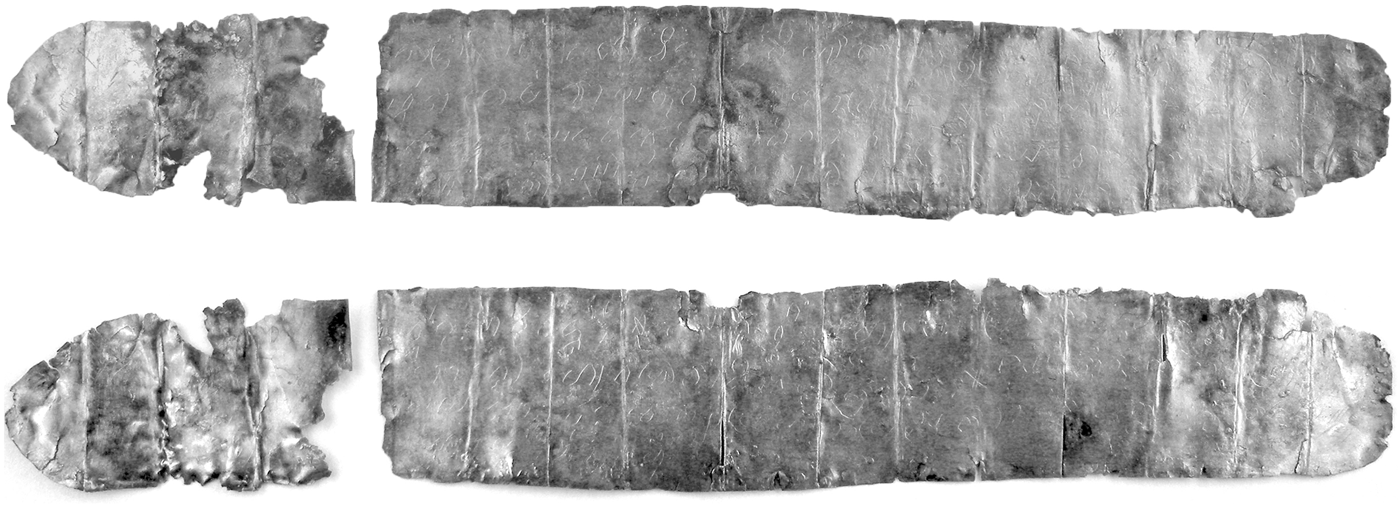
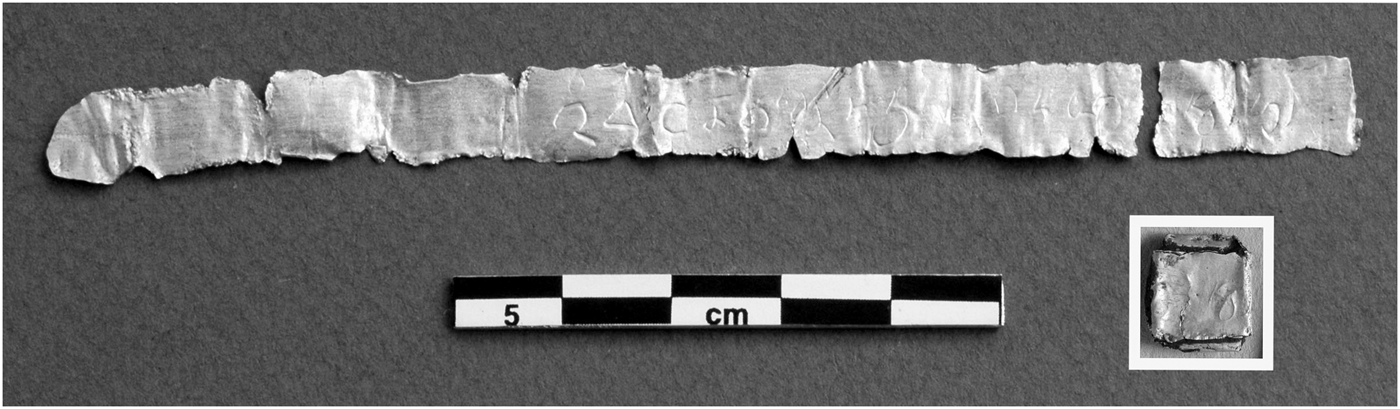
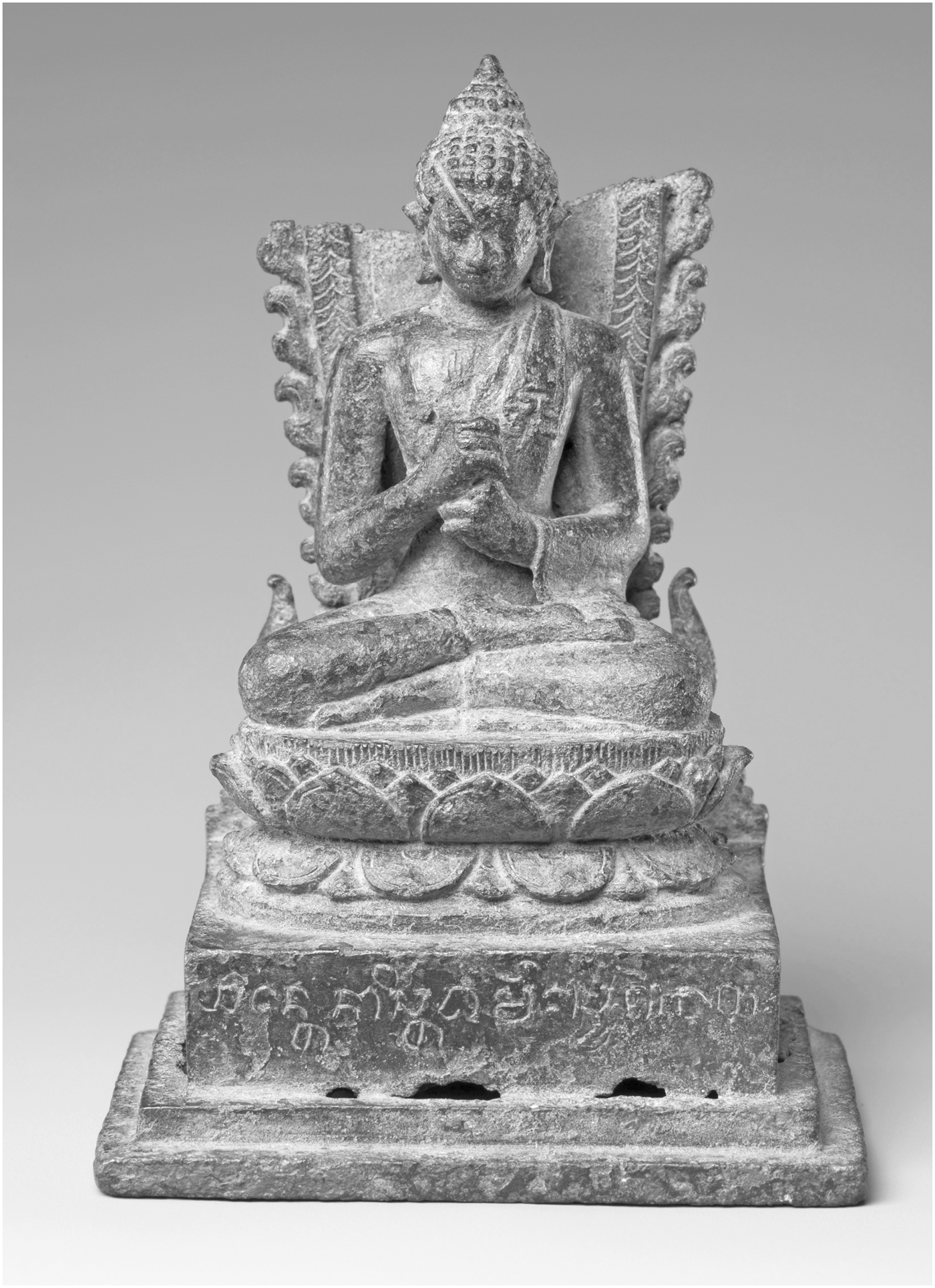
Subsequently, the September 1949 issue of the Journal of the Malayan Branch of the Royal Asiatic Society (vol. 22, pt. 4) was dedicated entirely to the Sambas finds, with papers contributed by Roland Bradell, Nilakanta Sastri, H.G. Quaritch Wales, Tom Harrisson and Tan Yeok Seong. No mention was made in this publication of any inscription as part of these finds. The collection was acquired by the British Museum in 1956, and the technical staff of the Museum then discovered that a rolled-up silver foil had been hidden in the base of the largest sculpture of the Sambas hoard (object 1, plates 1 and 2 in JMBRAS 22/4, 1949). At some moment after being unrolled, this foil broke into two fragments, currently kept at the British Museum under registration number 1956,0725.8.b.Footnote 19 Putting the two fragments close together, we can determine that the original would have been about 16 cm in length and 2.35 cm in height.
As far as I know, the inscription on this silver foil, covering both sides, has only rarely been mentioned in the scholarly literature and remains unpublished.Footnote 20 I will first present my reading of this document, then I will analyse its contents and discuss the importance of this artefact for the history of Buddhism and Buddhist art in Indonesia.
Text
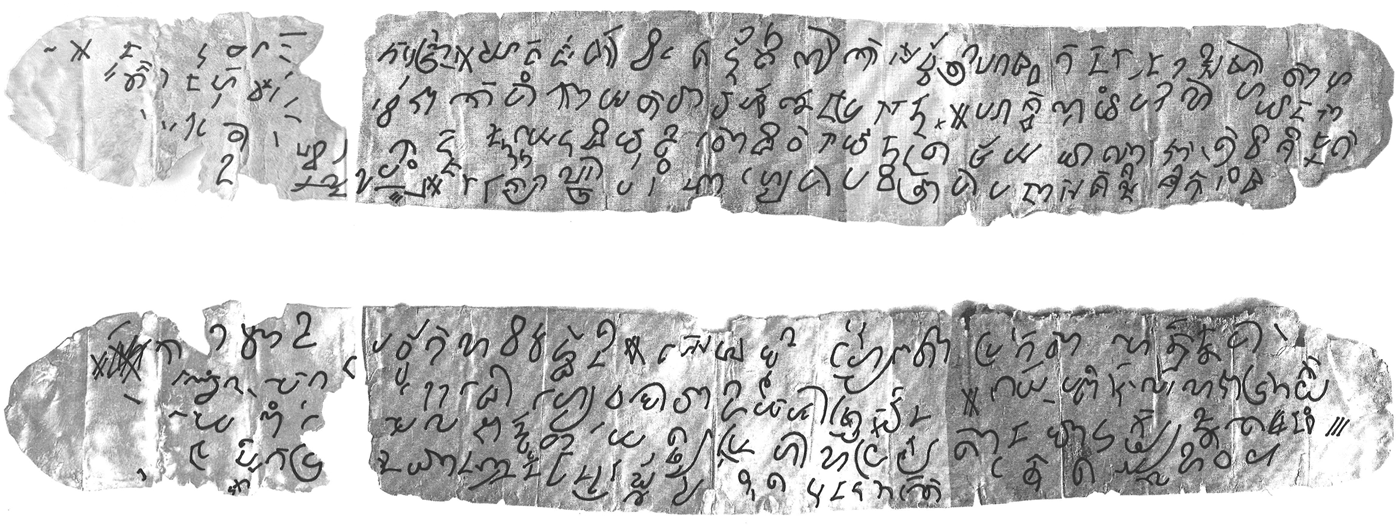
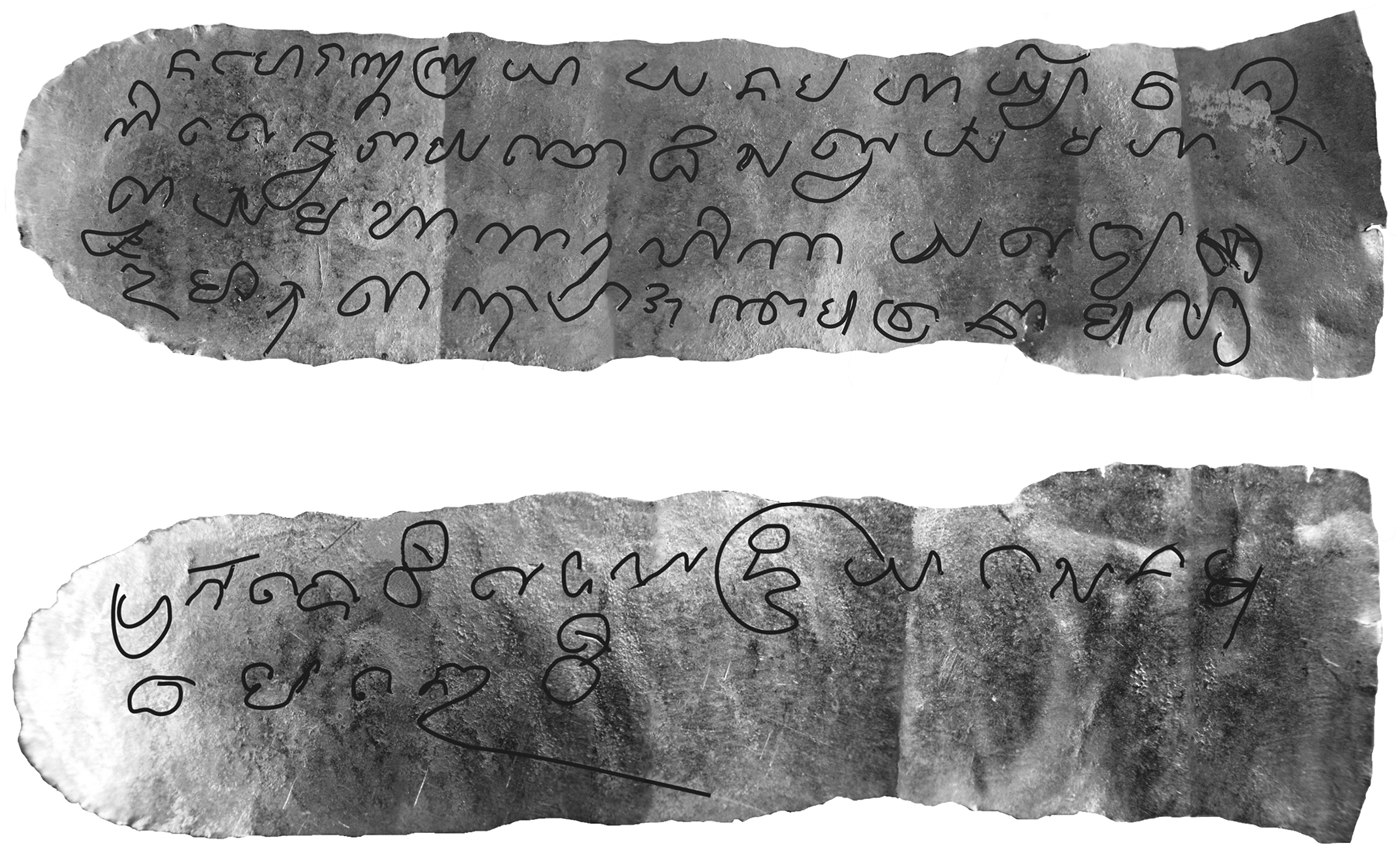
The foil is extremely hard to capture in its entirety photographically. After repeated provisional attempts based on different photographs offered by Michael Willis, and a tracing of the letters as observed by his research assistant Beatriz Cifuentes (without knowledge of the script), I was able to determine the reading from the original at the British Museum on 20 June 2012, using a microscope. As we will see on some other specimens of mantra/dhāraṇī inscriptions included in this article, the writing is sloppy, so that it often takes some goodwill to read a given akṣara in a way that makes sense. I subjoin photos of the original both with and without the mentioned tracing (Figures 2 and 3). While it does not seem necessary to point out all scribal errors, my notes anticipate some of the textual identifications made after the decipherment is presented.Footnote 21
The Sambas foil, obverse and reverse.
The Sambas foil, obverse and reverse, with tracing of the akṣaras by Beatriz Cifuentes.
Obverse:
(1) // na[ma] (°ār)yyā(na)[x n]tabhādrāFootnote 22 // yāvada kāci daśaddiśi loke sarvvatriyādhvaganara narasi(h)hāFootnote 23 tāhu(2)tān ahnaFootnote 24 vanda[mi] (sa)rvva °aśeṣāṁ (k)āyatu vācamanena prasannaḥ // yāś ca °imaṁ pariṇāmanarā(3)narāda(m·) x tvaFootnote 25 (sa)k j janayed adhimukti (vo)dhivaram anuprārthayamāno °agru viśiṣṭa bha(4)[ve]d i[mu] p[u]ṇya(m·) //Footnote 26 rakṣoghnā paramā hy eṣā pavitrā pāpanāsaśanī śrīka(r)ī dhī-
Reverse:
(1)Footnote 27karī cāṭiFootnote 28 sarvvaguṇavivarddhanī // ye dharmmā hyetoprabhavā hetun teṣā(2)ñ ca yo [n]irodho hy evam·vādī mahāśramanaḥ // ye māṁ (rū)peṇa °adrākṣu (3) ye māṁ [gho](ṣe)ṇa °anvayuḥ mathyyāprahāṇaprastā na mā drakṣyanti te janāḥ ||| (4) dra yaṁ bhadra[pra]nidhānaFootnote 29 °ini candravarmma x (na)ta (p)una °ā(va)tu CCi x (na)ta(rañca) hi xFootnote 30
Analysis
The text constituting lines 1–3 of the obverse can be identified with the following two disconnected verses in the Bhadracarī or Bhadracaripraṇidhāna, the famous Bodhisattva vow that once circulated independently but came to be transmitted as the last part of the Gaṇḍavyūhasūtra. I cite the text from the edition of Watanabe (Reference Watanabe1912):
yāvata keci daśaddiśi loke sarvatriyadhvagatā narasiṁhāḥ |
tān ahu vandami sarvi aśeṣān kāyatu vācamanena prasannaḥ || 1 ||
yaś ca imaṁ pariṇāmanarājaṁ śrutva sakj janayed adhimuktim |
bodhivarām anuprārthayamāno agru viśiṣṭa bhaved imu puṇyam || 48 ||
From the recent integral translation by Osto (Reference Osto2010):
Filled with faith, I honor with my body, speech and mind all the Lions among Men without exception who abide in all three times, in the world with its ten directions.
And whoever has heard this King of Spiritual Maturation, seeking after the blessing of enlightenment, may [that one] at once make the resolution [for enlightenment]. May the merit [from this] be the foremost and most excellent.
After these two verses follows a verse that is known to me elsewhere only in the Mahāpratisarāmahāvidyārājñī, albeit with the difference that all the nominal forms are neuter in that version (Hidas Reference Inui2012: 188 and 248):
rakṣoghnaṁ paramaṁ hy etat pavitraṁ pāpanāśanam |
śrīkaraṁ dhīkaraṁ caiva sarvaguṇavivardhanam ||
This is the foremost demon-slayer, the pure one, the destroyer of misdeeds. It brings about prosperity and wisdom, and increases all sorts of virtues.
The feminine forms we see may be explained as implying a word such as caryā or dhāraṇī, neither of which is actually found in the preserved portion of the text.
Next we read a truncated version of the ye dharmāḥ formula. The sequence of scriptural extracts is then terminated by a verse that I have identified in the Vajracchedikā Prajñāpāramitā, §26. In the widely used edition by Conze (Reference Conze1957), the verse runs as follows:Footnote 31
ye māṁ rūpeṇa cādrākṣur ye māṁ ghoṣeṇa cānvayuḥ |
mithyāprahāṇaprastā na māṁ drakṣyanti te janāḥ ||
The same verse is also quoted, without attribution to this specific text, in Candrakīrti's Prasannapadā on Mūlamādhyamikakārikā 22.16 (de la Vallée Poussin, Reference De la Vallée Poussin1903–13: 448), with the reading ghoṣeṇa anvayuḥ that we also see in our inscription and is confirmed by the Gilgit manuscript edited by Schopen (Reference Soekmono1989b: 105, folio 10b6). I quote Harrison's translation (Reference Harrison and Braarvig2006: 156):Footnote 32
Whoever saw me through my physical form, Whoever followed me through the sound of my voice, Engaged in the wrong endeavours, Those people will not see me.
Unfortunately it is impossible to decipher all of the last line of the inscription, which comprises a prose portion apparently composed in Old Malay. In the sequence yaṁ bhadrapranidhāna ini candravarmma we may recognize the Malay words yang and ini, which could yield the meaning “this vow to do good of Candravarman”, but one cannot exclude the possibility that yaṁ is intended as a Sanskrit word, and so even these readable parts of the line cannot, alas, be translated with certainty. But what seems evident is that this compilation of scriptural verses constitutes the vow (praṇidhāna) of a figure named Candravarman.Footnote 33
There is no obvious connection between the verses. If the verse that I have identified in the Mahāpratisarāmahāvidyārājñī is indeed taken from there and not from another, unknown, source, then we have here a further piece of (indirect) evidence concerning the cult of Mahāpratisarā in maritime South-East Asia.Footnote 34 More importantly, in the light of Schopen's much-cited publication (Reference Schopen1989a [Reference Schopen2005]: 300) emphasizing the great historical importance of an Indian inscription from Nalanda that cites verse 46 of the Bhadracarī, not only because “it contains the only verse of the Bhadracaripraṇidhāna known to occur in an Indian epigraph”, but more specifically because “this verse is the only passage from a Mahāyāna text so far known to occur in an Indian inscription” (emphasis Schopen), with the exception of “several specifically identifiable dhāraṇīs […] found at a number of sites”, the fact that we now find two other verses from it cited in this Indonesian inscription, alongside other verses from Mahāyāna scriptures, is certainly remarkable.Footnote 35 However, Schopen himself also adduced evidence suggesting that “The Bhadracarī itself apparently came to be classified as a ‘dhāraṇī text’ at some stage”, and that “if the Bhadracarī was so classified already in the tenth century, then the verse that occurs in our inscription may have to be considered only another instance of a ‘dhāraṇī’ in an Indian inscription” (Reference Schopen1989a [Reference Schopen2005]: 304 n. 12). The Sambas inscription seems to throw important new light on these problems.
Like the Nalanda inscription, ours lacks circumposed oṁ … svāhā. This seems to be in conformity with the fact that the text appears to characterize itself as a praṇidhāna, which is in principle not a category of scripture (buddhavacana “Buddha word”), and that it comprises two verses from the famous Bhadracaripraṇidhāna, which is a text uttered by the Bodhisattva Samantabhadra. The compilation also comprises the ye dharmāḥ formula, which is not buddhavacana either, for this stanza was uttered by the disciple Aśvajit (see Boucher Reference Boucher1991: 5–6), although it is hard to imagine a stanza that would be more quintessentially scriptural. The text is concluded by a stanza that was explicitly uttered by the Buddha in the first person. The use to which this inscription was put, being inserted into a Buddha image, strongly suggests that this compilation served the same function as the proper dhāraṇīs presented in this study, the juxtaposition of its elements being occasioned by their shared sacredness, which makes them suitable as “dharma relics”.Footnote 36
Now we would like to know how to date the inscription. First, the sculpture into whose base it was inserted is stylistically dateable to about the eighth century, and belongs to an iconographic type not entirely foreign to Java, but apparently better represented in Sumatra and the Malay peninsula.Footnote 37 But since the silver foil must have been inserted into the base at some point after the time of manufacture,Footnote 38 the probable eighth-century dating and provenance outside of Java are not necessarily applicable to the inscription itself.
From a palaeographic point of view, I would prima facie estimate the inscription to date from the ninth century. It is written in Kawi script, and the only dated inscriptions in this form of writing from the eighth century – all from the island of Java – are the Plumpungan (Central Java, 750 ce), Dinaya (East Java, 760 ce) and Mañjuśrīgha inscriptions (Central Java, 792 ce), while the ninth century is much more densely populated by dated inscriptions on that island. Moreover, the remarkable tilted shape of the akṣara ma seen in the Sambas foil appears to be a characteristic of some Javanese inscriptions of the mid-ninth century;Footnote 39 for instance the stone inscription of Wayuku dated 776 śaka = 856 ce depicted in pl. 3 of Brandes Reference Brandes1913,Footnote 40 whose script seems identical to that on the Sambas inscription. The same feature is observed in the lead-bronze plate with a dhāraṇī inscription from Borobudur, mentioned above, which was dated by Boechari to the mid-ninth century on palaeographic grounds, and it is observed again on the Nan Han-Cirebon gold foil presented below in section 4; by contrast, this feature seems to be absent from the Dinaya inscription. On the other hand, our inscription does seem to show a more archaic shape of the virāma (see rev., l. 2 evam·vādī), which is written above the consonant that it affects, than the partially turned variant that we see once in the Wayuku inscription.Footnote 41
All in all, it must be observed that there is very little difference between the Kawi script observed on the Wayuku inscription and that from Dinaya, which is nearly a hundred years older, and that the existence of three dated inscriptions from the second half of the eighth century makes it almost certain that the script was in use decades earlier. Louis-Charles Damais has attributed a substantial number of undated inscriptions using Kawi script, engraved on metalwork, to the second half of the eighth century, admitting that “pour ce groupe de documents de « 700–750 » Śaka, les marges d'erreur peuvent être assez grandes”, implying the possibility of a dating bracket 650–700 Śaka, which would place them in the second and third quarters of the eighth century ce.Footnote 42 So we cannot rule out that our Sambas foil, despite the features it seems to share with the Wayuku inscription, belongs to the eighth, and perhaps even to the first half of the eighth, century. Is there any reason to favour a dating to the first half of the eighth century and to go against the prima facie palaeographic estimate?
The answer may be affirmative, if we choose to identify the Candravarman of our inscription with king Zhandabo 旃達鉢, known from a single Chinese source, the Xin Tang shu, which reports his embassy to the Tang court in 669 ce,Footnote 43 and situates this king, whose name can plausibly be interpreted as a phonetic representation of Candrava(rma), in a country called Boluo 波羅. There has been a long debate about the identification of this country, some authors proposing Borneo, while Wolters (Reference Wolters1967: 186) situates it in northern or north-eastern Sumatra.Footnote 44 Admittedly one might argue that the connection with Borneo is immaterial, since Candravarman may have originated from elsewhere in the archipelago, and the Sambas hoard as a whole may have been buried in West Borneo after the metalwork had been brought there from across the sea. On the other hand, there is considerable evidence for relatively old Buddhist presence on the western and north-western coasts of Borneo, so a local Candravarman in the early eighth century ce would not be unexpected.Footnote 45
Whatever the date and original provenance of these artefacts, the Sambas silver foil is precious not only from a textual point of view, but also as an archaeological artefact. This is probably the only case of an Indonesian inscription engraved on metal foil such as this being found inside a sculpture, photographed in that state, then extracted and unrolled, finally leading to the decipherment of the text. As repeatedly stressed by Yael Bentor (Reference Bentor1995), there is ample evidence from various Buddhist texts showing that the insertion of dharma-relics into images was a widespread practice, besides the practice of inserting them into stūpas. The examples of such a practice preserved in India are apparently not numerous.Footnote 46 The practice was widespread in Indonesia (and other parts of South-East Asia), but no case is as richly documented as this one.Footnote 47
2. Stone inscription of Batu Bedil in Lampung
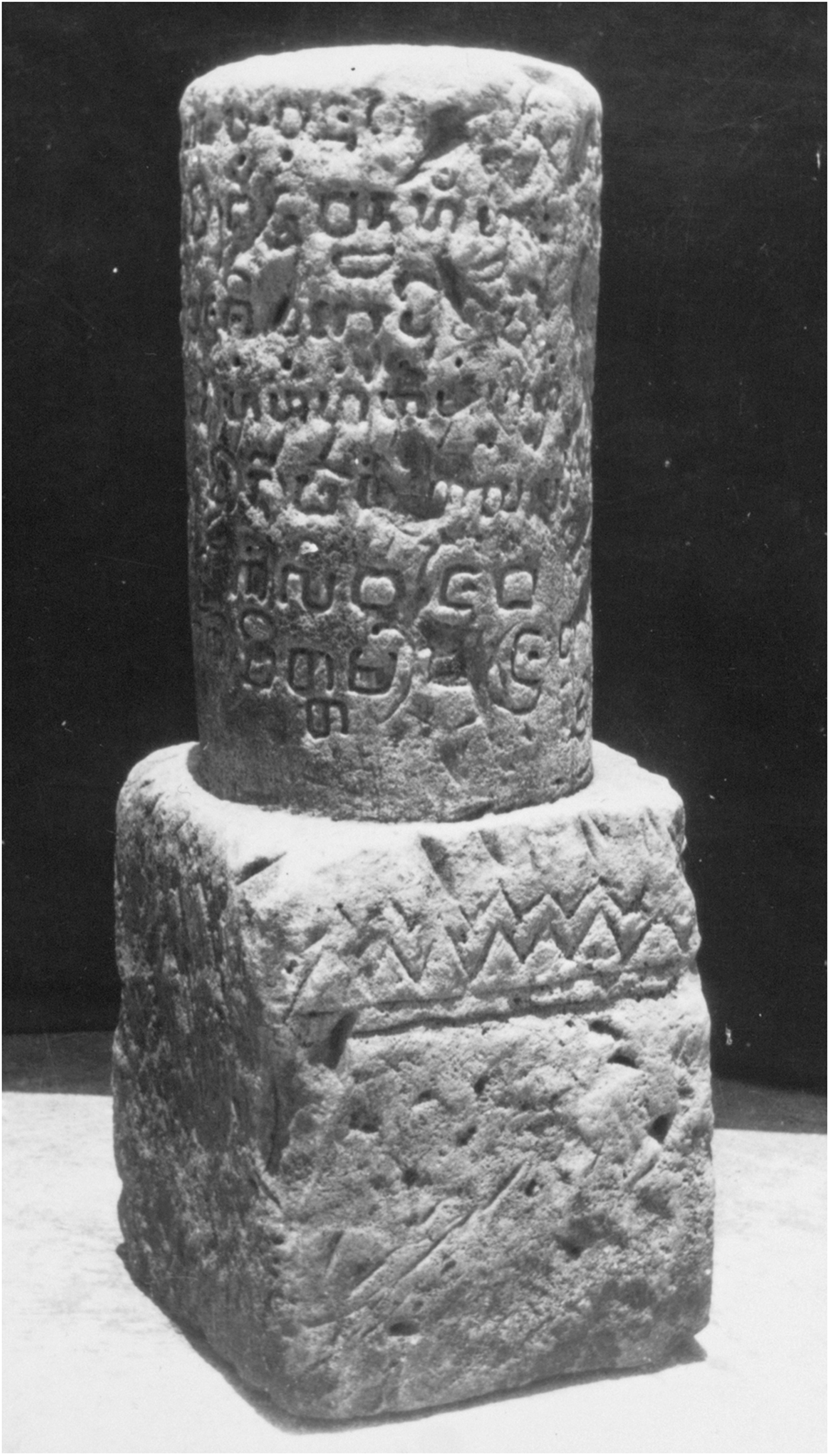
Let us move now to that great bastion of Buddhism in Indonesia, the island of Sumatra. In the far south of this island, in the province of Lampung, there is a complex of megalithic sites now known as Batu Bedil (Rifle Stone), after the most eye-catching megalith. It seems to have been the German ethnographer Friedrich W. Funke who first discovered this complex in 1953, and found there a large inscribed stone (Batu Surat) at about 40 m from a field marked by twenty-seven menhirs arranged in a square (originally probably 8 × 8 stones, arranged regularly over 40 × 40 m).Footnote 48 In Reference Funke1958, he published an extensive report of his findings (see especially pp. 20–22), including a ground plan of the field of menhirs in relation to the Batu Surat (pl. I), with a good photo of the inscription (fig. 8 on plate III). He assumed that the position of the inscribed stone in relation to the field of menhirs indicated a significant correlation; he also speculated (p. 21 n. 3) that the text of the inscription would be in Old Sundanese. Both of these speculations were rightly rejected by van der Hoop in a very critical review of Funke's book (v.d. Straaten and v.d. Hoop Reference Straaten1960: 285).
The site was visited again, in 1954, by a team of Indonesian and foreign archaeologists during a voyage of exploration that has become famous thanks to the full reports published by the leader of the team, Soekmono, on two occasions (1955 and Reference Soekmono1962), both with the inscription illustrated in the form of the OD photo 19576.Footnote 49 In the 1955 report (pp. 49–50), we find much more reliable information on the inscription:
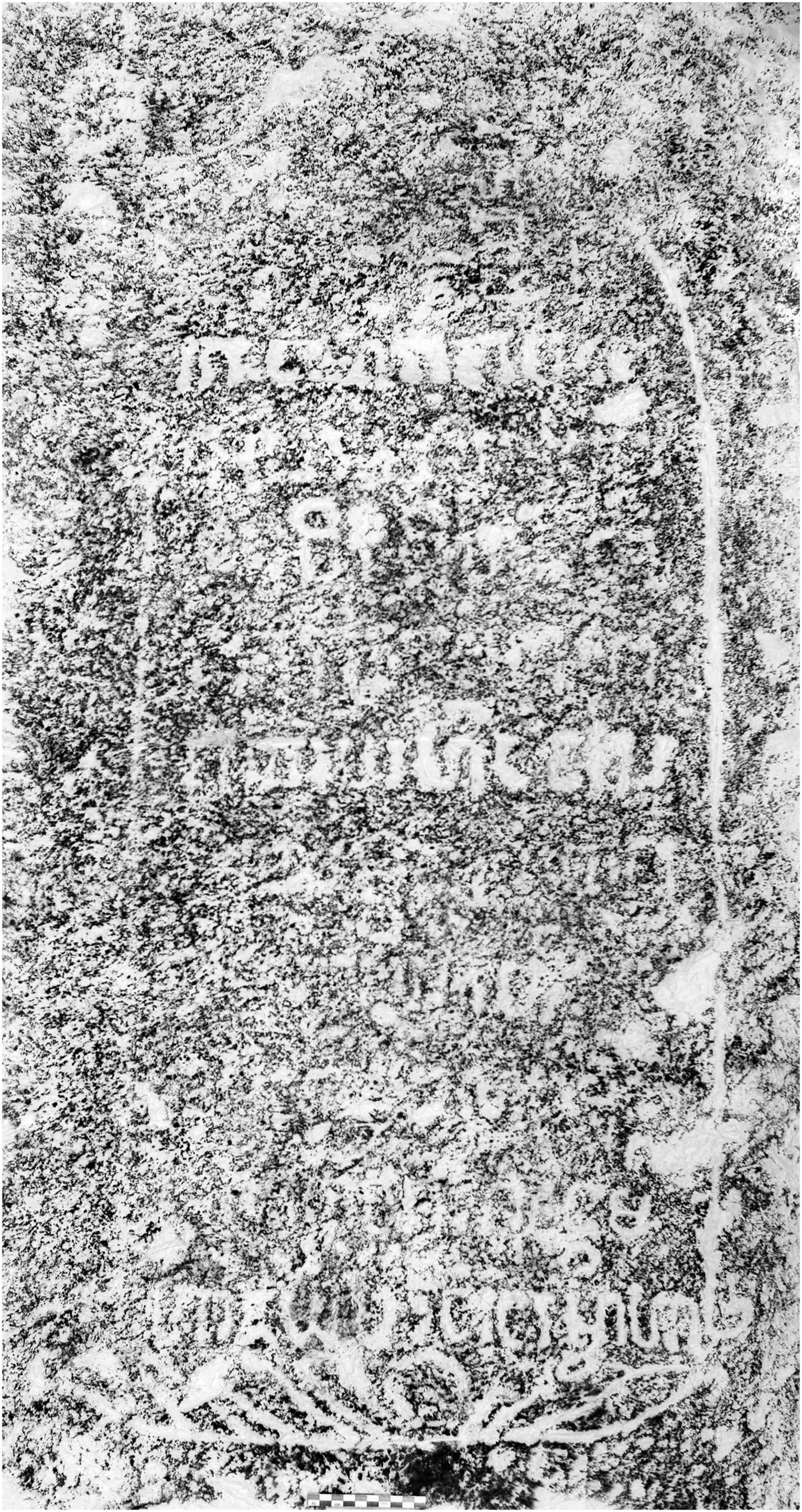
The measurements of this stone are 1.85 × 0.72 × 0.55 m. Its characters are ±5 cm in height, and there are 10 lines. Below this inscribed portion there is an attractive lotus flower, resembling the thrones of statues of deities. Although its characters are big, the middle portion of the stone is very worn, so that its decipherment is very difficult. From what it was possible to read on the spot, it is clear that the language that is used for the inscription is Sanskrit (in line 1 we read namo bhagawate and in line 10 swāhā). There is no year, but the shape of the characters points to the end of the 9th or the beginning of the 10th century. Namo bhagawate as beginning and swāhā as end give reason to suspect that this text is some kind of mantra. Only it is difficult to determine whether the religion is Buddhist or Śaiva, most probably Buddhist. If this is the case, then there is hope that it will be possible to read the complete stone, for there are many Buddhist mantras (called dhāraṇīs) whose expressions are similar.Footnote 50
More or less the same facts were mentioned by Damais (Reference Damais1962: 283–4, n. 5), who had himself participated in the voyage. He announced that a publication by J.G. de Casparis was forthcoming, but this has never materialized.Footnote 51 I visited the site myself in September 2011, and was able to make the estampage of which a photograph is included here (Figure 4). Although I still find three of the ten lines totally unreadable, I can publish a greater part of the inscription here because I am able to confirm the suspicion voiced by Soekmono that it is a known dhāraṇī, and have identified its source: the Aparimitāyuḥsūtra. With this source text in hand, I am able to read a number of akṣaras (here printed in italic) that it would otherwise probably have been impossible to decipher.
EFEO estampage n. 2043 of the Batu Bedil inscription.
(1) || namo bhagavate
(2)°aparimitāyurjñā-
(3)nasuviniścitate-
(4)jorājāya tathā-
(5) gatāyārhate sa-
(6)...
(7) ...
(8) ...
(9)svabhāvapariśuddhe ma-
(10) hānayaparivāre svāhā
These elements are sufficient to exclude the possibility that we are dealing with any other known dhāraṇī. We may initially compare the reading with the text of the dhāraṇī in the Aparimitāyuḥsūtra, edited on the basis of Nepalese manuscripts by Konow Reference Konow and Rudolf Hoernle1916: 301:
o namo bhagavate aparimitāyurjñānasuviniścitatejorājāya tathāgatāyārhate samyaksambuddhāya | tadyathā, o puṇyamahāpuṇya aparimitāpuṇya aparimitāyupuṇya jñānasambhāropacite | o sarvasaṁskārapariśuddhadharmate gagaṇasamudgate svabhāvapariśuddhe mahānayaparivāre svāhā ||
But comparison with the version of the dhāraṇī in the Khotanese manuscript (dating to about the middle of the tenth century ce)Footnote 52 that was edited in parallel by Konow, on the facing page of his edition, immediately shows that the Nepalese manuscripts, which are approximately 700 years more recent, give an expanded text:Footnote 53
namau bhagavate aparamittāyujñānasuviniścitatejaurājāya tathāgataya rhite samyatsabuddhāya tadyathā aum sarvasaṁskārapariśuddhadharmate gaganasamudgatte śvabhāvaviśuddhe mahānayaparivare svāhā
That this shorter text is older, and that the Nepalese manuscripts transmit an expanded version, is suggested by the fact that all three versions included in the Taishō edition of the Chinese canon show variants of the same short version.Footnote 54 Although our inscription is totally worn in the middle of the dhāraṇī, we may deduce from the fact that the preserved lines show an average of seven akṣaras per line that there would certainly not have been enough space for the sequence tadyathā o  puṇyamahāpuṇya aparimitāpuṇya aparimitāyupuṇya jñānasambhāropacite.Footnote 55 In other words, our inscription was engraved with a variant of the original shorter version of the dhāraṇī, and it must be noted that compared to the Khotanese and Chinese versions, ours may have been even shorter, for the number of syllables on lines 6–8 will have been about 21, whereas the number of syllables required to obtain the text of those other versions is 28. In this connection, it is a striking fact that the Sūtra itself repeatedly states that the dhāraṇī consists of 108 syllables, which it only does in the longer Nepalese recension. In the present context, I am unable to throw any light on this numerical problem.
In his recent article dedicated to the text, Richard K. Payne has drawn attention to the fact that the Aparimitāyuḥsūtra and dependent texts seem to have been among “the most popular bodies of literature in Nepal, in Dunhuang, and elsewhere throughout the Buddhist cosmopolis” (Reference Payne2007: 277).Footnote 56 The entire scripture consists of little more than the advice that one should copy, or have others copy, the sūtra, or the dhāraṇī, and promises diverse benefits for those who do, using i.a. the phrase (Konow Reference Konow and Rudolf Hoernle1916: 315–7):
yasmin pthivīpradeśa idam aparimitāyuḥsūtraṁ likhiṣyanti likhāpayiṣyanti, sa pthivīpradeśaḥ caityabhūto vandanīyaś ca bhaviṣyati |Footnote 57
Translation adapted from Silk (Reference Silk and Lopez2004: 427):
On whatever spot of earth they will write down or will have others write down this Aparimitāyuḥ-sūtra, that spot of earth will become a true shrine and worthy of veneration.
It seems reasonable to assume that the ancient local Buddhists who were involved in the manufacture of our inscription did so with precisely the motivation of founding a “true shrine”. More specifically, Soekmono's observation (cited above) that the text is provided with a lotus cushion, just like a Buddha image would be, is an unmistakeable expression of the intent behind engraving this text, namely that its presence as dharmakāya would be equivalent to the presence of the Buddha, and would sacralize the site.Footnote 58
It should be noted that there is considerable overlap in the terminology used by the Aparimitāyuḥsūtra to describe, on the one hand, the ways in which the text (or its dhāraṇī) can be used as well as the benefits that will result from such use and, on the other, the way we see use and benefits described in other scriptures that will be discussed further on in this article, notably the Amoghapāśah  daya (section 10).Footnote 59
Finally, regarding the date of our inscription (which Soekmono situated around 900 ce, see above), it should be noted that Damais (Reference Damais1967: 687 n. 1) was inclined to date it about a century older, without specifying the more archaic traits underlying this estimate. The text is in Kawi script that, frankly, seems less archaic to me than the script of the Sambas inscription (section 1).Footnote 60
3. Gold foil from sector Segaran IIA at Batujaya, West Java
During excavations in 2005 at the Buddhist complex of Batujaya, home to the oldest Buddhist monuments identified in Indonesia so far, the team led by Pierre-Yves Manguin discovered in the sector called Segaran IIA a piece of gold foil, folded up into a small squarish lump. When it was unfolded, it turned out to bear an inscription.Footnote 61 The existence of this inscription, besides that of other gold foils bearing the ajñānāc cīyate formula found at the same site, was mentioned by Hasan Djafar (2010: 93).Footnote 62 But the inscription so far remains unpublished. Thanks to excellent visual materials furnished by Manguin (Figure 5), I am now able to propose the following reading:
°oṁ °eṭana tan no bhadra(ṁ) pracoda(yā) svāhā
The reading is rather tentative, for the word eṭana makes no sense,Footnote 63 while the reading yā is also far from secure. I translate:
Om. Eṭana (?), may you impel to us that which is good! Svāhā.
Despite the problem posed by eṭana, it is clear enough that the dhāraṇī is an adaptation of some of the numerous variants of the final line of the Gāyatrī mantra, reading tan no nom pracodayāt, found in brahmanical literature (see Bloomfield Reference Bloomfield1906: 50–51). The word taking the place of nom is in each instance the nominative singular case form of the name of a deity. I am unable to trace this formula in any Buddhist source, but the idea that it is Buddhist finds support in the monumental context where the foil was discovered.
The foil found at Batujaya, Segaran IIA. Photo EFEO/P.-Y. Manguin.
The palaeographic appearance of the inscription is inconsistent, and comprises both some archaic features of Southern Brāhmī (i.e. “Pallava”) and some more Kawi-like characteristics. The stratigraphic context in which the artefact was found is somewhat difficult to interpret, the only thing that is certain being that it must date from before 800 ce. There is a greater archaeological likelihood that it belongs to a level dateable to 330–550 than to the subsequent level of 550–700/750.Footnote 64 From the epigraphist's point of view, however, this early dating bracket seems hard to accept. The other gold foil inscriptions from the same site give a more archaic impression that would more easily be compatible with such an early dating, although I would still be reluctant even in their case to consider a date before the sixth century.
4. Gold foil from the Nan Han period “Cirebon” shipwreck, coast of West Java
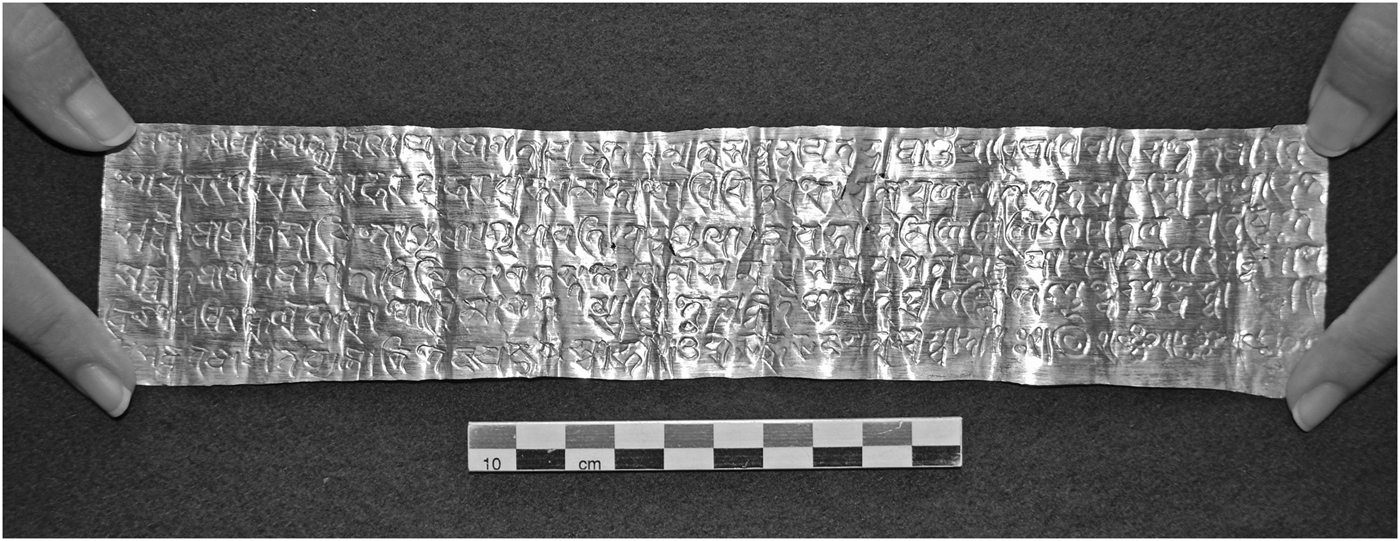
A sunken ship was discovered off the coast of West Java near the city of Cirebon in 2003. After the cargo had been salvaged, it could be determined that the shipwreck must date from about the last quarter of the tenth century, or later. Alongside large quantities of ceramics and a substantial number of bronze cult objects, the divers also recovered a piece of gold foil which is inscribed with a dhāraṇī of a total of six lines. It is very difficult to produce legible photographs of this small, irregularly shaped artefact (Figure 6), but Horst Liebner, who is writing his doctoral thesis about this shipwreck and has had extensive access to the cargo, has taken considerable effort to document the inscription. He helped me execute the tracing of the akṣaras that is shown here in Figure 6.Footnote 65
The foil recovered from the “Cirebon” shipwreck, obverse and reverse. Photo Horst Liebner, with tracing of the akṣaras by the author.
Obverse:
(1) namo ratnatrayāya nama °āryyāva(lo)-
(2) kiteśvarāya bodhisatvāya mahā(sa)-
(3) tvāya mahākā(r)uṇikāya tadya(thā)
(4) °o mārutākuha x kāmāvrā x (mālya)
Reverse:
(1) (prabhā)devī (°ada)lān driyase nam(u)
(2) (dha)man de(v)ī
Homage to the Triad of Jewels (Buddha, Dharma and Saṁgha)! Homage to noble Avalokiteśvara, the Bodhisattva, the great being, of great compassion. [The mantra is] like this: Om, … of the wind …, goddess who have the lustre of …, you bear …
Despite the fact that the writing is very faint, and that the photographs available do not show all parts of the texts with equal focus, it is possible to read more than half with certainty, due to the fact that the opening (up to the beginning of line 4 on the obverse) is highly formulaic, being found in a number of Buddhist scriptures. But I am unfortunately unable to identify the mantra part that begins with o , and am (therefore) unable to reconstruct the parts that are not formulaic. Since we find here the words māruta, meaning “wind” and (if my reading is correct) driyase, meaning “you are borne”, it may be suspected that the dhāraṇī was intended to protect against the dangers of voyage at high sea, and that the object on which it is inscribed was worn as an amulet, while the text was addressed to the goddess personifying the spell.
For the structure of this dhāraṇī, I refer to the Ekādaśamukha – a text of the same genre as the Aparimitāyuḥsūtra and the Amoghapāśah daya referred to in sections 2 and 10 of this article – of which a copy was found among the Gilgit manuscripts (seventh century). Here we find a sequence of six repetitively structured mantric sequences beginning with namo ratnatrayāya | namo vairocanāya tathāgatāya | nama āryāvalokiteśvarāya bodhisattvāya mahāsattvāya mahākāruṇikāya | nama atītānāgatapratyutpannebhyaḥ sarvatathāgatebhyo ’rhadbhyaḥ samyaksaṁbuddhebhyaḥ | oṁ diri diri dhuru dhuru | iṭṭe viṭṭe | cale cale | pracale pracale | kusume kusumavare | ili mili ciṭi svāhā | and ending with namo ratnatrayāya nama āryāvalokiteśvarāya bodhisattvāya mahāsattvāya mahākāruṇikāya | tadyathā piṭi piṭi tiṭi tiṭi | viṭi viṭi gaccha gaccha bhagavan āryāvalokiteśvara svabhavanam svabhavanaṁ svāhā | […] āryāvalokiteśvara gaccha svabhavanam ||.Footnote 66
The Sādhanamālā (eleventh century) furthermore contains three citations of a Siṁhanādadhāraṇī “Lion's Roar dhāraṇī”, that again shows the same structure (Bhattacharya Reference Bhattacharya1968: 48, 52, 54, 63): namo ratnatrayāya nama āryāvalokiteśvarāya bodhisattvāya mahāsattvāya mahākāruṇikāya tadyathā oṁ akaṭe vikaṭe nikaṭe kaṭaṁkaṭe karoṭavīrye svāhā.
On the basis of these comparisons, we expect the word svāhā somewhere in the part that I have not been able to decipher. In any case, it is clear that we have here a variation on dhāraṇī material of the type seen in the Ekādaśamukha and the Sādhanamālā. The palaeographic appearance of the script is consistent with a date in the ninth or tenth century.
5. Gold and silver foils from Candi Plaosan Lor, Central Java
In his Prasasti Indonesia II (1956: 170–2), J.G. de Casparis included as item no. V the edition of a “plate of gold leaf” which had been discovered during excavations at Candi Plaosan Lor in 1947. The discovery itself had been the subject of a brief discussion in OV 1948 (p. 30), where it was also mentioned that a little silver plate had been found near the plate of gold foil, bearing the same inscription. It seems to be this silver foil inscription that is captured on the photograph OD 17094. Unfortunately, the current whereabouts of neither of the two foil inscriptions appears to be known, and no archaeological photograph seems to have been taken of the gold foil inscription at the time of its discovery.Footnote 67 From their archaeological context, the inscriptions, written in Kawi script, may be assigned to the ninth century. The published reading is as follows:
(1) oṁ namo buddhāya namo dharmāya namaḥ saṁghāya tadyathā śuddhe viśuddhe śodhani viśodhani gaganaviśodhani cittaviśodhani pā(2)< pā >-varaṇaviśodhani karmāvaraṇaviśodhani viśuddhe viśuddhe kṣīṇe sarvakṣīṇe puṣpe supuṣpe rajoharaṇe sarvapāpa(3)viśodhani hare hare sarvāvaranāṇi daha daha sarvakarmāvaraṇāni paca paca sarvasthānagatāni padme padmākṣi padmaviśā(4)le pha pha pha pha pha svāhā
De Casparis indicated no substantial difficulty in reading the text of the gold foil, and there is no reason to doubt that his decipherment is correct. Indeed, several elements of this reading can also be recognized on the OD 17094 photo of a silver foil inscription. De Casparis correctly identified this text as a dhāraṇī, and he translated:
Oṁ! Homage to the Buddha, Homage to the Dharma, Homage to the Saṁgha. Thus (is the text): – Thou who art pure, perfectly pure, a purifier, a perfect purifier, a purifier of the atmosphere, a purifier of the mind, a purifier from the obstructions of Karman – thou, perfectly pure, perfectly pure, lean, perfectly lean, flowerlike, perfectly flowerlike, a remover of passion, a purifier from all evil – take away, take away all obstructions; burn, burn all obstructions of Karman; consume, consume (the impurities) gone into all the organs (?) – thou who art a Lotus, lotus-eyed, powerful in the lotus. Pha pha pha pha pha Svāhā.Footnote 68
This scholar was unable to identify a precise scriptural source for the dhāraṇī, but noted its affinity with the Sarvadurgatipariśodhanadhāraṇī. He knew the latter only from two manuscripts kept at the Bibliothèque nationale at Paris, and from the manner that he cites them it seems that he was not aware of the further contents of these manuscripts.Footnote 69 The scriptural source for this dhāraṇī is the eponymous Tantra, from which I cite (Skorupski Reference Skorupski1983: 127–8):
oṁ namo bhagavate sarvadurgatipariśodhanarājāya tathāgatāyārhate samyaksaṁbuddhāya | tadyathā | oṁ śodhane śodhane sarvapāpaviśodhani śuddhe viśuddhe sarvakarmāvaraṇaviśodhani svāhā |
This mantra was very widespread in Buddhist Asia, and existed in many variants. A version with only slightly different readings is one of two dhāraṇīs included in Taishō 1395 Baji kunan tuoluoni jing 拔濟苦難陀羅尼經 “Sūtra of the Dhāraṇī for Salvation from Tribulations” (21: 912c), a short dhāraṇī-sūtra about which Rolf Giebel (Reference Giebel1993) has published an article, where he cited all the versions he had managed to identify at the time (see p. 152 for the Taishō version). Now the Javanese dhāraṇī seems to comprise a combination, not known to me at this time from any other Buddhist tradition, of the Sarvadurgatipariśodhanadhāraṇī with another known dhāraṇī, pointed out to me by Rolf Giebel.Footnote 70 It appears in another short dhāraṇī-sūtra, translated by Faxian in 1001: Taishō 1399 Miechu wu nizui da tuoluoni jing 滅除五逆罪大陀羅尼經 “Sūtra of the Great Dhāraṇī for Extinguishing the Five Heinous Sins” (pañcānantaryāṇi)” (21: 915c–916a):
namo ratnatrayāya nama āryāvalokiteśvarāya bodhisattvāya mahāsattvāya mahākāruṇikāya tadyathā oṁ śuddhe viśuddhe suviśuddhe kṣīṇe parikṣīṇe puṣpe supuṣpe jaloharaṇe hara hara sarvāvaraṇāni paca paca sarvāpāyasthānāni padme padmākṣi padmaviśāle phale pha pha pha ha ha ha ha ha ajñāle ajñāle siddhajale svāhā.
As Giebel points out to me, in this Chinese version ajñāle is uncertain, and jaloharaṇe is probably an error for rajoharaṇe, as we read on the foils from Candi Plaosan. Although a precise scriptural source for the Javanese dhāraṇī may of course still be discovered, it seems adequate to say that it is built substantially on the same text as seen in Taishō 1399, with insertion of elements that are all known from the Sarvadurgatipariśodhanadhāraṇī, except the epithets gaganaviśodhani Footnote 71 and cittaviśodhani.Footnote 72 It has been reported that the same dhāraṇī has also been found engraved on silver and gold foils from Candi Sojiwan, which have not, to my knowledge, ever been published, but which were mentioned by Boechari (1976: 19 = 2012: 172, n. 21).
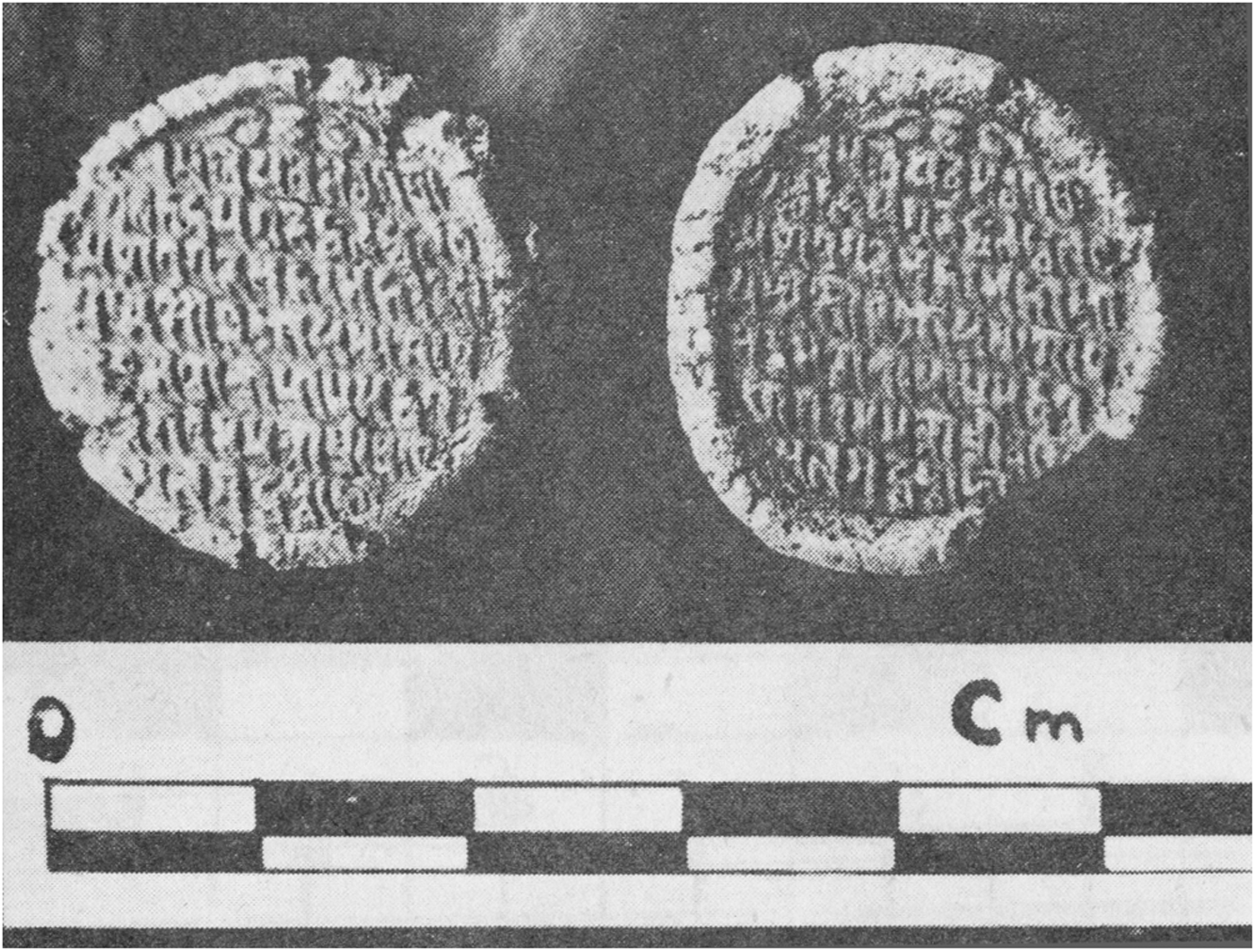
Subsequent restoration work at the site of Candi Plaosan Lor in 1993 has brought to light other gold, silver and bronze artefacts bearing Buddhist inscriptions of a similar type, but now in Siddhamātkā script closely resembling that of the Kalasan, Kelurak, Plaosan and Ratu Baka stone inscriptions, so datable to the period between the late eighth and mid-ninth centuries.Footnote 73 A provisional reading of two gold foils, without diacritics, was included in the report on these restorations (Gutomo and Niken Wirasanti Reference Hidas1998: 54 with photo no. 27 on p. 100) and later reproduced verbatim in Miksic et al. Reference Miksic, Nayati, Klokke and van Kooij2001: 323–4. Besides an evident ye dharmāḥ formula at the head of the second inscription cited by Miksic et al., it is hard to make any sense of these two inscriptions in this provisional reading. However, the Bureau of Conservation of Archaeological Remains (BPPP) for Central Java province obligingly assented in August 2012 to my request to put photographs of these artefacts at my disposal. Besides the two gold foils, the photos I received from the BPPP also included a third item, that appeared to be in silver, and of which I found no mention in the report by Gutomo and Niken Wirasanti, or the publication by Miksic et al. This third photograph showed an inscription in two long lines of Siddhamātkā script identical to that on the two gold foils, but the photograph was not sufficiently focused for me to be able to read the whole. I was subsequently allowed to come and inspect the three foils and photograph them myself.Footnote 74 On this basis, I am now able to publish the following readings and source identifications.
The taller gold foil was found in association with the reliquary in the SE corner below the floor level of the central chamber of the northern main temple at Candi Plaosan Lor.Footnote 75 It measures 5.2–5.8 × 25.5 cm, weighing 7.9 g (Figure 7).
(1) [siddham] namo bhagavate śākkyamuṇayeFootnote 76 tathāgatāyarhateFootnote 77 samyak·samvuddhāya tadyathā °o vodhi vodhi vodhi satvetathāgata(2)gocareFootnote 78 | dhara dhara hara hara prahara prahara mahāvodhicittadhare | culu culu śatasahasrarasmisañcoditeFootnote 79(3) sarvvatathāgatabhāṣite | guṇāguṇavatiFootnote 80 | vuddhaguṇā °avabhās(e)Footnote 81 mili mili gagamatalapratiṣṭiteFootnote 82(4) sarvvatathāgatathāgatādhiṣṭiteFootnote 83 | mabhastaleFootnote 84 | sama sama prasama prasamaFootnote 85 sarvvapāpaśamaṇeFootnote 86 | sarvvapāpe (5) viśodhaniFootnote 87 | hulu hulu | vodhimārgasamprasthite sarvvatathāgatapratiṣṭhite śuddhe śuddhe svāhā || (6) °o sarvvatathāgatavyalokiteFootnote 88 jaya jaya svāhā || °o huru huru jayamukhe svāhā || : || [fleurons]
This inscription gives the text of the Bodhigarbhālaṁkāralakṣadhāraṇī, a text which has drawn quite a bit of attention in Buddhist studies in the last three decades, and which was thus far not known to be attested in Indonesia. I refer for the most recent publication on this dhāraṇī to Strauch Reference Strauch, Mevissen and Banerji2009. Admitting the emendations proposed above, the version from Candi Plaosan Lor may be translated as follows:
Homage to the Lord Śākyamuni, the Tathāgata, the Arhant who is completely awakened. [The dhāraṇī is] like this: Om. Awaken awaken awaken, you (female deity of this dhāraṇī) who belong to the domain of all Tathāgatas! Hold hold! Take take! Steal steal, you who hold the thought of great awakening! Culu culu, you who are impelled by a hundred thousand rays, who have been uttered by all Tathāgatas!Footnote 89 O virtue, O you who possess virtue! You who possess the light of the virtues of a Buddha! Mili mili, you who are established on the vault of the sky, you who are governed by all Tathāgatas, you sky-surface! Calm, calm! Appease, appease, you who appease all evil, you who purify all evil! Hulu hulu, you who have set out on the path to great awakening, you who are established by all Tathāgatas, pure one, pure one, svāhā! Om. You who are observed by all Tathāgatas, win, win, svāhā! Om. Huru huru, you who are the face of victory, svāhā!
The reason why this dhāraṇī was deposited in the foundations of the monument is very clear from the framing Sanskrit text in which it is embedded in several other versions from India and Tibet. Let me quote here only Schopen's translation of the relevant passage (Reference Schopen1989a [Reference Schopen2005]: 329):
Whatsoever monk or nun or lay man or woman, or whatsoever other devout son or daughter of good family, after having written this Dhāraṇī, after having deposited it inside, will make a caitya [shrine, AG], by that single caitya being made[,] a hundred thousand caityas of the Tathāgata are (in effect) made. And those caityas come to be worshipped with articles (of worship), with all perfumes and flowers and incense, aromatic powders, cloths, umbrellas, flags and banners. But it is not merely the caitya (that is worshipped) thus: the Jewel of the Buddha, the Jewel of the Dharma, and the Jewel of the Community are (in effect) also worshipped with articles of such kind.
Another rolled piece of gold foil was found west of the SE reliquary. It measures 39 × 3.7–4.0 cm, weighing 15.2 g. Its reading is as follows (Figure 8):
(1) [siddham] ye dharmmā hetuprabhavā hetun teṣān tathāgato hy avadat teṣāṁ ca yo nirodha °evamvādī mahāśramaṇaḥ || namaḥ saptānāṁ (2) samyaksaṁvuddhakoṭīnāṁ tadyathā cala culaFootnote 90 cunde svāhā || namo bhagavate ratnaśikhine tathāgatāyārhate samyaksaṁvuddhāya (3) tadyathā °oṁ ratna ratna ratnasaṁbhave svāhā || namo bhagavate mañjuśriye kumāra kumāra(bhū)tāyaFootnote 91 tadyathā amala amala amalame(4)trāyaFootnote 92 svā(hā)
We have here the ye dharmāḥ formula, followed by a dhāraṇī called the Saptasaptatisamyaksaṁbuddhakoṭibhiruktā “Proclaimed by seventy-seven crores of completely awakened ones”, and two further dhāraṇīs of which the first is attested in transliteration in the Chinese canon (Taishō 1383, 21: 904b),Footnote 93 while the last remains unidentified. As for the Saptasaptatisamyaksaṁbuddhakoṭibhiruktā, I take this title from the single South Asian Sanskrit text where I have found the dhāraṇī in this full form: it stands at the start of section 2.7 of the Kāraṇḍavyūhasūtra, in the most commonly used edition, straight after the section where the Buddha's pupil has been taught the famous six-syllabled formula oṁ maṇi padme hūṁ (Vaidya Reference Vaidya1961: 301):
atha bhagavān śākyamunis tathāgato ’rhan samyaksaṁbuddhas tam etad avocat: labdhalābhas tvaṁ kulaputra? sa āha: yathā bhagavān jñānaṁ saṁjānīte | tataḥ saptasaptatiḥ samyaksaṁbuddhakoṭayaḥ saṁnipatitāḥ | taiś cāpi tathāgatair iyaṁ dhāraṇī bhāṣitum ārabdhā namaḥ saptānāṁ samyaksaṁbuddhakoṭīnām || om cale cule cundeFootnote 94 svāhā || iyaṁ saptasaptatisamyaksaṁbuddhakoṭibhiruktāFootnote 95 nāma dhāraṇī ||
I have made only the most evidently necessary emendations, in consultation of the facsimile edition of a Nepalese manuscript published by Lokesh Chandra (1981),Footnote 96 but even then, it is hard to escape the impression that the passage is incoherent, and therefore probably corrupt. The following translation makes this clear:
Then the Lord Śākyamuni, the Tathāgata, the fully awakened Arhant spoke this to him: “Have you obtained benefit, son of good family?” He answered: “Just as the Lord has perfect knowledge”. Thereupon seventy-seven crores of completely awakened ones flocked together, and those Tathāgatas started to pronounce this dhāraṇī: “Homage to the seven crores of completely awakened ones. Om. Cale cule, O Cundā svāhā!” This is the dhāraṇī called Saptasaptatisamyaksaṁbuddhakoṭibhiruktā.
The passage is not only hard to understand by itself, but also seems to lack coherence with its context in the text as edited from Nepalese manuscripts. Moreover, it is unattested in the significantly older Gilgit manuscript, and this absence does not seem to be an accident that can be attributed to the very fragmentary condition of this witness (see Mette Reference Mette1997: 122–3). One may therefore suspect that the passage is an interpolation in the Nepalese tradition of this text, but if this suspicion is justified, it begs the question from which source the passage might have been borrowed. Beyond noting that a variant dhāraṇī namaḥ reading saptānāṁ samyaksaṁbuddhakoṭīnāṁ, namaḥ cale cunde namaḥ is attested in Taishō 1169 (20:678c); that another variant namaḥ saptānāṁ samyaksaṁbuddhakoṭināṁ [sic], oṁ cale cule cunde is attested in the same text (20:686b); that the Javanese version of the dhāraṇī is found in precisely the same form among the Sanskrit texts brought to Japan by Kūkai in the early eighth century; and that this same collection of texts also includes a Cundāstotra which alludes to the same idea of the dhāraṇī being uttered by seven (instead of seventy-seven) crores of Buddhas,Footnote 97 I must leave these textual problems open here, and return to the inscription that was my starting point. In the case of this apparently composite second inscription, the reason for its deposit is unfortunately not provided by the identification of the source texts.
Gold foil recovered from the North shrine at Candi Plaosan Lor. Photo Arlo Griffiths.
Gold foil recovered from the North shrine at Candi Plaosan Lor. Photo Arlo Griffiths.
Nothing seems be known with certainty about the exact provenance of the third foil, mentioned above, but we may safely assume that it too was found during the restoration process of the same monument. Its dimensions are 56.5 × 3.6 cm, its weight 15.2 g. I read as follows (Figure 9):
(1) [ye dharmmā] hetuprabhavā hetun teṣān tathāgato hy avadat· teṣāṁ ca yo nirodha °evamvādī mahāśramaṇaḥ || namaḥ saptānāṁ samyaksamvuddhakoṭīnāṁ tadyathā cale cule cunde svāhā || namo (2) [ta](thāga)tāyārhate samyaksa(ṁ)vuddhāya tadyathā °akṣa 2Footnote 98 °akṣayapuṇyajñānasaṁbhāropacite svāhā || namo bhagavate ratnaśikhine tathāgatāyārhate samyaksaṁvuddhāya (3) [ra](tnameya)ratnasambhave svāhā
(Colour online) Silver foil recovered from the North shrine at Candi Plaosan Lor. Photos Arlo Griffiths.
Here again we find the ye dharmāḥ formula followed by the Saptasaptatisamyaksaṁbuddhakoṭibhiruktā. Then follows a variant of the mantra that, as we have seen above, forms part of the expanded recension of the dhāraṇī of the Aparimitāyuḥsūtra: tadyathā o puṇyamahāpuṇya aparimitāpuṇya aparimitāyupuṇya jñānasambhāropacite. I am unable to trace this variant with akṣa akṣa akṣaya° in any other text. Then follow the words namo bhagavate ratnaśikhine tathāgatāyārhate samyaksaṁvuddhāya which we saw previously on the second gold foil, but it is possible that they occur here with a termination that is slightly different from that we saw there (tadyathā oṁ ratna ratna ratnasaṁbhave svāhā). The silver foil is unfortunately damaged at the point of possible difference. As noted above (n. 93), a variant of this dhāraṇī addressed to the Buddha Ratnaśikhin is attested in the Chinese canon.
6. Two maṇḍala stakes (kīla) from Central Java
A recent publication from the Bureau of Conservation of Archaeological Remains (BPPP) of the special region of Yogyakarta includes, among numerous other items of interest, an inscribed object in tuff stone, resembling in shape some of the numerous inscribed boundary marking stones whose inscriptions form a distinct category of Javanese epigraphy.Footnote 99 The object is stated to have been found in 1975, but this cannot be correct. The very fact that an excellent set of photographs is preserved at Leiden University proves that the discovery must have taken place earlier, because photographs stopped being supplied to Leiden by 1959. According to the Leiden website (see n. 49), the creation of the prints of these OD photos 21151–21160 kept in Leiden dates to 1958. The provenance there cited is Kali Tirto, Berbah, Sleman; this disagrees slightly with the information in the recent publication, which states Jragung, Berbah, Sleman.Footnote 100 The stone is currently held at the site museum in the Prambanan complex (Taman Wisata Candi Prambanan) and bears the inventory number BG 37. One of the OD photos is reproduced here as Figure 10. The shape of the akṣaras points to a date in the ninth or tenth century. The published reading, virtually without diacritical marks, bears only a vague resemblance to the text that is actually engraved, which I read as follows:
(1) | °o() vajr(ā)nala hana daha pa(ca) ma(tha) bhañja raṇa hū (phaṭ·) vajra[n]e[tri bandha]Footnote 101(2) sarvvavighnān· svāhā, °o hulu hulu hū phaṭ·, °o druṁ vandha ha h(vana)ḥ (3) bajrapāśe hu,Footnote 102 °o vajrayakṣa hū, °o vajraśi(kha)re ruṭ· (maṭ·), (4) (h)ū() vajra(ka)rmma hū
°o bajrakīla kīlaya hūṁ phaṭ·, huṁ huṁ huṁ huṁ huṁ huṁ huṁ (5) huṁ huṁ huṁ, °oṁ gha gha ghātaya ghātaya sarvvaduṣṭān· phaṭ· kīlaya (6) kīlaya sarvvapāpān· phaṭ·, huṁ huṁ huṁ bajrakīla bajradha(7)(ro) jñāpayati,Footnote 103 sarvvaduṣṭān· kāyavāk·cittam· (va)jra(8)m· kīlaya hūṁ phaṭ·, //
I have presented the text in two paragraphs, for it appears that it is composed of two parts, identifiable in distinct Sanskrit texts preserved in manuscripts from Nepal. The first paragraph finds a remarkable parallel in the Sarvadurgatipariśodhanatantra. In the context of the ritual eradication by the tantric adept (yogin) of obstructions to his practice, we read a section intermingling ritual instruction with virtually the same mantras that we find on the stone. This section must be quoted here in full along with the editor's translation (Skorupski Reference Skorupski1983: 134–6; trans.: 12–3).Footnote 104 The mantras corresponding to those in the first paragraph of our inscription are indicated in bold type:
tato vajrānalena mudrāsahitena vighnadahanādikaṁ kuryāt | oṁ vajrānala hana daha paca matha bhañja raṇa hūṁ phaṭ ity udīrayet | abhyantaravajrabandhe ’ṅgulijvālāgarbhe ’ṅguṣṭhavajram utthitam iyaṁ vajrānalamudrā | tad anu | vajranetri bandha sarvavighnān iti | mudrāyuktyā sarvavighnabandhaṁ kuryāt | vajrabandhaṁ baddhvāṅguṣṭhadvayaṁ prasārya samaṁ dhārayet | vajranetrīmudrāFootnote 105 | prasāritavajrabandhaṁ bhūmyāṁ pratiṣṭhāpyādhobandhaṁ kuryāt | oṁ vajra dḍho me bhava rakṣa sarvān svāhā | vajrabhairavanetreṇa mudrāsahitenordhvabandhaṁ kuryāt | oṁ hulu hulu hūṁ phaṭ | iti | vajramuṣṭidvayaṁ baddhvālātacakraṁ bhrāmayitvā śirasopari tarjanyaṅkuśākāreṇa dhārayet | vajrabhairavanetramudrā | tasyādhastād vajrayakṣeṇa mudrāsahitena punar bandhaṁ kuryāt | oṁ vajrayakṣa hūṁ iti | vajrāñjaler aṅguṣṭhadvayaṁ prasāritaṁ tarjanīdvayaṁ daṃṣṭrā | vajrayakṣamudrā | vajroṣṇīṣeṇa mudrāyuktena pūrvāṁ diśaṁ bandhayet | oṁ druṁ bandha haṁ iti | druṁ iti vā | vajramuṣṭidvayaṁ kanyasāśṅkhalābandhena tarjanīdvayasūcīmukhaṁ parivartoṣṇīṣe sthāpayet | vajroṣṇīṣamudrā | punar vajrapāśena tām eva bandhayet | hūṁ vajrapāśe hrīḥ iti | vajramuṣṭidvayena bāhugranthiṁ kuryāt | vajrapāśāmudrāFootnote 106 | vajrapatākayā paścimāṁ diśaṁ bandhet | oṁ vajrapatāke pataṁgini raṭeti | vajrabandhe ’ṅguṣṭhasattvaparyaṅkasūcīṁ ktvāgrāsamānāmāvidāritāntyapaṭāgrī | vajrapatākāyāḥ | digvidikṣv adha ūrdhvañ ca vighnanikntanaṁ kuryāt | vajrakālyottarāṁ diśaṁ bandhet | hrīḥ vajrakāli ruṭ maṭ | iti | vajrayakṣamudrām eva mukhe dḍhīktya vajrakālyāḥ | vajraśikharayā dakṣiṇāṁ diśaṁ bandhet | oṁ vajraśikhare ruṭ maṭ | iti | vajramuṣṭidvayena parvatotkarṣaṇābhinayākāraṁ vajraśikharāyāḥ | vajrakarmaṇā maṇḍalabandhaṁ ktvā prākāraṁ dadyāt | hūṁ vajrakarmeti | punar abhyantaraprākāraṁ vajrahūṁkāreṇa hūṁ iti | vajramuṣṭidvayaṁ baddhvā bāhuvajraṁ samādhāya kaniṣṭhāṅkuśabandhitā trilokavijayanāmatarjanīdvayaṁ tarjanī | vajrahūṁkārasya | iyam eva madhyāgradvayaṁ vajraṁ vajrakarmaṇaḥ
Next he should burn the obstruction by applying the gesture of Vajrānala. He should exclaim: OṁVajrānala kill, blaze, consume, convulse, break, battle hūṁ phaṭ. The gesture of Vajrānala is the vajra-thumb raised in the middle of blazing fingers comprised inside the vajra-bond.
Photo OD 21151. Courtesy of Leiden University Library.
Next he says: OṁVajranetrī bind all the obstructions. He applies the gesture and binds all the obstructions. He makes the vajra-bond, stretches the thumbs and holds them evenly. This is the gesture of Vajranetrī. Placing the outstretched vajra-bond on the ground he should bind beneath. He says: OṁVajra be firm for me, protect all svāhā.
Applying the gesture of Vajrabhairavanetra he should bind above. He says: Oṁ hulu hulu hūṁ phaṭ. Binding the vajra-fists and waving them like a firebrand he should hold them above the head with the forefingers made into hooks. This is the gesture of Vajrabhairavanetra.
Once more by means of the gesture of Vajrayakṣa he should make a new bond beneath, saying: OṁVajrayakṣa hūṁ. The gesture of Vajrayakṣa is a form of the vajra-añjali with the thumbs outstretched and the forefingers projecting like tusks.
With the gesture of Vajroṣṇīṣa he should bind the eastern quarter. He says either Oṁ druṁ bind haṁ or just druṁ. He should place the vajra-fists on the crown of his bowed head with the little fingers linked together like a chain and the forefingers made into a point. This is the gesture of Vajroṣṇīṣa.
Once more he should bind the same quarter by applying the gesture of Vajrapāśa. He says: HuṁVajrapāśa hrīḥ. He should make a knot with the arms by means of the vajra-fists. This is the gesture of Vajrapāśa.Footnote 107
He should bind the western quarter by means of Vajrapatākā. He says: Oṁ, flyingVajrapatākā flutter. The gesture of Vajrapatākā is the vajra-bond in which the thumbs are crossed. The forefingers are put together and then parted, and the little fingers are made like banners.
He should destroy the obstruction below and above, in the quarters and in the intermediate quarters.
He should bind the northern quarter by means of Vajrakālī. He says: OṁVajrakālī ruṭ maṭ. The gesture of Vajrakālī is the gesture of Vajrayakṣa firmly placed at the heart.
With Vajraśikharā he should bind the southern quarter. He says: OṁVajraśikharā ruṭ maṭ. The gesture of Vajraśikharā is made with the vajra-fists shaped like an arched hillock. He binds the maṇḍala by means of the gesture of Vajrakarma. He makes thus the enclosing wall. He says: HuṁVajrakarma.
The inner enclosure is made by means of Vajrahuṁkāra, saying: Huṁ. He binds the vajra-fists and forms a vajra with his arms; the little fingers he makes into hooks and raises the forefingers into a point known as Trilokyavijaya (Victor over the Threefold World). This is the gesture of Vajrahuṁkāra. Footnote 108
It should be pointed out that this portion is found only in what Skorupski (Reference Skorupski1983: xvii) has called “version B” of the Tantra, and finds no correspondent in “version A”. Skorupski considered the Tibetan translation of “version A” to be as old as the eighth century, while the oldest evidence for the existence of “version B” would be a Tibetan translation from the thirteenth century. It is at first sight surprising to see our ninth–tenth-century Javanese inscription agreeing with the ostensibly “later” version, but in his review of Skorupski's work, van der Kuijp (Reference van der Kuijp1992) has pointed out that the very ancient date attached to “version A” cannot be taken at face value, and that the transmission of this version is not at all reliable; conversely, Skorupski has himself pointed out that the parts of “version B” not represented in “version A” “certainly represent very early materials” (p. xxix). That the set of deities involved in this portion had been received in Bali was already known from their occurrence in a Buddhist hymn transmitted on that island in manuscripts.Footnote 109 None of these, however, is earlier than the seventeenth century, although the presence of the set of deities must logically precede the oldest manuscript by some amount of time. It seems to me that our inscription now offers fairly strong evidence of the availability to Buddhist priests in ninth–tenth-century Java of a textual/ritual tradition very closely related to that preserved in the thirteenth-century Tibetan translation and still much later Nepalese manuscripts of the Sarvadurgatipariśodhanatantra.Footnote 110 It would hence seem that we can confirm with entirely independent evidence the conclusions reached earlier by Nihom, using the Balinese manuscript material, “that a tradition reflecting the form and content of [chapter 1 of “version B” of this Tantra] was available at some time in classical Indonesia”.Footnote 111 I will return to this issue below.
The second paragraph of the inscription is itself composed of three parts. The first runs from oṁ vajrakīla to phaṭ. Then we find tenfold repetition of huṁ (i.e. the bīja hū ). I will return to these first two parts below. The third part comprises the remainder of the inscription. This last part is found almost verbatim in a number of texts. I have found it in the ritual manuals Piṇḍīkramasādhana Footnote 112 and Sādhanamālā,Footnote 113 but also in the scripture Guhyasamājatantra, at 14.59 (Matsunaga Reference Matsunaga1978):
atha bhagavān sarvatathāgatakāyavākcittanibandhanavajraṁ nāma samādhiṁ samāpadyedaṁ sarvatraidhātukakāyavākcittakīlanavajraṁ svakāyavākcittavajrebhyo niścārayām āsa | oṁ gha gha ghātaya ghātaya sarvaduṣṭān phaṭ kīlaya kīlaya sarvapāpān phaṭ hūṁ hūṁ vajra kīlaya vajradhara ājñāpayati kāyavākcittavajraṁ kīlaya hūṁ phaṭ |
Then the Lord entered the meditation called “Binding Vajra of the bodies, speech and minds of all the Tathāgatas” and brought forth from the Vajras which are his own body, speech and mind this Vajra for pinning down the body, speech and mind of all the [Tathāgatas of the] three realms: “Oṁ gha gha strike strike all ills phaṭ! Pin down, pin down all evils phaṭ! Hūṁ hūṁ, Vajra, pin down – the Vajra-master commands the Vajra which is body, speech and mind – pin down hūṁ phaṭ!”.
However, in none of the mentioned texts is this mantra combined with o vajrakīla kīlaya hū phaṭ. It is only in another ritual manual, the Sarvavajrodaya composed by the ninth-century author Ānandagarbha (and the later Kriyāsaṁgrahapañjikā which seems to be based on it in this section), that I find this combination. In the edition based on a single eleventh-century Nepalese manuscript established by a group of young Japanese scholars, we read as paragraph 37:Footnote 114
tataḥ khadiravajrakīlakāḥ maṇḍalakoṇe catuṣṭaye vajreṇākoṭyāḥ |
oṁ vajrakīla kīlaya sarvavighnaṁ bandha hūṁ phaṭ ||
ity anena hdayenāṣṭottaraśataṁ parijapya | vāmavajramuṣṭyā vā pañcasūcikaṁ vajraṁ ādāya tena hūṁkāram udīrayan maṇḍalakoṇe catuṣṭaye maṇḍalanābhau ca kīlakapañcakaṁ niṣpādya | dakṣiṇakareṇa trisūcikavajrīktenākoṭayed imam udīrayan |
oṁ gha gha ghātaya ghātaya sarvaduṣṭān phaṭ ||
kīlaya kīlaya sarvapāpān phaṭ ||
vajrakīlavajradhara ājñāpayati svāhāFootnote 115 || iti ||
Then Vajra-stakes of khadira wood are to be driven into the four corners of the maṇḍala with a Vajra. He mutters around them one hundred and eight times with this heart-mantra: “Oṁ Vajra-stake, pin down all obstacles, bind hūṁ phaṭ!” Or else he takes a five-pronged Vajra with the left [hand held in the form of the] Vajra-fist, and while he utters the syllable hūṁ should make the five stakes in the four corners of the maṇḍala and in its centre with that [Vajra]; with his right hand made into [the shape of] a three-pronged Vajra he should drive [them into the ground] while uttering this [mantra]: “oṁ gha gha strike strike all ills phaṭ! Pin down, pin down all evils phaṭ! The Vajra-master of the Vajra-stake commands [you], svāhā!Footnote 116
Returning now to the first two parts of the second paragraph of our inscription, I presume that the tenfold repetition of the bīja hū, for which I do not find a precise textual parallel, indicates destruction of obstacles in the ten directions (the four cardinal and intermediate quarters of space, above and below);Footnote 117 it may be assumed that the Sarvavajrodaya’s instruction hūṁkāram udīrayan indicates a very similar liturgical element, although the number of the stakes there seems to be only five. As for the first part, a slightly more extensive variant of this occurs in another Javanese inscription of the ninth or tenth century, engraved on a liṅga-shaped stone whose precise provenance is unknown, held in the National Museum at Jakarta, under number D. 140.Footnote 118 This inscription was published first by Crucq (Reference Crucq1929: 274), and subsequently drew attention again from other scholars, all misguided by the idea that the language of the inscription was Old Javanese. However, some decades later Boechari (1964: 123 = 2012: 66 n. 5) observed that the text is in Sanskrit and must undoubtedly be read as follows:
vajrakīla kīlaya sarvvavighnān vandha vandha hūṁ phaṭ oṁ
This is (with just two minor variants: the repetition of vandha and the displacement of oṁ to the end) identical to the text of the kīlanah daya “heart-mantra for placing a stake” found first in the Sarvatathāgatatattvasaṁgraha, and hence repeated in several later Buddhist tantric texts, including the Sarvavajrodaya and the Kriyāsaṁgrahapañjikā, but not the Sarvadurgatipariśodhanatantra. The passage is as follows (Horiuchi Reference Horiuchi1983/I, p. 526, sections 1264–5):
maṇḍalasya tu madhye vai viddhvā khadirakīlakam |
tatas tu sūtraṁ dviguṇaṁ ktvā tena prasūtrayet ||
tatredaṁ kīlakahdayaṁ bhavati:
oṁ vajrakīla kīlaya sarvavighnān bandha hūṁ phaṭ ||
He should pierce a stake of khadira wood into the centre of the maṇḍala. Then he should make a cord of two threads and draw the lines with it. For this purpose, there is the spell for placing the stake: “Oṁ. Vajra-stake, pin down all obstacles, bind [them] hūṁ phaṭ!”
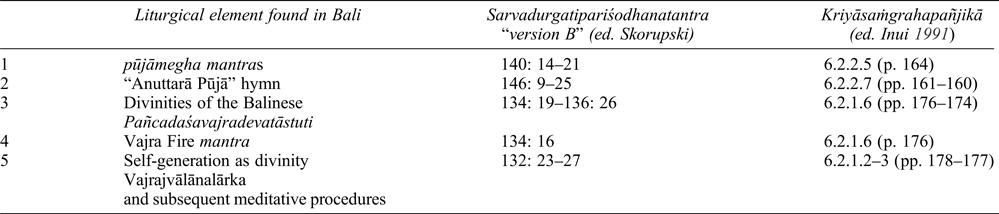
It is now time to draw conclusions from these data. With regard to the textual correspondences between chapter 1 of “version B” of the Sarvadurgatipariśodhanatantra, on the one hand, and Balinese Buddhist liturgical materials on the other, adduced by Nihom (Reference Nihom1994: 78–80) in favour of his conclusion that this Tantra was disseminated to the Indonesian archipelago, we have to keep in mind that all of the same correspondences can be traced in the Kriyāsaṁgrahapañjikā. This text, dating from the eleventh century, would be old enough to have served as the source for the Balinese material, but is too late to have served as source for the two inscriptions under discussion here. However, all of the relevant textual material is found in the Devatāyoga part of the sixth chapter of the text, and this is precisely the part which is considered to have been adapted from the significantly older Sarvavajrodaya.Footnote 119 This last text, possibly composed in the ninth century, would probably be old enough to have served as source for our inscriptions.Footnote 120 Unfortunately, the part corresponding to Kriyāsaṁgrahapañjikā 6 Devatāyoga is not preserved in the sole Sanskrit manuscript known to exist for this text. Because I do not have access myself to the Tibetan version of the Sarvavajrodaya, I limit myself to pointing out the correspondences between the elements that drew Nihom's attention in the Sarvadurgatipariśodhanatantra and the corresponding parts of the Kriyāsaṁgrahapañjikā (see Table 1).
Correspondences between Balinese Buddhist liturgy, Sarvadurgatipariśodhanatantra “version B” and the Kriyāsaṁgrahapañjikā
Among these elements, it must first be recalled that items 3 and 4 concern precisely the passages of the Sarvadurgatipariśodhanatantra (and Kriyāsaṁgrahapañjikā) which I have cited as a possible source for the first paragraph of the first inscription. If we may assume, then, that these and all the other elements, whose place in the Kriyāsaṁgrahapañjikā is indicated in the table, do indeed find their correspondent in the (Tibetan version of the) Sarvavajrodaya, this means that the first paragraph of our first inscription may have been quoted from that text rather than the Sarvadurgatipariśodhanatantra. If we keep in mind, furthermore, that the Tibetan version of the Sarvavajrodaya presumably offers parallels for all the segments of this inscription, and that this text is the only one which does so while also being old enough to have been known in (late) ninth-century Java, whereas the Sarvadurgatipariśodhanatantra does not provide a source for all elements of the first inscription, and does not offer anything corresponding to the part that is also represented in the second inscription, it seems that we must draw the conclusion that it is more likely that the Sarvavajrodaya (or a text closely related to it) than that the Sarvadurgatipariśodhanatantra inspired the rituals during which or with a view to whose execution these inscriptions were produced.Footnote 121
Although none of the ritual texts cited here prescribes the use of “stakes” (kīla) made of stone,Footnote 122 it nevertheless seems clear that these two stones served as stakes – possibly the central ones – during the ritual opening of the ground plan (maṇḍala) of Buddhist shrines. In this connection, given the physical resemblance of these stones to the rather numerous wholly or partly liṅga-shaped boundary markers preserved from Central Java, called “sīma stones” (vatu sīma) in contemporary inscriptions (cf. n. 99), it is significant that certain Indian inscriptions use precisely the word kīlaka to denote cadastral boundary markers.Footnote 123 Obviously, the spheres of a ritual demarcation of agricultural land and the ritual demarcation of maṇḍalas were felt to be connected in ancient India and Indonesia, as is expressed by the use in these spheres of a partly overlapping set of terminological and material culture.
7. Inscriptions with the mantra ṭaki hūṁ jaḥ
Another case where the Sarvavajrodaya could be pertinent to Javanese data is furnished by a group of inscriptions containing mantras with the sequence ṭaki/ī hūṁ jaḥ. In an important study published in 2003, Jeff Sundberg drew attention to and elucidated a unique gold artefact excavated in the Ratu Baka complex near Prambanan, bearing the text oṁ ṭakī hūṁ jaḥ svāhā. He has done his best to find a scriptural source for this mantra. Unable to find a precise match, he pinned much of his argument on the attestation of admittedly very similar, although not identical, mantras in the Sarvatathāgatatattvasaṁgraha.Footnote 124 However, oṁ ṭakī hūṁ jaḥ is attested as such in the Guhyasamājatantra (14.22), which Sundberg does not mention;Footnote 125 perhaps more significantly, it is also found in the Sarvavajrodaya, whose ritual system is based on that of the Sarvatathāgatatattvasaṁgraha.Footnote 126
Sundberg has pointed out that there are a few other, similar and obviously related stone inscriptions from Central Java, but in my opinion he was wrong to maintain, with his predecessors, that these inscriptions read paki instead of ṭaki, on which basis he concluded that “their mantra is not that of the Ratu Baka gold plate”.Footnote 127 It is safe to assume that ṭaki is intended throughout,Footnote 128 and the evidence suggests that the formula ṭaki hūṁ jaḥ at the beginning of three of these four short stone inscriptions recording the erection of boundary markers served the purpose of removing obstacles. For at Sarvavajrodaya section 56, we read (Mikkyō Seiten Kenkyūkai 1986–87: 267):
atyantanirvighnaṁ kartukāmena mttikayā pracchādanīyāḥ | evam api yadi vighnaṁ kurvanti | vajrahūṁkārayogaṁ ktvā ṭakkirājenākṣya vajrāṅkuśādibhir apy ākarṣaṇādikaṁ ktvā vajrahūṁkāraṁ baddhvā vāmapādena vighnapratiktim ākramya hūṁ vaṁ hūṁ ityādivivardhanayogāt pratyālīḍhapādāvasthito ’ntarāntarā ca meghādyabhimukhīṁ tāṁ mudrāṁ kṣipet | gagaṇodāraspharaṇadīptajvālākulaprabheṇa vajrahūṁkāreṇa pādaprahārābhighātena meghādikaṁ bhasmīkyamāṇaṁFootnote 129 cintayet | evaṁ ghātitā bhavanti |
He who wishes to effect complete freedom from obstacles should cover them (i.e. the effigies of the directional deities who might cause trouble, pinned down in section 55) with mud. If in this condition (evam) they [still] make trouble, he should immerse himself in [the deity] Vajrahūṁkāra and adduct them with the Ṭakkirāja; should also adduct them etc. with the Vajra-goads etc.; should bind the [seal of] Vajrahūṁkāra; and should step on the effigy of the obstacle with his left foot. After the practice of [self-]expansion with hūṁ vaṁ hūṁ etc., he should stand in pratyālīḍha stance, should throw that seal in the direction of the clouds etc., in between each of them, and should visualize that the clouds etc. are being burnt to ashes by Vajrahūṁkāra who shines like dense blazing fire expanding high in the sky and strikes [the obstacles] with his foot. In this way they are struck down.Footnote 130
From the evidence of Guhyasamājatantra 14.22, where the mantra oṁ ṭakki hūṁ jaḥ is explicitly called sarvatathāgataṭakkirājamahākrodha “the great wrath of all Tathāgatas who is [named] Ṭakkirāja”, it seems that ṭakkirājenāk ṣya can be interpreted as “having adducted by reciting the mantra named Ṭakkirāja”, and that the intended mantra is the one that concerns us here.Footnote 131 The position of the mantra in the three stone inscriptions corresponds precisely to that of the more familiar expression avighnam astu “let there be no obstacles!” found in several Javanese inscriptions of the ninth century onwards; one of these even opens more elaborately with oṁ avighnam astu gaṇapataye namaḥ “Oṁ, let there be no obstacles! Homage to Gaṇapati (the god who removes obstacles)”.Footnote 132
The fourth stone inscription with ṭaki jaḥ hūṁ comprises only a mantra, and has been read paki hūṁ jaḥ jaḥ hūṁ waho paki hūṁ jaḥ jaḥ hūṁ waho (that is, twice paki hūṁ jaḥ jaḥ hūṁ waho) by Damais, from a plaster cast kept in Leiden, the whereabouts of the original inscription being unknown. In the Kriyāsaṁgrahapañjikā (6.2.9, Inui Reference Inui1992: 139), in a section on the consecration of the Tantric master, I find oṁ ṭakki jaḥ hūṁ vaṁ hoḥ, which is virtually the same mantra and allows us to predict how Damais’ reading may be improved.Footnote 133 I have not yet found this in any scriptural source, and alas we have in this case neither context nor original artefact to help us understand the function of this inscription. Finally, I must add to this record the mantric sequence ṭaki hūṁ jaḥ daḥ hūṁ kiṭa in the lead-bronze inscription from Borobudur already mentioned a few times above.Footnote 134
8. Bronze image of Vairocana at the Metropolitan Museum of Art
A small bronze image of Vairocana in vajraparyaṅkāsana and displaying bodhyagrīmudrā is held at the Metropolitan Museum of Art in New York, under number 1987.142.171 (Figure 11). To my knowledge, it is so far unpublished,Footnote 135 no doubt because the iconography is very well known from other, better preserved specimens. But the inscription engraved on the figure's base lends it importance from perspectives other than art history. The script is that of Central Java, i.e. Kawi, in the ninth or tenth century. Excellent photos are viewable online through the Museum's website, and allow the following reading:
(1) ○ pratītya dharma pa(jā)(2)(ya)nte nāsti dharmaḥ (svabhāvata)(3)ḥ | ye [pra](tyī)tya (pra)jāna(4)te te jānant(i) dharmatāṁ ○
Bronze sculpture under inventory number 1987.142.171. Photo courtesy of the Metropolitan Museum of Art.
This is a surprisingly corrupt anuṣṭubh stanza, that I hesitantly restore as follows:Footnote 136
pratītya dharmāḥ prajāyante nāsti dharmaḥ svabhāvataḥ |
ye pratītya prajānate te te jānanti dharmatām ||
If the emendations are correct, then we may translate as follows:
Entities come into being dependently. There is no entity that derives from an independent existence. Those who understand dependent [origination], they know the true nature of reality.
This is a very basic expression of the core Buddhist doctrine of dependent origination (pratītyasamutpāda). Although I am unable to trace this verse in any preserved scriptural text, it could very well have been put in the Buddha's mouth in some Buddhist scripture now lost (or no longer available in Sanskrit), for a gāthā much like this one, and likewise untraceable in known scriptures, is found attributed to the Buddha in Candrakīrti's Prasannapadā on kārikā 4.19 (de la Vallée Poussin Reference De la Vallée Poussin1903–13: 505):
uktaṁ ca bhagavatā |
pratītyadharmān adhigacchate vidū na cāntadṣṭīya karoti niśrayam |
sahetu sapratyaya dharma jānati ahetu apratyaya nāsti dharmatā || iti
I quote the translation by Jacques May (Reference May1959: 240):
Le Bienheureux dit également: « Le sage pénètre les dharma dans leur conditionnalité. Il ne prend pas appui sur la vue fausse des extrêmes. Il sait qu'un dharma a des causes, des conditions: l'absence de cause, de condition n'est pas [dans] la nature des dharma ».
It seems reasonable to assume that this gāthā, engraved on the base of the image of Vairocana, served as dharma-relic, just like the stanzas engraved on a silver foil inserted into the base of the Sambas sculpture discussed above (section 1) or the texts on gold foil or clay tablets inserted into relic caskets and stūpas (sections 5, 9 and 10). And in this sense, this inscription is comparable to the other material presented in this paper.
9. Clay sealings from Bali
In Machi Suhadi's article on “Buddhist mantras in the ASEAN states”, the author's “mantra formula II” (1989: 117), a text originally published by Stutterheim (Reference Stutterheim1929: 38), can be identified with a widespread Buddhist dhāraṇī. The text is found stamped in Siddhamātkā script on small clay sealings found at Pejeng and (not far from Pejeng) at Blahbatuh,Footnote 137 inserted into miniature stūpas of unbaked clay. The reading published by Stutterheim was as follows:Footnote 138
namaḥ traya(va) savatathāgata tadapagantaṁ jvalajvaladhamadhā ālasaṁharasaṁhara āyussaṁsādha āyussaṁsādha savasatvānāṁ pāpaṁ sarvatathāgata samantāṣrī(th)a vimalaśuddha svāhā
This text can now be identified as the Vimaloṣṇīṣadhāraṇī. The following is the version of that dhāraṇī in a Dunhuang manuscript dating to about the ninth/tenth century published by Cristina Scherrer-Schaub (Reference Scherrer-Schaub and Kvaerne1994: 712):
tadyathā oṁ namas traiyadhvikānāṁ sarvatathāgatahdayagarbhe jvala dharmadhātugarbhe | saṁharaṇa āyuṁ saṁśodhaya pāpaṁ | sarvatathāgatasamante uṣṇīṣavimalaviśuddhe svāhā ||
There are some differences between this version and the Balinese sealings, but it is in any case clear from Schopen's (Reference Schopen1985) study of this text that the transmission of this dhāraṇī throughout Buddhist Asia was not very stable.Footnote 139 Moreover, it is only natural that Stutterheim's ignorance of the identity of the text, combined with the challenges of reading a text stamped in miniature size on this kind of material, has caused several misreadings. Luckily, a fairly good photograph showing two specimens of clay sealings stamped with the same matrix of this text was published by Putu Budiastra and Wayan Widia (Reference Budiastra and Widia1980–81: photo 9), which I reproduce here as Figure 12. On this basis, I am able to propose the following synthetic edition of the text as it was transmitted to Bali:
(1) nama(s tre)ya(dhva)sarvatathā-
(2) gatahdayagarbhe jvala jvala dha-
(3) rmadhātugarbhe saṁhara saṁhara ā-
(4) yus sa(ṁ)sodha (ā)yus saṁśodhaFootnote 140
(5) sarvasatvānāṁ pāpa(ṁ) sarvata-
(6) thāga(ta)samantoṣṇīṣa(vi)-
(7) malaś(u)ddhe svāhāFootnote 141
Two sealings from Bali. Reproduced from Putu Budiastra and Wayan Widia Reference Budiastra and Widia1980–81, photo 9.
Finding myself somewhat in disagreement with the way Scherrer-Schaub has translated her reconstituted text for the Dunhuang manuscript (Reference Scherrer-Schaub and Kvaerne1994: 713), I propose here the following translation, starting from the Balinese text, which is not essentially different:
Homage! O you [female deity of this dhāraṇī] who bear as womb the essence of all Tathāgatas of the three ages (past, present and future): burn, burn the evil of all beings! O you [dhāraṇī-deity] who bear as womb the dharma-relic: destroy, destroy [the evil]! Purify life, purify life!Footnote 142 O [you dhāraṇī-deity] who are immaculately pure like all the cranial protuberances of all Tathāgatas! Hail!
It is clear from the rich evidence adduced by Schopen (Reference Schopen1985) that the practice of stamping this dhāraṇī on clay and installing it in a stūpa is precisely in agreement with the way this text was used in other parts of the Buddhist world. The dating of these specimens is very hard to estimate on the basis of palaeography, but a date between 800 and 1000 ce seems likely.
More exceptional is the case of “mantra formula III” on the other clay object mentioned by Machi Suhadi (Reference Suhadi1989: 117–8). It was originally read as follows by Stutterheim (Reference Stutterheim1935: 88):
ity api sa bhagavān arhan samyaksaṁbuddho vidyācaraṇasaṁpannaḥ sugatālokavidyanuttaraḥ paruṣadasyumāravigāsuradevamanuṣyāṇāṁ niddho bhagava–
I do not have access to a photo of any sealing bearing this text, so I cannot verify Stutterheim's decipherment, but the text must be very similar if not identical to one of the many variants of the list of ten epithets of the Buddha.Footnote 143 A particularly close (if not identical) parallel is the phrase ity api sa bhagavāṁs tathāgato ’rhan samyaksaṁbuddho vidyācaraṇasaṁpannaḥ sugato lokavid anuttaraḥ puruṣadamyasārathiḥ śāstā devamanuṣyāṇāṁ buddho bhagavān iti, found in the Bodhisattvabhūmi 1.7 (Wogihara Reference Wogihara1930–36: 93). It means something like this: “Thus also the Lord is [known as] Tathāgata, fully awakened, Arhant, endowed with knowledge and [good] conduct, the Sugata, Supreme knower of the world, Coachman of men who need to be tamed, Teacher of gods and men, the Buddha, the Lord”. This formula is in any case not a mantra.
10. A gold foil from Pura Pagulingan on Bali
Finally, the last section of Machi Suhadi's article (Reference Suhadi1989: 118–9) was dedicated to a number of inscribed artefacts recovered during the dismantling of the temple Pura Pagulingan in preparation for its reconstruction. It was discovered then that the foundations showed an octagonal groundplan. It was at this level that two pieces of gold foil were discovered, beside a terracotta tablet (bearing the ye dharmāḥ formula) and a silver foil bearing a few akṣaras.Footnote 144 The first gold foil, rectangular in shape, was inscribed with a repeated ye dharmāḥ formula. Machi Suhadi also gives the text of the second gold foil, oval in shape, with three lines of writing in circles, referring in n. 31 to an unpublished report by Boechari (1985b). Having recently prepared the publication of this report from the author's own typescript (Boechari 2012: 526–8), I am able now to cite the reading precisely as Boechari saw it, without the copying mistakes in Machi Suhadi's publication:
(1) o hriḥ o jayāta svāhā oṣadavitā svāhā o dhū huṁ jaya svāhā namaḥ
(2) trailokyavijayāmoghapāṣāpratihato hriḥ haḥ hīḥ huṁ
(3) o phat kriḥ hriḥ svāhā ||
This comprises five mantras, each introduced by o , of which the fourth and most extensive is clearly identifiable as that which is called the upah dayamantra of the Amoghapāśah dayadhāraṇī in the edition by Kimura (Reference Kimura1979: 245 [12]), where this mantra does not appear to hold a particularly important position. This edition, however, is based only on late Nepalese manuscripts, and is altogether much less useful for historical research than the two painstaking publications by Meisezahl (Reference Meisezahl1962, Reference Meisezahl1965), which present witnesses conserving the text in a considerably more archaic state. Several witnesses – a Dunhuang manuscript containing an old Tibetan recension (possibly dating to the ninth century), a twelfth-century Sanskrit manuscript held at Cambridge University Library, and a Siddhamātkā manuscript preserved in Japan, apparently representing an old transmission of the Sanskrit text independent from that in Nepal – do not show the labels homamantra, h dayamantra, upah dayamantra, etc., identifying the ritual use of various constituent parts of the dhāraṇī. Furthermore, in both the Dunhuang and the Japanese manuscript, we find the mantra corresponding to this Balinese inscription precisely at the end of the dhāraṇī, without any of the added mantras that all (?) other manuscript witnesses show.Footnote 145 In other words, in the oldest versions of the text, the mantra that we see in Bali was the climax of the mantra portion, and hence it is not surprising that it would be chosen to stand for the whole. Also, the various manuscript witnesses show substantial variants among themselves for this sequence of mantras at the end of the dhāraṇī, so it seems unproblematic that the Balinese version is not identical to any other known version. Anyhow, now that the identity of this mantra has been determined, it must be kept in mind that the readings of this gold foil inscription from Bali are liable to be improved if the original could be inspected or good reproductions be made available.
Even though we do not know the precise archaeological context in which this gold foil was found, the function of this artefact may again rather clearly be inferred from the frame text of the dhāraṇī (Meisezahl Reference Meisezahl1962: 313):
yasmiṁś ca punar bhagavan pthivīpradeśe idam amoghapāśahdayaṁ pracaret veditavyaṁ bhagavaṁs tasmin pthivīpradeśe īśvaramaheśvarabrahmakāyikapramukhāni dvādaśadevaputraśatasahasrāṇi rakṣāvaraṇaguptaye sthāsyanti || caityasaṁmato bhagavan sa ca pthivīpradeśo bhaviṣyati yatredam amoghapāśahdayaṁ pracariṣyati |
This is the translation given in Schopen (Reference Schopen1976 [Reference Schopen2005]: 36):
And again, O Blessed One, on which spot of earth this Amoghapāśah daya would circulate, it is to be known that on that spot of earth, O Blessed One, 12 × 100,000 devaputras, headed by Īśvaras, Maheśvaras and the devas belonging to Brahma, will dwell for the purpose of protecting and shielding and guarding it. That spot of earth, O Blessed One, where this Amoghapāśah daya will circulate will become a highly honored sacred place.
We may hence assume that our inscription represents the epitome of the dhāraṇī, and its production must have been motivated by a similar intent to the inscription of Batu Bedil presented in section 2. In contrast to the Aparimitāyuḥsūtra, which was the source text there, it must however be pointed out that there is not, in the Amoghapāśah daya, any emphasis on “writing down” the text.
Conclusion
I have presented a fairly wide range of Indonesian inscriptions citing gāthās, mantras and dhāraṇīs, providing rather eloquent written testimony to the fact that the Indonesian archipelago was an integral part of the ancient Buddhist world. I hope to have shown that this epigraphical material, thus far very little known outside of Indonesia, deserves the attention of historians of Indian and pan-Asian Buddhism. I have simultaneously tried to contextualize the Indonesian data in the light of Buddhist texts not preserved in the archipelago, hoping to aid Indonesian scholars towards an appreciation of this material. Indeed, the primary source for interpreting why a given citation was produced in the form of an inscription will always be the textual frame from which the citation is extracted.
I have been able positively to identify the source texts for most of the gāthā, mantra and dhāraṇī inscriptions presented in this article. Despite the fact that we are mostly dealing with very short segments of text, there have been several instances where this material has offered readings that are of philological significance for the critical study of the source texts. These are, in Sanskrit alphabetical order (and limiting myself to source texts for which a Sanskrit recension is preserved), the Aparamitāyuḥsūtra, the Bodhigarbhālaṁkāralakṣadhāraṇī, the Bhadracaripraṇidhāna, the Vajracchedikā Prajñāpāramitā, and the Vimaloṣṇīṣadhāraṇī. More tentative identifications have involved the Kāraṇḍavyūha, the Mahāpratisarāmahāvidyārājñī, the Sarvadurgatipariśodhanatantra and the Sarvavajrodaya. If we may assume that the citation of mantras and dhāraṇīs from such source texts implies the availability of manuscripts of these texts as such, then I would seem to have made a big leap in determining which were the written Sanskrit vectors of Buddhism in ancient Indonesia. For with the exception of the Mahāpratisarāmahāvidyārājñī, the dissemination of none of these texts had thus far been proven on the basis of written evidence.
But is it really true that we may infer as much? Schopen has repeatedly addressed this question in his work on Indian dhāraṇī inscriptions, and has tended to answer in the affirmative. See e.g. Schopen's discussion of inscriptions with the Vimaloṣṇīṣadhāraṇī (Reference Schopen1985 [Reference Schopen2005]: 336):
The identification of the dhāraṇī on the seals and the “Schutzformel” found at Gilgit proves again that either the Samantamukhapraveśa or the Shes pas thams cad or both were known and actually used during the sixth to the ninth centuries at Paharpur in Bengal, at Bodhgayā and Nālandā in Bihar, and at Gilgit. It could, of course, be argued that only the dhāraṇī itself was known and available in these places. But that is difficult to maintain since a knowledge of the dhāraṇī by itself cannot account for the fact that the dhāraṇī is found in all four places in exactly the same setting: pressed into lumps of clay or written on birchbark and deposited in a stūpa. It is, in fact, only a knowledge of the texts that contain this dhāraṇī and explain how it is to be used that can account for this setting.
I am less confident about this matter than Schopen was thirty years ago. For instance, the Balinese version of the Amoghapāśah daya mantra, engraved in a circle on gold foil, does not conform to any instruction in that text. This means that practice was not bound by text, and I find myself quite easily able to imagine the transmission of mantras and dhāraṇīs by themselves, in specific material and ritual contexts, outside of the frame of larger texts containing instructions on their use. In this connection, it may also be pointed out that none of the Indonesian inscriptions presented here comprises any part of the prose that frames the mantras or dhāraṇīs in their respective source texts, different from several of the Indian cases published by Schopen. In fact I know of just one Indonesian mantra inscription where any of the framing prose is included in the citation; it will be published elsewhere.Footnote 146
In whichever way we have to imagine that these mantras and dhāraṇīs reached the Indonesian archipelago, it has become clear that the range of such texts that was used in this part of the Buddhist world must have been quite similar to the texts that were used in other Buddhist countries. As Schopen puts it (Reference Schopen1989a [Reference Schopen2005]: 336): “It is this group of texts that begins to make sense out of the picture of Buddhism that emerges from our archaeological sources”. Schopen has insisted on one other point, which it is important to repeat in the context of Indonesian studies, where many ideas from the colonial period still linger. There is nothing at all “Tantric” about most of the inscriptions and source texts that have occupied me in this contribution, “if by ‘Tantric’ we mean that phase of Buddhist doctrinal development which is characterized by an emphasis on the central function of the guru as religious preceptor; by sets – usually graded – of specific initiations; by esotericism of doctrine, language and organization; and by a strong emphasis on the realization of the goal through highly structured ritual and meditative techniques” (Reference Schopen1982 [Reference Schopen2005]: 310). The material I have discussed largely comprises “texts dealing with ritual forms open to all and religious problems common to all – monks, nuns, lay men and women” (Reference Schopen1989a [2005]: 337). However, a few of the inscriptions presented here may be labelled “Tantric”, in the sense that their source texts belong to “Tantric” Buddhist (Mantranaya) literature, such as the Sarvatathāgatatattvasaṁgraha, the Sarvadurgatipariśodhanatantra, and the Sarvavajrodaya.Footnote 147
With the exception of one relatively restricted area, I have for this paper cast my net all over the Indonesian archipelago.Footnote 148 I have not focused on any particular period, but unintentionally the material presented here has turned out all to belong, with a fair degree of certainty, to the period before the turn of the second millennium of our era. Even though we know that Buddhism still thrived during the eleventh to fourteenth centuries in East Java, which was politically dominant in that period, very few inscriptions of the kind presented here have so far come to my attention from that part of the island, and none that could be included here.Footnote 149 It seems possible that we see here a reflection of changes in the practice of Buddhism on Java during the “East Javanese period”, but it would be imprudent to draw such a conclusion from the very limited and largely negative evidence available so far.