Introduction
Mild cognitive impairment (MCI) generally refers to cognitive impairment that is more severe than that observed with normal aging, but not severe enough to cause apparently impaired daily function (Crous-Bou et al., Reference Crous-Bou, Minguillón, Gramunt and Molinuevo2017; Sanford, Reference Sanford2017). It is conceptualized as a boundary or a transitional state between aging and dementia (Morris et al., Reference Morris2001). Amnestic MCI (aMCI) is the most common phenotype of MCI, which has impairment in tests of episodic memory. It is associated with a considerable risk of further development to Alzheimer’s disease (AD; Campbell et al., Reference Campbell, Unverzagt, Lamantia, Khan and Boustani2013; Chung et al., Reference Chung2019; Kasper et al., Reference Kasper2020). Patients with aMCI have a conversion rate of 60.5∼100% to AD in 5∼10 years (Liu et al., Reference Liu2020), imposing a heavy psychological and financial burden on affected individuals, caregivers, and society. Currently, in view of no effective cure for aMCI and AD (Anderson et al., Reference Anderson, Hadjichrysanthou, Evans and Wong2017), it is crucial to study relevant risk and protective factors to protect elderly people against aMCI and AD.
Growing evidence has shown a bidirectional relationship between sleep problems and MCI (Chen et al., Reference Chen2016; Guarnieri and Sorbi, Reference Guarnieri and Sorbi2015) or AD (Ohayon and Vecchierini, Reference Ohayon and Vecchierini2002; Shi et al., Reference Shi2018; Wams et al., Reference Wams, Wilcock, Foster and Wulff2017). More than 60% of MCI and AD patients have at least one sleep disorder (Guarnieri et al., Reference Guarnieri2012). Patients with sleep problems have an increased risk of AD. Sleep duration is one of the most important sleep characteristics. However, the association between sleep duration and cognitive function is still inconclusive. Several studies have shown that prolonged sleep duration is significantly associated with poor cognitive function (Schmutte et al., Reference Schmutte, Harris, Levin, Zweig, Katz and Lipton2007). Conversely, a lack of sleep was associated with cognitive decline (Tworoger et al., Reference Tworoger, Lee, Schernhammer and Grodstein2006). Moreover, other studies have shown that either too short or too long sleep duration affected cognitive function(Benito-León et al., Reference Benito-León, Louis and Bermejo-Pareja2013; Chen et al., Reference Chen2016; Ding et al., Reference Ding, Li and Lian2020; Xu et al., Reference Xu, Tan, Zou, Cao and Tan2020a). In addition, most studies have mainly focused on recent sleep duration being experienced in late life. Few studies have focused on sleep duration in youth or in midlife.
In this study, we conducted a cross-sectional study with elderly individuals who were systematically recruited in city communities to examine the association between sleep duration in different stages of life and aMCI.
Materials and methods
Subjects
The China Longitudinal Aging Study (Xiao et al., Reference Xiao2013) is a long-duration population-based cohort study that focuses on the elderly population living in city communities in China. Participants were recruited from 15 sites of 8 provinces including Shanghai, Beijing, Guangdong, Zhejiang, Jiangxi, Liaoning, Shanxi, and Anhui in China. A total of 3,510 participants completed the interview during 2011 and 2012. A total of 2,977 participants were included in this study after excluding participants without complete demographic information (n = 11), aged less than 60 years old (n = 14), without diagnosis (n = 44), diagnosed with dementia (n = 173), diagnosed with vascular MCI (VMCI, n = 93), diagnosed with depression disorder (n = 20), diagnosed with other diseases, as generalized anxiety disorder, panic disorder, sub-clinical depression (n = 166), without sleep information (n = 12). Of the 2,977 participants, 505 participants were diagnosed with aMCI and defined as the aMCI group; 2,472 participants were normal aging elderly included in the healthy comparison (HC) group.
Ethical approval was obtained from Shanghai Mental Health Centre (IRB approval number: 2012-19; date: 2012-04-12). All participants signed an informed consent form before the study was initiated.
Data collection and diagnostic criteria
Each research center utilized the same questionnaire structured by the Shanghai Brain Health Foundation. The questionnaire consisted of five sections: sociodemographic characteristics and lifestyle, medical history, sleep patterns, weight and height, and emotional and psychosocial tests. In the “sociodemographic characteristics and lifestyle” section, we collected name, gender, age, educational years, smoking history, alcohol consumption, tea consumption, and physical activity. In the “medical history” section, we mainly collected histories of hypertension, heart disease, and diabetes. Sleep patterns were reported by the participants themselves, including nighttime sleep duration in their youth (18–44 years old), midlife (45–59 years old), and late life (over 60 years old). The subjects were asked “How many hours do you sleep on average in their youth (18 to 44 years old), midlife (45 to 59 years old), and late life (over 60 years old)?” We also asked the elderly about the time when they get up and fall in sleep to check the response. Furthermore, the response was verified by their families. Based on the weight and height, we calculated body mass index (BMI) = weight/height2 (kg/m2). Emotional and psychosocial tests included the Mini-Mental State Examination (O’Bryant et al., Reference O’Bryant2008) and the Montreal Cognitive Assessment (MoCA) (Gil et al., Reference Gil, Vega, Ruiz de Sanchez and Burgos2013). The Hachinski Ischemic Scale (Moroney et al., Reference Moroney, Bagiella, Desmond, Hachinski and Tatemichi1997) was used to exclude vascular dementia and VMCI. The Geriatric Depression Scale (Lin et al., Reference Lin2016) was used to exclude depression disorder.
The diagnostic criteria for aMCI, which were adapted from the MCI diagnostic criteria of Petersen (Portet et al., Reference Portet2006), were as follows: (1) memory complaints, preferably corroborated by an informant; (2) objective memory impairment; (3) preservation of general cognitive function; (4) intact activities of daily living; and (5) absence of dementia.
The diagnostic criteria for normal aging were as follows: (1) normal recognition, (2) no other severe physical disease, and (3) ability to cooperate and complete the relevant tests.
Statistical analyses
Statistical analyses were performed with SPSS version 22.0. Descriptive statistics were used in the analysis of sociodemographic characteristics, lifestyle, medical history, psychosocial tests, and sleep duration assessments. All continuous variables were tested for normality with the Kolmogorov–Smirnov test. The characteristics of the participants were compared using an independent Mann–Whitney U test for continuous data and a chi-square test for categorical data. The sleep duration in different stages of life was compared by the Wilcoxon signed-rank test. Curve estimation was used to estimate the relationship between sleep duration and MoCA scores. Specifically, we compared R 2 of a variety of types of nonlinear regression and found the relationship between sleep duration and MoCA scores showed an inverted U curve. According to the extreme points we got from the curve estimation, we set the cutoff values. When analyzing the sleep duration in one stage, participants were divided separately into two groups by the corresponding cutoff values. In each group, we used logistic regression analysis to examine the association between sleep duration in this stage adjusting demographic characteristics. If there is an association between sleep duration in one stage and aMCI, then we take other covariates that have been reported as influential factors of aMCI as independent variables to adjust the results. We did not impute missing values. Significant values were specified at P < 0.05.
Results
Basic characteristics analysis
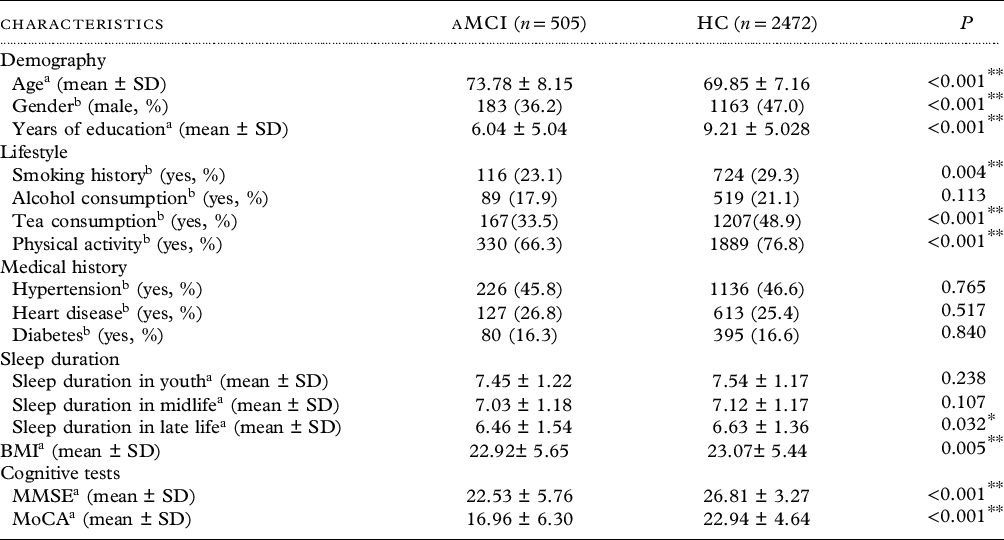
A total of 2,977 participants, ranging from 60 to 96 years old, were included in this study. Of these participants, 16.96% were diagnosed with aMCI. Table 1 shows the basic characteristics of all participants. The distribution of age, gender, educational years, smoking history, tea consumption, physical activity, BMI, and sleep duration in late life were all different in late life between the aMCI group and the HC group (Table 1, P < 0.05). Compared to those in the HC group, the participants in the aMCI group were older and had fewer educational years (Table 1, both P < 0.001). The proportion of male participants was lower in the aMCI group (Table 1, P < 0.001). The sleep duration in late life in the aMCI group is less than HC group (Table 1, P = 0.032). In addition, the participants in the aMCI group tended to smoke less (Table 1, P = 0.005), drink tea more (Table 1, P < 0.001), exercise less (Table 1, P < 0.001), and have lower BMI (Table 1, P = 0.004).
The basic characteristics of all participants

MMSE, Mini-Mental State Examination; MoCA, Montreal Cognitive Assessment; BMI, body mass index.
aMann–Whitney U test. b χ 2 test.
* P < 0.05, ** P < 0.01.
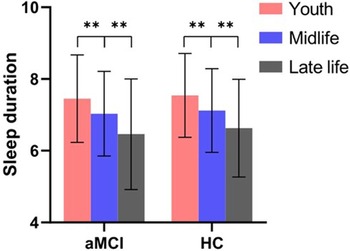
In the aMCI group, the mean nighttime sleep duration in youth, midlife, and late life were 7.45 ± 1.22, 7.03 ± 1.18, and 6.46 ± 1.54 hours, respectively. While in the HC groups, they were 7.54 ± 1.17, 7.12 ± 1.17, and 6.63 ± 1.36 hours. In both the aMCI and HC groups, the mean nighttime sleep duration showed decreasing tendency with increasing age (Figure 1). The differences in sleep duration between stages of life were significant.
The mean sleep duration presented significant decline with increasing age in HC group and aMCI group, respectively. ** P < 0.01.

Associations between sleep duration in different stages of life and MoCA scores
A nonlinear trend was revealed for the relationship between sleep duration and cognitive function in recent studies (Xu et al., Reference Xu2020b). The curve estimation indicated that the highest MoCA scores were associated with a sleep duration of 9.69 hours in youth. In midlife, the highest point for MoCA scores was associated with 8.71 hours; in late life, the highest point for MoCA scores was associated with 6.87 hours (Table 2).
An inverted U relationship between sleep duration in different stages and MoCA scores

** P < 0.01.
According to the extreme points, we took 10 hours in youth, 9 hours in midlife, and 7 hours in late life as cutoff values.
Association between sleep duration in different stages of life and aMCI
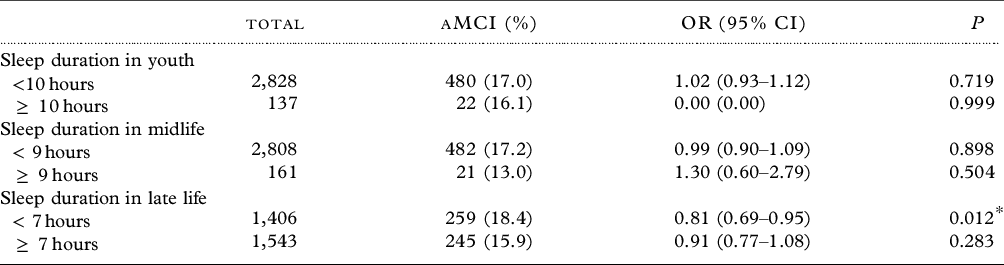
Based on these cutoff values in the different age periods, all participants were divided into two groups. Logistic regression was used to assess the relationship between sleep duration and aMCI. In the analysis, there are no results proving that sleep duration in youth (P = 0.719, sleep duration < 10 hours; P = 0.999, sleep duration ≥ 10 hours) or midlife (P = 0.898, sleep duration < 9 hours; P = 0.504, sleep duration ≥ 9 hours) had a significant association with aMCI (Table 3). We found that sleep duration in late life was associated with aMCI (P = 0.012, odds ratio (OR) = 0.81, 95% confidence interval (CI) = 0.69–0.95, Table 3) in the group sleeping less than 7 hours. Conversely, there was no significant association between sleep duration in late life and aMCI when sleeping equal to or more than 7 hours (Table 3).
Association between sleep duration in different stages of life and aMCI

Logistic regression adjusted for age, gender, and years of education.
Sleep duration cutoff values were rounding the extreme point in Table 2.
* P < 0.05.
Associations between other factors in late life and aMCI
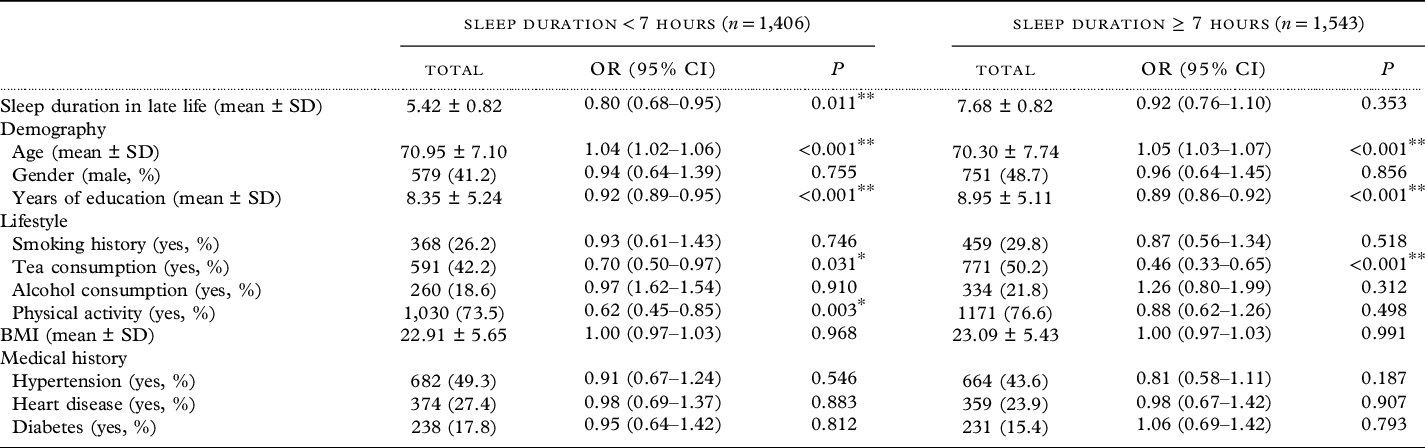
After taking all variables as independent values into logistic regression, we found each hour more of sleep duration was associated with approximately 0.80 of the original risk of aMCI (P = 0.011, OR = 0.80, 95% CI = 0.68–0.95, Table 4) when sleeping less than 7 hours in late life, as shown in Table 4. Age was a risk factor (sleep duration < 7 hours, P < 0.001, OR = 1.04, 95% CI = 1.02–1.06; P < 0.001, OR = 1.05, 95% CI = 1.03–1.07), while education was an important protective factor (sleep duration < 7 hours, P < 0.001, OR = 0.92, 95% CI = 0.89–0.95; P < 0.001, OR = 0.89, 95% CI = 0.86–0.92) against aMCI. Drinking tea was also a significant protective factor (sleep duration < 7 hours, P = 0.031, OR = 0.70, 95% CI = 0.50–0.97; P < 0.001, OR = 0.46, 95% CI = 0.33–0.65) against aMCI. Additionally, physical activity (sleep duration < 7 hours, P = 0.003, OR = 0.62, 95% CI = 0.45–0.85) played a protective role against aMCI.
Logistic regression in each group of sleep duration in late life

BMI, body mass index.
* P < 0.05, ** P < 0.01.
In addition, we took sleep duration as a three-category variable to supplement the relationship between short sleep and aMCI. Considering the sample size in each group, the subjects that slept less than 7 hours were classified into three categories: group 1 (6 hours ≤ sleep duration < 7 hours), group 2 (5 hours ≤ sleep duration < 6 hours), group 3 (sleep duration < 5 hours). First group was taken as the reference group. We received consistent results (online Supplementary Table S1) when taking sleep duration as either a categorical variable or a continuous variable, which both demonstrated that short sleep duration was a risk factor for aMCI when sleeping less than 7 hours (see online Supplementary Table S1 published as supplementary material online attached to the electronic version of this paper).
Discussion
This study presents the associations between aMCI and nighttime sleep duration at different stages of life and revealed other relevant factors for aMCI.
We found that the mean nighttime sleep duration showed a decreasing tendency with increasing age in both the aMCI group and HC group. The National Sleep Foundation (Foundation, Reference Foundation2018) recommends people aged 26–64 years to sleep for 7–9 hours and people aged ≥65 years to sleep for 7–8 hours, which is consistent with our findings. As people age, sleep quality and architecture often change and sleep’s homeostatic and sleep–wake cycle controls vary as well. Changes such as reductions in slow-wave sleep’s (SWS) percent and spectral power in the sleep electroencephalogram, number and amplitude of sleep spindles, rapid eye movement (REM) density, and the amplitude of circadian rhythms (Pace-Schott and Spencer, Reference Pace-Schott, Spencer, Meerlo, Benca and Abel2015) mainly reflect as a sleep of low quality, a decrease in sleep duration, an increase in sleep fragmentation, and a difficulty falling asleep. Besides, some sleep changes are associated with major medical issues, such as cardiovascular diseases or endocrine and metabolic diseases, neuropsychiatric disorders, and sleep disorders, the occurrence of which dramatically increases in middle to late life (Bliwise, Reference Bliwise1993). In the patients with MCI, sleep quality, SWS, spindles, and percent REM are further diminished, compared to normal aging (Pace-Schott and Spencer, Reference Pace-Schott, Spencer, Meerlo, Benca and Abel2015).
In our study, there were no results proving that sleep duration in youth or in midlife had a significant association with aMCI. Some studies reported that sleep duration in early life was associated with cardiovascular disease (Kwok et al., Reference Kwok2018), hyperglycemia (Kim et al., Reference Kim2018), abdominal obesity, and dyslipidemia (Mesas et al., Reference Mesas2014), all of which were reported relevant to aMCI. A larger number of samples with more confounding factors collected in early life are needed to further analyze the association between sleep duration in early life and aMCI. Besides, more subjects sleeping extremely long in early life should be recruited in the future study.
Sleep duration in late life did show an association with aMCI in our study. Short sleep had a relatively higher risk of aMCI. These findings were consistent with previous studies (Rauchs et al., Reference Rauchs2013; Tworoger et al., Reference Tworoger, Lee, Schernhammer and Grodstein2006). Sleep serves host-defense mechanisms, conserves caloric expenditures, and replenishes brain energy stores. When sleeping, there is an increase in convective exchange of interstitial fluid with cerebrospinal fluid, which may also serve to remove neurotoxic products that accumulate during wakefulness (Kang et al., Reference Kang2009). And memory consolidation is dependent on slow-wave and theta activity during sleep (Westerberg et al., Reference Westerberg2012). Spira et al. (Reference Spira2013) found that β-amyloid deposition increased when sleep was less than 7 hours; β-amyloid deposition in brain regions related to AD dramatically increased. Sanchez-Espinosa et al. (Reference Sanchez-Espinosa, Atienza and Cantero2014) found that sleep deficits in those with MCI were related to increased levels of plasma amyloid-β and cortical thinning. Some studies have shown that short sleep periods may cause the loss of white matter and brain atrophy (Adam, Reference Adam, McConnell, Boer, Romijn, Van De Poll and Corner1980; Yaffe et al., Reference Yaffe2016). Alperin et al. (Reference Alperin2019) reported that lower sleep duration was correlated with cortical volume and thickness reductions of a number of regions implicated in aMCI and AD. Some studies show that short sleep duration increased systemic inflammation (Irwin and Vitiello, Reference Irwin and Vitiello2019) and disrupted cortisol circadian rhythms (Abell et al., Reference Abell, Shipley, Ferrie, Kivimäki and Kumari2016), which were implicated in the development and progression of AD. Chronic short sleep (Kincheski et al., Reference Kincheski2017) affected glial function and expression of glutamatergic pre-synaptic and post-synaptic markers as reported. These studies had all suggested that short sleep duration is related to pathological and physiological changes associated with AD. Additionally, short sleep duration is related to the prevalence of aMCI. However, in this study, when sleep duration in late life was more than 7 hours, increases in sleep did not significantly affect the risk of aMCI. Our results may have significant public health implications. Early interventions for sleep problems, modulation of sleep duration, and maintain sleep healthy among elderly may help prevent aMCI. It may have a considerable effect on the independence and quality of life of elderly and their families. In the future study, we can explore whether nighttime sleep duration in late life can be modulated to delay the progression of cognitive decline (Wams et al., Reference Wams, Wilcock, Foster and Wulff2017).
Our study also suggested that age was a risk factor for aMCI, while education and physical activity were protective. Currently, there is a consensus that age and lower education (Caamaño-Isorna et al., Reference Caamaño-Isorna, Corral, Montes-Martínez and Takkouche2006; Crous-Bou et al., Reference Crous-Bou, Minguillón, Gramunt and Molinuevo2017) are risk factors for AD or aMCI. Physical activity as a protective factor for aMCI may work through multiple mechanisms, including activation of brain plasticity, promotion of brain vascularization, stimulation of neurogenesis, reduction in inflammation levels or perhaps, decreased rates of amyloid plaque formation (Crous-Bou et al., Reference Crous-Bou, Minguillón, Gramunt and Molinuevo2017). Many studies have shown that physical activity can reduce cognitive function decline, prevent MCI or AD, and even delay disease progression (Brown et al., Reference Brown, Peiffer and Martins2013; Intlekofer and Cotman, Reference Intlekofer and Cotman2013; Rolland et al., Reference Rolland, Abellan van Kan and Vellas2008). Further study on the proper intensity, mode, and duration of exercise was necessary. Our study was in line with previous studies (Pervin et al., Reference Pervin, Unno, Ohishi, Tanabe, Miyoshi and Nakamura2018; Zhang et al., Reference Zhang2020) and showed beneficial effect of tea on aMCI. Tea contains some effective chemical ingredients that may affect brain function, including tea polyphenols, caffeine, green tea catechins, and so on. They may work through the antioxidant activity, a reduction of brain inflammation and inhibition of amyloid-β aggregation (Kakutani et al., Reference Kakutani, Watanabe and Murayama2019). Green tea, as reported (Lin et al., Reference Lin, Tsai, Tsay and Lin2003), contained more tea polyphenols and caffeine than oolong or black tea. Investigations on the complexity of tea, types of tea, the ratio and temperature of water, or other chemical composition are worthy of further study. Gender, smoking history, alcohol consumption, BMI, hypertension, heart disease, and diabetes are associated with aMCI in the previous study. However, there were no results showing the association between them with aMCI in the sleep duration groups. The severity and medication of disease, the frequency of drinking alcohol, or smoking may affect the results, which calls for further study. After adjusting many influential factors, sleep duration in late life still played a significant role in the prevalence of aMCI.
Besides, there are several influential factors which were not involved in this study. AD is proved to be related to gene. Genes confirmed correlative to AD included APOE (Jablonski et al., Reference Jablonski2021), PSEN1 (Choi et al., Reference Choi2014), PSEN2, APP (Chen et al., Reference Chen2021). More and more studies provided the candidate genes waiting for further verification. Dyslipidemia is another related factor. Over the years, the relationship between cognitive decline and blood lipids is controversial. Different studies (Presečki et al., Reference Presečki2011; Warren et al., Reference Warren, Hynan and Weiner2012; Williams et al., Reference Williams2013) had various conclusions. Medication also influences the prevalence of MCI and AD. Some studies supported the use of non-steroidal anti-inflammatory drugs, antihypertensive medications, and the medicine for diabetes (Tolppanen et al., Reference Tolppanen2013) for the prevention of AD, but a consensus was not reached yet.
In summary, too short sleep duration in late life may increase the risk of aMCI. Among the elderly sleeping less than 7 hours, sleeping more can help reduce the risk of aMCI. Age and lower education are risk factors for aMCI. Improving sleep quality, modulating sleep duration, and developing a habit of physical exercise or drinking tea may reduce the likelihood of aMCI. The present study has several strengths, including a large community-dwelling sample in typical cities of China and sleep duration in different stages of life. Our results may have significant public health implications to alleviate the psychological and financial burden on individuals and society caused by aMCI or AD. Nevertheless, there are several limitations in our study. Firstly, this study was a cross-sectional study and cannot provide causal relationships between sleep duration and aMCI. Additional longitudinal studies are needed to validate the findings. Secondly, as most previous studies, this study depended on self-reported sleep duration. Although self-reported sleep duration was verified by their families, self-reported sleep duration across different stages of life may not be very accurate considering the variability in sleep duration in the long term. Objective sleep assessment tools, such as polysomnography, can be incorporated into subsequent research. Thirdly, other potential factors, such as coffee intake, gene impact, medication, and blood lipid levels, should also be considered. The model was built around the sleep duration. When talking about the effect of covariates, the results were not accurate enough due to the lack of the influential factors for covariates. Fourthly, the sample size of the subjects with very long-time sleep is small so that the analysis of sleep duration in youth or in midlife is simple. Lastly, our results are based on a Chinese population and may not applicable to other races.
Conclusion
Among the elderly sleeping less than 7 hours, there is a decreased risk of aMCI for every additional hour of sleep.
Conflict of interest
None.
Description of authors’ roles
Shifu Xiao, Tao Wang, and Hua Xu supervised the analysis and contributed to the design of the project. Mengya Yuan and Bo Hong contributed to the design of the project and drafting the manuscript. Mengya Yuan, Bo Hong, Wei Zhang, An Liu, Jinghua Wang, Yuanyuan Liu, and Feng Yan carried out the data collection. All authors critically revised the report, commented on drafts of the manuscript, and approved the final report.
Acknowledgements
This work was supported by grants from National Natural Science Foundation of China (81571298), Shanghai Health System Excellent Talent Training Program (2017BR054), Shanghai Pujiang Program (17PJD038), Clinical Research Center, Shanghai Mental Health Center (CRC2019ZD03, CRC2017ZD02).
Supplementary material
To view supplementary material for this article, please visit https://doi.org/10.1017/S1041610221000466