Introduction
Major depressive disorder (MDD) is the second leading cause of disability worldwide, contributing 8% of all years lived with disability (YLDs) in 2010 (Vos et al. Reference Vos, Flaxman, Naghavi, Lozano, Michaud, Ezzati, Shibuya, Salomon, Abdalla, Aboyans, Abraham, Ackerman, Aggarwal, Ahn, Ali, Alvarado, Anderson, Anderson, Andrews, Atkinson, Baddour, Bahalim, Barker-Collo, Barrero, Bartels, Basáñez, Baxter, Bell, Benjamin, Bennett, Bernabé, Bhalla, Bhandari, Bikbov, Bin Abdulhak, Birbeck, Black, Blencowe, Blore, Blyth, Bolliger, Bonaventure, Boufous, Bourne, Boussinesq, Braithwaite, Brayne, Bridgett, Brooker, Brooks, Brugha, Bryan-Hancock, Bucello, Buchbinder, Buckle, Budke, Burch, Burney, Burstein, Calabria, Campbell, Canter, Carabin, Carapetis, Carmona, Cella, Charlson, Chen, Cheng, Chou, Chugh, Coffeng, Colan, Colquhoun, Colson, Condon, Connor, Cooper, Corriere, Cortinovis, de Vaccaro, Couser, Cowie, Criqui, Cross, Dabhadkar, Dahiya, Dahodwala, Damsere-Derry, Danaei, Davis, De Leo, Degenhardt, Dellavalle, Delossantos, Denenberg, Derrett, Des Jarlais, Dharmaratne, Dherani, Diaz-Torne, Dolk, Dorsey, Driscoll, Duber, Ebel, Edmond, Elbaz, Ali, Erskine, Erwin, Espindola, Ewoigbokhan, Farzadfar, Feigin, Felson, Ferrari, Ferri, Fèvre, Finucane, Flaxman, Flood, Foreman, Forouzanfar, Fowkes, Franklin, Fransen, Freeman, Gabbe, Gabriel, Gakidou, Ganatra, Garcia, Gaspari, Gillum, Gmel, Gosselin, Grainger, Groeger, Guillemin, Gunnell, Gupta, Haagsma, Hagan, Halasa, Hall, Haring, Haro, Harrison, Havmoeller, Hay, Higashi, Hill, Hoen, Hoffman, Hotez, Hoy, Huang, Ibeanusi, Jacobsen, James, Jarvis, Jasrasaria, Jayaraman, Johns, Jonas, Karthikeyan, Kassebaum, Kawakami, Keren, Khoo, King, Knowlton, Kobusingye, Koranteng, Krishnamurthi, Lalloo, Laslett, Lathlean, Leasher, Lee, Leigh, Lim, Limb, Lin, Lipnick, Lipshultz, Liu, Loane, Ohno, Lyons, Ma, Mabweijano, MacIntyre, Malekzadeh, Mallinger, Manivannan, Marcenes, March, Margolis, Marks, Marks, Matsumori, Matzopoulos, Mayosi, McAnulty, McDermott, McGill, McGrath, Medina-Mora, Meltzer, Mensah, Merriman, Meyer, Miglioli, Miller, Miller, Mitchell, Mocumbi, Moffitt, Mokdad, Monasta, Montico, Moradi-Lakeh, Moran, Morawska, Mori, Murdoch, Mwaniki, Naidoo, Nair, Naldi, Narayan, Nelson, Nelson, Nevitt, Newton, Nolte, Norman, Norman, O'Donnell, O'Hanlon, Olives, Omer, Ortblad, Osborne, Ozgediz, Page, Pahari, Pandian, Rivero, Patten, Pearce, Padilla, Perez-Ruiz, Perico, Pesudovs, Phillips, Phillips, Pierce, Pion, Polanczyk, Polinder, Pope, Popova, Porrini, Pourmalek, Prince, Pullan, Ramaiah, Ranganathan, Razavi, Regan, Rehm, Rein, Remuzzi, Richardson, Rivara, Roberts, Robinson, De Leòn, Ronfani, Room, Rosenfeld, Rushton, Sacco, Saha, Sampson, Sanchez-Riera, Sanman, Schwebel, Scott, Segui-Gomez, Shahraz, Shepard, Shin, Shivakoti, Singh, Singh, Singh, Singleton, Sleet, Sliwa, Smith, Smith, Stapelberg, Steer, Steiner, Stolk, Stovner, Sudfeld, Syed, Tamburlini, Tavakkoli, Taylor, Taylor, Taylor, Thomas, Thomson, Thurston, Tleyjeh, Tonelli, Towbin, Truelsen, Tsilimbaris, Ubeda, Undurraga, van der Werf, van Os, Vavilala, Venketasubramanian, Wang, Wang, Watt, Weatherall, Weinstock, Weintraub, Weisskopf, Weissman, White, Whiteford, Wiersma, Wilkinson, Williams, Williams, Witt, Wolfe, Woolf, Wulf, Yeh, Zaidi, Zheng, Zonies, Lopez, Murray, AlMazroa and Memish2012). In comparison, anxiety disorders contribute 3.5% of all YLDs. Exposure to stressful events, such as war, is an established risk factor for depression (Gadermann et al. Reference Gadermann, Engel, Naifeh, Nock, Petukhova, Santiago, Wu, Zaslavsky and Kessler2012) and research has consistently demonstrated that military personnel deployed to war zones experience increased rates of psychological disorders (Magruder & Yeager, Reference Magruder and Yeager2009). However most research in this field has focused on post-traumatic stress disorder (PTSD); substantially less has focused on depression, even though depression is more prevalent than PTSD in veteran populations (Ikin et al. Reference Ikin, Sim, Creamer, Forbes, Mckenzie, Kelsall, Glass, McFarlane, Abramson, Ittak, Dwyer, Blizzard, Delaney, Horsley, Harrex and Schwarz2004; Fiedler et al. Reference Fiedler, Ozakinci, Hallman, Wartenberg, Brewer, Barrett and Kipen2006).
The Gulf War deployment was characterized by short air/ground wars, specific exposures (e.g. oil-well fire smoke, dust, chemical warfare agents, use of nuclear/chemical/biological protective suits, entering/inspecting enemy equipment; Kang et al. Reference Kang, Mahan, Lee, Magee and Murphy2000; Glass et al. Reference Glass, Sim, Kelsall, Ikin, McKenzie, Forbes and Ittak2006), stressful experiences among naval personnel, including fear/threat of entrapment below waterline, fear of death, or threat of nuclear/chemical/biological agent attack (Ikin et al. Reference Ikin, McKenzie, Creamer, McFarlane, Kelsall, Glass, Forbes, Horsley, Harrex and Sim2005), multiple vaccinations, prophylactic agents against nuclear/chemical/biological agent attack, pesticides and depleted uranium (Kang et al. Reference Kang, Mahan, Lee, Magee and Murphy2000).
In 2003, a systematic review of common mental disorders (defined as depression or anxiety) and PTSD in veterans of the 1990/1991 Gulf War found deployed personnel twice as likely to report common mental disorders compared to non-deployed personnel, and 3.5 times as likely to report PTSD (Stimpson et al. Reference Stimpson, Thomas, Weightman, Dunstan and Lewis2003). In 10 years since the publication of that review, several studies have been published on depression and other psychological disorders in Gulf War veterans, including studies of Australian (Ikin et al. Reference Ikin, Sim, Creamer, Forbes, Mckenzie, Kelsall, Glass, McFarlane, Abramson, Ittak, Dwyer, Blizzard, Delaney, Horsley, Harrex and Schwarz2004; McKenzie et al. Reference McKenzie, Ikin, McFarlane, Creamer, Forbes, Kelsall, Glass, Ittak and Sim2004) and US (Fiedler et al. Reference Fiedler, Ozakinci, Hallman, Wartenberg, Brewer, Barrett and Kipen2006; Toomey et al. Reference Toomey, Kang, Karlinsky, Baker, Vasterling, Alpern, Reda, Henderson, Murphy and Eisen2007) Gulf War veterans. In 2012, a systematic review of major depression in US military personnel from 1990 to 2011 found that currently deployed personnel had 2.2 times the odds of reporting major depression whereas previously deployed personnel had 2.5 times the odds of reporting major depression, compared to non-deployed personnel (Gadermann et al. Reference Gadermann, Engel, Naifeh, Nock, Petukhova, Santiago, Wu, Zaslavsky and Kessler2012). However, that review only examined US personnel and the results were not presented by theatre of operations, that is the results were presented for deployed personnel in general; these personnel may have been deployed to multiple locations and conflicts, which limited interpretation and the review's application. Studies included in the Gadermann et al. (Reference Gadermann, Engel, Naifeh, Nock, Petukhova, Santiago, Wu, Zaslavsky and Kessler2012) review were limited to those with sample sizes of more than 1000 personnel. None of the included studies had used a structured diagnostic interview for assessment of depression. Although there have been numerous individual publications on the psychological health, including depression, of Gulf War veterans, no systematic review of depression in Gulf War veterans has been published. One of the previous reviews in this field examined a more general term of common mental disorders and another included only US personnel and had some methodological limitations.
Undertaking a systematic review assists in drawing conclusions about consistency of the results of studies in relation to depression in Gulf War veterans compared to personnel who were not deployed to a war zone or who were deployed elsewhere. Conducting a meta-analysis and presenting its output produces a visual and comparable summary effect estimate of depression in Gulf War veterans compared with non-deployed military personnel and quantifies this in an overall summary measure.
The current study is the first to review systematically and quantitatively the literature on depression and dysthymia in Gulf War veterans worldwide compared to non-deployed military personnel. We have addressed previous limitations in the field by concentrating on depression as the psychological condition of interest, by only including studies with appropriate comparison groups, by excluding treatment, clinical and help-seeking samples, and by focusing solely on one theatre of operation. By publishing summary estimates on depression and dysthymia, it is easier and quicker for readers, including non-researcher veterans, clinicians and policymakers, to gain an overview of the relevant literature.
Method
Selection criteria and search strategy
We performed a systematic review of published and unpublished literature from 1990 to December 2012. We searched multiple electronic databases, including Medline, Medline In Process, PsycINFO, Embase, Published International Literature on Traumatic Stress (PILOTS) and the Cochrane Library from 1990 to December 2012, for studies relating to psychological outcomes of military personnel deployed in the Gulf, Afghanistan and Iraq conflicts. The psychological outcome of focus was depression; broad terms related to other psychological outcomes and psychological disorders in general, in addition to deployments to Iraq and Afghanistan, were included in the search strings to capture studies in which depression was not the main focus. This broad search enabled studies not specifically related to depression or to the Gulf War, but reporting relevant data, to be captured.
Inclusion criteria
Studies were included if the following criteria were met:
-
(1) The population consisted of military personnel deployed to the Gulf War (1990–1991), Afghanistan (2001–) or the Iraq War (2003–2011), encompassing Army, Navy, Air Force, Marines, Coast Guard, medics, and Reservists/National Guard.
-
(2) The study was published in English.
-
(3) The outcome of interest was depression, but studies containing any one of the psychological disorders of depression, anxiety disorders including PTSD, or substance or alcohol use disorders were included to ensure that no studies reporting depression were missed.
-
(4) The study included an appropriate military comparison group that differed in its level of deployment exposure to the corresponding conflict. Non-deployed personnel were defined as personnel who did not serve in the primary area of conflict, as in previous systematic reviews (Magruder & Yeager, Reference Magruder and Yeager2009). Other conflict/other deployed personnel were defined as personnel deployed outside the primary area of conflict or to other conflicts (e.g. German-deployed military personnel).
-
(5) The study provided enough information to generate an odds ratio (OR) by deployment.
Exclusion criteria
Studies were excluded based on the following criteria:
-
(1) The conflict deployed sample was of non-military personnel.
-
(2) The study was published in a language other than English.
-
(3) The sample was based on clinical or injured or treatment/help-seeking population/s, including studies based on data from Veterans Affairs (VA) treatment facilities.
-
(4) No appropriate military comparison group was included (e.g. civilians were used as a comparison group).
A list of free text and Medical Subject Headings (MeSH) terms corresponding to three concepts in the research question was developed. These concepts were:
-
(1) A1: Gulf War, Iraq War and Afghanistan War.
-
(2) A2: Military personnel, military veterans, military medicine and veterans’ health.
-
(3) B: Psychological disorders.
The final search strategy was: (A1 or A2) AND (B). Key words varied by database; however, a modified portion of the search string for Medline serves as an example:
(exp Gulf War OR Persian Gulf War OR Desert Storm OR Desert Shield OR exp Military Personnel/ OR exp Military Veterans/ OR military* OR service personnel or soldier* OR active duty OR deployed*) AND (exp depression/ OR (depress* OR dysthymi* or melancholi*)).
Study selection and data extraction
The search proceeded according to recommendations of the Preferred Reporting Items for Systematic Reviews and Meta-Analyses (PRISMA) statement (Moher et al. Reference Moher, Liberati, Tetzlaff and Altman2009). Titles and abstracts from each database were entered into the reference manager software, EndNote version X4. The search of the five databases yielded 14 098 titles and abstracts for review (see Fig. 1). Following the removal of duplicates, titles and abstracts were screened to identify studies for full-text review by the specified inclusion and exclusion criteria. J.B. reviewed all titles and abstracts and H.K. conducted a blind review of approximately 10% of titles and abstracts and 100% of the abstracts selected for full-text review and all eligible articles. Any discrepancies were resolved through collaboration.
PRISMA (Preferred Reporting Items for Systematic Reviews and Meta-Analyses) flowchart.

Quantitative and other crucial data for each individual study were extracted by standard data extraction forms developed for the review (descriptive data, summary measures of effect size, precision and assessment of risk of bias). We used the following protocol for extracting data to be included in the meta-analysis. Where more than one paper from the same study population, or the same paper, reported the same or a similar outcome measure, priority was given to the most valid and reliable case definition (Gilbody et al. Reference Gilbody, Richards, Brealey and Hewitt2007; Mitchell et al. Reference Mitchell, Vaze and Rao2009); the hierarchy was as follows: (1) structured diagnostic interview (Robins et al. Reference Robins, Wing, Wittchen, Helzer, Babor, Burke, Farmer, Jablenski, Pickens, Regier, Sartorius and Towle1988); (2) screening tool [e.g. the Beck Depression Inventory (BDI); Beck et al. Reference Beck, Steer and Carbin1988]; (3) self-reported physician diagnosis. We prioritized reported adjusted ORs over unadjusted ORs and unadjusted ORs over prevalences. Where results were given for both non-deployed and other-deployed comparison groups, we prioritized results for the non-deployed comparison group.
Risk of bias assessment
The PRISMA statement (Moher et al. Reference Moher, Liberati, Tetzlaff and Altman2009) notes that the reporting of assessment of risk of bias in included studies is important in the conduct of systematic reviews. ‘Risk of bias’ refers to ‘systematic error or deviation from the truth, in results or inferences’ (Higgins & Green, Reference Higgins and Green2011, p. 8.2). We conducted an assessment of the risk of bias of included studies by a tool that had been developed by Hoy et al. (Reference Hoy, Brooks, Woolf, Blyth, March, Bain, Baker, Smith and Buchbinder2012) for the assessment of prevalence studies in the Global Burden of Disease Study 2010 (GBD 2010): inter-rater agreement overall 91% and κ statistic 0.82, 95% confidence interval (CI) 0.76–0.86. This tool enables an overall risk of study bias based on assessment of the risk of bias of 10 individual items (five items each assessing external and internal validity) and we included an additional item on availability of, and adjustment for, possible confounding factors (Stimpson et al. Reference Stimpson, Thomas, Weightman, Dunstan and Lewis2003). Individual items were assessed as high and low risk of bias. The authors of the tool deliberately excluded a moderate category as testing indicated this was being used to avoid deciding between high and low risk of bias. Subsequently, inter-rater agreement improved substantially (Hoy et al. Reference Hoy, Brooks, Woolf, Blyth, March, Bain, Baker, Smith and Buchbinder2012).
Statistical analysis
The prevalence of depression was assessed across studies and sources of variability were assessed by subgroup analysis. As heterogeneity was expected between studies, a random effects meta-analysis, stratified by subgroups according to the outcome measure (diagnostic interview; screening tool; self-reported physician diagnosis), was conducted. We further report separate meta-analyses stratified by risk of bias (high versus low) and adjusted versus unadjusted ORs. Heterogeneity was indicated by the I 2 index, which is an estimate of the variability in results across studies that is due to heterogeneity rather than chance. I 2 ranges between 0% and 100%, with larger values representing greater heterogeneity (Higgins et al. Reference Higgins, Thompson, Deeks and Altman2003). Meta-analyses were conducted using MetaXL version 1.1 (Barendregt & Doi, n.d.), a tool for meta-analysis in Microsoft Excel.
Results
Application of the inclusion and exclusion criteria yielded 201 abstracts for further review (see Fig. 1). Of these, 34 were excluded based on the abstract, leaving 167 full-text titles for review. Twenty-five articles reported on psychological disorders in Gulf War veterans; of these, 14 (Perconte et al. Reference Perconte, Wilson, Pontius, Dietrick and Spiro1993; Sutker et al. Reference Sutker, Uddo, Brailey and Allain1993, Reference Sutker, Davis, Uddo and Ditta1995; IOWA Persian Gulf Study Group, 1997; Goss Gilroy Inc., 1998; Wolfe et al. Reference Wolfe, Proctor, Erickson, Heeren, Friedman, Huang, Sutker, Vasterling and White1999; Steele, Reference Steele2000; Gray et al. Reference Gray, Reed, Kaiser, Smith and Gastanaga2002; McCauley et al. Reference McCauley, Lasarev, Sticker, Rischitelli and Spencer2002; Ikin et al. Reference Ikin, Sim, Creamer, Forbes, Mckenzie, Kelsall, Glass, McFarlane, Abramson, Ittak, Dwyer, Blizzard, Delaney, Horsley, Harrex and Schwarz2004; Ishoy et al. Reference Ishoy, Knop, Suadicani, Guldager, Appleyard and Gyntelberg2004; Fiedler et al. Reference Fiedler, Ozakinci, Hallman, Wartenberg, Brewer, Barrett and Kipen2006; Toomey et al. Reference Toomey, Kang, Karlinsky, Baker, Vasterling, Alpern, Reda, Henderson, Murphy and Eisen2007; Kang et al. Reference Kang, Li, Mahan, Eisen and Engel2009) reported depression as an outcome and met criteria for inclusion in the quantitative synthesis. Of these 14 studies, four (Wolfe et al. Reference Wolfe, Proctor, Erickson, Heeren, Friedman, Huang, Sutker, Vasterling and White1999; Ikin et al. Reference Ikin, Sim, Creamer, Forbes, Mckenzie, Kelsall, Glass, McFarlane, Abramson, Ittak, Dwyer, Blizzard, Delaney, Horsley, Harrex and Schwarz2004; Fiedler et al. Reference Fiedler, Ozakinci, Hallman, Wartenberg, Brewer, Barrett and Kipen2006; Toomey et al. Reference Toomey, Kang, Karlinsky, Baker, Vasterling, Alpern, Reda, Henderson, Murphy and Eisen2007) used structured diagnostic interviews to determine caseness of MDD, dysthymia, or both (three of the four used the CIDI with DSM-IV criteria whereas Wolfe et al. used the SCID with DSM-III-R criteria), seven (Perconte et al. Reference Perconte, Wilson, Pontius, Dietrick and Spiro1993; Sutker et al. Reference Sutker, Uddo, Brailey and Allain1993, Reference Sutker, Davis, Uddo and Ditta1995; IOWA Persian Gulf Study Group, 1997; Goss Gilroy Inc., 1998; Ishoy et al. Reference Ishoy, Knop, Suadicani, Guldager, Appleyard and Gyntelberg2004; Kang et al. Reference Kang, Li, Mahan, Eisen and Engel2009) used depression screening tools and three (Steele, Reference Steele2000; Gray et al. Reference Gray, Reed, Kaiser, Smith and Gastanaga2002; McCauley et al. Reference McCauley, Lasarev, Sticker, Rischitelli and Spencer2002) used self-reported physician diagnosis.
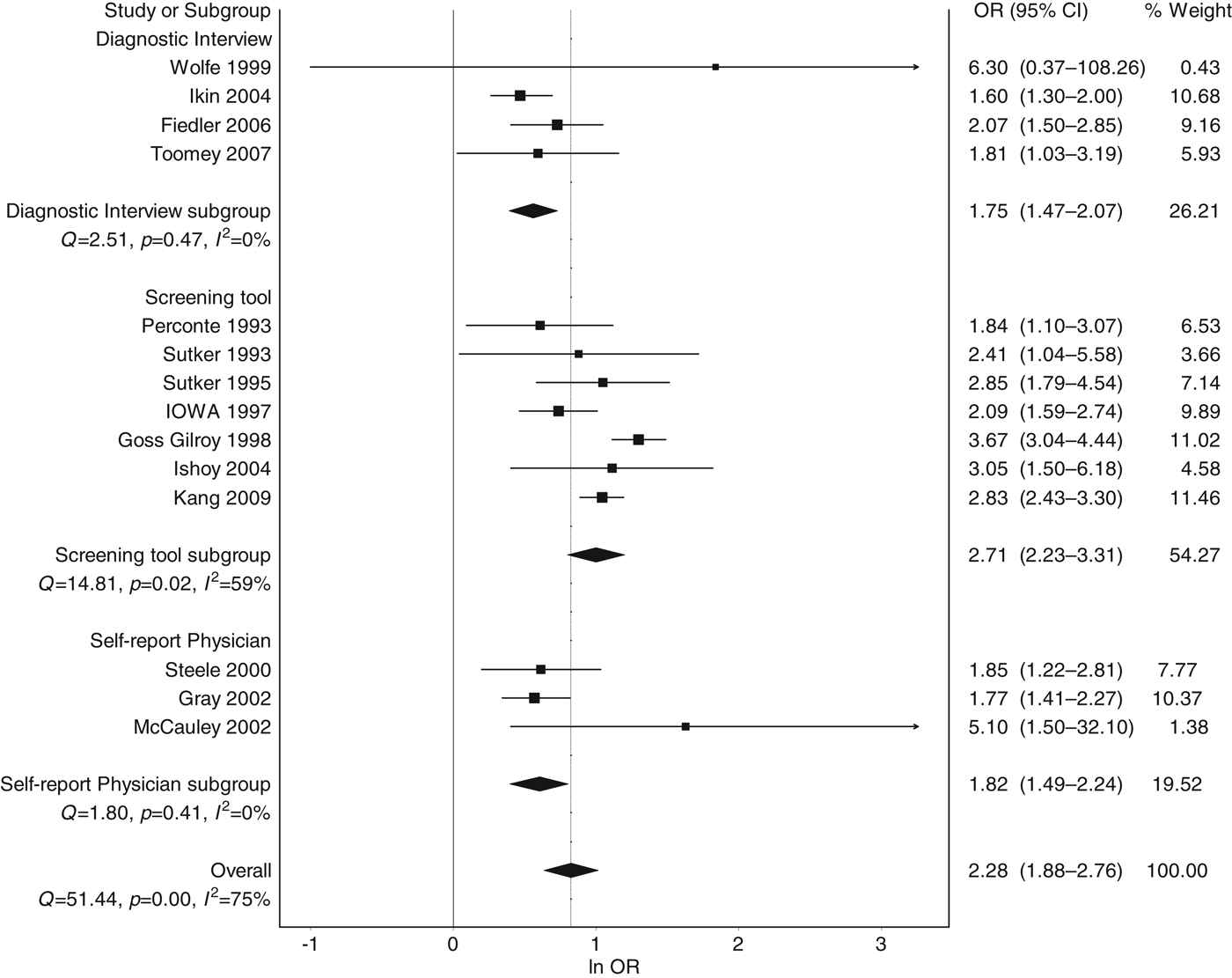
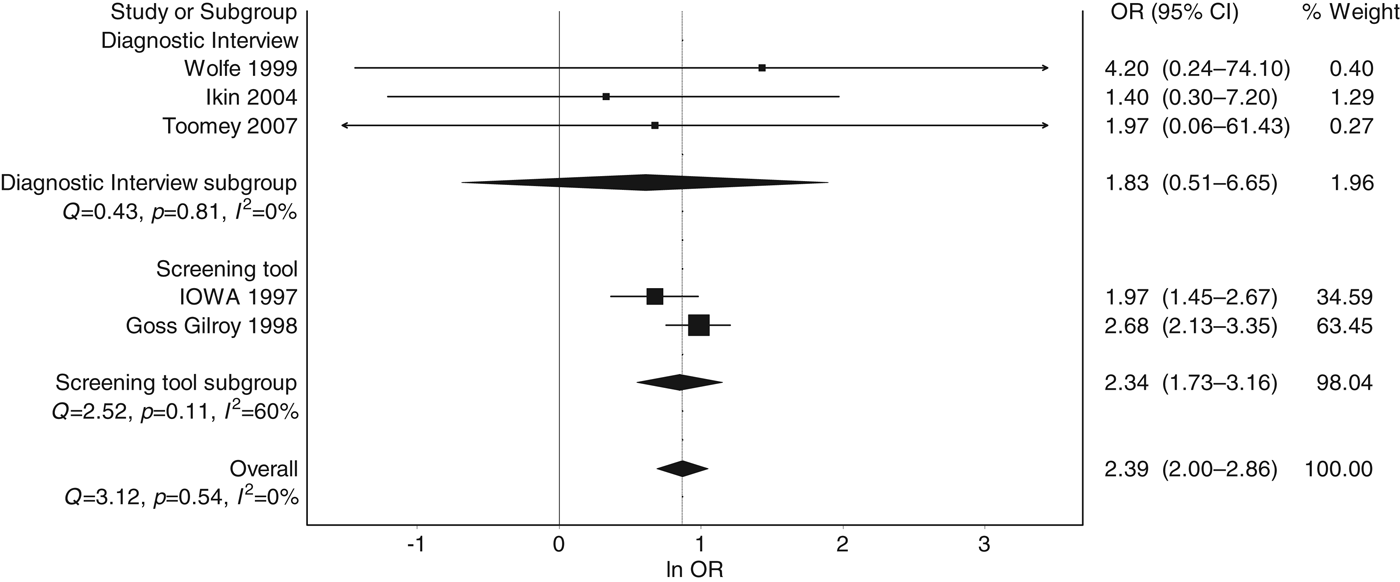
Six of the 14 studies did not present adjusted ORs (Perconte et al. Reference Perconte, Wilson, Pontius, Dietrick and Spiro1993; Sutker et al. Reference Sutker, Uddo, Brailey and Allain1993; IOWA Persian Gulf Study Group, 1997; Wolfe et al. Reference Wolfe, Proctor, Erickson, Heeren, Friedman, Huang, Sutker, Vasterling and White1999; Ishoy et al. Reference Ishoy, Knop, Suadicani, Guldager, Appleyard and Gyntelberg2004; Kang et al. Reference Kang, Li, Mahan, Eisen and Engel2009). We attempted contact with the authors to request this information but we were unable to obtain adjusted ORs for any of the six studies. Where studies did not provide an OR, these were calculated using the reported prevalence, or the numbers of deployed and non-deployed veterans with and without depression, using MetaXL 1.1 (Barendregt & Doi, n.d.), and subsequently entered into the meta-analysis along with the adjusted ORs from other studies. Where data were not presented in the desired categories of deployed versus non-deployed, the results were recalculated using the reported prevalences and numbers of veterans. Table 1 summarizes these 14 studies in the order of the case definition hierarchy given previously and within each of the groupings the studies were ordered by year of publication. The same order was followed in the forest plots (Figs 2 and 3).
Random effects meta-analysis forest plot of depression in Gulf War veterans compared to non-deployed military personnel.

Random effects meta-analysis forest plot of dysthymia or chronic dysphoria in Gulf War veterans compared to non-deployed military personnel.

Gulf War veteran (GWV) health studies investigating depression in GWVs and non-deployed military personnel

MDD, Major depressive disorder; non-deployed, a military comparison group who were not deployed to the Gulf War during the period of operations; CIDI, World Health Organization Composite International Diagnostic Interview (Robins et al. Reference Robins, Wing, Wittchen, Helzer, Babor, Burke, Farmer, Jablenski, Pickens, Regier, Sartorius and Towle1988); PRIME-MD PHQ, Primary Care Evaluation of Mental Disorders Patient Health Questionnaire based on DSM-III-R criteria (Spitzer et al. Reference Spitzer, Williams, Kroenke, Linzer, Hahn, Brody and Johnson1994); PHQ-9, Patient Health Questionnaire Depression Scale based on DSM-IV criteria (Kroenke & Spitzer, Reference Kroenke and Spitzer2002); BDI-I, Beck Depression Inventory-I; BDI-II, Beck Depression Inventory-II; SCL-90-R, Symptoms Check List, Revised Edition (Derogatis & Savitz, Reference Derogatis, Savitz and Maruish1999); PTSD, post-traumatic stress disorder; VAMC, US Veterans Affairs Medical Center; RR, risk ratio; BMI, body mass index; CI, confidence interval.
a Unadjusted OR (random effects model calculated in MetaXL (Barendregt & Doi, n.d.), using reported prevalences and sample sizes for deployed and non-deployed personnel).
b Gulf deployed with no other theatre experience.
Eight of the 14 studies received a high overall risk of bias assessment (Perconte et al. Reference Perconte, Wilson, Pontius, Dietrick and Spiro1993; Sutker et al. Reference Sutker, Uddo, Brailey and Allain1993, Reference Sutker, Davis, Uddo and Ditta1995; Wolfe et al. Reference Wolfe, Proctor, Erickson, Heeren, Friedman, Huang, Sutker, Vasterling and White1999; Steele, Reference Steele2000; Gray et al. Reference Gray, Reed, Kaiser, Smith and Gastanaga2002; McCauley et al. Reference McCauley, Lasarev, Sticker, Rischitelli and Spencer2002; Ishoy et al. Reference Ishoy, Knop, Suadicani, Guldager, Appleyard and Gyntelberg2004). Common factors contributing to this assessment were poorer depression outcome measures (i.e. self-reported physician diagnosis), poorer sample designs (i.e. convenience samples, non-random sample), lack of adjustment for possible confounding factors, high non-response bias and lack of calculation of ORs. None of the four studies using structured diagnostic interviews were assessed as having a high overall risk of bias.
Depression and major depression meta-analyses
The forest plot of the studies reporting depression (see Fig. 2) indicates an increased overall odds for Gulf-deployed compared to non-deployed military personnel reporting depression (OR 2.28, 95% CI 1.88–2.76). Overall heterogeneity, as indicated by I 2, was high, at 75%. Stratification by case definition reduced the heterogeneity dramatically for the diagnostic interview subgroup (I 2 = 0%) and the self-report physician diagnosis subgroup (I 2 = 0%), but less dramatically for the screening tool subgroup (I 2 = 59%). The OR for the group of studies using a screening tool (2.71, 95% CI 2.23–3.31; Perconte et al. Reference Perconte, Wilson, Pontius, Dietrick and Spiro1993; Sutker et al. Reference Sutker, Uddo, Brailey and Allain1993, Reference Sutker, Davis, Uddo and Ditta1995; IOWA Persian Gulf Study Group, 1997; Goss Gilroy Inc., 1998; Ishoy et al. Reference Ishoy, Knop, Suadicani, Guldager, Appleyard and Gyntelberg2004; Kang et al. Reference Kang, Li, Mahan, Eisen and Engel2009) was higher than the OR for the groups of studies using the diagnostic interview (1.75, 95% CI 1.47–2.01; Wolfe et al. Reference Wolfe, Proctor, Erickson, Heeren, Friedman, Huang, Sutker, Vasterling and White1999; Ikin et al. Reference Ikin, Sim, Creamer, Forbes, Mckenzie, Kelsall, Glass, McFarlane, Abramson, Ittak, Dwyer, Blizzard, Delaney, Horsley, Harrex and Schwarz2004; Fiedler et al. Reference Fiedler, Ozakinci, Hallman, Wartenberg, Brewer, Barrett and Kipen2006; Toomey et al. Reference Toomey, Kang, Karlinsky, Baker, Vasterling, Alpern, Reda, Henderson, Murphy and Eisen2007) or the self-report physician diagnosis (1.82, 95% CI 1.49–2.24; Steele, Reference Steele2000; Gray et al. Reference Gray, Reed, Kaiser, Smith and Gastanaga2002; McCauley et al. Reference McCauley, Lasarev, Sticker, Rischitelli and Spencer2002).
The OR for the diagnostic interview subgroup indicates the odds of Gulf-deployed, compared to non-deployed personnel, reporting major depressive disorder, rather than the more general overall outcome of ‘depression’, as all of the interview studies used DSM criteria for MDD.
A meta-analysis stratified by adjustment of OR (adjusted versus unadjusted) indicated little differences in overall odds of depression between the groups [OR (adjusted subgroup) 2.25, 95% CI 1.4–3.6 versus OR (unadjusted subgroup) 2.57, 95% CI 2.2–3.0, forest plot not shown]. Similarly, a meta-analysis stratified by risk of bias (high versus low) indicated little differences in the overall odds of depression between the groups [OR (high risk of bias) 2.03, 95% CI 1.71–2.40 versus OR (low risk of bias) 2.30, 95% CI 1.75–3.04, forest plot not shown].
Dysthymia or chronic dysphoria meta-analyses
Five of the 14 studies summarized in Table 1 reported dysthymia (Wolfe et al. Reference Wolfe, Proctor, Erickson, Heeren, Friedman, Huang, Sutker, Vasterling and White1999; Ikin et al. Reference Ikin, Sim, Creamer, Forbes, Mckenzie, Kelsall, Glass, McFarlane, Abramson, Ittak, Dwyer, Blizzard, Delaney, Horsley, Harrex and Schwarz2004; Toomey et al. Reference Toomey, Kang, Karlinsky, Baker, Vasterling, Alpern, Reda, Henderson, Murphy and Eisen2007) or chronic dysphoria (IOWA Persian Gulf Study Group, 1997; Goss Gilroy Inc., 1998) as outcomes. The forest plot in Fig. 3 indicates an overall OR of similar magnitude to depression; Gulf War veterans had more than twice the odds of reporting dysthymia or chronic dysphoria compared to non-deployed personnel (OR 2.39, 95% CI 2.0–2.86). The overall heterogeneity between studies was small (I 2 = 0%). Consistent with MDD, studies using a diagnostic interview to determine caseness (Wolfe et al. Reference Wolfe, Proctor, Erickson, Heeren, Friedman, Huang, Sutker, Vasterling and White1999; Ikin et al. Reference Ikin, Sim, Creamer, Forbes, Mckenzie, Kelsall, Glass, McFarlane, Abramson, Ittak, Dwyer, Blizzard, Delaney, Horsley, Harrex and Schwarz2004; Toomey et al. Reference Toomey, Kang, Karlinsky, Baker, Vasterling, Alpern, Reda, Henderson, Murphy and Eisen2007) yielded an overall lower OR (1.83, 95% CI 0.5–6.7) compared to studies using screening tools (IOWA Persian Gulf Study Group, 1997; Goss Gilroy Inc., 1998). The two studies using screening tools contributed much greater weight to the calculation of the overall OR than the studies using diagnostic interviews, probably because of the larger sample sizes in the studies using screening tools, although as was also shown in Fig. 2, screening tools generally produced higher ORs than more methodologically rigorous structured diagnostic interviews.
Discussion
Our systematic review and meta-analyses show that Gulf War veterans were more than twice as likely to experience depression compared with military personnel who were not deployed to the Gulf War. The elevated odds of depression were statistically significant in 13 of the 14 studies that were included. Meta-analyses stratified by risk of bias and by outcome measure demonstrated this finding was robust. The overall odds of Gulf War veterans experiencing dysthymia or chronic dysphoria compared to non-deployed personnel were also doubled, although only five of the 14 included studies investigated these conditions, and three of the five estimates were not statistically significant. In addition, two of the five studies were of chronic dysphoria, rather than the DSM-diagnosed condition of dysthymia.
Our results build on the findings of Gadermann et al. (Reference Gadermann, Engel, Naifeh, Nock, Petukhova, Santiago, Wu, Zaslavsky and Kessler2012) and Stimpson et al. (Reference Stimpson, Thomas, Weightman, Dunstan and Lewis2003), who both found approximately twice the risk of MDD and common mental disorders respectively in deployed, compared to non-deployed, personnel. However Stimpson et al. (Reference Stimpson, Thomas, Weightman, Dunstan and Lewis2003) did not examine anxiety and depression separately and only two studies included in their review used a structured diagnostic interview such as the CIDI or SCID to assess depression. Only one of these two studies met our inclusion criteria (Wolfe et al. Reference Wolfe, Proctor, Erickson, Heeren, Friedman, Huang, Sutker, Vasterling and White1999). We included a further three studies (Ikin et al. Reference Ikin, Sim, Creamer, Forbes, Mckenzie, Kelsall, Glass, McFarlane, Abramson, Ittak, Dwyer, Blizzard, Delaney, Horsley, Harrex and Schwarz2004; Fiedler et al. Reference Fiedler, Ozakinci, Hallman, Wartenberg, Brewer, Barrett and Kipen2006; Toomey et al. Reference Toomey, Kang, Karlinsky, Baker, Vasterling, Alpern, Reda, Henderson, Murphy and Eisen2007) published since the Stimpson et al. (Reference Stimpson, Thomas, Weightman, Dunstan and Lewis2003) review that used structured diagnostic interviews. Gadermann et al. (Reference Gadermann, Engel, Naifeh, Nock, Petukhova, Santiago, Wu, Zaslavsky and Kessler2012) only examined US personnel, did not strictly exclude studies without a valid comparison group and did not examine depression separately by theatre of operations. Our review addressed the limitations of previous research in this field and incorporated new studies in finding that there is more than a doubling of risk of depression and dysthymia or chronic dysphoria specifically in Gulf War veterans, rather than deployed groups more broadly.
Our finding was robust to risk of bias, which has not been investigated in previous reviews (Gadermann et al. Reference Gadermann, Engel, Naifeh, Nock, Petukhova, Santiago, Wu, Zaslavsky and Kessler2012; Stimpson et al. Reference Stimpson, Thomas, Weightman, Dunstan and Lewis2003). We drew on current epidemiological practice and expert group recommendations (Higgins et al. Reference Higgins, Altman, Gøtzsche, Jüni, Moher, Oxman, Savovic, Schulz, Weeks and Sterne2011) to use a tool specifically developed for assessing risk of bias in prevalence studies (Hoy et al. Reference Hoy, Brooks, Woolf, Blyth, March, Bain, Baker, Smith and Buchbinder2012). We modified the tool in this study to encompass an assessment of a study's adjustment for possible confounding factors. Our analysis revealed that the overall odds of Gulf War veterans experiencing depression compared to non-deployed personnel did not change substantially according to the risk of bias. However, a further stratified meta-analysis indicated that studies using a structured diagnostic interview or self-reported physician diagnosis yielded a lower risk of depression compared to studies using screening tools. This pattern was similar for dysthymia and chronic dysphoria. Importantly, however, the risk of major depression in Gulf War veterans remained significantly elevated when only studies using the most reliable approach (i.e. structured diagnostic interviews) were included in the analysis.
Strengths and limitations
This review is the first systematic review and meta-analysis to focus separately on depression and dysthymia specifically in Gulf War veterans, using a broad search that incorporated recently published studies combined with strict inclusion criteria. Adopting a rigorous approach to the meta-analysis, we were also able to eliminate many of the methodological concerns that have characterized previous systematic reviews. Specifically, only including studies that included a valid comparison group (military non-deployed personnel) meant that the risk of depression in Gulf War veterans was compared to that within a group that was similar other than in their deployment to the Gulf War, rather than using inadequate comparison groups, such as civilians. Similarly, this criterion necessitates that the odds of experiencing depression in deployed compared to non-deployed personnel were generated within studies, rather than between studies. In addition, studies using treatment-seeking populations were excluded, as they are self-selected, probably experience higher rates of depression, and are not representative of the overall military population of that deployment. Although it should be noted that the earlier studies used DSM-III-R criteria and the later ones used DSM-IV, there is no reason to assume this would have influenced the results. The criteria for depressive disorders in these two editions of the DSM were essentially identical.
By using strict inclusion criteria, we potentially exclude well-conducted prevalence studies that did not use a valid military comparison group. Comparing prevalence studies using different methodologies makes it difficult to ascertain whether the differences were due to the exposure/s of interest, or different methodologies. We combined unadjusted and adjusted ORs for confounders in the meta-analysis; however, a further stratified meta-analysis by adjusted versus unadjusted ORs indicated that the differences in the ORs were small. The focus of this systematic review was depression. We recognize that many Gulf War veterans and comparison group subjects with depression may also meet criteria for other psychological disorders including PTSD, substance use disorders and anxiety disorders (Ikin et al. Reference Ikin, Sim, Creamer, Forbes, Mckenzie, Kelsall, Glass, McFarlane, Abramson, Ittak, Dwyer, Blizzard, Delaney, Horsley, Harrex and Schwarz2004). A detailed examination of this co-morbidity, however, was beyond the scope of this review and would detract from the primary focus. The reality is that depression is often ignored in studies of veterans’ mental health, which tend to focus on PTSD. By no means all cases of depression will be identified using PTSD-specific measures and an overemphasis on PTSD risks missing substantial psychopathology. It is therefore important to study depression in its own right among veteran populations.
Implications of findings
The findings of this meta-analysis have important implications for our understanding of the relationship between Gulf War service and depression that is important for the medical management of this group of veterans. An earlier systematic review (Stimpson et al. Reference Stimpson, Thomas, Weightman, Dunstan and Lewis2003) reported an OR of 3.2 for PTSD in Gulf War veterans, a figure comparable to that found for depression in our analysis. It is, perhaps, not surprising that PTSD rates are high because that diagnosis was specifically designed to detect psychiatric disorder following exposure to extreme stress such as military deployment to a combat zone. Our finding that risk of depression is comparably high, however, is of great importance because depression can be missed; if clinicians are looking only for PTSD, they may only find PTSD. In reality, of course, these veterans routinely present with a complex mix of psychiatric and physical problems. The initial challenge is often one of engaging the veteran and developing a therapeutic alliance, before collaboratively generating a treatment plan. To do this, a comprehensive diagnostic formulation is required, and our review should help to highlight the importance of considering depression.
Our review has demonstrated that major depression and dysthymia are important conditions of which clinicians need to be aware when considering treatment plans and management strategies for Gulf War veterans. The impact of depression on engagement in treatment for other conditions, and on social and occupational functioning more broadly, needs to be considered. The findings also have important implications for defense forces and veterans’ affairs departments in deployed and veteran health policy and practice, particularly in terms of designing service models. Future research could consider factors that contribute to high overall risk of bias, such as non-random sampling, inadequate case definitions, non-calculation of estimates of effect size or collection of data on and adjustment for confounders.
This study highlights a consistently elevated risk of depression in Gulf War veterans compared to their non-deployed military counterparts. This elevated risk was robust despite different study methodologies, populations (US, Australian, Danish), branches of service (reservists, navy, air force), psychological outcome measures and sampling designs. The US deployed nearly 700 000 military personnel to the 1990/1991 Gulf War, Australia deployed close to 2000 personnel, the UK deployed approximately 53 000 military personnel, France deployed over 18 000 personnel, Canada deployed over 4000 personnel, Denmark deployed close to 700 personnel and more than 30 other countries provided air, sea or ground forces to the coalition as part of the multinational response to the invasion of Kuwait by Iraq on 2 August 1990. A doubling of the risk of serious and debilitating psychological disorders such as major depression and dysthymia are likely to have a high impact in these veterans and remains a relevant medical problem more than 20 years after the war. Studies in veterans of the Afghanistan and Iraq Wars suggest that these deployed personnel are returning with elevated levels of psychological disorders including depression (Ramchand et al. Reference Ramchand, Karney, Osilla, Burns, Caldarone, Tanielian and Jaycox2008; Wells et al. Reference Wells, Miller, Adler, Engel, Smith and Fairbank2011); this study serves as a reminder of the importance of considering depression in assessing veterans’ health. A small but growing literature of health in these veterans also suggests a high level of co-morbidity between disorders, such as PTSD, depression, and physical injuries such as traumatic brain injury (Carlson et al. Reference Carlson, Kehle, Meis, Greer, MacDonald, Rutks and Wilt2009). Such findings have important implications for effective treatment for Gulf War veterans.
Acknowledgments
This work was supported by a grant from the Australian Department of Veterans’ Affairs (DVA) to H. Kelsall, A. Forbes, M. Creamer and M. Sim (grant number ARP1122). The views expressed are not necessarily those of the Australian Government. We thank L. Romero, Senior Librarian at Alfred Health Ian Potter Library, for her guidance and expertise in developing the search strategy.
Declaration of Interest
None.