Introduction
In the second half of the first century ad, southern Britain was conquered by the Romans, to become the northernmost outpost of the Roman Empire. Despite its peripheral geographic location, the inclusion of the island within the Empire entailed a series of major socio-economic and cultural changes. The significance, character, and distribution of such changes, and the survival and influence of Iron Age traditions, have variably been interpreted and debated by historians and archaeologists alike. Some archaeological indicators, such as settlement patterns, ceramics, and iconography, have been linked to issues of cultural and economic domination, resistance, and syncretism, and have been the subject of intensive investigations (e.g. Millett, Reference Millett1990a, Reference Millett, Blagg and Millett1990b; Webster, Reference Webster2001; Pitts, Reference Pitts2008).
Zooarchaeology—the study of animal remains from archaeological sites—has also been contributing to our understanding of the Roman economy and culture since at least the 1970s. Through time and experience, zooarchaeologists have managed to identify a series of traits that are considered typical of husbandry practices during the Roman period. Such traits, however, tend to vary, sometimes substantially, between macro-regions and site-types. In the north-western provinces of the Empire, some clear patterns have been recognized: with very few exceptions, animal husbandry focused primarily on cattle, which was intensively exploited for traction in agricultural work and for meat production. Sheep, which in many areas dominated the animal economy in the British late Iron Age, became of secondary importance, while pigs, which played a major role in food production in Roman Italy, were the least represented of the three most common livestock species (cattle, sheep, and pig). Butchery practices became standardized and aimed at large-scale full exploitation of bovine carcasses (Grant, Reference Grant and Todd1989; King, Reference King1999; Albarella, Reference Albarella, Haselgrove and Moore2007; Maltby, Reference Maltby, Croxford, Ray and Roth2007).
Although the large size of cattle remains from Roman sites has long been recognized, more recent studies have analysed livestock morphometry through time and at different site-types, highlighting the complex dynamics and patterns of animal management which characterized the Roman period (Albarella, Reference Albarella, Haselgrove and Moore2007; Albarella et al., Reference Albarella, Johnstone and Vickers2008). These studies are now being complemented by the analysis of stable isotopes from animal remains, a promising though still under-exploited field of research, which suggests increased cattle mobility, first in the late Iron Age and then, more so, in the Roman period (Minniti et al., Reference Minniti, Valenzuela, Evans and Albarella2014).
Until recently, however, little attention has been paid to the transition between the late Roman and early Anglo-Saxon periods. In part, this is the result of the dearth of non-urban sites showing continuity of occupation between the fourth and the fifth–sixth centuries ad; discontinuity is indeed a topic frequently associated with the establishment of Anglo-Saxon communities and is often reflected in the material culture recovered from their settlements and cemeteries (e.g. Reece, Reference Reece1989; Evans, Reference Evans1990; Hamerow, Reference Hamerow2012). Early Anglo-Saxon animal husbandry has mainly been investigated in settlements that were established after the fall of Roman Britain. Most notably, the fifth- to seventh-century site of West Stow has been the subject of extensive investigation (Crabtree, Reference Crabtree1989). The evidence from this and other sites reveals a considerable degree of variation in terms of representation of the main domesticates and their use, although most assemblages differ greatly from those of the preceding Roman period (Crabtree, Reference Crabtree, Crabtree and Ryan1991, Reference Crabtree2014; Holmes, Reference Holmes2014). Such lack of regional coherence during the early period of Anglo-Saxon establishment may suggest that, in the immediate aftermath of the arrival of the Anglo-Saxons, the rural economy was not yet fully settled and integrated (O'Connor, Reference O'Connor2014). Rather, it seems that the character of animal husbandry was dictated by the needs of local, self-sufficient communities and by environmental constraints.
This study encompasses the transitions between the late Iron Age and the early Roman period, as well as between the late Roman and the early Anglo-Saxon periods. It attempts to assess the nature and extent of change in the biometric traits and butchery of the main domesticates. The interpretation of similarities and differences between assemblages dated to either ends of these transitions will contribute to characterize husbandry practices during the period of Roman occupation of Britain.
Sites and Materials
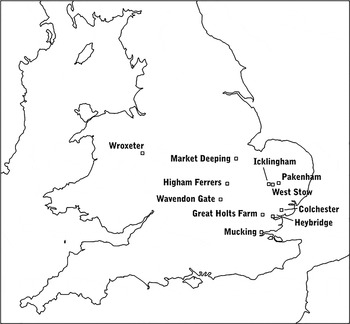
The study presents and discusses the zooarchaeological evidence from nine sites located in central-eastern England (Figure 1). These sites were chosen on the basis of their geographical location and the availability of biometric and butchery data. Some sites were rescue excavations, others research projects; consequently, recovery methods differ to some extent. However, the main evidence considered in this paper—biometry and butchery—is only marginally affected by recovery bias. Bearing in mind the great cultural variation of the three periods investigated, i.e. the late Iron Age, Roman and early Anglo-Saxon periods, all sites used in this study were, or soon developed into, civilian settlements.
Location of sites mentioned in the text.

Iron Age assemblages
Three sites with Iron Age phases have been considered in this study: Market Deeping (Lincolnshire), Heybridge (Essex), and Wavendon Gate (Milton Keynes, Buckinghamshire). The first site provided material from the middle to late Iron Age, which has been compared to the late Iron Age phases from the two latter excavations. Cattle remains prevail, though to different extents, at all three sites; exploitation of cattle was multi-purpose, with a focus on traction. Sheep husbandry was also important and was geared towards meat and wool production (Dobney & Jaques, Reference Dobney, Jaques, Williams, Hart and Williams1996; Albarella, Reference Albarella1997a; Johnstone & Albarella, Reference Johnstone and Albarella2002, Reference Johnstone, Albarella, Atkinson and Preston2015).
Roman assemblages
Data from the Roman period were collected from Heybridge, Wavendon Gate, Great Holts Farm (Essex), Pakenham, and Icklingham (the latter two in Suffolk). The first two sites provided data covering the whole period of Roman occupation; only late Roman data could be used from Pakenham, while Great Holts Farm and Icklingham are dated to the late Roman period only. At all Roman sites husbandry practices relied on cattle, which were intensively exploited for meat production and traction. Sheep were raised for meat and, to a lesser extent, wool, while pigs were less common (Beech, Reference Beech1991; Dobney & Jaques, Reference Dobney, Jaques, Williams, Hart and Williams1996; Albarella, Reference Albarella1997b; Johnstone & Albarella, Reference Johnstone and Albarella2002, Reference Johnstone, Albarella, Atkinson and Preston2015; Crabtree, Reference Crabtree2014).
Early Anglo-Saxon assemblages
The early Anglo-Saxon period is covered by three sites: West Stow (Suffolk), Higham Ferrers (Northamptonshire), and Mucking (Kent). The material selected for West Stow is dated to the fifth to early sixth century, while the assemblages from Higham Ferrers and Mucking are broadly dated to the fifth to seventh centuries. Caprines (mostly sheep) are more frequent than in the late Roman period, although cattle continue to play an important role; in general, the faunal evidence fits well the model of unspecialized husbandry practices, in which the main domesticates are exploited for a wide range of products (Crabtree, Reference Crabtree1989; Done, Reference Done and Hamerow1993; Albarella, Reference Albarella2000).
Methods
Biometry
The biometric data selected from each site were compared to highlight similarities and differences in the size and shape of remains of cattle, caprines (sheep/goat), and pig.
The measurements from post-cranial bones and teeth were taken according to von den Driesch (Reference von den Driesch1976), Payne & Bull (Reference Payne and Bull1988), and Davis (Reference Davis1992, Reference Davis1996). Unfused and fusing bones, as well as immature (porous or light) astragali, were excluded.
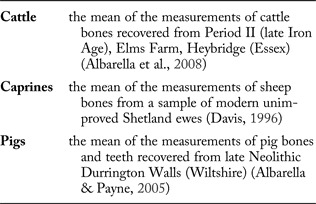
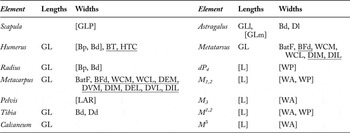
The analysis of measurements from the same element is to be preferred whenever possible, as it provides a better control on those variables that affect growth. In particular, teeth and different bones tend to react differently and to a different extent to ageing and sex, as well as to other variables such as nutrition and pathology (Payne & Bull, Reference Payne and Bull1988; Popkin et al., Reference Popkin, Baker, Worley, Payne and Hammon2012). In this study, it was possible to analyse elements individually in a few cases only. When the sample size was too small, measurements from different bones had to be merged by using a size index scaling technique; this method relates each measurement to a standard, producing a series of relative values which can be plotted on the same scale (Simpson et al., Reference Simpson, Roe and Lewontin1960; Meadow, Reference Meadow, Becker, Manhart, Peters and Schibler1999; Albarella, Reference Albarella, Dobney and O'Connor2002). The standards employed in this study are listed in Table 1, while the complete list of measurements used in the histograms is provided in Table 2.
Standards used in this study for producing the log ratio histograms.

List of measurements used in the log ratio histograms.

Measurements in square brackets, including all those from teeth, were only used for pigs, while those underlined were also used as sex-dependent measurements in one log ratio histogram (see Results). For an explanation of each measurement see references in the text.
The technique which calculates the decimal logarithm of the ratio between each measurement and the standard (‘log ratio’) was employed here, since it is easy to apply, provides a good visual representation, and is widely employed in the literature (Meadow, Reference Meadow, Becker, Manhart, Peters and Schibler1999; Albarella & Payne, Reference Albarella and Payne2005).
Although scaling index techniques make it possible to increase the sample size, the inclusion of bones which react differently to different variables compromises the resolution of the final results. Consequently, patterns related to changes in size or sex ratio may be masked or overemphasized (Meadow, Reference Meadow, Becker, Manhart, Peters and Schibler1999; Albarella, Reference Albarella, Dobney and O'Connor2002). Specific measurements can be excluded to mitigate these problems; still, the commonly encountered dearth of data, which makes this method invaluable to zooarchaeology, does not always make it possible to be particularly selective in the measurements to use.
Post-cranial bones and teeth have to be analysed separately since they react very differently to selective pressures. In particular, teeth tend to be conservative in terms of size changes within a population; hence abrupt variations in their size or shape suggest the introduction of a new genotype (Payne & Bull, Reference Payne and Bull1988).
In this study, the smallest breadth of the diaphysis of long bones (SD) and the smallest length of the collum scapulae (SLC) were excluded, as these measurements tend to increase after skeletal maturity and through the life of an animal, i.e. they are heavily affected by age. Other measurements are also affected by age, but to a lesser extent. In this study, however, the kill-off patterns of the animal populations compared did not differ substantially.
To avoid reducing the sample size, measurements that are variably sex dependent were generally combined (but see Results for a case in which it was possible to assess the effect of this variable on sheep metric data).
In a few cases length and width measurements were analysed separately, because dimensions lying on different axes can react differently to selection and environmental stimuli. Separating measurements makes it possible to verify whether measurements located on different axes are consistently different from the standard. If they are not, then shape differences between the standard populations and the analysed assemblage must be postulated (Davis, Reference Davis1996; Meadow, Reference Meadow, Becker, Manhart, Peters and Schibler1999). In this study, width and depth measurements were combined and compared to lengths. When shape differences were investigated, length and width/depth measurements from single bones were considered and analysed separately.
For pigs it was necessary to combine lengths and widths/depths in the same histograms due to the dearth of biometric data for this species, while for cattle and sheep only widths/depths were used to assess changes in size. In most cases, more than one measurement was available from the same bone and these were all included (see Table 2), except those mentioned above. Although this generated a greater element of interdependence of the plotted measurements, it also helped enhance the sample size. Because of the interdependence of measurements, mean differences could not be statistically tested; nonetheless, the patterns are fairly clear.
The biometric data from each site have been presented separately whenever possible. In some instances, the dearth of data from individual sites meant that they had to be grouped according to chronological phases.
All animal remains identified as caprines (sheep/goat) were used in this study, unless they had been clearly identified as goats. Evidence for the presence of goats in Roman and Anglo-Saxon England is very scant (Noddle, Reference Noddle, Hall and Kenward1994; Albarella with Pirnie & Viner, Reference Albarella, Pirnie and Viner-Danielsin prep.); for this reason, caprine specimens can reasonably be assumed to represent mainly sheep remains, and as such they have been treated.
Butchery
The incidence of butchery marks on cattle bones was calculated on the total number of bones recorded for that species for each assemblage and phase. Cut, chop, and saw marks were considered together. Specialized butchery practices were noted in terms of presence/absence.
Results
Biometric and butchery data are presented to compare patterns in the late Iron Age and the early Roman period, as well as the late Roman and early Anglo-Saxon periods. The results are described separately for each species.
Cattle
Biometry
Animal husbandry at most of the sites analysed here focused on cattle. In particular, during Roman times this animal was intensely exploited for traction in agricultural work, as well as for large-scale meat production and redistribution (Luff, Reference Luff1982; Grant, Reference Grant and Todd2007). Cattle remains are also particularly abundant in the Iron Age assemblages considered here, though many other sites dated to this period have a prevalence of caprines (Albarella, Reference Albarella, Haselgrove and Moore2007). Enough data from cattle remains were also available for the early Anglo-Saxon sites of West Stow, Higham Ferrers, and Mucking to provide a comparison with the late Roman period. As a result, the biometric data from cattle made it possible to investigate changes that took place in both transition phases.
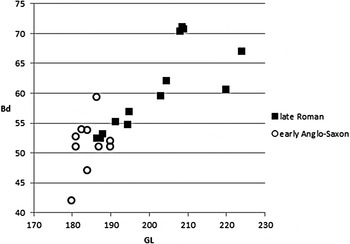
The pattern of change presented by the breadth of distal humeri from Iron Age, Roman, and early Anglo-Saxon assemblages illustrates the developments in the biometric characters of cattle throughout these periods (Figure 2). A clear increase in size is evident from the late Iron Age to the Roman period; despite the dearth of measurements from early Anglo-Saxon assemblages, it is also possible to detect a decrease in size in the post-Roman period. Metacarpals provide a similar picture; in Figure 3, values cluster in two separate groups, with Anglo-Saxon specimens being much smaller than their late Roman counterparts.
Distal humeri, breadth of trochlea (BT) (cattle). Histograms by periods, with measurements (in mm) from Heybridge, Wavendon Gate, Pakenham, Mucking, Higham Ferrers, and West Stow. Triangles indicate the means.

Metacarpals, greatest length (GL) vs distal breadth (Bd) (cattle). Scatter plot for the late Roman and early Anglo-Saxon periods, with measurements (in mm) from Great Holts Farm, Heybridge, Pakenham, Wavendon Gate, Mucking, and West Stow.

Although the study of measurements from individual elements allows a better control on variables affecting bone growth, the analyses presented here unfortunately rely on small sample sizes. Both humeri and metacarpals are substantially affected by sexual dimorphism, and the risk of a differential representation of males and females (as well as castrates) is enhanced when dealing with small samples.
The following analyses make use of the scaling index technique. The standard values used to calculate the log ratio are the mean values of cattle remains from the late Iron Age (Period II) at Heybridge (Johnstone & Albarella, Reference Johnstone and Albarella2002, Reference Johnstone, Albarella, Atkinson and Preston2015). This can be used as an additional element of comparison in the analyses that follow.
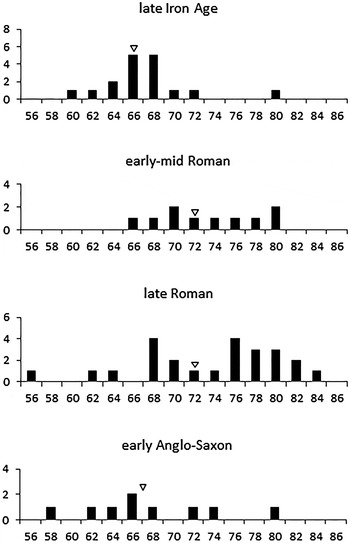
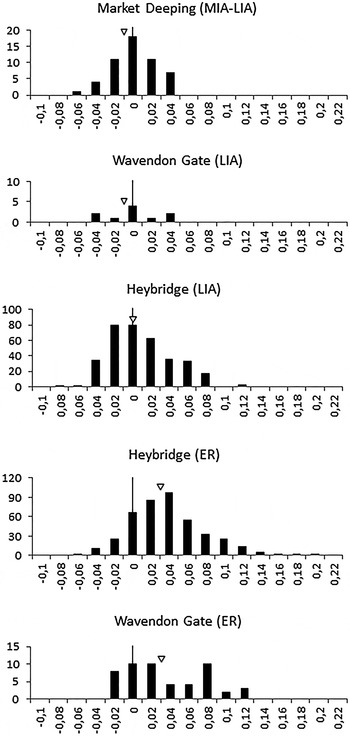
Figure 4 confirms the results obtained from the distal humeri. Both the middle to late Iron Age remains from Market Deeping and the late Iron Age material from Wavendon Gate are on average the same size as those from the same period from Heybridge, represented by the standard (whose average obviously lies at 0). The larger size of the remains from early Roman Heybridge and Wavendon Gate is evident, both in the log ratio average and in the distribution, which is clearly skewed to the right of the standard. Differences in age between the two periods could potentially affect such a trend, as some bones may continue to grow post-fusion. However, the kill-off pattern from early Roman Heybridge is similar to that of its late Iron Age phase (Johnstone & Albarella, Reference Johnstone and Albarella2002, Reference Johnstone, Albarella, Atkinson and Preston2015). Roman cattle at Wavendon Gate, on the other hand, were culled at an even younger age, and this underlines the fact that the size increase in this period is genuine (Dobney & Jaques, Reference Dobney, Jaques, Williams, Hart and Williams1996). Similarly, changes in the sex ratio are unlikely to have occurred, as highlighted by the analyses carried out for Heybridge by Albarella et al. (Reference Albarella, Johnstone and Vickers2008) and as suggested by the nature of the kill-off patterns mentioned above. Different proportions of females, males, and castrates are unlikely to have had an effect on livestock morphometry.
Log ratio histograms by site-periods (cattle, post-cranial bones, widths/depths combined). Triangles indicate the logarithmic means. Here and in the following figures: MIA = Middle Iron Age; LIA = Late Iron Age; ER = Early Roman; MR = Middle Roman; LR = Late Roman; EAS = Early Anglo-Saxon.

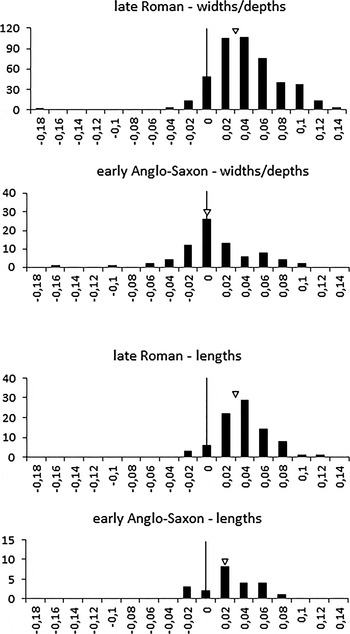
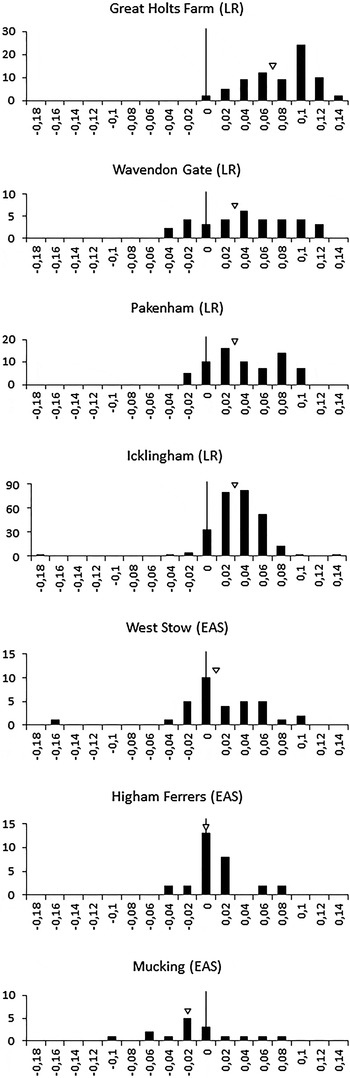
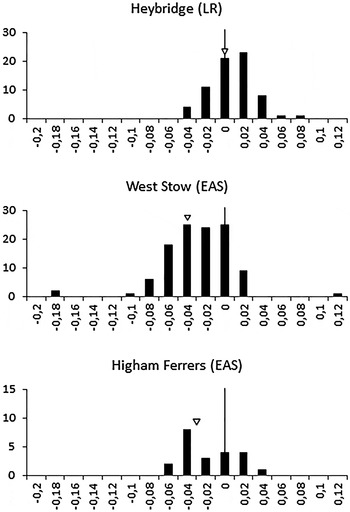
The comparison between late Roman and early Anglo-Saxon assemblages suggests a reversal to smaller animals. The difference is less pronounced for lengths (but note the smaller sample size; Figure 5), which may perhaps indicate more slender animals in the later period. Figure 6 presents the results separately for each site. The late Roman animals from Great Holts Farm were exceptionally large. At late Roman Wavendon Gate and Pakenham, cattle remains are as large as they were in the early Roman period at Wavendon Gate and at Heybridge, while the animals from Icklingham were slightly smaller. The values from early Anglo-Saxon West Stow, Higham Ferrers, and Mucking, on the other hand, tend to cluster around the standard, in a way similar to the late Iron Age assemblages shown in Figure 4. Despite the animals from West Stow being only slightly smaller than those from late Roman Icklingham, the biometric evidence from these sites altogether suggests a generalized decrease in the size of cattle in the post-Roman period. Although differences in the sex ratio can potentially compromise biometrical comparisons between site-periods, there is no substantial evidence for different proportions of males, females, and castrates in the assemblages considered. In addition, a comparison of the slightly bimodal patterns of cattle measurements at Great Holts Farm, Pakenham, and West Stow in Figure 6 highlights the decrease in average size of both females and males/castrates.
Log ratio histograms by periods (cattle, post-cranial bones, lengths and widths/depths shown separately), with measurements from Icklingham, Great Holts Farm, Pakenham, Wavendon Gate, West Stow, Higham Ferrers, and Mucking. Triangles indicate the logarithmic means.

Log ratio histograms by site-periods (cattle, post-cranial bones, widths/depths combined). Triangles indicate the logarithmic means.

Butchery
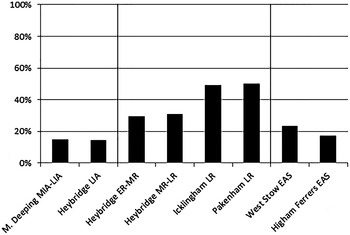
The incidence of butchery marks on cattle bones has been calculated for all the periods considered in this study (Figure 7). The cattle from Roman sites were much more intensely butchered than those from late Iron Age or early Anglo-Saxon assemblages. The pattern is clear for all the eight site-periods analysed. In addition, in the Roman assemblages there is evidence for specialized butchery practices.
Incidence of butchery marks by site-periods (cattle).

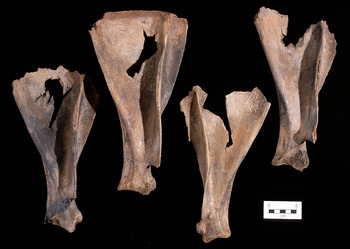
At Heybridge and Pakenham the scapulae (the most frequent cattle bone at Pakenham) were butchered in a standardized way: the acromion and spine were often chopped off at the base. The rim of the glenoid cavity was sometimes trimmed and vertical chop marks were also recorded on the coracoid process, which was often removed, and the neck. Cut and chop marks were often present along the upper and lower borders, sometimes recalling the ‘shaving’ marks described by Lauwerier (Reference Lauwerier1988). Cut marks were recorded, often in large quantities, on the ventral and dorsal sides of the scapular blade. In addition, ‘hook damage’ was often recorded; it consists of irregular holes on the blade, which are usually interpreted as the result of hanging the shoulder for curing (Schmid, Reference Schmid1972) (Figure 8).
Butchered cattle scapulae from Roman Heybridge, with hook marks visible on the blade. Scale: 5 cm.

This evidence suggests that cured beef shoulders were consumed on site; it is widely recognized as diagnostic of Roman butchery practice in the central and north-western provinces (Schmid, Reference Schmid1972; Lauwerier, Reference Lauwerier1988; Dobney et al., Reference Dobney, Jaques and Irving1996). Dobney (Reference Dobney, James and Millet2001) attempted to distinguish between hooked scapulae, which would have represented the remains of hot-smoked joints, and trimmed and intensely chopped scapulae, i.e. butchery activities that favoured the process of brining and cold smoking. However, in many instances the scapulae from Heybridge and Pakenham present both these patterns, underlining the difficulty of identifying a precise curing process on the basis of butchery traits.
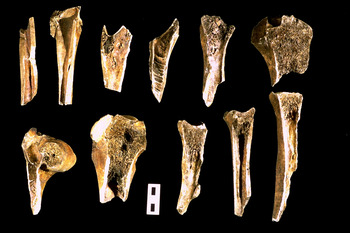
At Heybridge, Pakenham, and Icklingham many long bones were longitudinally split, resulting in helical breakages along the shaft; furthermore, in many instances the degree of chopping and fragmentation was very high (Johnstone & Albarella, Reference Johnstone and Albarella2002, Reference Johnstone, Albarella, Atkinson and Preston2015; Crabtree, Reference Crabtree2010; Rizzetto, Reference Rizzetto2014). The splitting of long bones is related to the extraction of marrow; this represented a valuable food source, although marrow could also be used for glue production or as fuel. Intensive bone chopping was probably for extracting fat and producing broth, hence the label ‘kitchen-soup’ given to discrete deposits that exclusively contain this kind of material (Schmid, Reference Schmid1972; van Mensch, Reference van Mensch1974; Maltby, Reference Maltby, Croxford, Ray and Roth2007) (Figure 9). Like the butchered (and often hooked) scapulae, this feature is characteristic of the northern half of the Roman Empire, but is unknown in the Mediterranean area, as well as in late Iron Age and early Anglo-Saxon assemblages.
‘Kitchen-soup’ deposit from Ortons Pasture, Rocester (Staffordshire). Scale: 3 cm.

Sheep
The biometric datasets for sheep provided enough data to cover the late Roman to early Anglo-Saxon transition; however, earlier developments revealed by the study of the Heybridge material (Albarella, et al., Reference Albarella, Johnstone and Vickers2008) will be integrated in the discussion below.
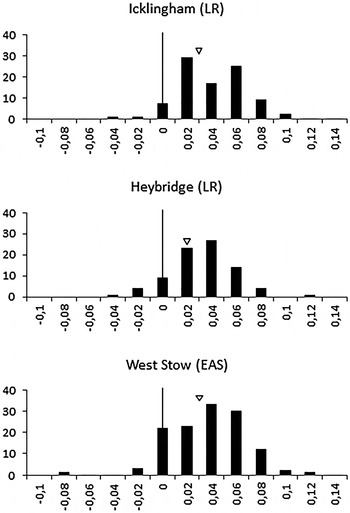
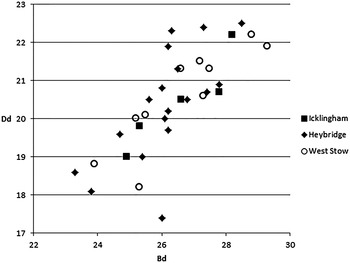
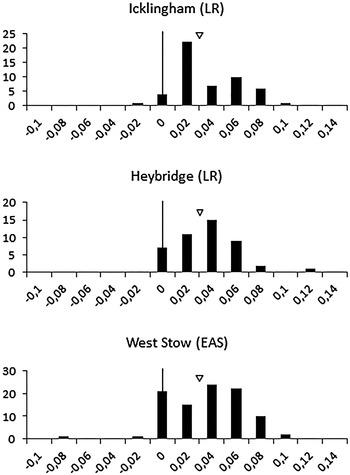
The width measurements of sheep bones from Icklingham and Heybridge (late Roman) and West Stow (early Anglo-Saxon) do not differ in terms of either log ratio average or distribution of values (Figure 10). The breadths and depths of the distal tibia confirm this result, with the values from West Stow covering the whole size range of the specimens from late Roman Heybridge (Figure 11).
Log ratio histograms by site-periods (sheep, post-cranial bones, widths). Triangles indicate the logarithmic means.

Distal tibiae, distal breadth (Bd) vs distal depth (Dd) (sheep). Scatter plot for the late Roman and early Anglo-Saxon periods, measurements in mm.

Measurements from humeri and metapodials, which are heavily sex-dependent (Davis, Reference Davis1996, Reference Davis2000), were also analysed. Size overlap between ewes, rams, and castrates occurs, and clear separations between their size ranges are unlikely to emerge from the histograms. Nevertheless, analyses employing this set of measurements are more affected by sex than other anatomical elements considered here. The results showed little or no difference in the proportion of female and male individuals (Figure 12). This suggests that the absence of substantial differences in size between late Roman and early Anglo-Saxon assemblages is genuine and not the coincidental result of changes in the sex ratio.
Log ratio histograms by site-periods (sheep, post-cranial bones, widths/depths combined), sex-dependent measurements. Triangles indicate the logarithmic means.

Pig
Pigs are only raised for meat and therefore tend to be slaughtered as soon as they reach their optimum weight. When this occurs, the animal has not yet reached full skeletal maturity and consequently most pig bones recovered from archaeological sites are unfused or fusing. As a result, the pig bone metric dataset is rather small. Five sites nevertheless produced enough data to assess potential changes in the biometry of pigs during the transition between the late Roman and early Anglo-Saxon periods.
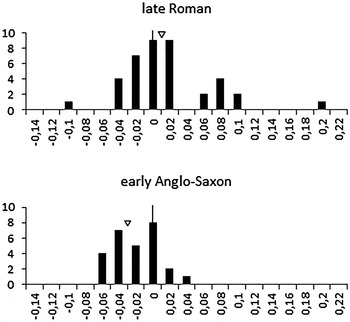
When the post-cranial bone data from individual sites are combined into two phases (late Roman and early Anglo-Saxon), there appears to be a perceivable decrease in size (Figure 13). The occurrence of wild boar (difficult to distinguish from the domestic pig) may potentially confuse this picture. However, the whole dataset includes only one large outlier from Icklingham, which suggests that wild boar is insufficiently common to substantially affect the pattern of size variation.
Log ratio histograms by periods (pig, post-cranial bones, lengths and widths/depths combined), with measurements from Icklingham, Pakenham, West Stow, and Mucking. Triangles indicate the logarithmic means.

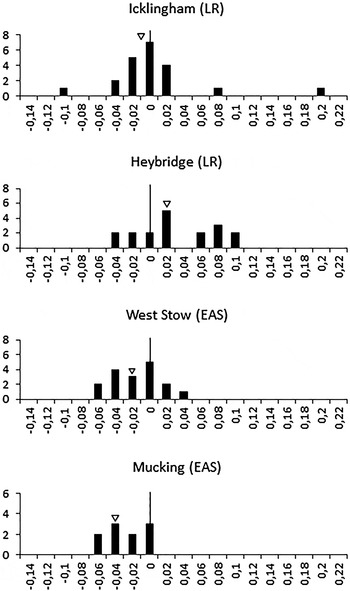
The evidence from individual sites provides some important details and warns against uncritical interpretations of combined assemblages (Figure 14). The animals from Icklingham (fourth century ad) are only slightly larger than those from Anglo-Saxon West Stow. The difference in size is however much more evident when the large pigs from late Roman Heybridge are compared to those from West Stow and especially Mucking.
Log ratio histograms by site-periods (pig, post-cranial bones, lengths and widths/depths combined). Triangles indicate the logarithmic means.

No pig tooth data are available for Icklingham, but a comparison between late Roman Heybridge and early Anglo-Saxon West Stow and Mucking suggests that pig teeth at these latter sites were much smaller (Figure 15).
Log ratio histograms by site-periods (pig, teeth, lengths, and widths). Triangles indicate the logarithmic means.

Discussion
Animal husbandry in Britain before and after the Romans
Biometrical studies of faunal remains have previously highlighted the larger size of Romano-British livestock, especially cattle, in comparison to late Iron Age animals. Such difference in size has been interpreted in terms of improvement promoted by the Romans (Albarella et al., Reference Albarella, Johnstone and Vickers2008). Larger and more robust cattle would have provided a greater quantity of meat and stronger workforce in the fields; similarly, the improvement in the size of sheep, pig, and even chicken would have resulted in a higher meat output.
The results presented in this article largely confirm such trends but also add new dimensions and detail to them. Cattle from early Roman assemblages (Heybridge III and Wavendon Gate) are larger than those from the late Iron Age contexts (Heybridge II and Wavendon Gate). In addition, cattle from late Iron Age sites are no larger than those from Market Deeping, more generally dated to the middle to late Iron Age. Although more biometric data from middle and late Iron Age sites are needed before drawing definite conclusions, currently we have no evidence of an increase in size occurring within the Iron Age.
The changes that occurred at the onset of the early Anglo-Saxon period seem to point in the same direction. The size gained under the Romans is lost; the cattle from the three early post-Roman sites used in this study are both smaller and much more gracile than their Roman counterparts.
Such a decrease in size and robustness remains difficult to interpret, and more biometrical studies on teeth and post-cranial bones are needed to provide a clearer picture of what occurred during the late and post-Roman periods. Large assemblages from the early Anglo-Saxon period are particularly rare, and in many cases provide no or little information on animal size. Clutton-Brock, for example, merely states that Anglo-Saxon cattle were ‘smaller than modern feral populations’ (Clutton-Brock, Reference Clutton-Brock and Wilson1976: 379). More detailed conclusions were drawn for south-eastern England, where the withers’ heights of early Anglo-Saxon cattle were defined as intermediate between Iron Age and Roman values (Crabtree, Reference Crabtree2012, Reference Crabtree2014). Cattle remains from the baths basilica site at Wroxeter (Shropshire), on the other hand, are no smaller in the fourth to sixth century than they were in the previous period, although in all phases their size remains considerably smaller than in Roman Heybridge (Hammon, Reference Hammon2011). In western Britain, the reduced impact of Roman influence on animal husbandry is reflected by other lines of archaeological evidence (Evans, Reference Evans1990 and references therein). The urban character of Wroxeter may have also caused an underestimation of potential livestock improvements under the Romans (for a discussion on settlement types and biometry, see Albarella et al., Reference Albarella, Johnstone and Vickers2008).
Biological processes and human agency may both have played a role in the size diminution of cattle at the three early Anglo-Saxon sites discussed here. It is likely that, when the selective pressures for larger animals were relaxed after the Roman period, the size of cattle gradually settled down and decreased slightly as a result of the lack of control in breeding or introduction of larger stock. However, it has been recognized that herds of smaller cattle existed side-by-side with improved animals throughout the period of Roman occupation (Maltby, Reference Maltby, Jones and Dimbleby1981). Luff (Reference Luff1982) even argued that some of these small-sized cattle were smaller than those dated to the Iron Age.
The dynamics of improvement suggested by Albarella et al. (Reference Albarella, Johnstone and Vickers2008) seek to explain the pattern of variation observed at Roman sites. The improvement of cattle is unlikely to have been a homogeneous process: larger cattle are first observed at producer and trading centres (such as at the villa at Great Holts Farm, Essex), where herds were dominated by imported cattle. Local animals were improved through interbreeding (e.g. at Heybridge), though at urban centres like Colchester (Essex), the effects of this ‘improvement’ were gradual, due to the multiple supply of a variety of cattle types to the main towns (Albarella et al., Reference Albarella, Johnstone and Vickers2008). In less ‘Romanized’ urban sites small animals often persisted, alongside a prevalence in sheep husbandry (King, Reference King1999). Variation in the size of cattle during Roman times is therefore to be expected, and indeed this is evident in the late Roman assemblages analysed here: the animals at Great Holts Farm are large (most likely as a result of imports), those from Icklingham relatively small (only slightly larger than those from West Stow), while those from Wavendon Gate, Pakenham, and Heybridge (Albarella et al., Reference Albarella, Johnstone and Vickers2008) lie in between.
As for pigs, the smaller size of bones from early Anglo-Saxon assemblages is paralleled by a clear difference in tooth size, which is smaller at West Stow and Higham Ferrers than at late Roman Heybridge. Although more assemblages need be analysed before generalizing the results to the rest of Britain, the evidence suggests that genetically distinct pig herds existed, as teeth are less susceptible than bones to environmental stimuli. At Heybridge, there is a highly significant increase in the size of pig teeth, along with an increase in bone size, between the early and mid-Roman periods (Albarella et al., Reference Albarella, Johnstone and Vickers2008). This, in combination with the difference in pig tooth size between late Roman Heybridge and the early Anglo-Saxon assemblages, suggests that larger pigs were introduced from continental Europe in Roman times, as has already been suggested for cattle.
The adoption of small animals by early Anglo-Saxon settlers cannot be regarded as a return to Iron Age standards but it certainly indicates a form of cultural and economic change. Perhaps the improvement of livestock required a range of skills and resources which were no longer available or selected for. In addition, it is likely that, by the fifth century, the large animals of the Roman period were rare or had already undergone a process of size diminution through interbreeding with local stock.
Large domesticates would obviously provide a series of advantages in terms of meat yield and, for cattle, traction force. The assumption that they had to be preferred at all times, however, relies more on modern theories of economic maximization than on the actual variables that affected choices made by past rural communities. It is possible, in other words, that improved livestock was simply not needed by early Anglo-Saxon settlers.
On most early Anglo-Saxon sites, animal exploitation did not focus as much on cattle (and traction) as in Roman times, but was rather based on small-scale meat production and on a range of secondary products such as dairying and wool. Large livestock would have also required more resources, labour, and skills to maintain, especially during winter. In addition, the subsistence economy which characterizes early Anglo-Saxon sites entailed a local redistribution of animal food, for which large carcasses of bovines were not well suited; ad hoc butchery of sheep or pig for use by a restricted group of people was much more the norm than the large-scale standardized beef production which characterized the Roman period. The analysis of the butchery evidence supports the latter suggestion: cattle bones are much less intensively butchered in early Anglo-Saxon assemblages (as indeed in late Iron Age ones); they also lack any indications of the specialized butchery activities observed on Roman sites.
The butchery activities described above (production of cured beef shoulders, marrow extraction, and ‘soup-kitchen’ deposits) probably derived from Roman military practices in the north-western provinces, and have been associated with the large-scale activity of professional butchers (Grant, Reference Grant and Todd1989). The widespread presence of these specialists reflects changes in the redistribution of beef: in Roman times, this relied on wholesale procurement, slaughter, and redistribution within a structured market system. In the Iron Age and early Anglo-Saxon period, on the other hand, animal remains derive from occasional local butchery events.
Because of these different needs, early Anglo-Saxon communities relied on sheep husbandry rather than cattle. In general, sheep husbandry requires less labour and resources than cattle herding. It is probably not by chance that sheep is the only domesticate at West Stow which is not smaller than the animals from late Roman assemblages, as the Anglo-Saxons invested many of their resources in the breeding of sheep.
Environmental conditions must also be taken into account when interpreting differences in livestock types. In Britain, a much higher concentration of Roman settlements characterizes the lowlands in the centre-south and south-east of the province, usually richer in heavy clay soils than the highlands in the centre-north and north-west, which were less affected by the socio-economic and cultural changes introduced by the Romans (Evans, Reference Evans1990). Although a recent large-scale review of British Roman sites (The Rural Settlements of Roman Britain project) has revealed a more homogeneous distribution than previously thought, a higher settlement density in the east remains visible when agricultural settlements are considered (Allen et al., Reference Allen, Blick, Brindle, Evans, Fulford, Holbrook, Richards and Smith2015). Larger cattle would have been useful for ploughing the heavy soils of the lowlands, where ‘Romanized’ settlements are concentrated, while they were less important on lighter soils, where quite a few of the ‘indigenous’ and post-Roman settlements can be found.
North-west Suffolk provides a good example in this respect. The late Roman site of Icklingham and the early Anglo-Saxon site of West Stow lie on the southern fringes of the Breckland, an area characterized by light, sandy soils, whose exploitation for agricultural purposes did not require the use of large robust animals. The late Roman site of Pakenham, on the other hand, lies on clay land a few kilometres east and, as mentioned earlier, produced particularly large cattle remains. Not only were the animals from West Stow smaller, but environmental conditions could partly explain why cattle from Icklingham are the smallest of all the late Roman examples analysed here.
Although local climate and soil conditions played a role, it is important to contextualize the evidence within the wider political and economic conditions of the Roman Empire. The fact that the improvement of domesticates is a central feature of Roman animal husbandry in many other provinces—e.g. in France (Lepetz & Yvinec, Reference Lepetz, Yvinec and Manneville1998), the Netherlands (Lauwerier, Reference Lauwerier1988; Groot, Reference Groot2008, Reference Groot2016), and Italy (MacKinnon, Reference MacKinnon2010)—warns us of the danger of interpreting cultural change in a small-scale, merely environmental, perspective.
The socio-economic context of change
The biometric and butchery analyses presented here highlight some key aspects of animal husbandry in Britain during the Roman period. Ultimately, these can contribute to characterizing the Roman economy and society in this corner of the Empire and beyond.
A major consequence of the socio-economic changes introduced by the Romans when they conquered a territory was the need for the lower class to produce a surplus. This was sold in local markets, and the money acquired in this way would have been used to pay cash taxes and rents. Such cycles fuelled a series of changes in production, distribution, and consumption at the lowest levels, which resulted in an overall increase in agricultural production and specialization; cumulatively, these changes brought about large-scale interregional flows of money and goods, with increasing urbanization and the establishment of a functional settlement hierarchy (Hopkins, Reference Hopkins1980; Esmonde Cleary, Reference Esmonde Cleary1989).
On a theoretical basis, such flows contributed to the integration of the local economy in that of the Empire. In practice, however, local conditions meant that considerable spatial and temporal variations existed. For example, the impact of change would have been much greater in areas where the previous economic system was entirely different, for instance where peasants used to pay little or no cash taxes.
The third-century crisis caused money to be debased considerably and created the need to increase taxation in kind. The collapse of the traditional fiscal system resulted in a decline of trade; however, the need for peasants to produce a surplus remained unchanged. Constantine's reorganization of the army and Diocletian's administrative reforms were designed to accommodate the new taxation system and increase the efficiency and control over tax collection (Esmonde Cleary, Reference Esmonde Cleary1989).
In the first half of the fifth century, the Romano-British economy experienced a dramatic decline, with evidence for imported goods and local traditional produce almost disappearing from the archaeological record (Evans, Reference Evans1990). Whatever the approach of individual authors to the study of the Roman economy, many suggest a link between such a decline and the collapse of taxation which followed the end of effective Roman control (e.g. Esmonde Cleary, Reference Esmonde Cleary1989; Evans, Reference Evans1990). Lewit (Reference Lewit2009) strengthens the argument by comparing the economic situation in the western and eastern parts of the Roman Empire in the fifth to sixth centuries: in the Eastern Roman Empire, the survival and continuation of central control and economic structures allowed and promoted settlement expansion, as well as an increase in agricultural production and specialization.
In sum, the Roman administration of Britain created the conditions for a series of long-lasting changes in the economy of the island, which were to endure until the very end of Roman Britain. Such changes had a great impact on food production and redistribution, mainly because of the need to sustain surplus production.
When changes in the size of the livestock and in butchery practices are interpreted within this politico-economic framework, it becomes easier to understand the reasons behind the initial sudden improvement of cattle, which were directly involved in agricultural production and could provide large quantities of meat. Similar developments in other domesticates would also fit within an economy which prioritized the production of a surplus. In the fifth century, the disappearance of improved animals and Roman butchery practices reflect the demise of Roman control on the island, highlighting even more the key role played by the Romans in shaping the economy of Britain for almost four centuries.
The new political and economic conditions brought about by the arrival of groups of people from continental Europe implies a radical reconsideration of the aims and nature of food production. The small, self-sufficient settlements that replaced Roman towns and market centres engaged in a less specialized form of husbandry (O'Connor, Reference O'Connor2014). Decision-making would have been driven by local needs and environmental conditions, with a marked increase in regional and micro-regional variation.
Conclusions
The comparison of the biometric and butchery evidence has revealed a clear pattern of change which affected cattle, pig, and sheep at all the sites considered in this study. Such change was, however, not homogeneous and local variation can be observed. Among the variables and processes involved, the complex dynamics of Roman animal improvement, the different extent of Romanization of some regions, environmental conditions, as well as local adaptation to new economic and political conditions in the immediate post-Roman period, played a part.
Overall, the nature and extent of changes in early Roman Britain and in the early post-Roman period suggest the introduction and collapse of a substantially new economic system. Unspecialized husbandry practices of the early Anglo-Saxon period should be seen as a functional adaptation to new socio-economic and political conditions, rather than as part of an inevitable process of decline.
The number of early Anglo-Saxon sites where zooarchaeological investigation can be undertaken is still low. In addition, the coverage within Britain is uneven, hindering a proper analysis of regional variation. However, the present study highlights the potential of an approach which combines different lines of zooarchaeological analysis. Although the debate is far from closed, there is sufficient zooarchaeological evidence to suggest that the four centuries of Roman occupation of Britain genuinely represented an anomaly, when seen as part of the long-term historical trajectory from late prehistory to the onset of the Middle Ages.
Acknowledgements
Many thanks to the anonymous referees for constructive comments and the Editorial Board for support and suggestions. We would also like to thank Jude Plouviez and Faye Minter, who gave us access to relevant material.