




No CrossRef data available.
Article contents
Risk factors for augmentation of the flow of blood to the lungs in pulmonary atresia with intact ventricular septum after radiofrequency valvotomy
Published online by Cambridge University Press: 22 April 2005
Abstract
Some patients with pulmonary atresia with an intact ventricular septum, mild to moderate right ventricular hypoplasia, and a patent infundibulum remain duct dependent on the flow of blood through the arterial duct despite adequate relief of the obstruction within the right ventricular outflow tract.
The objective of our study was to review the risk factors for stenting of the patent arterial duct, or construction of a Blalock-Taussig shunt, in the patients with pulmonary atresia and an intact ventricular septum who remain duct-dependent following radiofrequency valvotomy and dilation of the imperforate pulmonary valve.
We reviewed the data from 53 patients seen between November 1995 and December 2001. Of the 47 patients who survived, 6 required stenting of the patent arterial duct, while 4 needed construction of a modified Blalock-Taussig shunt to augment the flow of blood to the lungs at a mean of 7 plus or minus 5.7 days following the initial intervention. The remaining 37 patients required no additional procedures. We compared the findings in these two groups.
The mean diameter of the tricuspid valve in the patients requiring early reintervention was 8.5 plus or minus 3.7 millimetres, giving a Z-score of −1.1 plus or minus 1.47, whilst those in the group without early reintervention had values of 10.7 plus or minus 2.2 millimetres, giving a Z-score of −0.58 plus or minus 1.18 (p equal to 0.003). No statistically significant differences were found in right ventricular morphology, McGoon ratio, or residual obstruction across the right ventricular outflow tract after decompression of the right ventricle.
The diameter of the tricuspid valve, therefore, appears to be the only factor predicting the need for augmentation of flow of blood to the lungs. As just over one-fifth of our survivors required such augmentation, we hypothesize that stenting of the patent arterial duct may be performed as an integral part of primary transcatheter therapy in patients with pulmonary atresia and intact ventricular septum who have moderate right ventricular hypoplasia and a small tricuspid valve.
Keywords
Information
- Type
- Original Article
- Information
- Copyright
- © 2005 Cambridge University Press
The recent improvement noted in the survival over the short and medium term for patients with pulmonary atresia and an intact ventricular septum is due to better understanding of its anatomy, especially the morphology and size of the right ventricle.1, 2 Patients with severely hypoplastic right ventricles, a feature often associated with absence of the infundibulum and the presence of communications from the right ventricle to the coronary arteries, are assigned to functionally univentricular repair, while those with mild-to-moderate right ventricular hypoplasia and a patent infundibulum generally have a good outcome following surgical valvotomy, often with concomitant construction of a systemic-to-pulmonary arterial shunt.3, 4 Transcatheter valvotomy using radiofrequency, followed by balloon dilation of the imperforate pulmonary valve, however, is increasingly being accepted as an alternative to conventional surgery.5–8
Some patients, nonetheless, remain deeply cyanosed despite seemingly undergoing an adequate relief of the obstruction within the right ventricular outflow tract, requiring prolonged infusions of prostaglandin. Because of this, many surgeons choose routinely to construct a modified Blalock-Taussig shunt at the time of surgical valvotomy.3, 4 For those who undergo pulmonary valvoplasty as the primary treatment for right ventricular decompression, a second procedure in the form of construction of the surgical shunt may be required. For some patients, stenting of the patent arterial duct has been performed as an alternative to surgical creation of the shunt.9 This additional source of flow of blood to the lungs is required until the right ventricular compliance improves, and the right ventricle grows sufficiently to support the pulmonary circulation, or until the patient is ready for creation of a bidirectional cavopulmonary anastomosis in those whose right ventricular morphology is less than ideal.
Mirroring the fairly common surgical practice of routinely constructing a Blalock-Taussig shunt at the time of valvotomy, the question could be posed as to whether the patent arterial duct should routinely be stented as an integral part of transcatheter valvotomy, given that not an insignificant number of patients remain dependent on continued infusion of prostaglandin E1 despite adequate relief of obstruction at the ventricular outlet. With this question in mind, we have reviewed the risk factors for stenting of the patent arterial duct, or construction of a Blalock-Taussig shunt, in those patients with pulmonary atresia and an intact ventricular septum who remain dependent on flow through the arterial duct following radiofrequency valvotomy and dilation of the imperforate pulmonary valve.
Materials and methods
We retrospectively reviewed all patients with pulmonary atresia and an intact ventricular septum who underwent successful radiofrequency valvotomy in our institution from November 1995 to December 2001. All patients had a patent infundibulum, with an imperforate pulmonary valve. Detailed echocardiographic evaluation and radiofrequency valvotomy was performed as previously described.10 A HAT 300 radiofrequency generator, and 0.018 inch cerebalate wire was used (Suizer Osypka). All patients were ventilated for at least 4 hours after the procedure, and prostaglandin E1 was infused for at least 24 hours. In those patients who we could not wean from the infusion within 2 weeks, we either constructed surgically a modified Blalock-Taussig shunt, or stented the patent arterial duct.
Stenting was done antegradely via the newly opened right ventricular outflow tract (Fig. 1). Prostaglandin was stopped in the catheterization laboratory just prior to the procedure. A 0.014 inch coronary wire was passed from the aortic side into the pulmonary trunk using a Judkin right coronary catheter of 4 French dimension, or a pigtail catheter with a cut tip. The floppy tip of the wire was then snared in the pulmonary trunk, taken out of the venous sheath, and a Judkin right guiding catheter of 6 French dimension was then passed antegradely across the patent arterial duct into the aorta. An aortogram was performed to evaluate the length and diameter of the patent arterial duct at its narrowest point, usually at the site of insertion to the pulmonary artery, and at the ampulla. All stents used were of 4.0 millimetres in diameter, as all patients had restrictive ducts with a narrowest diameter of less than 2.5 millimetres despite infusion of prostaglandin to ensure a reasonable duration of patency. The stents chosen were between 2 and 3 millimetres longer than the length of the duct from its ampulla to the site of insertion into the pulmonary. The mean length was 11.9 millimetres plus or minus 2.8 millimetres. The stent, mounted on a balloon, was tracked over a 0.014 inch coronary wire antegradely into the descending aorta just distal to the duct (Fig. 1c). The Judkin guiding catheter was then withdrawn into the pulmonary trunk to expose the balloon and the stent. The stent was then gently pulled back, positioned, and adjusted to ensure that the entire length of the duct would be covered by the stent upon inflation. One or more aortograms were performed to ensure accurate positioning of the stent prior to inflation of the balloon. A final angiogram was done at the end of the procedure (Fig. 1d). The mean time required for stenting was 120 plus or minus 23.9 minutes. After stenting, the patients were routinely commenced on an infusion of heparin at 25 micrograms per kilogram per hour for 48 hours, followed by aspirin at a dose of 5 milligrams per kilogram daily.

Figure 1. A right ventriculogram (a) demonstrating a moderately sized right ventricle with a patent infundibulum and pulmonary atresia. The aortogram (b) shows a patent arterial duct which is stenosed. A cineangiogram (c) shows the passage of the stent antegradely across the newly opened right ventricular outflow tract following radiofrequency valvotomy and balloon valvoplasty. After stenting, another aortogram (d) shows good flow across the duct.
We divided the patients into 2 groups, those requiring stenting of the duct or construction of a Blalock-Taussig shunt, and those who did not require such early reintervention. We then compared the anatomic and haemodynamic data between the 2 groups. The information was retrieved from the records, echocardiography tapes, and reports of cardiac catheterization.
We reviewed the diameter of the tricuspid valve annulus, its Z value using the mean normal values calculated by Rowlatt, Rimoldi and Lev,11, 12 the degree of tricuspid regurgitation, right ventricular size and morphology, the presence or absence of communications between the right ventricle and the coronary arteries as documented on echocardiogram, and the size of the pulmonary arteries normalized to the diameter of the aortic root on angiography, the so-called McGoon index. The haemodynamic parameters of interest were residual obstruction within the right ventricular outflow tract, and the presence and degree of pulmonary and tricuspid regurgitation after ventricular decompression.
Group undergoing early reintervention.
A total of 52 patients underwent radiofrequency valvotomy as the primary procedure. Following the initial intervention, if the patients remained dependent on flow through the duct, in that they required an infusion of prostaglandin for more than 2 weeks, or their saturations of oxygen dropped to less than 60 percent despite being on prostaglandin, they were considered as requiring early re-intervention. Of the 47 survivors, 10 patients needed adjunct procedures to augment the flow of blood to the lungs. The arterial duct was stented in 6 patients, while in the other 4 we constructed surgically a modified Blalock-Taussig shunt. At the time of right ventricular decompression, their median weights and age were 3.1 kilograms, with a range from 2.4 to 6.8 kilograms, and 8 days, with a range from 3 days to 7 months, respectively.
The procedures to augment flow of blood to the lungs were done at a mean of 7 plus or minus 5.7 days following the initial procedure. In half, this was required as a semi-emergent procedure.
Group not requiring early reintervention.
There were 37 patients in this group. Their median ages and weight at intervention were 7 days, with a range from 1 day to 8 years, and 3.25 kilograms, with a range from 2 to 18 kilograms respectively. In three-quarters, infusions of prostaglandin E1 had been required prior to the procedure, but only 11 of the 43 patients (25.5 percent) required prostaglandin for more than 48 hours following the radiofrequency valvotomy.
Follow-up.
The duration of follow up in all patients was 21.3 plus or minus 10.6 months. We reviewed the duration of patency of the stents, the acquisition of any stenosis, and the need for any early reintervention. We also noted the degree of cyanosis, and echocardiographic observations relative to right ventricular growth and residual obstruction within the right ventricular outflow tract.
Statistical analysis.
The data were expressed as mean and standard deviations or median and range. Non-parametric statistical tests were used to compare the 2 groups. A p value of less than 0.05 was considered significant.
Results
Of the 47 survivors, 10 required procedures to augment the flow of blood to the lungs. There was no significant difference in the median weight or age of these patients at intervention compared to those not requiring an intervention (Table 1).
Table 1. Demographic and echocardiographic data.

The echocardiographic details prior to the intervention in both groups were not remarkable, with almost all patients having tripartitie right ventricular cavities. Equally, there was no significant difference in the grade of tricuspid regurgitation, or the presence of communications between the right ventricle and the coronary arteries (Table 1). The only difference noted between the groups was the mean diameter of the tricuspid valve, along with its mean Z-score (Figs 2 and 3). The mean diameter in the patients who needed additional procedures to augment pulmonary flow was 8.5 plus or minus 3.7 millimetres, whilst in those not requiring such procedures, the diameter was 10.7 plus or minus 2.2 millimetres (p equal to 0.003). This difference was also reflected by the mean Z-score of the tricuspid valve, at −1.1 plus or minus 1.47 in those undergoing early reintervention versus −0.85 plus or minus 1.18 in the group without early reintervention (p equal to 0.03). There was a wider scatter in the diameters of the tricuspid valve and its Z-score in the group not requiring early reintervention, with 2 patients having a Z-score of less than −2.5. In one of the patients undergoing early reintervention, there was associated Ebstein's malformation, and the Z-score for the tricuspid valve was more than 2.5.

Figure 2. Scattergraph showing the diameter of the tricuspid valve in the patients undergoing early reintervention as opposed to those without early reintervention.

Figure 3. Scattergraph showing the Z-scores for the diameter of the tricuspid valve in our two groups of patients.
There was no significant difference in the McGoon index between the two groups, nor were there significant differences in the degree of tricuspid or pulmonary regurgitation after ventricular decompression, or residual obstruction of the right ventricular outflow tract.
No major complications were encountered during stenting, except for transient supraventricular tachycardia in 2 patients, neither did any patient die after the procedure, and none of the patients suffered over-circulation to the lungs.
At follow-up, all stents except one had occluded spontaneously at a median of 6.85 months, with a range from 5 days to 36 months after stenting. The majority of the patients did not suffer any clinical deterioration when the shunt blocked. By then, the right ventricular compliance had improved, and the ventricle could sustain the pulmonary circulation. In one patient, the stent occluded after 5 days, and this patient required emergency construction of a Blalock-Taussig shunt. At mean follow-up of 13.3 plus or minus 12.1 months, with a median of 13.6 months, all survivors of those undergoing early reintervention had attained a biventricular circulation. None of the survivors required another procedure.
In those patients not requiring early reintervention, at mean of 10.7 plus or minus 8.1 months, 4 patients underwent a one-and-a-half ventricle repair, whilst the remaining patients had retained their biventricular circulations. In 2 of the 4 patients needing the one-and-a-half option, the Z-scores for the tricuspid valve were −3.5 and −4. The third had an Ebstenoid malformation of the tricuspid valve, while the last had severe infundibular pulmonary stenosis. In 6 of the patients not requiring early reintervention, a second procedure was needed to establish adequate antegrade flow into the pulmonary arteries 3 to 6 months after the radiofrequency valvotomy. In 4, the interventional valvoplasty was repeated, while in the other 2 the right ventricular outflow tract was reconstructed surgically.
Discussion
Pulmonary atresia with an intact ventricular septum is an uncommon disease, characterized by a wide variation in the size and morphology of the right ventricle, and a possible association with abnormalities of the coronary arterial circulation, precluding a uniform strategy of treatment.2, 13 In the subgroup of infants with a patent infundibulum blocked by an imperforate pulmonary valve, the outcome is favourable because it is often associated with mild, or at most moderate, right ventricular hypoplasia. Usually there is also only mild or moderate tricuspid regurgitation, and it is rare to find major communications between the right ventricle and the coronary arteries. In such patients, pulmonary valvotomy alone may be all that is required, a procedure that in the modern era of cardiac surgery is expected to have an excellent outcome. Many surgeons, nonetheless, additionally construct a systemic-to-pulmonary arterial shunt at the time of valvotomy, since a small number of patients, even with good right ventricular anatomy and adequate ventricular decompression, continue to remain deeply cyanosed due to persistently poor right ventricular compliance.3, 4 In the spectrum of anatomy seen in the setting of pulmonary atresia with intact ventricular septum, there are also patients with a more severe form of right ventricular hypoplasia, but nevertheless with a patent infundibulum and an imperforate pulmonary valve who hence are amenable to valvotomy. An additional source of flow of blood to the lungs, as for example by construction of a Blalock-Taussig shunt, is more likely to be required in these patients, as establishing continuity between the right ventricle and the pulmonary arteries may not guarantee adequate antegrade flow. Nowadays, radiofrequency valvotomy and balloon dilation of the imperforate valve have been shown to produce comparable outcomes to surgery, and are increasingly used as an alternative procedure.5, 7, 14
In our 47 patients who survived radiofrequency valvotomy, we retrospectively studied the morphologic and haemodynamic data, comparing the 37 patients who required no early re-intervention with the 10 who required augmentation of flow of blood to the lungs within 2 weeks of the initial procedure. Those patients requiring early reintervention had smaller right ventricular sizes as indicated by their smaller Z-scores for the tricuspid valve. These patients had a higher tendency to remain deeply cyanosed after an adequate right ventricular decompression, and required reintervention. There was some overlap between the groups, nonetheless, in relation to right ventricular size. In the group undergoing early reintervention, 2 patients had favourable right ventricles, while another 2 patients in the group not needing early reintervention had tricuspid valves with a Z-score less than −2.5. There was no difference between the groups with regard to the presence and degree of tricuspid regurgitation, the severity of residual obstruction within the right ventricular outflow tract, or the McGoon index.
Of the 10 patients needing augmentation of the flow of blood to the lungs, 4 needed a modified Blalock-Taussig shunt while, in the later part of our series, we stented the duct in the remaining 6 patients. Stenting has been shown to be a feasible alternative to construction of an arterial shunt, although experience with this technique is still limited.6, 10, 15 Blalock-Taussig shunts have the well-recognized complications, in the medium term, of causing distortion and stenosis of the pulmonary arteries, and loss of perfusion to the upper lobes on the side of the shunt. Being much more invasive, the surgical procedures may also be complicated by paralysis of the phrenic nerve, pleural effusion, and chylothorax, all requiring a longer stay in intensive care.16, 17 In this respect, stenting seems more attractive, but the results of early reports were not encouraging.13 More recent series, nonetheless, have been more promising.18, 19 In these 2 series, stenting of the arterial duct anterogradely via the newly opened pulmonary valve in patients with critical pulmonary stenosis and pulmonary atresia and intact septum who had been treated earlier with balloon dilation with or without radiofrequency valvotomy was shown to be safe, with no major complications.18, 19
In these series, the durability of patency was inferior to what is generally accepted for Blalock-Taussig shunts, but in the special situation of pulmonary atresia with intact ventricular septum, this is largely of no great significance, as augmentation of flow to the lungs is required only for a few weeks or months, over which time right ventricular compliance is expected to improve. In those with a less favourable right ventricle, the patients would by then have grown, and be able better to tolerate procedures such as reconstruction of the right ventricular outflow, or creation of a cavopulmonary anastomosis, by the time the stent has become severely stenosed or occluded. This was noted in all our patients except one, in whom the stent occluded after 5 days. This patient needed urgent construction of a Blalock-Taussig shunt. With the newer coronary stents that are coated with heparin, and with a more scrupulous attention to anticoagulation, the risk of acute thrombosis may be decreased.20
Given the potential for stenting the arterial duct, and the feasibility of this technique as an extension of transcatheter valvotomy, is there sufficient justification for incorporating stenting as an integral part of radiofrequency valvotomy, at least in selected patients, to mirror the widely accepted surgical practice of constructing a modified Blalock-Taussig shunt at the time of pulmonary valvotomy? The justification for the surgical practice is based on the difficulty of predicting right ventricular compliance after ventricular decompression, where valvotomy alone may not guarantee adequate oxygenation, even in patients with favourable size of the right ventricle. Does the data exist to support this interventional equivalent of an accepted surgical practice?
Our data illustrates the difficulty of predicting the improvement in right ventricular compliance after right ventricular decompression, especially in a lesion that is uncommon yet anatomically diverse. Given the constraint of the small number of patients who required augmentation of pulmonary flow, and the overlap between those with or without early reintervention, it is difficult to interpret the data conclusively. In the fairly large recent series reported by Agnoletti et al.,7 two-thirds of the patients undergoing successful transcatheter valvotomy remained dependent on prostaglandin and required augmentation of pulmonary flow after the initial procedure. The median tricuspid Z-score in their series was −1.2. Similarly, in the series reported by Humpl et al.,8 half of those undergoing successful transcatheter valvotomy required construction of shunts from 2 to 24 days after the initial procedure, with a mean Z-score of −1.33 plus or minus 1.58.8 Based on these data,7, 8 where more than half of the patients required Blalock-Taussig shunts within 2 to 3 weeks of valvotomy, would it be reasonable to recommend stenting of the duct at the time of valvotomy, provided this can be done safely and with relative ease? This would more than offset the costs incurred by long hospital stays, and that of an additional surgical procedure. On the other hand, this may mean that as many as half of patients are subjected to stenting when they do not really need it. The extra flow from the stented duct may lead to excessive pulmonary flow and cardiac failure. Alternatively, one may take the approach of prophylactic stenting in those with clearly small right ventricles, having Z-scores of less than −1.3. Based on our results, more than four-fifths of our patients who need reintervention have such Z-scores of less than −1.3. Subsequent to this retrospective experience, we have adopted the strategy of routinely stenting the arterial duct at the time of radiofrequency valvotomy in patients whose Z-score for the tricuspid valve was less than −1.3. This is not technically difficult, takes approximately an additional 20 minutes of procedural time, and carries minimal complications. A large multi-institutional study, nonetheless, may be needed to shed better light on the understanding of right ventricular compliance in the setting of pulmonary atresia with an intact ventricular septum.
References
De Leval M, Bull C, Stark J, Anderson RH, Macartney FJ. Pulmonary atresia and intact ventricular septum: Surgical management based on revise classification. Circulation 1982; 66: 272–280.Google Scholar
Freedom RM, Wilson G, Trusler GA, Williams WG, Rowe RD. Pulmonary atresia and intact ventricular septum: a review of the anatomy, myocardium and factors influencing right ventricular growth and guidelines for surgical intervention. Scand J Thorac Cardiovasc Surg 1983; 17: 1–28.Google Scholar
Jahangiri M, Zurakowski, Bichell D, et al. Improved results with selective management in pulmonary atresia and intact ventricular septum. J Thorac Cardiovas Surgery 1999; 118: 1046–1055.Google Scholar
Hanley FL, Sade RM, Blackstone EH, et al. Outcomes in neonatal pulmonary atresia with intact ventricular septum: a multi-institutional study. J Thorac Cardiovasc Surg 1993; 105: 406–427.Google Scholar
Ovaert C, Qureshi SA, Rosenthal E, Baker EJ, Tynan M. Growth of the right ventricle after successful transcatheter pulmonary valvotomy in neonates and infants with pulmonary atresia and intact ventricular septum. J Thorac Cardiovasc Surg 1998; 115: 1055–1062.Google Scholar
Alwi M, Geetha K, Bilkis AA, et al. Pulmonary atresia with intact ventricular septum – percutaneous radiofrequency valvotomy and balloon dilatation vs surgical valvotomy and Blalock-Taussig shunt. J Am Coll Cardiol 2000; 35: 468–476.Google Scholar
Agnoletti G, Piechand JF, Bonhoeffer P, et al. Perforation of the atretic pulmonary valve. J Am Coll Cardiol 2003; 41: 1399–1403.Google Scholar
Humpl T, Söderberg B, McCrindle BW, et al. Percutaneous balloon valvotomy in pulmonary atresia with intact ventricular septum: impact on patient care. Circulation 2003; 108: 826–832.Google Scholar
Rosenthal E, Qureshi S, Tynan M. Percutaneous pulmonary valvotomy and arterial duct stenting in neonates with right ventricular hypoplasia. Am J Cardiol 1994; 74: 304–306.Google Scholar
Abrahms S, Walsh K. Arterial duct morphology with reference to angioplasty and stenting. Int J Card 1993; 40: 27–33.Google Scholar
Rowlatt JF, Rimoldi MJA, Lev M. The quantitative anatomy of the normal child's heart. Pediatr Clin North Am 1963; 10: 499–588.Google Scholar
Kirklin JW, Barratt-Boyes BG. Cardiac Surgery, 2nd edn. Churchill Livingstone, New York, 1992, pp 3–60.
Bull C, De Leval M, Mercanti C. Macartney FJ, Anderson RH. Pulmonary atresia and intact ventricular septum: a revised classification. Circulation 1982; 66: 266–272.Google Scholar
Justo RN, Nykanen DG, William WG, Freedom RM, Benson LN. Transcatheter perforation of the right ventricular outflow tract as initial therapy for pulmonary valve atresia and intact ventricular septum in the newborn. Cathet Cardiovasc Diagn 1997; 40: 408–413.Google Scholar
Gibbs J, Rothman M, Rees M, Parsons J, Blackburn M, Ruiz C. Stenting the arterial duct: a new approach to palliation for pulmonary atresia. Br Heart J 1992; 67: 240–245.Google Scholar
Tamisier D, Vouhe PR, Vermant F, et al. Modified Blalock-Taussig shunts: results in infants less than 3 months of age. Ann Thorac Surg 1990; 49: 797–801.Google Scholar
Fermanis G, Ekangaki A, Salmon A, et al. Twelve year experience with the modified Blalock-Taussig shunt in neonates. Eur J Cardiothorac Surg 1992; 6: 586–589.Google Scholar
Schneider M, Zartner P, Sidiripoulos A, Konertz W, Hausdorf G. Stent implantation of the arterial duct in newborns with duct-dependent circulation. Eur Heart J 1998; 19: 1401–1409.Google Scholar
Gewillig M, Boshoff DE, Dens J, Mertens L, Benson LN. Stenting the neonatal duct in duct dependant pulmonary circulation: new techniques, better results. J Am Coll Cardiol 2004; 43: 107–112.Google Scholar
Hiatt BL, Carter AJ, Yeung AC. The drug-eluting stent: is it the Holy Grail? Rev Cardiovasc Med 2001; 2: 190–196.Google Scholar

A right ventriculogram (a) demonstrating a moderately sized right ventricle with a patent infundibulum and pulmonary atresia. The aortogram (b) shows a patent arterial duct which is stenosed. A cineangiogram (c) shows the passage of the stent antegradely across the newly opened right ventricular outflow tract following radiofrequency valvotomy and balloon valvoplasty. After stenting, another aortogram (d) shows good flow across the duct.
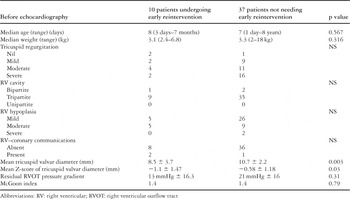
Table 1.

Scattergraph showing the diameter of the tricuspid valve in the patients undergoing early reintervention as opposed to those without early reintervention.

Scattergraph showing the Z-scores for the diameter of the tricuspid valve in our two groups of patients.
 You have
Access
- 23
- Cited by