Introduction
Cognitive models of auditory hallucinations propose that they arise from a deficit or bias in source monitoring, whereby verbal thoughts are not recognized as self-generated and are misidentified as externally generated voices (Frith, Reference Frith1987, Reference Frith1996; Bentall, Reference Bentall1990; Keefe et al. Reference Keefe, Arnold, Bayen and Harvey1999). Patients with schizophrenia show poor self-monitoring on a range of cognitive and motor tasks, and this impairment seems to be more marked in patients who have current positive symptoms (reviewed by Farrer & Franck, Reference Farrer and Franck2007). Self-monitoring of speech in patients with schizophrenia has been examined in a series of studies using a paradigm in which online auditory verbal feedback is manipulated while participants speak out loud (Cahill et al. Reference Cahill, Silbersweig and Frith1996; Johns et al. Reference Johns, Rossell, Frith, Ahmad, Hemsley, Kuipers and McGuire2001, Reference Johns, Gregg, Allen and McGuire2006). In these studies, patients who had auditory hallucinations and/or delusions at the time of testing tended to misattribute their own distorted speech as belonging to someone else.
There is increasing evidence that psychosis exists in the general population as a continuous phenotype, rather than an all-or-none phenomenon (van Os et al. Reference van Os, Hanssen, Bijl and Ravelli2000). Several large-scale studies have confirmed the presence of psychotic symptoms in the general population, with an average prevalence rate of 5.3% and interquartile range of 1.9–14.4% (reviewed by van Os et al. Reference van Os, Linscott, Myin-Germeys, Delespaul and Krabbendam2009). The psychosis continuum extends from subclinical experiences in otherwise healthy subjects to severe psychotic disorders associated with clinical need (Johns & van Os, Reference Johns and van Os2001; Hanssen et al. Reference Hanssen, Bak, Bijl, Vollebergh and van Os2005). Individuals with an At-Risk Mental State (ARMS) can be seen as lying between these two extremes. These individuals experience psychotic symptoms that are distressing enough for them to seek clinical help and are associated with a 25–40% risk of developing a first episode of psychosis within 12–24 months (McGorry et al. Reference McGorry, Yung, Phillips, Yuen, Francey, Cosgrave, Germano, Bravin, McDonald, Blair, Adlard and Jackson2002; Yung et al. Reference Yung, Phillips, Yuen, Francey, McFarlane, Hallgren and McGorry2003; Morrison et al. Reference Morrison, French, Walford, Lewis, Kilcommons, Green, Parker and Bentall2004). The most common presenting features of the ARMS are attenuated psychotic symptoms (Yung et al. Reference Yung, Phillips, McGorry, McFarlane, Francey, Harrigan, Patton and Jackson1998), which are qualitatively similar to full psychotic symptoms but less severe and associated with greater insight (Lappin et al. Reference Lappin, Morgan, Valmaggia, Broome, Woolley, Johns, Tabraham, Bramon and McGuire2007).
There is also evidence that emotional disturbances, such as anxiety and depression, contribute to the onset and development of psychotic symptoms (Freeman & Garety, Reference Freeman and Garety2003; Krabbendam et al. Reference Krabbendam, Myin-Germeys, Hanssen, de Graaf, Vollebergh, Bak and van Os2005; Wiles et al. Reference Wiles, Zammit, Bebbington, Singleton, Meltzer and Lewis2006). Emotional states may increase the risk for positive symptom formation and maintenance partly by exacerbating the cognitive biases underlying psychotic symptoms (Garety et al. Reference Garety, Bebbington, Fowler, Freeman and Kuipers2007). For delusions, there are mixed findings on the relationship between reasoning and emotional processes. Garety et al. (Reference Garety, Freeman, Jolley, Dunn, Bebbington, Fowler, Kuipers and Dudley2005) found that the jumping-to-conclusions bias characteristic of patients with delusions was not influenced by levels of anxiety or depression, as assessed by questionnaire measures. However, Ellet et al. (Reference Ellett, Freeman and Garety2008) found that brief exposure to an urban environment increased anxiety levels and jumping-to-conclusions bias in individuals with persecutory delusions. Although it is known that anxiety is associated with occurrence of hallucinations (Slade & Bentall, Reference Slade and Bentall1988) and hallucination-proneness (Allen et al. Reference Allen, Freeman, McGuire, Garety, Kuipers, Fowler, Bebbington, Green, Dunn and Ray2005), the relationship between anxiety and self-monitoring performance has yet to be examined.
If defective self-monitoring contributes to the development of hallucinations and other positive symptoms, then this impairment should be present in individuals who are at high risk of developing psychosis, before the onset of severe symptoms. There is evidence that the psychological mechanisms that putatively underlie psychotic symptoms also operate in individuals at lower levels of the psychosis continuum. For example, the jumping-to-conclusions bias characteristic of patients with schizophrenia and delusions (Freeman, Reference Freeman2007) has also been found in non-clinical volunteers with high levels of delusional ideation (Linney et al. Reference Linney, Peters and Ayton1998), in the relatives of patients with psychosis (Van Dael et al. Reference Van Dael, Versmissen, Janssen, Myin-Germeys, van Os and Krabbendam2006), and in people with an ARMS (Broome et al. Reference Broome, Johns, Valli, Woolley, Tabraham, Brett, Valmaggia, Peters, Garety and McGuire2007). Similarly, the misidentification of distorted self-generated speech by patients with schizophrenia and current positive symptoms (Allen et al. Reference Allen, Johns, Fu, Broome, McGuire and Vythelingum2004) has also been observed in healthy individuals with high levels of delusional ideation and hallucination proneness (Allen et al. Reference Allen, Freeman, Johns and McGuire2006).
Two previous studies have examined self-monitoring in high-risk groups, with mixed results. On a task measuring self-monitoring of actions, Versmissen et al. (Reference Versmissen, Myin-Germeys, Janssen, Franck, Georgieff, a Campo, Mengelers, van Os and Krabbendam2007b) found poor self-monitoring in a genetic high-risk group (first-degree relatives of patients with psychosis) and a psychometric high-risk group (individuals with subclinical psychotic symptoms as measured by the Community Assessment of Psychic Experiences, CAPE; www.cape42.homestead.com). They also found a positive association between self-monitoring errors and level of delusional ideation, but no relationship between errors and severity of hallucinations. However, Versmissen et al. (Reference Versmissen, Janssen, Johns, McGuire, Drukker, a Campo, Myin-Germeys, van Os and Krabbendam2007a) found no evidence of impairments in the same high-risk groups using a shortened version of the verbal self-monitoringFootnote † (VSM) task that has been associated with deficits in patients with schizophrenia.
The aim of the present study was to determine whether difficulties in VSM precede the onset of frank psychosis, by studying individuals with an ARMS. VSM is of particular interest in these subjects, as ‘prodromal’ symptoms are characteristically associated with uncertainty as to whether the experiences are self-generated or due to some external agent (Broome et al. Reference Broome, Woolley, Johns, Valmaggia, Tabraham, Gafoor, Bramon and McGuire2005). Moreover, in a large proportion of these individuals, their psychotic phenomena subsequently evolve into frank psychosis, making them an ideal group in which to examine the role of impaired self-monitoring in the development of the disorder. We used the same VSM paradigm that has been used previously to identify deficits in patients with established schizophrenia (Johns et al. Reference Johns, Gregg, Allen and McGuire2006), and tested the hypotheses that impaired self-monitoring (as indexed by errors, misattributions and reaction times) would be: (1) present in individuals with an ARMS; (2) associated with the severity and frequency of attenuated positive psychotic symptoms; and (3) associated with level of anxiety.
Method
Participants
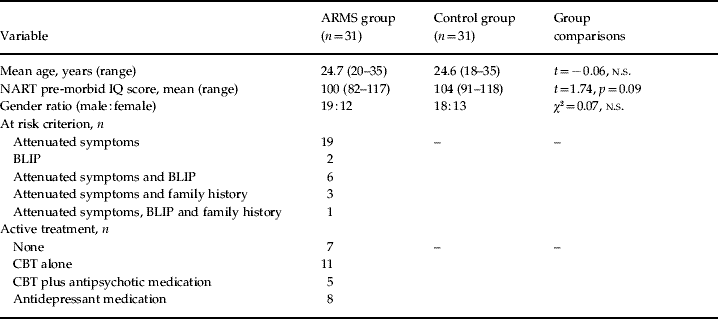
Thirty-one individuals with an ARMS were recruited from Outreach and Support in South London (OASIS), a clinical service for young people at high risk of developing psychosis (Broome et al. Reference Broome, Woolley, Johns, Valmaggia, Tabraham, Gafoor, Bramon and McGuire2005). Participants were assessed by experienced clinicians using the Comprehensive Assessment of At-Risk Mental States (CAARMS; Phillips et al. Reference Phillips, Yung and McGorry2000), and the diagnosis was confirmed at a consensus meeting with the clinical team. Participants met one or more of the following criteria for an ARMS (Yung et al. Reference Yung, Phillips, McGorry, McFarlane, Francey, Harrigan, Patton and Jackson1998): (i) attenuated positive psychotic symptoms; (ii) brief limited intermittent psychosis (BLIP), that is a brief psychotic episode that resolves spontaneously within 1 week; and (iii) a recent decline in functioning, plus either schizotypal personality disorder or a first-degree relative with psychosis. At the time of testing, 24 of the sample had started treatment, either in the form of cognitive behaviour therapy (CBT), CBT plus very low-dose antipsychotic medication, or antidepressant medication (Table 1). The ARMS group was compared with a group of 31 healthy volunteers recruited from the same part of South London as the ARMS subjects by local advertisements. They had no psychiatric diagnoses, as assessed by the Structured Clinical Interview for DSM-IV Axis I Disorders, Clinician Version (SCID-CV; First et al. Reference First, Spitzer, Gibbon and Williams1997). The two groups were matched for mean age and pre-morbid IQ, estimated using the National Adult Reading Test (NART), 2nd edition (Nelson & Willison, Reference Nelson and Willison1991) (Table 1). Participants gave written informed consent to participate in the study.
Demographic characteristics of the two groups and clinical features of the ARMS group
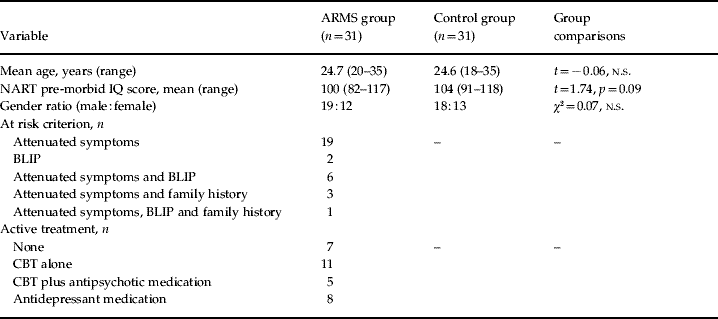
ARMS, At-Risk Mental State; NART, National Adult Reading Test, 2nd edn; BLIP, brief limited intermittent psychosis (see text for description); CBT, cognitive behaviour therapy; n.s., not significant.
VSM paradigm (Fig. 1)
Auditory feedback
Participants wore a set of stereo headphones with a microphone attached. They spoke into the microphone, which was connected to an audio switch box, an amplifier and a personal computer. Auditory input was transmitted through the headphones, and the volume of the signal was adjusted to a level at which participants reported that they could hear their voice only through the headphones when speaking aloud. Participants' speech was distorted online using a Digital Signal Processing (DSP) PCI card in the computer. Its pitch was either unchanged (no distortion) or lowered by two or four semitones (termed moderate or severe distortion, respectively). In the alien feedback condition, participants heard someone else's pre-recorded voice instead of their own as they spoke. This voice was matched to that of the participant for gender and local accent. The words had been recorded using Cool Edit 96 and saved as .WAV files, and had been distorted (as described above) on two-thirds of the trials. The participant's voice triggered the playing of a .WAV file using an audio switch and trigger box. The software (programmed in Visual Basic Version 6) controlled the stimulus presentation and auditory feedback.
Wiring diagram of the experimental paradigm. S, self; U, unsure; O, other. [Johns et al. (Reference Johns, Gregg, Allen and McGuire2006), Psychological Medicine 36, 465–474. © 2006 Cambridge University Press. Reprinted with permission.]

Stimuli
The words presented were personal adjectives, chosen because they reflect the typically personal content of auditory hallucinations in psychotic disorders. They were drawn from two comparable lists of 108 words of positive, negative and neutral valence, used in previous studies of VSM (Johns et al. Reference Johns, Rossell, Frith, Ahmad, Hemsley, Kuipers and McGuire2001, Reference Johns, Gregg, Allen and McGuire2006).
Design
Three experimental manipulations (feedback, distortion and valence) were applied in a pseudo-randomized design. The 18 possible combinations of feedback, distortion and valence were ordered randomly, with the constraint of no more than two consecutive trials of the same feedback and distortion combination. This procedure was repeated six times, and the six combination lists were ordered randomly to produce a complete playlist of 108 trials. Two playlists were generated for each word list, giving four playlists in total. Participants were given one of these four playlists, which were counterbalanced across the subject groups.
Procedure
Participants sat approximately 50 cm from the computer monitor and responded by pressing buttons on a button box. They used their preferred hand and rested their fingers in the same position between trials. Participants were instructed to be as quick and as accurate as possible; the computer recorded response choice and reaction time. They completed the following tasks:
Practice 1: reading aloud (nine trials)
Words were presented for 1000 ms, at 6000-ms intervals. Participants read each word aloud as soon it appeared, and heard their (undistorted) voice through the headphones.
Practice 2: reading aloud with alien feedback and/or acoustic distortion (12 trials)
Participants either heard their voice or the pre-recorded ‘alien’ voice through the headphones as they read the words out loud; speech was distorted on half of these trials. The letters S, U and O (for Self, Unsure and Other) were present at the bottom of the screen on each trial, and participants were required to indicate the source of the speech they heard by pressing the corresponding button on the box. The letter changed colour when participants pressed a button to indicate their response had been recorded. Participants had 5000 ms in which to respond, then there was a 1000-ms interval before the next word appeared.
Experimental task: reading aloud with alien feedback and/or acoustic distortion (108 trials)
Participants heard either their own voice or the alien voice as they spoke, and the speech was distorted on two-thirds of the trials. They made their decision about the source of the speech as described above. Their performance was observed by the investigator, and trials in which participants did not read the word or read it incorrectly or after it had disappeared were subsequently discarded.
Assessment measures
Psychopathology in the ARMS group was assessed using the CAARMS, the Positive and Negative Symptom Scale (PANSS; Kay et al. Reference Kay, Fiszbein and Opler1987) and the Hamilton Anxiety Scale (HAMA; Schutte & Malouff, Reference Schutte and Malouff1995). These measures were mostly administered on the same day of testing, although for a few participants the assessment was completed in a separate session.
Data analyses
The appropriate sample size was estimated on the basis of data previously reported by Johns et al. (Reference Johns, Gregg, Allen and McGuire2006) from patients with established psychosis. In that study, the sample size necessary to detect differences in error rates had been estimated to be 15 per group, based on comparisons between two groups using a t test with power set at 0.7, effect size of 0.8, and an α of 0.05 (G*Power). It was assumed that the effect size would be smaller for individuals with an ARMS, and the sample size was therefore estimated to be 30 per group (effect size 0.6).
Analyses of variance (ANOVAs) for repeated measures used the general linear model (GLM) procedure. The reported results of tests of within-subjects factors are the univariate or averaged data. The significance of the F values was assessed using Greenhouse–Geisser corrected degrees of freedom.
Errors
An error was defined as either a response that misidentified the source of feedback (Other instead of Self, and vice versa) or an Unsure response. The proportions of total errors and misidentifications were calculated for each combination of feedback, level of distortion and word group, and these proportional data were transformed using the arcsine transformation. The error responses made in each feedback condition were analysed separately using three-way ANOVAs for repeated measures. The within-subject factors were distortion (none, moderate, severe) and word valence (negative, positive, neutral). The between-subjects factor was participant group (controls, ARMS individuals). Although not all the error data met the assumptions of normality and homogeneity of variance required for ANOVA, this analysis was used because it is robust against violations of these assumptions (Howell, Reference Howell1992) and was the most appropriate for the experimental design. Group comparisons were performed using independent-sample t tests.
Reaction times
Median reaction times were calculated for correct responses and errors (defined as above). Reaction times were calculated for each level of feedback (all levels of distortion) to avoid missing data points for feedback×distortion conditions where participants' responses were all correct or incorrect. The data were analysed using a three-way ANOVA for repeated measures. The within-subject factors were feedback (own voice, alien voice) and response (correct, error), and the between-subjects factor was participant group. The reaction time data met the assumptions for ANOVA of normality and (apart from alien voice, correct responses) homogeneity of variance. Associations between errors and reaction times were also examined using Pearson's correlation coefficient.
Symptom correlations
In the ARMS group, relationships between performance on the VSM task (errors, reaction times) and scores on the assessment measures were examined using correlational analyses. Non-parametric Spearman's ρ was calculated because the interview and questionnaire data are ordinal. Although there was no hypothesis regarding the effect of treatment on self-monitoring, a one-way ANOVA was conducted to examine whether treatment influenced performance.
Results
Errors
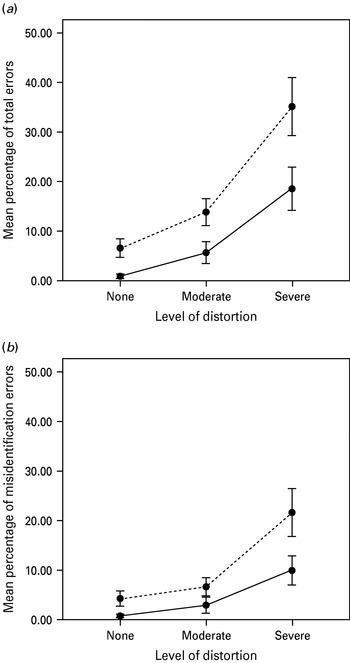
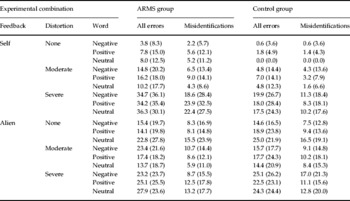
Table 2 shows the descriptive error data. In the reading aloud condition, participants with an ARMS made more total errors than controls (F=6.97, df=1, 60, p=0.011) when their speech was distorted (moderate distortion: t=−2.31, p=0.024; severe distortion: t=−2.24, p=0.029) (Fig. 2a). When the analysis was restricted to misidentification responses (i.e. excluded Unsure responses), the ARMS participants made more errors than controls (F=4.5, df=1, 60, p=0.038), but only when their speech was severely distorted (t=−1.99, p=0.05) (Fig. 2b). There was also a significant interaction between word valence and group (F=5.18, df=2, 60, p=0.007). Across all levels of distortion, ARMS participants made more misidentification errors than controls when the words presented were positive (t=−2.65, p=0.011) or neutral (t=−2.46, p=0.018), but not when they were negative.
Group means (±standard error of the mean) for (a) the percentage of total errors and (b) the percentage of misidentification errors at each level of distortion in the reading aloud condition. – - -, At-Risk Mental State group; –––, controls.

Group means (standard deviations) for the percentage of total errors and misidentification responses for each combination of feedback, distortion level and word type. There were six trials for each combination

In the reading aloud with alien feedback condition, there was no main effect of group, nor any significant interactions between the factors, in the analysis of total errors or misidentification responses.
Reaction times
The analysis of reaction times for correct responses and errors showed that, overall, participants in both groups were about 600 ms slower when they made errors than when they responded correctly (F=69.65, df=1, 40, p<0.001). The ARMS participants responded more slowly than controls overall (mean difference=460 ms; F=11.68, df=1, 40, p=0.001), but there were no interactions between feedback, response and group. However, correlational analyses revealed that, within the ARMS group, there was an inverse relationship between the number of misattribution errors during the reading aloud condition (across all levels of distortion) and the median reaction times for these errors (r=−0.515, p=0.012) (Fig. 3). This correlation was specific to misidentifications rather than total errors (which included unsure responses) and was not evident in the control group.
Relationship between the percentage of misidentification errors and reaction times for these errors in the At-Risk Mental State (ARMS) group.

Correlations with symptoms
We first examined associations between symptom scores and misidentification errors in the reading aloud with severe distortion condition. There were no significant correlations between the number of errors and scores on the PANSS (total) or the HAMA. However, there were inverse relationships between the number of misattributions and scores on measures of positive psychotic symptoms. Thus, misidentifications were correlated with a lower severity of unusual thought content (r=−0.404, p=0.024) and a lower severity and frequency of perceptual abnormalities (r=−0.454, p=0.01 and r=−0.396, p=0.028 respectively) on the CAARMS. There was also a trend for the number of misattributions to be inversely correlated with scores on the PANSS positive subscale (r=−0.349, p=0.054).
We then analysed associations between symptom scores and reaction times in the reading aloud condition. There was a significant relationship between reaction times for misidentification errors and the severity of perceptual abnormalities on the CAARMS (r=0.445, p=0.033), with severe symptomatology associated with longer reaction times. There were no other significant correlations.
The ANOVA showed no subgroup differences in errors or reaction times according to type of treatment being received by the ARMS participants.
Discussion
Self-monitoring performance in the ARMS group
Consistent with our first hypothesis, individuals with an ARMS had more difficulty than controls identifying the source of the auditory verbal feedback when their speech was distorted, as indicated by their greater overall error rate. The ARMS participants were also more likely than controls to misattribute their own distorted speech to an alien source when it was severely distorted. Unexpectedly, they made more misidentifications than controls when the words were complimentary or neutral, but not when they were derogatory. Although these results describe the group as a whole, there was a wide range in the number of errors made by participants within the ARMS group, from 0% to 100%, compared with a range of 0–64% in the control group. Within the ARMS group, some individuals will subsequently make a transition to psychosis (true positives) and some will not (false positives). It is possible that these subgroups differ from each other, which gives rise to the observed variation in error rates. However, the error rates were not bimodally distributed, indicating that there was no clear distinction between true and false positives within the group.
The ARMS group had longer reaction times than the control group, regardless of condition or response accuracy. This might suggest that the ARMS group were finding the task more difficult, although it may reflect a more general slowness in these participants, consistent with previous observations of decreased processing speed in prodromal subjects who go on to develop psychosis (Pukrop et al. Reference Pukrop, Ruhrmann, Schultze-Lutter, Bechdolf, Brockhaus-Dumke and Klosterkotter2007). There was an inverse relationship between the frequency of misidentifications made by the ARMS participants when their speech was distorted and the reaction times for these misidentifications; that is more errors were associated with shorter reaction times and fewer errors with longer reaction times.
The error results are consistent with a previous finding of a trend for misattributions of distorted speech in a smaller sample of at-risk individuals performing the same paradigm as in the present study (Johns et al. Reference Johns, Allen, Broome, Woolley, Vythelingum, Wykes and McGuire2005). The findings also corroborate those of Versmissen et al. (Reference Versmissen, Myin-Germeys, Janssen, Franck, Georgieff, a Campo, Mengelers, van Os and Krabbendam2007b), which showed poor action self-monitoring in participants with subclinical psychotic symptoms or a first-degree relative with psychosis. Taken together, these data indicate that defective self-monitoring is present in (at least some) individuals who may be at risk of becoming psychotic in the future. However, the results are not consistent with those reported by Versmissen et al. (Reference Versmissen, Janssen, Johns, McGuire, Drukker, a Campo, Myin-Germeys, van Os and Krabbendam2007a), who, using a shortened version of the same paradigm as in the present study, found no evidence of impaired VSM in their high-risk groups. However, the version of the paradigm they used may not have been sufficiently sensitive, as they also found no evidence of a self-monitoring deficit in psychotic patients, contrary to data from other studies (e.g. Cahill et al. Reference Cahill, Silbersweig and Frith1996; Johns et al. Reference Johns, Rossell, Frith, Ahmad, Hemsley, Kuipers and McGuire2001, Reference Johns, Gregg, Allen and McGuire2006).
The ARMS participants made fewer errors on the VSM paradigm than reported in studies of patients with schizophrenia, suggesting that self-monitoring is less compromised in this group than in patients with an established psychosis. For example, when reading aloud with their speech severely distorted, the ARMS group had a total error rate of about 35%, compared with error rates of 45% for schizophrenia patients in remission, and 55–75% in patients with current positive symptoms (Johns et al. Reference Johns, Gregg, Allen and McGuire2006). In addition, the ARMS group only made more misidentification errors than controls when their speech was severely distorted, when the self-monitoring task was more difficult. A similar pattern of results has been reported on the beads task (Broome et al. Reference Broome, Johns, Valli, Woolley, Tabraham, Brett, Valmaggia, Peters, Garety and McGuire2007), whereby ARMS participants only displayed a jumping-to-conclusions bias on the more difficult versions of the task.
The relationship between reaction times and the rate of misidentifications in the ARMS group suggested a trade-off between response speed and accuracy, which was specific to the reading aloud condition, when subjects were processing their own speech. Thus, ARMS participants with shorter reaction times made more misidentifications whereas those who responded more slowly had lower error rates. This finding is similar to that reported by Johns et al. (Reference Johns, Rossell, Frith, Ahmad, Hemsley, Kuipers and McGuire2001) when using the same paradigm in patients with schizophrenia; patients made more errors than controls in the reading aloud condition and responded more quickly than controls when they made these errors. This response style suggests that hasty decision making may contribute to misattribution of the source of speech during the VSM task in the ARMS and in patients with schizophrenia. These findings are consistent with those of Allen et al. (Reference Allen, Johns, Fu, Broome, McGuire and Vythelingum2004, Reference Allen, Freeman, Johns and McGuire2006) that individuals with positive symptoms also show an externalizing response bias on a speech appraisal task that does not have a self-monitoring component.
Associations with psychopathology in the ARMS group
Between-subject variation in task performance was found to be greater in the ARMS group than in the control sample. This is perhaps not surprising because follow-up data suggest that, although one-third of ARMS individuals will subsequently develop a psychotic disorder (McGorry et al. Reference McGorry, Yung, Phillips, Yuen, Francey, Cosgrave, Germano, Bravin, McDonald, Blair, Adlard and Jackson2002; Yung et al. Reference Yung, Phillips, Yuen, Francey, McFarlane, Hallgren and McGorry2003), in a further third the prodromal symptoms persist without transition to psychosis, and in another third the symptoms improve (Yung et al. Reference Yung, Phillips, Yuen, Francey, McFarlane, Hallgren and McGorry2003). We investigated putative factors that might be associated with misidentification errors within the ARMS group. Contrary to our second hypothesis, misidentifications did not correlate positively with the level of prodromal symptoms reported by ARMS participants. Instead, we found negative correlations between misattributions and the severity and frequency of attenuated positive symptoms, whereby individuals with more marked symptoms made fewer misattributions. One possible explanation for this is that the symptom data used in the correlational analyses were not specific enough to examine relationships between particular psychotic symptoms and task performance. The analysis was based on CAARMS summary scores, reflecting any perceptual abnormalities or unusual thought content reported, rather than on ratings of individual positive symptoms, such as auditory verbal hallucinations or delusions of passivity. Analysing these symptoms specifically may yield different results, but we were unable to investigate this because of the limited numbers of participants with a given specific symptom. An alternative interpretation of the results is that the ARMS participants who were more symptomatic overall possibly had greater awareness of their difficulties, were trying harder on the task, and thus made fewer errors when identifying the source of their distorted speech. This explanation is consistent with the positive association found between the severity of perceptual abnormalities and reaction times for misattributions. In addition, subjective cognitive difficulties have been reported in ARMS subjects, and are considered to be part of the early prodromal phase of psychosis (Schultze-Lutter et al. Reference Schultze-Lutter, Ruhrmann, Picker, Graf Von Reventlow, Daumann, Brockhaus-Dumke, Klosterkötter and Pukrop2007). However, this explanation is speculative, and we did not assess subjective awareness of cognitive difficulties in this study.
There was no relationship between task performance and anxiety as measured by the HAMA. Anxiety is common in subjects with an ARMS (Broome et al. Reference Broome, Woolley, Johns, Valmaggia, Tabraham, Gafoor, Bramon and McGuire2005), and it has been suggested that emotional states contribute to positive psychotic symptoms by exacerbating the cognitive biases underlying these symptoms (Garety et al. Reference Garety, Bebbington, Fowler, Freeman and Kuipers2007). The absence of a relationship between self-monitoring and general anxiety level in this study suggests that the group difference in error rates was not accounted for by anxiety. The finding is similar to that reported by Garety et al. (Reference Garety, Freeman, Jolley, Dunn, Bebbington, Fowler, Kuipers and Dudley2005) of no association between the jumping-to-conclusions bias in patients with delusions and levels of anxiety or depression. However, as those authors suggest, it is possible that rating scales of mood are not sensitive enough to detect associations, and mood induction techniques are needed.
Lastly, there was no difference in self-monitoring performance within the ARMS group according to treatment received. However, the number of participants in each treatment subgroup was small, and there may have been insufficient power to detect group differences. It is possible that treatment effects might have accounted for the unexpected negative correlation between the severity of prodromal symptoms and the frequency of misidentifications, in that treatment may have reduced symptom levels but had relatively less impact on task performance. Ideally, participants would have been tested prior to the administration of treatment, but the clinical needs of the individuals took precedence over participation in the study.
Summary
The results suggest that defective self-monitoring is present in individuals who are experiencing prodromal symptoms and have a high risk of developing psychosis. We are now following up and retesting the participants to assess how self-monitoring performance changes over time and how it relates to the subsequent onset of psychosis.
Acknowledgements
We are grateful to N. Vythelingum for programming the task. We also thank those who took part in the study and the staff of the OASIS team. The study was supported by the Guy's and St Thomas' Charitable Foundation and the Mental Health Foundation.
Declaration of Interest
None.