Unlike most cities and regions in Egypt, Fayyum has not received major attention from historians of the Ottoman period.Footnote 1 This is rather surprising given the importance of Fayyum as a population center, the many references to it in various narrative accounts from the ancient period on, and its large agricultural-productive capacities. It was said at the turn of the 15th century, for example, that each village in Fayyum produced enough foodstuffs to provision the whole of Egypt for one day.Footnote 2 The most obvious reason for this lack of historical work on Ottoman Fayyum is the absence of Islamic court records from the region—both from Fayyum and from the town of Beni Suef, to which Fayyum had been sporadically administratively attached since at least the late Mamluk period.Footnote 3 Court records have long been a mainstay of historians of Ottoman Egypt and other Ottoman provinces. Yet these records for Fayyum and Beni Suef have either not survived or have not yet been made available to researchers in the Egyptian National Archives (Dar al-Wathaʾiq al-Qawmiyya).Footnote 4 Without these rich sources of social and economic history, we are left to seek out other documentary evidence for the history of Fayyum in the Ottoman period.
As part of the effort to reconstruct the history of Ottoman Fayyum from sources other than court records, this article uses the rich archival collections of both the Prime Ministry's Ottoman Archive (Başbakanlık Osmanlı Arşivi) and the Topkapı Palace Museum Archive (Topkapı Sarayı Müzesi Arşivi) to uncover the environmental history of irrigation in the region during the first half of the 18th century. This period has not received much consideration from historians but is critical to any understanding of the transition from the early modern to the modern eras in Egypt and the Ottoman Empire.Footnote 5 Although numerous historians have employed these predominantly Ottoman Turkish archival documents to write political and economic histories of Ottoman Egypt—the empire's most agriculturally productive and financially lucrative province—none has dealt with the history of Fayyum specifically or the history of irrigation or environment in Egypt more generally.Footnote 6
Irrigation necessitated a very direct relationship between those in the immediate vicinity of a dam or canal who witnessed and experienced firsthand any infrastructural disrepair and those “downstream” who relied on the proper function of irrigation works for their food and revenues. This cooperative relationship forged by irrigation meant that Egyptian peasant cultivators and leaders, although not the only local Egyptian and imperial actors involved in the management of water in Ottoman Fayyum, were certainly the most important because they were the closest to irrigation works on the ground. There were several different local groups who brought instances of disrepair to the attention of the Ottoman imperial bureaucracy. Perhaps the most commonly referenced group in the archival record are ahāli. This somewhat vague term refers to “the people” of a village. Here I take it to mean those peasant cultivators who worked the land, were in the most direct contact with irrigation works, and hence were the ones most immediately affected by a deteriorating canal or dam. The documents cited here draw a clear distinction between this undifferentiated group of peasants and other local Fayyumis. Those who held higher rank in the rural community included mültezimīn, engineers, kāşifler (district administrators; sing. kāşif), village elders, and a group we will meet below known as ehl-i vukūf. The ahāli of Fayyum most usually brought their complaints to the Ottoman state in consultation with and through the mediation of these other rural actors.Footnote 7
Although the military-administrative Mamluk grandees of the Ottoman period wielded great power and authority in other subprovinces of Egypt during this period, the primary sources consulted for this study suggest they held little political influence in Fayyum during the first half of the 18th century. The example of Fayyum therefore serves as a useful historiographical counterweight to much of the scholarship on Ottoman Egypt, which has tended to argue for the continued importance of Mamluk political factions throughout the Ottoman period.Footnote 8 This limited Mamluk involvement in Fayyum goes a long way toward explaining, for example, why the “civil war” of 1711 and the political upheavals of the 1740s (both times during which irrigation repairs in Fayyum were undertaken) had seemingly very little impact on the region's history of water management.Footnote 9
Irrigation provides a particularly good lens through which to view the history of Ottoman Fayyum and the region's relationship to the rest of the Ottoman Empire because it was an intensely local process, differing according to each particular village environment, canal, sluice gate, and embankment. Water had to be managed and controlled by individuals on the ground with intimate experience in and knowledge of their local environments. At the same time, irrigation was a process of wide imperial concern. In an agriculturally rich region such as Fayyum—however distant it was from the imperial capital—irrigation water was essential to produce food that would be transported to feed individuals all over the Ottoman Empire. The water that irrigated Fayyum was converted into calories to feed stomachs in Istanbul, Cairo, Dubrovnik, Mecca, and Medina.
Beyond simply pointing to a new potential source base for historians of Ottoman Fayyum, Ottoman Egypt, and Ottoman environmental history, this article shows how the history of a region like Fayyum during the Ottoman period can be understood only by considering it in relation to other parts of the empire and to the imperial bureaucracy as a whole. Thus, this study contributes to a critique of the model of center and periphery that has long been used to explain relations between Istanbul and the empire's numerous provinces.Footnote 10 Critiques of this model have benefited greatly from considerations of the historiography of other early modern and modern empires, in which simple center–periphery descriptions no longer maintain much traction. It would, for example, now seem highly dubious to tell the story of modern Britain or early modern Spain without recognizing the complex and mutually determinative relationships between component parts of the British and Spanish empires.Footnote 11
Briefly put, the model of center and periphery asserts that the imperial capital drew to itself cash, military manpower, and grain and other raw materials from the rest of the empire with little interest in the cultural or social production, economic expansion, or history of these regions. Accordingly, the economic, human, and material output of the provinces was extracted and pulled solely toward the capital along vectors that weakened the further they emanated from the center. This model does not consider interactions between various “peripheries” (or various “centers”) that often bypassed Istanbul altogether. In this schema, Ottoman provinces come to be seen as piecemeal collections of sealed agricultural or economic units with little interaction with locales other than Istanbul. In her extremely provocative and instructive recent book, Karen Barkey describes this system with a “hub-and-spoke” metaphor: “One can say that most of the different segments of the polity remain largely unconnected among themselves. That is why an imperial system is best represented in terms of the hub-and-spoke network structure, where the rim is absent.”Footnote 12
Challenging this historiographical model, I show that Fayyum, like most Ottoman regions, did not operate in a vacuum with little connection to other parts of Egypt or the empire. On the contrary, Fayyum existed as just one part of an Ottoman imperial system of natural resource management. The region's relationship with Istanbul was not simply one of unidirectional resource extraction toward the imperial capital. Fayyumi locals, both peasants and elites, were in a consistently reciprocal, though of course unequal, relationship of push and pull with Istanbul. In the cases that follow, we will see how these locals came to inform the center's management of rural irrigation works. Simply put, power and knowledge moved in both directions along the spokes.
Likewise, a rim was most certainly present in the Ottoman Empire. Grains grown in Fayyum's rich soils were moved across the Mediterranean and Red Seas, while timber supplies from Anatolia, Greater Syria, and the Black Sea littoral were brought to Fayyum and elsewhere in Egypt to construct irrigation works and other infrastructure.Footnote 13 Fayyum's irrigated water came from rains in the Ethiopian highlands. Ottoman Egypt, in other words, was a world in which natural resources and products were in constant motion into, out of, and through the province. The exchange of resources, knowledge, and authority along the spoke between Istanbul and Fayyum (a spoke that usually ran through Cairo) ensured the proper irrigation of the Egyptian countryside. This water in turn made agricultural land productive, forging the multiple “rim” relationships Fayyum maintained during the early modern period through its export of food. The bureaucratic energy and coordination that kept this system functioning, productive, and sustainable was a constant negotiation between Egyptian peasant knowledge of local environments, Ottoman imperial administrative acumen, and the agency of natural processes such as rainfall, siltation, and plant growth.
Thus, the constant back and forth between Fayyumis and the imperial capital and the many “rim” relationships created by water in this one rather rural region of Egypt help us to conceptualize the Ottoman Empire more usefully and, to my mind, with greater historical accuracy than can be achieved by using a model of center and periphery. Hubs and spokes paint a picture of discrete points and fixed lines of connection, with many empty spaces between the spokes and little suggestion as to how points at the ends of different spokes, or for that matter the spokes themselves, fit together or affect one another. The Ottoman Empire was surely much more complicated than this. Perhaps there were multiple “rims” on the wheel at different distances from the center, perhaps certain spokes only reached certain rims and never touched others, or perhaps most spokes crossed and curved in very intricate ways. Or perhaps we should discard this metaphor entirely in favor of something like a web or a Penrose or Venn diagram. All of this granted, my goal here is not to advocate for one schematic metaphor over another. Any and all such diagramming impulses would ultimately fall short of capturing the historical details, nuances, contingencies, contradictions, and multivalent relationships that made up the Ottoman Empire. In considering the role of Egypt—and of a rather marginal locale like Fayyum—in the empire, I hope to be able to capture and understand some of this complexity.
SOMETHING LIKE A RIM
Fayyum's closest and most intense “rim” connection during the Ottoman period, as under earlier regimes, was with the Hijaz. This periphery–periphery relationship was built in large part on the movement of Fayyum's surplus grain to the region to feed yearly pilgrims to Mecca and Medina. Food—or the transference of caloric energy—was one of the primary factors in the maintenance of links between Fayyum—and the whole of Egypt, the proverbial breadbasket of the Ottoman Empire—and other parts of the Mediterranean as well as the Red Sea littoral.Footnote 14 Grains grown in Egypt went to fill stomachs not just in the HijazFootnote 15 but also in Tunis,Footnote 16 Yemen,Footnote 17 Aleppo,Footnote 18 Morocco,Footnote 19 Izmir,Footnote 20 western Tripoli,Footnote 21 eastern Tripoli,Footnote 22 Crete,Footnote 23 Salonica,Footnote 24 Algeria,Footnote 25 and Istanbul.Footnote 26 Apart from provisions shipped to the Ottoman capital, most of this food moved out of Egypt independently of the direct administrative oversight of Istanbul.
This massive network of commodity movement relied on steady supplies of irrigation water and on Egypt's established trade links with its Mediterranean and Red Sea neighbors and with regions of sub-Saharan Africa and South Asia.Footnote 27 Indeed, Egypt was in many ways the fulcrum of world trade in the late medieval and early modern periods before the realignment brought about by European penetration of the New World.Footnote 28 Throughout the early modern period, most Indian Ocean trading networks had a terminus on the Egyptian Red Sea coast; similarly, European trading routes that served to import coveted goods from East Asia and India into Europe loaded these commodities onto ships in Alexandria, Rosetta, and elsewhere on the Egyptian Mediterranean coast.Footnote 29 Exemplifying just how far early modern Egyptian trading connections went, the late 16th-century Cairene merchant Ismaʿil Abu Taqiyya, as Nelly Hanna has usefully shown, maintained investments and commercial relationships from Venice to Goa and from Aleppo to Kano (in what is today Nigeria).Footnote 30
Though perhaps not explicitly couched in terms meant to challenge a center–periphery model of early modern empire, some work has already considered Egypt's intraimperial links to other Ottoman provinces and its transregional connections to areas outside of the empire (both sorts of relationships functioning in ways that often bypassed the bureaucratic purview of Istanbul). Some historians have, for example, taken the Nile as their unit of analysis and, hence, have necessarily delved into Egypt's connections to Ethiopia, the Sudan, and other regions of Africa.Footnote 31 Others have considered how the cultivation and trade of a particular commodity such as coffee enmeshed Egypt in larger networks of commerce and consumption.Footnote 32 Similarly, studies of plague, cholera, and other diseases in the Ottoman Middle East show how disease traveled from and to Egypt and elsewhere with little regard for political boundaries or the strictures of the imperial bureaucracy.Footnote 33 Likewise, Peter Gran, Khaled el-Rouayheb, and others have documented the intimate intellectual connections between scholars in Egypt and their counterparts in Greater Syria, North Africa, and elsewhere that, again, did not run through Istanbul.Footnote 34 In short, Egypt cultivated and maintained multiple “rim” relationships with other provinces of the Ottoman Empire and with areas far beyond the empire's borders.
It was thus within this context of an early modern global economy that Fayyum's connections to the Hijaz, Istanbul, and elsewhere functioned. In the 18th century almost all annual imports to Jedda, the primary port of the Hijaz, came from Egypt on thirty to fifty rickety 300- to 600-ton ships.Footnote 35 About half of this merchandise consisted of European goods transported from Alexandria to Suez through Cairo then on to Jedda; the other half were Egyptian foodstuffs from Fayyum, the Nile Delta, and elsewhere earmarked for the provisioning of Mecca and Medina. It is unfortunately very difficult to estimate what percentage of the foodstuffs shipped to the Hijaz in the early 18th century originated in Fayyum's soils.Footnote 36 What is clear, though, is that the majority of Fayyum's surplus grain went to the Hijaz (often via Bulaq). This remained the case even in the 15th and 16th centuries, when the Delta emerged as Egypt's most lucrative area of agricultural cultivation, and Suez became the main port of export to the Hijaz. Fayyum is geographically much closer to Suez than to Qusayr, Aydab, or any of the other Upper Egyptian ports that saw reductions in the volume of their exports beginning in the 15th century.Footnote 37 Fayyum's geographical proximity to Suez ensured that the overall export volume of grains from the region to the Hijaz was not detrimentally affected by the waning importance of the southern ports. Fayyum also maintained its status as a major exporter of grain to the Hijaz because of the many awqāf endowed for the Haramayn in the region and throughout Upper Egypt more generally.Footnote 38 The chief function of these Upper Egyptian endowments attached to the Awqaf al-Haramayn was to provide grains for both the pilgrimage caravan and for the people of Mecca and Medina.Footnote 39
In bringing together the following stories of historical actors that include Egyptian peasants, Ottoman bureaucrats, silt, the sultan, religious pilgrims, and water, I hope to elucidate the connections of the bureaucratized eco-community that bound a rural region like Fayyum to Istanbul, the Hijaz, and other areas of the empire in the context of the globalized economy of the 18th century. In the process, I hope to demonstrate the limitations of some long-cherished overarching narratives of the nature of early modern imperial rule. After a brief discussion of the geographic and environmental circumstances of Ottoman Fayyum, I will consider three instances of major irrigation repair jobs carried out in Fayyum during the first half of the 18th century. I will use these cases to show how food connected Fayyum to other parts of the Ottoman Empire and how the imperial bureaucracy sought to maintain these productive connections by ensuring reliable supplies of irrigation water. I will then explain the role of local Egyptian Fayyumis, both peasants and village elites, in this imperial system of natural resource management and how they were able to use their privileged positions as possessors of knowledge of the local environment to affect the actions of the imperial government in Egypt, often against the interests of the state's own imperial officials. A primary goal throughout is to show how the relationship between Fayyum's rural residents and the Ottoman state functioned through a shared interest in irrigation and the cultivation of food destined for various parts of the empire.
FAYYUM AND ITS ENVIRONMENT
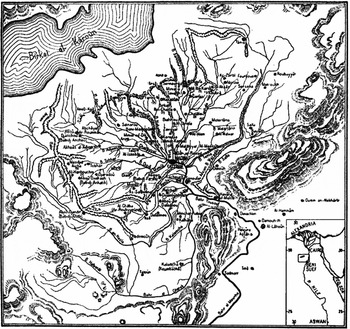
Unlike most population centers in Egypt, Fayyum is neither in the Nile Valley nor the Nile Delta.Footnote 40 It lies in a large natural depression in Egypt's western desert, known as the Libyan Desert.Footnote 41 As described by one traveler to the region, “Fayoum appears as the bud of the great lotus plant of Egypt, growing out of one side of the Nile stem, just below the Delta blossom”Footnote 42 (see Figure 1).
A map of Fayyum. Adapted from Karl Wessely, “Topographie des Faijûm (Arsinoites Nomus) in griechischer zeit,” Denkschriften der Kaiserlichen Akademie der Wissenschaften 50 (1904): 1–182 and A. E. R. Boak, “Irrigation and Population in Faiyum, the Garden of Egypt,” Geographical Review 16 (1926): 355.

The area of Fayyum is roughly 1,733 sq. km. (669 sq. mi.), nearly all of which is suitable for cultivation.Footnote 43 The northernmost section of the depression is entirely below sea level and bounded by a large brackish lake known as Birkat Qarun, whose surface lies 45 m. (147.64 ft.) below sea level.Footnote 44 The surface area of the lake is 214 sq. km. (82.63 sq. mi.).Footnote 45 Although Fayyum is usually described as an oasis, it is technically not because it relies entirely on the Nile for its usable water.Footnote 46 Fayyum is separated from the Nile Valley to the east by a high ridge of loose stone and dirt.Footnote 47 This ridge is pierced at only one point by a natural cut, and through this opening a canal brings Fayyum all of its water (save scant amounts from rain) for irrigation and other purposes. This extremely important waterway is known as Bahr Yusuf and branches off from the Nile at Beni Suef.Footnote 48 The canal leaves the Nile Valley at an area known as al-Lahun and enters Fayyum 5 mi. later at a point known as al-Hawara. It is literally the lifeline of Fayyum, because without this single waterway the region would be completely cut off from the Nile or any other freshwater source. The distribution and allotment of the entire water supply was controlled and manipulated at its entrance into Fayyum.Footnote 49
The two most important irrigation features on Bahr Yusuf were the regulating dike of al-Lahun and the seawall-like dam of al-Gharaq.Footnote 50 The dike of al-Lahun was built at the narrow gap that allowed Bahr Yusuf into Fayyum and was thus vital to regulating the flow of the canal and the amount of water that entered the region.Footnote 51 The dam of al-Gharaq was farther along the canal and was much larger in surface area than the dike of al-Lahun. Ottoman sources from the period describe it as a huge dam (sedd-i azīm) of impressive stature (bina-i cesīm) that had been in existence since times of old (kadim ül-eyyamdan).Footnote 52 It was built low in the Fayyum depression to trap the waters of the Nile behind its long wall in a huge lake (buheyre-i azīme) that was meant to supply the people of Fayyum with water for the entire year until the time of the next flood. It likewise prevented this water from spreading and branching out (intişār ve inşiʿāb) uncontrollably to flood villages and agricultural lands around Fayyum.
The people of Fayyum were thus completely dependent—for irrigation, drinking water, bathing water, and so forth—on the proper function of just a few irrigation works.Footnote 53 If for any reason one of them broke or was not functioning properly, great harm and hardship would be visited on the people of Fayyum, and, in turn, overall levels of food production in Egypt would drop.Footnote 54 Such a scenario was a constant fear in the 18th century.Footnote 55 Over and over again in petitions and imperial responses we find a standard rhetoric of complaint and of impending doom and danger related to the breaking of one of these dams and to the resulting decreases in food production. Because Fayyum was situated in a deep depression, the waters that reached it from the Nile gained great force as they moved down from higher elevations (al-Lahun was 23 m. or 75.46 ft. above sea level). Irrigation features like the dam of al-Gharaq were thus constantly—“day after day [yevmen feyevmen],” in the words of one document of repair—exposed to the force of the Nile's crashing waves (hurūş-i telātum-i emvāc) and the rush of its deluge (tezāhüm-i cereyan).Footnote 56 It is not surprising that the regulating dike of al-Lahun, the dam of al-Gharaq, and various other embankments, dikes, and dams on Bahr Yusuf were in constant need of repair. In the first half of the 18th century alone, nearly twenty major repairs were carried out on the dam of al-Gharaq.
Because Fayyum's topographical and geographical features meant that it relied on a single source of water to irrigate its entire area, the history of the region is a perfect case study of how changes to a single irrigation work carried significant and often dire consequences for wide swaths of agricultural land and for populations throughout Egypt and in other parts of the Ottoman Empire. If one dam broke on the canal of Bahr Yusuf, all of Fayyum's agricultural output for an entire year could be ruined.Footnote 57 The consequences of such an event for Egypt and for populations throughout the Ottoman Empire were great indeed. The manner in which Egyptian peasants and Ottoman bureaucrats dealt with the challenges posed by Fayyum's natural landscape shows just how invested peasant Fayyumis and the Ottoman state were in the collective maintenance of irrigation works in Egypt and how sensitive the environment of Fayyum was to changes made to its irrigation network.
CALORIES OF EMPIRE, 1709–11
Fayyum did not immediately fall under direct Ottoman administration in 1517, when much of Egypt became a province of the empire; it was only in the early 17th century that the region came to be directly administered, most likely by the subprovincial governor of Jirja.Footnote 58 Once brought within the administrative purview of the empire, Fayyum became one of the most concentrated and productive areas of cultivation in the Ottoman Empire's agriculturally richest province, supplying calories to stomachs across the empire. Water diverted from the Nile to Fayyum through the canal of Bahr Yusuf was used to grow food for people in Egypt, Istanbul, Mecca, and Medina. Quite logically, then, the maintenance of irrigation features on the canal of Bahr Yusuf was a matter of imperial concern. Between 1709 and 1711, the Ottoman state bureaucracy made the importance of the maintenance of the canal's irrigation features to imperial fortunes abundantly clear with its vigorous efforts to repair the dam of al-Gharaq and the dike of al-Lahun, both of which had suffered from a recent lack of maintenance and high flood levels.Footnote 59 At the heart of a series of orders for repairs from 1709 to 1711 was the imperial bureaucracy's understanding of the significance and self-sufficiency of the “rim” relationship between Fayyum and the Hijaz. The movement of food from Egypt to the Hijaz was operationally and financially in the hands of the Egyptian peasants, merchants, and sailors who produced the food and managed the trade. Maintaining the water that grew this food, however, was the empire's responsibility. To emphasize this point, Ottoman orders repeatedly observe that grains grown in the soils of Fayyum were to be moved to the Hijaz to feed the thousands of yearly pilgrims.Footnote 60 Here then is an example of the central Ottoman administration ensuring a natural resource base needed to maintain a relationship between two of its provinces—and, of course, also needed to maintain a flow of taxes to the empire's coffers—that, after this initial imperial act, functioned largely outside of the state's hands.
In 1709, the divan of the Ottoman sultan Ahmet III sent a firman to the imperial governor general (vali) in Cairo noting that much of Fayyum's land had been found to be sharāqī (parched).Footnote 61 The region's fields were not receiving adequate amounts of water because the regulation mechanisms on the canal of Bahr Yusuf had fallen into a state of disrepair. From its imperial perspective, the sultan's council wrote that it was not only Fayyum that was directly affected by this deterioration in the irrigation network. Repeating a well-worn idea in repair cases of this sort, the bureaucracy made clear that the great destruction to agricultural lands that might result should this situation remain unaddressed would hurt Egypt's overall agricultural yield and thus greatly reduce the amount of tax revenue available to the state. The sultan therefore ordered his vali to send to Fayyum engineers of sound judgment (mühendisin-i sahih ül-tahmin) to oversee the reconstruction of these dams as quickly as possible (alavechittaʿcil).Footnote 62 To fund this work, eleven Egyptian purses (kise-i mısrī) were made available from the annual tribute (Irsaliye) of 1708–9.Footnote 63
ʿAbd al-Rahman al-Jabarti's chronicle of Ottoman Egypt, one of the most important and widely cited Arabic narrative accounts of this period, makes only a fleeting reference to this firman.Footnote 64 It says simply that an imperial decree arrived in Cairo ordering the construction of a weir (qanṭara) at al-Lahun in Fayyum.Footnote 65 In the absence of Islamic court records from Fayyum, this passing phrase by al-Jabarti is one of the few references we have in any surviving Arabic source, published or unpublished, to this irrigation repair work in Fayyum in the summer of 1709.Footnote 66
These 1709 repairs were apparently inadequate, because a little over one year later sections of the very wide brick and stone (acır ve ahcar) wall of the dam of al-Gharaq were still weak and leaning toward the water of Bahr Yusuf, on the brink of total collapse (münhedim ve harab).Footnote 67 As in the previous year, a new firman insisted that if this situation were allowed to continue, the people of Fayyum would soon find themselves deprived of even a single drop of water (bir katre āb gelmeyūb), and their lands would become sharāqī once again. In addition, as before, this lack of water and, in turn, food would not only mean great turmoil and distress (perişanlık) for the people of Fayyum but—and more importantly from the perspective of the Ottoman state—would also lead to disruption and loss (kasr ve noksan) of state monies.Footnote 68 Before the promulgation of this sultanic order, the kāşif of Fayyum and the qadi of Beni Suef, along with other officials in the area, had been dispatched to inspect the dam.Footnote 69 On the basis of a report (keşf) summarizing their findings, the imperial administration released an additional eleven Egyptian purses and 11,600 paras from the annual tribute of 1709–10 for the dam's repairs.Footnote 70 Like the previous firman, this decree ends with a warning against spending more than the allotted sum and against any laziness or inefficiency in the repair work.
In these two firmans from 1709 and 1710, the Ottoman sultan and his government make clear that their concerns with irrigation in Fayyum stem first from the state's need for cash and second from their interest in providing grains to feed imperial subjects, the bureaucratic elite, and pilgrims traveling to Mecca and Medina each year. The dam of al-Gharaq and the dike of al-Lahun remained in a decrepit state of disrepair into 1711, threatening the people of the Hijaz with acute food shortages.Footnote 71 The Nile flood that year was exceptionally large and powerful, such that it partially destroyed many sections of the two irrigation structures, both those repaired in the previous two years and those that had not been repaired at all. As a result, the works were near total collapse, threatening to deprive Fayyum of any form of irrigation or watering (reyy ve irtivadan ātıl olmak). Of the dangers posed to irrigation and cultivation in and around Fayyum by damage to the dam and dike over this three-year period, those in 1711 were by far the worst.
The report commissioned to inspect the canal measured 27,234 sq. ziras (10,809.2 sq. m.) of damage to al-Gharaq's walls.Footnote 72 The damaged areas of the foundation (paye), walls (divarlar), and support girdle (kemer) of the Lahun dike measured a total of 9,980 sq. ziras (3,961.1 sq. m.). Between the two structures, the total area in need of repair was thus 37,214 sq. ziras (14,770.2 sq. m.). It was estimated (alavechittahmin) that the cost of repairing each square zira (0.3969 sq. m.) would be 15 paras, bringing the total cost to 22 Egyptian purses and 8,510 paras. The bulk of these funds would go toward purchasing the necessary building materials—mainly lime (kireç), wooden supports (şecār), and stone (taş)—and would be taken out of the Egyptian annual tribute of 1710–11.
Despite its difficulties and costs, the work required to return these irrigation features to what the inspection report calls their previously strong and rigid (kadimden metin ve müstahkem) condition was unavoidable. The Ottoman imperial system of natural resource management was predicated on all parts of this highly coordinated system functioning efficiently. The empire thus found its hand largely forced by the dictates of the river's flow and the manmade structures it oversaw to harness that flow. Once the physical reality of irrigation in the countryside was cast in the form of certain structural features, changing this rural world's infrastructural and imagined shape would have required a major investment of effort, money, and time. More important, the empire's hand was also forced by the historical precedent of the independently functioning relationship between Fayyum and the Hijaz. After all, Fayyum had for centuries sent its grain directly to the Hijaz for the sustenance of pilgrims and the populace of the holy cities. The large amount of money and effort put toward the repair of irrigation features on the canal and the fact that these repairs were carried out over three consecutive years show just how difficult and complex maintaining a steady supply of water was in Fayyum and how important these projects were both to the Hijaz and to the Ottoman state. Thus the need to convert the sun's energy into calories in Egypt's irrigated soils drove much of the Ottoman Empire's rule in the province.
A LOCAL EMPIRE, 1727
The connections enabled by Egypt's agricultural productivity and maintained by the Ottoman Empire's imperially coordinated system of natural resource management could only work by relying on the knowledge and practices of those who knew Egypt, its water, and its soils best. This connection between the local and the imperial was one that moved in both directions as Egyptian peasants and village leaders alternately tugged on and were pulled by the imperial capital. With their accumulated knowledge and experience, Egyptian peasants in Fayyum and elsewhere provided the Ottoman administration with the local expertise it needed to function productively on the ground. In considering the role of peasants in the maintenance and repair of irrigation works in Fayyum, I argue that it was they—rather than the empire's bureaucrats—who pulled the strings of power in controlling the operation and use of dams, sluices, and weirs. The Ottoman Empire in many ways devolved authority in the realm of irrigation to Egyptian peasants and other villagers because they knew the local environments of Egypt—vital knowledge needed for repair projects involving water—better than anyone else.
Egyptian peasants, village elders, and representatives of the Ottoman Empire thus participated in and constituted a unified system of natural resource use and management. Local peasant understandings of rural environments did not reflect some idyllic state of nature. In Ottoman Egypt, as in all imperial contexts, they were infused materially and ethically with the economic and political demands, needs, and desires of the polity and society around them. Likewise, the history of the Ottoman Empire in Egypt and throughout its domains cannot be understood without seriously accounting for the influence of local practice and knowledge in the function of the state. We must, in short, keep both the imperial and the local in play. The story of the Ottoman Empire cannot be told without Egyptian peasants, and the story of Fayyum and of Egypt as a whole cannot be told without the empire.
At the end of June 1727, the imperial palace in Istanbul sent a firman to the Ottoman vali in Cairo, Mehmed Paşa, about the current state of disrepair of the dike of al-Lahun and the dam of al-Gharaq.Footnote 73 This decree came in response to an earlier missive from the Egyptian vali that was, in turn, prompted by numerous petitions from Egyptian subjects complaining that if the two irrigation works in Fayyum were not fixed immediately, they would collapse, destroying much of the agriculturally rich region and leading to massive and expensive reconstruction efforts.Footnote 74 According to the two Arabic documents (ḥicce) drafted for the vali by local peasant Fayyumis and village elders with experience and knowledge (ehl-i vukūf) in Fayyum, the dams had to be repaired in the coming few months, before the onset of that year's flood. In response to these locals’ warnings of a massive flood (garīk) and widespread destruction, the vali sent some of his men to Fayyum, along with an architect and engineer, to inspect the damage. According to their report (keşf), the dams would cost a total of 347,195 paras (or thirteen Egyptian purses and 22,195 paras) to repair.
All of this information, together with the two original Arabic documents drafted for the vali, was forwarded to the palace in Istanbul. It was on the basis of these documents that the sultan and his retinue composed the firman sent to Cairo at the end of June 1727. Arriving in Egypt only a few weeks before the beginning of the flood season in late summer, this firman conveys the great foreboding and fear associated with the impending danger posed by the annual flood. As was customary, the funds needed for these repairs were to be taken from the province's annual tribute (in this case, of the year 1726–27). The sultan's order, however, stipulated that only 300,000 paras (or twelve Egyptian purses) and not the full amount requested by the vali (347,195 paras) were to be made available for this construction work. A dependable and trustworthy man (muʿtemed ve sadākatkār) was to be appointed to oversee these repairs and to inspect them once completed, and an engineer (mühendis), an architect (miʿmar), and a group of experts (ehl-i vukūf) were also to be consulted. As in similar cases, these men, especially the ehl-i vukūf and possibly the engineer as well, were in all likelihood locals from Fayyum who had risen in the imperial bureaucracy to become functionaries of the state.
This case shows that it was the ahāli of Fayyum who were most crucial to the timely and proper execution of these repairs. As the eyes and ears of the Ottoman Empire on the ground, peasant actors, working in concert with the ehl-i vukūf of that area, informed imperial authorities of the condition of the dams and of how best to proceed with their reconstruction. These men were locals who had probably spent most of their lives in Fayyum; they knew the dams and the normal course of the flood in their area, and they understood the soils and topographies of their villages’ fields. Because the environment of the countryside and irrigation within it could be understood only through years of intimate local interactions and experience, the Ottoman bureaucracy of Egypt had to rely on Egyptian peasants like the ones in this case to maintain the province's rural irrigation network. The local knowledge, experience, and expertise of these men influenced not only how the dams in Fayyum were rebuilt but also ultimately how the Ottoman Empire managed irrigation works throughout Egypt. With the two Arabic reports composed in Fayyum and sent to Istanbul, the local knowledge of these Egyptians literally entered the bureaucracy of the Ottoman state to influence and sustain its rule. By insisting that fixing irrigation works would serve not only their own interests but also those of the state, these men were able to make the state work for them or, at the very least, to make the state pay for this work with money diverted from Egypt's annual tribute.
Ottoman administration in the Egyptian countryside was thus not some distant abstraction commanding what it may from another continent. On the contrary, it operated at a very local level through its own bureaucrats and, even more important, through the labor and knowledge of local Egyptians. Peasants, village leaders, bureaucrats, and the Ottoman capital city were accordingly connected through an imperial network in which each played an important role in the repair of irrigation works in the Egyptian countryside and in which the local knowledge of peasants in one part of the ecosystem impacted and sometimes even dictated the actions of others elsewhere. What follows, then, is that Fayyum's dams affected economies, stomachs, ecosystems, and administrative structures in Istanbul, Cairo, the Hijaz, and elsewhere in the Ottoman Empire and that, conversely, Cairo and Istanbul affected these dams.
BUREAUCRATIC NATURAL DISASTERS, 1741–46
Within the eco-community created by irrigation in rural Egypt, peasants very often interacted directly with the Ottoman imperial state, even against the personal interests of the empire's own bureaucrats. Peasants in a place like Fayyum were frequently closely aligned with the Ottoman state, which trusted them to protect it from the subterfuge of its own functionaries dispatched to the region. This dynamic of imperial connection and interaction again shows the importance of local peasant knowledge and practice to the workings of the entire empire as well as the manner in which the use and maintenance of a natural resource like water tied rural communities in Egypt and beyond to centers of Ottoman power in Istanbul and Cairo. Telling examples of this interaction are instances in which Egyptian peasant leaders’ complaints about the machinations of thieving and otherwise conniving Ottoman bureaucrats led to the removal of these imperial functionaries. In such cases, the information provided by peasants was very often adopted and executed as imperial policy.
In 1744, the ahāli of Fayyum sent a number of petitions to the governor's divan in Cairo complaining that the dam of al-Gharaq's walls were in a near constant state of disrepair.Footnote 75 There had been various attempts to repair the dam in 1741 and 1742, but these had proven wholly inadequate in 1743, when that year's powerful flood destroyed large sections of the dam.Footnote 76 These locals’ letters rehashed much of the same standard rhetoric of complaint and imminent disaster that we saw previously. In response to these entreaties by a group of rural imperial subjects, the imperial government instructed Mehmed Paşa, the newly appointed vali of Egypt, to move swiftly to repair the structure.Footnote 77 The dam soon proved to be one of the most important issues of the new vali's two-year appointment. The sultan directed him to personally oversee its repair, bypassing the customary appointment of an overseer of construction (bina emini). The sultan's firman also concedes that two hatt-ı hümayuns had been issued previously with respect to these repairs but without effect. In 1744, Mehmed Paşa was thus instructed to appoint a group of state officials, engineers, architects, and local men of knowledge (erbab-ı vukūf) to inspect the dam's damage and to establish the costs of the needed repairs. They determined the size of the damaged area to be 130,300 sq. ziras (51,716.1 sq. m.) and the cost of the repairs to total eighty-seven Egyptian purses and 9,000 paras. As in previous repair cases, the necessary funds were to come from the Egyptian annual tribute (here from the year 1742–43).
Mehmed Paşa soon reported to the sultan that he had carried out the repairs as required.Footnote 78 His story, however, was contradicted by the correspondence of a group of Fayyumis who wrote to the imperial palace complaining that Mehmed Paşa had repaired only a small portion of the dam and that even this abbreviated repair work had not been done adequately. His failure to fix the dam properly thus left the structure weak and ill prepared to control the rushing waters of the flood. In 1745, the date of these letters, the Nile's flood waters indeed destroyed both the damaged sections of the dam that Mehmed Paşa had failed to repair and, even more worrisome, other parts of the dam that had previously been fully functional. The state of the dam was therefore now worse than it had been before Mehmed Paşa's repairs, and, according to the letters from Fayyum, if the entire dam were not repaired properly, then all of it would soon be completely washed away.
In addition to the looming danger of the structure's total collapse, it was soon discovered that Mehmed Paşa had stolen some of the money allocated to him for the repair work. A review of the Egyptian divan's accounts revealed that the dam's repair cost only eighty Egyptian purses. There was thus a discrepancy of seven Egyptian purses and 9,000 paras between what had been given to Mehmed Paşa and what he had spent on the repairs. This combination of ineptitude and the theft of state funds led to his replacement as vali of Egypt by Mehmed Raghib Paşa in the middle of June 1745.Footnote 79 When Raghib Paşa's predecessor was approached about the missing funds, he conceded that he owed the difference to the state as a debt (benim zimmetimdir) and swore (edā ederim) that he would repay it in a timely fashion.
To gain a better understanding of the condition of the dam of al-Gharaq, Raghib Paşa sent a group of state officials, engineers, architects, and local Fayyumis to inspect the damaged structure. These men concentrated on three sections of the dam's long wall: formerly damaged areas that Mehmed Paşa had repaired, damaged areas he did not repair, and parts of the dam destroyed after Mehmed Paşa's repair work. Sections of the dam that had been properly repaired measured 89,610 sq. ziras (35,566.2 sq. m.). Damaged areas that were supposed to have been repaired by Mehmed Paşa but that were left in ruin measured 46,362.5 sq. ziras (18,401.3 sq. m.). And formerly sturdy portions of the dam that had been destroyed by the most recent flood measured 20,025 sq. ziras (7,947.9 sq. m.). The total area in need of repair was thus 155,997.5 sq. ziras (61,915.4 sq. m.). As before, fifteen paras were required to repair each square zira (0.3969 sq. m.). The total cost of these repairs—which included 35,000 paras needed for other unspecified matters related to the construction (mühimmat-ı lāzime bina)—was therefore forty-one Egyptian purses and 5,812 paras. This sum was in addition to the eighty-seven Egyptian purses and 9,000 paras previously allocated for the repair work.Footnote 80
Mehmed Paşa's attempted thievery hurt both Egyptian peasants by saddling them with the ecological consequences of the dam's disrepair and the Ottoman state by robbing it of essential food and revenue. The letters from the ahāli of Fayyum to the imperial divan document how waterworks in Egypt created an irrigation network across the province that bound Ottoman bureaucrats, imperial elites in Istanbul and Cairo, Egyptian peasant cultivators, their village leaders, and rural groups such as ehl-i vukūf into one cooperative eco-community in which even the smallest changes in any one part of the network affected all those in the system. Because so many people and so much revenue in various locations throughout the Ottoman Empire were tied up in the proper function of a single irrigation work like the dam of al-Gharaq in Fayyum, the Ottoman bureaucracy of Egypt was forced to deal with the natural forces of the flood and the bureaucratic disasters caused by provincial governors who stole from the state. Moreover, because they were the ones most directly affected by and aware of Mehmed Paşa's illegal actions, peasants and village leaders in Fayyum were the first to bring his theft to the attention of the Ottoman state. It was thus these very direct links between peasants and other locals in the Egyptian countryside and Ottoman bureaucrats in Cairo and Istanbul that enabled the people of Fayyum to report Mehmed Paşa's dishonesty to the central state authority and that eventually led to the dam's proper repair.Footnote 81
CONCLUSION
Through a consideration of the Ottoman archival record of repairs to irrigation works in Ottoman Fayyum in the first half of the 18th century, in conjunction with other Arabic archival and chronicler sources of the period, I have suggested a way of conceptualizing the Ottoman Empire that avoids—or at least forces us to reevaluate—the model of center and periphery that remains the dominant mode of explaining relationships between Istanbul and the empire's provinces. Instead of a picture of the empire as a set of radiating spokes that diminish in strength as one moves farther away from the hub of Istanbul, the Ottoman Empire as seen through the history of irrigation in Ottoman Fayyum proves to be a much more complicated political and ecological combination of centripetal and centrifugal forces. The empire certainly “pulled” centripetally on its provinces for resources and taxes, but the pull was in both directions. Fayyum's peasants regularly informed the Ottoman state about irrigation works in rural Egypt and affected how the state dealt with these works. They were the ones who most often initiated repairs and who directed the state as to how best to undertake them. Moreover, the word of local Fayyumis was considered paramount in the removal of cheating state bureaucrats.
At the same time that Fayyum was in constant back and forth engagement with the Ottoman capital, its administrative, economic, and caloric relationships also moved centrifugally outward in many directions away from the center. The most important of Fayyum's centrifugal relationships in the Ottoman period was its role as a food supplier to the Hijaz. It is important to remember that this relationship, like that between Egypt and other regions, also functioned—as evidenced by the records of Islamic courts throughout Egypt—largely outside of the direct administrative purview of the Ottoman state. More fundamentally, it operated in the context of the global economic, ecological, and epidemiological relationships Egypt maintained in the first half of the 18th century. The overall point here, then, is that to understand the history of Ottoman Fayyum—and by analogy other rural regions of the empire and, in turn, the history of the empire as a whole—we must take into account its multiple relationships to various areas often at some distance from Egypt. The existence and exploitation of multiple kinds of sources for the narration of the history of Ottoman Egypt thus can only take us so far. We must also be open to allowing these sources to lead us toward conceptualizations of the Ottoman Empire that do not sit comfortably with our current thinking. The resulting payoff is potentially great. As I have shown here, we begin to be able to imagine Ottoman and Egyptian history in new ways that question prevailing assumptions about the nature and geography of imperial rule, the role of peasants and other locals in that rule, and the importance of nonhuman agents such as water and silt in shaping the empire.