During the first part of the twentieth century, new monumental city halls were planned in three European capital cities: in Copenhagen in 1905 by architect Martin Nyrop, in Stockholm in 1923 by architect Ragnar Östberg and in Oslo in 1950 by architects Arnstein Arneberg and Magnus Paulsson. Nyrop's city hall in Copenhagen was a great source of inspiration to Stockholm. Inspired by the city halls in Copenhagen and Stockholm, in the early 1910s, the leading politicians in Oslo began to plan a new city hall. For financial and political reasons, it was almost 40 years before this city hall was inaugurated. Today these buildings constitute central elements in the self-images and urban landscapes of these capital cities.Footnote 1 The city hall is a tool serving the urban historian, who sees the building as a set of ‘symbolic’ elements. As these presentations indicate, monumental city halls have many cultural and political meanings. The city hall is the main symbol of the city. It is the seat of civic government and local politics. The central elements of local power, municipal authority and civil society are present in their architecture. The aim of this article is to analyse the construction and symbolic significance of city halls in Copenhagen, Stockholm and Oslo in the context of this European development. Although the city hall is a building type that appears in virtually all types of town, the architecture, artistic decoration and iconography of these particular three buildings must be seen as symbols of a certain social, cultural and political setting.Footnote 2
The planning and building of the city halls of the three Scandinavian capital cities took place in a shared context. Copenhagen, Stockholm and Oslo were and still are the leading cities in the geographical entity of Scandinavia, or Norden, the Nordic countries. They have close historical links and a common north European experience. The Baltic Sea forms a natural setting for political and cultural networks. The fight for authority over this northern sea also caused several wars between Sweden and Denmark during the sixteenth and seventeenth centuries. The literature discussing the political and cultural content of Norden, a concept created in the middle of the nineteenth century and flourishing after World War II, is extensive.Footnote 3
Many inter-Nordic research projects have tried to identify Nordic phenomena through comparative studies of the impact of international cultural trends in different Nordic countries, with special focus on similarities and differences.Footnote 4 In architecture and design, certain twentieth-century residential and suburban buildings have been seen as nationalistic manifestations of something that is considered to be essentially Nordic.Footnote 5 The current research material – the city halls – conveys two things. They must be seen both as innovative structures, created on the basis of foreign impulses, and as the result of the more commonplace, a specific development of national and local forms.Footnote 6 The architecture, iconography and symbolic elements of the buildings reflect the ideas of certain governing elites in the capital cities. The link between local and international affairs was by no means accidental, especially, as Anthony Sutcliffe points out, ‘in the context of the organic, evolutionary ideology of human development which came to influence so many in the later decades of the nineteenth century’.Footnote 7
Nordic capital cities: centres of royal, national or local power
How to define Copenhagen, Stockholm and Oslo as capital cities? They were long-established urban centres before they became royal seats, capitals or seats of national government. According Peter Hall's useful typology, the Scandinavian capital cities can be defined as multi-function capitals. They combine most of the highest national-level functions and have a key position in providing cultural, political, economic and social impulses at international, national and regional levels. They are both political capitals, planned chiefly as seats of royal and later national government, but also serving as economic, cultural, political and social centres.Footnote 8
There is a close connection between urban expansion and state formation in Scandinavia. Centrality created an urban system, with a large dominant capital city, ruling a mass of minor towns and villages.Footnote 9 Stockholm, Copenhagen and Oslo are situated close to the waterways. The foundation of Copenhagen as a major fortified town was also part of a royal ‘regional’ policy, aimed at making the town a permanent settlement and market-place. Stockholm was situated at the boundary of sea and lake (the Lake Mälar area and the Baltic Sea) and was closely linked to developments in mining in central Sweden and to state controlled trade routes at sea.Footnote 10
As a result of the Reformation in Sweden and Finland (in 1527) and in Denmark and Norway (in 1536), the basis for new bureaucratic states was laid in Scandinavia. King Erik of Pomerania took Copenhagen from the bishop and the Hanseatic League. In 1416 the town had belonged to the Danish crown and was regarded as the royal capital. By the time of Christian IV's coronation in 1596, Copenhagen had become rich and powerful. Stockholm started to develop into the capital under the rule of King Gustav Wasa, whose aim was to create a modern centralized state. The growth and expansion of Stockholm and Copenhagen into major European royal centres during the seventeenth and eighteenth centuries was in close connection with the growth of kingdoms. The Swedish and Danish monarchs favoured the capitals, and granted them sole rights over their countries' foreign trade. Capital planning in Stockholm and Copenhagen was very European in its modern monumental pattern.Footnote 11
Constitutional monarchies were established in Sweden 1809 and in Denmark in 1814. The major political aim was to create domestic consolidation. Liberal and national movements gained momentum following the European Revolutions of 1830 and 1848. The modern political parliamentary system was established in Denmark in 1849 and in Sweden in 1865, when bicameral parliaments were introduced. Around the same time, the ramparts of the city of Copenhagen were opened to allow new housing to be built around the lakes (Søerne). The same development was seen some decades later in Stockholm. At the end of the century, many parts (malmarna) of the old city of Stockholm were planned and rebuilt according to new city planning ideals from Germany, where the process of controlled municipal town building or town planning had already started.Footnote 12
The old town of Oslo (known until 1924 as Christiania) was replanned and rebuilt by the order of the Danish king, Christian IV, in 1624. Oslo became the capital city of Norway in 1814. In that year, the king of Denmark surrendered Norway to Sweden, and Norway formed its first constitution. Many monumental buildings were erected as political symbols of Christiania's new capital city status: the Royal Palace, the Bank of Norway and the Oslo stock exchange, Later, in 1852, Norway's first university was founded. In 1905, Norway was separated from the union with Sweden, and Christiania became the capital of the newly formed kingdom of Norway.Footnote 13
Like many cities in Europe, Copenhagen, Stockholm and Christiania were in an expanding phase at the end of the nineteenth century. They developed into true national centres. In particular the coming of the railway system gave Stockholm and Oslo economic access to the interior of the country, leading to their urban growth. The growth in commerce and industry meant that capital cities became by far the largest cities in their countries, and also ‘true national capitals’ in the commercial and cultural sense. Industrialism created new job opportunities, and the urban population started to grow quickly. In the middle of the nineteenth century the population of Stockholm was 100,00; by the end of the century it had doubled. In Christiania, the population increased from 40,000 to 200,000, between 1850 and 1900.Footnote 14
This development caused strains on local governance. Municipal reforms were made in all Scandinavian countries, following the German model. In Norway the first municipals reforms were made as early as in 1837. In 1840, Copenhagen gained a new municipal constitution, which was soon expanded (1849). In the local history of Stockholm, the most important milestone was the passing of the local government statutes in 1862. State control was diminished and local authorities strengthened. The city councils became the city's supreme decision-making body. Following the German example, municipalities were given the authority to undertake activities which aimed to satisfy the common needs of their inhabitants.Footnote 15
Copenhagen, Stockholm and Oslo experienced a considerable expansion of the built-up areas between the years 1880 and 1920.Footnote 16 The qualitative changes left marks on their architectural images. The development of transportation demanded railway stations, port facilities and warehouses. The advance of industrialization generated completely new architectural and manufacturing structures. The increased demands of education, culture and sports required new planning and new building complexes. Improvements to the cities' infrastructure, regarding their roads and streets, street lighting, gas mains and electricity utilities, also became matters of importance for the municipality. New types of residential building were developed, and virtually all buildings in the city centres started to grow upwards. And relevant to this theme, the expansion of state and municipal administration required the construction of new office buildings.Footnote 17
Planning the city hall as symbol of municipal governance
The shift from centralization to municipal self-government and democratic ideas was one of the major trends at the end of the nineteenth century. Between 1860 and 1918, the municipal governance was in the hands of a bourgeois male elite, who were enlightened, liberal, creative, wealthy and even progressive. Many of them were formidable urban reformers.Footnote 18 These men, whether educated or ‘self-made’, were usually employed within the new industrial and professional occupations, especially banking, construction, insurance, services, commerce and the public sector. They formed the backbone of the new urban middle-class elite, active in many clubs, voluntary societies and political, national and cultural associations. Many of them were inspired by internationalist movements. Everywhere in Europe their power grew, not only in financial and commercial circles but also in politics and administration.Footnote 19
Communes and towns are seen as the main platforms for the modernization process in the national historiography of all Scandinavian countries.Footnote 20 As the citizen's right to vote was determined by the size of his income and payment of tax, municipal policy at the end of the nineteenth century was mainly the concern of rather wealthy local entrepreneurs. Capital cities became theatres where the ideals of modern city planning, modern municipal bureaucracy and modern professions were realized. Political decision-making developed alongside party politics at the same time as ‘the public sphere’ (the Bürgerliche Öffentlichkeit) and civil society was formed.Footnote 21
To understand the multifaceted architecture and symbolism of a city hall, one must also see the ideas behind it. First, let us define our terms. The earliest examples of this type of building in Europe date from the twelfth century. In Germany, the medieval town hall, das Rathaus, was a symbol of local pride.Footnote 22 The early German town halls were built to fulfil the needs of burghers. Primarily these needs were commerce, legal matters, burghers' meetings and representation, both public and private. Many different terms were used for the buildings (Saal, Bürgerhaus, Stadhaus, Wik- and Weichhaus, Gemeidehaus, Rathaus, Prätorium, Kophaus, Kaufhaus, Spielhaus, Dinghaus, Richthaus, Domus consulum, Domus civicum, etc). The development of this type of building is unclear, but the main features – meeting rooms (Ratsaal) and spaces for administration (Streibstube), archives and representation (Bürgersaal, Fürstesaal) were already developed during the fifteenth and sixteenth centuries.Footnote 23
In Britain this type of building had similar characteristics, although commercial activities were given primary importance. A Domus civica was recorded in some English towns during the sixteenth century. This term refers to buildings performing several different functions. ‘Town hall’ is the more usual translation, but it could also mean ‘town house’, ‘market house’, ‘guild hall’, ‘court hall’, ‘moot hall’ and ‘boot hall’. From this variety of definitions, as Robert Tittler writes, ‘the terms “town hall” and “civic hall” have been taken synonymously to mean the edifice characteristically regarded by contemporaries as the seat of whatever degree of autonomous civic administration a particular town may have enjoyed’. Early Italian and French city halls, Palazzo pubblico and Hotel de ville, were located in the principal open spaces in towns respectively at a river or by the sea. They were easily accessible, with covered halls which served as market places and places of assembly. A grand festival hall, office rooms, municipal treasury and a prison were already essential parts by the fifteenth and sixteenth centuries.Footnote 24
In Scandinavia, the German influence was strong. The town hall was known as rådhuset or raadhus or rathus during the sixteenth century. Council (rådet) buildings developed along continental lines. The council house (rådhuset) in cities and towns housed local and central administration and functioned as a court of law. When the modern city hall of the nineteenth century was developed, the old name continued mainly to be used. When cities grew, both names: stadshuset (town/city hall) and rådhuset, were, and still are, in use, both for those housing courts of law and those without.Footnote 25
The motives behind the construction of all three city halls were rather similar, indicating an equal level of urban development. First, there was a strong wish to put an end to the long-standing problem of overcrowding in the law courts and offices for city administrators. The new city hall was the fifth to be built in Copenhagen. It was motivated by referring to the lack of space for administration and representation. In 1887 the city architect Ludvig Fenger made the first drawings for a modern city hall. The existing council house (råd-, dom- and arresthuset) had been planned 100 years earlier. At the end of the nineteenth century, the need for space was much greater.Footnote 26
In Stockholm and Oslo the dream of a city hall (rådhuset) dated back to the years after the municipal reforms. In both cities the city administration grew in improvised quarters in the Old Town (Stockholm) and different offices in the city centre (Oslo). The idea of constructing an appropriate building to house the city administration took hold in Oslo as early as 1837 and in Stockholm in 1863. In Oslo, several plans for Raadstue-Localen or Kommunalbygning or Raadhus-bygning were made during the nineteenth century, without any concrete results. In Stockholm, the Old Town was considered the only acceptable location for a new building or buildings. The first committee appointed by the city council started work in 1892. As late as 1907, a proposal was made in favour of the Stock Exchange building, where the city council held its meetings. In Oslo, political separation from Sweden in 1905 led to a wave of nationalism and a rise in national self-esteem. The kingdom of Norway was created and the old city of Christiania became the new capital. The year before three city committees had reflected on different alternative solutions and arranged one architectural competition, concerning the Hammersborg area – but the plans had not been realized.Footnote 27
Both cities experienced a turning point in the long process. In Stockholm, Ragnar Östberg was one of the many architects involved in the project in the early 1890s. He made his first drawings for a ‘Hotel de ville’ in Stockholm as early as 1893. After a world wide study tour during the 1890s he returned home, having his thoughts still ‘in the game about the building question . . . examining the problems of a monumental project, that liberated the imaginations from daily drudgery’, as Östberg described later. The crucial point was in 1901 when city court judge Richard Öhnell asked Östberg's advice. The task was to be split: first a court house should be planned, then a building for city administration. The question of location was unsolved and Östberg made the proposal for a completely new site at Eldkvarn, on the royal island of Kungsholmen, ‘right on the water, so typical for Stockholm, and with enough additional land for future expansion’.Footnote 28
In all three cities, a series of architectural competitions took place. In Copenhagen an open free competition was announced for the summer of 1888, with two stages, following the European examples. A key figure, architect Ferdinand Meldahl, was a professor at the Academy of Art (Kunstakademiet) and a member of the city council. The fifteen entries, all sketches, were rather monumental, spanning the full breadth of historical styles, and drawing inspiration from monumental buildings like French castles, Flemish warehouses and Gothic churches. Two projects were different; one of which was Martin Nyrop's. As the jury noted, his project reflected a newer, freer style than the others. Later, in 1890, in the second stage of competition, Nyrop was chosen as the winner. His proposal met with opposition from leading Danish architects, and it was not until 1892 that the decision was made to allow Nyrop to plan the city hall. The work started immediately and the city council was able to hold its first meeting in the new building in 1903.Footnote 29
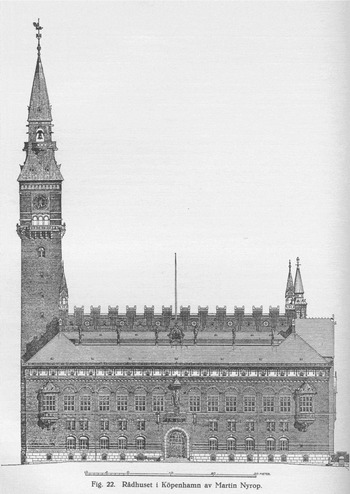
The city hall of Copenhagen was dedicated in September 1905. It immediately became a symbol of the Danish ‘national romantic style’, bearing architectural traces of the Nordic renaissance and Italian town halls, especially that of Siena. The main façade of the city hall has many iconographic details, such as a golden statue of Bishop Absalon, founder of the city, the clock, the Copenhagen city arms and a flag-pole, flanked by six watchmen. The Great Tower became a powerful symbol of the building, rising 350 feet high. In front of the building today is a popular open public square.
Source: Stockholms stadshus, 1923.

The city council of Stockholm held a two-round competition in 1902. The first dealt with the best design for a court house on the Eldkvarn. Östberg's proposal, Mälardrott, and Carl Westman's, Hörn, were the winning entries. They and four others were invited to a second round in 1905. The winning entry was a further modification of Östberg's proposal. During the following years he reworked Mälardrott several times, towards a more monumental building. Just as construction was about to begin in 1907, the original plans were cast aside. Here a key figure was council member and bank director, Knut Agathon Wallenberg. After a long discussion in the city council, a decision was made: two different buildings were ordered. The municipal building (stadshuset) was placed on the Eldkvarn site and the court house (rådhuset) in the Fruktkorgen area. As Wallenberg pointed out, ‘the municipal building will gain a location worthy of its noble duties (and) of representing the city, without competition from any other monumental building’. The final decision was made by the city council in 1911.Footnote 30
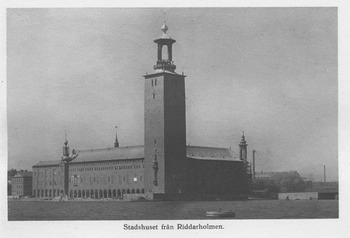
The city hall of Stockholm (1923) derives its monumentality from its detachment from the old city centre. Like all modern city halls, Östberg's city hall is also a dual-purpose building with a representative side and an administrative side. The building follows a rectangular ground plan, built around two open spaces. It is a piece of art, planned to be viewed from a distance. The water, the tower and the spacious layout create the illusion of monumental, but romantic sacredness.
Source: Stockholms stadshus, 1923.

In Christiania/Oslo the final planning of a new city hall started in 1916, when leading local politician and chairman of the city council (byrådet), Justice Hieronymus Heyerdahl, presented an idea for a new modern urban planned area. The aim was to combine the construction of a new town hall (storstue) with the restoration of the old city slum area close to the harbour at Pipervika. A further basic need was representation – 1914 had been a great jubilee year, the centenary of the Norwegian constitution (1814). The Norwegian capital city was lacking suitable festive and banquet spaces. Heyerdahl came up with the idea of placing the future city hall close to the sea. As he indicated, during the last decades of the nineteenth century, the city had developed into one of northern Europe's central ports.Footnote 31
The planning of the city halls in Copenhagen, Stockholm and Oslo was a long-term municipal project. In Copenhagen it took a mere 13 years, but Stockholm some 20 years and in Oslo over 40 years. In Christiania/Oslo, a first competition was already arranged in 1916, and one more in 1918. In 1920, Arnstein Arneberg and Magnus Paulsson, the winners of the 1918 competition, began to develop their drawings. After World War I, the political climate had changed with the fiery opposition of ‘tax payers’ to the plan becoming louder during the Great Depression. The original plans were revised several times and finally in April 1933, the foundation stone was laid. The city hall was constructed during the turbulent inter-war years. In 1950 when the city hall was inaugurated, Norway had experienced the war years and recovered from a period of German occupation.Footnote 32
The city halls in Copenhagen, Stockholm and Oslo were the progeny of open architectural competitions and the political process during the years of construction. Building costs were discussed and municipal needs, ideological matters and aesthetic values analysed. As a political process it fitted well into the municipal decision-making tradition in Scandinavia: important projects must have the support of the political majority. Three leading city council members played a key role and they were later called the ‘fathers of the city halls’: Meldahl in Copenhagen, Heyerdahl in Oslo and Wallenberg in Stockholm. All belonged to the wealthy professional urban bourgeois elite, Meldahl being an academic architect, Wallenberg one of the nouveau riche and Heyerdahl a member of an old and powerful Norwegian family. Wallenberg and Heyerdahl even dedicated themselves to collecting private funding for the city hall project. At a crucial moment, Wallenberg himself donated a large sum of money to finish the work. Heyerdahl managed to collect over one million Norwegian kroner from ‘interested Oslo burghers’, among them the king of Norway, with a substantial donation of 50,000 kroner. According to the jubilee publication of Oslo city hall, ‘never before had so many private citizens showed such great willingness to contribute to a municipal effort’. The aim was to see the city hall finished by 1924, when Christiania's 300-year jubilee was to be celebrated.Footnote 33
In all three cities, the work was locally controlled by a special building committee. Politically it was an independent body, responsible only to the city council. In Stockholm it was chaired by Wallenberg and in Oslo by engineer Peter Meinich. Nyrop played a key role as a mediator: in Stockholm he was an advisor to the city council during the entire time the city hall was being constructed. In Oslo Nyrop and Östberg were members of the competition jury. Nyrop's office was in fact right on the building site. The studios and workshops used for sculpture, painting, iron forging, woodcarving and textiles were located close to the building site or in the building area. Different kinds of specialists and professionals worked with the project, sharing a common goal and developing a strong sense of devotion. The finished products became the sum of each worker's contribution – and above all stood the heroic figure of the architect.
In all three cases, the city halls immortalized their architects. Nyrop, Östberg and Arneberg and Paulsson all belonged socially to the network of municipal decision makers. They were members of the new professional and patriotic bourgeois elite groups. Martin Nyrop (1849–1921) was a vicar's son. He was apprenticed to a carpenter in Copenhagen and then studied at the Royal Academy of Art. His early works included the first gasometer in Copenhagen and the buildings for the Nordic Exhibition of Industry, Agriculture and Art in Copenhagen (1888). Later he was a professor at the Academy of Fine Arts, a giant of the architectural profession and also a member of the city council. His collaborators called him ‘Master’, a title no Danish architect has yet inherited.Footnote 34
Ragnar Östberg (1866–1945) was the son of an accountant. He was educated first at the Stockholm Business School, and opened an office in Stockholm, but soon started to study architecture in Stockholm at the Technical High School and the Swedish Academy of Art. Östberg belonged to the young generation of Swedish architects. This ‘dedicated, obstinate man’ designed many public and private buildings in Stockholm. Nyrop and Östberg worked during a period when the architect's profession was changing. Both made a Grand Tour of southern Europe as young professionals. Both also rejected European nineteenth-century academic ideals and placed greater value on (what later was considered) ‘national and Nordic ideals’. Although many European influences were evident in these designs, it was their adaptation of motifs from local history and national architecture that aroused the enthusiasm of their contemporaries. Both were thus labelled ‘nationalist’ architects.Footnote 35
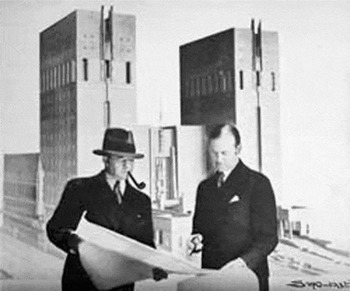
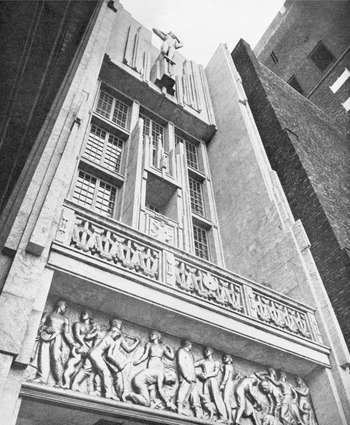
The construction of the Oslo city hall in Pipervika, in central downtown, started in 1931. It was interrupted by the outbreak of World War II, before the inauguration of the hall in 1950. Due to its distinctive architecture, interior art and iconography the building became one of Oslo's landmarks. The planning of the city hall made the architects, Arnstein Arneberg and Magnus Poulsson, immortal. In June 2005 the building was named Oslo's ‘structure of the century’.
Source: Byggekunst, 9–10 (1950).

Somewhat younger were the Norwegians, Arnstein Arneberg and Magnus Paulsson, who were born in the 1880s. Both studied at the Royal Drafting School in Christiania and in the Technical High School in Stockholm. They worked as independent architects before the planning work for the city hall started in 1916.Footnote 36 All four architects were labelled during their lifetime men of modern times. Nyrop was called the most ‘fervently nationalistic of all Danish architects', Östberg was a clear representative of the new generation of artists in 1890s’ Sweden. Arneberg and Paulsson were called the ‘double monarchs of Norwegian romantic architecture’. They all took their places at the forefront of the architects and artists who created the nationalist, and soon also the modernist, programme. Modern artists and architects wanted the right to express themselves freely, unburdened by tradition.Footnote 37
City hall and the myth of ‘national’
How and by whom were these architects immortalized? High expectations were already created during the planning and building stages and both operations were eagerly followed by the local press. The architectural competitions aroused considerable local and national interest. During their construction, the city halls in the capital cities also grew to become major national projects. Inauguration ceremonies, press publicity surrounding them and their coverage in architectural publications show the kind of reactions these buildings provoked in public opinion. In all three capitals, the city halls became a symbol of local collective memory and that being so, in terms of the historical research by French Pierre Nora, they are lieux de mémoire.Footnote 38 The main aim was to create a ‘public home’, a political forum, a ceremonial core and a symbolic centre for the capital city – and indeed for the nation and civil society at large.
The inauguration of the city halls was commemorated in all three cities by a magnificent publication. Copenhagen set the tone; Stockholm and Oslo followed. As the Danish journalist Peter Købke wrote in 1903, the city hall was the biggest public building ever seen in the country (‘det største Byggeforetagende, som Hovedstaden og hele Landet i mange Tider har set’). In the Publication officielle of the city hall of Copenhagen in 1908, the Danish publisher August Bang wrote:
The Danish Capital and the whole country regard Martin Nyrop's city hall as a work that does Denmark the highest honour. We, as a nation, are deeply gratified by the admiration the building excites in the minds of visitors from abroad, as evidenced by numerous treatises and essays in various languages, written by competent foreigners, in both the Old and the New World. In all civilized countries where the fame of the building has penetrated, the opinion is freely and repeatedly expressed that the city hall of Copenhagen is the most magnificent and the most characteristic architectural achievement of modern Denmark.Footnote 39
The jubilee books and architects' articles of the times show that the high reputation of these buildings was already created during the planning process, mainly by other artists and architects.Footnote 40 They set the tone for how these city halls should be viewed as symbolic objects. One of the leading Danish artists, architect Peder Vilhelm Jensen-Klint, described the Copenhagen's city hall in Nordisk Tidskrift in 1903. Swedish architect Ragnar Josephson analysed Stockholm's city hall in Ord och Bild in 1923. In Oslo the leading architectural journal, Byggekunst, dedicated a whole special issue to the city hall in 1950.Footnote 41 The motivation was clear: all three town halls were built to symbolize the role of the capital city in a national context. The combination of local and national themes worked in harmony with ‘European elements’.
Just these books and articles on the subject suggested a common understanding of how these city halls should be semiotically interpreted. The city halls of Copenhagen and Stockholm were viewed as national romantic monuments.Footnote 42 In Josephson's eyes, the Stockholm city hall was a ‘monumentum aere perennius’, a monument that would stand among leading European works of architecture. Jensen-Klint saw Copenhagen's city hall as a beautiful symbol, coming direct from the people's hearts (efter folkets hjerte) and reflecting the Danish spirit (Dansk ånd). In Stockholm city hall's jubilee publication the Viennese scholar and art historian, Professor Josef Strzygowski, noted that the city hall ‘is representative of our race and our geography – it is Aryan and Scandinavian’. Both elements expressed a feeling of power, independence and practicality, showing ‘the sober honesty that keeps to the object in view and lets the raw materials work and as such receive their due’.Footnote 43
In Oslo the situation was somewhat different. During the long planning period, architectural ideas changed many times, from national romantic to classical and finally to functionalist. Nationalist sentiment survived all these paradigm changes. Finally, the great dream of Norway's own monumental building was fulfilled, as the planning of the Oslo city hall resulted in the first modern skyscraper in Norway. According to Byggekunst, in 1950 modern monumentality was seen as best expressing post-war ‘genuine Norwegian identity’. The city hall of Oslo managed to combine modernism with a historical message and was thus ‘up to date’.Footnote 44
In symbolic terms, one central aspect was underlined: the city hall was attractive as a new type of building, because it could at the same time express the ‘character of a nation’, be a worthy representation of the ‘ethnic Scandinavian race’ and be the modern ‘soul of [the] capital city’. Architect Nyrop's city hall was the first to demonstrate ‘a design stamped by personality, and of individual character. . . befitting the Capital City of Denmark’.Footnote 45 This high level of appreciation is still to be seen whenever something is written on modern architecture and ‘modern times’ in Scandinavia. In 2000 Barbara Miller Lane described the Nordic city halls as being a new kind of public building. In her opinion, the Copenhagen city hall set the tone: ‘Nyrop's city hall and the buildings of his followers gave the impression of a new town within the city, one that contrasted strongly not only with the cramped streets and tiny buildings of the oldest part of Copenhagen but also with the solemn-looking neoclassical buildings around the Amalienborg.’Footnote 46
It was not by accident that the beloved Swedish national romantic poet Verner von Heidenstam praised King Gustav Wasa on 23 June 1923, when the Stockholm city hall was inaugurated. This day was chosen carefully. It was the most Swedish of all days – Midsummer Eve. On the same day the 400th anniversary of King Gustav Wasa's entry into Stockholm in 1523 was celebrated. In Swedish history, that day marked the foundation of the Swedish nation state.Footnote 47 The Wasa period greatly influenced the position of Stockholm. At the beginning of the sixteenth century it was still a modest trading town with 6,000 residents, closely linked to the Hanseatic League, but Gustav Wasa made the town the seat of royal power.Footnote 48
The inauguration ceremony of the new city hall was a grand festival in all three capitals. They followed a similar choreography, combining local, national and royal elements. In Copenhagen the city hall was inaugurated on the completion of the banqueting hall, on 12 September 1905. The inauguration day had symbolic value in both Sweden and Norway. In Stockholm it was the Wasa anniversary, in Oslo it was 14 May 1950, the city of Oslo's 900th jubilee, and close to the National Day (17 May). The celebrations had many elements, combining exhibitions in city museums, church services, concerts, theatre performances, public festivities in parks and market places and finally, in the evening, an honorary dinner and fireworks. In Oslo, the combined celebration of the city's jubilee and the inauguration of the city hall lasted for four days.Footnote 49
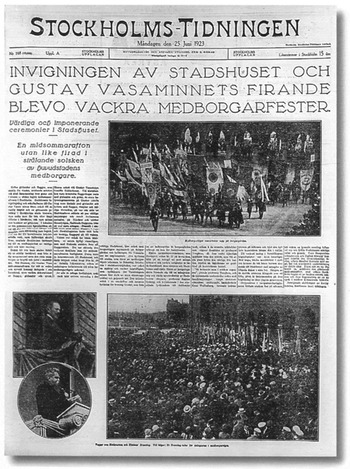
The front page of Stockholm Tidningen (Stockholm Times) on 25 June 1923 was dedicated to the special Midsummer Day in the capital city of Sweden: ‘The dedication of the city hall and the commemoration of Gustav Vasa were great civil celebrations.’ Honorary guest was King Gustaf V.
Source: Kungliga Biblioteket, Stockholm.

In keeping with the royalist approach to the festivities, King Christian IX in Copenhagen, King Gustaf V in Stockholm and King Haakon in Oslo attended the ceremonies, inaugurated the buildings and gave speeches. Much attention was given to the royal presence. The royal message was clear: all capital cities should be proud of their city halls, created by ‘men of spirit and practicality’ (King Haakon). King Christian thanked the burghers in Copenhagen for their monumental effort. King Gustaf V underlined the close relationship between Swedish kings and the city of Stockholm, ‘it can best be characterized by the words trust and co-operation’.Footnote 50
All three capital cities were proudly decorated. National flags with garlands were combined with city flags and military flags (Oslo). Inside the building, the banners of workers' guilds were present. In Copenhagen, the Tivoli nearby was beautifully illuminated. A special regatta was arranged in Stockholm to underline the maritime essence of the city hall. Here the most impressive event was the procession of citizens through the city to the courtyard of the city hall, emphasizing the democratic and liberal elements in Swedish history.Footnote 51 In front of the city hall in Oslo, the naval destroyer ships, Oslo, Bergen and Stavanger, lay at anchor. Thousands of people were gathered to follow the festivities in the streets. Guests filled the banqueting spaces, a combination of ministers and members of parliaments, high-ranking civil servants, and municipal decision makers and workers' representatives. Foreign journalists and guests, usually mayors, of other European capitals were also present.Footnote 52
Politically, the national and local elements were present at the inauguration ceremonies. The architects were guests of honour. The key speakers were usually the chairmen of the city councils. They gave the ‘ideological’ speech, evaluating the role and place of the city hall in the national and local context. In Copenhagen, Mayor Peder Jensen, a well-known social democrat, gave a speech ‘for King and Country’, which was, according to the newspaper, to the surprise of his audience. In Stockholm, Mr Allan Cederborg, chairman of the city council and one of the leading figures in the local community, praised the internal beauty of the building, which augured a period of a long and peaceful urban development. The building symbolized thus from the very start the strong political links between the state authorities and local government. Stockholm, as capital city, was the seat of this national consensus. The city hall, dubbed ‘The Queen of Lake Mälaren’, guaranteed, according to Cederborg, the city a prosperous future. In Oslo, the chairman of the city council, Mr Stokke, praised the unity of Oslo and Norway, which were ‘on their way to a prosperous future’.Footnote 53
The identification of city hall as both national symbol and local monument did not arouse any scepticism in the press or give rise to public debate. Both elements were proudly and naturally combined, as King Haakon expressed: ‘This building is a monument to Oslo's capacity to react and a Norwegian symbol of survival over the difficult war years.’Footnote 54 The city halls were praised for uniting the nation and its people. For the Swedish prime minister, Mr Branting, the city hall was a ‘castle of municipal self-government’, planned to represent the spirit of solidarity and civic duty. In Oslo, the idea of the city hall was linked to the ‘Norwegian love of liberty’. Music, patriotic songs and poetry were used to immortalize the city halls. The most spectacular musical performance was in Oslo, where a combined choir of 200 students, merchants and workers sang folk and patriotic songs in the inauguration ceremony. This musical performance was broadcast by loudspeakers all over the city.Footnote 55
The city hall and the myth of ‘European urbanity’
The city hall, charged with the role of civic representation, is a key site for exploring the meanings of public space. The European twentieth-century city hall fostered a vision of civic, urban identity, promoted by politicians, architects and planners. Thus the city hall may be understood as a microcosm of local social order, supporting culture and urbanity. It also challenged the concept of civic space in traditional city planning and municipal management. Some elements of continuity were present. Three traditional functions – meetings, markets and magistracy – were transformed in modern European city halls. The assembly room was a creation of the eighteenth century, linked to the needs of the bourgeois, but the multi-purpose public hall (for entertaining and gatherings) and the banqueting hall were something new. Both reflected the idea of the town as a cultural and social whole. The developing bureaucracy brought an increase in the amount of office and meeting space required. Extra space was needed for police and fire services, a restaurant, and library, archives and a registry clerk. With all these elements included, the fully fledged nineteenth-century European city hall was a complex building.Footnote 56
In all three Scandinavian capital cities the city hall as a building type continues to have a European role: it manifests civic, urban pride. A detailed town planning programme was launched in Copenhagen in 1888, when the municipality issued invitations for a design competition. Design guidelines were drawn up for the first time. The principal stipulations concerned costs, technical details and the building material to be used (natural stone or brick). The design was to include a covered courtyard, a banqueting hall, rooms for the city councillors and the magistracy, as well as offices for the four departments of the magistracy and the city archive. There was also a request for a garden plan. The total floor space required was specified precisely. In Stockholm, the city's building department had prepared a building agenda for the new city hall as early as 1892 and in Oslo in 1915.Footnote 57
How should we understand the city hall as an allegorical artefact? The city hall is a lieu de mémoire, but it is also an urban icon telling a narrative. The city hall will here be seen as a communicative element, as a medium expressing bourgeois values and ideas of urban history linked to the local, national and European context. The builders developed an urban, inclusive discourse, symbolically present in the architecture and iconography of the city halls. Here the buildings are analysed as expressions of myths, mythology and metaphors of urbanity and the status of the capital city. This analysis aids our understanding of how the urban, liberal and soon-to-be democratic message became visible. They formed ideas of cities as imagined communities with their own ‘national print-language’, according to the definition by Professor Benedict Anderson.Footnote 58
Here the concept of research on myths and memories by Anthony D. Smith will be used, transferred to an urban context. Cities are seen as compact and politically active units, occupied by modern, urban citizens, who need a creative and unified community. Urban elites created the narrative by using national values, myths and memories.Footnote 59 In this article, iconographically, the city hall is seen as the intersection of different narratives, all discussing the mythical dimension of urbanity. Three categories have been created to analyse buildings and narratives: (1) the European idea and urban context, (2) the civic and intellectual culture of the city, (3) urban origins and local history.
The significance of the city halls of Copenhagen, Stockholm and Oslo is in the variety of ways in which the vocabulary of traditional European city hall architecture was transferred to Scandinavia to express the individual personality of these cities. Nyrop and Östberg were familiar with the historical role of great town halls such as the Palazzo ducale in Venice, the city hall of Siena, Lübeck's Das rote Rathaus, the Hotel de ville in Paris and Amsterdam's Stadhuis. The central elements of these buildings were urban monumentality, their rich decoration and their location in the city centre, in the market place. Germany gave to Scandinavian city halls picturesque details, the festive hall, a tavern and courtyards. France and Belgium gave balconies and weathercocks. Italian architecture inspired the bell tower or campanile in Copenhagen and Stockholm.Footnote 60
First, all three city halls showed the eternal longing of the northerner for southern climes. Copenhagen's winning entry reflected the council's image of the city, inspired by medieval European urban history – solid, wealthy and looking forward to future growth. Stockholm's and Oslo's city halls are Mediterranean buildings, comparable to the public buildings of Italian city states. These port cities saw themselves as being a ‘new Venice of the north’. In Stockholm the city hall was located close to the sea so that its appearance differs depending on whether it is seen from the sea (openness and intimacy) or from the city (monumentality and closeness). The sea was seen as a romantic urban element, as architect R. Josephson wrote in 1923, ‘giving to the maritime city of Stockholm a new prosperous future’. In Oslo a monumental and symmetrical square (Fridtjof Nansens plass) was planned on the city-side of the city hall and the harbour area was reshaped. These open places on both sides of the city hall had a clear resemblance to medieval Italian urban and public piazzas.Footnote 61
Brick was considered to be an ‘honest European material’, influential in the architecture of the Netherlands, Denmark, England and northern Germany. These countries had a long urban history and strong mercantile traditions. Brick underwent a renaissance at the end of the nineteenth century as a suitable material for monumental modern buildings, with a polite bow to both urban history and medieval castles. Politically, brick was alien to the tradition of classicism, which was a high and supranational style with strong roots in imperial, aristocratic and state architecture. In all three city halls brick gave a feeling of medieval unity, or as architect R. Josephson put it, ‘gave a feeling of the romantic, picturesque tradition of both former local aristocratic milieus and medieval cities with their brick castles’.Footnote 62
The third element of the planning of the European city hall is the accessibility of the building. An essential component is the idea of distance or closeness being both physical and metaphorical. The best of classical city halls front on to an open square and communicate with the urban environment. In Copenhagen, the location of the city hall is the most urban and central of the three, close to the Tivoli amusement park and the new central railway station. The location of the main building has historical symbolism – it is on the spot where the first West Gate of the old city fortifications was situated. This gate was the urban starting point for measuring all road distances on Zealand.Footnote 63 The city hall deals more directly with the street life of the city. The Rådhuspladsen (the Town Hall Square) is one of the busiest meeting points in Copenhagen, an urban place for citizens and tourists, with many hotels, shops, cafés and restaurants nearby.
In Stockholm, Östberg's city hall is meant to be viewed from a distance. It is clearly a monumental, independent work of art, and thus less accessible than the old city hall in the medieval Old Town of Stockholm. It was planned to be separate from the crowded centre of the city, and to be viewed from the sea or from the city. A new bridge was, however, built to connect Kungsholmen to the old city. No public space was planned in front of the building – on the contrary, heavy traffic passes the building, which is also located close to the main railway station. The open inner space, a courtyard (Borgargård) in the city hall, functions like a closed ‘royal’ courtyard rather than an open, urban public space.
In Oslo, a bird's-eye view of the city reveals that the open waterside location puts the city hall, the royal palace, the bourse and the parliament building – traditional symbols of the capital city – all close to one another, with a clear communicative idea behind the arrangement. The setting of the building is somewhat different to that in Copenhagen and Stockholm; it derives its monumentality by pulling itself away from the most central parts of the city, but it communicates with the harbour area and creates its own spaces for urban participation, walking and entertainment.Footnote 64
The tower, the strongest medieval European element of power in urban and religious architecture, was the signature of the city halls in Copenhagen and Stockholm. In Italian towns the tower was a manifestation of civic protection against landlords, belligerent nobles and other undesirables. At the end of the nineteenth century it was transformed into a symbol of bourgeois pride and self-esteem, elevated above the urban horizon and welcoming visitors. In Copenhagen the public followed the building of the tower with great enthusiasm. The top of the tower is 350 feet above the ground and it contains a commemorative room in honour of the architect. In Stockholm, Östberg devoted most of his time to planning the tower. In Oslo, the tower motif was modernized from a single tower to a skyscraper with two high sections on each side of the building. Still, the asymmetry of the towers, the clock in the eastern tower and the astronomical clock in the western indicates medieval influence.Footnote 65
City hall as civic centre and modern, secular cathedral
All city halls have two main sections: the council offices for administration and governance and state rooms for receptions. The former reflected local themes in their symbolism and decoration, the latter reflected more national themes. In between is the third space, the civic hall, planned to accommodate great crowds of urban people on ceremonial and political occasions. The main civic space inside the building in Copenhagen is the Civic Hall (Rådhushallen) and in Stockholm the Blue Hall (Blåa Hallen). The ambitious, monumental, ceremonial main hall in Oslo, Rådhushallen, on the first floor, is the heart of the building. All three spaces welcome visitors. These regular-shaped grand main halls interweave ornaments, sculpture, paintings and decorative elements. The symbolism of civic pride is easy to feel.Footnote 66
In an iconographic sense, these halls differ somewhat. The materials for the façade of the Copenhagen civic hall come from all around Denmark. This collection of national materials was used to create a Mediterranean piazza, with façades, balconies, open gateways and loggias. In this ‘Italian’ hall, civic histories are told. Busts of famous Danes are placed here, including sculptor Bertel Thorvaldsen, an honorary citizen of Copenhagen, the writer Hans Christian Andersen, the nuclear physicist Niels Bohr, winner of the Nobel Prize, and architect Martin Nyrop. A line of inscription goes around the wall, describing the main events in the history of Copenhagen. The hall is used as a polling station during municipal and parliamentary elections. It is also used for official celebrations, exhibitions, concerts and receptions hosted by the city council.Footnote 67
The Blue Hall in Stockholm is regular in form and is the biggest space in the city hall. It is called ‘blue’ although it is a room of red brick. The floor and the stairs are of Kolmråden white marble. The unpainted red brick, ‘something quintessentially Swedish’, inspired the architect more than the marble. Blue has national connotations, blue being the colour of the Swedish flag. This hall was inspired by Italian urban architecture in the same manner as the hall in Copenhagen. Both have balconies, open walkways (loggias) and monumental staircases. On the rooftop terrace of the Blue Hall there is a bust of the architect Östberg, portrayed as a proud local artist holding the first version of the city hall in his hands.Footnote 68
In Oslo city hall one enters straight into the main hall, which combines the functions of civic hall and banqueting hall. It was a monumental space, in 1950 one of the biggest civic halls in Europe (38 m×31 m). As the city hall of Oslo is seen more as ‘hele nasjonens storsue’ (the monumental home of the whole nation), this space combines both civic and national elements. The main flooring material, marble, is rich in ornamentation and stairs placed along the long wall indicate the influence of the country's former capital, Stockholm. Although the Italian elements are evident (staircase, balconies) the grand hall is more of a national space. It opens on to the sea, and is more disciplined in its form.Footnote 69
According to the European tradition, the true wealth and civic pride of a city was to be seen in its banqueting halls. In Copenhagen the banqueting hall continues with the same interior architecture as the council chamber, with a heavy ceiling and white walls. Nyrop's ideas came from the Renaissance, a ‘period of joy and festivities’, and were influenced by the ancient ballroom.Footnote 70 In the middle of the longest wall stands a baldachin, where guests of honour sit. It is decorated with red roses and birds, the crown and coat of arms of the city, lions and hearts and a white cross, and a sailing boat at sea. Otherwise the hall is sparsely furnished, with a few particular items of furniture designed by the architect. The upper sections of the walls below the ceiling are decorated with 66 old municipal coats of arms. On the wall facing the town hall square there is an inscription commemorating ‘a splendid period when not only Greenland and the Faroe islands, but also Iceland and the former Danish West Indies (The Virgin Islands) considered Copenhagen capital of the realm’.Footnote 71
In all three city halls, the council offices are reached by monumental staircases. In Copenhagen there are two less monumental staircases, the Burghers' Stairs, built into the tower, and the Prefect's Stairs, known after 1938 as the Magistrate's Stairs, leading to a meeting room and the lord mayor's office. In the oak banisters of the Burghers' Stairs there are 17 decorative reliefs depicting the men who built the city hall. Close to the stairs are frescoes illustrating local history and making the point that Copenhagen has been the capital and main port of Denmark since the sixteenth century. Here, again, a selection of portraits of famous Danes is present, among them the scientists Otto Romer and Tycho Brahe and the nobleman Christoffer Valkendorf. In Stockholm the staircase is Renaissance-inspired, leading from the Blue Hall to the council corridors, which are flanked with offices. The busts above the office doors depict those who worked on the city hall project.Footnote 72
The magnificence of the décor in the council chambers was intended to remind councillors of the proud tradition of local self-government. The chambers were designed in accordance with the principle prevailing in almost all parliaments in continental Europe after the French Revolution. Members were to be seated in a semicircle, grouped according to their party affiliation, socialists on the left, and all conservatives on the right, facing the rostrum and the seat of the chairperson. In Copenhagen inspiration came from the Renaissance, in Stockholm from the Viking period and in Oslo from neoclassicism.
In all three council chambers the chairperson sits on a raised seat beneath a canopy, like a monarch, speaker of parliament or archbishop. In Copenhagen the baldachin is decorated with the city's coat of arms, and in the background there is an illustration of the city tree. A text engraved into the table, Retfaerd Raadets Aere, indicates the moral aspects of political decision making. The local symbols of two swords, an old money chest and two pairs of bronze lures (horns, the oldest Nordic wind instrument) are also to be found. In Oslo the tapestry behind the seat depicts the city's patron saint, St Hallvard. In Stockholm the seat of the raised chair is framed by purple cloth. Monumentality is accentuated in all the council chambers by large galleries for visitors and the press.
In Oslo, the semicircular council meeting room faces the Fridtjof Nansen Plass and follows the contour of that square. A clear European element of architecture, the ancient amphitheatre, is transformed to the north. In comparison with Stockholm and Copenhagen one can immediately see that the main political space here is more sparsely decorated, emphasizing ‘rationality’ and ‘democracy’ in political decision making and debate. Its main aesthetic ambition rests more on its solid interior architecture and the overall impression of monumentality than on rich decoration or copious artistic or historical detail. The chairman's seat is raised, with the tapestry behind the seat idealizing myth and reality in Oslo's history.
A sturdy, imposing ceiling is an important part of the iconography, according to the European tradition. In Copenhagen the ceiling, carried by six huge cross beams resting on gilt consoles is reminiscent of a ceiling in a royal castle or medieval stately home. Inspiration evidently came from the council hall (Rathaussalen) of Münster, in Germany. It was there that the Treaty of Westphalia was signed in 1648, bringing to an end the Thirty Years War. The effect is emphasized by the contrast with the simple whitewashed walls. In Stockholm the ceiling is exceedingly high, painted blue and red and with a trompe l'oeil skylight, which gives it the feeling of a Viking building, and opens to the sky. On the ceiling, at intervals, are pictures of Stockholm's history, from the day the boy first landed at Riddarholm to the day the Eldkvarn steam mill burned down.
The artwork on the façades of the buildings symbolizes both local and European tradition; the idea is to depict the intellectual culture of the city. In Copenhagen detailed decoration around the main doorways of the façade underlines the value of national flora and fauna, beloved motifs in the national romantic style. In Stockholm and Oslo a more detailed design is to be seen. In Stockholm, the classical Greek gods Bacchus and Mars are placed as statues on the northern façade and important figures of the Arts (Painting – Sculpture – Music – Architecture) are on the southern façade. A civic tree, an oak, was planted in the civic courtyard. In Oslo the use of the city's emblem, the swan, is repeated. The swan is, according to the poetic description of Has Ernst Kinck, the soul of Oslo. The four seasons, and sea horses, symbolizing the maritime nature of the city, are motifs in the decoration of the façade.
The modern city was seen as a combination of work and workers, the elite and the common people. In Copenhagen ‘urban work’ is symbolized by the guards of the city. Six watchmen flank the flagpole on top of the roof of the front building. These watchmen represent the police in ancient times. The eastern façade of Stockholm city hall is decorated with 23 gilded figures and depicts the different professions important to the city's history. Some are real figures, like Hjalmar Branting. In the civic courtyard both statesmen and local politicians are represented, from King Gustav Wasa, to the first elected chairman of the city council, Sigurd von Friesen. In Oslo the themes of the common people and everyday urban life were developed further. A series of sculptures depicting work, such as forest workers, fishing, building, are to be found on the façade. Statues and stone engravings of everyday life, including the corner relief Albertine, portraying two men and a prostitute, are located all around the building.
The intellectual life of the city is present in the cult of the architect. Nyrop and Östberg are watching over the city life both in painted and sculptured form. Eternal values are symbolized by the mother-and-child theme. In Stockholm a statue of a mother and child is at the foot of the tower, in Oslo it is to be found in many sculptures and reliefs. Urban folklore is also represented in the city halls of Stockholm and Oslo. In Stockholm on the roof top there is a statue of the bishop and the boy – according to legend the boy was the first resident of the city. In Oslo, the Yggdrasilfriesen in the civic courtyard (Borggården) consists of sixteen painted wooden reliefs, with motifs from Nordic mythology (Edda).
In term of their iconographic programme, it appears that city halls must be seen as secular modern cathedrals. The use of painting, sculpture, mosaic, textiles and building materials proclaim the mythical origins and the specific history of the capital city and its nation. Early urban iconography was developed in northern Europe during the sixteenth and seventeenth centuries. Large town halls in Lübeck, Amsterdam, Nurnberg and Aachen, among others, were designed to be showcases of their city's burgeoning prosperity. Their design was inspired by the Italian Renaissance and baroque and neoclassical architecture, adapted to suit local tastes. Artistic and decorative elements included doors, stairs, sculptures, and reliefs, paintings, textiles, inscriptions and coats of arms.Footnote 73
Traditionally the town hall was even connected with high aspirations of moral improvement. Old iconographical elements are present in their decoration: urban virtues, local legends and town emblems, allegorical figures symbolizing ancient virtues, gods and goddesses, as well as patrons and great men of the city and state. Such imagery attempted also to unite the city and the nation in the city halls of Scandinavian capital cities. Other themes present in the decoration of city halls in Copenhagen, Stockholm and Oslo were nature (the sea in all three cases), animals, flora, Christian symbols and people, as well as Nordic and Viking mythology. The written word, too, plays an important role in the buildings' architecture in the form of names, proverbs and folk songs. Quotations from various biblical and historical sources were most frequently used in the city hall of Copenhagen.Footnote 74
All three city halls integrated the official nationalism of the nation state into the urban history of the capital city. The representation of local history and legend was central to the artistic design. In Copenhagen the central element is the coat of arms depicting three towers, an anchor and a heart. The founding father of the city, Absalon, bishop of Roskilde and archbishop of Lund, is represented in the centre of the city hall's façade by a gilt statue. According to legend, he founded the city in 1167. By the main door there is a relief inspired by the shape and decoration of medieval cathedrals, with figures from Byens aeldste Råd (the old city council) and 25 members of various urban craft guilds. The motto on the building, Saa er Byn som Borger (S:B:B), ‘A city is what its citizens are’, is a saying often repeated. It is accompanied by the city coat of arms.Footnote 75
Also in Stockholm and Oslo the main symbols of local power – the city coat of arms, seals, the city emblem and its founding fathers – are also often repeated. In Stockholm the symbolic core of the building is formed jointly by the founding fathers and the crown. The national coat of arms: the three crowns representing the Swedes, the Goths and the Vandals, is at the top of the tower. Around the tower are statues of the patron saints of the city; St Erik, St Mary Magdalen, St Nicholas, patron saint of sailors, and St Clara, each facing the part of the city under their protection.
According to medieval tradition, the city is said to have been founded by Birger Jarl around 1250 in order to protect Sweden from a sea invasion by foreign navies, and to stop the pillage of such towns as Sigtuna on Lake Mälaren. Earl Jar was given a special place of honour in the city hall. His monumental cenotaph was placed at the base of tower. State nationalism is symbolically present in the sculpture of ‘St George and the dragon’, a free interpretation of the statue in Storkyrkan (the Great Church). It recalls the battle of Brunkeberg in 1471 when the Swedes prevented Danish forces from taking Stockholm; the dragon symbolizes the Danes, the princess represents Sweden's freedom and innocence.Footnote 76
St Hallvard is the central national and local emblem in the official coat of arms of Oslo. He is present in many design details. The main entrance is decorated with a tree panel depicting Sigurd killing the dragon Fåvne. Local mythology is present in Hårdråderommet, which is dedicated, in medieval guild-house style, to Harald Hårdråde, the founder of the city of Oslo. Here the decoration has ‘oldnorsk ornamentik’ with inspiration from ancient Viking ships. Two tapestries depict the foundation of Oslo and the fall of Hårdråde at the battle of Stamford Bridge in England in 1066.
The monumental entrance of the Oslo city hall has many interesting iconographic and artistic elements. St Hallvard is the central emblem in the coat-of-arms of Oslo, located in the middle of the main façade. Joseph Grimeland's statue The maid of Oslo can be seen as the personification of Oslo. Grimeland's bronze relief City meeting the countryside is placed above the main entrance. The idea of ancient Norvegian art or ‘oldnorsk ornamentik’, which owes its inspiration to the Viking period, is evident.
Source: Byggekunst, 9–10 (1950).

Great local and national figures are represented in many rooms. In Stockholm the Golden Hall (Gyllene Salen) is the effective climax of the city hall: a grand space combining the local and the national to form the history of the capital city. It is covered with gold mosaic tiles inspired by Sicilian church interiors and the Byzantine tradition. The north-facing main wall is dominated by a huge queen of Mälaren, holding her crown and sceptre, while the midsummer sun shines on her. The most important city buildings are in her lap, and she is receiving praise from the representatives of the regions of Sweden. The south wall is dedicated to the history of the city, with pictorial representations from medieval times to the modern day. National history is present in the window niches, starting with Bishop Ansgar christening the Swedes at Birka around AD 830, and continuing with monarchs such as Magnus Ladulås, Erik XIV, Queen Christina and Gustav III. Above this history lesson are representations of the seven virtues: faith, hope, charity, prudence, justice, fortitude and temperance, and the seven ages of man, from the cradle to the grave. Seven doors lead from the hall to the balcony. The pictorial illustrations on the eastern wall are dedicated to culture and the arts, nature and engineering.
In Oslo the equivalent of the Golden Hall is the Det Lange Galleriet (Long Gallery). Close aesthetic connections with Florence are evident, such as in its colourful ceramic relief work. In Oslo city hall, themes from everyday life are emphasized. Gender equality, industrialization and the presence of the working class were new features in local politics. The representation of contemporary political history is another novelty in the city hall of Oslo. The large murals of Civic Hall illustrate the history of Norway, its political development, its economy and commerce and its mythology and influential personalities. The main fresco is named Work – Administration – Festivities, and is clearly influenced by the nationalist spirit of post-war era. It is thus more modern, political and impressionistic than the paintings in Copenhagen and Stockholm.
Conclusion
In northern Europe the modern city hall took shape at the end of the nineteenth century, first in France, Germany, Austria and Great Britain, then in the Scandinavian countries. In all Nordic countries democracy entered the local decision-making process in this period. The city hall was designed for a new civil and urban society. Architecture in its urban context was seen as an instrument of social and political policy. It is thus evident that the city halls are manifestations of this political development.
In an iconographic sense, the city halls of the Scandinavian capitals conform closely to the conventional European model, inherited from earlier urbanized areas. In their architecture, the planners' particular admiration for Italian and German cities was combined with an esteem for art, design, architecture; national history in general, and local historical traditions in particular. In all three capitals the city hall is still a key factor in local collective memory and that being so, in terms of historical research, a real lieu de mémoire. The main aim was to create a public space, a political forum, a ceremonial core and a symbolic centre for the capital city – and indeed for the state, the nation and civil society at large.
One could also say in the case of Scandinavian city halls that the creative process was quite similar. First, the idea of a city hall was usually raised by one or two key figures with a clear vision of the political role of such a building. Second, an architectural competition was arranged. The winners were all in many ways immortalized through the project. Nyrop, Östberg and Arneberg and Poulsson were also all educated architects, themselves members of the new urban elite for whom they were planning. Third, the city hall was planned to be a central showcase and permanent exhibition space for national design, applied arts and handicraft. Fourth, due to the status of the capital city, the inauguration of the building was a cause for national celebration.
As a source of iconography, the city hall contained both artistic and political dimensions. During its usually very long period of construction, the city hall even became a major national project. In the cases of Oslo, Stockholm and Copenhagen, the city hall became the main national symbol, one of the principal works of its country's nationalistic architecture and culture. The city halls are pure works of art (Gesamtkunswerk) and they were planned for monumental art, design and architecture. Every room, all the furniture, textiles, colours, works of art and ornamental details were part of the basic vision, based on national or urban history and values. The artistic project provided many artists and designers with an important training opportunity. The best artistic talents were engaged, many of them becoming central figures within national culture.
The development between 1880 and 1950 changed the use of urban areas and buildings. Urban form and political interpretation marched hand in hand. City halls are central elements in understanding how bourgeois, liberal and the soon-to-be democratic and modernist message became visible in European capital cities. The planning of the Scandinavian capital city halls was by no means understood as a purely technical, functional or formal issue. The halls were expressions of political, social and cultural conditions, and changes in these conditions. City halls communicated with, and even manipulated, citizens, as the jubilee publications and inauguration ceremonies show. History helped the architects to interpret the source and nature of municipal pride, and urban historians were needed to tell this story. City hall architecture must in this sense be seen as a narrative element in the townscape. The new style municipal buildings were thus a justification for political independence in capital cities.