Social anxiety disorder (SAD) is characterized by a persistent fear of judgment from others that often drives avoidance of social situations, resulting in behaviors that adversely affect individuals’ functioning across multiple domains (e.g., social, academic, and occupational; American Psychiatric Association, 2013). The median age of onset for SAD is 13 years (Stein, Reference Stein2006), making it one of the most common anxiety disorders diagnosed during adolescence (Beesdo, Pine, Lieb, & Wittchen, Reference Beesdo, Pine, Lieb and Wittchen2010). Owing to the impairments experienced by individuals suffering from SAD and because the presence of social anxiety problems during adolescence is associated with an increased risk for concurrent and subsequent behavioral problems and other severe disorders – including depression, concentration difficulties, and conduct problems (Beesdo et al., Reference Beesdo, Bittner, Pine, Stein, Höfler, Lieb and Wittchen2007; Stein et al., Reference Stein, Fuetsch, Müller, Höfler, Lieb and Wittchen2001; Van Roy, Kristensen, Groholt, & Clench-Aas, Reference Van Roy, Kristensen, Groholt and Clench-Aas2009) – it is critical to understand the psychobiological mechanisms that contribute to the emergence of SAD during adolescence. Elucidating these mechanisms will inform the development of more effective, mechanism-driven, evidence-based treatments.
In this context, contemporary models have posited that SAD is characterized by an increased sensitivity to social stress resulting from maladaptive cognitive and emotion regulatory processing (e.g., fear of social rejection, negative self-evaluation). In particular, a growing body of literature has suggested that individuals vulnerable to SAD and other anxiety disorders tend to respond to stressors with pronounced negative affect – that is, they have greater stress sensitivity to negative events (Farmer & Kashdan, Reference Farmer and Kashdan2015). Heightened responses to life stressors may reflect a propensity to perceive interpersonal events negatively, thereby contributing to behaviors that are intended to minimize distress for the individual but that often generate or perpetuate interpersonal conflict (e.g., avoidance, withdrawal), leading to sustained symptoms of SAD (Hammen, Reference Hammen2015). Researchers have demonstrated that adolescents with a history of SAD symptoms report experiencing stress in response to social-evaluative threat, which, in turn, predicts greater SAD symptoms in late adolescence (Nelemans et al., Reference Nelemans, Hale, Branje, van Lier, Koot and Meeus2017).
Several researchers have also documented that individuals with, or at risk for, SAD are physiologically more sensitive to stress (Crişan, Vulturar, Miclea, & Miu, Reference Crişan, Vulturar, Miclea and Miu2016; Farmer & Kashdan, Reference Farmer and Kashdan2015; Nelemans et al., Reference Nelemans, Hale, Branje, van Lier, Koot and Meeus2017), suggesting that in addition to subjective stress reactivity, physiological function is an important domain to consider in understanding the psychobiology of SAD. Perceived stress is associated with physiological changes related to the autonomic nervous system (ANS), including changes in arousal, cardiovasculature, and respiration, which collectively mobilize individuals to engage in adaptive behavioral responses. Specifically, when encountering a stressor, an organism shifts from a “rest and digest” mode governed by parasympathetic nervous system (PNS) activity to a “fight or flight” mode governed by heightened sympathetic nervous system (SNS) activity (Berntson, Norman, Hawkley, & Cacioppo, Reference Berntson, Norman, Hawkley and Cacioppo2008; Porges, Reference Porges2007). During recovery from a stressor, healthy autonomic regulation is characterized by a shift back to PNS dominance (Kahle, Miller, Lopez, & Hastings, Reference Kahle, Miller, Lopez and Hastings2016; Mezzacappa, Kelsey, Katkin, & Sloan, Reference Mezzacappa, Kelsey, Katkin and Sloan2001). These patterns of physiological coordination between SNS to PNS activity during reactivity and recovery are posited to reflect the effectiveness of individuals’ autonomic regulation to stressors (Berntson et al., Reference Berntson, Norman, Hawkley and Cacioppo2008; Brosschot, Pieper, & Thayer, Reference Brosschot, Pieper and Thayer2005). Interestingly, recent work suggests that flexible changes in the PNS and SNS (i.e., increased reactivity and recovery) in response to emotionally evocative events are correlated significantly with adaptive emotion regulation (Kahle, Miller, Helm, & Hastings, Reference Kahle, Miller, Helm and Hastings2018; Miller et al., Reference Miller, Chocol, Nuselovici, Utendale, Simard and Hastings2013); in contrast, blunted PNS reactivity and recovery have been documented in internalizing disorders (Kircanski, Waugh, Camacho, & Gotlib, Reference Kircanski, Waugh, Camacho and Gotlib2016). Thus, dysfunction in ANS regulation, measured by disruptions in the ability to appropriately shift autonomic balance during or following a stressor, may represent two plausible – and not mutually exclusive – biological indicators of the maladaptive emotion regulatory processes that underlie SAD.
Finally, it is imperative that researchers consider sex when examining links among stress sensitivity (i.e., the tendency to perceive a stressor as distressing), autonomic regulation, and increasing rates of anxiety problems across adolescence. Sex-differentiated exposure to stressors (i.e., more experiences of interpersonal stress in females) may lead to differences in stress sensitivity that, in turn, contribute to sex differences in related physiological stress regulation and, ultimately, in symptoms of SAD and related disorders (Hamilton, Stange, Abramson, & Alloy, Reference Hamilton, Stange, Abramson and Alloy2015). Females report higher levels of perceived stress than do males (Bergdahl & Bergdahl, Reference Bergdahl and Bergdahl2002; Brougham, Zail, Mendoza, & Miller, Reference Brougham, Zail, Mendoza and Miller2009), and are twice as likely both to report internalizing symptoms and to be diagnosed with anxiety disorders in adolescence (Angold & Costello, Reference Angold and Costello1995). Sex differences in physiological responses to stress have been documented across the lifespan, with females exhibiting significantly greater SNS reactivity than do males starting in adolescence (Kudielka & Kirschbaum, Reference Kudielka and Kirschbaum2005; Kudielka, Buske-Kirschbaum, Hellhammer, & Kirschbaum, Reference Kudielka, Buske-Kirschbaum, Hellhammer and Kirschbaum2004; Ordaz & Luna, Reference Ordaz and Luna2012). Thus, the well-documented sex differences in the onset of SAD from adolescence through adulthood (i.e., females are more likely than are males to be diagnosed with SAD; Aune & Stiles, Reference Aune and Stiles2009; Caballo, Salazar, Irurtia, Arias, & Hofmann, Reference Caballo, Salazar, Irurtia, Arias and Hofmann2008; Merikangas et al., Reference Merikangas, He, Burstein, Swanson, Avenevoli, Cui and Swendsen2010) may arise from sex differences in both subjective stress sensitivity and autonomic reactivity and recovery to social stress.
In the present investigation we examined the associations among stress sensitivity, autonomic regulation in response to a well-validated laboratory social stress paradigm, and social anxiety symptoms in a community sample of female and male adolescents. Importantly, we recruited female and male adolescents to be matched on pubertal status, thereby allowing us to examine sex-specific effects without puberty-related confounds. Moreover, we conducted and coded comprehensive interviews in all participants to assess cumulative objective life stress as well as subjective stress severity. Thus, we were able to derive a measure of stress sensitivity that reflects the subjective severity of stressful experiences after accounting for objective severity. We hypothesized that: (a) stress sensitivity will be associated with symptoms of social anxiety; (b) this association will be mediated by dysfunction in ANS regulation (more inflexible responding; that is, a smaller shift from PNS to SNS dominance during physiological reactivity to an acute stressor and a smaller shift from SNS to PNS dominance during physiological recovery to the stressor); and (c) these associations will be stronger in females than in males.
Method
Participants
Potential participants were recruited from the San Francisco Bay Area through posted printed flyers, online advertisements placed in local parenting magazines, and social media platforms. Inclusion criteria for participants were English fluency and being 9–13 years of age. Given that the larger study was focused on the effects of early life stress on brain development across the pubertal transition, exclusion criteria for participants were post-pubertal status as measured by self-report Tanner staging (see “Pubertal Staging” below for more details), any contraindications to magnetic resonance imaging (MRI) (e.g., claustrophobia, braces, metal implants), a history of neurological disorder or any major medical illness, serious cognitive or physical challenges that might interfere with their ability to understand or complete procedures, or, for female participants, the onset of menses. Males and females were recruited to be matched on pubertal stage, measured by self-report Tanner staging. Participants and their parent(s)/legal guardian(s) signed assent and consent forms, respectively, to participate in this study, which was approved by the Stanford University Institutional Review Board. All participants were compensated for their time.
At the baseline assessment (T1) of the study, we recruited 214 adolescents (121 females) ages 9–13 years (M ± SD = 11.38 ± 1.05). Of these participants, 170 (92 females) ages 11–16 years (M ± SD = 13.40 ± 1.06) returned for a follow-up assessment (T2) approximately 24 months later (M ± SD = 23.98 ± 4.28 months). One hundred and sixty-nine participants completed a laboratory social stress test; 96 participants completed the task at T1 and 73 participants completed the task at T2 (because participants were debriefed after the task, they could only complete it at one timepoint). Of these 169 participants, six did not complete this task within 90 days of completing the measure of social anxiety and were subsequently excluded from our analyses. Thus, a total of 163 participants (90 females) were included in the current study: 94 participants (51 females) from T1 and 69 participants (39 females) from T2. As we note, below, participants who underwent the TSST at T1 did not differ from participants who received the TSST at T2 in sex, stress sensitivity, social anxiety, or physiological measures (see “Results”).
Stress sensitivity
Participants were interviewed at both timepoints using the modified version of the Traumatic Screening Inventory for Children (Ribbe, Reference Ribbe1996), during which they were asked whether they had experienced any of over 30 different types of stressful events (e.g., “Have you ever experienced a severe illness or injury?”, “Have your parents ever separated or divorced?”, “Have you ever been left alone or with a caregiver who was not able to take care of you?”). At T1, participants were interviewed about events that happened in their lifetime; at T2, participants were interviewed about events that happened since their T1 visit. Thus, for participants whose T2 data were used for the present investigation, we combined data from both of their stress interviews to obtain a single measurement of their cumulative stress exposure.
If a participant endorsed having experienced a stressful event, interviewers followed up with specific questions to contextualize the event (e.g., timing, duration, frequency, involvement of others). Further, for each type of stressor that a participant endorsed, s/he provided subjective severity ratings of how helpless, confused, or scared s/he felt at the time of the experience on a 4-point scale (0 = not scared; 3 = extremely scared). Next, for each event that a participant endorsed, a panel of three coders, blind to the participant's subjective severity ratings and reactions and behaviors during the interview, rated the objective severity of the event using a modified version of the UCLA Life Stress Interview coding system (Rudolph et al., Reference Rudolph, Hammen, Burge, Lindberg, Herzberg and Daley2000) based on a 5-point scale (0 = non-event or no impact; 4 = extremely severe impact). After this coding, we z scored and summed the maximum subjective and objective severity scores for each type of stressor endorsed (we chose this method in order to not overweight reports of frequent but less severe events; see King et al., Reference King, Colich, LeMoult, Humphreys, Ordaz, Price and Gotlib2017), thereby creating standardized indices of subjective stress severity and objective stress severity.
As in prior work (Ho et al., Reference Ho, King, Leong, Colich, Humphreys, Ordaz and Gotlib2017), we operationalized stress sensitivity as the residual variance in subjective stress severity after accounting for objective stress severity using a linear regression model on the standardized scores. Thus, stress sensitivity represented participants’ perceived severity of the stressful events beyond the events’ cumulative objective severity, such that positive values represented higher stress sensitivity than would be expected objectively, and negative values represented lower stress sensitivity than would be expected objectively.
Autonomic regulation during stress
Participants were randomized to undergo a modified version of the Trier Social Stress Test (TSST; Kirschbaum, Pirke, & Hellhammer, Reference Kirschbaum, Pirke and Hellhammer1993) at either T1 or T2. Electrodes were placed on the participants’ abdomen and nondominant hand in order to record electrocardiogram (ECG) and skin conductance level (SCL), respectively. Respiratory sinus arrhythmia (RSA; i.e., heart rate variability corresponding to respiration) is a measure of PNS activity and was computed from the ECG data (Berntson, Cacioppo, & Quigley, Reference Berntson, Cacioppo and Quigley1993). SCL is an index of SNS activity and measures skin conductivity through changes in electrical potentials in the skin (Critchley & Nagai, Reference Critchley and Nagai2013). The electrodes were attached to wireless devices that transmitted data to receiver modules placed in the session room (Biopac Systems, Goleta, CA). A computer in the session room recorded the data at a sampling rate of 500 Hz using the AcqKnowledge data acquisition and analysis program (Biopac Systems, Goleta, CA).
In our TSST protocol, participants were asked to sit quietly by themselves for 5 min in order to collect baseline data. After this 5-min baseline period, the experimenter read aloud a story prompt to the participants and told them that they had 5 min to prepare a 5-min ending to the story. Participants were told that they would tell this story ending in front of a judge, who would be videotaping them and evaluating the quality of their story. After the 5-min preparation period, participants gave their speech, while seated, to a confederate judge, who was trained to maintain a neutral demeanor and to not react to participants’ actions unless it was to keep a participant on task. The judge also acted as if s/he was taking notes throughout the interaction with the participant. Participants were given 5 min to complete their story. If participants finished earlier, the judge prompted them to continue. If participants refused to continue speaking for the rest of the 5-min story period, the judge and participant sat quietly until the period was over. After the story period, the judge notified the participant that his/her next task was to complete a 5-min mental math task during which s/he was given an original number and told to continuously mentally subtract a given number. Participants were interrupted if they made a mistake during this task and were told to start over. After the 5-min math period, participants were shown two 15-min videos depicting calming scenes of nature. These two 15-min recovery periods were combined to form one full recovery period used in analyses. Following the task, participants were debriefed and were informed that the judge was not actually evaluating them.
Autonomic Nervous System Laboratory (ANSLAB; Wilhelm & Peyk, Reference Wilhelm and Peyk2005) software was used to preprocess and extract RSA and SCL data from activity recorded by the electrodes. RSA values were computed from ECG data using a high-frequency bandpass ranging from 0.15 to 0.40 Hz during the story and math periods and were averaged. Baseline values were then subtracted from this story and math average value to yield RSA reactivity. SCL reactivity was calculated in the same manner. RSA and SCL recovery were calculated by averaging values across both recovery periods and subtracting the average of the story and math scores from these recovery scores (Miller, Gillette, Manczak, Kircanski, & Gotlib, Reference Miller, Gillette, Manczak, Kircanski and Gotlib2019).
Autonomic regulation was operationalized by combining standardized RSA and SCL change values, thereby representing physiological shifts from SNS activity to PNS activity (Miller et al., Reference Miller, Gillette, Manczak, Kircanski and Gotlib2019). RSA and SCL change values were z scored for standardization. Since RSA is a measure of PNS activity, RSA values were multiplied by −1 so that higher RSA scores represented lower PNS activity. Inverse standardized RSA values and standardized SCL values were summed to yield an index of a shift from PNS activity to SNS activity. Thus, for stress reactivity, positive values represent a shift to SNS dominance and negative values represent a shift to PNS dominance, from the baseline to the TSST. For stress recovery, positive and negative values represent a shift to SNS and PNS dominance, respectively, from the TSST to the recovery period.
Anxiety symptoms
The Multidimensional Anxiety Scale for Children, 2nd edition (MASC; March, Parker, Sullivan, Stallings, & Conners, Reference March, Parker, Sullivan, Stallings and Conners1997) was used to assess anxiety problems at both timepoints. The MASC is a reliable measure of anxiety in children and adolescents (Baldwin & Dadds, Reference Baldwin and Dadds2007; March, Sullivan, & Parker, Reference March, Sullivan and Parker1999). Owing to our interest in symptoms related to SAD, we focused our analyses on the social anxiety subscale of the MASC.
Pubertal staging
Pubertal staging at both T1 and T2 was measured with self-report Tanner staging (Marshall & Tanner, Reference Marshall and Tanner1968; Marshall & Tanner, Reference Marshall and Tanner1970; Morris & Udry, Reference Morris and Udry1980), which has been shown to be strongly correlated with physicians’ physical examinations of pubertal development (Shirtcliff, Dahl, & Pollak, Reference Shirtcliff, Dahl and Pollak2009). Female and male participants were shown sets of schematic drawings, dependent on their sex, depicting different developmental stages of pubic hair and breast/testes development ranging from 1 (prepubertal) to 5 (postpubertal). As in prior investigations from our group (Colich et al., Reference Colich, Williams, Ho, King, Humphreys, Price and Gotlib2017; King et al., Reference King, Colich, LeMoult, Humphreys, Ordaz, Price and Gotlib2017), pubic hair and breast/testes ratings were averaged to compute an index of overall pubertal development (Dorn, Dahl, Woodward, & Biro, Reference Dorn, Dahl, Woodward and Biro2006).
Medication usage
Use of medications that could affect physiological stress reactivity (e.g., vasodilators, beta-blockers, calcium channel blockers) was coded as a dichotomous variable (0 = no medications, 1 = taking medications).
Statistical analysis
All statistical analyses were conducted using R version 3.3 (https://www.r-project.org/). Two-tailed t tests and χ2 tests, where appropriate, were conducted to examine sex differences in demographics and variables of interest. Two-way repeated measures (analysis of variance, ANOVAs) with Greenhouse–Geisser sphericity correction were conducted to evaluate the main and interactive effects of sex and TSST condition on RSA and SCL. Linear regression models were conducted to test for associations among stress sensitivity, social anxiety symptoms, and autonomic regulation (during recovery and reactivity, separately), whether sex moderated these associations, and whether there were significant effects in males and females, separately, given sex-specific effects for several of these variables in prior literature (e.g., Brougham et al., Reference Brougham, Zail, Mendoza and Miller2009; Merikangas et al., Reference Merikangas, He, Burstein, Swanson, Avenevoli, Cui and Swendsen2010; Ordaz & Luna, Reference Ordaz and Luna2012). Finally, based on our findings (see “Results”), we tested whether autonomic regulation (in separate models for recovery and reactivity) statistically mediated the associations between stress sensitivity and social anxiety in females by conducting a series of bootstrapped regressions. We estimated the 95% confidence interval (CI) for the indirect effect (i.e., the mediation effect) using Monte Carlo simulations with 10,000 chains using the “RMediation” package in R (Tofighi & MacKinnon, Reference Tofighi and MacKinnon2011). In all of our statistical models, age, Tanner stage, and medication usage were included as covariates.
Results
Descriptive statistics
Descriptive statistics by sex are presented in Table 1. By design, females and males did not differ in pubertal status but did differ significantly in age, such that females were, on average, younger than males (t(161) = 3.36, p < .001). While males and females did not differ in objective stress severity (t(161) = 0.20, p = .842) or in subjective stress severity (t(159) = −1.46, p = .146), females exhibited significantly greater stress sensitivity than did males (t(159) = −2.89, p = .004). There were no sex differences on any other measures of interest.
Descriptive statistics by sex.

* indicates p < .05, ** indicates p < .01, and *** indicates p < .001
MASC = Multidimensional Anxiety Scale for Children; RSA = respiratory sinus arrhythmia; SCL = skin conductance levels
In Table 2 we present descriptive statistics by timepoint. As expected, participants differed across timepoint by age and pubertal status; there were no other significant differences.
Descriptive statistics by timepoint.

* indicates p < .05, ** indicates p < .01, and *** indicates p < .001
ANS = autonomic nervous system; MASC = Multidimensional Anxiety Scale for Children; RSA = respiratory sinus arrhythmia; SCL = skin conductance levels
Zero-order correlations among all key variables are presented in Tables 3 (all participants) and 4 (separated by sex).
Correlation matrix among key variables across all participants.

* indicates p < .05, ** indicates p < .01, and *** indicates p < .001
MASC = Multidimensional Anxiety Scale for Children; RSA = respiratory sinus arrhythmia; SCL = skin conductance levels
Correlation matrix among key variables by sex.

Correlations above the diagonal are among males. Correlations below the diagonal are among females.
* indicates p < .05, ** indicates p < .01, and *** indicates p < .001
MASC = Multidimensional Anxiety Scale for Children; RSA = respiratory sinus arrhythmia; SCL = skin conductance levels
Effects of TSST
We first examined whether the TSST was effective in eliciting autonomic reactivity by increasing SNS activity. Figure 1 depicts RSA (panel A) and SCL (panel B) values across the TSST session (separated by sex). There was a main effect of time during TSST on RSA F(2.76,623.35) = 4.465, p < .001) and SCL (F(3.42,414.24) = 39.107, p = 1.17 × 1024) but no main or interactive effects of sex (all ps > .244). We also tested whether RSA and SCL during reactivity and recovery differed from baseline. Participants had lower RSA during reactivity compared to baseline, an effect that was driven by females (all: mean difference = −0.33, t(322) = −3.08, p = .002; females: mean difference = −0.43, t(177) = −3.28, p = .001; males: mean difference = −0.22, t(143) = −1.20, p = .231). Similarly, participants had greater SCL during reactivity compared to baseline (all: mean difference = 3.59, t(311) = 5.14, p < .001; females: mean difference = 4.06, t(171) = 4.82, p < .001; males: mean difference = 3.03, t(138) = 2.62, p = .010). RSA during recovery did not differ significantly from baseline (all: mean difference = 0.07, t(297) = −0.56, p = .573; females: mean difference = −0.16, t(163) = −1.21, p = .227; males: mean difference = 0.06, t(132) = 0.28, p = .778). Participants also had greater SCL during recovery compared to baseline, an effect that was also driven by females (mean difference = 1.50, t(282) = 2.34, p = .020; females: mean difference = 2.27, t(259) = 2.90, p = .004; males: mean difference = 0.56, t(121) = 0.52, p = .602).
Mean values of respiratory sinus arrhythmia (RSA) and skin conductance levels (SCL) during the Trier social stress test (TSST) for each sex. Each value on the x-axis represents a 5-min period during the TSST. 1 = baseline, 2 = preparation, 3 = story, 4 = mental math, 5–10 = recovery.

Stress sensitivity and social anxiety
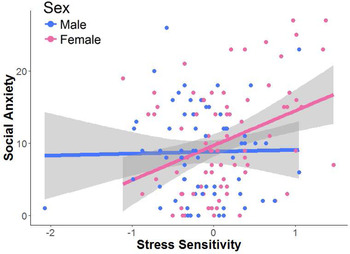
Across all participants, greater stress sensitivity was significantly associated with more severe social anxiety symptoms (β = .25, p = .004). This association was significantly moderated by sex (β = .30, p = .022): it was significantly positive in females (β = .43, p < .001) and was nonsignificant in males (p = 0.90). See Figure 2 for more details.
Associations between stress sensitivity and social anxiety by sex. Across all participants, greater stress sensitivity was significantly associated with greater social anxiety (β = .25, p = .004). Sex significantly moderated the association between stress sensitivity and social anxiety (β = .30, p = .022), such that this association was significantly positive in females (β = .43, p < .001) and nonsignificant in males (p = .90). All statistical models adjusted for age, pubertal status, and medication usage. Data and trends are plotted without adjustment for covariates for the purposes of visualization.

Stress sensitivity and regulation of the autonomic nervous system
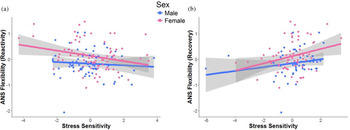
Across all participants, greater stress sensitivity was significantly associated with PNS dominance during reactivity (β = −.19, p = .037) and SNS dominance during recovery (β = .25, p = .013). These associations were not driven by changes in RSA activity from baseline to reactivity or from reactivity to recovery (all ps > .05). Rather, stress sensitivity was significantly associated with change in SCL activity from baseline to reactivity (β = −.205, p = .022) and from reactivity to recovery (β = −.036, p = .003). While sex did not significantly moderate the association between stress sensitivity and autonomic regulation during reactivity (p = .314), this association was significantly negative in females (β = −.26, p = .031) and was nonsignificant in males (p = .487). See Figure 3a for details. Similarly, while sex did not significantly moderate the association between stress sensitivity and autonomic regulation during recovery (p = .932), this association was significantly positive in females (β = .30, p = .023) and was nonsignificant in males (p = .095). See Figure 3b for details.
Associations between stress sensitivity and regulation of the autonomic nervous system (ANS) during reactivity (a) and recovery (b) by sex. Given that the measure of autonomic regulation was based on aggregating standardized scores, the zero value represents the mean shift to sympathetic nervous system dominance (i.e., decreasing heart rate variability and increasing skin conductance). Across all participants, stress sensitivity was significantly associated with parasympathetic nervous system dominance during reactivity (β = −.19, p = .037) and sympathetic nervous system dominance during recovery (β = .25, p = .013). While sex did not significantly moderate the association between stress sensitivity and flexibility of ANS during reactivity (p = .314), this association was significantly negative in females (β = −.26, p = .031) and nonsignificant in males (p = .487). Similarly, while sex did not significantly moderate the association between stress sensitivity and autonomic regulation during recovery (p = .932), this association was significantly positive in females (β = .30, p = .023) and nonsignificant in males (p = .095). All statistical models adjusted for age, pubertal status, and medication usage. Data and trends are plotted without adjustment for covariates for the purposes of visualization.

Regulation of the autonomic nervous system and social anxiety
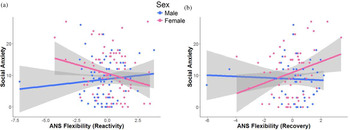
Across all participants, social anxiety symptoms were not significantly associated with autonomic regulation during reactivity or recovery (all ps > .113). While sex did not significantly moderate the association between social anxiety and autonomic regulation during reactivity (p = .051), this association was significantly negative in females (β = −.235, p = .040) and nonsignificant in males (p = .485). See Figure 4a for details. Similarly, while sex did not significantly moderate the association between social anxiety and autonomic regulation during recovery (p = .076), this association was significantly positive in females (β = .277, p = .026) and nonsignificant in males (p = .861). See Figure 4b for details. Specifically, for females, social anxiety was significantly associated with change in RSA activity from baseline to reactivity (β = .272, p = .016) and with change in RSA activity from reactivity to recovery (β = −.251, p = .041) but not with comparable changes in SCL (ps > .05). Neither changes in RSA nor in SCL during reactivity and recovery were significantly associated with social anxiety symptoms for males (ps > .05).
Associations between social anxiety symptoms and regulation of autonomic nervous system (ANS) during reactivity (a) and recovery (b) by sex. Given that the measure of autonomic regulation was based on aggregating standardized scores, the zero value represents the mean shift to sympathetic nervous system dominance (i.e., decreasing heart rate variability and increasing skin conductance). Across all participants, social anxiety symptoms were not significantly associated with autonomic regulation during reactivity (p = .294) or recovery (p = .113). While sex did not significantly moderate the association between social anxiety and flexibility of ANS during reactivity (p = .051), this association was significantly negative in females (β = −.235, p = .040) and nonsignificant in males (p = .485). While sex did not significantly moderate the association between social anxiety and flexibility of ANS during recovery (p = .076), this association was significantly positive in females (β = .277, p = .026) and nonsignificant in males (p = .861). All statistical models adjusted for age, pubertal status, and medication usage. Data and trends are plotted without adjustment for covariates for the purposes of visualization.

Mediation models
Because the associations among stress sensitivity, autonomic regulation during reactivity and recovery, and social anxiety symptoms were all statistically significant in females, we explored whether autonomic regulation during reactivity and recovery (separately) mediated the association between stress sensitivity and social anxiety. While the mediation effect for autonomic regulation during reactivity was not significantly different from 0 (95% CI: −0.03 to 2.12), the mediation effect for autonomic regulation during recovery was significant (B = 1.06, 95% CI: 0.02–2.64). Specifically, SNS dominance during recovery significantly explained variance in the association between stress sensitivity and social anxiety symptoms in females.
Discussion
Adolescence is a formative period of development marked by social reorienting, including a desire for social approval from peers (Blakemore, Reference Blakemore2008; Kilford, Garrett, & Blakemore, Reference Kilford, Garrett and Blakemore2016). Not surprisingly, therefore, adolescence is also a vulnerable time for the development of conditions characterized by fear of judgment or social humiliation, particularly SAD. While heightened stress sensitivity is a central feature in conceptual models of psychopathology – and while there is evidence for greater stress sensitivity in individuals with SAD – the specific psychobiological mechanisms by which stress sensitivity contributes to the emergence of SAD in adolescents is not well understood.
Previous work from our group examining a subset of the adolescents reported here focused on neural correlates underlying emotion regulation (i.e., white matter connectivity between the amygdala and ventromedial prefrontal cortex) as putative mediators of the link between stress sensitivity and SAD. Importantly, we did not find evidence that this neural circuit mediated links between stress sensitivity and SAD, and, critically, we did not examine sex-specific associations (Ho et al., Reference Ho, King, Leong, Colich, Humphreys, Ordaz and Gotlib2017). Given that a growing body of literature has implicated ANS dysfunction both in stress reactivity generally (Spear, Reference Spear2009) and in SAD specifically (Farmer & Kashdan, Reference Farmer and Kashdan2015), in this study we sought to examine whether the links between stress sensitivity and social anxiety symptoms were mediated by dysfunction in autonomic regulation. Specifically, we operationalized ANS dysfunction as the failure to shift from PNS to SNS during stress reactivity and as the failure to shift from SNS to PNS during stress recovery. While both processes are indicative of autonomic dysregulation, the former implicates a dominant PNS whereas the latter implicates a dominant SNS; thus, these two accounts not only yield distinct contributions to existing psychobiological models of SAD but also have distinct treatment implications. Finally, because we were limited in our statistical power to detect significant moderating effects of sex (Perugini, Gallucci, & Costantini, Reference Perugini, Gallucci and Costantini2018), we stratified our analyses by sex given evidence of sex-specific effects in these processes (e.g., Brougham et al., Reference Brougham, Zail, Mendoza and Miller2009; Merikangas et al., Reference Merikangas, He, Burstein, Swanson, Avenevoli, Cui and Swendsen2010; Ordaz & Luna, Reference Ordaz and Luna2012).
Consistent with our hypotheses, we found that females showed heightened stress sensitivity compared to males; further, among females only, sustained SNS activity during recovery from a stressor explained the extent to which stress sensitivity – that is, the tendency to perceive and experience stressors as more distressing – was associated with social anxiety symptoms in adolescents. While we found significant associations across all participants between stress sensitivity and autonomic regulation, and between stress sensitivity and social anxiety, our sex-specific analyses revealed that these effects were driven by females; stress sensitivity, autonomic regulation, and social anxiety were not significantly associated with each other in males.
Our finding that dominant SNS activity during stress recovery is a key physiological mechanism explaining the contribution of psychological stress reactivity to social anxiety symptoms in females has important clinical implications. Interventions that target SNS function (either by dampening activity in this system or by promoting PNS activity) through breathing exercises, in conjunction with cognitive and emotion regulatory strategies, may be particularly effective for female adolescents who are suffering from or at risk for SAD. Such interventions may draw from existing mindfulness-based therapies, such as mindfulness-based stress reduction (MBSR), mindfulness-based cognitive therapy (MBCT), and acceptance and commitment therapy (ACT), that are appropriately modified for adolescents. MBSR, MBCT, and ACT have been demonstrated to help reduce avoidance behaviors and emotion reactivity to negative self-beliefs in both adults (Goldin & Gross, Reference Goldin and Gross2010) and adolescents with SAD (Azadeh, Kazemi-Zahrani, & Besharat, Reference Azadeh, Kazemi-Zahrani and Besharat2016; Swain, Hancock, Dixon, Koo, & Bowman, Reference Swain, Hancock, Dixon, Koo and Bowman2013).
We did not find statistically significant associations among stress sensitivity, autonomic regulation, and SAD in male adolescents. Thus, a clear direction for future research is to investigate the psychobiological mechanisms that underlie the onset and maintenance of SAD in male adolescents. Additional work is also needed to address some of the limitations of the present study. For example, the design of this investigation required us to rely on retrospective reports of stressful life events; however, recent work suggests that there are differences between retrospective and prospective reports of adverse experiences in youth (Baldwin, Reuben, Newbury, & Danese, Reference Baldwin, Reuben, Newbury and Danese2019; although see Scott, McLaughlin, Smith, & Ellis, Reference Scott, McLaughlin, Smith and Ellis2012, who found that both types of report predict mental health outcomes). In addition, prospective studies starting at earlier ages will help to elucidate processes that shape the development of heightened stress sensitivity. One possibility is that this tendency is a consequence of biological sensitivity to stressors combined with excessive exposure to events that elicit stress responses (Ellis, Boyce, Belsky, Bakermans-Kranenburg, & Van IJzendoorn, Reference Ellis, Boyce, Belsky, Bakermans-Kranenburg and Van IJzendoorn2011). As a related point, there are additional aspects of the experience of life stress during development that warrant further investigation. For example, consistent with a stress sensitization model, repeated or chronic exposure to threatening stimuli may affect stress sensitivity and associated autonomic systems (McLaughlin, Conron, Koenen, & Gilman, Reference McLaughlin, Conron, Koenen and Gilman2010a); however, life stress characterized by an absence of exposure to positive stimuli (i.e., experiences of deprivation or neglect) may affect the development of stress sensitivity and autonomic regulation differently than would life stress characterized by threat (McLaughlin, Sheridan, & Nelson, Reference McLaughlin, Sheridan and Nelson2017). Finally, while we focused in this study on symptoms of SAD, exposure to life stressors during childhood and adolescence is associated with a greater risk of developing a range of psychopathology, including depression, substance dependence, and schizophrenia in both adolescence (Green et al., Reference Green, McLaughlin, Berglund, Gruber, Sampson, Zaslavsky and Kessler2010; LeMoult et al., Reference LeMoult, Humphreys, Tracy, Hoffmeister, Ip and Gotlib2019) and adulthood (Kessler et al., Reference Kessler, McLaughlin, Green, Gruber, Sampson, Zaslavsky and Benjet2010; McLaughlin et al., Reference McLaughlin, Green, Gruber, Sampson, Zaslavsky and Kessler2010b). As our study sample was a community sample of adolescents who were exposed to normative stressors, and because SAD is one of the most commonly diagnosed disorders during this developmental period, we limited the present investigation to symptoms in this domain. It is clear, however, that future work should examine whether dysfunction in autonomic regulation is a transdiagnostic mechanism through which stress sensitivity leads to the emergence of psychopathology in general or, alternatively, if this mechanism is specific to disorders that are characterized by maladaptive responses to stress (e.g., depression, anxiety, posttraumatic stress disorder [PTSD]).
Conclusions
In the present study, we explored associations among stress sensitivity, autonomic stress responses during reactivity and recovery phases of a social stressor, and symptoms of social anxiety in a large community sample of female and male adolescents. Guided by a stress sensitivity framework, we found that inappropriately prolonged SNS activity following stressful events may explain how stress sensitivity – that is, the tendency to perceive and experience stressors as more distressing – leads to social anxiety symptoms in adolescent girls. Our findings also suggest that interventions targeting SNS function, either by dampening activity in this system or by promoting PNS activity, will be particularly effective for female adolescents who are experiencing SAD.
Acknowledgments
The content is solely the responsibility of the authors and does not necessarily represent the official views of the NIH. The authors thank Monica Ellwood-Lowe, M. Catalina Camacho, Sophie Schouboe, Alexandria Price, and Anna Cichocki for their help with data collection, and Lucy King, Kathryn Humphreys, Natalie Colich, and Sarah Ordaz for their help with data organization and coding. Finally, we thank the families who participated in this study.
Funding Statement
This research was supported by the National Institutes of Health (NIH; R37MH101495 to IHG, K01MH117442 to TCH, T32MH019908 to JGM) and the Brain and Behavior Research Foundation (Young Investigator Award 20814 to KK). The funding agencies played no role in the preparation of this article.
Conflicts of Interest
None