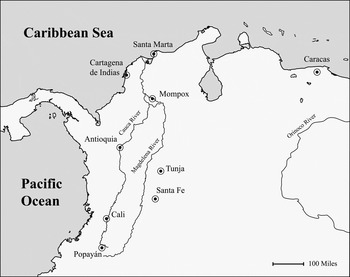
In the mid-1700s, the town of Mompox flourished in the Spanish viceroyalty of the New Kingdom of Granada, today part of the Republic of Colombia. Built on the banks of the northern Magdalena River, an important waterway connecting the Andean interior with the Caribbean Sea, Mompox constantly buzzed with travelers and trade alike. Mompox was home to a community of merchants who profited handsomely from both legal trade and smuggling, their networks reaching places as far away as Lima in Peru and Cádiz in Spain. These merchants were frequently also slaveholders and landowners. On haciendas outside of town, slaves cultivated the land and tended large herds of cattle. They gathered wood and resins and hunted for game and jaguars (panthera onca) that preyed on livestock. Along with free people of color, slaves also worked as artisans, journeymen, and oarsmen on boats transporting goods and people up and down the riverFootnote 1 (see Figure 1).
Mompox and other urban settlements in the New Kingdom of Granada. Source: Illustration by Eric A. Schewe.

In 1799, the slaves of the San Bartolomé de la Honda hacienda, one of the biggest rural estates controlled from Mompox, rebelled against the heirs of their late master, Juan Martín de Setuaín. The uprising was at least a year in the making. The slaves had slowed down work beginning in May 1798. In April 1799, most of them refused to work altogether, asserting that their master had set them free in his last will and testament and expelled their overseer. Over the next 3 years, the alarmed executor and heirs of the estate tried their best to re-enslave the members of this community. The former slaves, in turn, fought hard to ensure their freedom, struggling to do so while remaining on the land. They aspired to obtain manumission, but they also imagined building a free community in La Honda itself under the authority not of masters and overseers, but of a priest and a magistrate.Footnote 2
Important evidence has survived about this uprising, affording the opportunity to study the interdependence of slavery, freedom, settlement patterns, and legal culture in eighteenth-century Mompox. This evidence includes correspondence, account books, inventories, legal claims and criminal and civil proceedings. In this article, I draw on these and other documents to explore the complexities of the former slaves’ legal imagination. Their claim to freedom was inseparable from their understanding of the nature of the bond tying them to their master. Their desire to continue to live in the estate under the authority of church and crown representatives was inseparable from a corporatist understanding of their community. The people of La Honda seem to have hoped to transition from being slaves under an absentee master into free vassals of the king living in state of policía (densely settled and in an orderly fashion, both civic and religious).Footnote 3 The goal of achieving manumission on the land had specific legal and social underpinnings.
First, testamentary manumission—the freeing of slaves after a master's death as promised in his or her last will and testament—was an avenue to freedom, albeit one difficult to traverse. Testamentary manumission is most usually associated with cases of individual slaves or single families, very often women and their immediate relatives living in urban areas who struggled to gain their freedom after their masters had died.Footnote 4 By contrast, the events of La Honda involved several rural slave families claiming manumission, and doing so not before the local magistrates but by taking their freedom by force. In spite of this, the leaders seem to have expected that magistrates in Mompox and Santa Fe (present-day Bogotá), the viceroyalty's capital, could deem their claim legitimate, sparing them further enslavement or prison sentences.Footnote 5
Second, the leaders of La Honda claimed that they had had an agreement with their late master. In exchange for their obedience while awaiting deliverance from slavery, the master would guarantee a reliable supply of basic necessities, including time for prayers and religious holidays. Their master, however, had breached this pact. Supplies had become scarce, the slaves went naked, and religious practices were disrupted. The master's failure became an important element to further legitimize the uprising and the expectation of lasting freedom. When these types of arrangements took place, their dynamics shifted along with changes in the balance of power between slaveholders and those in bondage. Some slaves, under the right circumstances, tried to hold masters accountable to the negotiated terms by complaining, making legal claims before magistrates, or open rebellion.
Third, after the uprising, some members of this community expected to peacefully live under the authority of a priest and a magistrate, forming a partially independent settlement. The people of La Honda understood their small society to be a corporate community with aspirations to municipal privileges and duties approved by the authorities. The idea that former slaves could aspire to form their own town was not far-fetched. Beginning in the 1740s, royal agents and Catholic clergymen had resettled people in Spanish-style towns—ideally built with a plaza and a church as their center of gravity—in an effort to bring dispersed rural dwellers under political control, religious orthodoxy, and fiscal oversight. Throughout the province of Cartagena de Indias, where Mompox was located, free people of color and sometimes runaway slaves had become residents of these towns and hamlets.Footnote 6 If authorities recognized the people of La Honda as a formal community, then the former slaves could enjoy both political and social stability on the basis of obedience to the king and the Holy Mother church, maintaining possession and use of the land.
The ways in which magistrates, military personnel, and priests dealt with urban and rural commoners, and the echoes of individual cases’ outcomes, could shape slaves’ notions of, and expectations from, the legal system.Footnote 7 Acting magistrates embodied the king's authority and were expected to showcase the monarch's wisdom and prudence.Footnote 8 Some slaves carefully considered recent events and the potential reactions of both putative masters and local authorities before they set out to rebel, to complain before a magistrate, or to combine these and other means of struggle. For most slaves, however, judicial action against their master and physical resistance to their enslavement remained difficult to accomplish.Footnote 9
Further questioning what Michelle A. McKinley has called the “unilateral narrative of testamentary manumission,”Footnote 10 this article argues that although masters could use the promise of freedom as a tool of social control, slaves interpreted those promises in light of their own understandings and specific knowledge of the local dynamics of bonded labor, the actual practice of manumission, the corporatist nature of society, and the connections between life in policía and political stability. In a society in which free individuals and families achieved social belonging only through their membership in corporations (brotherhoods, guilds, parishes, cities), for the community of La Honda to successfully achieve freedom and legal standing depended not on manumission alone, but also on forming a social body with specific political privileges, however limited.Footnote 11 The alternative was the dismemberment of the community, social exclusion, and economic insecurity. To sketch a coherent picture of the legal imagination of the people of La Honda, I must therefore build from the ground up, first examining the world of slavery that they tried so hard to change.
The Land and the Slaves
The distance between Mompox and La Honda was relative. Located on an anabranch of the Magdalena River, the main artery of transportation in the region, La Honda was an 8 day riverine trip upriver from Mompox. For those traveling from the hacienda to town, however, the trip downriver took three days. Goods and people—and along with them news and rumors—leaving from Mompox took about a week to reach the hacienda. Word of what transpired in La Honda, however, was quick to reach the masters in town. These dynamics of distance and communication shaped the rhythms of contact between both places.
La Honda had a long history before the late eighteenth century uprising, as surviving records dating back to the late 1600s illustrate. Mompox's local Jesuit college had bought the estate in 1695, but the Jesuits did not hold on to it for very long. José de Mier, an up-and-coming patrician who established one of the largest fortunes in Mompox, purchased the estate in 1728. At this time, forty slaves worked in La Honda, which boasted 10,000 cacao trees. Mier, however, had plans to transform the property. He soon purchased neighboring lands for expansion and improvement, beginning the transition from cacao to sugar cane cultivation.Footnote 12 Either Mier himself or his heirs eventually sold the improved property to Juan Martín de Setuaín. It remains difficult to ascertain when this happened, although by the time of the uprising, Setuaín had clearly been master of the estate for several years.
By the 1790s, the hacienda's physical and social landscape had changed dramatically since the time of the Jesuit owners. Only 1,500 cacao trees remained, whereas fifteen large plots of land were now planted in sugar cane. La Honda was now home to 101 slaves. Buildings, trees, and garden plots were located on a swath of land at the center of the property. Slave social life as well as production activities took place in this central space, known as the ranchería. On this hamlet, there were nineteen houses for the workers and a thatched-roof chapel for the celebration of mass and religious festivities, which was equipped with gold and silver utensils, religious icons, and bells. Finally, the trapiche, the grinding mechanism for the extraction of sugar cane juice and its annexed boiling house, was located at the very heart of the ranchería. A road connected the ranchería with a landing place on the river, where boats constantly loaded and unloaded people, produce, and supplies.Footnote 13 With a church and a plaza-like space, this hamlet already resembled formally incorporated towns where free people of color lived.
Life at La Honda moved at the pace of the agricultural calendar. Things revolved around the molienda, a word that expresses both the harvest time and the action of grinding the cane. Unlike the zafra in Cuba or the safra in Brazil, which took place once a year and extended for several months, the molienda took place every 4 months and lasted for a few weeks.Footnote 14 Over the course of the molienda, slaves rushed to cut and grind the cane, and then boiled its juice in copper cauldrons, slowly turning the liquid into miel. Miel, the thick syrup obtained from boiling sugar cane juice, was finally packaged in barrels and transported to Mompox on river boats.Footnote 15
The harvest cycle was short, but the slaves kept busy year round. In addition to sugar cane-related work, slaves repaired buildings and tools on the property; took care of more than 2,000 plantain trees as well as several coconut, orange, lime, and other trees; and tended horses, pigs and cattle. Situated in a particularly fertile corner of the region, La Honda offered a landscape of sugar cane fields, garden plots, grasslands, and forests abundant in game and wood. Limestone deposits complemented the resources of this land. The hacienda had three furnaces in which slaves turned this sedimentary rock into quicklime for construction and other purposes.Footnote 16
In spite of this seeming abundance, social activities and agricultural work at La Honda could not be sustained without supplies from Mompox. From town, the master had to send boatloads of provisions including salt, spices, wine, clothes, fabric, tools, candles, shot, and gunpowder. In addition to material goods, the master had to supply slaves with some medical care, as well as “spiritual goods,” an amalgam of objects and rituals as important as food and shelter. This included religious objects and time for mass and prayer, both daily as well as periodically on Catholic holidays. Occasionally, a priest sent by Setuaín performed the rituals of the sacraments, which required candles, wine, incense, and other religious paraphernalia. Transportation upriver was slow and costly, but the master had to keep the estate supplied.Footnote 17
The reproduction of the labor force relied heavily on the slave families in the hacienda. With just over 100 slaves, La Honda was an unusually large estate.Footnote 18 Slaves at La Honda were organized into family units, generally including parents, children, and, sometimes, grandparents. Although its riverfront location offered some possibilities for escape, slaves’ family ties, the threat of violence from overseers, and the difficulty of establishing a new life elsewhere deterred most residents from taking this risky step.Footnote 19
Juan Martín de Setuaín, owner of the land and master of the slaves, was both an important property holder and a prominent merchant in Mompox. He was known in town for financing the construction of the bell tower of the Santa Bárbara Church, which still stands today.Footnote 20 With the help of his proxies and slave drivers, Setuaín controlled his rural estate from Mompox. In spite of his rapidly deteriorating health, this absentee owner stayed at the helm of his affairs throughout the 1790s. On August 20, 1796, Setuaín contracted to supply the local royal distillery with 400 cántaras of miel every year for the next 5 years. This was equivalent to more than 6,000 liters. A valuable raw product for the distillery, miel was transformed into aguardiente, a popular form of white rum. The production and trade of aguardiente was a monopoly of the state.Footnote 21
Moving the miel downriver to the distillery in town was relatively easy. Boats transported the sugar cane syrup from La Honda to Mompox in a few days. Manuel de Herrera, the administrator of the royal distillery, received the shipments and paid Setuaín or his proxies. By the end of April 1798, Setuaín had delivered almost 600 cántaras. Bartolomé Gallardo, another one of Setuaín's proxies, had sold this produce for 900 pesos. However, although on each visit Gallardo usually brought to the distillery more than 100 cántaras, on May 31, 1798 he brought only 25 cántaras.Footnote 22
Work routines and the balance of power seem to have dramatically changed in the estate at this point. Possibly anticipating the death of their master, the slaves had slowed down production. As the ailing Setuaín slowly lost his agility as a manager, the slaves seem to have exercised increasing autonomy, inching closer to the achievement of de facto freedom. When Setuaín died in town on April 9, 1799, news of his death traveled to La Honda. The slaves stopped working altogether, openly defying their overseer.Footnote 23 Word of this development soon made it back to town.
By July 1799, it had become evident that production at the hacienda would not begin again any time soon. Juan Nepomuceno Surmay, the executor of Setuaín's last will and testament, approached the royal distillery with a request to cancel the late Setuaín's contractual obligations.Footnote 24 The distillery administrators, however, made it clear to Surmay that they expected La Honda to keep supplying their shop with sugar cane syrup. Surmay was facing a difficult situation. The surviving records of La Honda reveal no major conflicts between masters and slaves before 1798. Now, however, slaves expressed open discontent and refused to work. They further thought that they were entitled to their freedom, which they asserted that their late master had promised to them.
Promises of Freedom
Masters seem to have, at times, effectively used promises of freedom as a means to foster slave acquiescence, as freedom was potentially the most coveted goal of people in bondage. Although masters seem to have thought that providing food and shelter for slaves and allowing them to form families would help avoid sickness, premature death, negligence, and rebellion, they also understood that the prospect of freedom could keep the balance of power to their favor. This was not a mechanistic process. Masters had to constantly elicit obedience and reiterate their promises, and slaves expected masters to keep their word.Footnote 25
Promises of freedom often took the form of testamentary manumission, the prospect of legally sanctioned liberty deferred until after the master's death. It is the promise aspect of this dynamic that should be emphasized.Footnote 26 Masters reiterated their intentions of granting freedom; however, the time of delivery almost always remained unclear. Even when they were lucky enough to be included in a testamentary clause ordering manumission, slaves had to wait for an unknown period of time, hoping that the testament remained unaltered, while obediently continuing to perform their duties. Moreover, a master's word did not guarantee manumission. Even after years of loyalty, slaves could find themselves fighting for their promised freedom against tenacious and litigious creditors and inheritors. The last wishes of a deceased master could easily disappear in the thicket of legal action.Footnote 27
Setuaín seems to have repeatedly promised freedom to prevent slave unrest. An expectation of freedom existed among the families of La Honda before Setuaín's death on April 9, 1799. The slaves had taken their master for his word, remaining attentive to news and rumors on his health. When news of Setuaín's death finally materialized, people in La Honda assumed themselves manumitted and expelled their overseer;Footnote 28 however, they did not go away, instead taking control of the land and its resources. Surmay, the executor of Setuaín's last will, immediately dispatched a man named Francisco Javier Monteros to order the now alleged slaves to return to the fields. Monteros arrived in La Honda on May 11, 1799. He quickly returned to Mompox with bad news for Surmay: self-assured and now regarding themselves as free people, the men and women of La Honda had declared that they had no master other than God.Footnote 29 They remained in control of the estate.
The former slaves claimed that Setuaín had repeatedly pledged to manumit them. More specifically, in June 1799, some of the former slaves claimed that Setuaín had promised to set them free after a period of 10 years of faithful labor. They further claimed that, on a different occasion, Setuaín had told them that they would earn freedom after his death.Footnote 30 In early 1800, some of the former slaves even claimed that their former master had written a clause granting their freedom into his last will and testament. A white man, they claimed, had read the document and related this important information to them. Unfortunately, they had also learned that someone had burned the document.Footnote 31
As soon as the master died, the people of La Honda took matters in their own hands and aggressively asserted their freedom. Although an alternative course of action would have been to petition the magistrates in town to substantiate Setuaín's words, the community of La Honda chose to understand his promises as having self-executing potential. This tactic was crucial, as the slaves had never been promised to receive ownership of the estate but now aspired to live as free people on this very land. It remains difficult to elucidate how they extended the claim to freedom to a claim to freedom on the land. However, it is clear that defending the territory and defending their newly gained freedom became one and the same.
After the slaves claimed their own freedom, Surmay moved to regain control of the land and the people. He hired José María Rodríguez to visit La Honda, spy for him, and try to convince the alleged slaves to return to work. Rodríguez arrived in La Honda on the night of June 25, 1799. He had received a set of written instructions from Surmay, ordering him to send the leaders of the movement to Mompox or to Morales, a town on the other side of the river not far from La Honda. Rodríguez was further instructed to gather information on the movement and figure out whether it seemed necessary to request help from the royal authorities in order to retake control of the property. Faced with resistance and confusing circumstances, Rodríguez found his tasks difficult to execute.Footnote 32
Unable to accomplish his goals, Rodríguez returned to town and gave an account of his encounter and conversations with individuals from La Honda. On arriving at the ranchería, Rodríguez had requested lodging and food from a man named Carlos, who seemed amiable enough. Soon, however, six or seven men armed with pikes and machetes surrounded Rodríguez, demanding to know the reasons behind his visit to La Honda.Footnote 33 Rodríguez told his interlocutors that he had simply travelled there to buy supplies (it was common for people to visit haciendas to purchase maize, plantains, and pigs) and to talk to one Father Melchor, perhaps the priest who regularly visited La Honda during these years. After further inquiry on the part of the armed men, Rodríguez told them that he meant no harm, as he had showed up without a “stick” in his hands. He further told them that he would leave the estate if they wished him to. In turn, the armed men told Rodríguez that he could stay, but that they were “resolved and determined to give up their heads before serving any white man or consenting to having any white man come to the hacienda.”Footnote 34
Just when Rodríguez thought he could sleep over, however, a different group of armed men showed up. They told Rodríguez to leave, because they no longer wanted any white man at the hacienda. Rodríguez then took to the road, but as he approached the landing, he was again invited by Vicente, a former slave who had held overseeing responsibilities, to spend the night. In spite of the confusing circumstances, Rodríguez did stay that night and spent some hours talking to the former slaves Antonio, Ascención, Valerio, and Vicente. They turned out to be eager for news from Mompox and Cartagena de Indias, the provincial capital and an important port town on the Caribbean coast.Footnote 35
Unwritten Pacts
After deciding to stay at La Honda over the night of June 25, 1799, Rodríguez provided his interlocutors with their desired news, taking the opportunity to convince them of the futility and dangerousness of their course of action. Rodríguez mentioned how revolts, battles, and sieges had recently shattered the world in dramatic ways, perhaps referencing the turbulent 1790s, a decade of turmoil marked in the Caribbean by the Haitian Revolution, a major slave uprising beginning in August 1791.Footnote 36
Rodríguez tried to link the events at La Honda with the events that had unfolded recently in the outside world, telling the former slaves that even free men “found themselves in unhappy servitude, worse off than slaves for defending their Law and their King.” He suggested that the community of La Honda could not keep their enemies at bay forever, and that armed struggle was an act of sheer folly even for the most legitimate of causes.Footnote 37 Although never specifically mentioned in the La Honda records, it was against the backdrop of at least three episodes of slave unrest that this conversation took on a serious significance.
People in Cartagena, Mompox, and Santa Fe kept abreast of the uprisings in the neighboring French Caribbean, especially in Saint Domingue (Haiti) after 1791. Bureaucrats thought that the revolutions abroad could spark upheavals in the viceroyalty.Footnote 38 In Mompox, the memory of an alleged plan to burn the town to the ground remained fresh. In January 1793, a series of roaring fires had consumed more than 400 houses in town. Patricians feared that the fires had resulted from a “conspiracy” involving slaves and free people of color.Footnote 39 Perhaps even more importantly, the events at La Honda took place in alarming synchrony with an alleged conspiracy in the city of Cartagena, one that seemed to prove that slave revolution had indeed arrived from abroad. Authorities believed that “French Negroes”—an expression denoting people of African descent with alleged or real ties with the troubled slave colonies in the French Caribbean—had plotted to take over the city. News of this alleged conspiracy broke out on April 1, 1799, just a few days before the uprising at La Honda.Footnote 40
Although information of slave action elsewhere may have encouraged people in La Honda to shake off their own enslavement, people in bondage in Mompox and its area of influence had previously risen against their masters regardless of external triggers.Footnote 41 The conversation between Rodríguez and the former slaves Antonio, Ascención, Valerio, and Vicente suggests that La Honda's leaders had specific grievances against Setuaín that they expressed through an idiom of interdependence and mutual responsibilities. Rodríguez directly asked the alleged slaves why they refused to work. In addition to mentioning that their late master had repeatedly made promises of freedom to them, they also justified their refusal to work based on their belief that Setuaín had unfulfilled his Christian and civil obligations as a master.Footnote 42
Rodríguez's interlocutors suggested that they had offered their loyalty and hard work expecting that they would receive enough food and clothing, and, eventually, freedom. Although they had worked for many years, from dawn until dusk and even into the night, keeping their part of this unwritten pact, Setuaín had failed to provide for the basic needs of his slaves. The master's slow physical decline seems to have hindered the timely delivery of supplies to La Honda, a costly and time-consuming task that was apparently disrupted by early 1798. When supplies were not forthcoming, it was not unusual for slaves to rise up or protest against their masters.Footnote 43
The former slaves further elaborated on Setuaín's failure to keep his obligations, mentioning the master's failure to provide for their spiritual needs. Antonio, Ascención, Valerio, and Vicente told Rodríguez that they had not only lacked food and clothes but also candles, which were essential for religious practices, especially for praying the rosary at night.Footnote 44 The master's failure to provide the community with spiritual comfort could be depicted as a grave fault not only against the slaves but against Catholicism itself, a fundamental tenet of society embodied in prayer.
The former slaves’ religious practices became a crucial part of their arguments. Their remarks on this issue highlighted the master's failure to fulfill his obligations and deployed their own understanding of communal life at La Honda before and after the uprising. The families who lived in the hacienda, Rodríguez's interlocutors suggested, had “entrusted themselves to the Virgin” in hope that their plans of freedom would come to fruition. They explained how they had offered her a chanted mass every month, celebrating her feast every year and devotedly praying the rosary on a regular basis. Their cause had a religious dimension, and their community was headed by a patron saint (the specific advocation remains unclear). Now that they had successfully kept outsiders at bay, they planned to serve God and the local priest, whom they said that they much esteemed.Footnote 45
Members of the community of La Honda who spoke to Rodríguez further explained that they had never planned to shake off their religious obligations. According to Rodríguez's testimony, the former slaves told him that they had requested a priest to come to the estate. Therefore, they claimed, their actions were not an uprising at all. In exchange for the presence of a priest in their community they intended to pay primicias (first fruits of the harvests, tithes), estipendios (the priest's salary), and other ecclesiastical dues (presumably on account of sacraments and ritual accoutrements).Footnote 46 Although priests had visited the hacienda before the uprising, community members now aspired to have a man of the cloth permanently living in La Honda. By suggesting that they would pay for his services, the former slaves indicated their loyalty to the Spanish polity, as a clear differentiation between church and state did not exist. The crown, through the privilege of patronato real, governed ecclesiastical appointments and managed church revenues in the Spanish Indies. By suggesting that La Honda could have its own priest, the former slaves declared their intention to become a legally incorporated settlement, which implied submission to both majesties, spiritual and temporal.Footnote 47
Inhabitants of Spanish-style towns were usually keenly aware of the legal identity of their municipalities, and the people of La Honda knew this well. They did not hope to become a ciudad (the highest ranking form of settlement, with a town council, at least one parish, common lands, and rural dependencies). But they seem to have aspired to become a formally incorporated submunicipality. This could happen by becoming an anexo (usually a small settlement subordinated to a larger town), a sitio (usually a hamlet dense enough to have a name and maybe a church, but also subordinated to a larger town), or even a vice-parroquia or parroquia (a town robust enough to rank as vice-parish or parish and, therefore, to pay for its own priest and have a certain degree of independence).Footnote 48 These types of settlements were prevalent throughout the province of Cartagena de Indias.
Over the course of the decades between 1740 and 1790, the Spanish government had authorized several campaigns of territorial reorganization in the province of Cartagena. Families scattered throughout wooded areas had been settled on new towns. People living in existing hamlets deemed too small or out of the way had been moved to other, larger settlements. Built according to Spanish notions of policía, these new towns had churches in small plazas and their streets, although few in number, were laid out with a grid pattern in mind (often hard to follow because of the location of the settlements on river banks). Although several of these new settlements failed or were only occupied for a few months each year, they were legally incorporated as parishes, vice-parishes, or anexos.
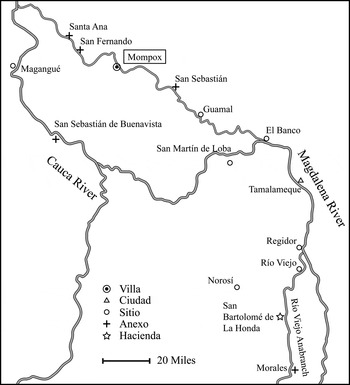
Within the jurisdiction of Mompox, downriver from La Honda, several new settlements had been founded, including El Banco, Tamalamequito, and San Sebastián de Loba. Some of these resembled the central hamlet at La Honda. Morales, the closest settlement to La Honda, predated the territorial reforms. However, authorities modified its municipal status, making it an anexo to the city of Simití. Described by the bishop of Cartagena in 1772 as a “vice-parish” of “free people,” Morales had a church and customs officers, but it was subordinated to the authorities and the parish priest in SimitíFootnote 49 (see Figure 2).
Urban and rural settlements in the vicinity of San Bartolomé de La Honda, c. 1799. Source: Illustration by Eric A. Schewe.

Although it was Spanish authorities who had sparked the creation or reform of these towns, often forcing people to settle down and abide by the orders of priests and magistrates, on at least one occasion, escaped slaves negotiated a governing agreement with provincial and diocesan bureaucrats. Not far from the city of Cartagena, in a mountainous and wooded area known as the Montes de María, runaway slaves had formed their own community beginning in the late 1500s. In the early 1700s, Cartagena's bishop Antonio María Casiani negotiated an agreement with the “maroons.” In exchange for turning away new runways seeking refuge in the town and adjacent woods, authorities recognized the community's free standing. Incorporated as San Basilio, the settlement obtained the privilege to select its own authorities (who reported to the governor directly) and was given parish status.Footnote 50
People at La Honda expressed the desire to achieve similar recognition. Once they took control of the estate they regarded themselves as free, and insisted on their religious and political zeal, expressing their hope to have their own priest as well as their aspirations to come to an agreement with temporal authorities. In the conversation with Rodríguez, Valerio mentioned that they would eventually allow a magistrate from Morales or Simití to hold formal authority over their community. La Honda's leaders planned to enter into a new pact, one that would transform them into vassals of the king first and foremost. Although they were determined to prevent “white” people from entering the estate, Surmay was welcomed to send someone to collect the remaining tools and cattle. However, they told Surmay that he should be aware that they were no “fools” and had enough men and arms to defend themselves from his attempts to “enslave” them.Footnote 51
The claim to manumission became inseparable from the control and transformation of the land and the social interdependence between its inhabitants and outsiders. The former slaves’ understanding of this transformation can be inferred from yet another episode from Rodríguez's visit. As he prepared to leave the hacienda on the morning of June 26, Rodríguez was approached by a man named Juan Clemente, one of the former slaves. Juan Clemente ordered Rodríguez to leave La Honda at once. When Rodríguez boarded his boat, a former slave on the wharf reached out to cut the rope tying the small vessel to the dock. The pilot of the boat (a man under Rodríguez's orders) said that the rope did not belong to the hacienda and should not be cut. Some former slaves in turn answered that “this was not a hacienda anymore, and that he should be careful not to come back with any white people because he would have a bad time.”Footnote 52 A hacienda existed, in the former slaves’ perspective, not so much as a physical space but as a dynamic relationship of power. The undoing of the unwritten pact binding together master and slaves had brought about the end of the hacienda.
Defending the new social order in La Honda meant not only protecting the town from outsiders and re-enslavement, but also developing an alternative to slave agriculture. During slavery, people in the estate had to rely on supplies from Mompox, as they were expected to devote most of their energy to sugar cane planting. Soon after the 1799 uprising, the community abandoned the cane fields and instead devoted more time to garden plots. They also began to freely travel to nearby places up and down the river, including Río Viejo, Regidor, San Martín de Loba, Norosí, and Morales, where they traded for supplies that they could not produce on their own.Footnote 53 Freedom of movement and economic engagement with neighboring settlements were now the rule, not the exception.
This transformation entailed great risk for the families living in La Honda. Their gains could be thwarted from the outside if Setuaín's executor and heirs managed to retake the hacienda themselves or with the help of local authorities. However, the former slaves seem to have hoped that the authorities in Mompox might come to favor their cause and recognize them as a free community. Even though they expected to come to an agreement with the magistrates of Morales or Simití, this would never happen without the consent of the magistrates in Mompox, whose political pull and physical power were significantly more substantial. To better understand the expectations of the former slaves, I will now turn to the pre-existing dynamics among magistrates, slaves, and masters in Mompox over the years leading up to 1799.
Tribuni Plebis
In the New Kingdom of Granada, slaves did on occasion reach local authorities, magistrates, and viceregal authorities. Civil and criminal records show that some slaves protested when their masters breached agreements or treated them with violence and abuse. They also complained about the lack of clothing and food and the elimination of their garden plots, and they even made legal claims against executors who failed to fulfill the wishes expressed by masters in their last wills and testaments.Footnote 54 Slaves in the countryside had to overcome more difficulties to bring their complaints before magistrates than did slaves in urban settings,Footnote 55 but communication between towns and rural estates was constant. Intensely connected with Mompox throughout the 1700s, the inhabitants of La Honda seem to have been aware of slaves engaging with the local authorities in town.
Among the very few slaves who could read and write, some directly engaged with magistrates and royal bureaucrats. A case in point is Francisco Javier de Mier, a slave who had worked in the “exercise of the quill” for one of the richest men in Mompox, Juan Bautista de Mier y la Torre, the first marquis of Santa Coa. After the death of his master in 1750, Mier had become the slave of Field Marshal José Fernando de Mier y Guerra. Determined to change his master, whom he accused of cruel treatment, the slave-scrivener filed a lawsuit in 1758. In a letter written in 1760 while he was in prison pending the final decision of his case, Javier de Mier reported to the viceroy that someone had assaulted him, taking away his “trunk of papers” with the documents pertaining to his legal undertakings.Footnote 56 Physical violence could disrupt the plans even of those slaves who seemed best positioned to defend themselves.
Slaves who could not write or had little understandings of legal proceedings drew on the services of lawyers, notaries, and papelistas—scribes with informal legal training—who sold their services and wrote letters and petitions on behalf of others following common legal standards.Footnote 57 These workers of ink and paper were active throughout the Spanish world and seem to have been common in the thriving Mompox of the 1700s.Footnote 58 Growing commerce necessitated new institutions and practices relying heavily on literacy and scribal skills. By 1799, there were more royal bureaucrats, literate clergymen, and secular bookkeepers in Mompox than anywhere else in the province, except for Cartagena de Indias, the provincial capital.Footnote 59 Slaves could learn which scribes were willing to write on their behalf.
Some slaves in and around Mompox apparently familiarized themselves with specific magistrates, local notables, and the quarrels among them.Footnote 60 Detailed knowledge of local circumstances could enable slaves to better plan when and how to make a legal claim. This was a world of small proportions (approximately 15,000 people dwelled in Mompox in 1801) where individuals either lived in close physical proximity to their peers and superiors, or were able to easily keep abreast of relevant developments. The best-informed slaves might have even known which specific magistrates had shown a tendency to favor slaves in their rulings. Relying on several sources of jurisprudence, some jurists in the New Kingdom of Granada expressed sympathy for slaves.
When settling issues of slavery and freedom, magistrates usually relied on the Siete Partidas, the medieval legal code of Castile and the fundamental source of Spanish and Spanish American jurisprudence. The code regarded slaves as human beings subjected to a wretched condition, as opposed to chattel pure and simple. Under certain circumstances, therefore, slaves could claim entitlement to means for ameliorating their lives or even acquiring their freedom,Footnote 61 but the road was not easy. Masters and magistrates often ignored or violated the norms and principles contained in the Siete Partidas. From time to time, however, the law prevailed.Footnote 62 Most importantly, when this happened, the information “spilled” outside of magistrates’ bureaus.Footnote 63 Presumably, the outcomes of specific cases became known to nonlitigating slaves, who in turn tried to press their own claims. As different magistrates held different opinions, knowledge of potentially sympathetic men of letters could spread quickly among slave communities.
Although the evidence is fragmentary, it is known that some local magistrates expressed sentiments of commiseration toward slaves. The lawyer José Ignacio de San Miguel, who held the office of corregidor, the highest authority in the district of Mompox, on one occasion wrote that “most laws” tended to protect slaves, whom he considered wretched individuals who had lost their freedom. San Miguel expressed that the written laws offered protection to slaves, but that nonetheless masters in Mompox treated their slaves “with little humanity,” scarcely providing them with food and clothing. According to San Miguel, who seems to have been himself an owner of slaves, this was a clear affront to the principles of “humanity” and “good government.”Footnote 64
San Miguel had ruled in favor of the slave Gregorio José Cevallos in 1777. Master potter at the brickworks owned by José Antonio de Bros y Arango, Cevallos complained against his owner and requested a new master. His master, Cevallos argued, gave him too much work to do and provided him with little food and clothing. The potter added that his master beat his slaves for the slightest of mistakes. San Miguel gave Bros y Arango 3 days to provide Cevallos with papel, a document authorizing him to go about town looking for someone willing to buy him from his current master. Ordered to sell his most skillful slave, Bros y Arango appealed to the Real Audiencia in Santa Fe, the instance of last resort in the viceroyalty.Footnote 65
Pablo Sarmiento, Bros y Arango's attorney in Santa Fe, argued that compelling slave owners to allow slaves to find a new master was illegal. Sarmiento was relying on the principles of property expressed in the Siete Partidas, although his direct source was not the code itself, but rather a treatise by a minister of the Council of the Indies, a prominent jurist who had also been oidor (judge) in the Real Audiencia of Lima, Peru. Sarmiento never mentioned the jurist by name. An extant handwritten copy of the treatise is missing some pages, making it difficult to ascertain the identity of its author.Footnote 66
Among the Mompox and Santa Fe magistrates, however, sources of jurisprudence were not limited to the Siete Partidas. Lawyers sympathetic to slaves and litigant slaves themselves pushed the terms of litigation into the arena of local practices. Some slaves, for example, relied on the terms negotiated with their masters when making their claims. In his allegations, most likely crafted with the help of a scribe, the slave potter Cevallos argued that masters paid slaves when they were sent to work on holidays. However, claimed Cevallos, his master did not follow this costumbre (custom). Cevallos further stated that slaves who gathered firewood were usually not ordered both to cut and to carry it to the brickworks. In spite of this, and with disregard for his old age (Cevallos was 60 years old), his master had required him to perform both tasks.Footnote 67
Portraying work-related agreements and local practices as customary could play to Cevallos’ advantage. The idiom of custom had significant weight in Spanish legal tradition, becoming an important tool of litigation beyond the Iberian peninsula.Footnote 68 The word “custom” could convey different meanings for different magistrates, but once litigants successfully portrayed a process or situation as belonging to the realm of custom, regardless of its actual prevalence across time, magistrates tended to assume that such custom had evolved with the tacit consent of the monarch.Footnote 69
Bros y Arango did not reject the use of the notion of custom, and based his own assertions on local practice. He admitted that he gave little food to his slaves. But he argued that once they completed their tasks, slaves received cash and free time as compensation. He claimed even to allow slaves to gather their own firewood and to use the kiln at the brickworks to fire their own pottery, which they could later sell for a profit. The slaves themselves had agreed to this, claimed Bros y Arango, who suggested that if they required more food, they should work full time instead of following a task system. This reciprocal arrangement, which Cevallos portrayed as customary, shaped the dynamics of slave labor at the brickworks. While both the master and the slave likely accommodated their petitions to their own needs, their arguments must have been crafted within the limits of plausibility.Footnote 70
Although it is difficult to ascertain to what extent reciprocal arrangements were prevalent in Mompox, the sources suggest their presence in both town and country into the early 1800s. In La Honda, the men and women refusing to work seem to have made this decision based on a principle of reciprocity between masters and slaves. Soon after the uprising, the former slaves talked about the failure of the ailing Setuaín to supply them with food, clothing, and candles for religious services. Their claim of freedom on account of manumission promises was also reinforced by the master's failure to respect the terms of the arrangement.Footnote 71
Different idioms and legal strategies were thus available to slaves, masters, and magistrates during litigation, some of which emanated from written legislation. Although the medieval Siete Partidas remained of paramount importance in legal practice, litigators also drew on more recent written codes and sources. A case in point is the 1789 royal decree containing instructions on the “education, treatment, and occupations of slaves” in the Spanish Indies.Footnote 72 Although pushback from slaveholders led to the repeal of the decree, in the New Kingdom of Granada some slaves and magistrates continued to appeal to the clauses contained in the document. Against the wishes of authorities in Spain, this code remained in use well into the 1800s.Footnote 73
Magistrates sympathetic to slaves bringing legal cases further drew on legal manuals and commentaries by legal glossers. In 1804, acting as public attorney for the slave María Magdalena Soto, a woman seeking her freedom, Mompox magistrate Melchor Sáenz de Ortíz quoted verbatim from the Spanish jurist José Marcos Gutiérrez. On his annotations to a very popular handbook for notaries, Gutiérrez remarked how easy it would be to demonstrate that “no men are slaves but in the legal codes, and in the inhumanity and insensibility of other free men.” According to Gutiérrez, nature itself could not allow the wrong of slavery. Sáenz de Ortíz shared Gutiérrez's wish to see the words serf, servitude, slave, and slavery utterly banished from all legal codes.Footnote 74 Expressing contempt toward forms of forced labor was not very common, but some magistrates did on occasion mention their opposition to slavery. The evidence is fragmentary, but the words of Sáenz de Ortíz might be indicative of early antislavery sentiments springing among some learned individuals in the Spanish world of the mid to late 1700s.Footnote 75
Lawyers did not lead an antislavery campaign; however, debates on slavery, freedom, and the privileges and obligations of slaves and masters took place among magistrates in Mompox and Santa Fe as a matter of course. It remains impossible to ascertain whether echoes of legal debates or news of the 1789 decree reached the community of La Honda before or after 1799. Nevertheless, families in La Honda hoped to shake off the yoke of slavery without shaking off submission to both majesties. This may indicate that they expected certain magistrates to eventually favor their cause. However, the people of La Honda might have also been aware that slaveholders could easily use lawyers and legal documents to thwart their plans and re-enslave them.
The Documents of Slavery and Freedom
Most slaves knew well the “efficacy of ink on paper,” the potential of formal and legal documents to produce tangible consequences on their lives.Footnote 76 They often saw masters and bureaucrats establishing or reaffirming their servile status with the help of written documents. Notaries formalized the sale and purchase of slaves by writing down the transactions in their books. After baptizing the children of enslaved women, priests usually certified the sacrament in a book set apart for slaves. Scribes drafted inventories of estates, duly listing slaves as property. During litigation, these documents had probative value. After the uprising of 1799, the inhabitants of La Honda tried hard to prevent the drafting of a new inventory of the estate, one that would list them back into the category of “slaves.” The former slaves knew that documents could either help or hurt their cause.Footnote 77
For Juan Nepomuceno Surmay, the executor of Juan Martín de Setuaín's last will and testament, the drafting of a property inventory was particularly important. As the first order of business in all probate proceedings, executors had to list and appraise all assets left by the deceased individual. An important legal instrument, the inventory was crucial for the partition of the property among heirs and creditors.Footnote 78 In July of 1799, Surmay instructed José María Rodríguez to take on the role of overseer, to send “slaves” peacefully back to work and to summon priest Melchor de la Vega to the hacienda. But Rodríguez also had another important task to perform: he had to draft the inventory for the settlement of the estate. The former slaves, however, successfully prevented Rodríguez from doing so.Footnote 79
By December 1799, almost a year and half since work had slowed down at La Honda, the former slaves had achieved autonomy, refusing to follow orders and refusing to be inventoried. Norberto Aconcha, one of the men hired by Surmay to try to restore order to La Honda, wisely advised Surmay that he should be very cautious when drafting the inventory of the estate. Hacienda inventories included all the names and ages of enslaved people. Aconcha assured Surmay that once they see an outsider counting them and writing down their names as part of the estate's assets, the people on the estate “will know that they are slaves.”Footnote 80
The former slaves strategically opposed the drafting of an inventory. On January 8, 1800, Aconcha recognized that drafting the inventory would be counterproductive, or at any rate a hard task to complete. For the slaves “are all armed against me,” wrote Aconcha, and “they say I am their enemy, and they have taken arms twice to come to my house to insult me.”Footnote 81 People in La Honda allowed Aconcha to recover some of the livestock as well as some tools, but convincing the former slaves to return to subordination seemed impossible. The ex-slaves had already sold some of their former master's belongings and had entirely abandoned their work on the cane fields. Jaguars had begun to prey on the unguarded livestock.Footnote 82
A few of the former slaves, however, did try to negotiate with their would-be masters. Some of them visited Aconcha, who was based in the town of Morales, trying to broker a new understanding. However, the former slaves Ybiricu, Carriazo, and Luis, who enjoyed positions of leadership in the community, refused to negotiate, much less return to bondage.Footnote 83 Carriazo, whose given name was Antonio, had been a capitán or slave foreman, according to a 1795 slave inventory.Footnote 84 The social prominence granted him by his slave duties made him a natural leader. Most people in La Honda seem to have supported his rank and opinion.Footnote 85
Surmay also tried to find a negotiated solution, although he only offered a return to the pre-1798 state of affairs. On February 23, 1800, following Aconcha's advice, Surmay wrote and sent a letter to those he called his “beloved slaves.” Firm and paternalistic in its tone, the letter offered pardon to the former slaves on condition that they return to work on the cane fields and abandon their intentions to become free. Surmay also sent a letter to Aconcha asking him to draft the inventory. Three months later, however, the former slaves had not given up and no one had managed to retake the estate or draft an inventory. Aconcha himself insisted that as long as no fresh inventory existed, the workers would continue to claim that they were not slaves but free people.Footnote 86
Exasperated by the situation at La Honda, Surmay filed a criminal and civil lawsuit against the alleged slaves in July 1801.Footnote 87 He held them responsible for all the damages caused to the late Setuaín's assets. Furthermore, he stated that the rebels had defied both God and the king, setting a bad example for obedient slaves elsewhere. The “slaves” of La Honda were “lazy,” Surmay argued, and they refused to be “subjected to the servitude in the toils of their master, and the obligations that they have on account of their social station.” He also stated that these individuals had chosen violence over reason, arrogance over humility, vice over virtue, and the “debauchery of all passions” over modesty and honesty.Footnote 88 In short, Surmay accused the former slaves of crime and sin.
Surmay designed his rhetoric on the basis of religion and social order, the very basis on which the people of La Honda had crafted their own argument. Whereas the slaves looked back in time to the errors of their late master, Surmay couched his argument within the present moment and potential future consequences of the actions of those who had risen up against authority. The former slaves, Surmay suggested, not only lacked Christian cardinal virtues (prudence, justice, temperance, and fortitude) but also acted in ways that would negatively impact the dynamics of property and obedience. The people of La Honda defied “natural” and “civil” law, he further argued, and they showed no respect for the “written laws” and total contempt for the “new code” governing slavery (the 1789 decree).Footnote 89
Perhaps hoping to appeal to magistrates of different sentiments and inclinations on the issues of slavery and freedom, Surmay cast a wide net in his written accusation.Footnote 90 Although the workers of La Honda had taken direct action instead of appealing to the magistrates in Mompox, they remained able to file for manumission. With some luck, the alleged slaves could prove that their master had offered them freedom in exchange for their faithful services. If they managed to produce the rumored manumission clause in Setuaín's last will and testament while resisting the drafting of a new inventory, the odds might be in their favor.Footnote 91 In any case, by bringing this affair to the authorities, Surmay had risked encountering magistrates with sympathy for freedom claims or antipathy to the inheritors he represented.
For reasons that remain unclear, local authorities proved to be slow and indecisive in this case. Surmay sought to get the magistrates’ assistance in thwarting the uprising. No action against those on La Honda, however, was forthcoming until late 1801 or early 1802,Footnote 92 but action eventually did occur: On May 10, 1802, a general inventory of the hacienda was finally drafted. After a process of “pacification,” in reality a small but costly war on the rebel community on which little evidence survives, Surmay had regained control over the land. The basis for the plan to achieve semimunicipal status that the former slaves had harbored had been effectively eroded, but the violence of the so called “pacification” had also eroded the basis on which Surmay expected to rebuild the hacienda.Footnote 93
Extant inventories shed light on the transformations La Honda underwent following the 1799 uprising. Whereas in 1795 the property had held just over 100 individuals as slaves, the 1802 inventory lists 13 slaves. Two of them were very old and four were younger than 15 years of age. Thirty-one fighters who had been captured during the “pacification,” including the leader Antonio Carriazo and his wife Paula, had been sold as slaves to José Martínez Troncoso, a local patrician. A few who had taken to the woods came back and agreed to relocate to town, presumably as slaves once again. Still, the labor force was not robust enough to resume production. More than fifty people remained at large. They continued to assert their freedom, leaving La Honda for nearby woods and settlements.Footnote 94
Two of the slaves who remained at La Honda managed to partially negotiate the terms of what may have seemed an inevitable re-enslavement. Juan Florencio, a 60-year-old man, had shown his opposition to the uprising and had convinced some of the runways to return from the woods. In the new inventory, he was listed with a value of 25 pesos. With such a low valuation, Juan Florencio may have hoped eventually to purchase his own freedom. The low value was granted to him under the condition that he stayed on the hacienda as an overseer. He was also allowed to have his own garden plot. Carlos José Mier, 48 years old, had also helped to bring back some of the fugitives. He made a similar deal for his re-enslavement. By way of contrast, another slave by the name of José Ignacio, 22 years old, was fully appraised at 150 pesos. He was offered no special privileges.Footnote 95
As most of the people were not re-enslaved, the legal proceedings against them continued for some years after 1802. By 1808, the case had reached the Real Audiencia, where the claim that the people of La Honda had pressed proved to be quite realistic. The tribunal granted freedom to all members of the community, including those who remained at large. Although the records of the Real Audiencia proceedings have disappeared, there is reliable evidence on this decision.
Two letters from 1807 and 1808 mentioned a ruling favorable to the former slaves. These documents were written by Setuaín's heirs, who insisted on the illegitimacy of this ruling.Footnote 96 On July 23, 1808, María Isabel and José Emeterio de Mier y Setuaín, Setuaín's godchildren and inheritors, addressed the Real Audiencia. They were appealing a recent decision in which that tribunal had decreed the “freedom of all the negroes of La Honda.” María Isabel again addressed the Real Audiencia in a second letter dated September 13, 1808. This time, she conceded that Setuaín had indeed pledged to set his slaves free. This concession strongly suggests that the Real Audiencia had granted manumission based on the existence of legal evidence of this promise.Footnote 97 However, a favorable decision would have been nearly irrelevant to the now dismembered community of La Honda. For those who survived, freedom now had to be envisioned anew, and aspirations to political belonging re-evaluated and detached from the land.
***
Although the slaves of La Honda set out to gain their liberty through rebellion rather than first appealing to the local magistrates, the evidence on how they understood their claim to freedom affords a glimpse of the interdependence among their legal imagination, the ways in which magistrates dealt with issues of slavery and freedom in Mompox and Santa Fe, and the political and religious culture permeating settlement patterns in the province of Cartagena. The people of La Honda understood the potential of manumission not merely as liberty from the bonds of slavery, but also as representing collective political belonging within the Spanish municipality regime.
The leaders of the movement that began in 1798 justified their uprising by insisting on their master's failure to fulfill both his material obligations and his religious duties to them. By contrast, they had worked intensely without abandoning their obligations to God. Because the master's failures had in effect broken an existing pact between master and slaves, some slaves assumed the self-executing nature of the freedom promise at the heart of this pact. They sealed their freedom by expelling their overseer; however, they perfectly recognized that defending their gains was a matter of force, something perhaps best achieved by holding onto the very land where they had been enslaved for generations.
Staying put in the nucleated settlement of La Honda had a strategic potential that went beyond keeping would-be masters at bay. The people of La Honda contemplated the possibility that the authorities would favor their cause, aspiring not only to have their freedom recognized, but also to be incorporated into a semimunicipal unit, living under a priest and a magistrate. They already inhabited a relatively dense hamlet with a church at its center, where they prayed and celebrated their own patron (the Virgin Mary), to whom they had entrusted their cause. These could be solid foundations to achieve corporate status and a condition of subjecthood.
The ways in which free people organized themselves (or were forcibly organized by authorities) and settled the land informed the decisions and aspirations of those seeking to transition from slavery to freedom. Although scholars seldom pay attention to the interdependence between municipality regimes and the choices available to people with tenuous claims to political belonging, the status of the settlements in which people lived was of paramount importance in corporatist societies. Different privileges and obligations attached to different types of settlements, and few could claim protection by the monarch outside of a legally incorporated town or its jurisdiction.
There seems to be a set of cross-purposes at the center of this story: a community in open rebellion whose members expected that physical resistance would lead to an agreement with local authorities by which freedom would be formalized and political status granted. Understanding this paradox remains a matter of interpretation. One will never know the full details of their plans and notions. From the records, however, one can infer the existence of a legal logic among the leaders, one based on awareness of the corporate potential of their community and the enormous challenges of litigation; however, it was not abstract ideas of the law what guided their thinking and actions. Rather, it was the potential reactions of magistrates and the existing dynamics of litigation, authority, and settlement patterns that people in this community seem to have most carefully considered as they crafted their project of manumission on the land. Potential legal redress was not the end, but merely the beginning of life after slavery.
Judicial action, lawyerly debate, and everyday life experience shaped the horizons and social worlds of slaves in ways that we still do not fully comprehend. Further research on collective claims to freedom in urban and rural contexts should allow understanding of issues of slavery and freedom in their various legal dimensions, including before, during, and after litigation. And if archival evidence continues to be uncovered while scholars carefully listen to what remains of the voices of those held in slavery, it may begin to be seen how those with the least legal standing came to influence decisions made by those with the greatest legal authority.