Age of Consent
In contemporary queer nightlife, the club door is not just a physical threshold but also a symbolic one, marked increasingly by posted codes of conduct and social contracts of consent. These scripts, once radical tools of protection and inclusion, have become bureaucratic rituals, encountered with eye rolls or memeified into cultural satire. A productive friction emerges between the codified ideals of queer nightlife—consent, safety, and inclusivity—and the unpredictable, often messy realities of sensory, sexual, and pharmacological experience. Tracing the genealogies of club rules and juxtaposing the sensory logics of ecstasy and ketamine reveals how nightlife culture grapples with risk, visibility, and desire in an anxious age of digital surveillance. Rather than dismiss the politics of safety or romanticize transgression, we ask: What kinds of queer possibilities emerge not through the affirmation of identity, but through its dissolution? What forms of collectivity take shape in the darkness—of the club, of the k-hole,Footnote 1 of the “dark forest” of off-grid digital life away from public social media? And how might we understand the club not as a space of resolution, but of discomfort, defamiliarization, and play? Moving between and around semiotic, sociological, psychoanalytic, and phenomenological modes of encountering the performance of sound, vision, touch, and drugs in and between bodies enables emergent strategies of holding, creating, and being in queer space.
The now de rigueur list of rules audiences are expected to agree to before a night out can be displayed on websites and/or wall spaces, and in the case of the Brooklyn club Nowadays, verbally explained to every patron before entering. One lineage of such rules is the creation of safe spaces in gay bars and feminist organizations beginning in the 1960s and ’70s. While right-wing infowar tactics focused on university campuses have shifted the valence of safe space in the contemporary moment to coddling, exclusion, and censorship (represented by trigger warnings and language policing), the emergence of this discourse was about the creation of spaces that allowed for disagreement and uncomfortable discussion in the creation of community and a common political vision (Kenney Reference Kenney2001:24–25). Another significant predecessor to, if not origin of, today’s door policies, are the rules of 924 Gilman, a longstanding punk club in Berkeley, California, which include “no racism, no sexism, no homophobia, no transphobia” (Bay Area Punk n.d.a). These rules were initially instituted in the late 1980s (Bay Area Punk n.d.b) in response to a hardcore music scene that could facilitate the violence of white supremacy (Edge Reference Edge2004:28).
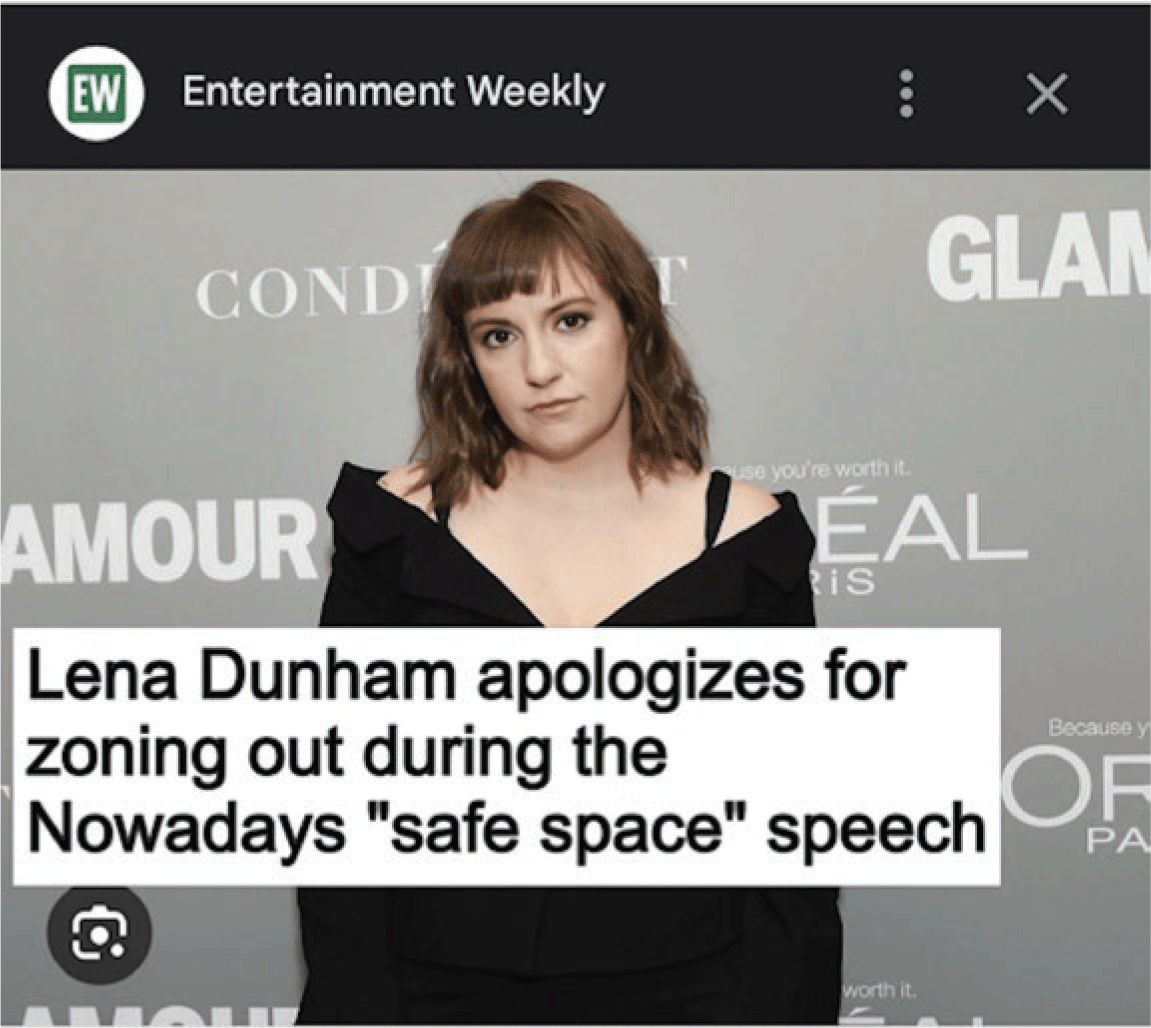
While these rules persist in many clubs today, audiences have become so accustomed to them that they are now often self-consciously satirized. For example, in an Instagram post roasting the ongoing, gentrifying hipster-ization of Bushwick, Brooklyn, a 2016 photo of Lena Dunham in front of a step-and-repeat is overlaid with the text, “Lena Dunham apologizes for zoning out during the Nowadays ‘safe space’ speech” (@meetmeintranspecos 2024) (fig. 1). The meme updates Dunham’s reputation as a profuse apologizer (Arnold Reference Arnold2017), situating it within the milieu of Bushwick’s all-night dance music venues. The meme’s reference to the “Safer Space Policy” of the venue Nowadays illustrates contemporary preoccupations with discourses around safety, embodiment, protection, and enforcement, and the varying and conflicting directions in which they continue to be developed. The meme slyly acknowledges the boredom that can settle in while listening to a list of rules being read aloud by the doorperson before entering a space ostensibly of queerness (though not necessarily sex), drugs, and sound. It begs the question, is this policy even meant for everybody’s ears? And, like a preflight safety demonstration, how many people are actually paying attention? Moreover, might zoning out itself be one of the pleasures of entering such a space?
Meme from @meetmeintranspecos, posted 28 June 2024 on Instagram. (Screenshot by Benjamin Haber and Daniel J. Sander)

While scholars like João Florêncio (Reference Florêncio2023) have argued that a focus on queer clubs allows us to “find a way out” of what Oliver Davis and Tim Dean (2022), building on Robyn Wiegman (Reference Wiegman2012), have called the “juridical imaginary” of queer studies, we suggest that the memeification of the Nowadays “safe space” speech indicates that this juridical imaginary has not been left behind, but has taken such hold within queer nightlife culture that it is now the object of humorous imagery and allows participants to distance themselves from that very culture. While there is wide variability in the actual enforcement of these rules, with some spaces taking them more seriously than others, their wide circulation on social media as objects of parody suggests a reevaluation of the juridical impulse within queer discourse. The cheeky play around the seriously framed rules of engagement reflects a tension between the high aspirations of the rules and the way that they play out in the club. The lists of rules that now adorn the websites and sometimes the doors of club spaces at the heart of the Brooklyn scene speak to the complex role of language in framing the positionalities of participants in nightlife culture. As the curation of party attendees has shifted from word of mouth and flyers passed between friends to Instagram posts, the strategic imperative to organize the right crowd has become more proactive.
While listed as and often understood as rules, safer space policies can be understood as one part of a larger collection of signals intended to protect an always fragile vibe. In her club memoir, Health and Safety: A Breakdown, Emily Witt writes of the Deleuzian wordplay on digital techno flyers. “This elevated language was both serious and not. It was a shared aspiration that drew people together in one room and an acknowledgement of our alienation; it was also poking fun at its own wishful ideation” (2024:105). Witt suggests that the exclusivity in social media club discourse performs both a political potentiality and a satirization of the seriousness for which such high-minded language supposedly reaches.
Nowadays’ safer space policy notably requests that you “please not stare at anyone” and “if you want to touch another guest or someone who is working, ask first if it’s okay” (Nowadays n.d.). The intent of such directives can be implicitly understood in terms of predefining a set and setting in which queer people can feel comfortable enough for positive bodily experiences. At the same time, however, they cannot account for the potentially pleasurable risks of the unexpected, unconscious, experimental, and uncomfortable. As Luis Manuel Garcia-Mispireta has argued in his dancefloor ethnography Together, Somehow, it is those unexpected and otherwise inappropriate encounters—the vague and underdefined club intimacies he calls liquidarity—that can make clubs messy, utopian spaces (2023:32–33). Garcia-Mispireta specifically highlights sustained eye contact as one kind of affective mirroring or “rhythmic entrainment” that thickens the social experience of the club and can lead to more positive interactions with strangers (2023:142–43).
For Rosemarie Garland-Thomson, the impulse to regulate staring reflects the perceived danger of intemperate curiosity, “at once purposeless and purposeful, at one moment intrusion, and the next idleness” (2009:65). The promiscuity of the stare is threatening in its capaciousness. The regulation of staring plays a central role in incorporating disabled people into “polite society.” Nondisabled children are taught that it is rude to stare at the disabled (Garland-Thomson Reference Garland-Thomson2009:71–72), and behavior around eye contact and gaze-related expectations is normalized in children with autism (Hustyi et al. 2023), who can otherwise struggle with avoiding eye contact (Trevisan et al. 2017), making too much eye contact (The Treetop 2024), and failing to recognize the directionality of another’s gaze (Crehan and Althoff Reference Crehan and Althoff2021). This last quality, clinically dubbed the “stare-in-the-crowd effect,” speaks to the different capacities for understanding what can be perceived as offensive in a gaze.
Just as the university policies concerning active or affirmative sexual consent that flared in the 1990s (and have periodically reemerged as cultural flashpoints) were subject to mocking opprobrium,Footnote 2 so too have the politics of consent around staring within club culture been ridiculed. In a cruel twist connecting the regulatory gaze of the dancefloor to the regulatory gaze of social media, public rules about staring can invite insidious attention such as that from a New York tabloid looking for examples of liberal piety to expose. A 2022 New York Post article laments an Australian club’s safe space policy that forbids unwanted staring from afar as a “new woke policy,” mourning that “the days of checking someone out at a club are over” (Steinberg Reference Steinberg2022). This framing obscures a more interesting conversation to be had about the changing nature of sex in the context of clubland and about what has happened to the ga(y)ze as cruising has largely shifted from a direct dance of eyes to something more typically mediated through apps. More worrisome is when these discourses spill over into right-leaning mainstream media, leading to the dark memeification of queer youth as coddled snowflakes.
We acknowledge that we, too, flirt with the very exposure risks we are highlighting here by publishing work on underground queer club and drug cultures, though this danger is somewhat attenuated by the limited reach of a largely paywalled academic journal. It is worth noting, however, that the most impactful and generative academic articles, like the most impactful and generative club nights, are ones that allow for the pleasure of risky possibilities away from the glare of viral scrutiny. We hope that we have managed to thread that needle in this piece.
Big Time (A)sensuality
Drugs—both for better and for worse—have long played a central role in queer nightlife culture. Both as a complex experience of embodiment and a metaphor for social transformation, queer drug use often functions as a cultural vanguard in ways similar to fashion and music. The rising popularity of ketamine and the fading significance of ecstasy in nightlife are analogous to shifts in contemporary queer youth participation in a social media surround marked by acute concerns around risk, consent, and exposure.Footnote 3 Social media functions as an essential promotional tool, a connective forum, and a smooth entry point for outsider participation and documentation, making it an increasingly central space for the performance of queer nightlife discourse and its entanglements with the broader culture. Drugs, too, function as central interfaces for encountering nightlife in the form of performance-
enhancing or -altering media to smooth, defamiliarize, refamiliarize, provide friction, and otherwise deconstruct and reconstruct our bodyminds in relation to corporeality and collective possibility.
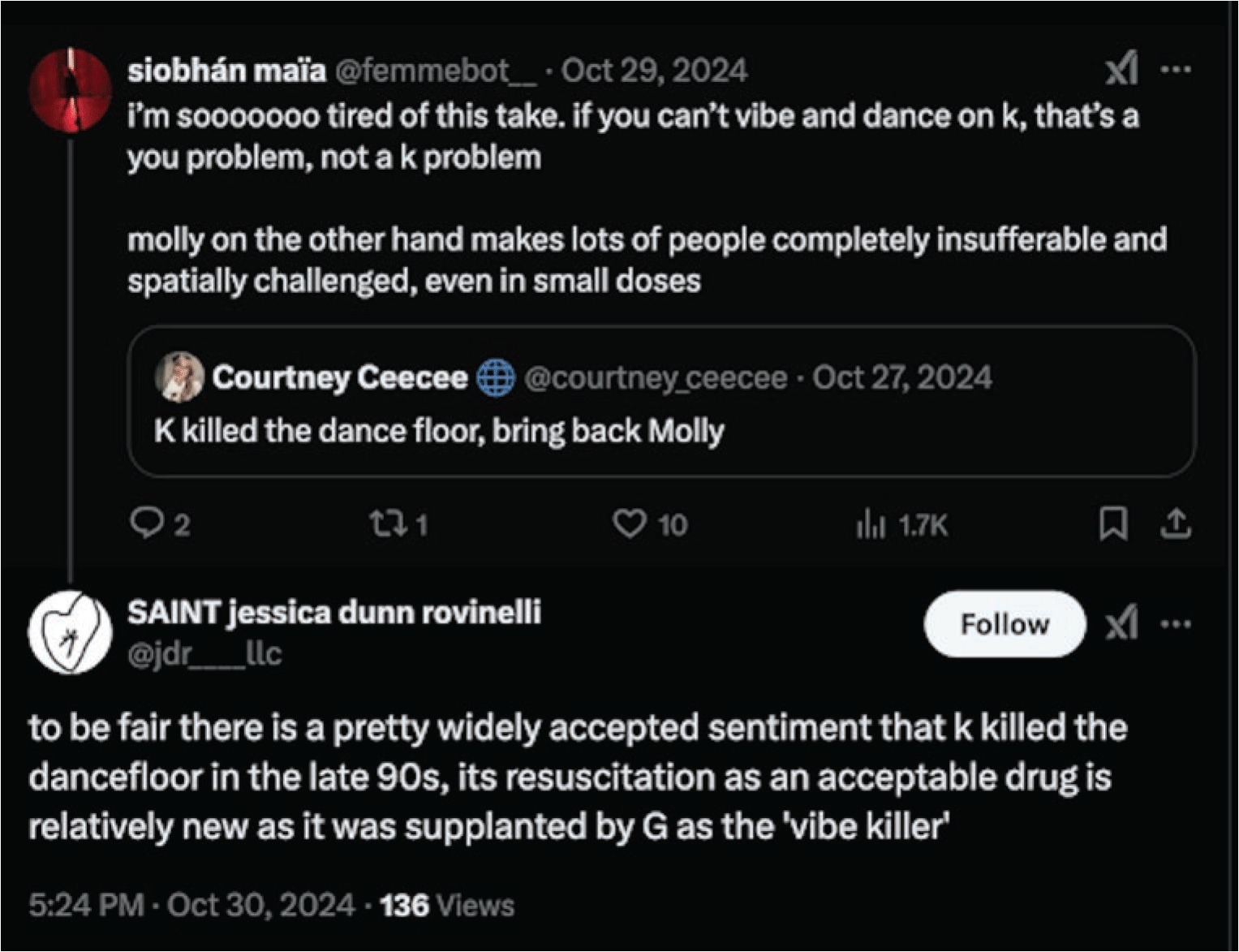
Evolving drug cultures—and their metaphors—offer another lens for understanding sensory experience in the club. One broadly discussed distinction (as in the tweet in figure 2) explores the shifting popularities and effects of ecstasy and ketamine. Their felt experiences, the types of bodily comportment and performance that they allow, especially in relation to their effects on sight, touch, and sound, are significantly different. What is it about ecstasy’s pure bliss and ketamine’s anesthetic pleasures that make them the drugs-of-choice for many in clubs?
Ketamine discourse on X (formerly Twitter). (Screenshot by Benjamin Haber and Daniel J. Sander)

On the one hand, ecstasy, a club drug most prevalent in nightlife scenes from the mid-’80s to the late aughts, is increasingly seen by young queer people as messy, inconvenient, and out of step with a cultural moment suffused with anxiety and the politics of consent. Uncharitably characterized in a retweet by Siobhán Maïa, ecstasy “makes lots of people insufferable and spatially challenged, even in small doses” (@femmebot 2024). For some, however, these properties actually heighten its appeal, as can be seen in Courtney Ceecee’s tweet: “K killed the dancefloor bring back Molly”
(@courtney_ceecee 2024). Though ecstasy/Molly, aka MDMA, has been swept up in the psychedelic revolution in clinical psychiatry (Jacobs Reference Jacobs2021), its unruly sensibility has made it more niche within contemporary nightlife. This speaks to the ways in which drugs and their affiliated cultures can resonate or clash with the shifting politics of regulating bodies within space. Ecstasy’s longer-
lasting effects, and the next-day aftercare they often require, clash with the demands of wage labor and neoliberal productivity.Footnote 4
On the other hand, ketamine is fast-acting and short-lived, has anesthetizing qualities that can mask its side effects, and does not typically cause much of a hangover. Ketamine has unique properties that have helped it gain traction within burgeoning formal clinical care settings, offering a low-risk, rapidly efficacious treatment for anxiety, depression, and a variety of other contemporary ills. Its rising popularity in nightlife spaces is, in part, a reflection of its increasing presence in the culture at large, as boutique clinics dot the landscape and ads for ketamine therapy flood social media. But while one course of ketamine therapy can run into the thousands of dollars and is typically not covered by insurance, the street price of K is considerably more affordable. It is notable, too, that ketamine’s surge in popularity occurred alongside the easing of Covid-19 pandemic restrictions, with the dissociating quarantine experiences of isolation, social distance, and diffuse anxiety proving hard to kick. As young people struggle to reenter IRL social scenes amidst rising global fascism, acute economic uncertainty, and increasing violence and hatred towards queer people in general and trans people in particular, the felt experience of ketamine as a protective bubble matches the cultural mood.
Ketamine activates a perception of increased distance that abstracts vision, as the stark boundaries of objects are softened with the fuzziness of nearsightedness. At its most abstract, in a k-hole, the systematicity that overlays, or is within, the everyday is revealed. At the same time, one’s own internal perception is hollowed out, the eyes telescope inward, collapsing surface and depth into black holes, akin to what Bataille called “solar anuses,” writing, “vision itself, attracted by nausea, is torn out and torn apart by the sunbursts into which it stares” (1931:n.p.). The eyes on ketamine are big, wet, and dark, no longer intersubjective windows to the soul, but part of the “performance of detachment” of a “dissociative pout” (Fisher-Quann Reference Fisher-Quann2022). Analogous to the way in which a dream might trigger a bodily response indistinguishable from one induced by reality, ketamine collapses the distinction between self-touch and touch by others (Kaldewaij et al. 2024). The sonic atmosphere that soundtracks this experience tends away from traditional instrumentation, melody, and sometimes even rhythm, toward the ambient, synthetic, and onomatopoetic; a chaotic and undulating landscape of loopy and bloopy aquatic sound effects and video game music. The work of the late producer Sophie is exemplary here for the way in which it “imagine[s] a hyperreal world of […] sounds which cartoon-ize and exaggerate naturally occurring or organic sounds and phenomena, and materials that don’t exist at the moment” (Arte TRACKS 2018).
These haptic and sonic qualities produce less a Rimbaudian derangement of the senses, or what Deleuze and Guattari called a body without organs, than a defamiliarization and detachment from them. On the one hand, ketamine performs on the human body in a way that is reminiscent of the anonymity of some queer sex, of “the particular ‘facelessness’ of glory hole sex, where bodies are fragmented, where visual social cues are limited or non-existent, and where verbal communication is likewise limited or non-existent” (Holmes et al. 2010:255). On the other hand, the significant difference is that while “the glory hole allows the free play of desire and fantasy for both users,” ketamine, for many, largely vacates sexual desire (255). In this respect, ketamine renders the human a machine, severing actions from feelings and making organs without bodies.
And here there is a tension between the vigilant prescriptions of a space, evidenced by posted rules, and drug-induced states of zoning out within that space. If one can’t tell from where touch is coming, it might be hard to ask before touching another, let alone wanting to touch or wanting to ask. Staring, too, takes on an enigmatic quality as it becomes hard to focus on anything in particular and the gazes of others are rendered distanced/domesticated through a gamification quality many users report when on ketamine. Though wildly combined in practice, the particular performances and metaphors of ketamine are oftentimes counterposed to those of ecstasy. When you’re on ecstasy, “you’re smiling at people, you’re looking into peoples’ eyes” (Coogan in Reid 1992), and everything feels, inside and out, tinged with the electricity of an ASMR (autonomous sensory meridian response). You are compelled to look and touch promiscuously. If ketamine causes wild defamiliarization of the everyday, ecstasy tends towards the overly familiar. Ecstasy is spatially challenged, unrestrained in its drives, anarchic in its orientations, and devoid of composure in manners and expectations. Within this context, the need to explicitly and symbolically delimit a safe setting through restriction might seem reasonable. Yet, in what ways might looking and touching be negotiated without linguistic legislation? This is not to suggest that everyone should be able to stare and touch freely, as contact can be violative and inadmissible, but that an openness to bodily pleasures, some of which might not be known in advance, can also be conveyed outside of language through sensory interaction itself.
Ecstasy is so-named because of the ecstatic reimagining of inside and outside, the skin functioning less as a border and more as a sense multiplier. At least for some, the inner and outer body sensory foreplay that ecstasy allows for chemically can be accompanied by or lead to an ecstatic state of a spiritual sort. Enhanced by the trance effect of repetitive music, an overwhelming sense of interpersonal interconnection and reciprocity can be experienced as transcendent, “whether that trans-individual is the couple-in-love, or the dancing crowd, or the cosmos” (Reynolds Reference Reynolds2012:xxviii). Different from yet of a piece with the house rules of today’s dancefloors, the cyberutopian values of PLUR (peace, love, unity, and respect) make sense as guiding principles for gatherings of people experiencing epiphany together.
While seemingly well-intentioned, the hippie affirmations of the ecstatic can be just as questionably seamless as identity-based prohibitions. To recall the context out of which the rules of 924 Gilman emerged, the subtext of safer space injunctions, like those of Nowadays, against violence, racism, transphobia, and sexism, as well as against nonconsensual staring and touching, is that while creating a space to mandate the good time of every/body, the rules are not for the edification of every/body. Rather, they are for those bodies who are endowed with and deploy an individualized, affluent, patriarchal masculinity and who, as such, might be inclined to violate the bodily autonomy of another. Consent, however, does not necessarily insure against such violations. As Andrea Dworkin has suggested, consent assumes an equality among individuals who are just as often, for reasons of gender and class, not actually peers ([1979] 1981:59), and, as Avgi Saketopoulou has suggested, “the affirmative consent model presumes a fully conscious subject even though desire is often unconsciously conflicted” (2023:96). Thus, while PLUR values are less explicit about nonconsensual looking and touching, they assume a sense of reciprocity that just might not be the case socially and/or psychically.
If nightlife’s rules promise more than they can deliver, might its terms instead be reshaped by its experience—by queerness relocated not in the affirmation of selfhood, but in the unawareness of bodies and the abandonment of identity, by an ecstasy that is not transcendent but inhuman? Rather than returning to a PLUR wholeness of ecstasy-induced spiritual communion as an antidote to the prevalence of ketamine, the glory here would be “to lose yourself, shed your identity and thoughts, and be a series of motions and sensations” (Lippens Reference Lippens2024:146). As we shall see, this would be to détourné the deleterious effects of disembodied digital culture.
Dancing in the Dark (Forest)
Moves to work on, around, or beyond identitarian queerness have been criticized for their unmarked whiteness. Scholars such as Saketopoulou, as well as Bobby Benedicto, however, have begun to put pressure on the polemic that has been staged between the whiteness of arguments for the unbinding, overwhelming, and anonymizing aspects of the psychoanalytic sexual drive, and the position that these aspects are risks that queers of color do not have the privilege to take. For Benedicto, this sets up a false equivalence between the social negation of minoritarian positionalities and the ontological negativity of a self that is inherently other to itself. The dangers of this are not only that it disallows queers of color the ecstasy of self-shattering, but also that it forces nonwhite subjects to be beholden to categories of social difference in which they become metonymic stand-ins for populations (Benedicto Reference Benedicto2019).
Transposing this psychoanalytic argument in terms of nightlife: lists of “no’s” that attempt to symbolically repair, affirm, and protect socially negated positionalities simultaneously preserve the fantasy of subjectivity as self-apparent, sovereign, and whole as if power differentials could be checked at the door. Put another way, these lists of rules also exhibit an unmarked whiteness in the way in which they can absolve, through self-flagellation, privileged, white “participation in elitism or gentrification,” as the creator of the Lena meme is aware (Song Reference Song2022). Analogous to an app’s terms and conditions, which we never read but must click OK on before downloading, safe space rules attempt to provide clubs with a sort of ethical inoculation against bias that is easily ignorable by guests. And in practice, once inside the club, nightlife bends its own rules, creating the risk of encounters that are disarming, and potentially—though not necessarily—ecstatic in their unexpectedness, discomfort, and silence. It is important to note that bending the rules is not so much against consent, but as in Saketopoulou’s formulation, at its limits. Especially for the uninitiated, but also for some in general, operating within the limited and predetermined terms of affirmative consent might be preferable. For others, however, knowing whether you’re being perceived as staring or touching someone—let alone how you both identify and what your politics are—can be hard to calibrate ahead of time and fuzzy through the haze of fog, drugs, and sound. Precisely in its deprivileging of sight, recognition, and spoken language, the nightclub is conducive to “the importance of ‘losing sight of the self,’” of others; of zoning out (Benedicto Reference Benedicto2023:n.p.).
Ketamine, too, is abundant in its ambivalences in relation to vision, sociality, and embodiment. In Simon Reynolds’s dancefloor dispatches from the 1990s, all that was old is new again, as the relationship between drugs and embodiment swirls between connection and withdrawal. If ecstasy performs fantasies of a postidentitarian cyberutopian hyperconnection of the early internet age, ketamine’s sharp, disconnected antisociality swoops in to burst that bubble:
At raves, kids take regular “bumps” of “Vitamin K” to sustain a plateau state of boneless stupor. They’ve even started bringing blankets to parties, so they can loll around on the floor. K’s popularity with ravers is mysterious: unlike E or acid, it doesn’t make music sound fantastic, it’s antisocial verging on autistic, and it certainly doesn’t make you wanna dance. (Reynolds [1998] Reference Reynolds2012:308)
While the suggestion that ketamine “doesn’t make you want to dance” is questionable at best, and our suggestion is that ketamine is not antisocial but has a particular social shape, there is something worth exploring about Reynolds’s equivalence of autism, ketamine, and the antisocial. Autism and ketamine can both be framed as interruptive of normative vision. We explored earlier how for many people with autism, the “stare-in-the-crowd effect” highlights the difficulty of detecting and responding to a gaze across distance (Crehan and Althoff Reference Crehan and Althoff2021); this experience is also familiar to many nightclub users of ketamine. While autistic people could be more accurately described as differently social rather than antisocial, the metaphor highlights how normative understandings of the social rely on specific gestures, comportments, and communication styles. It is also notable that ecstasy’s “pro-social” effects have made it a treatment for the “social impairment” of autism (Chaliha et al. Reference Chaliha, Mamo, Albrecht, Lam, Takechi and Vaccarezza2021), again re-privileging an unquestioned norm.
The contemporary preoccupation with the violation of staring seems to be related to the nosy gaze of the camera. Losing oneself and getting into the zone can put one at risk of ongoing, circulatory exposure. Stephen Yang’s cross-cultural work on the global underground dance movement frames the visibility facilitated by the smartphone as a form of play around access and obfuscation (2024). In queer clubs especially, the smartphone becomes a tool of management—balancing openness with the need to protect a vulnerable population engaged in practices that may skirt legal and cultural boundaries. Taking pictures, even of oneself, is now widely seen as gauche on most dancefloors, with some clubs giving out stickers to cover phone cameras upon entry. While media of people “too fucked up” at the club or festival have long been a popular genre of viral content, recent controversy over a video of fans gurningFootnote 5 at an electronic music show in Australia is a sign of the changing norms around exposure (Walsh-Cotton Reference Walsh-Cotton2024). Though not removed until it had been viewed millions of times (and remaining easily searchable), the public discourse around the video suggests such content is seen as increasingly exploitative. The DJs of the night apologized for “preying on people’s vulnerability,” sparking a lively discussion about the ethics of nonconsensual dancefloor media (Walsh-Cotton Reference Walsh-Cotton2024).
Aware of the foundationally “leaky” and “promiscuous” nature of digital technology in general and social media in particular (Chun and Friedland Reference Chun and Friedland2015), a growing number of young people are withdrawing from the public internet, the inherent riskiness of circulatory exposure not worth the upside of small deposits from creator funds. In dissociating from the messy, chaotic, and undifferentiated communal riskiness of going viral on social media, we see a parallel in the movement away from a drug that in its ecstatic externality brings its own risks vis-à-vis the terms and conditions of contemporary club life. There is a sense that ecstasy, in its undifferentiated social possibilities, mirrors the cultural common denominator that algorithmic culture pushes creators towards; it’s easy to have a good time on E, almost too easy. As Emily Witt glosses, “Molly lies. […] Everything was fun on it, all music was danceable, every person was wonderful, and the blinky lights looked pretty” (2024:116).
The smoothness of an ecstatic sociality and the risks it entails are also mirrored in the ease by which queer parties are now found online. As tensions between the desire to create a scene structured by DIY aesthetics and queer politics meet the ongoing dependence on big platforms to promote events and host discourse about them, some parties are returning to older models of exclusivity, sometimes married to the technologies of the so-called “cozyweb” (Rao Reference Rao2019), i.e., email lists, Discord servers, and WhatsApp and Telegram groups (Appleton n.d.). While the dominance of queer
app-based relationality has led to considerable hand-wringing about the disappearance of lesbian and gay bars and to worries about home-bound queers (Mattson Reference Mattson2023), it is clear that young people still want to be around each other, even if they have become less comfortable with the norms and contingencies of legacy gay spaces.
A singular contingency that marks a generational shift among queers concerns feelings about sex, another issue that maps well onto the shifting youth cultural experience of club drugs. Accompanying the social, political, and economic upheaval of the Trump-fueled breakdown of the liberal order has been what Kate Julian has termed a “sex recession” (2018). While Julian offers a number of hypotheses for young people’s increasing discomfort with sex—including the widespread availability of porn and a post–Me Too reevaluation of bodily pleasure—most notable for our purposes is the segregation of sex to apps and the accompanying desexualization of IRL spaces, including bars and clubs. One young interviewee described the shift starkly: after striking out at hitting on people at a bar, he felt that “hitting on someone in person had, in a short period of time, gone from normal behavior to borderline creepy” (Julian Reference Julian2018).
Queer sociality, once centrally organized around sex, has not been immune to this shift, one that has its counterpart in an ongoing reevaluation around the centrality of sex to the queer project more broadly. Tim Dean has been at the forefront of pushing back on queer theory’s increasingly expansive purview that has left sexual desire relatively marginalized within the academy. Critiquing Lauren Berlant and Lee Edelman’s 2013 book Sex, or the Unbearable, Dean focuses on the way that the dense conceptual language aligns with a supposed “hatred of sex”: “Abstraction enables the maintenance of a hygienic distance from the messiness of embodied desire” (2015:621).
It may seem odd that the response to the widespread dominance of abstract frames via the technologies of digital quantification and depersonalization would intersect with a desire for a substance whose hallmark is clean, disconnected vision. But while abstraction is a route for violence and dispossession, it can also be a form of protection against a world where sex, contact, exposure, and identity are suffused with the risks of a social field structured by the “logic that blames the user, her habits of leaking, for the inherent leakiness of new media” (Chun Reference Chun2017:147). In this context, queer ketamine sociality could be seen as part of an emergent digital vision of the communal, one that allows for a certain kind of risky play away from the glare of an undifferentiated mass public. The “oceanic, only connect” rush of ecstatic, always-on digital abundance (Reynolds Reference Reynolds2012:xxv) fades into the dull, anxious depression of being underwhelmed by the overwhelming. The ketamine social is thus analogous to the digital “dark forest” (Strickler Reference Strickler2019), where forms of embodied experience can happen outside the messy exposure of the mass public and social media’s PLUR-adjacent community guidelines around unity and respect.Footnote 6
Meme from r/distressingmemes on Reddit, posted on 24 August 2023. (Screenshot by Benjamin Haber and Daniel J. Sander)

McKenzie Wark has written that the best raves seem to be “poly-intoxicant” (2024), and there is value in not getting too comfortable in the dissociated dark forest, as well as lessons to be learned from earlier models of nightlife sociality. If we understand ketamine as offering a “buffer” that “allow[s] people to escape from the oppressiveness of the ‘I’” (Love 2024), what should we do with that space away from the stultifying and risky regime of compulsory identification? Ketamine offers an opportunity to rediscover the body as a site of collective potential, to reconnect with embodiment as a site of strange purposelessness and queer possibility. Rather than the ecstasy body experienced through others, however, this would be the body experienced through itself, a bodyself abstracted from the dangers of the network and thus opened to emergent forms of being together.
The ongoing attempts to confront a scary and hostile world through attempts at rule-based method, management, and calculation are thoroughly reasonable, yet have ultimately served to make nightlife, and the world, more boring and utilitarian. Rather than seeking to articulate terms and conditions for the club, to forge a common language through which to hope for a juridical politics of the everyday, we might seek to make nightlife less capturable and calculable and more surprising and disappointing, to make nightlife foggier, and to embrace discomfort as a key value of the defamiliarizing potential of queer nightlife.