Introduction
The tomato red spider mite Tetranychus evansi Baker & Pritchard (Acari: Tetranychidae) is an invasive pest in Africa (Migeon et al., Reference Migeon, Ferragut, Escudero-Colomar, Fiaboe, Knapp, de Moraes, Ueckermann and Navajas2009). Although commonly known to be a serious pest of tomato (Lycopersicon esculentum M.) and aubergine (Solanum melongena L.) (both Solanaceae), T. evansi is also a pest of several other solanaceous plants including nightshade (Moraes et al., Reference Moraes, McMurtry and Baker1987; Fiaboe et al., Reference Fiaboe, Fonseca, de Moraes, Ogol and Knapp2006). African nightshades have for long been considered as inedible poisonous plants and troublesome agronomic weeds (Schilling and Andersen, Reference Schilling and Andersen1990; Edmonds and Chweya, Reference Edmonds and Chweya1997; Schippers, Reference Schippers2000); however, in western, eastern and southern Africa, the leaves are sold as vegetables in both rural and urban markets for dietary consumption (Edmonds and Chweya, Reference Edmonds and Chweya1997). In addition, their fruits and leaves are also used as a source of dye, and for various medicinal purposes (Schippers, Reference Schippers2000). In this regard, African nightshades are among the top priority indigenous vegetables earmarked for further research and improvement due to their role in improving the nutritional and economic status of marginalized and nutritionally vulnerable populations in Africa (Schippers, Reference Schippers2000).
In the last decade, T. evansi has become one of the most severe pests of solanaceous crops in Africa, causing crop losses of up to 90% in south-east Africa (Sibanda et al., Reference Sibanda, Dobson, Cooper, Manyangarirwa and Chiimba2000; Saunyama and Knapp, Reference Saunyama and Knapp2003) and West Africa (Duverney and Ngueye-Ndiaye, Reference Duverney and Ngueye-Ndiaye2005). A recent laboratory study revealed that some African nightshade species have considerable effects on life table parameters of T. evansi (Murungi et al., Reference Murungi, Nyende, Wesonga, Masinde and Knapp2010). In this study, Solanum sarrachoides Sendter negatively affected the doubling time and hence the intrinsic rate of the natural increase of T. evansi. However, the resistance mechanisms underlying the differential suitability of African nightshades to T. evansi have not been explored, although trichomes have been implicated in related solanaceous species (Simmons and Gurr, Reference Simmons and Gurr2005).
Foliar trichomes are unicellular or multicellular structures arising from the epidermal tissues (Larkin et al., Reference Larkin, Young, Prigge and Marks1996). They represent a plant morphological trait that can impose resistance to herbivores (Peters and Berry, Reference Peters and Berry1980; Fernandes, Reference Fernandes1994). Trichomes act as mechanical defence to small arthropods that impede the movement on the leaf surface, restrict access to food, diminish food digestibility and assimilation, and reduce fecundity (Valverde et al., Reference Valverde, Fornoni and Núñez-Farfán2001; Kennedy, Reference Kennedy2003; Simmons et al., Reference Simmons, Gurr, McGrath, Nicol and Martin2003; Handley et al., Reference Handley, Ekbom and Agren2005). In addition to the mechanical defence, some plant glandular trichomes secrete toxic chemicals and/or sticky exudates that may entrap and kill small insects (Gurr and McGrath, Reference Gurr and McGrath2002). For instance, the hairy nightshade S. sarrachoides has been reported to confer some degree of resistance to the two-spotted spider mite Tetranychus urticae Koch (Rasmy, Reference Rasmy1985). Leaves of this nightshade species have a high density of glandular hairs and mites quickly get entrapped in their exudates, which are released when the trichome cuticle breaks after being touched by the mites (Van Haren et al., Reference Van Haren, Steenhuis, Sabelis and De Ponti1987; Chatzivasileiadis and Sabelis, Reference Chatzivasileiadis and Sabelis1997; Chatzivasileiadis et al., Reference Chatzivasileiadis, Boon and Sabelis1999).
We hypothesized that the differential levels of nightshade preference by T. evansi are partially associated with the plant's trichome-based physical resistance. We tested this hypothesis using laboratory assays to study the influence of trichomes in different African nightshade species on a biological and a behavioural response of T. evansi.
Materials and methods
Plant material
The African nightshade species evaluated included S. sarrachoides (GBK 028726), which was obtained from the Gene Bank, Kenya, and Solanum villosum Miller (MW 13), Solanum scabrum Miller (SS 52), Solanum americanum Miller (SA) and Solanum tarderemotum Bitter (MW 03) that were sourced from the World Vegetable Centre (AVRDC, Arusha, Tanzania). To produce seedlings, seeds were sown in soil enriched with compost in plastic seedling trays kept in a greenhouse at the International Centre of Insect Physiology and Ecology (icipe), Nairobi, Kenya. The greenhouse temperature was monitored using a HOBO Pro Series Temp, relative humidity (RH) data logger (www.onsetcomp.com). The daily average temperature in the greenhouse during the experiments was 23 ± 1°C and 60–70% RH. Seedlings were transplanted into pots (29 cm in diameter) filled with a mixture of soil, compost and sand (3:2:1, v/v) 28 days after sowing. Plants were watered daily and each pot was fertilized with 3 g calcium ammonium nitrate (26% N) 2 weeks after transplanting.
Mites
Mites used in this study were sourced from a colony maintained on potted tomato plants (variety Moneymaker obtained from the East African Seed Company, Nairobi, Kenya), in a rearing room at a temperature of 25 ± 1°C, 50–70% RH and 12 h photoperiod.
Trichome identification and quantification
Twelve fully expanded young leaves were collected at random from 4-week-old plants of each respective nightshade species. Photographs of fully expanded leaves were taken with a 25 × light microscope (Leitz Orthoplan; Leitz GmbH, Wetzlar, Germany) along the midrib. Identification and classification of the trichomes was made based on the presence or absence of glands according to the criteria established by Luckwill (Reference Luckwill1943) to classify trichomes in Lycopersicon spp. Trichome counts were made under a 32 × dissecting microscope (Leica MZ8; Leica Microsystems, Wetzlar, Germany) fitted with a square grid to assist in counting. Ten squares (each 0.11 mm2) were selected at random on the abaxial surface of each leaf. Densities were expressed as the number of trichomes/mm2. Three replicates each with 36 leaves were carried out for respective plant species.
Effect of trichomes on mite fecundity
Fecundity tests were carried out on leaf disks of the same age as leaves on which the number of trichomes was counted and representing each investigated species. Four leaf disks (25 mm in diameter) of the respective species were maintained individually in one Petri dish (86 mm in diameter) stacked with cotton wool moistened with tap water and placed into plastic trays (36 × 23 × 2.3 cm). A single female deutonymph and two males were carefully picked from the colony and transferred to the respective leaf disks for oviposition. These rearing units were placed in an incubator maintained at 25 ± 1°C, 70–80% RH and a 12 h photoperiod. Males were removed 48 h later, after the female had emerged. The number of eggs laid per female was monitored daily during the first 10 days of the oviposition period. The leaf disks were changed every 4 days. A total of five replicates, each with 20 deutonymphs, were evaluated for each plant species.
Effect of trichomes on mite movement
The effects of trichomes on various African nightshade species on T. evansi movement were quantified with a no-choice thumbtack bioassay modified from that described by Weston and Snyder (Reference Weston and Snyder1990). Young leaves of the respective species whose trichome density had previously been determined were used. One leaf of each species was attached to a board of Styrofoam® through a metallic thumbtack (9 mm in diameter) placed at the centre of its abaxial surface. One replicate consisted of four leaves of each species individually placed on the Styrofoam® boards. Ten female spider mites were transferred with a fine camel-hair brush to the head of each thumbtack. The trial was carried out on a laboratory bench at 23 ± 1°C. Distances travelled by each mite onto the leaf surface were measured as the shortest distance (in cm) between the mite and the thumbtack edge, and were recorded after 15, 30, 45 and 60 min. Mites that stayed on the thumbtack were considered to have travelled a distance equal to zero. Three replicates, each with 40 spider mites, were carried out for each plant species.
Data analysis
Data on fecundity (number of eggs laid by female T. evansi) were analysed using a generalized linear model with a negative binomial error and logarithmic link. Leaf trichome density was log-transformed {log10(x+1)} prior to analysis of variance. Data on distances travelled by mites onto the respective species after the specified time duration were analysed using two-way analysis of variance where effect of plant species, time and the interaction were evaluated. Means were separated by Tukey's honestly significant difference (HSD) test. Distances travelled by mites and eggs laid onto the respective species were correlated with trichome densities, respectively. All data analyses were implemented using R-Development-Core-Team (2011).
Results
Trichome identification and quantification
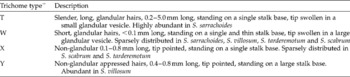
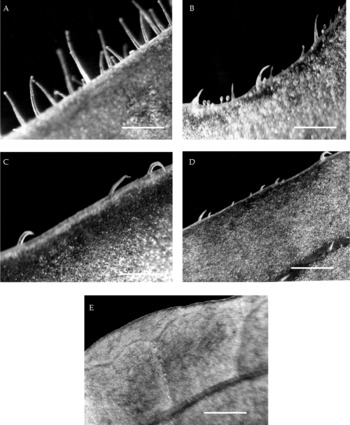
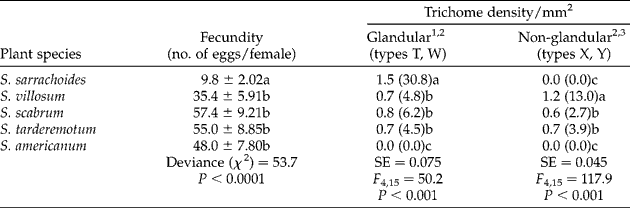
A morphological description of the five trichome types, identified based on the presence or absence of glands and length, is given in Table 1. The range in the length of glandular trichomes (types T, W) was < 0.1–5.0 mm, while non-glandular trichomes (types X, Y) were shorter in size with a range of < 0.1–0.8 mm. The head of the trichome types T and W is swollen in a glandular vesicle, although larger in the latter (Fig. 1A and B). Non-glandular type X, found in S. scabrum and S. tarderemotum, stands on a single stalk base, is pointed at the tip and also long and appressed (Fig. 1C and D). Trichome type Y, found in S. villosum, is also appressed but stands on a large stalk base (Fig. 1B). Significant differences in densities of both glandular and non-glandular trichomes were detected among the species (Table 2). The range of glandular trichome density was 4.5–30.8 trichomes/mm2, while there was a narrower distribution of non-glandular trichomes with a range of 2.7–13 trichomes/mm2. The highest number of glandular and non-glandular trichomes was recorded in S. sarrachoides (30.8 trichomes/mm2) and S. villosum (13 trichomes/mm2), respectively (Table 2).
Description of the trichome types identified in five African nightshade species

+ T, W, X and Y refer to randomly assigned letters to the identified trichome types.
Trichomes on the leaves of various Solanum species. A, S. sarrachoides, long glandular trichomes, type T; B, S. villosum, short glandular hairs, type W and non-glandular hairs, type Y; C, S. scabrum, non-glandular hairs, type X; D, S. tarderemotum, non-glandular hairs, type X; E, S. americanum is completely glabrous. Scale bars: A, 3000 μm; B, 100–600 μm; C, 700 μm; D, 300 μm; E, no trichomes.

Fecundity of Tetranychus evansi females and trichome density (number of trichomes/mm2) in five Solanum species
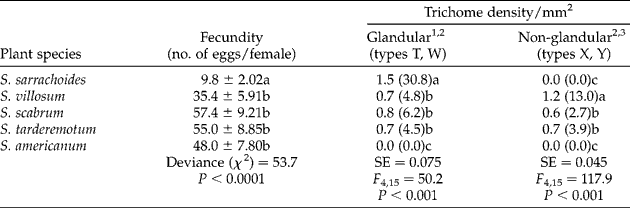
Mean values with the same letter within a column are not significantly different (Tukey's HSD test; α = 0.05).
1 With ‘heads’.
2 Values in parentheses are untransformed means of trichome density.
3 With no ‘heads’.
Mite fecundity
Significant differences in the number of eggs laid per female within 10 days on various plant species were detected, with S. sarrachoides having the least number (Table 2). Correlation analysis revealed that the density of glandular hairs (types T, W) negatively affected fecundity (r = − 0.68; P = 0.001). In contrast, the correlation between the density of non-glandular hairs and fecundity was not significant (r = 0.08; P = 0.73).
Mite movement
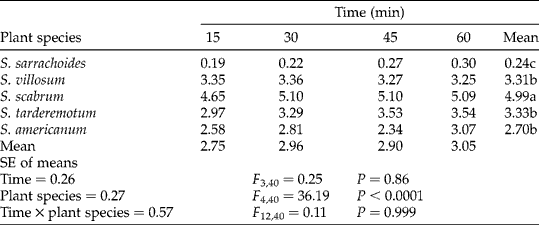
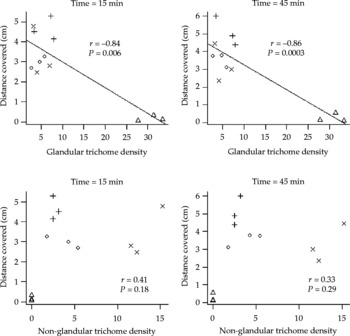
Significant differences in the distance walked by mites on various plant species were detected (Table 3). This indicates that repellence was highest on S. sarrachoides leaves and lowest on S. scabrum. However, different time durations and their interaction with the various species did not reveal any significant differences (Table 3). Correlation analysis showed that glandular trichome density reduced the distance travelled at 15 and 45 min, whereas there was no apparent relationship with non-glandular types (Fig. 2).
Average distance (in cm) travelled by Tetranychus evansi females on the abaxial leaf surface of five selected African nightshade species for a given period of time
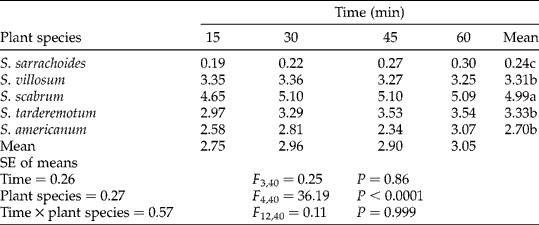
Mean values with the same letter within a column are not significantly different (Tukey's HSD test; α = 0.05).
Correlation between distances covered (cm) by Tetranychus evansi females and trichome density (trichomes/mm2) in Solanum species. △, S. sarrachoides; +, S. scabrum; ×, S. tarderemotum; ⋄, S. villosum

Discussion
The results of this study demonstrate that nightshade species may differentially influence T. evansi reproduction and movement on the leaf surface. Mite fecundity and distance travelled were negatively correlated with densities of glandular trichomes (types T, W), suggesting that resistance by the African nightshade species to T. evansi is associated with the plant's morphology. This concurs with Rasmy (Reference Rasmy1985) who reported that high densities of glandular trichomes deterred the oviposition of T. urticae on Lycopersicon hirsutum var. glabratum C.H. Mull, and on S. sarrachoides compared with the cultivated tomato L. esculentum. In addition, Maluf et al. (Reference Maluf, Inoue, Ferreira, Gomes, Castro and Cardoso2007) reported that higher densities of glandular trichomes decreased distances walked by mites onto the leaf surface of interspecific crosses of Lycopersicon spp. Recently, Alba et al. (Reference Alba, Montserrat and Fernández-Muñoz2009) also found an association between glandular trichomes of a population of recombinant inbred lines of tomato species and two-spotted spider mite resistance.
Reports on the role of non-glandular trichomes in resistance to arthropods are rare (Simmons and Gurr, Reference Simmons and Gurr2005). In this study, we found that the density of non-glandular trichomes (types X, Y) associated with S. scabrum, S. villosum and S. tarderemotum was not significantly correlated with the movement and fecundity of T. evansi. Previous research has reported a positive effect of non-glandular trichomes (type V) on the larval survival of T. evansi in L. esculentum var. ‘Money Maker’ (Wosula et al., Reference Wosula, Knapp and Agong2009) and also a positive correlation between type V trichomes and larval survival of the potato tuber moth Phthorimaea operculella (Zeller), in L. hirsutum (Gurr and McGrath, Reference Gurr and McGrath2002). However, Simmons and Gurr (Reference Simmons and Gurr2005) reported that this finding could possibly be an artefact, since plants with a high density of these non-glandular trichomes typically have a lower density of glandular trichomes (types IV and VI) and vice versa. Coincidentally, in our study, we found that S. sarrachoides had a high density of glandular trichomes but lacked non-glandular trichomes. Likewise, S. scabrum, S. villosum and S. tarderemotum lacked or had lower densities of glandular trichomes but higher densities of non-glandular trichomes. Contrary to these reports, experiments with beach strawberry cultivars Fragaria chiloensis L. (Mill.) (Rosaceae) revealed a negative correlation between non-glandular trichome densities and resistance against T. urticae (Luczynski et al., Reference Luczynski, Isman, Raworth and Chan1990). The authors also reported a decrease in the number of eggs laid by T. urticae with an increase in the density of non-glandular trichomes.
Although some pests prefer hairy surfaces for oviposition, previous studies have reported a lower resistance to spider mites in glabrous leaves of petunia ecotypes (Griesbach et al., Reference Griesbach, Neal and Bentz2002; Simmons and Gurr, Reference Simmons and Gurr2005). In the present study, S. americanum, which is completely glabrous, compared favourably with S. scabrum, S. villosum and S. tarderemotum, which had a rather low density of trichomes, in relation to mite movement and fecundity. Mites walked freely on the leaf surface and oviposition was high, suggesting that S. americanum has a lower level of resistance to spider mite damage similar to those that had non-glandular hairs.
Conclusion
Results of the present study suggest that glandular trichome density may form a basis for the selection of African nightshade genotypes with higher resistance to spider mites. Since this study was conducted under laboratory conditions, further research is required to establish whether these African nightshade species affect reproduction and movement of mites when grown under greenhouse and field conditions. Furthermore, an evaluation of the effect of trichome chemistry on the plant–arthropod interaction as well as the organoleptic properties of these African nightshade species for consumer satisfaction is recommended.
Acknowledgements
This study was funded by a grant from the German Academic Exchange Service (DAAD) to the JKUAT. We thank the World Vegetables Center (AVRDC, Tanzania) for providing four lines of the African nightshade species. Also, we thank the Gene Bank of Kenya for providing the seeds of S. sarrachoides.