Weed control is a major consideration in agronomic crops, including wheat. In the United States, Italian ryegrass [Lolium perenne L. ssp multiflorum (Lam.) Husnot] is a major weed problem in winter wheat (Liu et al. Reference Liu, Hulting and Mallory-Smith2016). Controlling Italian ryegrass is difficult because it has developed resistance to several classes of herbicides, including acetyl CoA carboxylase (ACCase) (Ellis et al. Reference Ellis, Steckel, Main, de Melo, West and Mueller2010) and acetolactate synthase (ALS) (Chandi et al. Reference Chandi, York, Jordan and Beam2011). New control strategies including alternate modes of action would be beneficial to producers.
Pyroxasulfone is an herbicide with a new mode of action to help control Italian ryegrass and other weedy species in wheat (Lawrence and Burke Reference Lawrence and Burke2014). Pyroxasulfone is a group 15 herbicide, and its mode of action involves reducing the biosynthesis of very long chain fatty acids (Tanetani et al. Reference Tanetani, Kaku, Kawai, Fujioka and Shimizu2009). Italian ryegrass control following pyroxasulfone PRE application ranged from 65% to 100% in a study in Oregon (Hulting et al. Reference Hulting, Dauer, Hinds-Cook, Curtis, Koepke-Hill and Mallory-Smith2012). The authors reported that pyroxasulfone applied at the application rates and timings in the studies had a high level of activity against Italian ryegrass and excellent winter wheat safety. Control of rigid ryegrass (Lolium rigidum Gaudin), a taxonomic relative to Italian ryegrass, was examined in Australia. Walsh et al. (Reference Walsh, Fowler, Crowe, Ambe and Powels2011) reported that pyroxasulfone provided effective control of ACCase-resistant and susceptible rigid ryegrass populations when applied PRE. In the rates used in that study, pyroxasulfone application had little or no effect on the growth and survival of wheat. Boutsalis et al. (Reference Boutsalis, Gill and Preston2014) reported that pyroxasulfone achieved 98% control of rigid ryegrass when applied PRE. Their research demonstrated that PRE applications of pyroxasulfone can be safely and effectively used to control rigid ryegrass in no-till wheat, although related research showed that carrier volume may need to be increased to realize the full effectiveness of this application (Borger et al. Reference Borger, Riethmuller, Ashworth, Minkey, Hasheem and Powles2013).
Pyroxasulfone may also have potential as a post-harvest treatment to reduce seed bank inputs of Palmer amaranth (Amaranthus palmeri S. Wats.) after summer annual crops (Crow et al. Reference Crow, Steckel, Hayes and Mueller2015). This use may disallow wheat sowing in the same fall if pyroxasulfone persistence is evident. Pyroxasulfone could also potentially be used in some areas in a November application timing to reduce ryegrass growth the following spring, because ryegrass is also problematic in some summer annual cropping systems (Bond et al. Reference Bond, Eubank, Bond, Golden and Edwards2014). However, this application timing may result in chemical runoff over the wet period in some situations. Also, cooler temperatures over the winter may reduce herbicide dissipation.
Limited information is available on the behavior of pyroxasulfone applied in the cooler fall period. Pyroxasulfone dissipation expressed as half-life values varied from 39 to 134 d, and the dissipation was strongly affected by soil moisture conditions in a Colorado study (Westra et al. Reference Westra, Shaner, Westra and Chapman2014). That research was in a summer annual crop production system, indicating soil temperatures were high and soil moisture contents were low, with reduced water slowing pyroxasulfone dissipation. Field studies conducted in Tennessee showed pyroxasulfone half-life in a summer cropping system to be variable over a two-year period, with the first year (wet soil conditions) half-life being 8 d and the second year (dry soil conditions) half-life being >71 days (Mueller and Steckel Reference Mueller and Steckel2011). Soil moisture affected pyroxasulfone dissipation in the field, with slower dissipation associated with dry soil conditions.
Pyroxasulfone was developed by the Kumiai-Ishihara Chemical Company and has the same active ingredient currently marketed by three different companies in the United States. Pyroxasulfone is marketed as a single component active ingredient in an 85% dry flowable (Anonymous 2017c), another dry flowable combination formulation of pyroxasulfone plus flumioxazin (Anonymous 2017b), and a liquid SC formulation of pyroxasulfone plus carfentrazone (Anonymous 2017a). The liquid formulation is a suspo-emulsion. The use labels reflect differences in ideas about potential for wheat injury from these products, but time before application, soil moisture and temperature, and varietal sensitivity all could influence crop response and weed control. There are no published comparisons of the three different formulations and their behavior in soil in the same field.
The objectives of this study were 1) to determine the persistence of pyroxasulfone under field conditions in a winter wheat production system, and 2) to examine the effect of the different formulations on pyroxasulfone dissipation under Tennessee winter field conditions.
Materials and Methods
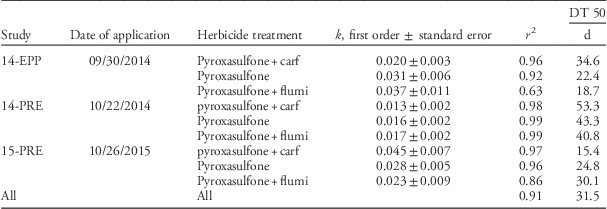
Field studies were established in Knoxville, Tennessee in the falls of 2014 and 2015. The soil was a Sequatchie loam (fine loamy, silicious, thermic Humic Hapludult) with an organic matter content of 1.8% and pH of 6.2. The field sites were tilled prior to study establishment to bury plant residue and facilitate later soil sampling. The study in 2014 consisted of an early preplant application applied 21 days before planting (14-EPP), and then a pre-emergent application on the day of planting (14-PRE) (Table 1). The 2015 study (15-PRE) consisted only of a pre-application applied immediately after wheat planting. Wheat (‘Pioneer 26R22’) was drilled into 18-cm-wide rows to a depth of 2.5 cm at a density of 70 kg ha−1. Agronomic production practices, including fertility and other management, were typical for the area (Main et al. Reference Main, Newman, Stewart and Steckel2008). Each individual plot was 3- by 10-m and was arranged using a randomized complete block design with four replications. The target dose of pyroxasulfone for all treatments was 100 g ai ha−1, which was applied using a handheld boom equipped with six flat-fan nozzles delivering 190 L ha−1. Soil samples were collected from the 0- to 8-cm depth at approximately weekly intervals after each application for approximately 60 d, and then another sample was taken the following spring using methods previously described (Mueller and Senseman Reference Mueller and Senseman2015). Two soil samples (10-cm diam) were collected from each of the four replicates. The two soil cores from each plot were composited in a plastic bag at the field site. Once collected in the field, all samples were immediately stored in freezers (−20 C) for later analysis. Each reported measurement is the mean of four separate data points.
Descriptors of field studies of pyroxasulfone applied to soil in a wheat field in Knoxville, TN. Study codes indicate the year that the study was initiated and application timing relative to wheat planting. Full descriptions of herbicide treatments in text.Footnote a
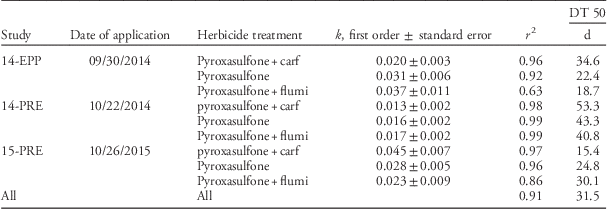
a Abbreviations: EPP, early preplant; PRE, preplant; carf, carfentrazone; flumi, flumioxazin; DT 50, half-life; d, days.
The pyroxasulfone concentration was determined in each soil sample as previously described (Mueller and Steckel Reference Mueller and Steckel2011). Each soil sample was allowed to thaw and come to room temperature and was thoroughly mechanically mixed and homogenized. Then 40 g wet soil was placed in a 250 ml Nalgene low-density polyethylene bottle (all reagents and lab supplies available from Thermo Fisher Scientific, Atlanta, GA). Methanol (80 ml) was added to each bottle and the mixture was placed on a reciprocating shaker for 2 h. Samples were removed from the shaker and allowed to statically equilibrate for 10 min, then an aliquot of the extract was filtered (Fisherbrand 25-mm syringe filters, 0.45 μm polytetrafluoroethylene (PTFE), nonsterile, cat no. 09-730-21) directly into a 2.0 ml liquid chromatography mass spectrometry (LCMS)-certified vial. Pyroxasulfone concentrations were determined using an external standard technique (analytical pyroxasulfone courtesy of Kumiai-Ishihara Chemical Company, Ikenohata, Japan) with the standard curve of 0.1, 1, 10, and 100 mg kg−1. The lower limit of detection in soil using these procedures was 0.5 mg kg−1. Mass spectrometry parameters were previously described (Mueller and Steckel Reference Mueller and Steckel2011).
Environmental data were collected using a permanent weather station located 150 m from the field plots (Watchdog 2000, Spectrum Technologies, Inc., Aurora, IL). The unit recorded temperature, rainfall, relative humidity, wind speed, and wind direction hourly. Data were collected and entered into an Excel spreadsheet, which was used to calculate average daily temperature and weekly rainfall amounts, both referenced to the first herbicide application of that year.
Based on preliminary studies, pyroxasulfone recovery from the soil was 92%±4% (data not shown) and concentrations were corrected for recovery and for antecedent soil moisture status. The data were analyzed by location and by herbicide treatment. Means were calculated for each sampling event and presented as a mean ± SE in the attached figures. The first order regression equation
 $$f\, {\equals}\, a{\asterisk}\,{\rm exp}\,\left( {{\minus}b{\asterisk}k} \right)$$
was used to regress the pyroxasulfone concentration against time (days after treatment [DAT]). The first-order rate constant, k, indicates the rapidity of the pyroxasulfone loss from the soil, and values are shown on Table 1. Each first-order rate constant was used to calculate a half-life expressed as a DT 50 by the relationship of 0.693/k=DT 50. In general, the first order equation fit the observed data well (r 2=0.63 to 0.99, with mean =0.91). For discussion purposes, half-lives were compared and averaged over the three formulations and over the three experiments. For ease of discussion, the term DT 50 is being used as a synonym for half-life, although some readers view these as distinct and separate ideas.
Results and Discussion
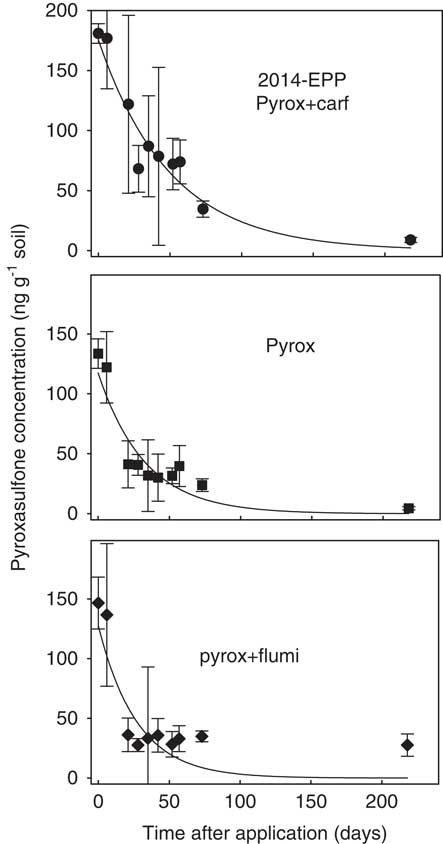
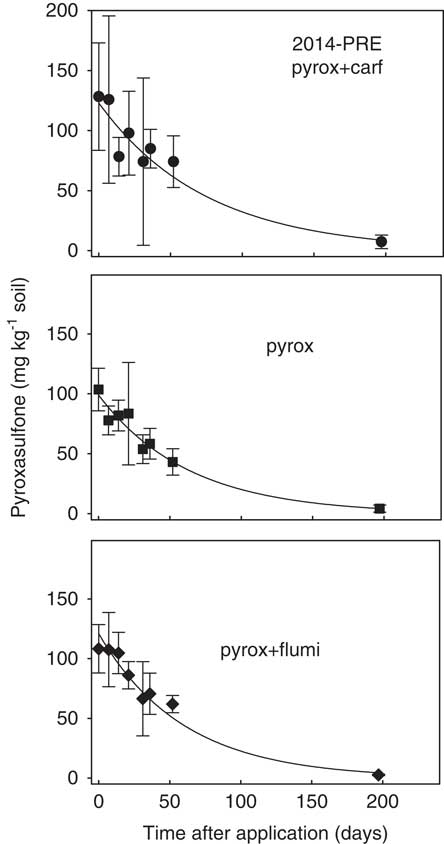
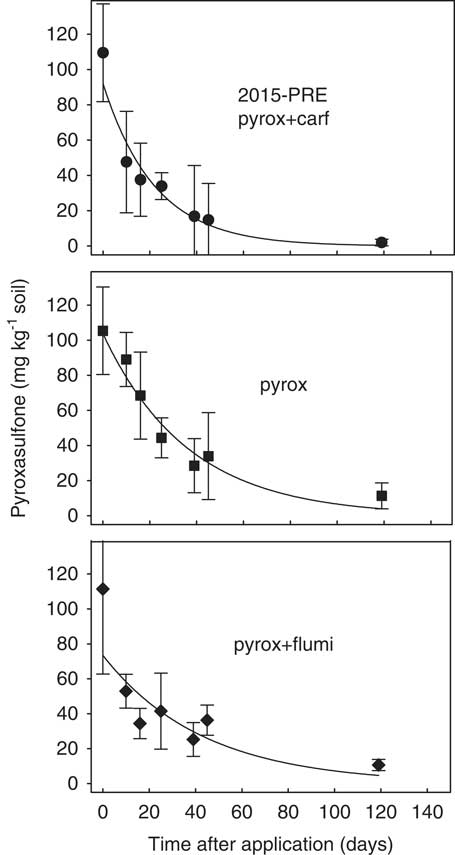
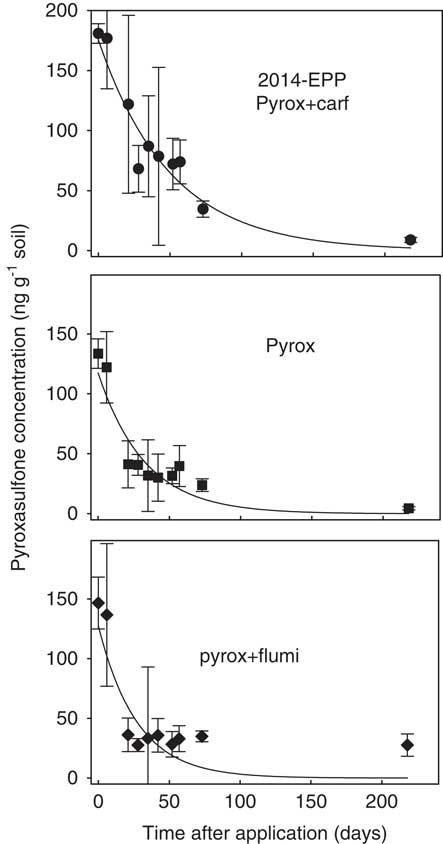
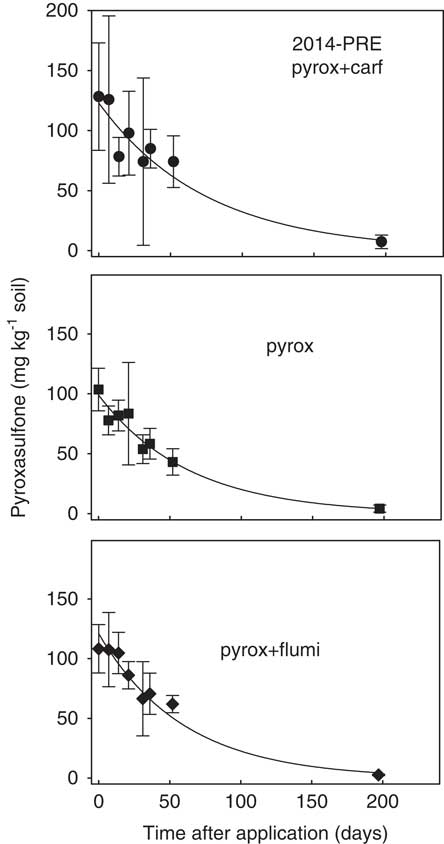
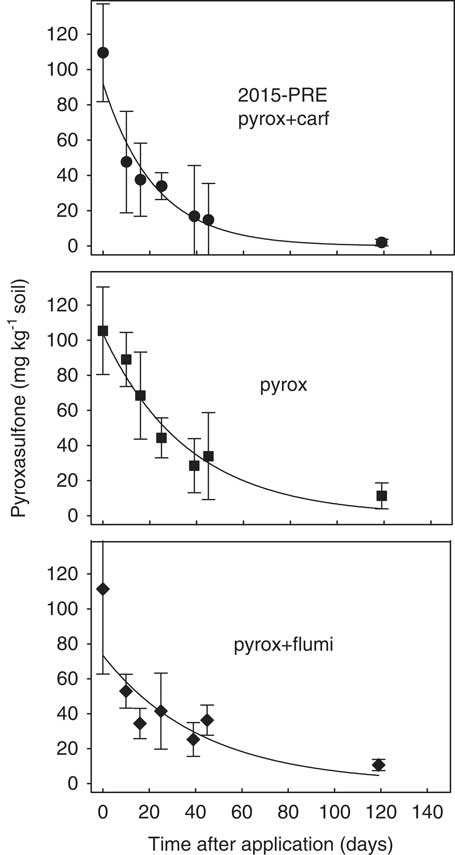
Pyroxasulfone was detected at levels above the limit of detection of 0.5 mg kg−1 soil in all soil samples. Pyroxasulfone DT 50 values within an experiment were similar, but were variable in the different studies (Table 1). Pyroxasulfone DT 50 values in all studies ranged from a low of 15.4 d to a high of 53.3 d across all studies. Pyroxasulfone dissipation in 14-EPP followed first-order kinetics, and the average half-life was 25.3 d (Figure 1). Pyroxasulfone dissipation in 14-PRE was slower, with all half-lives greater than 40 d (Figure 2). Pyroxasulfone dissipation in 15-PRE was more rapid and indicated a possible formulation affect in this study (Figure 3). When averaged across the three studies, the DT 50 values were 34.4, 30.2, and 29.9 d for pyroxasulfone plus carfentrazone, pyroxasulfone, and pyroxasulfone plus flumioxazin, respectively. These trends would indicate that formulation had little or no effect on pyroxasulfone dissipation in this experiment. The differences among the studies however, indicate that environmental factors impact pyroxasulfone dissipation.
Pyroxasulfone dissipation in a 2014 field study (14-EPP) in Knoxville, TN, in an early preplant application. Each data point represents the mean of four measurements ±1 SE for each commercially available formulation. Abbreviations: carf, carfentrazone; flumi, flumioxazin; pyrox, pyroxasulfone.
Pyroxasulfone dissipation in a 2014 field study (14-PRE) in Knoxville, TN, following PRE application. Each data point represents the mean of four measurements ±1SE for each commercially available formulation. Abbreviations: carf, carfentrazone; flumi, flumioxazin; pyrox, pyroxasulfone.
Pyroxasulfone dissipation in a 2015 field study (15-PRE) in Knoxville, TN, following a PRE application. Each data point represents the mean of four measurements±1 SE for each commercially available formulation. Abbreviations: carf, carfentrazone; flumi, flumioxazin; pyrox, pyroxasulfone.
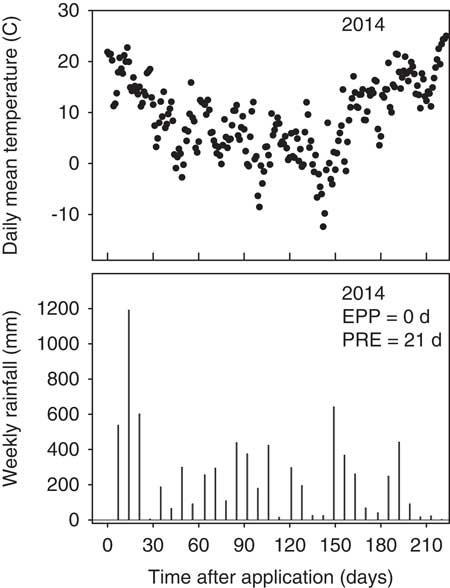
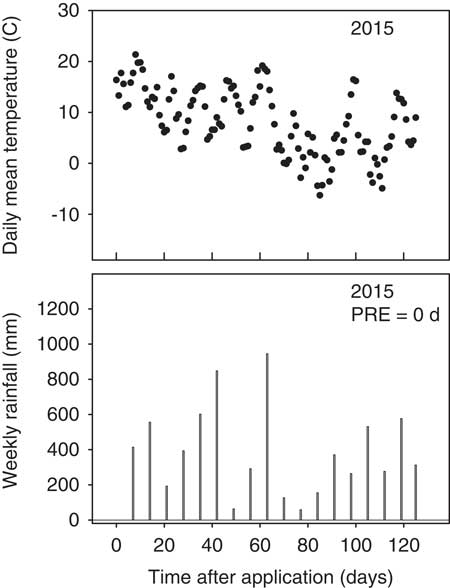
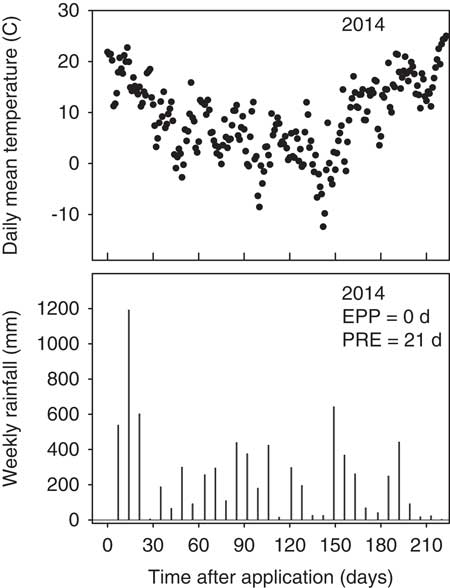
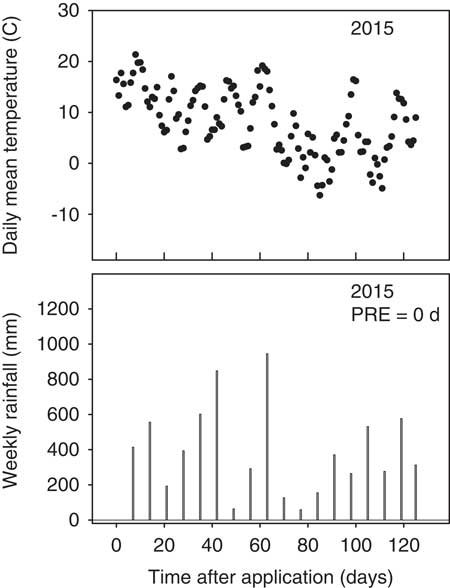
Previous research indicated a strong linkage between environmental conditions and pyroxasulfone dissipation (Mueller and Steckel Reference Mueller and Steckel2011; Westra et al. Reference Westra, Shaner, Westra and Chapman2014). Pyroxasulfone dissipation in our study was similar in two of three studies (14-EPP and 15-PRE) and dissimilar in the other study (14-PRE). This is attributed to warmer temperatures in the first 21 d of the sampling interval in the 14-EPP study (mean, 17.6 C; Figure 4) and 15-PRE (mean, 15.2 C; Figure 5) compared to the sampling interval in the 14-PRE study (6.9 C; Figure 4). Soil temperature would appear to be the main driving force in the differences between these studies, because soil moisture was adequate to excessive throughout the sampling interval in all studies (Figures 4 and 5). However, another big difference between the 14-EPP and 14-PRE studies was a major rainfall event between application of the EPP and PRE. This rainfall event may have moved pyroxasulfone out of the 0- to 8-cm soil zone, and thus below our sampling area. There was not a major rainfall event like this one after the PRE application. So the difference in 2014 could have been due to differences in the rainfall pattern as well as differences in temperature.
Daily mean temperature and weekly rainfall at field location in 2014 for studies 14-EPP and 14-PRE, with data referenced to DAT 0 for 14-EPP study.
Daily mean temperature and weekly rainfall at field location in 2015 for studies 15-PRE, with data referenced to DAT 0 for 15-PRE study.
With a half-life of approximately 30 d, pyroxasulfone would be anticipated to provide residual control of late-fall-emerging Italian ryegrass and other weedy plants in the wheat field environment. Samples taken the following spring indicated minimal pyroxasulfone residues (range of 2.0 to 27.6 mg kg−1, with a mean overall of 8.4 mg kg−1), which would not be expected to cause injury to rotational crops planted after wheat in the mid-south region (Figures 1–3). Cropping patterns in other geographies that have highly sensitive rotational crops, such as sugar beets, may have potential carry-over under some scenarios. There was no apparent difference between the three formulations of pyroxasulfone examined in the study. As expected, there was more rapid herbicide loss in warmer and moist soil environments.
Acknowledgments
Technical support by staff of the University of Tennessee Institute of Agriculture, including Joe Beeler, David Kincer, Dennis Edralin, Stephen Nassan, and Anna Ekene Davis Tharpe, is gratefully acknowledged. Materials provided by FMC, BASF, and Valent USA were used to conduct this research. This research was funded by the Tennessee Agricultural Experiment Station.