Introduction
Multiple mating, especially polyandry, is common in tephritids and refractory periods for females have been reported in the range of one day to four weeks, whereas males are generally found to be able to mate daily for several days or maintain the ability to mate for several weeks (Tychsen & Fletcher, Reference Tychsen and Fletcher1971; Fletcher & Giannakakis, Reference Fletcher and Giannakakis1973; Fay & Meats, Reference Fay and Meats1983; Prokopy & Roitberg, Reference Prokopy and Roitberg1984; Robacker et al., Reference Robacker, Ingle and Hart1985; Kuba & Itô, Reference Kuba and Itô1993; Landolt, Reference Landolt1994; Meats & Fay, Reference Meats and Fay2000; Kraaijeveld et al., Reference Kraaijeveld, Katsoyannos, Stavrinides, Kouloussis and Chapman2005; Radhakrishnan & Taylor, Reference Radhakrishnan and Taylor2007, Reference Radhakrishnan and Taylor2008).
The fitness consequences of multiple mating have been extensively reviewed (Ridley, Reference Ridley1988; Birkhead & Møller, Reference Birkhead and Møller1998; Arnqvist & Nilsson, Reference Arnqvist and Nilsson2000). For tephritid fruit flies, it is possible that repeated mating can shorten the lifespan of females, but this may be offset by increased fecundity (Chapman et al., Reference Chapman, Miyatake, Smith and Partridge1998).
Much research on multiple mating of tephritid females has focussed on the means by which male ejaculate inhibits remating during the refractory period (Fletcher & Giannakakis Reference Fletcher and Giannakakis1973; Kuba & Itô, Reference Kuba and Itô1993; Mossinson & Yuval, Reference Mossinson and Yuval2003; Kraaijeveld & Chapman, Reference Kraaijeveld and Chapman2004; Harmer et al., Reference Harmer, Radhakrishnan and Taylor2006; Radhakrishnan & Taylor, Reference Radhakrishnan and Taylor2007, Reference Radhakrishnan and Taylor2008). Other factors that affect the length of the refractory period and remating frequency include density, biased sex ratio and long-term adaptation to crowded culture conditions (Robinson et al., Reference Robinson, Cayol and Hendrichs2002; Vera et al., Reference Vera, Wood, Cladera and Gilburn2002; Kraaijeveld et al., Reference Kraaijeveld, Katsoyannos, Stavrinides, Kouloussis and Chapman2005). Notwithstanding the fact that many tephritids in the field can form mating aggregations (Tychsen, Reference Tychsen1977; Sivinski, 1984; Arita & Kaneshiro, Reference Arita and Kaneshiro1989; Prokopy et al., Reference Prokopy, Poramarcom, Sutantawong, Dokmaihom and Hendrichs1996), the high densities in some laboratory cultures can be as artificial as those used in the technique of ‘forced mating’ that is used to produce unusual events, such as interspecific hybrids (Takai et al., Reference Takai, Kanda, Oguma, Cheong, Joesoef and Sucharit1984; Taylor & Craig, Reference Taylor and Craig1985; Ye et al., Reference Ye, Xu, Huang and Zhao1992; Pike & Meats, Reference Pike and Meats2002). Thus, different laboratory protocols can yield different results on multiple mating, even for the same species. It would be desirable to use conditions of density and sex ratio similar to those found in the field; and, indeed, multiple mating can be detected in the field by finding DNA microsatellite evidence for polyandry (Tripet et al., Reference Tripet, Touré, Dolo and Lanzaro2003; Kraaijeveld et al., Reference Kraaijeveld, Katsoyannos, Stavrinides, Kouloussis and Chapman2005; Song et al., Reference Song, Drew and Hughes2007). However, this does not give precise evidence of the numbers of matings per female and cannot provide any on refractory period.
This paper describes research that used conditions that reduced any potential for forced mating to a minimum because flies were caged in male-female pairs in 20×20×20 cm cages, and each pair was observed daily during the normal dusk mating period until the female died. Thus, polyandry was not possible unless a male that died was replaced. Two species studied were Bactrocera cucumis (French) and Bactrocera cacuminata (Hering). The former is a serious pest of commercial cucurbits in Queensland; whereas the latter is widespread along the entire Australian eastern seaboard; and, although it is not a pest, it has some potential to be one because it can be cultured in a variety of commercial fruits (Fitt, Reference Fitt1986; Drew, Reference Drew1989).
Materials and methods
Study insects
B. cucumis were obtained from a laboratory colony approximately ten generations old and held at the ICMPFF laboratories, Griffith University, Brisbane. Laboratory colonies were maintained accord to the methods of Swaine et al. (Reference Swaine, Corcoran and Davey1978), with about 6–8 weeks elapsing between generations. B. cacuminata were reared from infested fruits of its major host plant, Solanum mauritianum Scopoli, that were collected from the field at Mt Gravatt, Brisbane.
All flies were reared, and the experiments conducted, under constant environmental conditions of 25°C (±1°C), 60–70% relative humidity and a photoperiod of 9 h:15 h, light:dark cycle with a natural dusk from a window occurring at the start of the dark phase. Under these conditions, fly mating activity occurred under dusk illumination between 1730 to 1930 hours. Flies for the experiments were allowed to emerge from puparia within 30×30×30 cm stock cages, enclosed with a fine synthetic mesh, immediately separated into sexes in separate cages and then provided with a diet of sugar, yeast protein (MP Biomedicals LLC enzymatic yeast hydrolysate) and water.
Mating study
For B. cucumis, mating observations were conducted on 62 pairs of virgin flies combined at three days after emergence from puparia. Each pair was confined in a cage (20×20×30 cm) and provided with the same diet as in the stock cages of emerged males and females noted above. Over time, males that died were replaced with males from the same cohort that had also been held with a single female under the same environmental conditions. Females that died were not replaced. Each pair of flies was monitored daily during the dusk phase and records made of mating pairs. These observations were conducted using a dull red torch light in order not to disturb mating pairs. Observations continued for 274 days. It was not possible to systematically record courtship activity because of the number of pairs and the poor light.
For B. cacuminata, two sets of observations were conducted along similar lines to those above. In the first case, 22-day-old virgin males and females were combined in 35 single pairs in separate cages. Observations continued until the last female died at 134 days. In the second case, all procedures were identical except that 45 pairs of virgin flies were set up when the flies were seven days old.
Statistical analyses
Statistical analyses established the significance (P) and predictive power (percentage of variance explained, 100 r 2) of various correlations. These correlations were: (i) between the number of matings and age of death; (ii) the delay between the first and second mating, and the second and third mating; (iii) the delay between the first and second, and the third and fourth mating; (iv) the delay between the second and third, and the third and fourth mating; and (v) the delay between the age of first mating and each of the aforementioned delays. Significance was defined in relation to a critical P of α=0.05 that was subjected to Dunn-Sidâk's adjustment to α′, where α′=1−(1−α)1/n and n=the number of comparisons in the analysed group (Sokal & Rohlf, Reference Sokal and Rohlf1995).
Comparison was also made between the distribution of number of matings per female and that expected by chance from the binomial distribution. When a fly can mate no more than once per fortnight, the binomial probability of mating r times in n fortnights is:

where r(i) is a number from zero to n inclusive, q=1−p, and ΣW r(i)=1.
The number of flies expected to mate 0, 1 … n times was found by multiplying the pertinent value of W r by the number of flies starting a trial.
Results
Survival and mating in B. cucumis
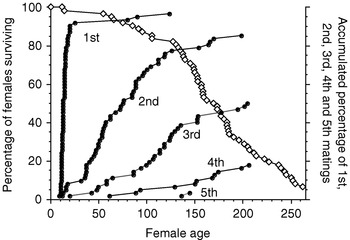
Sixty of the 62 pairs of B. cucumis that were caged together at three days old mated at least once and, of these 60, 53 pairs (88%) mated twice, 31 pairs (52%) mated three times, 11 pairs (18%) mated four times and 2 pairs (3%) mated five times. The mean refractory period between matings was remarkably constant but the standard deviations were wide; the means (±SE) in days were, respectively, 59±40.4, 60.6±29.4 and 63.0±17.0. This was associated with a wide asynchrony in mating times with a great deal of variation between pairs in terms of the number of matings achieved by a given age (fig. 1).
Percentage of female B. cucumis (white symbols) surviving and (black symbols) accumulated percentages of first, second and subsequent matings.

B. cucumis females lived up to 274 days (mean 171±7.5 SE). There was a significant relationship between the number of matings and the time of female death (P=0.005; n=58), indicating that the longer-lived flies had mated more often. The correlation explained 13% of the variance.
Relation of periods between successive matings in B. cucumis
The times (refractory periods) between the first and second matings in B. cucumis and the times between the second and third matings were significantly correlated if treated as a single comparison but not in terms of the Dunn-Sidâk adjusted level of significance (α′) for multiple comparisons, (P=0.04, α′=0.017; n=31). The correlation accounted for 14% of the variance. The times between the first and second, and the third and fourth matings were not correlated (P=0.64; n=11, accounting for 2.4% of variance) and neither were the times between the second and third, and the third and fourth mating (P=0.36; n=31, accounting for 9.4% of the variance).
There was no correlation between age of first mating in B. cucumis and the time between the first and second mating or the third and fourth mating (P=0.46; n=53 and 0.56; n=31, respectively).
Survival and mating in B. cacuminata
For B. cacuminata, 23 of the 35 pairs caged together at 22 days old mated once and, of these 23, 17 pairs (74%) mated twice and 5 pairs (22%) mated three times. Similarly, 27 of the 45 pairs caged together at seven days old mated once and of these 27, 15 pairs (56%) mated twice and 4 pairs (15%) mated three times. The mean refractory periods were lower than the values found for B. cucumis, being about 27–39 days with SEs ranging from 6.3–14.6.
B. cacuminata females caged together at 22 days old lived for a maximum of 134 days (mean 92 days±4.5 SE) and those caged together at seven days lived a maximum of 130 days (mean 86 days±5.2 SE). There was no significant difference between these two means (t=0.84, df=78, P(two-tailed)=0.4). The correlation between lifespan and the number of matings in B. cacuminata that mated was significant (P=<0.001, n=50), indicating that the longer-lived flies tended to mate more often, and this relationship accounted for 40% of the variance.
The correlations between the time of first mating in B. cacuminata and the time between the first and second matings, and second and third were not significant (P=0.95; n=32 and P=0.65; n=9, respectively). Likewise, the correlation between the time between the first and second matings, and the second and third was not significant (P=0.66; n=9).
Mating, chance and the expectation from the binomial model
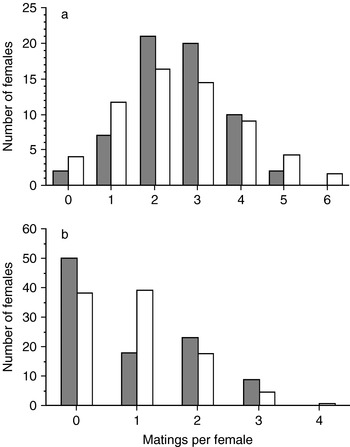
For B. cucumis, the relationship between the distribution of matings per female and the binomial expectation is shown in fig. 2a. There were 62 B. cucumis females in the study, and a total of 159 matings were recorded in the 20 fortnights of observation; thus, the binomial probability of observing a mating by a given female in a given fortnight was 159/20/62=0.1282. The distribution of matings per female expected over the whole period according to this probability and the number of periods is compared to the observed frequencies in fig. 2. The two distributions do not deviate significantly (χ2=9.21, P=0.101, df=5).
The distribution of frequency of matings per female in (a) B. cucumis and (b) B. cacuminata compared to the binomial expectation ( , observed; □, binominal expectation).

For B. cacuminata, the relationship between the distribution of matings per female and the binomial expectation is shown in fig. 2b. The binomial probability for this species (following the procedure outlined above) was calculated as 91/8/100=0.11375. In this case, the two distributions are significantly different (χ2=21.1, P<0.001, df=3). Because the result could have been influenced by the large proportion of non-maters, a comparison was made using only the numbers of B. cacuminata females that mated more than once. In this case, 18 females mated once only (thus, mated zero times more than once), 23 mated once more than once and 9, and zero mated twice and three times more that once, respectively. The binomial probability (deducting a fortnight for the first mating period) was calculated as 41/7/50=0.1171. The binomial expectations using this probability did not differ significantly from the observed values (χ2=3.56, P=0.313, df=3).
Discussion
Multiple mating and survival
A high percentage of females of both B. cacuminata and B. cucumis mated at least twice and in all experiments. The refractory period for B. cacuminata exceeded that recorded for B. tryoni by Fletcher & Giannakakis (Reference Fletcher and Giannakakis1973) while that for B. cucumis was twice as long. The demonstrated multiple mating in monogamous pairs would suggest a potential for polyandry in the field. This has been borne out for one of our study species by Song et al. (Reference Song, Drew and Hughes2007) who found, through molecular examination of the progeny of wild B. cacuminata females, that they mated with at least two males. The higher number of matings per female in B. cucumis was associated with their long life spans. The maximum was 274 days compared to 134 days for B. cacuminata in this study and 140 days recorded in laboratory conditions for B. tryoni by both Drew et al. (Reference Drew, Courtice and Teakle1983) and Meats (Reference Meats2006). The difference in the degree of multiple mating between B. cucumis and B. cacuminata is most likely due to the greater opportunity for mating in the former afforded by its longer lifespan. Within species, female insects generally gain fitness benefits from mating frequently (generally polyandrously) but this may not be manifested in increased longevity (Arnqvist & Nilsson, Reference Arnqvist and Nilsson2000; Ivy & Sakaluk, Reference Ivy and Sakaluk2005; Gershman, Reference Gershman2007; Seslija et al., Reference Seslija, Marecko and Tucic2008).
The role of chance in individual pairings
The very weak or non-significant relationships between the intervals between matings in individual B. cucumis mating pairs are consistent with the distribution of matings among pairs being not significantly different to that expected by chance. However, the distribution of the number of matings among females in B. cacuminata was non-random, despite non-significant relationships between the intervals between matings. In this case, the cause appears to be the unexpectedly high proportion of non-maters (50%) because, when the distribution of mating frequencies of females mating more than once are considered, there is no significant departure from random expectation.
The importance of null models (such as the Poisson) to the analysis of mating data has been recognised by several authors because what appears to be governed by sexual selection or other biotic influences may also be explained as the outcome of random processes (Sutherland, Reference Sutherland1985; Bradbury & Andersson,Reference Bradbury and Andersson1987; Hartley & Shepherd, Reference Hartley and Shepherd1995; Friedl & Klump, Reference Friedl and Klump2005; Snyder & Gowaty, Reference Snyder and Gowaty2007). Meats & Fay (Reference Meats and Fay2000) established that matings per male in B. tryoni were consistent with a random model, whereas Focardi & Tinelli (Reference Focardi and Tinelli1996) found that a model of behaviour in leks governed by random processes not only produced results usually consistent with random expectation but occasionally produced results that were not.
The SIT and female refractory periods
The SIT, or the control of a pest by the mass release of conspecific sterile males, relies on the ability of the sterile males to mate with wild females and cause sterility of any eggs and, failing that, to impose as long a refractory period as possible. However, remating frequency may be increased by crowding, biased sex ratio and long-term adaptation to crowded laboratory culture (Robinson et al., Reference Robinson, Cayol and Hendrichs2002; Vera et al., Reference Vera, Wood, Cladera and Gilburn2002; Kraaijeveld et al., Reference Kraaijeveld, Katsoyannos, Stavrinides, Kouloussis and Chapman2005). Thus, adaptation to mass rearing can decrease the refractory period of females, although whether this is solely due to a deficiency in sterile males is not certain. For example, Radhakrishnan & Taylor (Reference Radhakrishnan and Taylor2007) using B. tryoni from an SIT factory found about 15% of females remated within one day rather than the period of four weeks reported by Fletcher & Giannakakis (Reference Fletcher and Giannakakis1973). Kraaijeveld et al. (Reference Kraaijeveld, Katsoyannos, Stavrinides, Kouloussis and Chapman2005) considered that, under such circumstances, polyandry could be a drawback in genetic control programmes. However, it would make no difference to the ratio of sterile males to wild males required as long as the ejaculate of released sterile males was as effective in imposing a refractory period as wild males (Curtis, Reference Curtis1985). An effective sterilizing dose of radiation not only causes dominant lethal mutations in spermatids and spermatozoa (fatal to any fertilized egg) but also prevents the initiation of further spermatogenesis. Thus, depending upon the timing of irradiation, a virgin sterile male will either have no sperm or a limited exhaustible supply (Ashburner, Reference Ashburner1989). For two Bactrocera species examined to date, it is not necessary for sperm to be present in the ejaculate in order for mating to cause a refractory period (Kuba & Itô, Reference Kuba and Itô1993; Harmer et al., Reference Harmer, Radhakrishnan and Taylor2006; Radhakrishnan & Taylor, Reference Radhakrishnan and Taylor2007, Reference Radhakrishnan and Taylor2008). If the ejaculate of the sterile males does not cause such a long female refractory period as that of wild males, this would have to be rectified by releasing sterile males at a higher rate.
When small production areas of about 1 km across have to be treated with the SIT (e.g. see Barnes, Reference Barnes, Vreysen, Robinson and Hendrichs2007), polyandrous multiple mating of wild females could be advantageous, as it would result in the remating of any that invaded from neighbouring untreated sites, and such females would stand a very high probability of mating with sterile males (Helsinki et al., Reference Helsinki, Hood and Knols2008).