Introduction
Cholesteatoma is defined as hyperplastic keratinised stratified squamous epithelium present in the middle ear and mastoid that has osteoclastic activity and is capable of bone resorption. It involves subepithelial connective tissue (known as the perimatrix) and is characterised by a chronic inflammatory reaction. Osteoclastic activity in the area neighbouring the perimatrix and bone resorption can cause hearing loss, vestibular dysfunction, facial nerve paralysis and (even) lethal intracranial complications. The only treatment option is surgery, and revision surgery may be needed owing to a recurrence rate of up to 15 per cent.Reference Sudhoff, Liebehenz, Aschenbrenner, Jung, Hildmann and Dazert 1 , Reference Choufani, Roper, Delbrouck, Hassid and Gabius 2
The exact pathogenesis of cholesteatoma is unknown, but four different theories have been proposed.Reference Kuo 3 Firstly, the retraction pocket theory states that cholesteatoma formation is caused by retraction of Shrapnell's membrane due to Eustachian tube dysfunction and desquamated keratin accumulation in the retraction pocket. Secondly, the metaplasia theory states that metaplasia of middle-ear epithelium into stratified squamous epithelium may cause cholesteatoma formation. Thirdly, according to the immigration theory, squamous epithelium of the external ear canal migrates into the middle ear through a perforation in the tympanic membrane to cause cholesteatoma formation. Finally, the papillary ingrowth theory states that inflammation-induced basal cell hyperplasia of keratinised epithelium in the Shrapnell's membrane may invade subepithelial tissue in the pars flaccida (Prussak's space) and grow into the middle ear without a need for tympanic membrane perforation.
Several experimental models of cholesteatoma formation have been developed.Reference Ismi and Unal 4 Experimental induction of cholesteatoma by propylene glycol began following the observation that applying topical eye drops containing propylene glycol (Cortisporin®) to the middle ears of chinchillas resulted in epithelial migration and the formation of cholesteatomatous chronic otitis media.Reference Ismi and Unal 4 Administration of a 90 per cent propylene glycol solution to the middle ear results in cholesteatoma formation in up to 100 per cent of experimental animals.Reference Ismi and Unal 4 Several compounds have been used to prevent cholesteatoma formation in experimental models: the application of 5-fluoro-uracil, trans-retinoic acid and intratympanic corticosteroid inhibit cholesteatoma formation in propylene glycol induced otitis media, whereas hyaluronic acid, cyclophosphamide, mitomycin C, systemic corticosteroid and systemic naproxen sodium have no significant effect.Reference Wright, Bird and Meyerhoff 5 – Reference Kayhan and Algun 12
Recently, mesna (sodium 2-mercaptoethanesulfonate; C2H5NaO3S2) has been used in otological surgical procedures such as tympanic membrane lateralisation in atelectatic ears and cholesteatoma matrix dissection from the surrounding bone to decrease the recurrence rate.Reference Yilmaz, Goksu, Bayramoglu and Bayazit 13 , Reference Kalcioglu, Cicek, Bayindir and Ozdamar 14 However, the potential of mesna to inhibit cholesteatoma formation in chronic otitis media has not been investigated. This study aimed to evaluate the effectiveness of this compound against experimental cholesteatoma and thus its clinical potential.
Materials and methods
The study was performed in an animal research laboratory in a tertiary centre using 20 Wistar albino male rats, each weighing 260–400 g.
Animals were first anaesthetised by an intraperitoneal injection of 150 mg/kg ketamine hydrochloride and 25 mg/kg xylazine hydrochloride, and then their external auditory canal and tympanic membranes were examined using a surgical microscope (Möller Allegra 50, Möller-Wedel, Wedel, Germany). The rats were divided into 2 groups of 10: in the control group, the right ear was treated with saline (saline control group; 10 ears) and the left ear was treated with propylene glycol plus saline (propylene glycol control group; 10 ears); and in the mesna group, both ears were treated with propylene glycol plus mesna (20 ears). On days 1, 8 and 15, the saline control group had an intratympanic injection of 0.2 ml saline and the propylene glycol control group and the mesna group were injected with 0.2 ml 100 per cent propylene glycol. Intratympanic injections were performed via the tympanic membrane pars tensa. One week after the last propylene glycol injection (on day 22), a single intratympanic injection of 0.2 ml of a 10 per cent mesna formulation (400 mg Uromitexan, Eczacibasi Drug, İstanbul, Turkey) was administered to the mesna group and a single injection of 0.2 ml isotonic saline solution was administered to the propylene glycol control group; the saline control group was left untreated. At 12 weeks after the last intratympanic injection, animals were killed with an intraperitoneal injection of high-dose xylazine. Temporal bones were dissected and sent for histopathological evaluation.
Approval for animal experimentation was obtained from the local ethics committee.
Histopathological preparations
Temporal bones were fixed in buffered 10 per cent formaldehyde, decalcified in 10 per cent nitric acid and embedded in paraffin. Four-micrometre sections in a transverse plane to the tympanic membrane were then cut from each paraffin block and stained with haematoxylin and eosin.
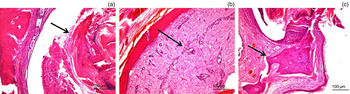
The tympanic membrane, middle-ear mucosa and bulla were assessed by microscopy (Nikon Eclipse E600, Nikon, Tokyo, Japan) for the presence of various predetermined histological features. An expert pathologist blinded to the experimental group evaluated all histopathological specimens. Cholesteatoma was histologically defined as the presence of a tumour comprising non-nucleated keratin scales and a corneal layer comprising stratified squamous epithelium (Figure 1a). Other histomorphological parameters were evaluated, including the presence of granulation tissue (Figure 1b), cyst formation at the bulla, fibrosis and epithelial hyperplasia (Figure 1c).
Photomicrographs showing a histological section of a middle-ear cholesteatoma. (a) The arrow indicates desquamated keratin (H&E; ×100). (b) Arrow indicates granulation tissue in the middle-ear cavity (H&E; ×200). (c) Arrow indicates epithelial hyperplasia in the cholesteatoma (H&E; ×400).

Statistical analysis
Relationship between experimental groups and categorical variables were evaluated by the likelihood ratio values of χ2 tables. If a significant relationship between categorical variables was identified, a two-proportion comparison was performed. Categorical variables were summarised as frequencies and percentages. A frequency chart was drawn for every contingency table. Statistical analysis was performed using IBM SPSS Statistics software version 11.5 (Chicago, Illinois, USA) and MedCalc version 11.5.0 (Soft32; http://medcalc-statistical-software.soft32.com/). A p value smaller than 0.05 was considered statistically significant.
Results
During the study, two rats in the control group and three rats in the mesna group were killed on the recommendation of the institute veterinarian because of their poor health status and the need for long follow-up period (12 weeks).
Cholesteatoma formation
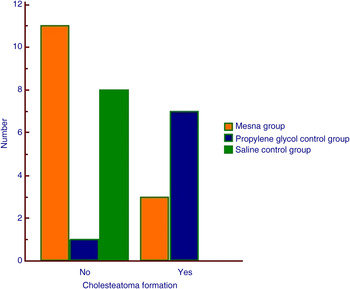
Cholesteatoma formation rates were significantly different among the three groups: saline control group, 0 per cent; propylene glycol control group, 88 per cent; and mesna group, 21 per cent (p < 0.001). The incidence of cholesteatoma formation was significantly greater in the propylene glycol control group than in the mesna (p = 0.01) and saline control (p = 0.002) groups. There was no significant difference in cholesteatoma formation between the mesna and saline control groups (p = 0.446; Figure 2).
Histogram comparing cholesteatoma formation numbers among groups. No = no cholesteatoma formation; yes = cholesteatoma formation

Granulation tissue formation
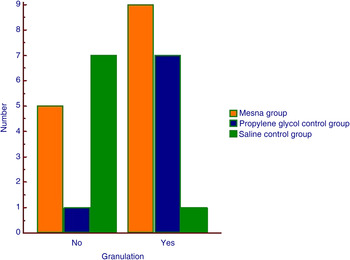
There was a significant difference in granulation tissue formation among all three groups (p = 0.005), but no significant difference between the propylene glycol control and mesna groups (p = 0.498). The incidence of granulation tissue formation was higher in the propylene glycol control group than in the saline control group (p = 0.012; Figure 3).
Histogram comparing granulation tissue formation among groups. No = no cholesteatoma formation; yes = cholesteatoma formation

Cyst formation in the bulla, fibrosis and epithelial hyperplasia
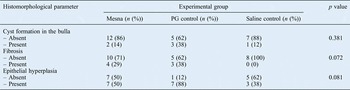
There were no significant differences in cyst formation in the bulla (p = 0.381), fibrosis (p = 0.072) and epithelial hyperplasia (p = 0.081) among groups (Table I).
Cyst formation in the bulla, fibrosis and epithelial hyperplasia: comparison among groups

PG = propylene glycol
Discussion
This study found that administration of a single dose of intratympanic mesna decreased the cholesteatoma formation rate in propylene glycol induced otitis media compared with a saline injection. However, there was no significant difference in the rates of granulation tissue, fibrosis, epithelial hyperplasia and cyst formation. Both ears of animals in the mesna group were treated with propylene glycol plus mesna to allow doubling of the sample size for the study group while using the same number of animals as for controls.
Mesna is a synthetic sulphur compound that contains a sulfhydryl group and belongs to the group of thiol compounds. It acts by breaking disulfide bonds in mucous polypeptide chains, causing mucolysis.Reference Yilmaz, Goksu, Bayramoglu and Bayazit 13 It is mainly used in uro-oncology to prevent toxicity associated with cyclophosphamide chemotherapy; however, its mucolytic action means that it can also be used to treat mucosal diseases of the airway, such as chronic bronchitis, bronchitis with asthma, bronchoconstriction, emphysema, bronchiectasis, rhinitis, chronic pharyngitis and laryngitis as a topical nasal spray and in aerosol formulations.Reference Casale, Di Martino, Salvinelli, Trombetta and Denaro 15 Owing to this action, mesna has also been used during surgery to facilitate tissue dissection, for example, in abdominal myomectomy and lumbar spine surgery.Reference Casale, Di Martino, Salvinelli, Trombetta and Denaro 15 It is also a potent antioxidant drug that acts via its sulfhydryl group to scavenge reactive oxygen metabolites and decrease oxidative stress induced cellular toxicity.Reference Casale, Di Martino, Salvinelli, Trombetta and Denaro 15 , Reference Song, Liu, Li, Liu, Song and Song 16
Following evidence that intratemporal mesna administration has no cochlear ototoxic effects in both experimental and clinical studies,Reference Vincenti, Mondain, Pasanisi, Piazza, Puel and Bacciu 17 – Reference Vincenti, Magnan and Zini 19 the drug began to be used in otological practice. Mesna has been used to aid dissection of the cholesteatoma matrix, which is rich in disulfide bonds.Reference Casale, Di Martino, Salvinelli, Trombetta and Denaro 15 , Reference Vincenti, Mondain, Pasanisi, Piazza, Puel and Bacciu 17 Yilmaz et al. reported that administration of 20 per cent mesna to atelectatic ears is a practical method of detaching the retracted tympanic membrane from the middle-ear mucosa, but did not compare cholesteatoma formation in mesna-treated vs control ears.Reference Yilmaz, Goksu, Bayramoglu and Bayazit 13 Kalcioglu et al. and Vincenti et al. recommended the use of mesna in mastoidectomy surgery to chemically dissect the cholesteatoma matrix from the surrounding bone in patients with chronic otitis media with cholesteatoma, and found lower residual cholesteatoma rates.Reference Kalcioglu, Cicek, Bayindir and Ozdamar 14 , Reference Vincenti, Magnan, Saccardi and Zini 20
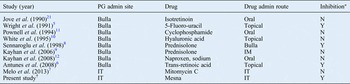
Although several chemical reagents such as talcum powder, dimethylbenzanthracene and latex have been used to induce cholesteatoma formation in experimental models, propylene glycol is the most effective and most widely used agent for this purpose.Reference Ismi and Unal 4 Administration from the bulla to the middle ear behind an intact tympanic membrane can cause hyperplasia of the lamina propria epidermis and connective tissue. If there is ongoing middle-ear inflammation, the hyperplastic epidermis of the tympanic membrane migrates through the intact tympanic membrane, reaches the middle ear, continues proliferating and, after keratinisation, forms the cholesteatoma matrix. According to this papillary ingrowth model, pathogenesis proceeds without retraction pockets or tympanic membrane perforation.Reference Sennaroglu, Ozkul, Gedikoglu and Ergin 8 Although most studies have administered propylene glycol via the bulla, intratympanic administration can induce similar rates of cholesteatoma formation: bulla administration of propylene glycol is reported to cause cholesteatoma formation rates of 0–90 per cent,Reference Wright, Bird and Meyerhoff 5 – Reference Kayhan and Algun 12 while the only previous study to use intratympanic administration reported a rate of 63.6 per cent.Reference Melo, Caldas Neto, Leão and Campos 7 In the present study, cholesteatoma formation was achieved in seven out of eight ears (88 per cent) in the propylene glycol control group via intratympanic administration. The higher cholesteatoma formation rate compared with the study of Melo et al. can be attributed to the longer interval after intratympanic administration (12 weeks vs 10 weeks).Reference Melo, Caldas Neto, Leão and Campos 7 The slightly higher mortality rate in the control group vs the mesna group (20 per cent vs 30 per cent) in the present study may be due to a lack of antibiotic prophylaxis. In contrast to bulla administration, intratympanic administration also perforates the tympanic membrane, which allows epithelial cell migration to the middle ear for cholesteatoma formation. Previous studies on propylene glycol induced cholesteatoma are summarised in Table II.
Reports of propylene glycol induced cholesteatoma

*Of cholesteatoma formation. †Presented study. PG = propylene glycol; admin = administration; N = no; y = yes; IM = intramuscular; IT = intratympanic
-
• Cholesteatoma is hyperplastic keratinised stratified squamous epithelium in the middle ear and mastoid with osteoclastic activity and bone resorption capacity
-
• Propylene glycol is widely used to promote cholesteatoma formation in experimental studies, mainly via bulla application
-
• Several drugs can inhibit propylene glycol induced cholesteatoma in experimental models
-
• Mesna is a mucolytic agent used for chemically dissecting the cholesteatoma matrix from the surrounding bone and retraction pockets
-
• This study showed that a single intratympanic injection of mesna application can inhibit propylene glycol induced cholesteatoma formation
Ultrastructural analysis of cholesteatoma morphology shows three distinct zones: the peripheral zone, the matrix and the central zone. In the peripheral zone, the perimatrix (originating from the lamina propria of the middle-ear mucosa) shows features of inflamed connective or granulation tissue. Proliferating keratinised stratified squamous epithelium forms the matrix. The central cystic component is formed by desquamated corneocytes and keratin. As the cystic component expands, the pressure of the perimatrix against the neighbouring bone and osteoclastic cascade reactions cause bone resorption.Reference Miodoński, Litwin, Składzień and Zagórska-Świeży 22
Although the exact pathogenesis remains unknown, an imbalance between keratinocyte proliferation and apoptosis is thought to be the main trigger.Reference Miodoński, Litwin, Składzień and Zagórska-Świeży 22 Inflammatory mediators such as prostaglandins, leukotrienes, tumour necrosis factor α and interleukin 1β, enzymes such as matrix metalloproteinases, growth factors such as epidermal growth factor and transforming growth factor α, and the effects of ongoing chronic infection have all been proposed to participate in the reaction cascade involved in cholesteatoma formation.Reference Kuo 3 , Reference Maniu, Harabagiu, Schrepler, Cătănă, Fănută and Mogoantă 23 , Reference Louw 24 Oxidative stress is also thought to be a contributory factor: levels of reactive oxygen species scavengers including superoxide dismutase, glutathione peroxidase and catalase are reported to be decreased in cholesteatoma tissue.Reference Eskiizmir, Yuceturk, Onur, Var and Temiz 25 Keratinocytes are the key cells that form the matrix and initiate the reaction cascade in cholesteatoma. During pathogenesis, their uncontrolled proliferation is associated with up-regulation of the intermediate filament proteins cytokeratin 6, 13, 16 and 19 in the matrix; these proteins can be used as markers of keratinocyte proliferation, along with Ki-67.Reference Kuo 3 , Reference Maniu, Harabagiu, Schrepler, Cătănă, Fănută and Mogoantă 23 Most retraction pockets do not lead to cholesteatoma formation if keratin debris is effectively removed by cell migration from the basal layer to the surface.Reference Sudhoff and Tos 26 However, uncontrolled keratin formation by proliferating keratinocytes in the cholesteatoma matrix forms a vicious cycle in which the accumulated keratin debris overwhelms the self-cleaning mechanisms of the tympanic membrane, preventing clearance of newly formed keratin.Reference Sudhoff and Tos 26 Since cholesteatoma is a hyperkeratotic disease with advanced keratinisation, vitamin A derivatives (which are effective in treating skin keratinisation disorders) have been used in experimental models to inhibit cholesteatoma formation.Reference Antunes, Fukuda, Penido Nde and Ferreira 6 , Reference Jove, Vassalli, Raslan and Aoolebaum 21
Intermolecular disulfide bonds have roles in keratin intermediate filament assembly, organisation and dynamics, and are therefore important for stabilising these filaments in skin keratinocytes.Reference Feng and Coulombe 27 Thus, mesna may inhibit cholesteatoma formation via its antioxidant properties and by destabilising keratin filaments through disrupting their disulfide bonds.Reference Kalcioglu, Cicek, Bayindir and Ozdamar 14 , Reference Casale, Di Martino, Salvinelli, Trombetta and Denaro 15 Additional clinical studies may provide evidence for the mechanism involved in mesna inhibition of cholesteatoma formation.
Conclusion
Intratympanic propylene glycol effectively promotes cholesteatoma formation in experimental animals, and this study has shown that this can be blocked by a single intratympanic injection of mesna. Additional clinical studies are needed to determine the mechanism of action of mesna inhibition of cholesteatoma formation.
Acknowledgements
This study was funded by the Mersin University Academic Research Unit (grant number 2015-AP2-1163). We thank Dr D Derici, Department of Biostatistics, University of Mersin, for statistical analysis of the results and Dr T Yener, Mersin University Animal Research Laboratory, for his kind hospitality in providing laboratory space for this study.