Introduction
Connoisseurs of music were barely able to keep a straight face when confronted with yodelling … (Ling Reference Ling1997, p. 3)
Professor Jan Ling's statement quoted here pinpoints a problem that haunts yodelling in our era: many people simply do not take it seriously. Yodelling's position in contemporary Anglophone society is tellingly indicated by a statement in an instruction book titled How to Yodel ‘The Cowboy Way’ (Robbins and Field 1997). On page 8 of this book in large print, centred at the top, appears this statement: ‘Warning! Some of the sounds made while learning to yodel will be annoying to other people.’ There is little in the accompanying text to mark this statement as humorous or ironic. In fact, further down the page, the message is repeated: ‘First, find a private place to practice, where you can be alone, with no distractions. Some of the sounds made while learning to yodel will be annoying to other people. You must be in a place where you will not feel inhibited toward making these sounds, and not be disturbing to nor disturbed by anyone else’ (Robbins and Field Reference Robbins and Field1996, p. 8). Such remarks may easily be read as straightforward statements of fact. Doubtless there may be some validity in such a ‘warning’, but the same could be printed in a beginners' tutor for violin, trumpet, clarinet, or any other musical instrument. But because such warnings are not customary in instruction books, this one appears to indicate a self-consciousness peculiar to yodelling. A premise of this essay is that yodelling is considered something of a joke within the predominating taste codes in the UK and in North America: considerable circumstantial evidence suggests that yodelling tends to be regarded as mildly humorous and corny, at least. For example, BBC Radio 4 aired a programme in 2005 which was announced thusly in the Radio Times: ‘Why is it that whenever Sandi Toksvig hears the curious Alpine-American vocal technique known as yodelling, she's unable to control a smile?’ (Radio Times, January 2005).
In 2009 Roger Boyes wrote in The Times: ‘To the uninitiated it might seem like a cry of pain. There are those, including the Pope, who view the yodel as joyous communion; others have compared it to the protracted scream of a cat that has a firework attached to its tail’ (Boyes Reference Boyes2009), and on a website that gives instructions on how to yodel, the author includes this disclaimer:
I take no responsibility for the consequence of yodeling in social situations. This includes: lawsuits, strange looks, uproarious laughing, traffic accidents, major moves up or down in the stock market, divorces, or loss of employment. However, I do accept full responsibility for the smiles and laughter the practice of yodelling might elicit. (Norm 1996)
The title of this essay asks that you accept another premise: that at one time the yodel must not have been a joke, that it must have been taken at least fairly seriously and was employed in a variety of ways by a range of musicians whose attitudes were quite at odds with those predominating today. The aim of this essay is to elucidate some of the factors which contributed to this change in the yodel's fortunes. The focus here is on the semantic coding that inevitably accompanies the construction and use of musical gestures: the associations that are automatically produced as a result of continual repetitions. Thus, the contexts in which musical signifiers are placed contribute to the associations the signifiers accrue. I will trace a shift in prevailing attitudes toward a single signifier – the yodelled voice – and present a micro-history of an expressive device which concentrates on the special significances that device acquired in its particular uses. My intention is to sketch out a field of connotation that yodelling in musical contexts has tended to evoke in order to trace a shift in the attitudes toward the device itself which has resulted from changing reactions to the connotations it provokes. Indeed, attitudes toward yodelling since its earliest uses have become inverted, so that the yodel's reception today is diametrically opposed to that obtaining in the early 19th century. The aim here is to shed light on some of the processes which have contributed to this inversion of attitudes.
That yodelling has long been an important aspect of popular singing styles is easy enough to see. Yodelling has enjoyed an unbroken tradition in Western popular music, particularly in German-speaking countries, obviously, but also in North America, where it has been cultivated since the early 19th century, the time when it began to be well known.Footnote 1 Since then in America yodelling has been heard in all forms of popular entertainment: minstrelsy, vaudeville, music theatre, operetta, country, jazz, pop – practically everything. Nevertheless, yodelling – and not just yodelling, but the very mention of the word – provokes strong reactions. This virtually self-evident observation is based simply on the frequent response I get when I tell people about my research subject: aside from yodellers themselves and specialists in musicology and folklore, people tend to smile, smirk and occasionally laugh out loud, responses generally betraying some degree of incredulity. Thus I conclude that many people simply do not take yodelling seriously. The question is: why is the yodel so often dismissed as an amusing irrelevance? (cf. Toskvig above, Radio Times 2005). Has that always been the case? Or did the yodel slowly begin to appear ridiculous to many people? What processes contributed to this shift in attitudes toward the yodel? In order to answer such questions, attention here is directed to the meaning of ‘the yodel’ in relation to socio-cultural struggles and ideologies.
I intend to elucidate the yodel's function as a musical signifier by briefly outlining some of its historical uses, beginning with some early appearances in European music, to more or less the present, and examining the kinds of contexts into which yodelling has been incorporated. By tracing the gradual changes in these contexts and the uses to which yodelling has been put, I hope to illustrate its gradual loss of esteem and the inversion of its original romantic connotations, changes which virtually guarantee the negative reactions mentioned earlier. The focus on the uses of this single musical device through time will, I hope, illuminate wider currents in popular tastes and attitudes.
Part of yodelling's problem, if it can be put that way, lies in its difference from normal vocalisation. The yodel technique is in fact a negation of the smooth voice techniques that became canonised in the classical singing tradition (Wise Reference Wise2007; see also Rosselli and Wistreich, in Potter Reference Potter2000) This fact must surely have contributed to the yodel's low esteem. Classical singers aspire toward a smooth and homogeneous tone across the entire compass of their voice and work hard to mask the tonal variations that naturally occur between vocal registers. In the gradual split between classical music and popular music that took place over the course of the 19th century, yodelling can be understood as articulating a conflict between two forms of expression and their attendant ideologies: classical music was concerned with its literature and also its striving for the ideal singing voice, whereas the emergent popular aesthetic concerned itself more with novelty and idiosyncrasy. In this opposition greater value has, generally speaking, been accorded to classical aesthetics, while popular styles – yodelling particularly – have, up until the latter part of the 20th century, tended to be regarded as negligible and ‘other’. So yodelling was gradually edged out of classical music's canonised vocal techniques because, rather than masking the natural break between registers, it emphasised it.
But before this split took place, yodelling made various appearances in what we now call classical music. So how did yodelling get into classical music in the first place?
Romanticism, mountains and the yodel
With the emergence of Romanticism in European art at the turn of the 19th century, musicians developed a renewed interest in the descriptive, both pictorial and philosophical, and in the wake of Jean-Jacques Rousseau artists turned their attention with increased vigour to the depiction of nature. Furthermore, what captured their imaginations was not the idea of nature subdued or nature shaped by the mind of man, as had been the prevailing intellectual attitude during the Enlightenment (an early indication is evident, for example, in Andrew Marvell's ‘The Garden’), but rather nature as a special force in itself. Nature, wild and untameable, uncorrupted by the interference of humankind, began to hold aesthetic and philosophical value for artists and intellectuals such as it had never possessed before. In particular, the Alps, which during the Enlightenment had seemed to some observers harsh and ugly, chaotic and formless, now exerted a fascination for writers, painters and composers, who were more interested in depth of experience than in satisfying order. The Alps began to feature in key works of the Romantic era such as, for example, Byron's Childe Harold's Pilgrimage (1812–1818) and Manfred (1817), Mary Shelley's Frankenstein (1818), and in the paintings of Caspar David Friedrich.
Changes in the attitude toward nature can be perceived through its treatment in music. In Vivaldi's Four Seasons, for example, the interest is in nature as it impinges upon human actions, whereas nature for its own sake has no particular value in the 18th century. Unshaped by human art, nature lacked refinement to the 18th-century sensibility. In the era of Empfindsamkeit, a well-cultivated garden had appeal; perilous gorges did not. With Haydn's The Seasons, we see the beginnings of the perception of value in nature in its own right. And for the next generation in particular – the Romantics – the Alps represented the zone least tamed by human hand, and therefore became an object of fascination.
In an effort to evoke the Alps using musical techniques, composers began in the early Romantic period to employ musical phrases derived from yodels and their associated form, the Kuhreihen or Ranz des vaches. Such devices were used for colouristic or pictorial effects. Often, these were intended as evocations of peasants, of mountains or of the countryside in general, or sometimes of psychological states connected with Romantic ideas about nature or ineluctable forces. Among the best known of these yodel and Ranz tunes are those appearing in Beethoven's Sixth Symphony, known as the Pastoral (Reference van Beethoven1808; Example 1), and in Rossini's opera Guillaume Tell (Reference Rossini1829; Example 2).
Ludwig van Beethoven, Symphony No. 6, the Pastoral, 5th movement, bars 1–5.

Giaocchino Rossini, Guillaume Tell, Overture, Pastorale excerpt.

Although these passages just given are based on known melodies, they and similar figures are musical stylisations drawing on some of the features of these Alpine melodies. Specifically they involve repeated arpeggios, typically based on a second inversion decorated with neighbour notes and often sounded over a drone bass, as in these examples. The major 6th and octave leaps are the points at which an actual voice would break into falsetto to make the yodel.
Such yodel stylisations abound in the first wave of Swiss-themed songs in the first decades of the 19th century. These songs, called Jodellieder, appeared first in Switzerland (Baumann Reference Baumann1976, pp. 207–210) but were widely imitated by English-speaking composers. For example, in Devereaux's ‘The Mountaineer's Return’, the following passage occurs in the piano part as a refrain, its rhythm and contour highly suggestive of the repeating arpeggios of yodel and Ranz tunes (Example 3).
L. Devereaux, ‘The Mountaineer's Return: The Evening Song of the Alpine Peasants’, bars 33–4 and 62–3 (New York, James L. Hewitt and Co., n.d.).

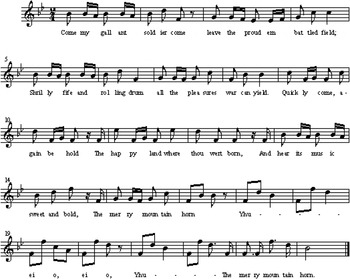
Moreover, many of these songs feature a wordless call of some sort. This in itself was not new or unusual. ‘Tra la la’, ‘fa la la’, ‘hey nonny nonny’, and similar wordless refrains have a venerable tradition in English-language song; one thinks, for example, of ‘Deck the Halls with Boughs of Holly’. Yet in the Swiss-themed songs under discussion here, such passages, more than simply serving as a merry refrain to round out a verse, function as icons in the Peircean sense. In other words, these wordless passages, some quite extended, seem to be vocal representations of the ideas or images mentioned in the lyric; they resemble these ideas and images by their distinctive rhythms and arpeggiated chords. As such they are sonic anaphones, to borrow Philip Tagg's terminology (Tagg Reference Tagg1999), and they represent, or associate with, depending on the lyrics, alp horns, hunting horns, shepherds' pipes, or vocal calls of an unspecified type. In fact, the non-specificity of the lyrics makes these vocal calls particularly interesting. They seem at times to depict one thing in one verse and another thing in the next, as in the following example from Henry Bishop's ‘The Merry Mountain Horn – in Imitation of the Swiss Style’ (Example 4).
Henry Bishop, ‘The Merry Mountain Horn’, bars 15–38 (New York, W. Taylor, n.d.).

These examples should suffice to indicate that the yodel idea exerted some fascination upon composers at this time. Yodel-like calls were regularly incorporated as instrumental stylisations, and wordless calls appear in vocal music whose lyrics deal with themes associated with Switzerland and the Alps. Such figures in such cases appear intended to evoke mountain settings, the peasants and shepherds who lived there, and a pastoral Golden Age.
The widening connotative field
The examples just given are drawn from the first half of the 19th century, when yodelled passages (or at the least, opportunities for yodelling) occur both in songs and in operas, for example the Tyrolienne in Act 3 of Rossini's Il Viaggio a Rheim and Betly's Cavatina in Adolphe Adam's (Reference Adam1834) Le Chalet. In the latter part of the 19th century, when yodelling was dying out in what we now call classical music, popular music in its burgeoning forms embraced it. Yodelling offered the popular music of the day a technique capable of communicating showiness, or prettiness, or soulfulness, and more. Moreover, yodelling served to evoke connotations of a romanticised Golden Age (such as it had done for the early Romantic composers just mentioned), or it could conjure up the Old Country, with its beer hall boisterousness. The yodel songs of J.K. Emmet offer evidence of this (Wise Reference Wise2008). In some special forms it could evoke loss, regret and heartbreak. For example, several recordings were made by yodellers at the end of the 19th century of ‘Roll On, Silver Moon’ (Sloman and Barker Reference Sloman and Barker1848), a mid-century song expressing exactly these sentiments.
But the more specifically Swiss pastoral songs of the early 19th century, with their stock characters, such as hunters and shepherds, eventually gave way to far more generalised images and locations. The Alps were often still mentioned, but the lyric themes were transformed away from quaint pastoralism into broader ideas such as freedom and liberty, for example. An instance of this tendency can be seen in ‘To My Bright Alps Again’, written in 1861. While specifically citing the Alps, the theme of this song is nevertheless the contrast between the conventional pleasures of ‘the tame heart’ and the greater depth of experience of ‘the free’ in his/her romantic quest.
This example is given to illustrate the idealised images typical of the Romantic tendencies of the 19th century. The mountain imagery serves as a visual correlative to the ideals expressed in the words, and the yodel functions as a sonic correlative. We observe that in Anglo-American popular song yodelling remains associated with mountains, but the geographic setting undergoes a change. The Americanisation of mountain songs begins with The Hutchinson Family who – inspired by the Rainer Family from Tyrol, who toured the United States of America from 1839 to 1843 (Nathan Reference Nathan1946) – formed their own singing family troupe and became the most famous of the home-grown singing families in America to follow in their wake. As in the case of the Rainers, the sheet music published at the time is an unreliable record of what their performances must have been like. But one example may nevertheless serve to demonstrate something of their yodelling. ‘The Mountain Echo’ celebrates mountain landscapes in a way obviously influenced by the Swiss.
Words such as solitude and splendour recall the themes of the earlier Swiss-style songs. But the second verse clearly identifies the locale as American, geographically as well as ideologically: the mountains ‘rise from the Hudson's magnificent tide’, ultimately:
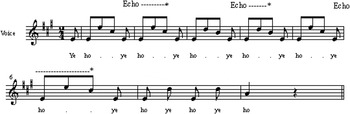
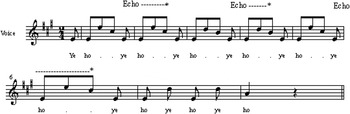
So the Hutchinsons seem to have taken care to let us know that they are not singing about just any mountains: this is not Switzerland. The first aural images in the lyrics – the scream of the eagle and clarion blast on the gale – set a brave tone for some lusty yodelling. The yodelling itself forms a link in the chain of associations linking mountains with eagle, freedom, clarion call and voice. Each verse is followed by an eight-bar yodel refrain with an echo effect, likely performed with alternating voices and changes in dynamics (Example 5).
Hutchinson Family, ‘The Mountain Echo’, bars 41–8 (New York, Horace Waters, 1853).
A change in the locale, however, would ultimately have an impact on the associations triggered by mountain imagery, and that fact would determine yodelling's reception in its later manifestations. Traditionally, mountains have been viewed as either an idealised repository of virtue or as the home of the ignorant backwoods rustic. A swing in the suggestiveness of mountain imagery plainly occurred in North American popular music toward the end of the 19th century. While earlier songs such as ‘Mountain Echo’ were suffused with romantic idealism, the shift in the song's fictional locale to America's Southern mountains, such as the Appalachians or the Ozarks, meant that the cultural stereotype of the hillbilly began to edge out any remnants of romantic idealism. Evidence of this shift is visible in a number of songs published in Tin Pan Alley in the first decades of the 20th century, such as ‘The Big-eyed Goblin Man’ (Reference Albright1916) by Oklahoma Bob Albright and ‘When They Yodel Ragtime Songs in Tennessee’ (Reference Morrissey1918) by Will Morrissey. These songs feature Southern locations and stereotyped representations of African Americans deriving from the coon song, signified by the dialect of the lyrics, the ragtime rhythms, and blues formulas.
Performers such as Oklahoma Bob Albright very likely influenced Jimmie Rodgers and the other hillbilly performers who emerged in the late 1920s, since this material appears to be the earliest evidence of blues mixed with yodelling, earlier for example than the recordings of Charles Anderson. The noteworthy aspect for our purposes is that the singer-personae of the new-style songs share an important feature with their earlier Swiss-style counterparts: they are marked by their distance from the city. In musical terms that difference is marked by means of yodelling.
The shift from Europe to America had important ramifications. Indeed, where once pastoral connotations reigned in the Swiss-styled songs, now ‘rustic’ was in the ascendancy, with different associative fields including ‘coarse’, ‘rough’, ‘wild’ and ‘rude’. This Southern rustic ‘wild’ differs markedly from that term in ‘To My Bright Alps Again’ mentioned earlier. In that song, ‘wild’ is imagined as the escape from the fetters of too much civilisation. In reference to the hillbilly stereotype, wild apparently means too little civilisation. The recording ‘Reckless Tex’ by Goebel Reeves, one of the hillbilly yodellers popular in the late 1920s and 1930s, provides a clear example. In that example the yodelling is completely transformed with gurgling, trilling, comical leaps and even high-pitched squeaking that sounds remarkably like Shemp Howard in the Three Stooges. So the new terrain – ‘Reckless Tex’ lists dozens of American towns and regions – and its new character – the rootless, wandering Southern hobo – stake out the new semantic territory inevitably in new musical signs.
While yodelling in the early 20th century links up with hillbilly wackiness, at the same time it was losing any remaining connection with more sober subjects or reflective states of mind. For example, in the 19th century songs such as the aforementioned ‘Roll on, Silver Moon’, with its sorrowful theme of the death of a lover, could employ yodelling without adverse effect. Interestingly, the published version of that song has no indication whatsoever of yodelling, but yodelling key words of the refrain became a part of the traditional way of performing that song, as is clear from several turn-of-the-century recordings (Wise Reference Wise2008). Performers may have felt that the yodel provided a special voice or register for the expression of the sorrowing soul. Interestingly, yodelling words as opposed to nonsense syllables commonly occurs in songs of more serious emotions: one thinks of Tommy Johnson's ‘Canned Heat Blues’, Jimmie Rodgers's ‘Never No Mo Blues’ or Hank Williams's ‘Ramblin’ Man', for example. Nevertheless, despite some later attempts to link it with spiritual matters, yodelling in its 20th-century popular music contexts by and large completely lost the gravitas it maintained in some late 19th-century contexts.
However, since the middle of the 20th century a number of yodellers have sung religious and gospel songs featuring yodelling; Janet McBride, for example, has released an album of gospel songs (Reference McBride2002), some with yodelling, and Slim Whitman's hit ‘Casting My Lasso toward the Sky’ (Reference Whitman1949) has a religious theme. But generally speaking the type of yodelling one hears in them is more likely to be equated with an extroverted stand-up-and-testify variety of declamation rather than with quiet devotional meditation; they tend more toward Billy Graham than toward Boethius. So while yodelling in the context of the post-WWII religious song by and large seems devoid of mystery and mysticism, it does, however, strongly associate with Southern fundamentalism. As a result, titles such as ‘I Want to Yodel for the Lord’ or ‘Jesus Put a Yodel in My Heart’ risk, in the somewhat cynical context of recent English-language pop music, provoking reactions not unlike that of Karl Spaizier who, discussing yodelling in 1790, wrote: ‘Any musician would have to work hard to suppress a sarcastic smile’ (quoted in Ling Reference Ling1997, p. 3).
Yodelling and comedy
While Anglo-American yodelling since the 19th century was shedding its melancholic and doleful associations, it was appearing increasingly in the context of comedy. The radio barn dance programmes of the 1930s, for example, provided just such a framework to mix the purported music of the common folk with rustic humour and high jinks. Beginning with performers such as Uncle Dave Macon, who yodelled occasionally, hillbilly music and hillbilly humour were at times virtually indistinguishable as mediated via radio. The presentation of the acts, their costuming, and performance styles were all deeply influenced by the comical notion of the hillbilly stereotype. Thus the DeZurik Sisters, splendid yodellers that they were, found themselves using their talents in the service of comic animal impersonations in order to sell their radio sponsors' farm feed products (Bufwack and Oermann Reference Bufwack and Oermann1993, p. 98). Indeed, the DeZurik Sisters were also known as the Cackle Sisters, a name which emphasises the comedy of their yodelled barnyard imitations.
Emmett Miller's yodelling similarly has an undeniable comic dimension. A blackface comedian and singer, he assumed in his act the role of the fictitious ignorant ‘coon’ with humour as the object. Thus, his amazing yodelling, with its startling jumps between registers, is at least partially in the service of comedy. This assertion is virtually proven by the fact that his smoothest crooning recording, ‘She's Funny That Way’, has no yodelling at all: yodelling, presumably, would only have trivialised his most sincere song.
The hillbilly-era performers, however, were not the first to use yodelling for comic purposes. That process began in the British music halls and American vaudeville, as evidenced by a large amount of sheet music from the era. ‘Yew-ra-liar-ty’, from 1893, can serve as an illustration. Subtitled ‘Burlesque Yodel Song’, it shows an early tendency to use yodelling for laughs. Each line of the ditty is punctuated with two brief yodels, but the refrain at the end of each verse constitutes the yodelled punch-line indicated by the title. One verse and chorus will illustrate:
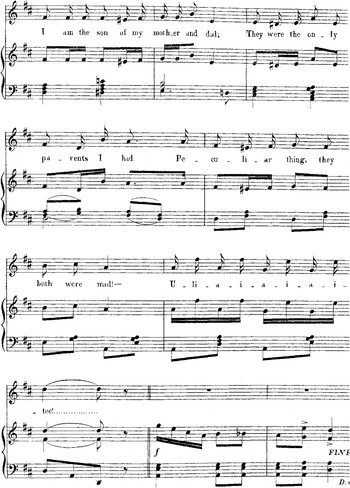
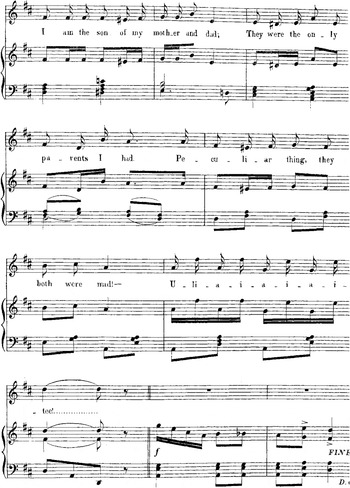
Another comic song from this era, ‘U-li-a-i-tee’, seems to equate yodelling with madness (Example 6).
George A. Stevens and G. Wells, ‘U-Li-A-I-Tee (Burlesque Yodel Song)’ (London and New York, Francis, Day and Hunter, Reference Stevens and Wells1902).
As we move from printed sheet music to recordings, we see ample evidence of the yodelled voice in comedy. For example, ‘The Happy German Twins’, a recording made in 1906 by George P. Watson and Len Spencer, is a typical vaudeville comedy sketch sending up the Germans, and the yodel is a key signifier. Since the days of J.K. Emmet, the singing actor who in the 1870s created the comic stage character Fritz Von Der Vonderblinkenstoffen, through whom he introduced many yodelling hits, yodelling in the theatre had served as a signifier for Germany. Along with the stage accents and Biergarten oom-pah-pah rhythms, the yodelling helped establish the ethnicity of the characters. The Fritz character in which Emmet specialised is an early example of the funny foreigner, marked by his accent, his lack of familiarity with American ways and, in this case, his yodelling. The 1906 recording by Watson and Spencer is simply one of several in the long line of performers continuing the so-called Dutch character that Emmet helped to establish. (‘Dutch’ in this case is a corruption of Deutsch, meaning German, and has long been used in American theatre to refer to comic German stereotypes.) In ‘The Happy German Twins’ the telling line for the yodel's esteem occurs just after Watson yodels a tune; in a stage-German accent he asks:
GPW: ‘Say, vat vould you do if you had a throat like mine, eh?’
LS: ‘I vould cut it.’ (Watson and Spencer Reference Watson and Spencer1906)
Frank Wilson was another Dutch-humour specialist who recorded before the advent of the microphone. The yodelling in his numbers similarly serves as a signifier for both ‘the Old Country’ and the funny foreigner. The comic yodelling of Goebel Reeves and Emmett Miller, both mentioned earlier, serves a similar function; it marks a difference: in the former the wandering hobo or tramp, in the latter the black other.
Away from recordings but at much the same time we find farcical send-ups of the yodel itself in the theatre. An example is a segment called the ‘Yodelling Duet’ from The Beauty Spot, a musical play published in 1918. The duet for Josephine and Schamyl makes a mockery of the usual late Romantic images associated with yodelling: at each mention of a stock image from the earlier repertoire of yodel songs, some ludicrous and unexpected sound effect is heard off-stage, a lampooning of the hackneyed Romantic conventions which was probably very funny in performance. These examples show the increasing tendency to place the yodel into absurd contexts, which has the effect of reinforcing any inclination to see the yodel itself as absurd.
J: Hark! Don't you hear that melody we know?
U-ra-li-tee O!
S: Oh! U-ra-li-ti-i-ty O!
J: See, 'tis the shepherd on his homeward way.
What do you hear him say?
S: Ah! What is the gist of his lay, eh? (Hee haw)
J: There grow the Edelweiss so delicate,
Inarticulate.
S: I hear it calling its mate. (noise)
J: Hark to the music ringing in the dells.
S: Yes, it is the song of the bells. (noise)
Oh merry bells.
J: Far climbs the mountaineer into the snow
U-ra-li-tee O!
S: U-ra-li-ti-ti-ty O!
J: Hark, do you hear that modulating note,
So gentle and remote? (noise)
S: Ah! it is the trill of the goat.
J: Now do you hear the linnet in the vale,
Running up the scale? (noise)
S: Surely that is the nightingale!
J: Hush! Do you hear that bleating from afar?
Sweetly do the lambkins baa-baa. (quack)
S: Hark to the baa-lamb. (Harris et al. Reference Harris and Tate1918)
A much more recent example of comic contextualisation of yodelling occurs in Tim Burton's Reference Burton1996 film Mars Attacks!, wherein the world is saved from destruction at the hands of homicidal Martians by the sound of Slim Whitman's yodelling. Slim Whitman is in some circles a byword for corniness, and one likely reason for this is his yodelling. Indeed, ‘corn’, ‘corn pone’ and ‘corny’ are all pejorative terms highlighting the split between urban and rural values that overtook the United States around the middle of the 20th century: corn relates to the farm and thus to rustic. ‘Corny’ is at the opposite end of the spectrum from ‘hip’, and the joke in the film, presumably, is that this music is unarguably ‘bad’. The film assumes, and the audience is put into the position of accepting, that this music is loved only by marginalised Alzheimer patients such as Granny in the home where she is spending her twilight years. The director is also at pains to associate Whitman's music with that of Lawrence Welk, whose programme is starting on the television when the scene shifts to the retirement home, and whose music similarly is apparently considered of interest only to the aged.
The film's appropriation of Whitman's recordings is funny because, not only do most humans in the film apparently hate it (Tom Jones, playing himself, says with disgust, ‘Who put that on?’ when he hears Whitman's yodel over the radio), but because the yodelling is literally intolerable to the Martians: it makes their heads explode, filling the inside of their glass helmets with green goo.
Now, the question remains: what had changed? How was it that the yodel had become this type of signifier?
A framework for a paradigm shift
Recalling Ling's statement at the beginning of this essay, we may imagine that the ironisation of the yodel is a process that perhaps has been latent in it all along. But its actuation in the context of the culture in the United States really speeds up from about the 1930s, paradoxically at the moment of the yodel's greatest popularity, when both hillbilly and cowboy performers were cultivating it and having big commercial successes. Representations such as the ‘Dwarfs' Silly Song’ from Disney's 1937 film Snow White and the Seven Dwarfs (sic) are interesting in that they appear to locate the yodel for the broad, general population by making the ‘otherness’ of the yodel apparent in a lyrical, mythical way: it is the freakish little dwarves, after all, who do the yodelling, not Snow White; even the title of their ditty (‘Silly Song’) announces how we are to regard it.
For, kind and benevolent as they may be, the dwarves are clearly not the sort who can hope to wed the likes of Snow White. They ultimately are the second-class citizens, the colourful exotics, mild and friendly, but not like ‘us’. The tacit understanding is that they will remain in the forest and never threaten to move into our neighbourhoods.
Yet in this classic film they are the ones who yodel. Quite unlike the Swiss hunters and those other rugged Alpine types whom we met earlier, Prince Charming does not announce his arrival from a distance with a manly yodel. Why not? Because charm equates with ‘smooth’, and yodelling contradicts that principle. While rough, masculine-gendered yodel calls had emerged in Southern blues – the Jimmie Rodgers ‘Blue Yodel’, for example – the personae associated with these were likewise ‘others’: the Southern, black-influenced hillbillies who were socially beyond the pale for the mainstream. Prince Charming would never yodel like that.
Disney's Snow White ties together with Tim Burton's Mars Attacks! in that the former can be read as representing the idealised and mythicised social order that is, at the beginning of the latter, on the brink of destruction. Together these films frame the era during which the yodel became almost completely ironised in North American popular music. During this period, at least two factors contributed to this process: urbanisation of tastes and the emergence of the cool aesthetic (Stearns Reference Stearns1994; Pountain and Robins Reference Pountain and Robins2000; MacAdams Reference MacAdams2001).
Historically, the yodel has been tied to the outsider or lower class, never to have been accepted as the musical language of the dominant group (in the Western European and North American traditions). Yodelling seems always to carry some aspect of ‘folk’, and that sets it in opposition to a mainstream whose tastes since WWII have tended toward a valorisation of ‘sophistication’. In the early 19th century, as a result of the romantic Alpine imagery bound up in the sign, the yodel enjoyed a prestige in the musical vocabulary that it eventually lost. Indeed, at that time it often was associated with idealism and high art.
Even then, of course, the yodel idea may have been of interest to primarily orchestral composers, appearing only from time to time in an actual singer's repertory. In most contexts it represented, to put it very simply, a Golden Age, a romantic construct of a ‘better’ time before the corruption brought upon civilisation as a result of urbanisation and later industrialisation (e.g. Beethoven's Pastoral Symphony). Yet by the 20th century that kind of romantic imagery had lost its appeal. On the other hand, the replacement for the 19th-century paradigm that began with performers such as Oklahoma Bob Albright and flourished with Jimmie Rodgers, Goebel Reeves and their contemporaries – the ragtime/blues yodel – was constructed of elements which prevented it from taking its place nearer the centre of music making; in other words, it was too black sounding: it was bluesy, it was rural and it was rough. Interestingly, the yodel Disney gives to the dwarves in Snow White is clearly modelled upon the European version, resembling the Southern blue yodel not in the slightest. In 20th-century American popular music, yodelling has been the voice of the outsider classes and exotics only and has never been able to shake off its associations with the hills and pre-modernity.
But such an association with pre-modernity illuminates a subtext to the yodelling in the film Mars Attacks!. The high-pitched falsetto yodel in this context might be read not simply as a marker of the alleged corniness of Slim Whitman, but as sign for America's mythic ‘lost innocence’. Each corrupt or venal character in the film personifies the forfeited innocence of America. Yet the innocence (or naiveté), symbolised by Whitman's yodelling, ironically, saves them from destruction. The other characters in the film, clearly recognisable American types, are incapable of positive action, beginning with the unctuous president and his odious press secretary. The newscasters are portrayed as utterly superficial, concerned only with the image they present on television. Las Vegas – itself emblematic of greed and gaudiness – figures as a dominant site within the film's action. And there are the militantly jingoistic all-American trailer-dwellers, first seen as their gung-ho son proudly demonstrates to his family his ability to assemble his automatic rifle in under two minutes while blindfolded. In the context of the film this is read as his devotion to the United States Army and clearly is intended as humorous and ironic. Later in the film this family dismiss the idea of protecting the grandmother, being more concerned to protect their trailer and television set.
On the other hand, the sympathetic characters, the ones who actually make a difference to the outcome, are the ‘lost’ ones; they are the apparently negligible people at the margins of society: the spaced-out, uncool and less popular son, who works in the donut shop, and his equally spaced-out grandmother, whom he does not abandon, although the rest of his family are willing to, and who inadvertently saves the world with her beloved Slim Whitman record.
The yodel as other
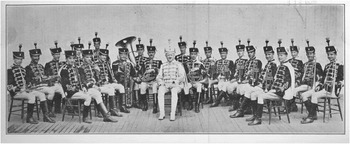
The yodel was ‘other’ from the moment it entered the musical lingua franca of the early 19th century; much of its interest to composers, performers and audiences lay in its exoticism. It is quasi-music, para-music, additional and very frequently mere ‘novelty’. Its inability to rise above second-class status partly explains its ultimate exclusion by classical music. Interestingly, the use of the term ‘yodel’ or ‘yodel song’ increases in proportion to the distancing from the ‘serious’ classical repertoire. In the case of ‘The Merry Mountain Horn’ by Bishop, mentioned earlier, for example, ‘yodel’ is not mentioned anywhere in the music, although the wordless passage clearly affords an opportunity for yodelling, as its subtitle suggests. However, in the latter part of the 19th century, the title pages of many pieces proclaim their status as ‘yodel songs’; nevertheless their style and idiom set them apart from their ‘serious’ contemporaries, who by that time ignored the yodel altogether. Indeed, North American composers who aspired to write ‘classical’ music generally eschewed yodelling completely. By the turn of the 20th century, classical singers such as Elizabeth Schumann-Heink and Margaret Keyes could get away with the odd yodel in a Swiss ditty placed near the end of a recital programme, but yodelling was far more likely to be welcome in novelty acts such as Al Sweet's Singing Band who, dressed in uniforms and shakos (Figure 1), performed a wide variety of material (American Memory). Otherwise, a few gimmicky pop songs coming from Tin Pan Alley via the revue or variety stage were far more likely to make space for some yodelling than ‘serious’ songs. Within the classical tradition the yodel had become a gauche and unwelcome country cousin, embarrassing to those interested in ‘art’.
Al Sweet's Singing Band, ca. 1922 (courtesy of the Special Collections Department, University of Iowa Libraries).

By the middle of the 20th century the yodel had become so thoroughly associated with rural genres – hillbilly music and cowboy music – that it assumed a role as an index of Southern and rural attitudes. This association alone was sufficient reason for the dominant classes to marginalise yodelling or to distance themselves from it on matters of taste. One way of distancing was through comedy and later through irony. In comic or ironic contexts yodelling is permissible; in ‘serious’ contexts, it is not.
By means of such comedy and indeed satire, the yodel in the counter-culture of the 1960s actually became an instrument in a political struggle. For example, because of its close association with rural culture, Frank Zappa could employ the yodel to signify reactionary attitudes in American society: conservatives, rednecks, chauvinists and the presumed benighted South generally. To illustrate, in Frank Zappa's song ‘Lonesome Cowboy Burt’ from the film titled 200 Motels, the redneck character Lonesome Cowboy Burt yodels. It is one of his significant markers.
In the film, Burt appears dressed in a ridiculously gaudy cowboy outfit, with a blue satin shirt, a red vest and a cowboy hat. Occasional inserts show him pointing a machine gun around the bar where he is singing. In his song, performed in a mock-country style, he introduces himself and proclaims that he has come to California to find pretty girls.
His yodel comes immediately after the line ‘my bold advance on this here waitress’. Presented as an oaf, his gauche and charmless way with women is objectified in his yodelling. But especially revealing about Burt's character and political leaning are the following lines:
A key term here is ‘communist bastard’, which in this case is code for a hippy. This idea unambiguously illustrates Burt's position in the then-current ideological struggle: his aversion to hippies is part and parcel of his intolerance, his lust and his violence. These ideas are signalled musically to Zappa's audience through the stomping, faux-country polka beat of the music and the yodelling.
A similar political point is made in some slightly earlier recordings by The Fugs. ‘Johnny Pissoff Meets the Red Angel’ (1968), for example, is significant in this context as the yodelled cracks in Johnny's voice clearly parody country music styles of the era. That Johnny Pissoff expresses himself in the country idiom associates his attitudes with those of the reactionary elements of the society.
His rant is directed at all the agitators for change: ‘And hey, mister – tell all the niggers my name is Johnny, Johnny Pissoff.’ Later it is ‘tell all the commies’ and ‘tell all the draft card burners’. The quickest musical code in the late 1960s for the communication of Johnny's reactionary politics was the country voice singing style, and this is signalled by his frequent use of the crack-voice yodelled words. The chain of associations is something like this: the crack in the voice and the musical style are synecdoches of the country music idiom; this idiom is an index of the presumed rabid conservatism and traditionalism of the people who like this type of music; so the break in Johnny Pissoff's voice is an index of his bigotry and reactionary politics. These two examples from the Mothers of Invention and The Fugs demonstrate how yodelling continued to be an effective sign but in a completely new context and with a new purpose: by co-opting its historical associations with rustics the yodel is used to satirise right-wing politics and express the ideology of the counterculture in America.
The yodel in fact was a very handy device, as by the 1960s it could unequivocally be used as a synecdoche for rural music generally, which itself connoted conservative values. A simple distinction could thus be drawn, delineating the contrasting ideologies during the middle and latter part of 1960s America. Progressive attitudes were associated with rock music; indeed, there was by this time progressive rock music, as a subset of the larger genre. Progressive rock was generally considered the site of psychedelic experience and mind alteration, and thus connoted liberation and a whole host of other attitudes associated with freedom (Whiteley Reference Whiteley1992). On the other hand, country music, understood as the voice of traditionalism and conservatism, began to make overt political statements. Increasingly, country songs were appearing that specifically confronted the hippies' countercultural stance. Songs such as Ernest Tubb's ‘It's America: Love It or Leave It’ (Reference Tubb1970) and especially Merle Haggard's ‘Okie From Muskogee’ (Reference Haggard1969) and ‘Fighting Side of Me’ (Reference Haggard1970) gave to country music its reactionary political voice – a voice directed particularly at the hippies, the draft dodgers, the bra burners, et al. Tellingly, Haggard's ‘Okie’ uses the same crack-voice yodel decoration of words to signify his ideological stance as Ed Sanders had done in his satirical ‘Johnny Pissoff Meets the Red Angel’. The ne plus ultra in this direction, however, must be Red River Dave's ‘The California Hippie Murders!’. Beginning with a bloodcurdling female scream, the song describes in lurid detail the murder of Sharon Tate by the Charles Manson family. The yodel incorporated into this song has a weird irony: the tune Dave McEnery yodels is one of Jimmie Rodgers's sunniest creations, which had always – until now – been associated with cheerful moods (Wise Reference Wise2010).
More recently, yodelling has appeared in films where its significances have been much less politically charged. Interestingly, while they create more affectionate and nostalgic contexts for the yodel, they nevertheless present it as ultimately comical.
The Coen Brothers film, O Brother, Where Art Thou? (Reference Coen and Coen2000), for example, is simultaneously an adaptation of Homer's Odyssey and a celebration of old-time music. It would be perverse to read it as anything other than positive in its view of rural Southern music. Nevertheless, the yodelling in the film – appearing in fact at the film's climax – is again ironic and comical. It occurs in a performance of Jimmie Rodgers's ‘In the Jailhouse Now’; the performers, the film's protagonists – on the run from the chain gang and attempting to avoid capture – are dressed in outrageous hillbilly costumes, clearly marked for comedy. In fact, with their long beards and flop hats, they resemble very exactly the stereotype discussed by Anthony Harkins (Reference Harkins2004) in his study Hillbilly: A Cultural History of an American Icon. Moreover, the filming of the performers as they sing is done to maximise the comic effect, with humorously odd facial expressions, for example. So while Southern rural music generally is celebrated, it is still performed with the comical overtones that have characterised its presentation since the radio barn dances of the 1930s. It is as though the ironic stance provides the necessary distancing to make this music acceptable to the broader public.
The yodel's staying power, even if at the margins of mainstream musical activity, is interesting. As long as a suitable functional role for it within a musical text can be found, then it is likely that performers will continue to make use of it. The problem for the yodel has always been in finding that suitable expressive role. Clearly, changes in tastes and in fashion have necessitated evolving roles for the yodel. In early 19th-century music, that role was primarily as a signifier for Switzerland and the wealth of indexical relationships following on from that. When the yodel's use for pictorialism and allusion to Switzerland lost its artistic currency, the function shifted to serve other purposes in the music. This may have been in the service of more generalised ideas of pastoralism, or ideas extending from concepts such as joy, freedom, solitude and more. More recently, in some of the uses I have been discussing, yodelling's association with pre-industrial pastoralism has transformed into associations with other, typically negative ideas about life away from the city: ignorance, intolerance and violence.
The appeal the yodel exerted on intellectuals and artists in the Romantic era may seem long past, and its current connection with rural genres may appear to doom it for the mainstream in the immediate future. However, with the growing interest in world music, new contexts are emerging and yodelling is once again cropping up in what may be called a contemporary guise and with new connotations. Zabine, for example, is an Austrian singer who has worked with Hubert von Goisern, among others, and whose 2001 album Transalpin blends yodelling with electronica and dance music. Another distinctive approach comes from the group Stimmhorn, who combine yodelling, alp horns and other unusual folk instruments with Tuvan throat singing in a stark, brooding music. The considerable interest in Tuvan-style singing in Germany and elsewhere, coupled with the growing interest in world music generally, may well trigger new uses for the yodelling voice. For scholars interested in the history of musical ideas, humankind's primary musical instrument will doubtless remain a key area of study.