Introduction
Acute otitis media is a common disease of childhood and one of the most common reasons for referral of children to otolaryngologists. It is the most common reason for antibiotic prescription and a significant economic burden.Reference Rettig and Tunkel1 The causative organisms in acute otitis media have changed over the last decades with the increasing implementation of pneumococcal vaccination programmes. The most common bacterial organisms that cause acute otitis media are Streptococcus pneumoniae, non-typeable Haemophilus influenzae and Moraxella catarrhalis.Reference Grijalva, Nuorti and Griffin2 In the majority of cases, the disease is self-limiting; however, because of complications, persistence and recurrence of the disease, otitis media is still a considerable cause of morbidity in children.
Otitis media with effusion (OME) may occur as a residual effect of acute otitis media. Mucosal changes have been suggested to be of importance for the subsequent development of OME.Reference Casey, Kaur, Friedel and Pichichero3 Otitis media with effusion is histologically characterised by a chronic inflammatory condition with overproduction of mucin in response to an underlying stimulus that caused an inflammatory reaction.Reference Park and Yeo4 Approximately half of the children who experience acute otitis media will have OME one month after, and 10 per cent will develop it three months after the initial diagnosis.Reference Kubba, Pearson and Birchall5
Reactive oxygen species are produced in both physiological and pathological conditions, and are detoxified by tissue defence systems. The degradation of reactive oxygen species is carried out by enzymatic and non-enzymatic defence systems such as superoxide dismutase, glutathione peroxidase, catalase, glutathione, vitamin E and vitamin C.Reference Pichichero6 When the balance between reactive oxygen species production and antioxidant defence systems is disturbed, the level of reactive oxygen species increases. Excessive production of reactive oxygen species that overcomes antioxidant defence mechanisms causes oxidative stress. This can lead to many cellular events, including lipid and protein peroxidation, and DNA injury, with resultant tissue damage and exacerbation of inflammation. There are a number of studies demonstrating the role of free oxygen radicals in middle-ear diseases, both in experimental animals and human subjects.Reference Machlin and Bendich7–Reference Kawana, Kawana, Yokoo, Quie and Giebink11
Alpha-lipoic acid is a naturally occurring co-factor that has a role in the oxidative decarboxylation of alpha-keto acids. Humans can synthesise alpha-lipoic acid de novo in very small amounts from fatty acids and cysteine. Therefore, alpha-lipoic acid needs to be taken from exogenous sources.Reference Shay, Moreau, Smith, Smith and Hagen12In vivo, alpha-lipoic acid is reduced to dihydrolipoic acid. Both alpha-lipoic acid and dihydrolipoic acid are antioxidants.Reference Packer, Kraemer and Rimbach13, Reference Packer, Witt and Tritschler14 They also interact with other physiological antioxidants to regenerate oxidised antioxidants including vitamin E, ascorbic acid, glutathione and coenzyme Q.Reference Packer, Kraemer and Rimbach13 Furthermore, alpha-lipoic acid has anti-inflammatory effects. It has been shown to decrease inflammatory responses via the inhibition of the nuclear factor kappa beta (NF-κB) signalling pathway.Reference Li, Fu, Zhao, Ji, Luan and Zang15
This study aimed to evaluate the potential anti-oxidative and anti-inflammatory effects, as well as the therapeutic role, of alpha-lipoic acid in experimentally induced otitis media in guinea pigs.
Materials and methods
Animals
Twenty-five adult albino guinea pigs were used. Each animal weighed 310–420 g. All animals were obtained from Ataturk University's Experimental Animal Laboratory at the Medicinal and Experimental Application and Research Center.
The animal experiments and procedures were performed in accordance with national guidelines for the use and care of laboratory animals, and the study was approved by Ataturk University's local animal care committee (approval number: 2014–1/11).
The guinea pigs were housed in standard plastic cages on sawdust bedding in an air-conditioned room at a temperature of 22 ± 1 °C, with a 12/12-hour dark/light cycle. Standard guinea pig food and tap water were given ad libitum. Adapting time before the experiment was two weeks.
The animals were free of middle-ear disease, as confirmed by otoscopic examination. For the induction of otitis, all animals other than those in the negative control group (five guinea pigs), were anaesthetised with a combination of ketamine (50 mg/kg) and diazepam (0.1 mg/kg) administered intraperitoneally. All procedures were performed under sterile conditions. Under otomicroscopic view, S pneumoniae type 3 (ATTC® 6303™) (0.1 ml at 1.3–2.4 × 10⁶ CFU/ml), was inoculated into the middle-ear cavity on both sides via a transtympanic route. The animals were initially examined at 48 hours post-inoculation in order to perform otomicroscopy and confirm the presence of otitis media. In four of the animals, otitis media was not developed in one side. Hence, these animals were divided into four groups, each containing five guinea pigs with nine infected ears.
The healthy control (negative control) group comprised five healthy guinea pigs and no treatment was given. In the saline treated (positive control) otitis group, the animals were not given any medication, but 2 cc phosphate-buffered saline was administered intraperitoneally for 7 days. In the penicillin G (antibiotic) treated otitis group, the animals were given penicillin G (intramuscularly, 160.000 U/kg/day) for 7 days. In the alpha-lipoic acid treated otitis group, the animals were given alpha-lipoic acid (orally, 50 mg/kg/day) for 7 days. In the penicillin G plus alpha-lipoic acid treated otitis group, the animals were given penicillin G (intramuscularly, 160.000 U/kg once daily) and alpha-lipoic acid (orally, 50 mg/kg/day) for 7 days. Nasogastric feeding tubes were used for the administration of alpha-lipoic acid via an orogastric approach.
After 7 days, all animals were sacrificed using a lethal dose of intracardiac sodium pentothal. Temporal bones were taken bilaterally, and left middle-ear mucosa of the animals was prepared for histopathological evaluations and right ear mucosa for biochemical evaluations.
Histopathological analysis
Neutral-buffered formalin (10 per cent) was used to fix the bulla tissues. They were fixed in formalin for 72 hours. After fixation, treatment tissues were decalcified with 6 per cent nitric acid for 7 days. The specimens were immersed in 10 ml of nitric acid separately in single tubes and maintained at room temperature. The acid solution was replaced with a new acid solution every 48 hours. Sodium bicarbonate was applied in a neutralisation process to the decalcified specimens for 3 hours for each subject. Then histological processing was applied. The specimens were dehydrated with a decreased series of alcohol, cleared with xylene, and then embedded in paraffin.
Sections of 5 µm thickness were obtained from each paraffin block, which were serially cut. The serial sections were stained with Mayer's haematoxylin and eosin and Mallory trichrome (Diapath™ special stains) for histopathological examination. The stained specimens were visualised and evaluated under a Leica™ DM light microscope. The histological changes were scored to ease reproducibility. The morphological changes were graded as compared to the control (non-otitis) group: 0 when there was no change, 1 when the change was mild, 2 when the change was moderate and 3 when the change was severe. These changes were assessed according to the variables described below and the average values for each variable were determined.
Mucosa and tympanic membrane thickness was graded according to the increase in thickness relative to the control (non-otitis) group. Mucosal vascularisation was graded according to the increase in the number of vascular lumens in one field. Mucosal inflammation and tympanic membrane inflammation were graded according to the inflammatory cell count of mucosa and the tympanic membrane based on the inflammatory cell count per field at 200 × magnification. Mucosal secretory metaplasia was defined as the transformation of the normally flat epithelium into goblet cells; the changes were graded according to the percentage of transformed cells within the total number of cells observed. Epithelium integrity was scored as 0 if not disrupted, 1 when mildly disrupted, 2 when moderately disrupted and 3 when there was severe disruption.
Biochemical analysis
Mucosal samples sized 0.5 cmReference Grijalva, Nuorti and Griffin2 were used for the biochemical analysis. Superoxide dismutase activity,Reference Sun, Oberley and Li16 glutathione levelsReference Sedlak and Lindsay17 and malonyldialdehyde levelsReference Ohkawa, Ohishi and Yagi18 from each sample supernatant and standard were measured at room temperature in duplicate, with a modified method, using an enzyme-linked immunosorbent assay reader. The average absorbance of each sample and standard were calculated. A standard curve was plotted and the equation was obtained from the absorbance of standards. Linear superoxide dismutase, glutathione and malonyldialdehyde concentrations were calculated according to this equation. The results of the superoxide dismutase, glutathione and malonyldialdehyde in the tissues were expressed as U/mg protein, mmol/ml protein and nmol/mg protein, respectively. All data are presented as mean value ± standard deviation (SD) based on per milligram protein. The protein concentrations were determined by the Lowry method using commercial protein standards (Total Protein Kit, TP0300-1KT; Sigma-Aldrich, St Louis, Missouri, USA).
Statistical analysis
The statistical analysis was completed using SPSS Statistics 20.0 software (IBM, Somers, New York, USA). Differences among the means were statistically analysed by a one-way analysis of variance test followed by a least significant difference test; p < 0.05 was determined as significant. The values are stated as means ± SD.
Results
Histopathological results
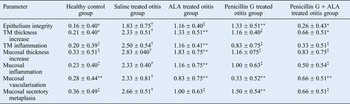
Histopathological sections of the groups are demonstrated in Figure 1. The histological findings are summarised in Table I.
Histopathological sections (5 µm thickness) of: healthy control group (a and b), saline treated otitis group (c and d), alpha-lipoic acid treated otitis group (e and f), penicillin G treated otitis group (g and h), and penicillin G plus alpha-lipoic acid treated otitis group (i and j). Images on the left side represent haematoxylin and eosin staining (×200) and those on the right side show Mallory trichrome staining (×200).

Histological findings for each group

Data represent mean scores ± standard deviation. Mean differences were considered significant at p < 0.05. Values marked with different symbols (‘*’, ‘†’, ‘‡’ and ‘**’) within each row indicate a statistically significant difference between groups for that parameter (values marked with the same symbols within each row did not differ according to the statistical analysis for the evaluated parameter). Hence, for epithelium integrity, the results for the healthy control group and penicillin G plus alpha-lipoic acid treated otitis group were not significantly different and are thus represented with the same symbol. Similarly, for mucosal vascularisation, only the results for the saline treated otitis group were significantly different from those of the other groups. (The symbols within each row are independent of the symbols in other rows.) ALA = alpha-lipoic acid; TM = tympanic membrane
Healthy control group
The thickness of the tympanic membrane and single layer squamous epithelium was normal. Vascular structures, cells and collagen-elastic fibrils of lamina propria were normal. The integrity of mucosal epithelium of the middle ear was preserved. Thickness of mucosa, vascularisation and mucosal glands were histologically normal in appearance in the subepithelial region.
Saline treated otitis group
Tympanic membrane thickness was increased significantly compared to the control (non-otitis) group. There was polymorphonuclear leukocyte infiltration around the tympanic membrane lamina propria. Metaplasia of middle-ear mucosa was observed. Epithelial integrity was disrupted in multiple areas and vascularisation was observed in some areas of mucosa. Mucosal thickness was markedly increased because of interstitial oedema. Collagen deposition was observed in mucosa. Besides inflammatory cells, plasma cells were present in loose connective tissue.
Alpha-lipoic acid treated otitis group
Tympanic membrane thickness and epithelium was normal. Sparse inflammatory cells were present in tympanic membrane mucosa. Middle-ear mucosa thickness was increased as a result of interstitial oedema. There was a minor increase in vascularisation and rare metaplasia in mucosa. Scarce polymorphonuclear leukocyte infiltration was observed in the subepithelial region. Epithelial integrity was close to normal.
Penicillin G treated otitis group
Tympanic membrane thickness and epithelium was normal. Sparse inflammatory cells were present in tympanic membrane lamina propria. There was metaplasia of pseudostratified columnar epithelium in some areas of mucosa. Epithelial integrity was preserved. There was significant subepithelial inflammatory cell infiltration. Middle-ear mucosa thickness was increased as a result of interstitial oedema. No vascularisation of mucosa was seen.
Penicillin G plus alpha-lipoic acid treated otitis group
Tympanic membrane epithelium was normal. There was a slight increase in tympanic membrane thickness compared to normal. Metaplasia of mucosal epithelium was observed in some areas. Epithelial integrity was normal, as in the control (non-otitis) group. There was an increase in middle-ear mucosa thickness as a result of increased fibrous tissue. Rare vascularisation of mucosa with localised perivascular polymorphonuclear leukocyte infiltration was seen. Inflammatory cell infiltration density was significantly decreased compared to other otitis groups.
Biochemical results
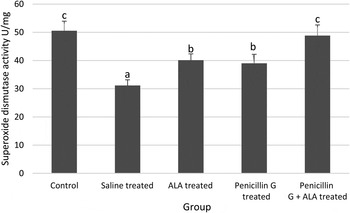
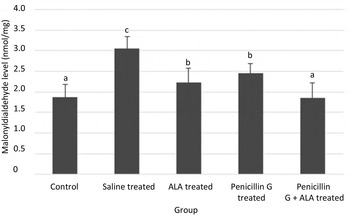
Superoxide dismutase activity, glutathione levels and lipid peroxidation (malonyldialdehyde) levels were evaluated in all animals. The results are shown in Figures 2–4. Glutathione and superoxide dismutase levels were highest in the healthy control group, followed by the penicillin G plus alpha-lipoic acid treated otitis group, the alpha-lipoic acid treated otitis group and the penicillin G treated otitis group, and were lowest in the saline treated otitis group. Malonyldialdehyde levels were highest in the saline treated otitis group, followed by the penicillin G treated otitis group and the alpha-lipoic acid treated otitis group, and were lowest in the healthy control group and the penicillin G plus alpha-lipoic acid treated otitis group.
Serological analysis showed the lowest superoxide dismutase activity in the saline treated otitis group. The superoxide dismutase activity in the penicillin G plus alpha-lipoic acid treated otitis group were close to those of the control (non-otitis) group. Bars marked with different letters indicate a statistically significant difference between groups (at a level of 5 per cent) (bars marked with the same letters did not differ according to the statistical analysis). ALA = alpha-lipoic acid

Serological analysis showed lowest glutathione levels in the saline treated otitis group. Glutathione levels of the penicillin G plus alpha-lipoic acid treated otitis group were close to those of the control (non-otitis) group. Bars marked with different letters indicate a statistically significant difference between groups (at a level of 5 per cent) (bars marked with the same letters did not differ according to the statistical analysis). ALA = alpha-lipoic acid

Serological analysis showed the highest malonyldialdehyde levels in the saline treated otitis group. Malonyldialdehyde levels of the penicillin G plus alpha-lipoic acid treated otitis group were close to those of the control (non-otitis) group. Bars marked with different letters indicate a statistically significant difference between groups (at a level of 5 per cent) (bars marked with the same letters did not differ according to the statistical analysis). ALA = alpha-lipoic acid

Discussion
Otitis media is a public health problem that represents a significant healthcare burden. Despite antimicrobial therapy, acute otitis media can still cause complications and progression to chronic suppurative otitis media, characterised by permanent perforation of the tympanic membrane or chronic otitis media with effusion (OME).
It has been suggested that the use of antibiotics to treat acute otitis media in children may not influence the subsequent development of acute mastoiditis, which is the most common suppurative complication of acute otitis media.Reference Ho, Rotenberg and Berkowitz19 Host defence mechanisms against infective organisms consist of non-specific innate immune system and pathogen-specific adaptive immune processes.Reference Mittal, Kodiyan, Gerring, Mathee, Li and Grati20 Besides the host defence mechanisms, infection severity needs to be further controlled to protect self-tissues from immune attack. Tissue damage control enhances the barrier function of epithelial cells to prevent pathogen access to host tissues and limits the disease severity without interfering with pathogen load.Reference Soares, Gozzelino and Weis21
The significant middle-ear inflammation that occurs in otitis media may cause tissue damage that can lead to reversible and irreversible changes, including secretory metaplasia of middle-ear mucosa, resorption of ossicles and perforation of the tympanic membrane.Reference Cayé-Thomasen and Tos22, Reference Salomonsen, Hermansson and Cayé-Thomasen23 It has been shown that upregulation of inflammatory cytokines occurs both in the middle and inner ear following S pneumoniae inoculation in mice, providing a potential molecular basis for sensorineural hearing loss reported with otitis media.Reference MacArthur, Pillers, Pang, Kempton and Trune24
The emergence of antibiotic resistance and potential toxicities of antibiotics is a continuing problem. Additionally, the inadequacy of current treatments to prevent the progression of acute otitis media to chronic OME, and the potential complications of acute otitis media itself, justifies the investigation of non-antibiotic strategies in the management of otitis media. In the present study, we aimed to investigate the potential therapeutic role of alpha-lipoic acid in otitis media, which is a compound with well-known anti-oxidative and anti-inflammatory effects.
In our study, alpha-lipoic acid alone improved epithelial integrity, and alleviated tympanic membrane and mucosal inflammation, mucosal vascularisation, and mucosa and tympanic membrane thickening, in otitis media. Epithelium integrity was better preserved in the alpha-lipoic acid treated otitis group than in the penicillin G treated otitis group. Mucosal secretory metaplasia was similar in the control (non-otitis) and alpha-lipoic acid treated otitis groups, pointing to the role of alpha-lipoic acid in the prevention of secretory metaplasia in otitis media. The anti-inflammatory and tissue protective effects of alpha-lipoic acid were even more pronounced when it was used in combination with penicillin G. In the alpha-lipoic acid plus penicillin G treated otitis group, epithelial integrity was well preserved and histological findings of inflammation were significantly decreased compared to the saline treated, penicillin G treated and alpha-lipoic acid treated otitis groups.
In acute otitis media, reactive oxygen species have been shown to be released mainly by neutrophils and pathogenic bacteria.Reference Takoudes and Haddad25, Reference Long, Tong, Shannon and DeMaria26 Reactive oxygen species cause tissue damage by peroxidation of lipids and proteins. The role of reactive oxygen species in the pathogenesis of acute otitis media has been reported in several studies.Reference Pichichero6–Reference Takoudes and Haddad9, Reference Yariktas, Doner, Dogru, Yasan and Delibas27
Prolonged inflammation in the middle ear is a critical factor in the progression from acute to chronic otitis media.Reference Wright and Meyerhoff28 It has been demonstrated that tumour necrosis factor-alpha (TNF-α), a proinflammatory cytokine in mucoid effusion, markedly increases mucin messenger RNA expression in middle-ear epithelium, suggesting that TNF-α plays an important role in the development of mucoid otitis media.Reference Lin, Haruta, Kawano, Ho, Adams and Juhn29 The expression of TNF-α is primarily regulated by NF-κB at the transcriptional level.Reference Yao, Mackman, Edgington and Fan30 In rabbit middle-ear epithelial cells, NF- κB has been identified as a key modulator of chronic inflammation.Reference Barrett, Kristiansen and Ovesen31 It has been suggested that NF-κB activation is linked to the generation of reactive oxygen species.Reference Christman, Blackwell and Juurlink32 Alpha-lipoic acid has been shown to inhibit the activation of NF-κB.Reference Suzuki, Aggarwal and Packer33, Reference Kim, Chang, Kim, Lee, Kim and Su34
Alpha-lipoic acid has been reported to protect the inner ear from antibiotic-induced and cisplatin-induced ototoxicity,Reference Conlon, Aran, Erre and Smith35, Reference Kim, Cho, Sagong, Kim, Lee and So36 and noise-induced trauma.Reference Quaranta, Dicorato, Matera, D'Elia and Quaranta37 In addition, alpha-lipoic acid has been reported to prevent the development of myringosclerosis in myringotomised rats.Reference Tatar, Yoruk, Unal, Selli, Yayla and Halici38 A limited number of studies have evaluated the role of alpha-lipoic acid in infections.Reference Eremeeva and Silverman39 Cadirci et al. showed that alpha-lipoic acid decreased the serum levels of inflammatory cytokines and improved the oxidative status of lungs injured by cecal ligation and puncture-induced sepsis in rats.Reference Cadirci, Altunkaynak, Halici, Odabasoglu, Uyanik and Gundogdu40
The data on the therapeutic role of antioxidant agents in acute otitis media are insufficient. Aladag et al. found that vitamin A improved oxidative status in rats given antibiotics and vitamin A when compared to the control group.Reference Aladag, Guven, Eyibilen, Sahin and Koseoglu41 A study by Aydogan et al. reported that selenium supplementation for 10 days increased glutathione peroxidase and superoxide dismutase levels in acute otitis media induced rats compared to the control group.Reference Aydogan, Tastan, Aydın, Senes, Akgedik and Berkem42
• Alpha-lipoic acid decreased tissue damage and inflammation, prevented secretory metaplasia, and improved oxidative status in experimental acute otitis media
• These favourable effects were enhanced by the addition of the alpha-lipoic acid to the antibiotic treatment
• This safe, inexpensive pharmacological compound can be used alone or with antibiotics when treating acute otitis media
• Alpha-lipoic acid targets inflammation and tissue damage, and may reduce acute otitis media complications and prevent progression to chronic state
To the best of our knowledge, our study is the first to investigate the role of alpha-lipoic acid on oxidative status and tissue damage in experimentally induced otitis media. In our study, alpha-lipoic acid increased the tissue superoxide dismutase and glutathione levels, and decreased lipid peroxidation (as indicated by decreased malonyldialdehyde levels), compared to the saline treated otitis group. Although alpha-lipoic acid was shown to improve the oxidative status in our otitis model, it was found to be inferior to penicillin G when used alone. The most significant improvement in oxidative status was achieved when alpha-lipoic acid and penicillin G were combined in the treatment. Malonyldialdehyde levels in the alpha-lipoic acid plus penicillin G treated otitis group were not different from those in the healthy control group, indicating that the combination of alpha-lipoic acid and antibiotic treatment prevented lipid peroxidation that occurred as a result of reactive oxygen species.