INTRODUCTION
Each year an estimated 1.5 million people in the United States alone sustain a nonfatal brain injury [Centers for Disease Control (CDC), 2007]. Approximately 80% of these injuries are classified as mild, involving only a brief loss or alteration of consciousness [Centers for Disease Control (CDC), 2003]. The economic impact of mild TBI (MTBI) or concussion is substantial, accounting for approximately 44% of the 56 billion dollar annual cost of TBI in the United States (Thurman, Reference Thurman, Miller and Hayes2001). Even for patients not admitted to the hospital, the economic burden of concussion is considerable with many patients not returning to work until 1 to 3 months after injury and having reduced self-rated productivity for several months thereafter (Boake, McCauley, Pedroza, Levin, Brown, & Brundage, Reference Boake, McCauley, Pedroza, Levin, Brown and Brundage2005).
MTBI is also a significant health and economic problem for the uniformed services. MTBI is one of the most common forms of combat-related injury. Indeed, TBI has been identified as the “signature injury” of the Iraq war. Roughly 60% of the patients seen at Walter Reed Army Medical Center for blast-related injuries sustained a TBI (Okie, Reference Okie2005). Most cases of concussion recover completely within the first 3 months in terms of cognitive function (Belanger, Curtiss, Demery, Lebowitz, & Vanderploeg, Reference Belanger, Curtiss, Demery, Lebowitz and Vanderploeg2005). The literature on athletes sustaining concussion suggests recovery within 7 to 10 days on cognitive measures (Belanger & Vanderploeg, Reference Belanger and Vanderploeg2005).
While the effect of a single concussion on cognitive measures has been relatively well studied, the impact of multiple concussions is still largely unknown. A recent study of the Navy-Marine Corps Combat Trauma Registry revealed that battle-injured were more likely than those injured outside of battle to have multiple TBI diagnoses (Galarneau, Woodruff, Dye, Mohrle, & Wade, Reference Galarneau, Woodruff, Dye, Mohrle and Wade2008), suggesting the importance of this issue for the military in particular. However, this issue has been studied almost exclusively within the sports literature. In examining the effects of a single MTBI on cognitive performance, Belanger and Vanderploeg (Reference Belanger and Vanderploeg2005) found that prior head injury was associated with greater cognitive sequelae. Studies that specifically mentioned the exclusion of athletes with prior head injury, either in terms of recent or remote prior head injuries, had a much smaller effect size (d = .11) than those that did not exclude such athletes (d = .74). These effect sizes were calculated based on current cognitive performance—it is, therefore, not known whether these differences are enduring.
The same meta-analysis also compared athletes involved in risky sports (i.e., soccer and boxing) to control participants in less risky sports (e.g., track and field) and found a significant and moderate effect (d = .31) on cognitive measures. The overall effect (d) of “exposure” as measured by examining the correlation between length of participation and neuropsychological functioning was .71 (p < .05) based on four effect-size estimates. In these studies, exposure was determined by number of boxing bouts and/or length of career (Drew, Templer, Schuyler, Newell, & Cannon, Reference Drew, Templer, Schuyler, Newell and Cannon1986; Murelius & Haglund, Reference Murelius and Haglund1991), or frequency of heading in soccer (Abreau, Templer, Schuyler, & Hutchison, Reference Abreau, Templer, Schuyler and Hutchison2000; Downs & Abwender, Reference Downs and Abwender2002). The largest effects were noted in the domains of delayed memory, executive functions, and language, with d values of .47, .54, and .57, respectively.
Collectively, these results suggest that participation in sports that involve contact with the head (i.e., soccer heading and boxing) has a small but significant adverse impact on neuropsychological functioning. However, as these studies were quite variable in terms of participant selection (e.g., length of sport participation, number of previous head injuries, etc.), further research is necessary to clarify these findings. Correlational studies suggested a dose–response relationship such that longer participation in boxing and soccer is associated with poorer neuropsychological status. Presumably, these findings are due to repeated MTBI.
Most of the scientific literature focusing specifically on the effect of multiple MTBI comes from the sports arena. There are inconsistent reports regarding adverse long-term effects of having two or more concussions. For instance, while some studies have found adverse long-term effects on cognitive performance (Collins et al., Reference Collins, Grindel, Lovell, Dede, Moser and Phalin1999; Moser & Schatz, Reference Moser and Schatz2002; Moser, Schatz, & Jordan, Reference Moser, Schatz and Jordan2005; Wall et al., Reference Wall, Williams, Cartwright-Hatton, Kelly, Murray and Murray2006), others have not (Gaetz, Goodman, & Weinberg, Reference Gaetz, Goodman and Weinberg2000; Iverson, Brooks, Collins, & Lovell, Reference Iverson, Brooks, Collins and Lovell2006; Iverson, Brooks, Lovell, & Collins, Reference Iverson, Brooks, Lovell and Collins2006; Macciocchi, Barth, Littlefield, & Cantu, Reference Macciocchi, Barth, Littlefield and Cantu2001). Furthermore, some studies have found that athletes with two prior concussions recover more slowly (Gronwall & Wrightson, Reference Gronwall and Wrightson1975; Guskiewicz et al., Reference Guskiewicz, McCrea, Marshall, Cantu, Randolph and Barr2003) from a concussion, while other studies find no such relationship between recovery time and prior concussion history (Iverson, Reference Iverson2007).
In summary, there is suggestion from a prior meta-analysis (Belanger & Vanderploeg, Reference Belanger and Vanderploeg2005) that repeated MTBI may have an adverse long-term impact on cognitive functioning. However, studies that specifically examine this issue have produced variable results. The purpose of the current study was to determine the magnitude of impairment in those participants with multiple concussions across multiple cognitive domains. Of primary interest was whether there are differences in effect sizes based on cognitive domain (e.g., attention, memory, etc.). Exposure studies within the sports literature suggest that measures of delayed memory, executive functions, and language may be most affected.
METHOD
Search Strategy and Selection Criteria
Articles published between 1970 and May 2009 were identified through a literature search of online databases (PUBMED, PsychINFO, and MEDLINE). The search was limited to articles published in the English language using human participants. The key words were as follows: “multiple,” “recurrent,” “cognition,” “minor,” “head injury,” “brain injury,” “mild,” “traumatic brain injury,” and “concussion.” In addition, we examined the reference sections of previous meta-analyses, as well as the reference sections of retrieved empirical studies to locate additional studies. This was done to minimize the possibility of overlooking any studies missed in the computerized database searches.
To be included in the analysis, studies had to meet several criteria which were implemented to ensure a reasonably homogeneous set of studies and to allow for the calculation of effect sizes pertaining to the potential cognitive sequelae of multiple MTBI. First, studies had to include only MTBI patients in their group comparisons. Studies that did not separate their findings by TBI severity level were excluded. Second, participants with multiple MTBI had to be compared with a comparison group of participants who had sustained only one MTBI. Some studies also compared participants with multiple MTBIs with those who had no prior TBI. However, because previous meta-analyses showed no lasting adverse effects of a single MTBI and because most studies used a single prior MTBI as the comparison group, the current study did not calculate effect sizes using a no prior MTBI comparison group. Third, participants had to be compared on cognitive measures, either clinically validated tests or experimental measures. Fourth, the studies had to include sufficient statistical information to allow for calculation of effect sizes. Fifth, participants had to be adults or adolescents, as children may have different cognitive sequelae following MTBI (Borg et al., Reference Borg, Holm, Cassidy, Peloso, Carroll and von Holst2004; Capruso & Levin, Reference Capruso and Levin1992).
We examined a total of 123 studies from which 8, with a total of 10 effect sizes, met inclusion criteria (see asterisked studies in the reference section). All studies were conducted with athletes. Of note, the Bruce and Echemendia study (Bruce & Echemendia, Reference Bruce and Echemendia2009) contributed three separate effect sizes, as results were presented for three separate groups of participants. The 10 studies contributed a total of 614 cases of multiple MTBI and 926 control cases with one MTBI. The basic characteristics of each of the included studies are displayed in Table 1, including the overall effect size (d) for each study.
Characteristics of the 10 studies included in the meta-analysis

Note
*Indicates study inclusion criteria for number of months subject had to be injury free. This variable was not reported in four studies, but those were all pre-season evaluations such that prior concussions were likely 9 months or more earlier. **Indicates range of concussions in the multiple concussion group (no mean reported). ***Mean effect size is for cognitive outcomes only (i.e., symptom complaint domain is excluded). ✓ = variable was analyzed. n.a. = not available in the study. Cognitive ability domains: A = attention; EX = executive functions; FL = fluency; AQ = acquisition memory; DM = delayed memory; V = visuospatial skill; MO = motor function; SX = symptom complaints.
The number of concussions sustained by the multiple MTBI groups were not consistently reported (i.e., it was most typically coded as 2+ MTBI). The Collins et al study (Collins et al., Reference Collins, Grindel, Lovell, Dede, Moser and Phalin1999) had the greatest reported range, with the multiple MTBI group having a history of 2 to 10 MTBIs. The average number of concussions was less than three in those studies reporting this variable.
Cognitive Outcome Measures
The outcome measures were tests of cognitive performance. These tests were grouped into nine broad domains of functioning, based upon the typical grouping seen in the neurological and neuropsychological literature (Lezak, Reference Lezak2004; Strauss, Sherman, & Spreen, Reference Strauss, Sherman and Spreen2006) and the grouping we have used in prior meta-analytic studies of MTBI (Belanger et al., Reference Belanger, Curtiss, Demery, Lebowitz and Vanderploeg2005; Belanger & Vanderploeg, Reference Belanger and Vanderploeg2005). For experimental tasks (i.e., tasks not validated for clinical use), we relied upon the authors’ domain assignment. Measures included within the six domains are as follows: attention – Trail Making Test-Part A (Reitan & Wolfson, Reference Reitan and Wolfson1985), Attention subscale of the Repeatable Battery for Assessment of Neuropsychologist Status (Randolph, Reference Randolph1998), Penn State Cancellation Test, Digit Span and Digit Symbol subtests from the Wechsler Intelligence Scales (Wechsler, Reference Wechsler1997), trial 1 of Colour Trails (D’Elia & Satz, Reference D’Elia and Satz1989), the Speed of Comprehension Test (Baddeley, Emslie, & Nimmo-Smith, Reference Baddeley, Emslie and Nimmo-Smith1992), subtests (processing speed, complex reaction time, and simple reaction time) from the Concussion Resolution Index (Erlanger, Feldman, & Kutner, Reference Erlanger, Feldman and Kutner1999), subtests (reaction time, visual motor speed, and processing speed) from the Immediate Postconcussion Assessment and Cognitive Testing (Maroon et al., Reference Maroon, Lovell, Norwig, Podell, Powell and Hartl2000), Symbol Digits Modalities Test (Smith, Reference Smith1973), the color naming portion of the Stroop Neuropsychological Screening Test (Trenerry, Crosson, DeBoe, & Leber, Reference Trenerry, Crosson, DeBoe and Leber1989), CogSport (Collie, Maruff, Makdissi, McCrory, McStephen, & Darby, Reference Collie, Maruff, Makdissi, McCrory, McStephen and Darby2003), and experimental reaction time tasks; executive functioning – Trail Making Test-Part B (Reitan & Wolfson, Reference Reitan and Wolfson1985), and the Stroop Neuropsychological Screening Test (Trenerry et al., Reference Trenerry, Crosson, DeBoe and Leber1989), Trial 2 of Colour Trails (D’Elia & Satz, Reference D’Elia and Satz1989); fluency – Controlled Oral Word Association Test (Benton & Hamsher, Reference Benton and Hamsher1976); memory acquisition – learning trials or immediate recall trials from the following tests: Repeatable Battery for Assessment of Neuropsychologist Status (Randolph, Reference Randolph1998), Brief Visuospatial Memory Test – Revised (Benedict, Reference Benedict1997), Hopkins Verbal Learning Test (Brandt, Reference Brandt1991), Hopkins Verbal Learning Test - Revised (Benedict, Schretlen, Groninger, & Brandt, Reference Benedict, Schretlen, Groninger and Brandt1998); delayed memory – delayed recall portions from the following tests: Immediate Postconcussion Assessment and Cognitive Testing (Maroon et al., Reference Maroon, Lovell, Norwig, Podell, Powell and Hartl2000), Repeatable Battery for Assessment of Neuropsychologist Status (Randolph, Reference Randolph1998), Brief Visuospatial Memory Test – Revised (Benedict, Reference Benedict1997), Hopkins Verbal Learning Test (Brandt, Reference Brandt1991), Hopkins Verbal Learning Test - Revised (Benedict et al., Reference Benedict, Schretlen, Groninger and Brandt1998); motor abilities – the grooved pegboard test (Lafayette Instrument Company, Undated); and postconcussion symptom reporting –Concussion Symptom Scale (Lovell & Collins, Reference Lovell and Collins1998) and the Post-Concussion Symptoms scale (Maroon et al., Reference Maroon, Lovell, Norwig, Podell, Powell and Hartl2000).
Data Extraction and Statistical Analysis
Effect sizes were calculated using techniques espoused by Hunter and Schmidt (Reference Hunter and Schmidt1990). Calculated from the data reported in each study was the effect-size estimate, d (i.e., the single MTBI control group mean minus the multiple MTBI group mean, divided by the pooled standard deviation). Thus, d represents the standardized difference between the two groups within each study, with a positive effect size indicative of better performance by the single MTBI control group. In studies where more than one dependent measure was present for a cognitive domain (e.g., multiple tests of attention), an averaged effect size was calculated for the overall analysis to avoid one study dominating the results. For example, if a study had tests with both nonverbal and verbal memory, these effect sizes were averaged to generate the overall effect size for memory. For the overall effect sizes reported in this study, the averaged ds are weighted by each study’s sample size.
Moderator Variables
We also calculated the Q statistic to examine homogeneity of effect sizes across studies. The null hypothesis of homogeneity among obtained effect sizes suggests that the observed results represent a single population effect and differences among the obtained effect sizes are due to sampling error. If a significant Q value is observed, on the other hand, this indicates heterogeneity of results and potential moderator effects. Q is computed by dividing the variance of the sample-weighted ds by the sampling error variance and this quantity is then multiplied by the number of data points or samples (Hunter & Schmidt, Reference Hunter and Schmidt1990). The Q statistic is evaluated on the χ2 distribution at k – 1 degrees of freedom, where k equals the total number of samples. If Q exceeds the upper-tail critical value of the χ2 distribution then the null hypothesis of homogeneity is rejected and potential moderators of the effect size may be explored.
RESULTS
Overall Effect Size
The overall weighted effect size (d) of MTBI on neuropsychological performance was 0.06 (p > .05) based on 10 effect sizes, Q (9) = 81; p < .05. Because the Q value was significant, we examined the influence of the potential categorical moderating variable of cognitive domain (Hunter & Schmidt, Reference Hunter and Schmidt1990). In an attempt to understand the unaccounted for variance, effect sizes were evaluated by cognitive domain.
Overall Effect Sizes by Cognitive Domain
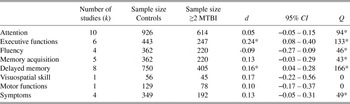
Weighted effect sizes for the seven cognitive domains are displayed in Table 2, as well as the effect size for symptom complaints. Multiple MTBI was associated with statistically significant deficits only on measures of executive and delayed memory. These effect sizes were small to medium in size (Cohen, Reference Cohen1988). It is difficult to evaluate the results of the motor and visuospatial measures, as only one study included such tests. Smallest overall effects were found on fluency and attention measures. As can be seen in Table 2, significant heterogeneity was apparent in most domains.
Effect sizes for six cognitive domains and symptom complaints

Note
* p < .05.
DISCUSSION
Our meta-analysis provides a review of the literature on multiple MTBIs. Results from studies meeting our inclusion criteria suggest no overall significant effect on neurocognitive functioning or symptom complaints. This finding is consistent with prior meta-analyses examining the impact of single MTBI in athletes (Belanger & Vanderploeg, Reference Belanger and Vanderploeg2005).
However, using cognitive domain as a moderator, it was found that both executive functions (d = .24) and delayed memory (d = .16) were associated with multiple self-reported MTBIs. These findings are consistent with a prior meta-analysis of the sports literature (Belanger & Vanderploeg, Reference Belanger and Vanderploeg2005), which demonstrated a significant relationship between “exposure” to head injury (in terms of number of boxing bouts and/or length of career, or frequency of heading in soccer) and neuropsychological functioning, particularly on measures of delayed memory, executive functions, and language. The effect sizes in the current study are considered small according to convention (Cohen, Reference Cohen1988), and their clinical significance is unclear. Given the exploratory nature of the moderator analyses, further hypothesis-driven prospective studies will be needed to confirm these findings. The effect sizes for memory acquisition and symptom complaints were of similar magnitude, although not statistically significant.
There are several limitations to this study. Most notably, the included studies relied upon self-report of MTBI history. While this was necessary, it likely introduces significant error due to retrospective memory errors by the participants. Such memory errors may influence an individual’s beliefs regarding his or her abilities which may, in turn influence motivation on testing. However, it is expected that, if present, such an impact would be present in the single and multiple MTBI groups and would, therefore, unlikely introduce systematic bias. The possibility of such errors, however, does highlight the importance of accurate recording of injury data for future research efforts. Certainly, previous research has demonstrated the importance of stringency in defining MTBI, as well as the importance of demographic variables, neither of which was investigated in this meta-analysis. Also, the included studies did not examine the impact of prior MTBIs on recovery from a recent MTBI. Some studies suggest that having a history of prior MTBI adversely affects recovery rates from a recent MTBI (Gronwall & Wrightson, Reference Gronwall and Wrightson1975). Additionally, there were two studies excluded due to the use of a different comparison group; these studies found associations between multiple MTBI and cognition (Moser & Schatz, Reference Moser and Schatz2002) and symptom complaints (Thornton, Cox, Whitfield, & Fouladi, Reference Thornton, Cox, Whitfield and Fouladi2008). Finally, the Q values were still significant even after moderator analyses. As Q is susceptible to artificial variance inflation when the number of studies is large (Hunter & Schmidt, Reference Hunter and Schmidt1990), it is difficult to know whether nonsignificant Q values were due to few studies, and in turn if the significant Q values were due to a greater number of studies. Also, as we were unable to control for potential artifacts (e.g., reliability of the neuropsychological measures), an inflation of Type I error is likely (Schmidt & Hunter, Reference Schmidt, Hunter, Schinka and Velicer2003). Therefore, there remain important as-yet-unidentified moderators.
The results of this meta-analysis should also be considered a conservative estimate of the association of multiple MTBIs and cognitive performance. The comparison group in each case was participants with a single concussion. Although prior meta-analyses suggest no residual effects of single MTBIs after one to three months, an alternative comparison group would be controls with no previous history of MTBI. Also, time since injury was not reliably reported in the included studies and, therefore, it is difficult to ascertain the extent to which these studies are comparable.
Despite these limitations, this meta-analysis provides evidence that sustaining two or more MTBIs has little overall association with cognitive performance several months later, although there is a small association with poorer performance on delayed memory and executive measures. The studies included in this analysis included participants who reported an average of between two to three concussions. The extent to which there may be a “threshold effect” has yet to be determined. The dementia pugilistica phenomenon suggests the likelihood of such a threshold. Both animal and human studies have shown plausible neuropathological explanations for potential adverse effects of multiple concussions on the brain and cognitive functioning (Creeley, Wozniak, Bayly, Olney, & Lewis, Reference Creeley, Wozniak, Bayly, Olney and Lewis2004; DeRoss, Adams, Vane, Russell, Terella, & Wald, Reference DeRoss, Adams, Vane, Russell, Terella and Wald2002; McKee et al., Reference McKee, Cantu, Nowinski, Hedley-Whyte, Gavett and Budson2009). In addition, a prior meta-analysis examining cognitive performance based on “exposure” suggests a significant effect (d = .71) using number of boxing bouts, length of boxing career, and/or frequency of heading in soccer as the measure of exposure (Belanger & Vanderploeg, Reference Belanger and Vanderploeg2005). Clearly, additional work is needed to determine where such a threshold lies, although it is likely to be person-specific and difficult to determine due to the retrospective nature of assessment.
ACKNOWLEDGMENTS
The research reported here was supported by the Department of Veterans Affairs, Veterans Health Administration (VHA). Further support was provided by the Defense and Veterans Brain Injury Center and the James A. Haley Veterans’ Hospital. The views expressed herein are those of the authors and do not necessarily reflect the views of the Department of Veterans Affairs. There are no conflicts of interest.