Introduction
No consensus exists on the optimal treatment of Graves’ disease once anti-thyroid medication fails to induce remission. In the USA and Europe, radioactive iodine and life-long anti-thyroid medication are the most common treatment choices, respectively. However, In et al. Reference In, Pearce, Wong, Burgess, McAneny and Rosen1 recently calculated that total thyroidectomy is the more cost-effective option. This important paper calculated operative risk and quality of life indicators using published thyroidectomy data, the vast majority from patients undergoing the procedure for benign multinodular goitre.
Hypocalcaemia is a potentially serious complication of thyroid surgery, which can cause neurological symptoms such as paraesthesia and tetany, and rarely, cardiac arrhythmia. Even in the absence of clinical features, hypocalcaemia on the first post-operative day can herald a further fall in a patient's serum calcium concentration.
No prospective studies have been published comparing the prevalence of post-operative hypocalcaemia following total thyroidectomy for Graves’ disease versus multinodular goitre. Hitherto, it has not been known whether patients with Graves’ disease are more or less susceptible to hypocalcaemia following total thyroidectomy, when compared with patients undergoing the same procedure for other benign diseases of the thyroid. As a result, there has been little evidence from which to indicate to Graves’ disease patients the likely risks of total thyroidectomy, compared with those of anti-thyroid medication or radioiodine therapy. Likewise, it has been impossible to accurately compare the cost-effectiveness of these three treatment options.
The current study aimed to compare the relative risk of hypocalcaemia requiring medical treatment, following total thyroidectomy for Graves’ disease versus multinodular goitre.
Methods
We conducted a prospective cohort study of consecutive patients undergoing total thyroidectomy for Graves’ disease and multinodular goitre.
We excluded from the study any patients with a history of previous thyroid surgery, a histological diagnosis of malignancy, known pre-operative hypocalcaemia, less than total thyroidectomy, or a blood transfusion during the study period.
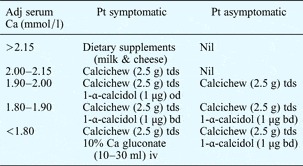
Serum calcium concentrations were measured on the first post-operative day, and calcium supplementation was prescribed according to our standard protocol (Table I).
Standard hypocalcaemia management after thyroid surgery

Adj = adjusted; pt = patient; tds = thrice daily; od = once daily; bid = twice daily; iv = intravenous
The operative technique did not differ between patients. Dissection was confined to the thyroid capsule, with ligation of the tertiary branches of the inferior thyroid artery. Every effort was made to identify all four parathyroid glands.
Statistical analysis
The chi-square test was used to analyse categorical independent data, and the independent sample t-test was used for normally distributed data. All statistical analyses were conducted using the Statistical Package for the Social Sciences version 11.5 for Windows software (SPSS Inc, Chicago, Illinois, USA). Mean values are accompanied by standard deviations (SDs). All p values were considered statistically significant at the 5 per cent level, and were two-sided.
Results
Data were collected from a total of 98 patients: 37 consecutive patients who underwent total thyroidectomy for Graves’ disease, and 61 consecutive patients who underwent total thyroidectomy for benign multinodular goitre.
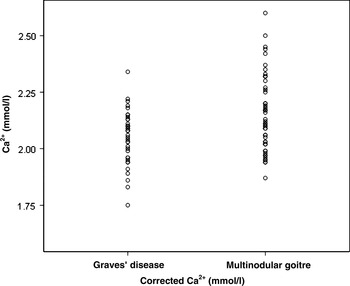
Of the Graves’ disease patients, 91.9 per cent (n = 34) became biochemically hypocalcaemic (i.e. an adjusted serum calcium concentration of less than 2.20 mmol/l (8.8 mg/dl)), compared with 70.5 per cent (n = 43) of the multinodular goitre patients. Thus, the relative risk of hypocalcaemia for a patient with Graves’ disease was 1.34 (95 per cent confidence interval (CI) 1.08–1.57, p = 0.012). The mean post-operative corrected calcium concentration for Graves’ disease patients was 2.05 mmol/l (SD = 0.12), compared with 2.14 mmol/l (SD = 0.17) for benign multinodular goitre patients (p = 0.003) (Figure 1).
Post-operative corrected serum calcium concentrations for patients with Graves’ disease and with benign multinodular goitre, 24 hours after total thyroidectomy.

Post-operative calcium supplementation was required in 56.8 per cent (n = 21) of Graves’ disease patients, compared with 34.4 per cent (n = 21) of multinodular goitre patients. Thus, the relative risk of post-operative calcium supplementation for a patient with Graves’ disease was 1.75 (95 per cent CI 1.05–2.92, p = 0.037).
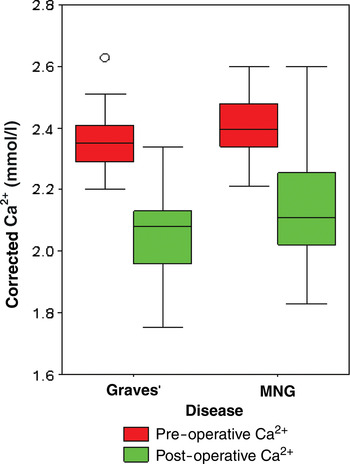
The pre-operative corrected calcium concentration was retrospectively available for 68 per cent of Graves’ disease patients (mean = 2.36 mmol/l, SD = 0.10) and 72 per cent of multinodular goitre patients (mean = 2.40 mmol/l, SD = 0.09). No patient in either group was hypocalcaemic pre-operatively; however, one patient in the Graves’ disease group had a corrected serum calcium concentration slightly above the normal range, at 2.63 mmol/l. There was no significant difference between the mean pre-operative corrected calcium concentrations of the two groups (p = 0.11) (Figure 2).
Corrected serum calcium concentrations pre-operatively and on day 1 after total thyroidectomy. Box plots with outliers represents means, standard deviations, and maximum and minimum values. MNG = multinodular goitre

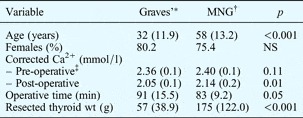
The Graves’ disease group were younger than the multinodular goitre group: mean ages were 32 years (SD = 11.8) compared with 58 years (SD = 13.2), respectively.
The mean thyroidectomy operating time for Graves’ disease patients was longer, at 91 minutes (SD = 15.5), compared with 83 minutes (SD = 19.2) for multinodular goitre patients, although the mean weight of Graves’ disease thyroids was significantly lighter, at 57 g (SD = 38.9), compared with that of multinodular goitre thyroids, at 175 g (SD = 122.0) (p < 0.001) (Table II).
Total thyroidectomy patient data, by disease

Data represent means (standard deviations) unless otherwise specified. *n = 37; †n = 61. ‡Calculation based on results for 25 Graves’ disease patients and 44 multinodular goitre (MNG) patients. NS = not significant at 5% level; min = minutes; wt = weight
Discussion
Our data suggest that patients with Graves’ disease are at increased risk of hypocalcaemia following total thyroidectomy, and are more likely to require treatment with calcium supplements prior to their discharge from hospital, compared with patients with multinodular goitre.
Our results have potentially important implications for the management of patients with Graves’ disease. Firstly, a patient in whom anti-thyroid medication has failed to induce remission must be informed of the increased risk of hypocalcaemia associated with thyroidectomy, compared with the published risk for multinodular goitre. Secondly, patients with Graves’ disease require close observation following total thyroidectomy and may not all be suitable for day-case surgical units.
We have previously demonstrated that measurement of intra-operative serum parathyroid hormone concentration can identify patients at increased risk of hypocalcaemia.Reference Wong, Price and Scott-Coombes2 Patients with Graves’ disease may be particularly good candidates for the use of this technique.
There are a number of postulated hypotheses for the underlying mechanism of hypocalcaemia following thyroidectomy for Graves’ disease, including (1) surgical injury to the parathyroid glands as a result of a more vascular thyroid gland,Reference Yamashita, Noguchi, Murakami, Uchino, Watanabe and Ohshima3 (2) release of calcitonin following manipulation of the thyroid,Reference Escobar-Jimenez, Torres, Picon, Megias and Moll4 and (3) rapid skeletal uptake of calcium due to the sudden reversal of thyrotoxic osteodystrophy present before thyroidectomy.Reference Wilkin, Isles, Paterson, Crooks and Beck5–Reference Michie, Duncan, Hamer-Hodges, Bewsher, Stowers and Pegg7
In the present study, we did not attempt to establish the prevailing mechanism which causes hypothyroidism. Nonetheless, we identified that the operative time required to remove the thyroid gland in a patient with Graves’ disease was significantly longer than that required for the same operation in a patient with multinodular goitre. Although there was no particular difference in the operative field of dissection between the two groups, since the Graves’ thyroid gland was typically smaller, our result suggests a more difficult dissection, possibly as a result of the demonstrably increased blood supply to the thyroid gland in Graves’ disease.Reference Erdogan, Anil, Cesur, Baskal and Erdogan8
• Most published data on total thyroidectomy complications relate to multinodular goitre patients
• Comparison of multinodular goitre and Graves’ disease patients shows that Grave's disease increases the risk of post-operative hypocalcaemia requiring calcium supplementation
• Measurements of the cost-effectiveness of treating Graves' disease by thyroidectomy may not be valid if complication rates (and associated costs) are extrapolated from data collected on patients undergoing throidectomy for multinodular goiter
In the published literature, there is a wide discrepancy between different authors’ definitions of post-operative hypocalcaemia following thyroid surgery. Some studies have only included cases which are symptomatic,Reference Friguglietti, Lin and Kulcsar9 or in which treatment has been initiated,Reference Perzik10 whereas other authors have not declared their definition.Reference Thomusch, Machens, Sekulla, Ukkat, Lippert and Gastinger11 We measured the serum calcium concentration on the morning of the first post-operative day, because this was the critical time for deciding whether to discharge the patient from the ambulatory surgery unit and whether to start calcium supplementation. It is possible that, in doing so, we underestimated the overall prevalence of post-operative hypocalcaemia, since a patient's serum calcium concentration can fall further beyond the first 24-hour period.
Many centres now aim to discharge patients within 24 hours of thyroidectomy. However, our results suggest that arrangements should be made for patients with Graves’ disease to be monitored closely for hypocalcaemia, beyond 24 hours post-operatively.
Conclusion
This study demonstrates that the risk of hypocalcaemia requiring medical treatment, following total thyroidectomy for Graves' disease is significantly higher than following total thyroidectomy for multinodular goitre. We expect that these results will provide evidence to both better inform Graves' disease patients of the likely risks of total thyroidectomy, compared with those of anti-thyroid medication or radioiodine therapy and to more accurately compare the cost-effectiveness of these three treatment options.
Acknowledgement
The authors would like to thank Mr. David Pothier for advice and critical comments on the manuscripts.