INTRODUCTION
Geographical patterns of genetic variation reflect both historical process and present gene flow attributable to the biological characteristics of the organism under study (Fauvelot & Planes, Reference Fauvelot and Planes2002; Imron et al., Reference Imron, Hale, Degnan and Degnan2007). A number of mechanisms have been suggested to explain how population structure can evolve in a marine environment without any obvious physical boundary to gene flow including physical oceanographic factors, such as currents, tides, violent storms, and historical changes; and such biological factors as local recruitment, larval transport potential, or reproductive strategy (reviewed in Hansen et al., Reference Hansen, Nielsen and Grønkjaer2007). Historical process associated with climatic oscillations through geological time is one of the most important factors in determining the current distribution of species. Climatic changes have had a major influence on the formation of species, the establishment of major intraspecific phylogenetic lineages, and the patterning of the present-day distribution of plant and animal species (Hewitt, Reference Hewitt2000). The north-western (NW) Pacific is characterized by marginal seas, which were particularly impacted by Pleistocene glacial cycles. Seascape dynamics of this region are proved to have profoundly influenced the intraspecific genetic diversity of marine species by DNA markers (review in Shen et al., Reference Shen, Jamandre, Hsu, Tzeng and Durand2011). The overlapping distribution of multiple divergent lineages is a striking phylogeographic pattern that is common to most of the organisms that have been investigated in this region, and it raises the question of whether some of these lineages are in fact cryptic species (Shen et al., Reference Shen, Jamandre, Hsu, Tzeng and Durand2011). For example, three highly divergent mitochondrial lineages were detected in flathead mullet, Mugil cephalus. This high inter-lineage divergence raises questions about the taxonomic status of M. cephalus. However, mitochondrial DNA phylogeny represents only the genealogy of a single gene that is almost only maternally inherited. Therefore, the results need to be confirmed by congruence with the results obtained from a nuclear gene. Shen et al. (Reference Shen, Jamandre, Hsu, Tzeng and Durand2011) used the combination of mtDNA marker and nuclear marker amplified fragment length polymorphism (AFLP) to successfully identify three cryptic species in M. cephalus and solve the status of three mtDNA lineages in this species.
Redlip mullet Liza haematocheilus (Temminck & Schlegel, 1845) is a member of the family Mugilidae and a close relative of M. cephalus. This euryhaline estuarine-dependent fish occurs in shallow coastal waters as well as freshwater regions of rivers from Japan in the north, through the Korean Peninsula, to the coast of China in the south (Zhu et al., Reference Zhu, Zhang and Cheng1963; Masuda et al., Reference Masuda, Amaoka, Araga, Uyeno and Yoshino1984). The biology of this species is similar to M. cephalus. Previous study has showed that three distinct divergent mitochondrial lineages exist in L. haematocheilus in the NW Pacific (Liu et al., Reference Liu, Gao, Wu and Zhang2007). Net genetic distance between lineages varied from 1.53% to 2.41%. However, the status of three distinct lineages was not solved by mtDNA. AFLP was introduced by Vos et al. (Reference Vos, Hogers, Bleeker, Reijans, van de Lee, Hornes, Friters, Pot, Paleman, Kuiper and Zabeau1995). It can provide a very large number of polymorphic markers with very fast and relatively simple laboratory work. This technique seems to be very robust and its reproducibility was tested among different laboratories with high success. Another important aspect of this technique is that it does not require any prior knowledge about the taxa that is going to be investigated, and the same protocol could be used for a wide range of organisms. The AFLP method has been successfully used in fish evolution and population genetic studies (Wang et al., Reference Wang, Jayasankar and Khoo2000; Xia & Jiang, Reference Xia and Jiang2006; Liu et al., Reference Liu, Lun, Zhang and Yang2009; Song et al., Reference Song, Zhang and Gao2010). In the present study, eight populations of L. haematocheilus in the NW Pacific were analysed using AFLP to estimate the level of independence of the different L. haematocheilus mtDNA lineages.
MATERIALS AND METHODS
Sample collection
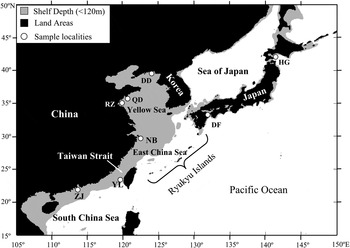
Liza haematocheilus specimens (N = 91) were collected from 8 localities from China to Japan during 2004–2005 (Table 1; Figure 1). Muscle samples were preserved in 70–90% ethanol before DNA extraction.
Locations for sample collection of Liza haematocheilus. Shaded sea areas are continental shelves that would have been dry during periods of low sea level. Populations are marked by abbreviations that correspond to abbreviations in Table 1.

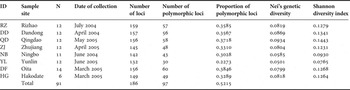
Parameters of genetic diversity for populations of Liza haematocheila.

AFLP analysis
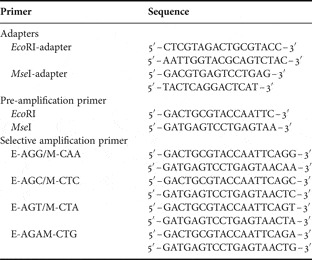
Genomic DNA was isolated from muscle tissue by proteinase K digestion followed by a standard phenol–chloroform method. DNA was subsequently resuspended in 100 µl of TE buffer (10 mmol/l Tris-Cl, 1 mmol/l EDTA, PH = 8.0). Procedures of AFLP were essentially based on Vos et al. (Reference Vos, Hogers, Bleeker, Reijans, van de Lee, Hornes, Friters, Pot, Paleman, Kuiper and Zabeau1995) and Wang et al. (Reference Wang, Jayasankar and Khoo2000). About 100 ng genomic DNA was digested with 1 unit of EcoR I and Mse I (NEB) at 37°C for 6 hours. Double-stranded adapters were ligated to the restriction fragments at 20°C overnight after adding 1 µl 10 × ligation buffer, 5 pmol EcoR I adapter (EcoR I-1/EcoR I-2; Table 1), 50 pmol Mse I adapter (MseI-1/MseI-2; Table 1), 0.3 unit of T4 DNA ligase (Promega) with a final volume of 10 µl. Preamplification polymerase chain reaction (PCR) was conducted using an Eppendorf Thermocycler (Mastercycler 5334) with a pair of primers containing a single selective nucleotide. Amplification was performed at an annealing temperature of 53°C for 30 seconds. The 20 µl PCR product mixture was diluted 10-fold with distilled water and used as templates for the subsequent selective PCR amplification. The selective amplifications were carried out in 20 µl PCR reaction volume containing 1 µl productions of preamplifications, 1 × PCR reaction buffer, 150 µM of each dNTP, 30 ng of each selective primer, and 0.5 unit of Taq DNA polymerase on a gradient thermal cycler (Mastercycler 5334) with a touchdown cycling profile of nine cycles of 30 seconds at 94°C, 30 seconds at 65°C (−1°C at each cycle), and 30 seconds at 72°C followed by the cycling profile of 28 cycles of 30 seconds at 94°C, 30 seconds at 56°C, and 1 minute at 72°C. The final step was a prolonged extension of 7 minutes at 72°C. PCR products were run on 6.0% denaturing polyacrylamide gel electrophoresis (PAGE) for 2.5 hours at 50°C on the Sequi-Gen GT Sequencing Cell (Bio-Rad, USA), and finally detected using the silver staining technique modified from Merril et al. (Reference Merril, Switzer and Van Keuren1979). Sequences of AFLP adapters and primers are listed in Table 1. Four primer combinations (E-AGG/M-CAA, E-AGC/M-CTC, E-AGT/M-CTA and E-AGA/M-CTG) were chosen for AFLP analysis (Table 2).
Adapter and primer sequences used in amplified fragment length polymorphism analysis.

Data analysis
Amplified fragment length polymorphism bands were scored for presence (1) or absent (0), and transformed into 0/1 binary character matrix. Proportion of polymorphic loci, Nei's genetic diversity and Nei's standard genetic distance (Nei, Reference Nei1972) were calculated by POPGEN. Similarity indices were calculated using the formula S = 2Nab/(Na + Nb) (Nei & Li, Reference Nei and Li1979), where Na and Nb are the number of bands in individuals a and b, respectively and Nab is the number of sharing bands. Genetic distances between individuals were computed using the formula D = –ln S (Nei & Li, Reference Nei and Li1979). Genetic relationships among populations were estimated by constructing an Unweighted Pair Group Method with Arithmetic Mean (UPGMA) tree based on Nei's standard genetic distance in Mega 4.0. Population structure of L. haematocheilus was investigated using the analysis of molecular variance (AMOVA) software package and F-statistics in ARLEQUIN 2.000.
RESULTS
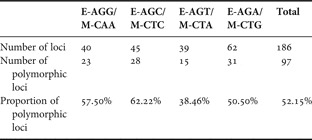
Among 91 individuals, a total of 186 fragments, with a size range of 50–500 bp, were amplified by four AFLP primer combinations, with an average of 46.5 bands for each primer combination (Table 3). The proportion of polymorphic loci overall populations was 91.74% (Table 1). The number of polymorphic loci amplified by four primer combinations for each population ranged from 30 to 60, with the average of 50.12 polymorphic loci per population.
Number of bands generated by primer combinations.

Low genetic diversity was observed in all geographical populations. The population with the highest proportion of polymorphic loci (38.46%) was population Oita, whereas that with the lowest value was population Yunlin, in which the proportion of polymorphic loci and number of polymorphic loci was 22.73% and 30, respectively. The population with the highest Nei's genetic diversity was Qingdao population, with a value of 0.0934, the lowest Nei's genetic diversity was also found in Yunlin population, only with a value of 0.0501 (Table 1).
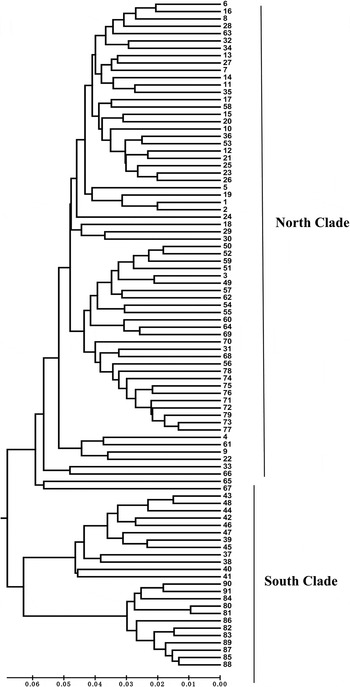
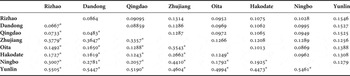
The UPGMA tree of all individuals based on Nei genetic distance revealed two clusters (Figure 2). Individuals of the geographically close populations Zhujiang and Yunlin clustered together to form the South Clade. Individuals from north of China and Japan formed the North Clade. Three were very strong geographical differences in clusters, two clades represent north and south populations of L. haematocheilus. Based on the UPGMA tree, the 8 populations were clustered into 2 groups, supporting the separation of the South Clade and North Clade. In order to reveal the genetic structure of this species, the 2-level hierarchical AMOVA was conducted. Significant separation of the North and South clades was also supported by AMOVA, with 23.82% of all variance being partitioned between the two clades (F CT = 0.23 P = 0.04). The genetic structures of the populations within two clades were also investigated by AMOVA. In the North Clade, 84.29% of the genetic variation was found within populations, whereas 15.71% of the variation (P = 0.000) was between populations, indicating significant population structure in the north populations. AMOVA indicated that the genetic variation between populations was 46.04% (P = 0.000), indicating that large and significant genetic differentiation existed in the South Clade. Based on the UPGMA tree of all individuals, complete genetic break between populations Yunlin and Zhujiang were detected. Moreover, pairwise F ST values among all populations were also significant (P < 0.05), ranging from 0.0667 to 0.5461 (Table 4), supporting significant genetic differentiation among populations and high limited gene flow among populations.
Unweighted Pair Group Method with Arithmetic Mean tree of all individuals based on the Nei & Li (Reference Nei and Li1979) distance (Rizhao 1–12; Dandong 13–24; Qingdao 25–36; Zhujiang 37–48; Oita 49–62; Hakodate 63–68; Ningbo 69–79; Yunlin 80–91).

Nei's genetic distance (above) and pairwise F ST (below) between populations of Liza haematocheilus.

*, significant P < 0.01.
DISCUSSION
The conservation of genetic diversity is important for the long-term interest of any species (Falk & Holsinger, Reference Falk and Holsinger1991). Genetic variation in L. haematocheilus had been studied by isozymes and mitochondrial DNA sequences (Liu et al., Reference Liu, Gao, Wu and Zhang2007; Meng et al., Reference Meng, Gao and Zheng2007). Isozyme result indicated the possible divergence of L. haematocheilus between the South China Sea and the other sea areas of China due to geographical isolation (Meng et al., Reference Meng, Gao and Zheng2007). MtDNA control region sequences analysis of L. haematocheilus revealed three mtDNA distinct lineages in the NW Pacific, reflecting isolation of the three marginal seas of the NW Pacific during Pleistocene low sea-level stands (Liu et al., Reference Liu, Gao, Wu and Zhang2007). However, because the mtDNA control region in Liu et al. (Reference Liu, Gao, Wu and Zhang2007) is maternally inherited, it is not possible to determine whether the presence of divergent mitochondrial lineages in the same sample is a result of secondary contact after an extended period of isolation and/or the presence of two sibling species. In the present study, two separate geographical groups were detected in this species by AFLP markers. The north group included Rizhao, Dandong, Qingdao, Ningbo, Oita and Hakodate populations. The south group included Yunlin and Zhujiang populations. The AFLP result was consistent with the isozyme analysis, supporting the divergence between South China Sea populations and other areas. The incongruence between nuclear groups and mitochondrial lineages suggests the three distinct lineages do not represent cryptic species and the presence of divergent mitochondrial lineages in the same sample is a result of secondary contact after an extended period of isolation. However, the complete genetic break between nuclear groups in the present study proved that L. haematocheilus might be a species complex rather than a unique panmictic unit. The present study demonstrates that L. haematocheilus is indeed composed of at least two genetically divergent groups in the NW Pacific.
The causes of differentiation in marine organisms are not well understood. In marine environments, the geographical structure of populations may be influenced by local environmental conditions and the life history of the species. The geographical structure of a species is not only due to present factors, but also more importantly to historical factors (Santos et al., Reference Santos, Schneider and Sampaio2003). Since the Plio-Pleistocene, successive periods of sea-level regression have directly impacted the species connectivity of the marginal seas of the NW Pacific. The genetic differentiation of two groups of L. haematocheilus is related to past physical barriers to gene flow between the South China Sea and East China Sea after the secondary contact of three mtDNA lineages. During the Pleistocene glacial period, the South China Sea was an enclosed inland sea connected to the Pacific through the Bashi Strait between Taiwan and Luzon (Wang, Reference Wang1999) (Figure 1). Lowered sea levels during the Pleistocene period would have resulted in physical barriers between the South China Sea and East China Sea. The past physical barriers between the South China Sea and East China Sea had been supported by the mtDNA analysis and isozyme data of L. haematocheilus (Liu et al., Reference Liu, Gao, Wu and Zhang2007; Meng et al., Reference Meng, Gao and Zheng2007). Similar genetic breaks have also been described between the East China Sea and South China Sea populations of shellfish and Mugil cephalus (Li et al., Reference Li, Li, Song and Su2003; Pan et al., Reference Pan, Song, Pu and Sun2005; Shen et al., 2011).
Besides the historical factor, genetic differentiation among populations of L. haematocheilus could be explained by the features of nearshore discontinuous distribution and the unique life history of this species. The majority of shallow-water marine taxa have a bipartite life cycle in which relatively sedentary, demersal adult stages produce larvae that develop in the pelagic environment before recruiting to the benthos. Widely distributed marine organisms with planktonic larvae were once assumed to lack population structuring in open ocean environments due to the lack of apparent barriers to gene flow (Rosenblatt & Waples, Reference Rosenblatt and Waples1986). The spatial extent of larval dispersal in marine systems has traditionally been inferred from estimates of pelagic durations of larval dispersive stages, from the modelled movements of passive particles by ocean currents. Liza haematocheilus is a euryhaline estuarine-dependent species. A short migration between the low-salinity for spawning and feeding and the high-salinity offshore water for over-winter is reported in this species. Though L. haematocheilus adults are relatively sedentary, the length of the pelagic larval stage until settlement is about 4 weeks (Li, Reference Li1992; Yoshimatsu et al., Reference Yoshimatsu, Matsui and Kitajima1992). Juveniles (11–20 mm standard length) form dense schools and migrate to inshore waters and shallow estuaries (Li, Reference Li1992). These early life-history characteristics indicate that potential larval dispersal of L. haematocheilus is high. However, nuclear genetic heterogeneity is recorded between two groups, which revealed no contemporary gene flow between the North Clade and South Clade. Furthermore, strong genetic structure within clades shows highly limited genetic exchange between close populations of L. haematocheilus in the absence of contemporary dispersal barriers. The discovery of marked geographical structure in L. haematocheilus indicates low level of dispersal and evidence for local larval retention. The short migration of L. haematocheilus and larval local retention might reduce gene flow and enhance the genetic differentiation between neighbour populations. Coastal marine fishes utilize near-shore or estuarine habitat as nursery grounds for larvae and juveniles. In contrast to pelagic or reef-based species, where reproduction often involves long-distance transport of larvae, such coastal species have developed strategies to minimize offshore transplant of larvae (Checkley et al., Reference Checkley, Raman, Maillet and Mason1988; Sponaugle et al., 2002). The mtDNA control region sequence analysis of L. haematocheilus also supported the limited dispersal potential of this species. The populations of cofamily species, Mugil cephalus, with the similar ecological feature of L. haematocheilus showed the similar genetic pattern. The prevalence of self-recruitment was regarded as the reason for limited gene flow among M. cephalus populations. The results in the present study showed that the simple assumption that extended pelagic larval duration will result in broad dispersal is a faulty foundation for the management of fisheries resources and for understanding the geographical context of speciation in the sea.
This study provided the molecular evidence for the existence of different genetic groups, and solved the status of mtDNA lineages in L. haematocheilus by AFLP markers. The present study also demonstrated the limited dispersal potential of L. haematocheilus. AFLP markers are effective methods to delineate genetic diversity and structure of population and can provide effective conservation and management strategies for species. However, only 91 individuals were analysed in this species; this is not a sufficient number of individuals in population genetics using variable markers. It is necessary to increase the size of the sample of individuals and use different molecular markers for assessing the genetic structures of L. haematocheilus.
ACKNOWLEDGEMENTS
The present study could not have been carried out without the willing help of those listed in collecting specimens: Mr Dian-Rong Sun, Dr Chin-Wei Chang, Dr Chao Chen, Mr Li-Yuan Li, Dr Koji Yokogawa and Mr Tatsunori Wada. Professor Jin-Xian Liu and two anonymous referees gave insightful comments on this manuscripts. This work was supported by the National Natural Science Foundation of China (grant number 41006075), grant from Key Lab of Manculture and Enhancement of Zhejiang Province, Foundation for Distinguished Young Talants in Higher Education of Quangdon, Ching (LYM10088), Education Department of Zhejiang Province Outstanding Young Teachers Program and the Open Foundation from Ocean Fishery Science and Technology in the Most Important Subjects of Zhejiang (grant number 20100106).