Introduction
Lecanora Ach. (Lecanoraceae) is a large genus comprising c. 800 species and is defined by hyaline and simple spores, Lecanora-type asci, green algal photobionts, an usually thalline margin of the apothecium and generally a crustose thallus (LaGreca & Lumbsh Reference LaGreca and Lumbsch2001; Pérez-Ortega et al. in press). Lecanora s. str. comprises c. 300 species and is characterized by the presence of oxalate crystals in the amphithecium and the production of atranorin and/or usnic acid in the cortex (LaGreca & Lumbsch Reference LaGreca and Lumbsch2001). This genus has been divided into several groups, which were until recently circumscribed using morphological, anatomical or chemical characters (Arup & Grube Reference Arup and Grube1998). In recent years, molecular studies began clarifying the phylogenetic relationships in and between some of these groups. These indicate that Lecanora s. str. is a heterogenous assemblage of species (Grube et al. Reference Grube, Baloch and Arup2004), but the relationships between groups are still largely unresolved (Pérez-Ortega et al. in press).
The core of Lecanora is the L. subfusca group, which contains the type species L. allophana Nyl., and is identified by the presence of a crustose thallus containing atranorin, either as a major or trace constituent; as well as crystals in the amphithecium and filiform conidia (Lumbsch et al. Reference Lumbsch, Messuti and Nash2003). So far, no phylogenetic studies have been performed in order to assess the phylogenetic relationships of species currently included in this group, although some were used in studies relative to other groups, namely on the subgenus Placodium and the L. rupicola and L. varia groups. Both the subgenus Placodium and the L. varia group were found to be heterogenous, and some species considered to belong here were found to group with other Lecanora groups (Arup & Grube Reference Arup and Grube1998; Pérez-Ortega et al. in press). The L. rupicola group, previously circumscribed to saxicolous species containing sordidone, was found to be monophyletic and including all species containing sordidone, regardless of their substratum, such as the corticolous species of the L. carpinea group (Grube et al. Reference Grube, Baloch and Arup2004). Further, it has been shown that the genus Rhizoplaca Zopf is polyphyletic and is nested within several groups of Lecanora (Arup & Grube Reference Arup and Grube2000). More studies are therefore needed to clarify the phylogenetic relationships between members of Lecanora, which may require more intensive taxon sampling (Pérez-Ortega et al. in press).
Lecanora sorediomarginata sp. nov. was discovered at Dunas de Quiaios (Figueira da Foz) on the central west coast of Portugal. It is epiphytic on Pinus pinaster Aiton and P. pinea L. Dunas de Quiaios is a pine forest on a sand dune area, which was scarcely vegetated until 1924 (Almeida Reference Almeida1997). In that year the Portuguese Forest Services started stabilizing the dunes by sowing P. pinaster, the species selected to promote dune stabilization, together with Acacia longifolia (Andrews) Willd, A. retinoides Schltdl., Corema album (L.) D. Don, Myrica faya Aiton and Ulex europaeus L., in the interior dunes. Since the original seeding, Cistus salvifolius L., Cytisus grandiflorus (Brot.) DC., Halimium halimifolium (L.) Willk., H. calycinum (L.) K. Koch and Lavandula stoechas L. subsp. sampaiana Rozeira have spontaneously naturalized and proliferated in the area (Almeida Reference Almeida1997). Other species occurring in secondary dunes include Acacia melanoxylon R. Br., Arbutus unedo L., Eucalyptus globulus Labill. and P. pinea, the last thought by some authors to be the original forest species of these sand dunes (Danielsen Reference Danielsen2008). In the depressions and flat surfaces of these dunes hygrophilic species such as Schoenus nigricans L. and Scirpus holoschoenus L., among others, can be detected (Almeida Reference Almeida1997).
This pine forest on sand dunes is rich in epiphytic and terrestrial lichens. The most abundant epiphytic lichens are Chrysothrix candelaris (L.) J. R. Laundon and Pyrrhospora quernea (Dicks.) Körb., followed by Hypogymnia physodes (L.) Nyl., Flavoparmelia caperata (L.) Hale, Parmotrema reticulatum (Taylor) M. Choisy, Usnea rubicunda Stirt. and U. subscabrosa Nyl. ex Motyka. Other interesting species have also been found here, including Hypotrachyna lividescens (Kurok.) Hale and H. pseudosinuosa (Asahina) Hale, species not previously known from the Iberian Peninsula (Rodrigues et al. Reference Rodrigues, Elix, Vingada, Alfonso and Soares2007). Chrysothrix flavovirens Tønsberg, Lepraria elobata Tønsberg and Ochrolechia arborea (Kreyer) Almb. have also been found at Dunas de Quiaios and are novelties for the Portuguese lichen flora (S. A. Rodrigues et al., unpublished data).
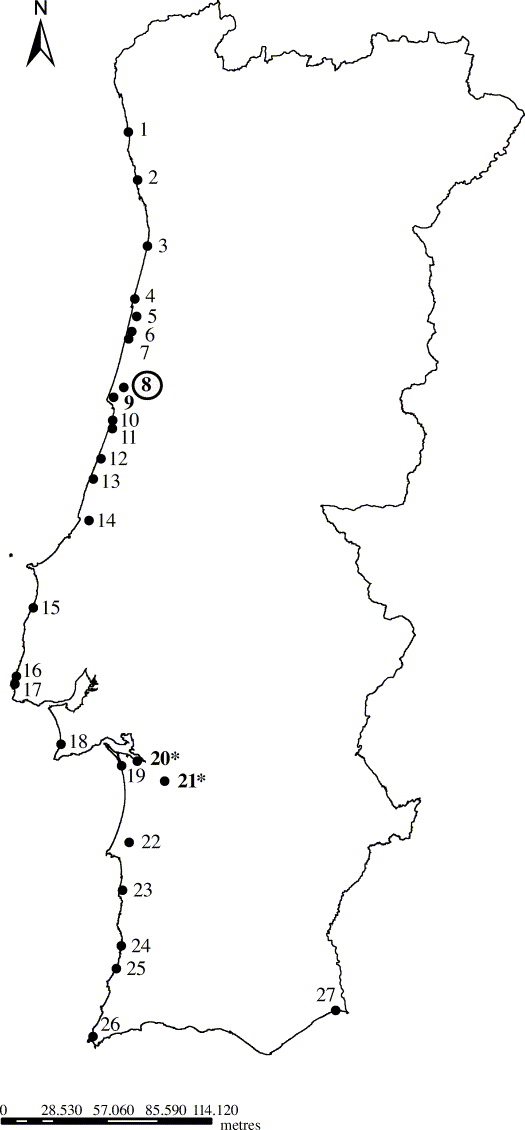
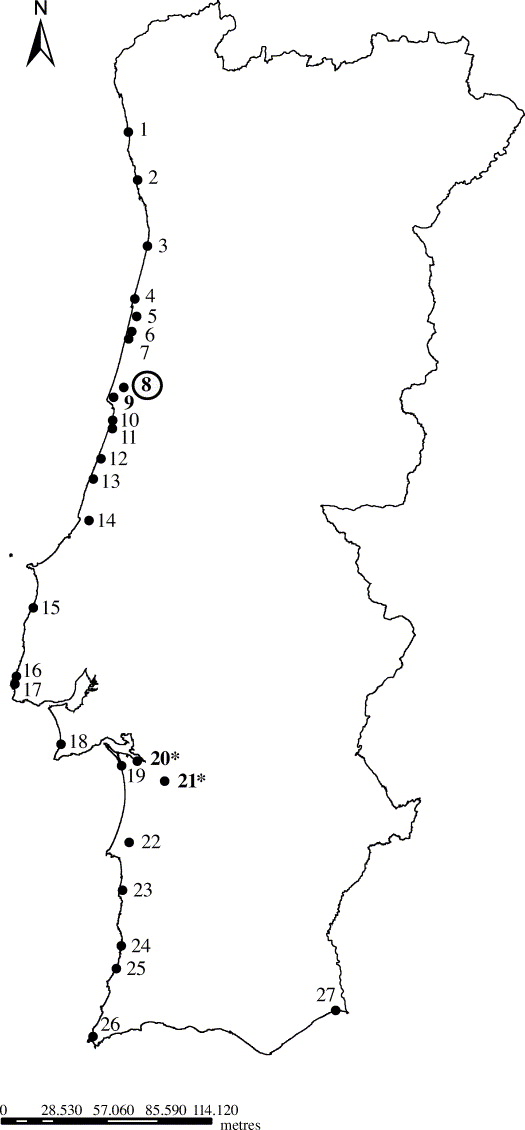
Pine forests on sand dunes are common along the Portuguese coast. The most famous is probably the pine forest of Leiria known as “Pinhal de Leiria”, where seeding was greatly encouraged by king D. Dinis (13–14th century) (Arroteia Reference Arroteia2009). Given the large number of pine forests on sand dunes along the coast, surveys were undertaken in other similar areas, ranging from north to south-eastern Portugal (Fig. 1) in search of L. sorediomarginata. In most of the forests the main phorophyte is P. pinaster, but in Mata de Valverde (Alcácer do Sal) (Fig. 1, 21) P. pinea is the main phorophyte. Some neighbouring mountains beyond the sand dunes were also visited, including Serra da Boa Viagem (Figueira da Foz) (Fig. 1, 9) and Serra de Sintra (Sintra) (Fig. 1, 17). The type locality, Dunas de Quiaios (Figueira da Foz) (Fig. 1, 8), as well as several of the localities visited are national forests or forest perimeters owned and/or partially managed by Portuguese Forest Services ( Fig. 1, 3, 5–14, 17, 21–22). Some areas are within Natural Parks or Nature Reserves, as is the case of the Natural Parks of Litoral Norte (Fig. 1, 1), Sintra-Cascais (Fig. 1, 16, 17), Arrábida (Fig. 1, 18) and Sudoeste Alentejano e Costa Vicentina (Fig. 1, 23–26); and of the Nature Reserves of S. Jacinto (Fig. 1, 4) and of Estuário do Sado (Fig. 1, 19–20). Most of the areas surveyed belong to the Natura 2000 Network (Fig. 1, 1, 4, 6–8, 15, 17–20, 23–27), Dunas de Quiaios being part of the Site “Dunas de Mira, Gândara e Gafanhas” (PTCON0055) (ICN 2006).
Locations where Lecanora sorediomarginata was found along the Portuguese coast. 1- Fão (Esposende), 2- Parque de Campismo de Angeiras (Matosinhos), 3- Dunas de Ovar (Ovar), 4- Dunas de S. Jacinto (Aveiro), 5- Dunas da Gafanha (Ílhavo), 6- Dunas de Vagos (Vagos), 7- Dunas de Mira (Mira), 8- Dunas de Quiaios (Figueira da Foz), 9- Mata do Prazo de Santa Marinha/Serra da Boa Viagem (Figueira da Foz), 10- Dunas da Leirosa (Figueira da Foz), 11- Mata do Urso (Figueira da Foz), 12- Mata do Pedrógão (Leiria), 13- Pinhal de Leiria (Marinha Grande), 14- Mata do Valado (Nazaré), 15- Praia do Seixo (Torres Vedras), 16- Praia das Maçãs (Sintra), 17- Serra de Sintra (Sintra), 18- Praia do Moinho de Baixo (Sesimbra), 19- Praia da Comporta (Alcácer do Sal), 20- Murta (Alcácer do Sal), 21-Mata de Valverde (Alcácer do Sal), 22- Área Florestal de Sines (Santiago do Cacém), 23- Praia do Malhão (Odemira), 24- Praia do Carvalhal (Odemira), 25- Praia de Vale dos Homens (Aljezur), 26- Pinhal de Vale Santo (Vila do Bispo), 27- Dunas de Vila Real de Santo António (Vila Real de Santo António). Numbers in bold refer to locations where L. sorediomarginata was found both on Pinus pinaster and P. pinea, while numbers in bold and with an asterisk refer to locations where this species was found only on P. pinea. The encircled number refers to the type locality.
Materials and Methods
The morphology of the thallus was examined under stereomicroscopes and images were taken with a stereomicroscope (Nikon SMZ1500), using the program NIS-Elements (Nikon). The measurement of morphological structures, such as wart size, diameter of apothecia and thickness of the apothecial margin were made using a Leica MS5 stereomicroscope. The thickness of the thallus, as well as the size of consoredia and soredia, were made in samples mounted in lactophenol cotton blue and viewed under a Leitz HM-LUX 3 microscope.
Anatomical observations of the apothecia were performed on hand-cut sections and also on microtome sections mounted in K/I and lactophenol cotton blue. For obtaining microtome sections, apothecia were placed in gelatine (Tissue-Tek, Sakura), frozen inside a microtome (Microm HM 505 E) at −20°C, and 14 µm thick sections cut. Sections for spot tests with K and C were mounted in distilled water. The same procedure was used for viewing the reactions of the epihymenial crystals following the addition of K and HNO3. Images of the apothecial sections were taken with an epifluorescence microscope (Optihot 2, Nikon), using the imaging program NIS-Elements (Nikon). Images were taken under normal and polarized light and under a UV excitation filter (EX 330-380 nm, DM 400 nm and BA 420 nm).
SEM imaging of both hand-cut and microtome sections of apothecia and of consoredia and soredia was performed with a Scanning Electron Microscope (JSM-6480LV, JEOL). Apothecial sections were mounted on SEM holders and covered with gold in a Sputter Coater (SCD 004, Balzers).
Specimens were analyzed chemically by standardized thin-layer chromatographic methods (TLC) (White & James Reference White and James1985; Elix & Ernst-Russell Reference Elix and Ernst-Russell1993; Orange et al. Reference Orange, James and White2001) and by high performance liquid chromatography (HPLC) (Elix et al. Reference Elix, Giralt and Wardlaw2003).
Confirmation of the identity of L. sorediomarginata from distinct localities was performed by morphological and chemical analysis (TLC) of one to three specimens from each location.
The locations visited were georeferenced using GoogleEarth and maps were plotted using ArcGis version 9.2.
Phylogenetic analysis
For DNA extraction, soredia and apothecia were used from L. sorediomarginata and L. lividocinerea Bagl. respectively; they were separated from the thallus with the help of forceps. Special care was taken to avoid areas with possible contaminating fungi. Samples were extracted using the DNEasy Plant Mini Kit (Qiagen®), following the manufacturer's protocol, with minor modifications (Crespo et al. Reference Crespo, Blanco and Hawksworth2001). PCR reactions were prepared for a 25 µl final volume, containing 1·25 µl of each primer (10 µM), 17·5 µl of distilled water and 5 µl of the DNA template; PuReTaq Ready-To-Go PCR beads (GE Health Care, Amersham Biosciences, 2004) were added to the mix according to the manufacturer's instructions. PCR amplifications were carried out in a PTC-100 Peltier® Thermal Cycler, using the following conditions: initial denaturation for 4 min at 94°C, followed by 3 cycles of 1 min at 94°C, 1·30 min at 54°C and 1·45 min at 72°C; then 30 cycles of 1 min at 94°C, 1 min at 48°C and 1·45 min at 72°C, and final elongation for 7 min at 72°C. The following primers were used for PCR amplifications: ITS1F (Gardes & Bruns Reference Gardes and Bruns1993), ITS4 (White et al. Reference White, Bruns, Lee, Taylor, Innis, Gelfand, Sninsky and White1990), ITS1LM (Myllys et al. Reference Myllys, Lohtander, Kallersjo and Tehler1999) and ITS2KL (Lohtander et al. Reference Lohtander, Myllys, Sundin, Kallersjo and Tehler1998). PCR products were purified using QIAquick PCR Purification Kit (Qiagen®) following the manufacturer's instructions. Both complementary strands were sequenced by Secugen (CIB, Madrid), using the BigDye® Terminator v3.1. Sequence fragments obtained were checked, assembled and edited in SeqMan v.7 (Lasergene®).
Sequence alignment
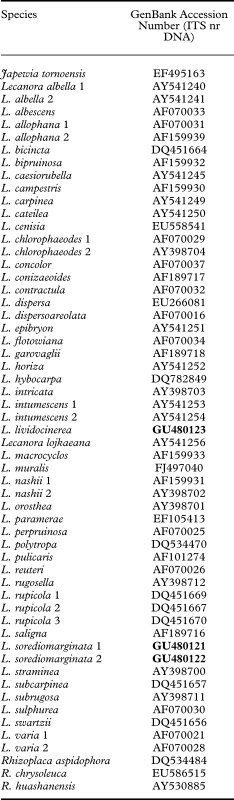
Amplicons obtained from our samples were aligned with members of the genus Lecanora found in GenBank, trying to encompass the highest diversity within the genus. For that, members of L. dispersa, polytropa, rupicola, subfusca, symmicta and varia groups, as well as of the Protoparmeliopsis group were used in the analysis, corresponding to a total of 47 ingroup and 1 outgroup taxa (Japewia tornoensis (Nyl.) Tønsberg) (Table 1). Alignments were constructed using Muscle v3.6 (Edgar Reference Edgar2004) and subsequently checked and improved by hand. Ambiguously aligned regions were removed from the alignment using Gblocks 0.91b (Castresana Reference Castresana2000). Nucleotide substitution models were statistically selected with the help of jModelTest (Posada Reference Posada2008, program available at http://darwin.uvigo.es). Model selection was made according to the Akaike information criterion (AIC, Akaike Reference Akaike1974); the General Time Reversible substitution model (Tavaré Reference Tavaré1986), with a proportion of invariant sites and site specific substitution rates following a gamma distribution with six rate categories (GTR+I+G), had the lowest –lnL value according to the AIC. Bayesian analyses were carried out using MrBayes, version 3.1.2 (Huelsenbeck & Ronquist Reference Huelsenbeck and Ronquist2001). The (MC)3 analysis was run for 5000K generations starting from a random tree, employing 8 simultaneous chains and using the default temperature of 0·2. Every 200th tree was sampled and the first 5000 trees were discarded as burn-in. Posterior probabilities of each branch were calculated by counting the frequency of trees that were visited during the course of the B/MCMC analysis. The 50% majority-rule consensus tree was obtained from the remaining trees. Trees were visualized using the program Treeview (Page Reference Page1996).
ITS rDNA sequences used in the phylogenetic analysis of Lecanora sorediomarginata and their GenBank accession numbers (newly produced sequences in bold)

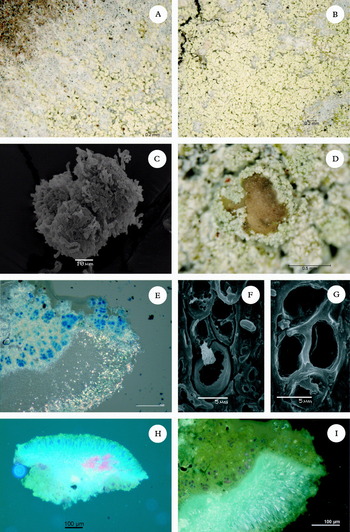
Lecanora sorediomarginata. A, margin of the thallus, where the thin prothallus is visible as well as warts that lead to soralia; B, older, entirely sorediate part of the thallus; C, consoredium, with three component-soredium; D, apothecia with a consorediate, flexuose margin; E, section of an apothecium under polarized light, crystals are present in the epihymenium, subhymenium, hypothecium, and consoredia; F, ascus with some septate spores, septation observed in both immature and mature spores; G, ascus with simple spores; H, section of an apothecium seen under UV fluorescence, a substance present in the epihymenium and in the consoredia of the amphithecium fluoresces UV+ yellow, in the subhymenium, hypothecium, parathecium is another UV+ red substance; I, section of an apothecium seen under UV filter, where the UV+ yellow fluorescence is visible in the epihymenium and the consoredia both in the amphithecium and under the apothecium. Scales: A & B = 0·2 mm; C = 10 µm; D = 0·5 mm; F & G = 5 µm; H & I = 100 µm.

Taxonomic Description
Lecanora sorediomarginata Rodrigues, Terrón & Elix sp. nov
MycoBank MB 518287
Thallus crustaceus, cretaceo-griseus usque ad viridis, verruculosus et cum sorediis. Prothallus cretaceus, ad thalli marginem et inter verrucas visibilis. Soredia verrucularum exorientes, initium sejuncta, sed posterius confluentia ad matura thalli partes. Soredia composita per tenuia soredia et consoredia. Photobiont Trebouxia. Apothecia lecanorina, rara, sejuncta vel aggregata, sessilia, 0·37–1·25 mm diam. Discus epruinosus, pallide vel obscure brunneus. Excipulum thallinum flexuosum, cum sorediis. Epihymenium brunneum, propter crystallorum brunneorum praesentiam, inspersum. Sporae ellipsoidales, incoloratae, simplices vel monoseptatae, 4·0–8·5 × 6·5–11·5 µm. Hypothecium hyalinum, algarum stratum absens. Thallus continens acidum 3,5-dichlorinum-2′-O-methylnorstenosporicum [major] et vestigiae plurium acidorum aliorum.
Typus: Portugal, Beira Litoral, Figueira da Foz, Dunas de Quiaios, MGRS: 29TNE1654, 49 m alt., epiphytic on Pinus pinaster in a pine forest on sand dunes, 15 December 2006, S. A. Rodrigues AVE-L 197 (AVE-L—holotypus; LEB- Lichenes 7581—isotypus).
(Fig. 2)
Thallus crustose, corticolous, whitish-grey to greenish, appearing as separate patches in distinct scales of Pinus bark, or forming a continuous crust up to 8 cm wide. Margin endosubstratal to very thinly episubstratal, (0) 7·5–(28·0)–52·0 µm thick (n = 9) or forming small warts, 0·07–(0·14)–0·25 mm diam. (n = 74) (Fig. 2A). In certain older areas of the thallus, it may become more obviously episubstratal and up to 38·0–(213·5)–1184·5 µm thick (n = 9). Prothallus whitish, visible at thallus margin and around warts. A black border line sometimes present between neighbouring thalli, or when in contact with P. quernea or L. lividocinerea; otherwise not visible. Thallus sorediate; soredia arising from rupture of episubstratal warts. Soralia initially isolated and sparse but becoming dense or coalescing in older areas of the thallus (Fig. 2B), composed of both fine soredia and consoredia. Consoredia greenish in the upper part and whitish grey in the lower part, coarse, somewhat elongate, 22·5–(45·0)–139·0 × 35·0–(54·5)–147·0 µm (n = 47), wall indistinct (Fig. 2C). Fine soredia usually rounded, ±slightly elongated, 16·0–(22·5)–37·0 × 17·0–(25·5)–37·0 µm (n = 57). Medulla not observed. Photobiont Trebouxia, 4·0–(8·5)–11·5 µm diam.
Apothecia rare, scattered or grouped, lecanorine, sessile, 0·37–(0·76)–1·25 mm diam. (n = 19) (Fig. 2D). Disc epruinose, pale to dark brown; amphithecium flexuose, sorediate, concolorous with the thallus, usually persistent, but sometimes consoredia eroded from part of the margin, (0) 0·05–(0·12)–0·22 mm wide. Epihymenium brownish due to the presence of fine brown crystals, crystals soluble in KOH, insoluble in HNO3, pulicaris-type (Brodo Reference Brodo1984), ±also present in the hymenium and subhymenium (POL+) (Fig. 2E), inspersed with small oil droplets. Hymenium hyaline, 60·0–(68·0)–82·0 µm high (n = 5), I+ blue; inspersed with oil droplets. Paraphyses septate, branched at the base of the hymenium or in the subhymenium, not capitate, slightly bent near the tip, leptodermatous type, c. 1·0 µm diam. Subhymenium 41·0–54·0–65·0 µm thick (n = 5). Hypothecium hyaline, 140·0–(150·0)–160·0 µm thick (n = 4) in the centre; algal layer not present. Parathecium hyaline, 23·0–(29·0)–50·0 µm thick at the extremity of the apothecia. Amphithecium entire in very early stages, but then completely composed of consoredia, lacking medulla and cortex, with small crystals (POL+), 451·0–(474·0)–526·5 µm thick (n = 5) near the parathecium. Asci clavate 32·0–(42·5)–50·0 × 12·5–(15·5)–19·0 µm (n = 7). Spores ellipsoid, hyaline, simple or monoseptate, 4·0–(6·5)–8·5 × 6·5–(10·0)–11·5 µm (n = 96) (Fig. 2F & G).
Chemistry. Soralia P−, K− or +yellow, KC+ red, C+ red. Contains: 3,5-dichloro-2′-O-methylnorstenosporic acid [major], 3,5-dichloro-2′-O-methylanziaic acid [minor], 3,5-dichloro-2′-O-methylnordivaricatic acid [minor], 5-chloro-2′-O-methylanziaic acid [trace], atranorin [minor], chloroatranorin [minor], and usnic acid [trace].
Large droplets of one or several substances that fluoresce red when a UV (330–380 nm) filter is applied were observed in the hypothecium, subhymenium and parathecium (Fig. 2H). These were larger than the oil droplets present in the hymenium and epihymenium. The presence of one or more additional substances that fluoresce yellow under the same filter were also detected in the epihymenium and amphithecium, as well as in the consoredia beneath the apothecium (Fig. 2I). These UV+ substances do not entirely coincide with the POL+ crystals, at least not in the epihymenium.
Etymology. The specific epithet “sorediomarginata” refers to the nature of the margin of the apothecia of L. sorediomarginata, which is completely sorediate at maturity.
Substratum. Bark of trunks and branches of Pinus pinaster and P. pinea.
Distribution. Occurs in coastal pine forests, as well as in nearby mountains, along the west coast of Portugal, south of Esposende (Fig. 1, 1), as well as in the south-eastern coast. It was found at varying distances from the sea, from approximately 260 m at Praia de Vale dos Homens (Rogil, Parque Natural do Sudoeste Alentejano e Costa Vicentina) (Fig. 1, 25) to approximately 22 km at Mata de Valverde (Alcácer do Sal) (Fig. 1, 21). It was found at approximately 34 m from the Sado Estuary (Fig. 1, 19). Although surveys were conducted north of Esposende at Praia da Amorosa (Viana do Castelo) and at Mata do Camarido (Caminha), L. sorediomarginata could not be found at these localities. Despite that, its presence in these more northern areas cannot be ruled out. At present it is known only from Portugal.
Selected specimens examined. Portugal: Minho: Esposende, Parque Natural do Litoral Norte, Dunas de Ofir/Fão, Fão, MGRS: 29TNF1894, epiphytic on Pinus pinaster in the border of a pine forest on sand dunes near a road, 2 m, 15 v 2009, S. A. Rodrigues (AVE-L 266, LEB-Lichenes 7826). Douro Litoral: Matosinhos, Angeiras, Parque de Campismo de Angeiras, MGRS: 29TNF2368, 23 m alt., epiphytic on P. pinaster in a small pine stand area used for camping, 15 v 2009, S. A. Rodrigues (AVE-L 268). Beira Litoral: Ovar, Dunas de Ovar, Cortegaça, MGRS: 29TNF2932, 8 m alt., epiphytic on P. pinaster in a pine forest on sand dunes, 25 vi 2009, S. A. Rodrigues (AVE-L 291, LEB-Lichenes 7827). Aveiro, Reserva Natural das Dunas de S. Jacinto: Dunas de S. Jacinto, S. Jacinto, MGRS: 29TNF2203, 8 m alt., epiphytic on P. pinaster in a pine forest on sand dunes, 23 iv 2009, S. A. Rodrigues (AVE-L 295, LEB-Lichenes 7828); Ílhavo, Dunas da Gafanha, Gafanha do Carmo, MGRS: 29TNE2394, 13 m alt., epiphytic on P. pinaster in a pine forest on sand dunes, 26 iii 2009, S. A. Rodrigues (AVE-L 235, LEB-Lichenes 7829); Vagos, Dunas de Vagos, Gafanha do Areão, MGRS: 29TNE2185, 21 m alt., epiphytic on P. pinaster in a pine forest on sand dunes, 26 iii 2009, S. A. Rodrigues (AVE-L 298, LEB-Lichenes 7830); Mira, Dunas de Mira, Barra de Mira, MGRS: 29TNE1981, 17 m alt., epiphytic on P. pinaster in a pine forest on sand dunes, 26 iii 2009, S. A. Rodrigues (AVE-L 301, LEB-Lichenes 7831); Figueira da Foz, Dunas de Quiaios, Quiaios, MGRS: 29TNE1654, 49 m alt., epiphytic on P. pinaster, 05 i 2007, S. A. Rodrigues (AVE-L 218); MGRS: 29TNE1554 (BG-L 88210); ibid. MGRS: 29TNE1655, 49 m alt., epiphytic on P. pinea, 26 vi 2009, S. A. Rodrigues (AVE-L 307); MGRS: 29TNE1758, 49 m alt., epiphytic on a branch of P. pinea in a pine forest on sand dunes, 26 vi 2009, S. A Rodrigues (LEB-Lichenes 7832); Figueira da Foz, Mata do Prazo de Santa Marinha/Serra da Boa Viagem, Serra da Boa Viagem, MGRS: 29TNE1149, 205 m alt., epiphytic on P. pinaster, 26 vi 2009, S. A. Rodrigues (AVE-L 306); MGRS: 29TNE1149, 200 m alt., epiphytic on P. pinea in a pine forest in a mountainous area, 26 vi 2009, S. A. Rodrigues (AVE-L 287, LEB-Lichenes 7833); Figueira da Foz, Dunas da Leirosa, Costa de Lavos, MGRS: 29TNE1137, 21 m alt., epiphytic on P. pinaster in a pine forest on sand dunes, 25 iv 2009, S. A. Rodrigues (AVE-L 264, LEB-Lichenes 7834); Figueira da Foz, Mata do Urso, Leirosa, MGRS: 29TNE1032, 28 m alt., epiphytic on P. pinaster in a pine forest on sand dunes, 25 iv 2009, S. A. Rodrigues (AVE-L 262, LEB-Lichenes 7835); Leiria, Mata do Pedrógão, Pedrógão, MGRS: 29S0416, 24 m alt., epiphytic on P. pinaster in a pine forest on sand dunes, 25 iv 2009, S. A. Rodrigues (AVE-L 303, LEB-Lichenes 7836). Estremadura: Marinha Grande, Pinhal de Leiria, S. Pedro de Muel, MGRS: 29SNE0004, 49 m alt., epiphytic on P. pinaster in a pine forest on sand dunes, 25 iv 2009, S. A. Rodrigues (AVE-L 256, LEB-Lichenes 7837); Nazaré, Mata do Valado, Valado dos Frades, MGRS: 29SMD9882, 27 m alt., epiphytic on P. pinaster in the border of a pine forest on sand dunes, 27 iv 2009, S. A. Rodrigues (AVE-L 246); Torres Vedras, Casal do Seixo, Praia do Seixo, MGRS: 29SMD6834, 46 m alt., epiphytic on P. pinaster in a small pine stand on sand dunes used for recreation, 27 iv 2009, S. A. Rodrigues (AVE-L 251, LEB-Lichenes 7838); Sintra, Parque Natural de Sintra-Cascais, Colares, Praia das Maçãs, MGRS: 29SMC5996, 25 m alt., epiphytic on P. pinaster in a pine stand area on sand dunes heavily used for habitation, 27 iv 2009, S. A. Rodrigues (AVE-L 239, LEB-Lichenes 7839); Sintra, Parque Natural de Sintra-Cascais, Serra de Sintra, Ulgueira, MGRS: 29SMC5992, 265 m alt., epiphytic on P. pinaster in a pine forest in a mountainous area, 27 iv 2009, S. A. Rodrigues (AVE-L 292); Sesimbra, Parque Natural da Arrábida, Aldeia do Meco, Praia do Moinho de Baixo, MGRS: 29SMC8459, 24 m alt., epiphytic on P. pinaster in a small pine stand on sand dunes, 01 vi 2009, S. A. Rodrigues (AVE-L 277). Baixo Alentejo: Alcácer do Sal, Reserva Natural do Estuário do Sado: Comporta, Praia da Comporta, MGRS: 29SNC1748, 24 m alt., epiphytic on P. pinaster in a pine forest on sand dunes, 01 vi 2009, S. A. Rodrigues (AVE-L 269); Alcácer do Sal, Reserva Natural do Estuário do Sado: Comporta, Murta, MGRS: 29SNC2651, 19 m alt., epiphytic on P. pinea in a pine forest on sand dunes, 01 vi 2009, S. A. Rodrigues (AVE-L 270); Alcácer do Sal, Mata de Valverde, Albergaria, MGRS: 29SNC4140, 79 m alt., epiphytic on P. pinea in a pine forest on sand dunes, 31 iii 2009, S. A. Rodrigues (AVE-L 234); Santiago do Cacém, Área Florestal de Sines, Relvas Verdes, MGRS: 29SNC2106, 69 m alt., epiphytic on P. pinaster in a pine forest on sand dunes, 03 iv 2009, S. A. Rodrigues (AVE-L 297); Odemira, Parque Natural do Sudoeste Alentejano e Costa Vicentina, Vila Nova de Milfontes, Praia do Malhão, MGRS: 29SNB1880, 67 m alt., epiphytic on P. pinaster in a pine stand on sand dunes near the beach, 30 v 2009, S. A. Rodrigues (AVE-L 200, LEB-Lichenes 7840); Odemira, Parque Natural do Sudoeste Alentejano e Costa Vicentina, Brejão, Praia do Carvalhal, MGRS: 29SNB1849, 30 m alt., epiphytic on P. pinaster in a small pine stand on sand dunes near the beach, S. A. Rodrigues 30 v 2009 (AVE-L 274, LEB-Lichenes 7841). Algarve: Aljezur, Parque Natural do Sudoeste Alentejano e Costa Vicentina, Rogil, Praia de Vale dos Homens, MGRS: 29SNB1537, 30 m alt., epiphytic on P. pinaster in a pine stand on sand dunes near the beach, 30 v 2009, S. A. Rodrigues (AVE-L 308); Vila do Bispo, Parque Natural do Sudoeste Alentejano e Costa Vicentina, Sagres, Pinhal de Vale Santo, MGRS: 29SNB0300, 74 m alt., epiphytic on a branch at breast height of P. pinaster, 31 v 2009, S. A. Rodrigues (AVE-L 296), epiphytic on P. pinaster in a pine forest on sand dunes, 31 v 2009, S. A. Rodrigues (LEB-Lichenes 7842); Vila Real de Santo António, Dunas de Vila Real de Santo António, Monte Gordo, Praia do Cabeço, MGRS: 29SPB3515, 7 m alt., epiphytic on P. pinaster in the border of a pine forest on sand dunes, 13 vi 2009, S. A. Rodrigues (AVE-L 284. LEB-Lichenes 7843).
Phylogenetic analysis
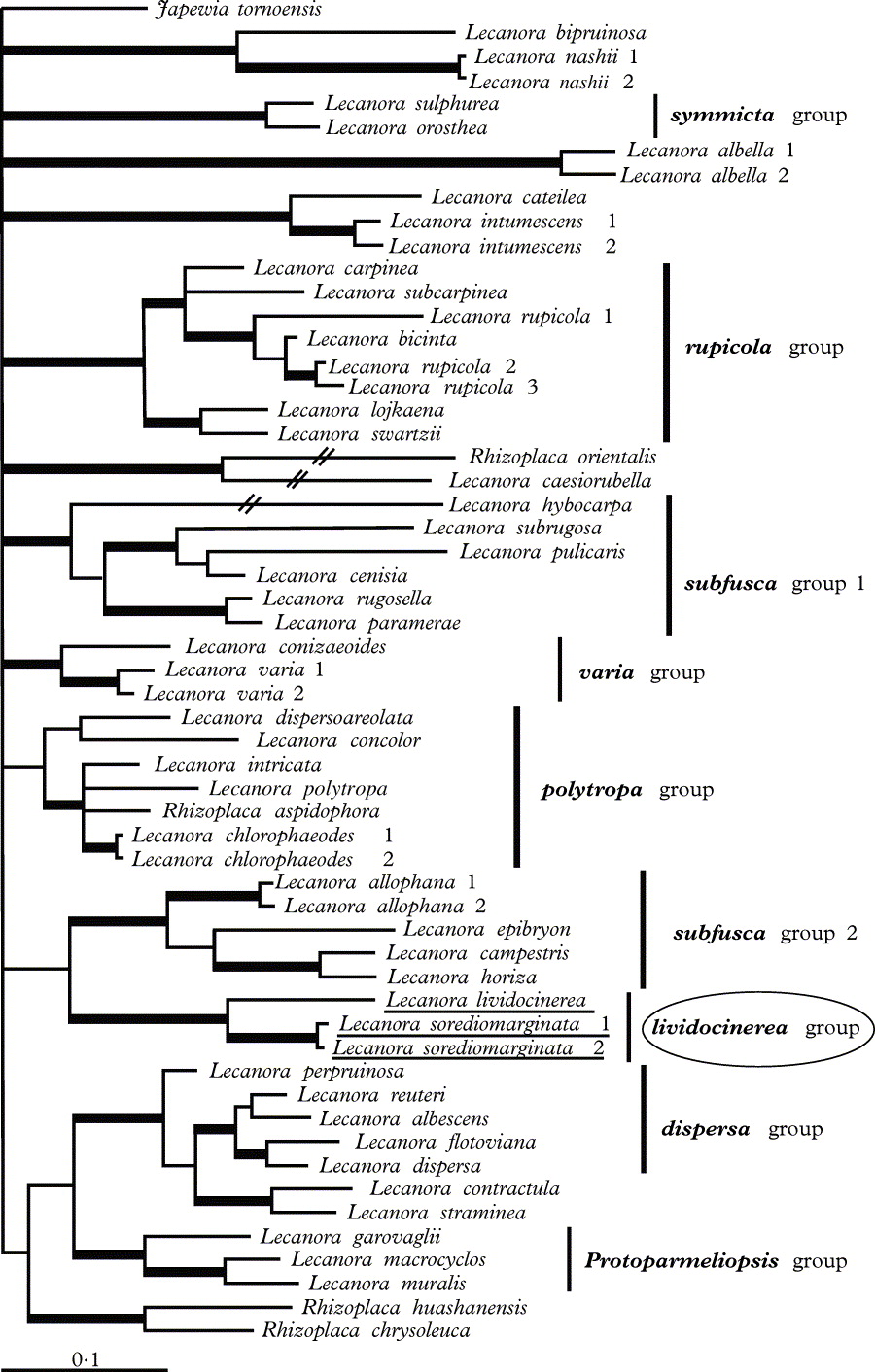
The new sequences, two of L. sorediomarginata and one of L. lividocinerea, aligned with sequences acquired from the GenBank, resulted in a matrix of 455 unambiguously aligned characters after Gblocks analysis. The likelihood parameters of the Bayesian analysis are available from the authors upon request. The majority-rule consensus tree based on 20 000 trees from the B/MCMC sample is shown in Figure 3.
Phylogenetic tree based on ITS rDNA sequences. Bold branches mean posterior probabilities ≥ 0·95.
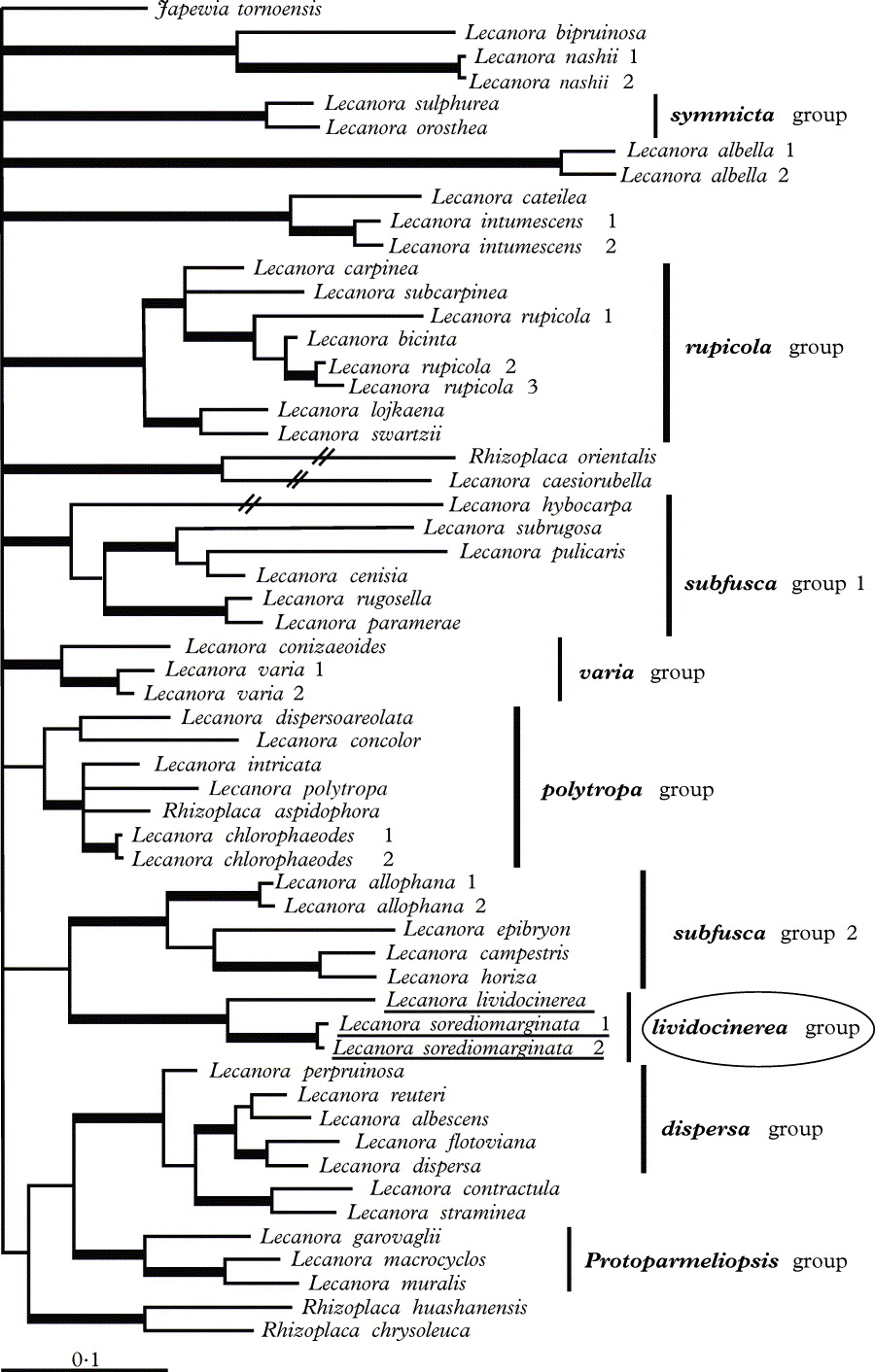
In the 50% majority-rule consensus tree, the three specimens of L. lividocinerea and L. sorediomarginata form a strongly supported clade (PP=1). The two specimens of L. sorediomarginata differed in one substitution and one indel of 3 nucleotides in their ITS sequences. On the other hand, the ITS sequence of L. lividocinerea diverged in 58 positions compared to L. sorediomarginata. The phylogenetic position of the group formed by these two taxa is still unclear. Although the group was sister to the ‘subfusca’ group in the tree obtained from the Bayesian analysis, this relationship was not supported statistically. Likewise, the relationships among the previous groups recognized in the literature (e.g. Arup & Grube Reference Arup and Grube1998; Blaha & Grube Reference Blaha and Grube2007; Pérez-Ortega et al. in press) are not well supported in our analysis, probably due to the low number of molecular characters used in the analysis.
Discussion
The position of Lecanora sorediomarginata within the groups of Lecanora so far defined is not clear. In our phylogenetic analysis L. sorediomarginata turned out to be more closely related to L. lividocinerea than to other members of the ‘subfusca’ group, which seems to indicate the importance of chemistry when defining natural groups within the genus. Unfortunately, fresh material of L. sulphurella, which is chemically similar to L. sorediomarginata, was not available at the time of this study. Further research is necessary to determine whether these taxa actually belong to a ‘new group’ within Lecanora. The absence of an amphithecial cortex and medulla at maturity and the absence of usnic acid or atranorin as major compounds make it difficult to place this species in any particular group based on morphological and chemical characters. Some specimens had minute apothecia with entire margins in the beginning of their development. The margin was found to be composed of entangled hyphae with algal cells, without a clearly defined cortex.
The nature of the amphithecium in L. sorediomarginata, which is completely sorediate from early juvenile stages, is not unique within Lecanora. In this regard it is similar to other sorediate species known to have sorediate apothecial margins, but which have an entire margin in the beginning of the apothecial development. These include L. barkmaniana Aptroot & van Herk, L. conizaeoides Nyl. ex Cromb., L. epanora (Ach.) Ach., L.expallens Ach., L. farinaria Borrer, L. impudens Degel., L. subaurea Zahlbr. and L. umbrosa Degel. (Tønsberg Reference Tønsberg1992; Brodo et al. Reference Brodo, Owe-Larsson and Lumbsch1994; Aptroot & van Herk Reference Aptroot and van Herk1999; Ryan et al. Reference Ryan, Lumbsch, Messuti, Printzen, Śliwa, Nash, Nash, Ryan, Diederich, Gries and Bungartz2004; Edwards et al. Reference Edwards, Aptroot, Hawksworth, James, Smith, Aptroot, Coppins, Fletcher, Gilbert, James and Wolseley2009).
Lecanora sorediomarginata is a very uniform species in terms of morphology. The thallus always has a granular-sorediate appearance, with warts visible at the margin of the thallus. The older, completely sorediate parts of the thallus may appear as a continuous, cracked granular surface. This may cause it to be confused with Ochrolechia microstictoides Räsänen, which also grows in some of the above localities, but the latter has an obvious episubstratal margin with a mean thickness of 54·5 µm (n = 7) in which the alga is uniformly distributed. Lecanora sorediomarginata, on the other hand, has an endosubstratal to very thin episubstratal margin, where warts arise and lead to soralia; the alga is not uniformly distributed but only present in the warts, not in between. Futhermore, the chemistry of O. microstictoides is quite distinct from that of L. sorediomarginata, with variolaric acid with satellite and lichesterinic acids present in the thallus (Tønsberg Reference Tønsberg1992).
Lecanora sorediomarginata may also be confused with Ochrolechia arborea (Kreyer) Almb., a species characterized by a whitish thallus, which is continuous or warted in the periphery, the continuous margin having a mean thickness of 57·0 µm (n = 11) and warts with a mean thickness of 79·0 µm (n = 18). The soralia are rounded and usually delimited in specimens growing on branches of Pinus, but may be confluent in specimens on the trunk of the same phorophyte. Chemically O. arborea contains gyrophoric acid, lecanoric acid (trace) and lichexanthone (Tønsberg Reference Tønsberg1992), as well as orsellinic acid (Boqueras et al. Reference Boqueras, Barbero and Llimona1999).
Only two other Lecanora species were found at the type locality and are also likely to occur at other areas surveyed: L. expallens and L. strobilina (Spreng.) Krieffer. Lecanora expallens usually has a thin, indeterminate, green or pale yellow, sorediate thallus, with predominantly confluent soralia. The apothecia grow to 1 mm diameter and the disc varies in colour from dull yellow to dark red, with the margin soon becoming sorediate or excluded. It can be readily distinguished from L. sorediomarginata by the colour of the thallus and its secondary metabolites [thiophanic and usnic acids and zeorin as major substances (Tønsberg Reference Tønsberg1992)].Lecanora strobilina has a granular-warted, greenish to yellowish grey, esorediate thallus. The apothecia have an average diameter of 0·35 mm, and the yellowish-ochre to orange-brown, flat to convex discs have an entire to crenulate margin, which may be persistent or become excluded. This species contains usnic acid, decarboxysquamatic acid and ±zeorin (Printzen Reference Printzen2001).
No additional sorediate, epiphytic species of Lecanora are known so far from the type locality. Several other European species have an areolate thallus, with initially discrete soralia that later become contiguous, but none of these exhibit a C+ red thalline reaction. A number of these species, including L. allophana (Ach.) Nyl. f. sorediata (Schaer.) Vain., L. barkmaniana, L. impudens and L. norvegica Tønsberg, contain atranorin or chloroatranorin as a major substance, in addition to other substances (Tønsberg Reference Tønsberg1992; Aptroot & van Herk Reference Aptroot and van Herk1999). Lecanora compallens van Herk & Aptroot and L. flavoleprosa Tønsberg, are also similar in morphology, but contain usnic acid as a major metabolite in addition to other substances (Tønsberg Reference Tønsberg1992; van Herk & Aptroot Reference van Herk and Aptroot1999). Lecanora sorediomarginata contains atranorin and chloroatranorin in only minor amounts and traces of usnic acid and does not contain any other substances in common with these species. Lecanora conizaeoides could also be considered a similar species, not only because it has an aerolate thallus with soralia that become confluent, but also due to the ±sorediate thalline exciple (Tønsberg Reference Tønsberg1992). Nevertheless, the presence of fumarprotoetraric acid as a major compound clearly distinguishes this species chemically. Lecanora variolascens Nyl. has a rimose-aerolate thallus, but the soralia are usually well delimited and rarely become confluent; it contains atranorin and psoromic acid as major substances (Lumbsch et al. Reference Lumbsch, Plümper, Guderley and Feige1997).
Chemically, L. sorediomarginata is similar to the epiphytic L. lividocinerea Bagl. and to the saxicolous L. sulphurella Hepp. Lecanora lividocinerea is characterized by a yellowish-white to whitish-grey thallus, which is esorediate, thin to thick, and with dispersed verrucae or verruculae. The apothecia are sessile, with pale yellow to pale red-brown or grey-brown discs, which may be epruinose or slightly whitish grey pruinose. The thalline exciple is concolorous with the thallus thin, entire, and ±verrucose to verruculose (Lumbsch & Elix Reference Lumbsch, Elix, McCarthy and Mallet2004). It contains atranorin [major], 3,5-dichloro-2′-O-methylanziaic acid [major], chloroatranorin [minor], 5′-chloro-2′-O-methylanziaic acid [minor], 3,5-dichloro-2′-O-methylnorhyperlatolic acid [minor] and 3,5-dichloro-2′-O-methylnorstenosporic acid[minor] (Elix et al. Reference Elix, Barclay, Lumbsch and Wardlaw1997; Lumbsch & Elix Reference Lumbsch, Elix, McCarthy and Mallet2004). It is known from coastal localities in Portugal (van den Boom & Giralt Reference van den Boom and Giralt1996; Carvalho et al. Reference Carvalho, Figueira, Jones, Sérgio, Sim-Sim and Catarino2002; Paz-Bermúdez & López de Silanes Reference Paz-Bermúdez and Lopez de Silanes2007) and it occurs in other coastal localities in the Mediterranean (Paz-Bermúdez & López de Silanes Reference Paz-Bermúdez and Lopez de Silanes2007) as well as in Australia (Lumbsch & Elix Reference Lumbsch, Elix, McCarthy and Mallet2004). Lecanora sulphurella has a grey to bright yellow, rimose-aerolate thallus with sessile apothecia, which have a slightly pruinose black disc and a persistent margin of the same colour as the thallus (Follmann Reference Follmann1976). It contains atranorin [major], chloroatranorin [major], 3,5-dichloro-2′-O-methylanziaic acid [major] and calycin [minor] (Lumbsch & Feige Reference LaGreca and Lumbsch1992). It is known in the Macaronesian area and from the Iberian Peninsula (Llimona & Werner Reference Llimona and Werner1975; Follmann Reference Follmann1976; Lumbsch & Feige Reference LaGreca and Lumbsch1992).
The Instituto da Conservação da Natureza e da Biodiversidade (ICNB), the Natural Parks of Litoral-Norte, Sintra-Cascais, Arrábida and Sudoeste Alentejano, and the Nature Reserves of S. Jacinto and Estuário do Sado are thanked for permissions to search for and collect L. sorediomarginata in their areas and also for information on the location of pine forest patches. We thank Eng. Isabel Mata (Autoridade Florestal Nacional, AFN) for permission to search and collect L. sorediomarginata in Serra de Sintra, and for a guided visit to that locality. We also thank Carla Quintaneiro, Salomé Menezes (Universidade de Aveiro, Portugal) and Rui Costa for their company during some of the field trips, Paz Herráez and Serafín Pérez (Universidad de León, Spain) for performing and teaching how to cut microtome sections, Antonio Sanchez and Silvia González (Universidad de León, Spain) for performing SEM analysis and assistance in the Microscopy Service, Per Magnus Jørgensen (University of Bergen, Norway) for revising the Latin diagnosis and Cristina Azevedo for producing the map in Figure 1. The first author was supported by Fundação para a Ciência e Tecnologia (SFRH/BD/18541/2004) and part of this work was supported by FCT Project Grant reference PTDC/AMB/76006/2006.