1 Introduction
In this paper, we study problems related to the recognizability of morphisms (also called substitutions). This notion concerns the unambiguity in the representation of an infinite sequence y as the image
 $\sigma (x)$
by a morphism
 $\sigma $
of another sequence x, up to some normalized shift, called a centered
 $\sigma $
-representation. It belongs to a general notion of unambiguity in symbolic dynamics (see [Reference Béal, Perrin and Restivo3]).
By Mossé’s theorem [Reference Mossé18, Reference Mossé19], every aperiodic primitive morphism
 $\sigma $
is recognizable on the shift
 $X(\sigma )$
(see the precise definitions in §3). This surprising result was initially formulated (in an incorrect way) by [Reference Martin17] (see [Reference Kyriakoglou13] on the genesis of the theorem and its possible variants). It was further generalized by Bezuglyi, Kwiatkowski, and Medynets [Reference Bezuglyi, Kwiatkowski and Medynets7], who proved that every aperiodic non-erasing morphism
 $\sigma $
is recognizable on
 $X(\sigma )$
. Next, it was proved by Berthé et al [Reference Berthé, Steiner, Thuswaldner and Yassawi6] that every non-erasing morphism
 $\sigma $
is recognizable on
 $X(\sigma )$
for aperiodic points.
The main result of this paper is a generalization of Mossé’s theorem.
Theorem 1. Every morphism
 $\sigma $
is recognizable on
 $X(\sigma )$
for aperiodic points.
This means that every aperiodic point in
 $X(\sigma )$
has a unique centered
 $\sigma $
-representation as a shift of the image by
 $\sigma $
of some
 $x\in X(\sigma )$
.
We actually prove the result of [Reference Berthé, Steiner, Thuswaldner and Yassawi6] concerning the recognizability for aperiodic points for the most general class of morphisms, including ones containing erasable letters. Our proof does not use the fact that the shift
 $X(\sigma )$
defined for an aperiodic non-erasing morphism has a finite number of minimal subshifts (proved and used in [Reference Bezuglyi, Kwiatkowski and Medynets7]), or the stronger fact that the set of languages of points in a shift
 $X(\sigma )$
defined by a non-erasing morphism is finite (proved and used in [Reference Berthé, Steiner, Thuswaldner and Yassawi6]). Our proof relies on the notion of elementary morphism, due to Ehrenfeucht and Rozenberg [Reference Ehrenfeucht and Rozenberg10]. By a result, proved independently by Karhumäki, Maňuch, and Plandowski [Reference Karhumäki, Maňuch and Plandowski11] and by Berthé et al [Reference Berthé, Steiner, Thuswaldner and Yassawi6], every elementary morphism is recognizable for aperiodic points. We use this result to prove Mossé’s theorem (and its generalizations). This represents actually also a substantial simplification of the proof, since the available proofs of Mossé’s theorem are all more difficult, including the proof in [Reference Kurka12] which is essentially reproduced in [Reference Durand and Perrin9], using improvements from [Reference Kyriakoglou13].
We also give a characterization of injective morphisms recognizable on the full shift in terms of groups in finite monoids (Theorem 6.7). This translation of the property of recognizability in terms of finite monoids is a new approach which puts in evidence for the strong link between recognizability and automata theory.
Finally, we give a quadratic-time algorithm to check whether an injective morphism is recognizable on the full shift for aperiodic points (Corollary 7.3).
Note that the notion of recognizability can also be defined for substitutions in dimension
 $2$
or higher. This was first considered in [Reference Mozes20] where the recognizability property is used to prove that a two-dimensional (
 $2\text {D}$
) substitution shift is sofic. The property was also used in [Reference Aubrun and Sablik1] to simulate an effective subshift by a sofic and also in [Reference Aubrun and Sablik2]. A generalization of Mossé’s theorem to the
 $2\text {D}$
case was proved in [Reference Solomyak28]. Let us also mention that the recognizability of morphisms has been extended to sequences of morphisms in [Reference Berthé, Steiner, Thuswaldner and Yassawi6] (see also [Reference Donoso, Durand, Maass and Petite8]).
The paper is organized as follows. After an introductory section on the basic notions of symbolic dynamics, we formulate the precise definition of a morphism recognizable on a shift space and prove some elementary properties of recognizable morphisms. In §4, we introduce elementary morphisms and prove that every elementary morphism is recognizable for aperiodic points (Theorem 4.5). In §5, we give the new proof of Mossé’s theorem and its extensions. In §6, we formulate a condition characterizing recognizable injective morphisms in terms of groups in finite monoids (Theorem 6.7). In §7, we show that all notions handled in this paper are decidable and, notably, by algorithms of low polynomial complexity.
2 Symbolic dynamics
We briefly recall the definitions of symbolic dynamics. For a more complete presentation, see [Reference Lind and Marcus14] or the recent [Reference Durand and Perrin9].
2.1 Words
Let A be a finite alphabet. We denote by
 $A^*$
the free monoid on A and by
 $A^+$
the set of non-empty words on A. The empty word is denoted by
 $\varepsilon $
. We denote by
 $|u|$
the length of the word u.
For a word
 $w\in A^*$
and
 $a\in A$
, we denote by
 $|w|_a$
the number of occurrences of a in w.
A word
 $s\in A^*$
is a factor of
 $w\in A^*$
if
 $w=rst$
. The word r is called a prefix of w. It is proper if
 $r\ne w$
(that is, if
 $st$
is not empty).
For
 $U\subset A^*$
, we denote by
 $U^*$
the submonoid of
 $A^*$
generated by U. For
 $U=\{u\}$
, we write
 $u^*$
instead of
 $\{u\}^*$
.
A set
 $U\subset A^*$
is a code if every
 $w\in U^*$
has a unique decomposition in words of U. A prefix code is a set
 $U\subset A^*$
such that no element of U is a prefix of another one.
Two words
 $u,v$
are conjugate if
 $u=rs$
and
 $v=sr$
for some words
 $r,s$
.
A word is primitive if it is not a power of a shorter word.
An integer
 $p\ge 1$
is a period of a word
 $w=a_0a_1\ldots a_{n-1}$
with
 $a_i\in A$
if
 $a_i=a_{i+p}$
for
 $0\le i\le n-p-1$
.
2.2 Shift spaces
We consider the set
 $A^{\mathbb {Z}}$
of two-sided infinite sequences on A. For
 $x=(x_n)_{n\in \mathbb {Z}}$
, and
 $i\le j$
, we denote by
 $x_{[i,j]}$
the word
 $x_ix_{i+1}\ldots x_j$
and
 $x_{[i,j)}$
the word
 $x_ix_{i+1}\ldots x_{j-1}$
.
The set
 $A^{\mathbb {Z}}$
is a compact metric space for the distance defined for
 $x\ne y$
by
 $d(x,y)=2^{-r(x,y)}$
with
 $$ \begin{align*} r(x,y)=\min\{|n|\mid n\in\mathbb{Z}, x_n\ne y_n\}. \end{align*} $$
The shift transformation
 $S:A^{\mathbb {Z}}\to A^{\mathbb {Z}}$
is defined by
 $y=S(x)$
if
 $y_n=x_{n+1}$
for every
 ${n\in \mathbb {Z}}$
. We sometimes denote
 $Sx$
instead of
 $S(x)$
.
A shift space X on a finite alphabet A is a closed and shift invariant subset of
 $A^{\mathbb {Z}}$
.
A topological dynamical system is a pair
 $(X,S)$
of a compact metric space and a continuous map from X to itself. For every shift space X, since S is continuous and X is compact, the pair
 $(X,S)$
is a topological dynamical system.
The orbit of a sequence
 $x\in A^{\mathbb {Z}}$
is the set
 $\{S^n(x)\mid n\in \mathbb {Z}\}$
.
A point
 $x\in A^{\mathbb {Z}}$
is periodic if there is an
 $n\ge 1$
such that
 $S^n(x)=x$
. Otherwise, it is aperiodic. A periodic point has the form
 $w^\infty =\ldots ww\cdot ww\ldots $
(the letter of index
 $0$
of
 $w^\infty $
is the first letter of w). For
 $x\in A^{\mathbb {Z}}$
, we denote
 $x^+=x_0x_1\ldots $
, which is an element of
 $A^{\mathbb {N}}$
, and
 $x^-=\ldots x_{-2}x_{-1}$
, which is the element y of
 $A^{-\mathbb {N}}$
defined by
 $y_{-n}=x_{-n-1}$
for
 $n\in \mathbb {N}$
. For
 $x\in A^{-\mathbb {N}}$
and
 $y\in A^{\mathbb {N}}$
, we denote by
 $z=x\cdot y$
the two-sided infinite sequence z such that
 $z^-=x$
and
 $z^+=y$
.
A word w is a factor of
 $x\in A^{\mathbb {Z}}$
if
 $w=x_ix_{i+1}\ldots x_{j-1}$
for some
 $i,j\in \mathbb {Z}$
with
 $i\le j$
.
The language of a shift space X, denoted
 $\mathcal {L}(X)$
, is the set of factors of the elements of X. For
 $x\in A^{\mathbb {Z}}$
, we also denote by
 $\mathcal {L}(x)$
the set of factors of x. Thus,
 $\mathcal {L}(X)=\bigcup _{x\in X}\mathcal {L}(x)$
.
2.3 Morphisms
A morphism
 $\sigma : A^*\to B^*$
is a monoid morphism from
 $A^*$
to
 $B^*$
. It is non-erasing if
 $\sigma (a)$
is non-empty for every
 $a\in A$
.
The incidence matrix of a morphism
 $\sigma : A^*\to B^*$
is the
 $(A\times B)$
-matrix
 $M(\sigma )$
whose row of index a is the vector
 $(|\sigma (a)|_b)_{b\in B}$
.
For example, if
 $\sigma : a\mapsto ab,b\mapsto ac,c\mapsto a$
, we have
 $$ \begin{align*} M(\sigma)=\begin{bmatrix}1&1&0\\1&0&1\\1&0&0\end{bmatrix}\hspace{-2.5pt}. \end{align*} $$
A morphism
 $\sigma $
defines a map from
 $A^{\mathbb {N}}$
to
 $B^* \cup B^{\mathbb {N}}$
defined by
 $\sigma (x_0x_1\ldots )=\sigma (x_0)\sigma (x_1)\ldots, $
from
 $A^{-\mathbb {N}}$
to
 $B^* \cup B^{-\mathbb {N}}$
defined by
 $\sigma (\ldots x_{-1}x_{0})=\ldots \sigma (x_{-1})\sigma (x_0)$
, and also a map from
 $A^{\mathbb {Z}}$
to
 $B^* \cup B^{\mathbb {N}} \cup B^{-\mathbb {N}} \cup B^{\mathbb {Z}}$
defined by
 $\sigma (x)=\sigma (x^-)\cdot \sigma (x^+)$
.
Let
 $\sigma : A^*\to B^*$
be a morphism whose restriction to A is injective. The set
 $U=\sigma (A)$
is a code if and only if
 $\sigma $
is injective on
 $A^*$
. Note that
 $\sigma $
can be injective on
 $A^*$
without being injective on
 $A^{\mathbb {Z}}$
(the converse being obviously true). It is injective on
 $A^{\mathbb {Z}}$
if and only if it is injective on
 $A^{\mathbb {N}}$
and on
 $A^{-\mathbb {N}}$
.
Example 2.1. The Fibonacci morphism
 $a\mapsto ab,b\mapsto a$
is injective on
 $A^{\mathbb {N}}$
, as one may easily verify. The morphism
 $\sigma : a\mapsto a,b\mapsto ab,c\mapsto bb$
is not injective on
 $A^{\mathbb {N}}$
since
 $\sigma (ac^\omega )=\sigma (bc^\omega )$
.
Let
 $\sigma : A^*\to A^*$
be a morphism from
 $A^*$
to itself. The language of
 $\sigma $
, denoted
 $\mathcal {L}(\sigma )$
, is the set of factors of the words
 $\sigma ^n(a)$
for some
 $n\ge 0$
and
 $a\in A$
. The shift defined by
 $\sigma $
, denoted by
 $X(\sigma )$
, is the set of sequences with all their factors in
 $\mathcal {L}(\sigma )$
.
One has
 $\mathcal {L}(X(\sigma ))\subset \mathcal {L}(\sigma )$
but it is not true in general that
 $\mathcal {L}(X(\sigma ))=\mathcal {L}(\sigma )$
. Indeed, the words of
 $\mathcal {L}(X(\sigma ))$
can always be extended (we have
 $awb\in \mathcal {L}(X(\sigma ))$
for some
 $a,b\in ~A$
) while this needs not be true of the words of
 $\mathcal {L}(\sigma )$
. Note that if
 $w\in \mathcal {L}(X(\sigma ))$
, then w is a factor of some
 $\sigma ^n(a)$
for all large enough n.
An erasable letter of a morphism
 $\sigma : A^*\to A^*$
is a letter a in A such that
 $\sigma ^n(a) = \varepsilon $
for some integer n. A word is erasable if it is formed of erasable letters.
If w is an erasable word, then
 $\sigma ^{\operatorname {\mathrm {Card}}(A)}(w)=\varepsilon $
. Indeed, set
 $A_i=\{a\in A\mid \sigma ^i(a)=\varepsilon \}$
. Then
 $A_1\subset A_2\subset \cdots \subset A$
and thus there is
 $k\le \operatorname {\mathrm {Card}}(A)$
such that
 $A_k=A_{k+1}$
, which implies
 $A_{k+j}=A_{k}$
for all
 $j\ge 0$
.
Proposition 2.2. Let
 $\sigma : A^*\to A^*$
be a morphism. The set of erasable words in
 $\mathcal {L}(\sigma )$
is finite.
We first prove the following well-known lemma (see, for example, [Reference Queffélec25, Lemma 5.5]).
Lemma 2.3. For every word
 $u\in \mathcal {L}(\sigma )$
, there is some
 $m\ge 0$
and words
 $v_i,w_i\in \mathcal {L}(X)$
for
 $0\le i\le m$
, such that
 $$ \begin{align} u=v_0\sigma(v_1)\ldots\sigma^{m-1}(v_{m-1})\sigma^m(v_m)\sigma^{m-1}(w_{m-1})\ldots\sigma(w_1)w_0, \end{align} $$
with
 $|v_i|,|w_i|\le |\sigma |$
.
Proof. We may assume that
 $|\sigma|\ge 1$
(otherwise
 $\mathcal{L}(\sigma)=A$
and the result is true). We use induction on the integer
 $$ \begin{align*} n(u)=\min\{n\ge 0\mid u\mbox{ is a factor of }\sigma^n(a)\mbox{ for some $a\in A$}\}. \end{align*} $$
The result is true if
 $n(u)\le 1$
, choosing
 $m=0$
and
 $v_0=u$
. Otherwise, by definition of
 $\mathcal {L}(\sigma )$
, there exists a word
 $u'\in \mathcal {L}(\sigma )$
such that
 $u=v_0\sigma (u')w_0$
. Choosing
 $u'\in \mathcal {L}(\sigma )$
of maximal length, we have moreover
 $|v_0|,|w_0|\le |\sigma |$
. By induction hypothesis, we have a decomposition of equation (2.1) for
 $u'$
, that is,
 $$ \begin{align*} u'=v^{\prime}_0\sigma(v^{\prime}_1)\ldots\sigma^{m-1}(v^{\prime}_{m-1})\sigma^m(v^{\prime}_m)\sigma^{m-1}(w_{m-1}')\ldots\sigma(w_1')w_0'. \end{align*} $$
In this way, we obtain
 $$ \begin{align*} u=v_0\sigma(u')w_0=v_0\sigma(v^{\prime}_0)\ldots\sigma^{m}(v^{\prime}_{m-1})\sigma^{m+1}(v^{\prime}_m)\sigma^{m}(w^{\prime}_{m-1})\ldots\sigma(w_0')w_0, \end{align*} $$
which is of the form of equation (2.1).
Proof of Proposition 2.2
Let
 $u\in \mathcal {L}(\sigma )$
be erasable. Let
 $m\ge 0$
,
 $v_i,w_i$
with
 ${|v_i|,|w_i|\le |\sigma |}$
be such that equation (2.1) holds. Since u is erasable, all
 $v_i,w_i$
are erasable. Since
 $\sigma ^{\operatorname {\mathrm {Card}}(A)}(w)=\varepsilon $
for every erasable word w, we can assume that
 $m\le \operatorname {\mathrm {Card}}(A)-1$
. This implies that the length of u is bounded.
Note that the maximal length of erasable words in
 $\mathcal {L}(\sigma )$
is, according to the proof above, bounded by
 $2|\sigma |\sum _{i=0}^{k-1}|\sigma |^i=2|\sigma |(|\sigma |^k-1)/(|\sigma |-1)$
, where
 $k=\operatorname {\mathrm {Card}}(A)$
.
Corollary 2.4. Let
 $\sigma : A^*\to A^*$
be a morphism. For every x in
 $X(\sigma )$
, the sequence
 $\sigma (x)$
is in
 $X(\sigma )$
. The map
 $x\mapsto \sigma (x)$
is continuous on
 $X(\sigma )$
.
Proof. We have to prove that
 $\sigma (x)$
is two-sided infinite. By Proposition 2.2, x has an infinite number of non-erasable letters on the left and on the right, and thus
 $\sigma (x)$
is two-sided infinite. Since
 $\sigma $
is continuous at every point x such that
 $\sigma (x)$
is infinite, it is continuous on
 $X(\sigma )$
.
Note that since
 $X=X(\sigma )$
is compact, and since
 $\sigma $
is continuous on X by Corollary 2.4, the pair
 $(X,\sigma )$
is a topological dynamical system. Thus, it is both a dynamical system
 $(X,S)$
with respect to the shift transformation and a dynamical system
 $(X,\sigma )$
.
As another corollary of Proposition 2.2, we have the following characterization of the morphisms such that
 $\mathcal {L}(X(\sigma ))=\mathcal {L}(\sigma )$
.
Proposition 2.5. Let
 $\sigma : A^*\to A^*$
be a morphism. One has
 $\mathcal {L}(\sigma )=\mathcal {L}(X(\sigma ))$
if and only if every letter
 $a\in A$
is in
 $\mathcal {L}(X(\sigma ))$
.
Proof. Assume that the condition is satisfied. Every
 $w\in \mathcal {L}(\sigma )$
is a factor of some
 $\sigma ^n(a)$
for
 $a\in A$
and
 $n\ge 0$
. Let
 $x\in X(\sigma )$
be such that
 $a\in \mathcal {L}(x)$
. By Corollary 2.4, we have
 $\sigma ^n(x)\in X(\sigma )$
. Since
 $w\in \mathcal {L}(\sigma ^n(x))$
, we obtain
 $w\in \mathcal {L}(X(\sigma ))$
. The converse is obvious.
Example 2.6. The morphism
 $\sigma : a\mapsto ab,b\mapsto abab$
is periodic. The closure of
 $\sigma (A^{\mathbb {Z}})$
is
 $(ab)^\infty \cup (ba)^\infty $
.
A word
 $w\in A^*$
is growing for
 $\sigma $
if the sequence
 $(|\sigma ^n(w)|)_n$
is unbounded. A word is growing if some of its letters are growing. The morphism
 $\sigma $
itself is said to be growing if all letters are growing.
Actually, we have the following property of growing letters.
Proposition 2.7. If
 $a\in A$
is growing for
 $\sigma $
, then
 $\sigma ^{r\operatorname {\mathrm {Card}}(A)}(a)$
contains, for every
 $r\ge 0$
, at least
 $r+1$
non-erasable letters. In particular,
 $\lim _{n\to \infty }|\sigma ^n(a)|=\infty $
.
Proof. Set
 $k=\operatorname {\mathrm {Card}}(A)$
. Assume first that
 $\sigma ^k(a)$
contains only one non-erasable letter. Then, this letter has to be growing. Next, by the pigeonhole principle, there are
 $i,p$
with
 $i+p\le k$
and
 $p\ge 1$
such that
 $\sigma ^i(a)=ubv$
and
 $\sigma ^p(b)=rbs$
with
 $u,v,r,s$
erasable and b a growing letter. However, then, since
 $\sigma ^{\operatorname {\mathrm {Card}}(A)}(r)=\sigma ^{\operatorname {\mathrm {Card}}(A)}(s)=\varepsilon $
, the word
 $$ \begin{align*} w=\sigma^{p\operatorname{\mathrm{Card}}(A))}(b)=\sigma^{p(\operatorname{\mathrm{Card}}(A)-1)}(r)\ldots\sigma^p(r)rbs\sigma^p(s)\ldots\sigma^{p(\operatorname{\mathrm{Card}}(A)-1)}(s) \end{align*} $$
is a finite fixed point of
 $\sigma ^p$
, that is, such that
 $\sigma ^p(w)=w$
, a contradiction with the fact that b is growing. This proves the statement for
 $r=1$
.
Next, assume that
 $\sigma ^{rk}(a)$
contains
 $s\ge r+1$
non-erasable letters
 $a_1,\ldots , a_s$
. One of them, say
 $a_i$
, has to be growing. Then each of the
 $\sigma (a_1),\ldots ,\sigma (a_s)$
contains a non-erasing letter and
 $\sigma ^k(a_i)$
contains at least two by the property for
 $r=1$
. Thus,
 $\sigma ^{(r+1)k}(a)$
contains at least
 $r+2$
non-erasing letters.
3 Recognizable morphisms
Let
 $\sigma : A^*\to B^*$
be a morphism. A
 $\sigma $
-representation of
 $y\in B^{\mathbb {Z}}$
is a pair
 $(x,k)$
of a sequence
 $x\in A^{\mathbb {Z}}$
and an integer k such that
 $$ \begin{align} y=S^k(\sigma(x)), \end{align} $$
where S denotes the shift transformation. The
 $\sigma $
-representation
 $(x,k)$
is centered if
 $0\le k<|\sigma (x_0)|$
.
Note that, in particular, a centered
 $\sigma $
-representation
 $(x,k)$
is such that
 $\sigma (x_0)\ne \varepsilon $
.
Note that if y has a
 $\sigma $
-representation
 $(x,k)$
, it has a centered
 $\sigma $
-representation
 $(x',k')$
with
 $x'$
a shift of x. Indeed, assume
 $k\ge 0$
(the case
 $k<0$
is symmetric). Let
 $i\ge 0$
be such that
 $|\sigma (x_0\ldots x_{i-1})|\le k<|\sigma (x_0\ldots x_i)|$
. Set
 $k'=k-|\sigma (x_0\ldots x_{i-1})|$
and
 ${x'=S^ix}$
. Then,
 $S^{k'}\sigma (x')=S^{k'+|\sigma (x_0\ldots x_{i-1})|}\sigma (x)=S^k\sigma (x)=y$
and
 $0\le k'<|\sigma (x^{\prime }_0)|$
. Thus,
 $(x',k')$
is a centered
 $\sigma $
-representation of y.
For a shift space X on A, the set of points in
 $B^{\mathbb {Z}}$
having a
 $\sigma $
-representation
 $(x,k)$
with
 $x\in X$
is a shift space on B which is the closure under the shift of
 $\sigma (X)$
. Indeed, if
 $(x,k)$
is the
 $\sigma $
-representation of y, then
 $S(y)$
has the
 $\sigma $
-representation
 $(x',k')$
with
 $$ \begin{align*} (x',k')=\begin{cases}(x,k+1)&\mbox{ if }k+1<|\sigma(x_0)|,\\ (S(x),0)&\mbox{ otherwise.}\end{cases} \end{align*} $$
Definition 3.1. Let X be a shift space on A. A morphism
 $\sigma : A^*\to B^*$
is recognizable on X (respectively recognizable on X for aperiodic points) if for every point
 $y\in B^{\mathbb {Z}}$
(respectively every aperiodic point
 $y\in B^{\mathbb {Z}}$
), there is at most one centered
 $\sigma $
-representation
 $(x,k)$
of y with
 $x\in X$
.
For
 $X=A^{\mathbb {Z}}$
, we simply say recognizable instead of recognizable on X. Note that, as an equivalent definition of recognizability on X (respectively recognizability for aperiodic points), for every
 $y,y'\in A^{\mathbb {Z}}$
and
 $0\le k<| |\sigma (y^{\prime }_0)|-|\sigma (y_0)| |$
such that
 $\sigma (y)=S^k(\sigma (y'))$
is in X (respectively is an aperiodic point in X), one has
 $k=k'$
and
 $y=y'$
.
A morphism
 $\sigma : A^*\to B^*$
is circular if it is injective and if for every
 $u,v\in B^*$
,
 $$ \begin{align*} uv,vu\in\sigma(A^*)\Rightarrow u,v\in\sigma(A^*). \end{align*} $$
Note that a circular morphism is non-erasing, since otherwise it would not be injective.
The following property, originally from [Reference Restivo26], is well known. We will not use it but we state it for the sake of clarity.
Proposition 3.2. A morphism is recognizable if and only if it is circular.
Example 3.3. The Fibonacci morphism
 $\sigma : a\mapsto ab,b\mapsto a$
is circular and thus recognizable.
Example 3.4. The Thue–Morse morphism
 $\sigma : a\mapsto ab,b\mapsto ba$
is not circular. It is not recognizable since
 $(ab)^\infty $
can be obtained as
 $\sigma (a^\infty )$
and as
 $S(\sigma (b^\infty ))$
. However, it is recognizable for aperiodic points since any sequence containing
 $aa$
or
 $bb$
has at most one factorization in
 $\{ab,ba\}$
.
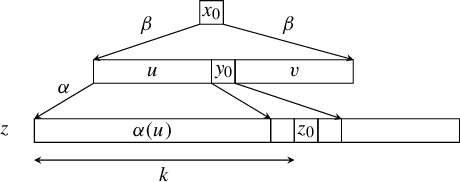
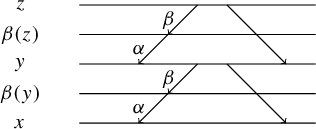
The composition
 $\sigma =\alpha \circ \beta $
.

Example 3.5. The morphism
 $\sigma : a\to aa,b\mapsto ab,c\mapsto ba$
is not recognizable for aperiodic points. Indeed, every sequence without occurrence of
 $bb$
has two factorizations in words of
 $\{aa,ab,ba\}$
.
Proposition 3.6. The family of morphisms recognizable for aperiodic points is closed under composition.
Proof. Let
 $\sigma =\alpha \circ \beta $
with
 $\beta : A^*\to B^*$
and
 $\alpha : B^*\to C^*$
. Assume that
 $\alpha ,\beta $
are recognizable for aperiodic points. Let
 $z\in C^{\mathbb {Z}}$
be an aperiodic point. Let
 $(x,k)$
be a centered
 $\sigma $
-representation of z. Since
 $0\le k<|\sigma (x_0)|$
, there is a decomposition
 $\beta (x_0)=ubv$
with
 $u,v\in B^*$
and
 $b\in B$
such that
 $|\alpha (u)|\le k<|\alpha (ub)|$
. Set
 $\ell =|u|$
,
 $m=|\alpha (u)|$
, and
 $y=S^{\ell }(\beta (x))$
. Then,
 $y_0=b$
and
 $z=S^{k-m}(\alpha (y))$
(see Figure 1). Thus,
 $(y,k-m)$
is a centered
 $\alpha $
-representation of z and
 $(x,\ell )$
is a
 $\beta $
-representation of y. Conversely, if
 $(y,n)$
is an
 $\alpha $
-representation of z and
 $(x,\ell )$
is a centered
 $\beta $
-representation of y, then
 $(x,k)$
with
 $k=|\beta (y_{-\ell }\ldots y_{-1})|+n$
is a centered
 $\sigma $
-representation of z. This shows the uniqueness of
 $(x,k)$
.
4 Elementary morphisms
Definition 4.1. A morphism
 $\sigma : A^*\to C^*$
is elementary (or indecomposable) if for every alphabet B and every pair of morphisms
 $\alpha : B^*\to C^*$
and
 $\beta : A^*\to B^*$
such that
 $\sigma =\alpha \circ \beta $
, one has
 $\operatorname {\mathrm {Card}}(B)\ge \operatorname {\mathrm {Card}}(A)$
.
If
 $\sigma : A^*\to C^*$
is elementary, one has in particular
 $\operatorname {\mathrm {Card}}(C)\ge \operatorname {\mathrm {Card}}(A)$
and moreover
 $\sigma $
is non-erasing.
Example 4.2. The Thue–Morse morphism
 $\sigma : a\mapsto ab,b\mapsto ba$
is elementary. Indeed, if
 $\sigma =\alpha \circ \beta $
with
 $\beta : \{a,b\}^*\to c^*$
, then
 $ab=\alpha (c^i)$
and
 $ba=\alpha (c^j)$
, which is impossible.
The notion of elementary morphism appears for the first time in [Reference Ehrenfeucht and Rozenberg10]. A sufficient condition for a morphism to be elementary can be formulated in terms of its incidence matrix.
Proposition 4.3. If the rank of
 $M(\sigma )$
is equal to
 $\operatorname {\mathrm {Card}}(A)$
, then
 $\sigma $
is elementary.
Proof. Indeed, if
 $\sigma =\alpha \circ \beta $
with
 $\beta : A^*\to B^*$
and
 $\alpha : B^*\to C^*$
, then
 $$ \begin{align*} M(\sigma)=M(\,\beta)M(\alpha). \end{align*} $$
If
 $\operatorname {\mathrm {rank}}(M(\sigma ))=\operatorname {\mathrm {Card}}(A)$
, then
 $\operatorname {\mathrm {Card}}(A)=\operatorname {\mathrm {rank}}(M(\sigma ))\le \operatorname {\mathrm {rank}}(M(\alpha ))\le \operatorname {\mathrm {Card}}(B)$
. Thus,
 $\sigma $
is elementary.
This condition is not necessary. For example, the Thue–Morse morphism
 $\sigma : a\mapsto ab,b\mapsto ba$
is elementary but its incidence matrix
 $$ \begin{align*} M(\sigma)=\begin{bmatrix}1&1\\1&1\end{bmatrix} \end{align*} $$
has rank one.
If
 $\sigma : A^*\to C^*$
is a morphism, we define
 $\ell (\sigma )=\sum _{a\in A}(|\sigma (a)|-1)$
. We say that a decomposition
 $\sigma =\alpha \circ \beta $
with
 $\alpha : B^*\to C^*$
and
 $\beta : A^*\to B^*$
is trim if:
-
(i)
 $\alpha $
is non-erasing;
-
(ii) for each
$b\in B$
, there is an
$a\in A$
such that
$\beta (a)$
contains b.


Proposition 4.4. Let
 $\sigma =\alpha \circ \beta $
with
 $\alpha : B^*\to C^*$
and
 $\beta : A^*\to B^*$
be a trim decomposition of
 $\sigma $
. Then,
 $$ \begin{align} \ell(\alpha\circ\beta)\ge \ell(\alpha)+\ell(\,\beta). \end{align} $$
Proof. Set
 $\sigma =\alpha \circ \beta $
. We have
 $$ \begin{align*} \ell(\sigma)-\ell(\,\beta)&=\sum_{a\in A}(|\sigma(a)|-|\beta(a)|) =\sum_{a\in A}\sum_{b\in B}(|\alpha(b)||\beta(a)|_b-|\beta(a)|_b)\\ &=\sum_{a\in A}\sum_{b\in B}(|\alpha(b)|-1)||\beta(a)|_b =\sum_{b\in B}\bigg((|\alpha(b)|-1)\sum_{a\in A}|\beta(a)|_b\bigg). \end{align*} $$
Since
 $\alpha $
is non-erasing, every factor
 $|\alpha (b)|-1$
is non-negative. Since every b appears in some
 $\beta (a)$
, every factor
 $\sum _{a\in A}|\beta (a)|_b$
is positive, whence the conclusion.
The following result is from [Reference Karhumäki, Maňuch and Plandowski11]. It also appears in [Reference Berthé, Steiner, Thuswaldner and Yassawi6] with the stronger hypothesis that
 $\sigma : A^*\to B^*$
is such that
 $M(\sigma )$
has rank
 $\operatorname {\mathrm {Card}}(A)$
.
Theorem 4.5. An elementary morphism is recognizable for aperiodic points.
We first prove Theorem 4.5 in a particular case. A morphism
 $\sigma : A^*\to B^*$
with no erasable letter is left marked if every word
 $\sigma (a)$
for
 $a\in A$
begins with a distinct letter. Symmetrically, it is right marked if every word
 $\sigma (a)$
for
 $a\in A$
ends with a distinct letter. In particular, if
 $\sigma $
is left marked,
 $\sigma $
is injective on A and
 $\sigma (A)$
is a prefix code. It is clear that a marked morphism is elementary.
The following statement, which is a particular case of Theorem 4.5, appears in [Reference Berthé, Steiner, Thuswaldner and Yassawi6, Lemma 3.3]. We give an independent proof.
Proposition 4.6. If
 $\sigma : A^*\to B^*$
is left marked, then it is recognizable for aperiodic points.
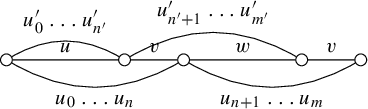
The words
 $u,v,w$
.

We fist show the following elementary lemma.
Lemma 4.7. Let
 $\sigma : A^*\to B^*$
be an injective morphism and let
 $U=\sigma (A)$
. If
 $\sigma $
is not injective on
 $A^{\mathbb {N}}$
, there exist words
 $u,v,w$
such that
 $$ \begin{align} u,uv,vw,wv\in U^*\quad\mbox{and}\quad v\notin U^*. \end{align} $$
Proof. By the hypothesis, there exist
 $u_0,u_{1},\ldots $
and
 $u^{\prime }_0,u^{\prime }_{1},\ldots $
with
 $u_i,u^{\prime }_i\in U$
such that
 $u_0u_{1}\ldots =u^{\prime }_0u^{\prime }_{1}\ldots. $
We may assume that
 $u_0\ne u^{\prime }_0$
. For every
 $n\ge 0$
, there is
 $v_n$
and
 $n'\ge 0$
such that
 $u_0\ldots u_n = u^{\prime }_0\ldots u^{\prime }_{n'}v_n$
. Since
 $\sigma $
is injective, we have
 $v_n\notin U^*$
. We may moreover assume that
 $v_n$
is a prefix of
 $u^{\prime }_{n'+1}$
. Let
 $n<m$
be such that
 $v_n=v_m$
. Set
 $u^{\prime }_{n'+1}\ldots u^{\prime }_{m'}=v_nw$
(see Figure 2). Then
 $u=u^{\prime }_0\ldots u^{\prime }_{n'}$
,
 $v=v_n=v_m$
, and w satisfy equation (4.2).
Proof of Proposition 4.6
Set
 $U=\sigma (A)$
. Since U is a prefix code,
 $\sigma $
is injective on
 $A^{\mathbb {N}}$
. If it is not injective on
 $A^{-\mathbb {N}}$
, by the symmetric version of Lemma 4.7, there are words
 $u,v,w$
such that
 $u,vu,vw,wv\in U^*$
but
 $v\notin U^*$
. We may assume that
 $u,v,w$
are chosen of minimal length. Since
 $\sigma $
is left marked, either u is a prefix of w or w is a prefix of u. In the first case, set
 $w=uw'$
. Then, since U is prefix,
 $u,wv=uw'v\in U^*$
imply
 $w'v\in U^*$
. However, then
 $(vu)(w'v)(u)=(vuw')(vu)$
, which is a contradiction. Finally, if
 $u=wu'$
, then
 $vw,vu=vwu'\in U^*$
imply
 $u'\in U^*$
, and we may replace
 $u,v,w$
by
 $u',w,v$
, which is a contradiction again. Thus,
 $\sigma $
is injective on
 $A^{-\mathbb {N}}$
.
Assume now that
 $y\in B^{\mathbb {Z}}$
has two distinct centered
 $\sigma $
-representations
 $(x,k)$
and
 $(x',k')$
. We may assume
 $k=0$
. Since
 $\sigma $
is injective on
 $A^{-\mathbb {N}}$
, we have
 $k'\ne 0$
. We will prove that y is periodic.
Let P be the set of proper prefixes of U. For
 $p\in P$
and
 $a\in A$
, there is at most one
 $q\in P$
such that
 $p\sigma (a)\in U^*q$
. We denote
 $q=p\cdot a$
. Let
 $p_0=y_{-k'}\ldots y_{-1}$
. Since
 $y=\sigma (x)=S^{k'}(\sigma (x'))$
, we have
 $$ \begin{align*} \sigma(\ldots x^{\prime}_{-2}x^{\prime}_{-1})p_0&=\sigma(\ldots x_{-1}),\\ p_0\sigma(x_0x_1\ldots)&=\sigma(x^{\prime}_0x^{\prime}_1\ldots). \end{align*} $$
As a consequence, there exists for each
 $n\in \mathbb {Z}$
a word
 $p_n\in P$
such that
 $p_n\cdot x_n=p_{n+1}$
. Since
 $\sigma $
is left marked, there is for every non-empty
 $p\in P$
at most one
 $a\in A$
such that
 $p\cdot a$
is in P. However, all
 $p_n$
are non-empty. This is clear if
 $n<0$
since otherwise
 $p_0$
is also empty. For
 $n>0$
, we have
 $$ \begin{align*} \sigma(\ldots x^{\prime}_{i_n})p_n&=\sigma(\ldots x_n),\\ p_n\sigma(x_{n+1}\ldots)&=\sigma(x^{\prime}_{i_n+1}\ldots), \end{align*} $$
and thus, since
 $\sigma $
is injective on
 $A^{\mathbb {Z}}$
,
 $p_n=\varepsilon $
implies that
 $x=x'$
. Thus, x is periodic and y is also periodic.
Consider the labeled graph with P as a set of vertices and edges
 $(p,a,q)$
if
 $p\cdot a=q$
. By what we have seen, the path
 $\ldots p_n\stackrel {x_n}{\rightarrow }p_{n+1}\ldots $
is a cycle and thus y is periodic.
The graph used in the last part of the proof will appear again in §7.
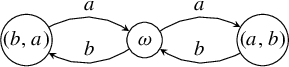
Example 4.8. The Thue–Morse morphism
 $\sigma : a\to ab,b\to ba$
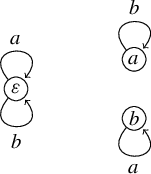
is left marked. Thus, it is recognizable for aperiodic points (as we have already seen). The graph used in the proof of Proposition 4.6 is represented in Figure 3.
The graph associated with the Thue–Morse morphism.

The proof of Theorem 4.5 also uses the following statement, originally due to [Reference Linna15] (see also [Reference Berstel, Perrin, Perrot and Restivo4] and [Reference Lothaire16, Ch. 6]).
Proposition 4.9. If a morphism
 $\sigma : A^*\to C^*$
is not injective on
 $A^{\mathbb {N}}$
, there is a trim decomposition
 $\sigma =\alpha \circ \beta $
with
 $\alpha : B^*\to C^*$
and
 $\beta : A^*\to B^*$
such that
 $\alpha $
is injective on
 $B^{\mathbb {N}}$
,
 $\operatorname {\mathrm {Card}}(B)<\operatorname {\mathrm {Card}}(A)$
, and every
 $b\in B$
appears as the first letter of
 $\beta (a)$
for some
 $a\in A$
.
Proof. Assume first that
 $\sigma $
is non-erasing. We use an induction on
 $\ell (\sigma )$
. If
 $\ell (\sigma )=0$
, set
 $B=\sigma (A)$
. Let
 $\alpha $
be the identity on B and let
 $\beta =\sigma $
. All conditions are clearly satisfied.
Assume now the statement is true for
 $\ell <\ell (\sigma )$
. Since
 $\sigma $
is not injective on
 $A^{\mathbb {N}}$
, we have
 $\sigma (a_0a_1\ldots )=\sigma (a^{\prime }_0a^{\prime }_1\ldots )$
for some
 $a_i,a^{\prime }_i\in A$
with
 $a_0\ne a^{\prime }_0$
. We can assume that
 $\sigma (a_0)$
is a prefix of
 $\sigma (a^{\prime }_0)$
. Set
 $\sigma (a^{\prime }_0)=\sigma (a_0)v$
. If v is empty, set
 $B=A\setminus \{a_0\}$
. Let
 $\alpha $
be the restriction of
 $\sigma $
to B and let
 $\beta $
be defined by
 $\beta (a^{\prime }_0)=a_0$
and
 $\beta (a)=a$
for
 $a\ne a^{\prime }_0$
. Clearly,
 $\sigma =\alpha \circ \beta $
and all conditions are satisfied.
Next, assume the v is non-empty. Define
 $\alpha _1:A^*\to C^*$
by
 $\alpha _1(a^{\prime }_0)=v$
and
 $\alpha _1(a)=\sigma (a)$
for
 $a\ne a^{\prime }_0$
. Next, define
 $\beta _1:A^*\to A^*$
by
 $\beta _1(a^{\prime }_0)=a_0a^{\prime }_0$
and
 $\beta _1(a)=a$
for
 $a\ne a^{\prime }_0$
. Then,
 $\sigma =\alpha _1\circ \beta _1$
since
 $$ \begin{align*} \alpha_1\circ\beta_1(a^{\prime}_0)=\alpha_1(a_0a^{\prime}_0)=\sigma(a_0)v=\sigma(a^{\prime}_0) \end{align*} $$
and
 $\alpha _1\circ \beta _1(a)=\alpha _1(a)=\sigma (a)$
if
 $a\ne a^{\prime }_0$
. The morphism
 $\beta _1$
is injective on
 $A^{\mathbb {N}}$
because no word in
 $\beta _1(A)$
begins with
 $a^{\prime }_0$
. Thus,
 $\alpha _1$
is not injective on
 $A^{\mathbb {N}}$
. By equation (4.1), we have
 $\ell (\alpha _1)<\ell (\sigma )$
. By induction hypothesis, we have a decomposition
 $\alpha _1=\alpha _2\circ \beta _2$
for
 $\beta _2:A^*\to B^*$
and
 $\alpha _2:B^*\to C^*$
with
 $\operatorname {\mathrm {Card}}(B)<\operatorname {\mathrm {Card}}(A)$
, the morphism
 $\alpha _2$
being injective on
 $B^{\mathbb {N}}$
, and every letter
 $b\in B$
appearing as the initial letter in the word
 $\beta _2(a)$
for some
 $a\in A$
. Note that since
 $\alpha _1$
is non-erasing,
 $\beta _2$
is non-erasing.
Set
 $\beta =\beta _2\circ \beta _1$
. Since
 $\beta _1,\beta _2$
are non-erasing,
 $\beta $
is non-erasing. Then,
 $\sigma =\alpha _1\circ \beta _1=\alpha _2\circ \beta _2\circ \beta _1=\alpha _2\circ \beta $
. The decomposition
 $\sigma =\alpha _2\circ \beta $
satisfies all the required conditions. Indeed, let
 $b \in B$
. Then there is
 $a \in A$
such that b is the first letter of
 $\beta _2(a)$
. If
 $a \ne a_0$
, we have
 $\beta _1(a) = a$
and thus b is the first letter of
 $\beta (a)$
. Suppose next that
 $a=a^{\prime }_0$
. Since
 $\sigma (a_0a_1\ldots )=\sigma (a^{\prime }_0a^{\prime }_1\ldots )$
and since
 $\alpha _2$
is injective on
 $B^{\mathbb {N}}$
, we have
 $\beta (a_0a_1\ldots )=\beta (a^{\prime }_0a^{\prime }_1\ldots )$
. Since
 $\beta _1(a_0)=a_0$
and
 $\beta _1(a^{\prime }_0)=a_0a^{\prime }_0$
, we obtain
 $\beta _2(a_0)\beta (a_1\ldots )=\beta _2(a_0a^{\prime }_0)\beta (a^{\prime }_1\ldots )$
and thus
 $$ \begin{align*} \beta(a_1\ldots)=\beta_2(a^{\prime}_0)\beta(a^{\prime}_1\ldots), \end{align*} $$
showing, since
 $\beta $
is non-erasing, that b is the initial letter of
 $\beta (a_1)$
.
Consider now a morphism
 $\sigma $
such that the set
 $B=\{a\in A\mid \sigma (a)\ne \varepsilon \}$
is strictly contained in A. Let
 $\beta : A^*\to B^*$
be defined by
 $\beta (a)=a$
if
 $a\in B$
and
 $\beta (a)=\varepsilon $
otherwise. Let
 $\alpha $
be the restriction of
 $\sigma $
to
 $B^*$
. Then,
 $\sigma =\alpha \circ \beta $
and
 $\alpha $
is non-erasing. If
 $\alpha $
is injective on
 $B^{\mathbb {N}}$
, we are done. Otherwise, by the first part of the proof, we have
 $\alpha =\alpha _1\circ \beta _1$
with
 $\alpha _1: B_1^*\to C^*$
and
 $\beta _1: B^*\to B_1^*$
with
 $\alpha _1$
injective on
 $B_1^{\mathbb {N}}$
,
 $\operatorname {\mathrm {Card}}(B_1)<\operatorname {\mathrm {Card}}(B)$
, and every
 $b_1\in B_1$
appears as the first letter of some
 $\beta _1(b)$
. Then, the decomposition
 $\sigma =\alpha _1\circ (\beta _1\circ \beta )$
satisfies all the conditions.
Example 4.10. Set
 $A=C=\{a,b,c\}$
. The morphism
 $\sigma : a\mapsto ab$
,
 $b\mapsto abc$
,
 $c\mapsto cc$
is not injective on
 $A^{\mathbb {N}}$
because
 $\sigma (ac^\omega )=\sigma (bc^\omega )=abc^\omega $
. The decomposition
 $\sigma =\alpha \circ \beta $
with
 $\alpha : u\mapsto ab,v\mapsto c$
and
 $\beta : a\mapsto u,b\mapsto uv,c\mapsto vv$
satisfies the conditions of Proposition 4.9.
By a symmetric version of Proposition 4.9, an elementary morphism
 $\sigma : A^*\to A^*$
is injective on
 $A^{-\mathbb {N}}$
. Since a morphism which is injective on
 $A^{\mathbb {N}}$
and on
 $A^{-\mathbb {N}}$
is injective on
 $A^{\mathbb {Z}}$
, we obtain the following corollary of Proposition 4.9.
Corollary 4.11. An elementary morphism
 $\sigma : A^*\to C^*$
is injective on
 $A^{\mathbb {Z}}$
.
Proof of Theorem 4.5
Let
 $\sigma : A^*\to B^*$
be an elementary morphism. We use an induction on
 $\ell (\sigma )$
. Since
 $\sigma $
is elementary, it has no erasable letter and the minimal possible value of
 $\ell (\sigma )$
is
 $0$
. In this case,
 $\sigma $
is a bijection from A to B and thus it is recognizable.
Assume now that
 $\sigma $
is not recognizable on aperiodic points. Thus, there exist
 ${x,x'\in A^{\mathbb {N}}}$
and w with
 $0<|w|<|\sigma (x_0)|$
such that
 $\sigma (x)=w\sigma (x')$
for some proper suffix w of
 $\sigma (a')$
. Set
 $\sigma (a')=vw$
. We can then write
 $\sigma =\sigma _1\circ \tau _1$
with
 $\tau _1: A^*\to A_1^*$
and
 $\sigma _1: A_1^*\to B^*$
and
 $A_1=A\cup \{a"\}$
, where
 $a"$
is a new letter. We have
 $\tau _1(a')=a'a"$
and
 $\tau _1(a)=a$
otherwise. Next,
 $\sigma _1(a')=v$
,
 $\sigma _1(a")=w$
, and
 $\sigma _1(a)=\sigma (a)$
otherwise. Since
 $\ell (\tau _1)>0$
, we have
 $\ell (\sigma _1)<\ell (\sigma )$
by equation (4.1).
Since
 $\tau _1$
is injective on
 $A^{\mathbb {N}}$
,
 $\sigma _1$
is not injective on
 $A_1^{\mathbb {N}}$
. By Proposition 4.9, we can write
 $\sigma _1=\sigma _2\circ \tau _2$
with
 $\sigma _2:A_2^*\to B^*$
and
 $\tau _2:A_1^*\to A_2^*$
for some alphabet
 $A_2$
such that
 $\operatorname {\mathrm {Card}}(A_2)<\operatorname {\mathrm {Card}}(A_1)$
and that every letter
 $c\in A_2$
appears as the first letter of some
 $\tau _2(a)$
for
 $a\in A_1$
. Then, by equation (4.1), we have
 $$ \begin{align} \ell(\sigma_1)\ge \ell(\sigma_2)+\ell(\tau_2). \end{align} $$
If
 $\operatorname {\mathrm {Card}}(A_2)<\operatorname {\mathrm {Card}}(A)$
, then
 $\sigma $
is not elementary and we are done. Otherwise, we have
 $\operatorname {\mathrm {Card}}(A_2)=\operatorname {\mathrm {Card}}(A)$
. We may also assume that
 $\sigma _2$
and
 $\tau _2\circ \tau _1$
are elementary since otherwise
 $\sigma $
is not elementary.
Since
 $\sigma _2$
is elementary and since
 $\ell (\sigma _2)\le \ell (\sigma _1)<\ell (\sigma )$
, by the induction hypothesis,
 $\sigma _2$
is recognizable for aperiodic points.
Since
 $\sigma =\sigma _2\circ \tau _2\circ \tau _1$
, we have also
 $$ \begin{align} \ell(\sigma)\ge \ell(\sigma_2)+\ell(\tau_2\circ\tau_1). \end{align} $$
Thus, if
 $\ell (\sigma _2)>0$
, the inequality
 $\ell (\tau _2\circ \tau _1)<\ell (\sigma )$
holds. Since
 $\tau _2\circ \tau _1$
is elementary, we obtain that
 $\tau _2\circ \tau _1$
is recognizable for aperiodic points by induction hypothesis. Thus, by Proposition 3.6,
 $\sigma $
is recognizable for aperiodic points.
Let us finally assume that
 $\ell (\sigma _2)=0$
. Then,
 $\sigma $
is left marked because
 $\sigma _2$
is a bijection from
 $A_2$
onto B and every letter of
 $A_2$
appears as an initial of
 $\tau _2(a)$
for
 $a\in A_1$
. We obtain the conclusion by Proposition 4.6.
5 Recognizability and iterated morphisms
In this section, we address the problem of the recognizability of morphisms
 $\sigma : A^*\to A^*$
on the shift
 $X(\sigma )$
.
The following is proved in [Reference Bezuglyi, Kwiatkowski and Medynets7, Proposition 5.10] for non-erasing morphisms. We give a proof which holds for morphisms with erasable letters.
Theorem 5.1. Let
 $\sigma : A^*\to A^*$
be a morphism. Every point y in
 $X(\sigma )$
has a
 $\sigma $
-representation
 $y=S^k(\sigma (x))$
with
 $x\in X(\sigma )$
.
Proof. Let
 $k=|\sigma |$
. Let y be in
 $X(\sigma )$
. For every
 $n> 2k$
, there is an integer
 $m \geq 1$
such that
 $y_{[-n,n]}$
is a factor of
 $\sigma ^m(a)$
for some letter
 $a \in A$
.
Hence,
 $y_{[-n, n]} = s \sigma (a_1 \ldots a_\ell ) p$
, where
 $a_i \in A$
,
 $a_1 \ldots a_\ell $
is a factor of
 $\sigma ^{m-1}(a)$
, s is a suffix of a word in
 $\sigma (A)$
and p is a prefix of a word in
 $\sigma (A)$
. Since
 $n> 2k$
, at least one letter
 $a_i$
is such that
 $\sigma (a_i) \neq \varepsilon $
. We write
 $a_1 \ldots a_\ell = u_1 \ldots u_r$
, where
 $r \geq 1$
,
 $u_j = v_jb_j$
with
 $b_j \in A, v_j \in A^*$
(the word
 $v_j$
being possibly the empty word),
 $\sigma (v_j)=\varepsilon $
, and
 $\sigma (b_j) \neq \varepsilon $
.
Then, there are integers
 $n \leq k_1 < k_2 < \cdots < k_{r+1} \leq n+1$
such that
 $y_{[-n, n]} = s \sigma (u_1) \ldots \sigma (u_r) p$
, with
 $s = y_{[-n, k_1)}$
,
 $\sigma (u_j) = y_{[k_j,k_{j+1})}$
,
 $p= y_{[k_{r+1},n]}$
. Note that
 $\sigma (u_j)=\sigma (a_j)$
is non-empty and belongs to
 $\sigma (A)$
.
For every i with
 $-n + k \leq i \leq n-k$
, we denote by
 $f_n(i)$
the unique triple
 $(k_j, k_{j+1}-1, u_j)$
defined above such that
 $k_j \leq i < k_{j+1}$
.
Since
 $\sigma (A)$
is finite and since there is a finite number of erasable words in
 $\mathcal {L}(\sigma )$
by Proposition 2.2, there is a finite number of triples
 $f_n(0)$
. Thus, there is a strictly increasing sequence
 $(i_n)_{n \in \mathbb {N}}$
of natural integers such that
 $f_{i_n}(0)$
is constant. We denote this constant value by
 $f(0)$
.
Taking a subsequence of
 $(i_n)_{n \in \mathbb {N}}$
, we may also assume that all
 $f_{i_n}(-1)$
and
 $f_{i_n}(1)$
are equal to some triple
 $f(-1)$
and
 $f(1)$
, respectively. By iterating his process, we define for each
 $i \in \mathbb {Z}$
a triple
 $f(i)=(j_i, \ell _i, u_i)$
. By construction,
 $f(i) = f(i')$
for all
 $i, i' \in [j_i, \ell _i)$
.
We now concatenate the words
 $u_i$
to build a point x as follows. We define a strictly increasing sequence
 $(j_n)_{n \in \mathbb {Z}}$
of integers by
 $j_0 = 0$
, for
 $n> 0$
,
 $j_n$
is the least integer larger than
 $j_{n-1}$
such that
 $f(j_n) \neq f(j_{n-1})$
, and for
 $n < 0$
,
 $j_n$
is the largest integer less than
 $j_{n+1}$
such that
 $f(j_n) \neq f(j_{n+1})$
. Let
 $x= \ldots u_{j_{-2}}u_{j_{-1}}.u_{j_0}u_{j_1}u_{j_2}\ldots $
. By construction,
 $x \in X(\sigma )$
and there is some integer r such that
 $y = S^r(\sigma (x))$
.
We will also need the following more technical statements. The first one concerns growing letters. Let
 $\sigma : A^* \rightarrow A^*$
be a morphism. Recall that a letter a is growing if
 $|\sigma ^n(a)|$
is unbounded and that, in this case, by Proposition 2.7, one has actually
 $\lim _{n \rightarrow +\infty } |\sigma (a)| = + \infty $
.
Proposition 5.2. Let
 $\sigma : A^* \rightarrow A^*$
be a morphism and let S be the set of right-infinite sequences x such that every
 $x_{[0, n]}$
is a prefix of some
 $\sigma ^m(a)$
for a fixed letter a.
If
 $x \in S$
contains a growing letter, there are integers r and
 $0 \leq k < r$
such that
 $x = \lim _{n \rightarrow +\infty }\sigma ^{rn+k}(a)$
.
The set of points
 $x \in S$
with no growing letters is a finite set of eventually periodic right-infinite sequences.
Proof. We first assume that x contains a growing letter. Let
 $x_i= b$
be the first growing letter of x. Thus,
 $x = x_{[0, i)}bx'$
, where
 $x_{[0,i)}$
is non-growing. There are integers
 $m < m'$
such that
 $x_{[0,i)}b$
is a prefix of
 $\sigma ^m(a)$
and of
 $\sigma ^{m'}(a)$
. Let
 $r = m'-m$
.
Since
 $x_{[0,i)}b$
is a prefix of
 $\sigma ^m(a)$
,
 $\sigma ^{r}(x_{[0,i)}b)$
is a prefix of
 $\sigma ^{m'}(a)$
and thus
 $\sigma ^{r}(x_{[0,i)}b)$
is prefix comparable with
 $x_{[0,i)}b$
. Since
 $x_{[0,i)}$
is non-growing,
 $\sigma ^{r}(x_{[0, i)})$
is a prefix
 $x_{[0, j)}$
of
 $x_{[0, i)}$
and
 $\sigma ^{r}(b) = x_{[j,i)}bu$
, where u is a non-erasable word (otherwise, b would not be growing).
Then, for all integers n,
 $\sigma ^{nr}(x_{[0, i)}b) = x_{[0,i)}bu\sigma ^r(u) \ldots \sigma ^{(n-1)r}(u)$
. Thus,
 $\lim _{n \rightarrow +\infty } \sigma ^{m+rn}(a)$
exists. It follows that
 $\lim _{n \rightarrow +\infty } \sigma ^{m+k+rn}(a)$
exists for every
 $0 \leq k < r$
. It also follows that x is one of the points
 $x^{(k,r)}= \lim _{n \rightarrow +\infty } \sigma ^{k+rn}(a)$
for some
 $0 \leq k < r$
.
Let us show that there is a finite number of such points. If y is another point of S with a growing letter,
 $y = \lim _{n \rightarrow +\infty } \sigma ^{k'+r'n}(a)$
with
 $r'> r$
,
 $0 \leq k' < r'$
, then we have
 $y = x^{(k^{\prime\prime},r)}$
for some
 $0 \leq k^{\prime\prime} < r$
.
We now assume that all letters of x are non-growing. There are non-negative integers
 $r, p \leq \operatorname {\mathrm {Card}}(A)$
such that
 $\sigma ^r(a) = ubv$
and
 $\sigma ^p(b) = wbz$
with
 $u, w$
non-growing,
 $b \in A$
growing. We get that for any
 $k \geq 0$
,
 $$ \begin{align*} \sigma^{r + kp}(a) = \sigma^{kp}(u) \sigma^{(k-1)p}(w)\ldots \sigma^p(w)wbz^{(k)}. \end{align*} $$
Since u and w are non-growing, there are non-negative integers
 $i, i'$
such that
 $\sigma ^{i'p}(u) = \sigma ^{i'p + ip}(u)$
and
 $\sigma ^{i'p}(w) = \sigma ^{i'p + ip}(w)$
. It follows that
 $$ \begin{align*} \sigma^{r + i'p + kip}(a) = \sigma^{i'p}(u) \sigma^{((i'+ki)-1)p}(w)\ldots \sigma^p(w)wbz^{(i'+ki)}. \end{align*} $$
Note that w is non-erasable since otherwise x would have a growing letter. Thus, for large enough k, we get
 $$ \begin{align*} \sigma^{r + i'p + kip}(a) = t z^{k-1} \sigma^{(i'-1)p}(w) \ldots \sigma^p(w)wbz^{(i'+ki)}, \end{align*} $$
where
 $t = \sigma ^{i'p}(u) \sigma ^{(i' + i -1)p}(w) \ldots \sigma ^{i'p}(w)$
, and
 $z = \sigma ^{(i'+i -1)p}(w) \ldots \sigma ^{i'p}(w)$
.
Every
 $x_{[0, n]}$
is a prefix of some
 $\sigma ^{N_n} (a)$
. There is an infinite number of n such that
 $N_n$
is equal to
 $r + i'p + k_nip + h$
for some fixed
 $0 \leq h < ip$
for some non-negative integer
 $k_n$
. It follows that for an infinite number n,
 $x_{[0,n]}$
is a prefix of
 $\sigma ^h(tz^{k_n-1}t')$
, where
 $t' = \sigma ^{(i'-1)p}(w) \ldots \sigma ^p(w)w$
. It follows that there is a finite number of words
 $u,v$
depending only on
 $\sigma $
such that
 $x = uv^\omega $
. Hence the conclusion.
The second one gives a sufficient condition to have
 $X(\sigma )=X(\sigma ^n)$
. This is not always true, as shown by the example of
 $\sigma : a\mapsto bc, b\mapsto cc,c\mapsto bb$
. We have
 $^\omega c\cdot b^\omega $
is in
 $X(\sigma )$
but not in
 $X(\sigma ^2)$
.
Lemma 5.3. Let
 $\sigma : A^*\to A^*$
be a morphism. If every letter
 $a\in A$
appears in
 $\sigma (A)$
, then
 $X(\sigma ^n)=X(\sigma )$
for every
 $n\ge 1$
.
Proof. It is enough to show that
 $\mathcal {L}(\sigma ^n)=\mathcal {L}(\sigma )$
. We first clearly have
 $\mathcal {L}(\sigma ^n)\subset \mathcal {L}(\sigma )$
. Conversely, let
 $u\in \mathcal {L}(\sigma )$
. Then u is a factor of some
 $\sigma ^{m}(a)$
. Let k be such that
 $kn \leq m < (k+1)n$
. Since every letter appears in
 $\sigma (A)$
, the letter a appears in
 $\sigma ^{(k+1)n- m}(b)$
for some letter b and thus u is a factor of
 $\sigma ^{n(k+1)}(b)$
. Hence,
 $u \in \mathcal {L}(\sigma ^n)$
.
A morphism
 $\sigma : A^*\to A^*$
is primitive if there is an integer
 $n\ge 1$
such that every
 $b\in A$
appears in every
 $\sigma ^n(a)$
for
 $a\in A$
.
A morphism
 $\sigma : A^*\to A^*$
is aperiodic if
 $X(\sigma )$
does not contain periodic points.
The following result is proved in [Reference Berthé, Steiner, Thuswaldner and Yassawi6] in the case of non-erasing morphisms. It is a generalization of Mossé’s theorem asserting that every aperiodic primitive morphism
 $\sigma $
is recognizable on
 $X(\sigma )$
. Our new proof holds for the general case of morphisms with erasable letters and relies on Theorem 4.5. It also gives a proof of the original version of Mossé’s theorem which is easier than the previous ones (see the comment after the proof).
Theorem 5.4. Every morphism
 $\sigma : A^*\to A^*$
is recognizable on
 $X(\sigma )$
for aperiodic points.
Proof. Let
 $\sigma : A^*\to A^*$
be a morphism.
Case 1. We first assume that every letter of A is a letter of some word of
 $\sigma (A)$
. By Lemma 5.3, we have
 $X(\sigma ) = X(\sigma ^n)$
for every positive integer n.
It is enough to prove the statement for a power
 $\sigma ^n$
of
 $\sigma $
. Indeed, assume that
 $\sigma ^n$
is recognizable on
 $X(\sigma ^n)=X(\sigma )$
for aperiodic points. Let x be an aperiodic point
 $x\in X(\sigma )$
and let
 $(z,K)$
be its unique centered
 $\sigma ^n$
-representation. Let
 $\sigma ^{n-1}(z_0)=uav$
with
 $a\in A$
be the unique factorization of
 $\sigma ^{n-1}(z_0)$
such that
 $|\sigma (u)|\le K<|\sigma (ua)|$
. Set
 $y=S^{|u|}\sigma ^{n-1}(z)$
and
 $\sigma (a)=sx_0t$
. Then,
 $(y,|s|)$
is the unique centered
 $\sigma $
-representation of x.
Indeed, it is a centered
 $\sigma $
-representation of x. If
 $(y',k')$
is another centered
 $\sigma $
-representation of x, let
 $(z',r')$
be a centered
 $\sigma ^{n-1}$
-representation of y. Set
 $\sigma ^{n-1}(z^{\prime }_0)=u'a'v'$
with
 $|u'|=r'$
and
 $\sigma (a')=s'x_0t'$
with
 $|s'|=k'$
. Then,
 $u'a'$
is a prefix of
 $\sigma ^{n-1}(z^{\prime }_0)$
such that
 $|\sigma (u')|\le |\sigma (u')|+k' <|\sigma (u'a')|$
. Since
 $(z',|\sigma (u')|+k')$
is a centered
 $\sigma ^n$
-representation of x, we have
 $z = z'$
,
 $K=|\sigma (u')|+k'$
and thus
 $ua=u'a'$
, which implies
 $y=y'$
and
 $ k' = |s|$
.
Choose n such that
 $\sigma ^n$
has a decomposition
 $\sigma ^n=\alpha \circ \beta $
with
 $\beta : A^*\to B^*$
and
 $\alpha : B^*\to A^*$
, and
 $\operatorname {\mathrm {Card}}(B)$
minimal. Then,
 $\tau =\beta \circ \alpha $
is elementary. Indeed, if
 $\tau =\gamma \circ \delta $
with
 $\delta :B^*\to C^*$
and
 $\gamma : C^*\to B^*$
is a decomposition of
 $\tau $
such that
 $\operatorname {\mathrm {Card}}(C)<\operatorname {\mathrm {Card}}(B)$
, then
 $\sigma ^{2n}=(\alpha \circ \gamma )\circ (\delta \circ \beta )$
is a decomposition of
 $\sigma ^{2n}$
with
 $\delta \circ \beta : A^*\to C^*$
and
 $\alpha \circ \gamma : C^*\to A^*$
such that
 $\operatorname {\mathrm {Card}}(C)<\operatorname {\mathrm {Card}}(B)$
, which is a contradiction.
It is easy to check that
 $\alpha $
is also elementary. Moreover, we have
 $$ \begin{align} \beta(X(\sigma))\subset X(\tau). \end{align} $$
Indeed, consider
 $x\in X(\sigma )$
and let w be a factor of
 $\beta (x)$
. We have to prove that w is a factor of some
 $\tau ^m(c)$
for
 $c\in B$
. Now, since
 $x \in X(\sigma ^n)$
, there in an
 $N\ge 1$
such that w is a factor of some
 $\beta \circ \sigma ^{Nn}(a)$
for
 $a\in A$
and
 $N\ge 1$
, and also a factor of
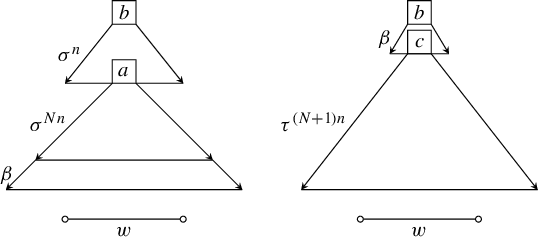
 $\beta \circ \sigma ^{(N+1)n}(b)$
with a a factor of
 $\sigma ^n(b)$
(see Figure 4). Since
 $\sigma ^n=\alpha \circ \beta $
, there is a letter c such that
 $a\in \alpha (c)$
and
 $c \in \beta (b)$
. Since
 $\beta \circ \sigma ^n=\tau ^n\circ \beta $
, we obtain that w is a factor of
 $\tau ^{(N+1)n}(c)$
.
Proving that w is a factor of
 $\tau ^m(c)$
.

Let
 $x\in X(\sigma )$
be an aperiodic point. Consider two centered
 $\sigma ^n$
-representations
 $(y,k)$
and
 $(y',k')$
of x with
 $y,y'\in X(\sigma )$
. Let
 $(z, \ell )$
and
 $(z', \ell ')$
be centered
 $\sigma ^n$
-representations of y and
 $y'$
, respectively, with
 $z,z'\in X(\sigma )$
(we use here Theorem 5.1). Then,
 $(\beta (z),m)$
and
 $(\beta (z'),m')$
are, for some unique
 $m,m'$
, some centered
 $\tau $
-representations of
 $\beta (y)$
and
 $\beta (y')$
, respectively (see Figure 5). The fact that
 $m,m'$
are unique results from the fact that
 $\tau $
is elementary and thus recognizable for aperiodic points by Theorem 4.5.
The points
 $x,y,z$
.

Since
 $\alpha $
is elementary, it is recognizable for aperiodic points. Since
 $\alpha (\beta (y))=\sigma ^n(y)$
and
 $\alpha (\beta (y'))=\sigma ^n(y')$
, this implies that
 $\beta (y),\beta (y')$
belong to the same orbit. Since
 $\tau $
is recognizable for aperiodic points, we obtain that
 $\beta (z)$
and
 $\beta (z')$
belong to the same orbit. Applying
 $\alpha $
again, we conclude that
 $y,y'$
belong to the same orbit. Since x is aperiodic, this implies that
 $y = y'$
and
 $k = k'$
. Thus,
 $\sigma ^n$
is recognizable for aperiodic points.
Case 2. We now prove the general case. We prove the result by induction on the number of letters which do not appear in some word of
 $\sigma (A)$
. The case where there is no such letter is Case 1 and thus the property holds. Let a be a letter of A which does not appear in a word in
 $\sigma (A)$
and set
 $B= A \setminus \{a\}$
. We denote by
 $\sigma _B$
the morphism
 $\sigma $
restricted to
 $B^*$
. By induction hypothesis,
 $\sigma _B$
is recognizable on
 $X(\sigma _B)$
for aperiodic points. We denote by K the maximal length of all
 $\sigma ^n(b)$
for non-growing letters b in B.
Let y be an aperiodic point having two centered
 $\sigma $
-representations
 $(x, k)$
and
 $(x', k')$
with
 $x, x' \in X(\sigma )$
. We cannot have
 $x,x'\in X(\sigma _B)$
and we may assume that x belongs to
 $X(\sigma ) \setminus X(\sigma _B)$
. Thus, there is an integer m such that
 $x_{[-m, m]}$
is not a factor of any
 $\sigma ^n(b)$
for
 $b \in B$
. For each integer
 $n \geq m$
, there is an integer
 $N(n)$
such that
 $x_{[-n,n]}$
is a factor of
 $\sigma ^{N(n)}(a)$
.
We have
 $\sigma (a) = b_1 \ldots b_\ell $
with
 $b_i \in B$
. Since
 $x_{[-m, m]}$
is not a factor of any
 $\sigma ^n(b_i)$
, there are integers
 $1 \leq i_n \leq \ell $
,
 $-m \leq k_n < m$
such that
 $x_{[-n, k_n)}$
is a suffix of
 $\sigma ^{N(n)-1}(b_1 \ldots b_{i_n})$
and
 $x_{[k_n, n]}$
is a prefix of
 $\sigma ^{N(n)-1}(b_{i_n+1} \ldots b_\ell )$
. Let
 $b_{j_n}$
be the last growing letter of
 $b_1 \ldots b_{i_n}$
and
 $b_{r_n}$
be the first growing letter of
 $b_{i_n+1} \ldots b_\ell $
. Note that such growing letters exist for large enough n.
There is an infinite number of integers n such that
 $i_n = i$
,
 $j_n = j$
,
 $r_n = r$
,
 $k_n = M$
, where
 $1 \leq j \leq i < r \leq \ell $
and
 $-m \leq M < m$
.
Since
 $b_{j+1} \ldots b_i$
and
 $b_{i+1} \ldots b_{r-1}$
are non-growing, the lengths of all words
 $\sigma ^{N(n)-1}(b_{j+1} \ldots b_i)$
and
 $\sigma ^{N(n)-1}(b_{i+1} \ldots b_{r-1})$
are bounded by
 $K \ell $
. Thus, there is an infinite number of integers n such that moreover
 $|\sigma ^{N(n)-1}(b_{j+1} \ldots b_i)| = p$
,
 $|\sigma ^{N(n)-1}(b_{i+1} \ldots b_{r-1})| = p'$
for some fixed integers
 $0 \leq p, p' \leq K\ell $
.
Let
 $b = b_j$
and
 $c = b_r$
. Since
 $b, c$
are growing, for each n, there are integers
 $m, m'$
such that
 $x_{[-n, M-p)}$
is a suffix of
 $\sigma ^m(b)$
and
 $x_{[M+p',n]}$
is a prefix of
 $\sigma ^{m'}(c)$
.
By Proposition 5.2, there are finite sets
 $L, R$
of respectively left- and right-infinite sequences, and a finite set U of words of length at most
 $2K\ell $
such that x is a shift of
 $tut'$
with
 $t \in L$
,
 $u \in U$
, and
 $t' \in R$
. Thus, there is a finite number of such orbits.
We define a sequence
 $(x^{(i)})_{i \geq 0}$
of two-sided infinite sequences
 $x^{(i)}$
by
 $x^{(0)} = x$
and
 $x^{(i)} \in X(\sigma ) \setminus X(\sigma _B)$
such that
 $x^{(i-1)} =S^k\sigma (x^{(i)})$
for some k. There is an infinite number of i such that
 $x^{(i)}$
are shifts of the same sequence. Thus, there are integers
 $i, j$
with
 $j \geq 1$
such that
 $\sigma ^j(x^{(i)})$
is a shift of
 $x^{(i)}$
. As a consequence,
 $y \in X(\sigma ) \setminus X(\sigma _B)$
. Thus,
 $x, x' \in X(\sigma ) \setminus X(\sigma _B)$
.
As above, we define sequences
 $(x^{(i)})$
and
 $({x'}^{(i)})$
for x and
 $x'$
. Thus, there are integers
 $i, j$
with
 $j \geq 1$
such that
 $\sigma ^j(x^{(i)})$
is a shift of
 $x^{(i)}$
and
 $\sigma ^{j}({x'}^{(i)})$
is a shift of
 ${x'}^{(i)}$
. We get that there is an integer i such that
 $x^{(i)}$
and
 ${x'}^{(i)}$
are in the same orbit and thus x and
 $x'$
also.
Now if
 $x \neq x'$
of
 $k \neq k'$
with
 $0 \leq k < |\sigma (x_0)|$
and
 $0 \leq k' < |\sigma (x^{\prime }_0)|$
, we get that y is periodic, which is excluded. Thus, y has a unique centered
 $\sigma $
-representation in
 $X(\sigma )$
.
Note that to prove Mossé’s theorem itself, one only needs the first case in the above proof. Indeed, if
 $\sigma $
is primitive, every letter appears in
 $\sigma (A)$
. Note also that in this case, Proposition 5.2 is not used. The previous proofs of Mossé’s theorem work on a fixed point of the morphism and handle indices of this sequence, resulting in fairly complicated arguments (see for example [Reference Kurka12]). The proof given in [Reference Durand and Perrin9] avoids these indices but remains essentially the same as that of [Reference Kurka12]. The use of the notion of elementary morphism, through Theorem 4.5, seems to us a major simplification.
We give below an example of a morphism
 $\sigma $
such that
 $X(\sigma )$
contains both periodic and non-periodic points.
Example 5.5. Let
 $\sigma $
be the morphism
 $\sigma : a\mapsto bac,b\mapsto bb,c\mapsto cd,d\mapsto c$
. The set
 $X(\sigma )$
contains the aperiodic point
 $^\omega b\cdot a\sigma ^\omega (c)$
, where
 $\sigma ^\omega (c)=cdccd\ldots $
is the one-sided Fibonacci sequence. It also contains the periodic point
 $y=b^\infty $
. Every point, except y, has a unique centered
 $\sigma $
-representation.
6 Automata and syntactic groups
We now introduce notions from automata theory which will allow us to formulate a characterization of morphisms
 $\sigma : A^*\to B^*$
which are recognizable for aperiodic points (Theorem 6.5).
Let
 $\mathcal {A}=(Q,I,T)$
be a finite automaton on the alphabet A with Q as a set of states, I as a set of initial states, and T as a set of terminal states. Such an automaton is just a graph with Q as a set of vertices and edges labeled by A. The language recognized by
 $\mathcal {A}$
is the set of labels of paths from I to T. The automaton is deterministic if for every
 $q\in Q$
and a in A, there is at most one edge starting at q labeled a (the term deterministic corresponds to the term right-resolving used, in particular, in [Reference Lind and Marcus14]).
An automaton is unambiguous if for every
 $p,q\in Q$
and
 $w\in A^*$
, there is at most one path from p to q labeled by w. An automaton is unambiguous for aperiodic points if for every aperiodic two-sided infinite word x, there is at most one path of the automaton labeled by x.
Proposition 6.1. Let
 $\sigma : A^*\to B^*$
be a morphism. If
 $\sigma $
is recognizable for aperiodic points, either
 $\sigma $
is periodic or
 $\sigma $
is injective.
Proof. Assume that
 $\sigma $
is not periodic. If
 $\sigma $
is not injective, there are some distinct
 ${u,v\in A^*}$
such that
 $\sigma (u)=\sigma (v)=d$
. Since
 $\sigma $
is not periodic, there is some w such that
 ${c=\sigma (w)}$
and
 $\sigma (u)$
are not powers of the same primitive word. Then,
 ${^\omega }c\cdot dc^\omega $
is aperiodic and has more than one centered
 $\sigma $
-representation. Thus,
 $\sigma $
is not recognizable for aperiodic points.
For every finite set
 $U\subset B^+$
, there is a particular automaton which recognizes
 $U^*$
, called the flower automaton of U. Its set of states is the set Q defined as
 $$ \begin{align*} Q=\{(u,v)\in B^+\times B^+\mid uv\in U\}\cup \{\omega\}, \end{align*} $$
where
 $\omega $
is a new element. There are four type of edges labeled by
 $a\in B$
:
 $$ \begin{align*}\begin{array}{ll} (u,av)\stackrel{a}{\longrightarrow}(ua,v)&\kern1pt\text{for }uav\in U, u,v\ne1;\\[3pt]\omega\stackrel{a}{\longrightarrow}(a,v)&\kern1pt\text{for }av\in U, v\ne 1;\\[3pt](u,a)\stackrel{a}{\longrightarrow}\omega&\kern1pt\text{for }ua\in U, u\ne 1;\\[3pt]\omega\stackrel{a}{\longrightarrow}\omega&\kern1pt\text{for }a\in U.\\ \end{array}\end{align*} $$
The state
 $\omega $
is both initial and terminal. It is easy to verify that the flower automaton recognizes
 $U^*$
. Moreover, the set U is a code if and only if its flower automaton is unambiguous (see [Reference Berstel, Perrin and Reutenauer5]).
Note that a morphism
 $\sigma : A^*\to B^*$
is left marked if and only if the flower automaton of
 $\sigma (A)$
is deterministic.
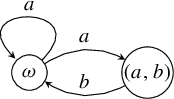
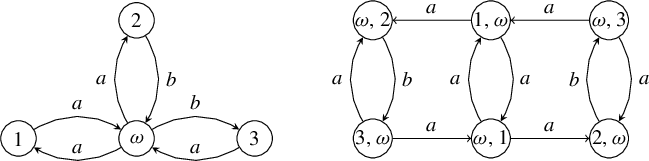
Example 6.2. Let
 $\sigma : a\mapsto ab,b\mapsto a$
be the Fibonacci morphism. The flower automaton
 $\mathcal {A}$
of
 $\sigma (A) = \{ab, a\}$
is represented in Figure 6.
The flower automaton of
 $\sigma (A) = \{ab, a\}$
.

Let
 $\mathcal {A}$
be a finite automaton. For
 $w\in A^*$
, we denote by
 $\varphi _{\mathcal {A}}(w)$
the
 $Q\times Q$
-relation defined by
 $$ \begin{align*} \varphi_{\mathcal{A}}(w)_{p,q}=\begin{cases}1&\mbox{ if }p\stackrel{w}{\rightarrow}q,\\0&\mbox{otherwise.} \end{cases} \end{align*} $$
The monoid
 $M(\mathcal {A})=\varphi _{\mathcal {A}}(A^*)$
is the monoid of transitions of the automaton
 $\mathcal {A}$
. For
 ${m\in M(\mathcal {A})}$
, we denote indifferently
 $m_{p,q}=1$
,
 $(p,q)\in m$
or
 $p\stackrel {m}{\rightarrow }q$
the fact that
 $(p,q)$
are in relation by m.
When
 $\mathcal {A}$
is deterministic, each relation
 $\varphi _{\mathcal {A}}$
is a partial map from Q to itself and thus
 $M(\mathcal {A})$
is a submonoid of the monoid of partial maps from Q to Q.
When
 $\mathcal {A}$
is unambiguous, the monoid
 $M=M(\mathcal {A})$
is called an unambiguous monoid of relations. This means that for every
 $m,n\in M$
and
 $p,q\in Q$
such that
 $p\stackrel {mn}{\rightarrow }q$
, there is a unique
 $r\in Q$
such that
 $p\stackrel {m}{\rightarrow }r\stackrel {n}{\rightarrow }q$
. This also means that we can consider the elements of M as
 $\{0,1\}$
-matrices with
 $0,1$
considered as integers.
As in any monoid, the Green relations
 $\mathcal R$
and
 $\mathcal L$
are defined by
 $m\mathcal R n$
if
 $mM=nM$
and, symmetrically,
 $m\mathcal L n$
if
 $Mm=Mn$
. It is classical that
 $\mathcal R$
and
 $\mathcal L$
commute and thus that the composition
 $\mathcal R\mathcal L=\mathcal L\mathcal R$
is an equivalence, traditionally denoted by
 $\mathcal D$
.
For an element m of a monoid M, we denote by
 $H(m)$
the
 $\mathcal H$
-class of m, where
 $\mathcal H$
is the Green relation
 $\mathcal H=\mathcal R\cap \mathcal L$
. It is a group if and only if it contains an idempotent e (see [Reference Berstel, Perrin and Reutenauer5]). In this case, every
 $m\in H(e)$
has a unique inverse
 $m^{-1}$
in the group
 $H(e)$
.
Let M be a unambiguous monoid of relations on Q. A fixed point of a relation
 $m\in M$
is an element
 $q\in Q$
such that
 $q\stackrel {m}{\longrightarrow }q$
. A group in a monoid M is a subsemigroup of M which is a group. Let G be a group in M with neutral element e. Let S be the set of fixed points of e. The restriction of the elements of G to
 $S\times S$
is a faithful representation of G by permutations on S. The number of elements of S is called the degree of G.
The above representation of groups also exists in a monoid of relations which is ambiguous but is more complicated (see [Reference Perrin and Ryzhikov24] or [Reference Perrin, Ryzhikov, Saxena and Simon23]).
A group in the monoid
 $M(\mathcal {A})$
is strongly cyclic (or special) if
 $\varphi _{\mathcal {A}}^{-1}(G)$
is a cyclic submonoid of
 $A^*$
. This notion was introduced by Schützenberger in [Reference Schützenberger and Pollak27] (see also [Reference Perrin and Rindone22]). It implies that G itself is a cyclic group. It also implies that
 $\varphi ^{-1}(D)$
, where D is the
 $\mathcal D$
-class containing G, is also included in the set of factors of the same cyclic submonoid. In particular, if
 $e,f$
are idempotents in D, then
 $\varphi _{\mathcal {A}}^{-1}(e)=u^+$
and
 $\varphi _{\mathcal {A}}^{-1}(f)=v^+$
, where
 $u,v$
are conjugate. Moreover, if
 $m\in D$
is such that
 $m=em=mf$
, then
 $$ \begin{align} \varphi_{\mathcal{A}}^{-1}(e)=(rs)^+,\quad \varphi_{\mathcal{A}}^{-1}(m)=(rs)^+r,\quad \varphi_{\mathcal{A}}^{-1}(f)=(sr)^+. \end{align} $$
A pair
 $(m,e)$
of elements in a monoid M is a linked pair if
 $m=me$
and
 $e=e^2$
. The following result is [Reference Perrin and Pin21, Theorem 2.2].
Proposition 6.3. Let
 $\varphi :A^*\to M$
be a morphism from
 $A^*$
into a finite monoid M. For every
 $x\in A^{\mathbb {N}}$
, there exists a linked pair
 $(m,e)$
in M such that
 $x\in \varphi ^{-1}(m)\varphi ^{-1}(e)^\omega $
.
A dual statement holds for a left-infinite sequence. Consequently, for every
 $x\in A^{\mathbb {Z}}$
, there is a triple
 $(e,m,f)$
with
 $e,f$
idempotents and
 $m=em=mf$
such that
 $x\in {^\omega }\varphi ^{-1}(e)\varphi ^{-1}(m)\varphi ^{-1}(f)^\omega $
.
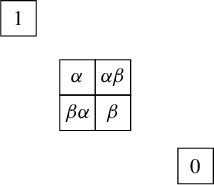
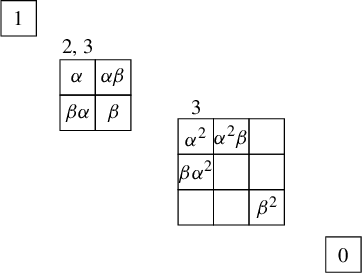
Example 6.4. Let
 $\sigma $
be the Fibonacci morphism and let
 $\mathcal {A}$
be the flower automaton of
 $\sigma (A)=\{ab,a\}$
(see Figure 6).
Set
 $\alpha =\varphi _{\mathcal {A}}(a)$
and
 $\beta =\varphi _{\mathcal {A}}(b)$
. One has
 $a^2\equiv a$
,
 $aba\equiv a$
, and
 $b^2\equiv b^3$
, which is a zero of the monoid. The monoid of transitions of
 $\mathcal {A}$
is formed of
 $6$
elements pictured in Figure 7 (we adopt the usual egg-box representation of monoids corresponding to the Green relations, see [Reference Berstel, Perrin and Reutenauer5]). Besides
 $1$
and
 $0$
, there are three groups in
 $M(\mathcal {A})$
reduced to one element (
 $\alpha $
,
 $\alpha \beta $
and
 $\beta \alpha $
), which have degree
 $1$
.
The monoid of transitions of
 $\mathcal {A}$
.

Theorem 6.5. Let
 $\sigma : A^*\to B^*$
be an injective morphism and let
 $\mathcal {A}$
be the flower automaton of
 $\sigma (A)$
. The morphism
 $\sigma $
is recognizable for aperiodic points if and only if
 $\mathcal {A}$
is unambiguous for aperiodic points.
Proof. The morphism
 $\sigma $
is recognizable for aperiodic points if and only if every aperiodic point x of
 $B^{\mathbb {Z}}$
has at most one decomposition in words of
 $\sigma (A)$
, that is, if there is at most one two-sided infinite path of
 $\mathcal {A}$
labeled by x going through the state
 $\omega $
for an infinite number of positive and negative indices. As
 $\sigma (A)$
is finite, every two-sided infinite path of
 $\mathcal {A}$
goes through the state
 $\omega $
for an infinite number of positive and negative indices. Thus,
 $\sigma $
is recognizable for aperiodic points if and only if
 $\mathcal {A}$
is unambiguous for aperiodic points.
An automaton
 $\mathcal {A}$
is weakly deterministic if there is an integer n such that for every state p and every word w of length n, there is at most one right-infinite path starting at p with label starting by w. Symmetrically,
 $\mathcal {A}$
is weakly codeterministic if there is an integer n such that for every state p and every word w of length n, there is at most one left-infinite path ending at p with label ending by w.
The notion of weakly deterministic automaton corresponds to that of a right-closing map in symbolic dynamics. More precisely, the map assigning its label to a right-infinite path in the automaton is right closing if and only if the automaton is weakly deterministic.
The following statement gives a necessary condition for an automaton to be unambiguous for aperiodic points. An automaton is periodic if the labels of all infinite paths are periodic. Otherwise, it is said to be non-periodic. Note that in a periodic automaton which is strongly connected, the labels of all finite paths are factors of
 $u^*$
for a single word u.
Proposition 6.6. If a strongly connected non-periodic finite automaton is unambiguous for aperiodic points, it is weakly deterministic and co-deterministic.
Proof. Assume that
 $\mathcal {A}$
is not weakly deterministic. Then there is a state p and a right-infinite sequence x such that there are two paths starting at p labeled x. Since
 $\mathcal {A}$
is strongly connected, there is a left-infinite path ending at p. Let y be the label of this path. Since
 $\mathcal {A}$
is non-periodic, we may choose y aperiodic. Then,
 $y\cdot x$
is an aperiodic point which is the label of more than one path in
 $\mathcal {A}$
. The case where
 $\mathcal {A}$
is not weakly co-deterministic is symmetrical.
We now characterize as follows the unambiguous automata which are unambiguous for aperiodic points. Combined with Proposition 6.1 and Theorem 6.5, this will give us a characterization of morphisms which are recognizable for aperiodic points. Indeed, if
 $\sigma $
is recognizable for aperiodic points, by Proposition 6.1, either it is periodic or it is injective. In the first case, it is trivially recognizable for aperiodic points. In the second case, by Theorem 6.5, it is recognizable for aperiodic points if and only if the flower automaton of
 $\sigma (A)$
is unambiguous for aperiodic points.
Theorem 6.7. A strongly connected unambiguous finite automaton
 $\mathcal {A}$
is unambiguous for aperiodic points if and only if the following conditions are satisfied.
-
(i)
$\mathcal {A}$
is weakly deterministic and co-deterministic. -
(ii) For every idempotent
$e\in \varphi _{\mathcal {A}}(A^+)$
of rank at least
$2$
, the group
$H(e)$
is strongly cyclic. -
(iii) For every pair
$(e,f)$
of idempotents in
$\varphi _{\mathcal {A}}(A^+)$
of rank at least
$2$
, and every pair of distinct fixed points
$p,p'$
and
$q,q'$
of e and f, respectively, if some
$m\in \varphi _{\mathcal {A}}(A^*)$
is such that
$p\stackrel {m}{\rightarrow }q$
and
$p'\stackrel {m}{\rightarrow }q'$
, then
$e,f$
and m belong to the same
$\mathcal D$
-class.


Proof. Assume that
 $\mathcal {A}$
is unambiguous for aperiodic points. By Proposition 6.6, condition (i) is satisfied. Let e be an idempotent in
 $M(\mathcal {A})$
of degree
 $d\ge 2$
. If the group
 $G=H(e)$
is not strongly cyclic, there are words of arbitrary large minimal period in
 $L=\varphi _{\mathcal {A}}^{-1}(G)$
and thus there is an aperiodic sequence
 $x\in A^{\mathbb {Z}}$
such that all its factors are factors of words in L. Indeed, if G is not strongly cyclic, there are words
 $u,v$
which are not powers of the same primitive word such that
 $e\in \varphi _{\mathcal {A}}(u)\cap \varphi _{\mathcal {A}}(v)$
. Then,
 $\{u,v\}^*$
contains words of arbitrary large minimal period and thus an infinite sequence x with all its factors which are factors of words in
 $\{u,v\}^*$
. Then, x is the label of d paths in
 $\mathcal {A}$
and consequently,
 $\mathcal {A}$
is not recognizable for aperiodic points. This proves that condition (ii) holds. Assume finally that m is such that
 $p\stackrel {m}{\rightarrow }q$
and
 $p'\stackrel {m}{\rightarrow }q'$
for some fixed points
 $p,p'$
and
 $q,q'$
of two idempotents
 $e,f\in \varphi (A^+)$
. If
 $e,f$
do not belong to the same
 $\mathcal D$
-class, we have
 $e\in \varphi _{\mathcal {A}}(u^+)$
and
 $f\in \varphi _{\mathcal {A}}(v^+)$
for non-conjugate primitive words
 $u,v$
(two idempotents are in the same
 $\mathcal D$
-class if and only if they are conjugate). Let w be such that
 $\varphi (w)=m$
. Then
 ${^\omega }u w v^\omega $
is an aperiodic sequence which is the label of two distinct paths.
Assume conversely that the conditions are satisfied. Consider a point
 $x\in A^{\mathbb {Z}}$
which is the label of more than one path. Since
 $M=M(\mathcal {A})$
is a finite monoid, there is, by Proposition 6.3, some
 $m\in M$
and idempotents
 $e,f\in M$
with
 $em=mf=m$
such that
 $x\in {^{\omega }EwF^\omega }$
with
 $E=\varphi _{\mathcal {A}}^{-1}(e)$
,
 $\varphi _{\mathcal {A}}(w)=m$
, and
 $F=\varphi _{\mathcal {A}}^{-1}(f)$
. The two paths have the form
 $p\stackrel {e}{\rightarrow }p\stackrel {m}{\rightarrow }q\stackrel {f}{\rightarrow }q$
and
 $p'\stackrel {e}{\rightarrow }p'\stackrel {m}{\rightarrow }q'\stackrel {f}{\rightarrow }q'$
. If
 $p=p'$
, then
 $\mathcal {A}$
is not weakly deterministic. Similarly, if
 $q=q'$
, it is not weakly co-deterministic. Thus, by condition (iii),
 $e,m,f$
belong to the same
 $\mathcal D$
-class. By condition (ii), using equation (6.1), this implies that x is periodic.
Example 6.8. Let
 $\sigma : a\mapsto ab,b\mapsto ba$
be the Thue–Morse morphism and let
 $\sigma (A)=\{ab,ba\}$
. The flower automaton of
 $\sigma (A)$
is represented in Figure 8. The monoid of transitions of
 $\mathcal {A}$
is represented in Figure 9 with
 $\alpha =\sigma (a)$
and
 $\beta =\sigma (b)$
. There are two groups of degree
 $2$
, each reduced to one element, namely
 $ab$
and
 $ba$
. They are strongly cyclic since
 $\varphi _{\mathcal {A}}^{-1}(\alpha \beta )=(ab)^*$
.
The flower automaton of
 $\sigma (A)=\{ab,ba\}$
.

The monoid of transitions of
 $\mathcal {A}$
.

7 Efficient algorithms
The conditions of Theorem 6.7 give an effective characterization of morphisms recognizable for aperiodic points. We now consider the problem of finding a more efficient procedure to check whether this property holds.
If
 $\mathcal {A}=(Q,I,T)$
is a finite automaton on A, the square
 $\mathcal {A}\times \mathcal {A}$
of the automaton
 $\mathcal {A}$
is the following automaton. Its set of states is
 $Q\times Q$
and its edges are the
 $((p,q),a,(r,s))$
such that
 $(p,a,r)$
and
 $(q,a,s)$
are edges of
 $\mathcal {A}$
.
The diagonal of
 $\mathcal {A}\times \mathcal {A}$
is the set of states of the form
 $(p,p)$
with
 $p\in Q$
. A strongly connected component of an automaton is non-trivial if it contains at least one cycle.
A simple path in
 $\mathcal {A}$
is a path with all states distinct except the extremities. A simple cycle around a state p of
 $\mathcal {A}$
is a simple path from p to p.
It is easy to verify that
 $\mathcal {A}$
is unambiguous if and only if there is no path in
 $\mathcal {A}\times \mathcal {A}$
going from a diagonal state to a diagonal state and going through a non-diagonal one. This gives a polynomial algorithm to check whether an automaton is unambiguous.
It is also easy to verify that if
 $\mathcal {A}$
is unambiguous, its square is also unambiguous. Indeed, assume that there are two paths in
 $\mathcal {A} \times \mathcal {A}$
:
 $$ \begin{align*} &(p,q)\stackrel{w}{\rightarrow}(u,v)\stackrel{w'}{\rightarrow}(r,s);\\ &(p,q)\stackrel{w}{\rightarrow}(u',v')\stackrel{w'}{\rightarrow}(r,s), \end{align*} $$
then there are paths
 $p\stackrel {w}{\rightarrow }u\stackrel {w'}{\rightarrow }r$
,
 $p\stackrel {w}{\rightarrow }u'\stackrel {w'}{\rightarrow }r$
and
 $q\stackrel {w}{\rightarrow }v\stackrel {w'}{\rightarrow }s$
,
 $q\stackrel {w}{\rightarrow }v'\stackrel {w'}{\rightarrow }s$
in
 $\mathcal {A}$
implying
 $u = u'$
and
 $v =v'$
.
We have already seen in Proposition 6.1 that if
 $\sigma $
is a morphism which is recognizable for aperiodic points, then it is injective or periodic.
The size of an automaton is the sum of the number of states and the number of edges of the automaton.
Proposition 7.1. Let
 $\mathcal {A}$
be an unambiguous strongly connected automaton. Then
 $\mathcal {A}$
is unambiguous for aperiodic points if and only if the following conditions are satisfied.
-
(i) Every non-trivial strongly connected component of
$\mathcal {A}\times \mathcal {A}$
out of the diagonal is reduced to a cycle. -
(ii) There is no path between two non-trivial strongly connected components of
$\mathcal {A}\times \mathcal {A}$
.


All these conditions can be checked in a quadratic time in the size of
 $\mathcal {A}$
.
Proof. Since
 $\mathcal {A}$
is unambiguous,
 $\mathcal {A} \times \mathcal {A}$
is unambiguous. Note that the set of diagonal states is a non-trivial strongly connected component of
 $\mathcal {A} \times \mathcal {A}$
. It cannot contain non-diagonal states since
 $\mathcal {A}$
is unambiguous.
We first show that the conditions are necessary. Let C be a non-trivial strongly connected component of
 $\mathcal {A} \times \mathcal {A}$
which is non-diagonal. Let
 $\pi $
be a simple cycle labeled by u around
 $(p,q)$
with
 $p \neq q$
in C and another cycle
 $\pi '$
which is not a power of
 $\pi $
around
 $(p,q)$
labeled by v. Since
 $\mathcal {A} \times \mathcal {A}$
is unambiguous, u and v are not a power of the same word. Thus, there is a two-sided infinite sequence x which is a concatenation of words u and v which is not periodic. This sequence is the label of a two-sided infinite path of
 $\mathcal {A} \times \mathcal {A}$
going through
 $(p,q)$
after reading u or v. Since
 $p \neq q$
, this leads to two distinct paths labeled by x in
 $\mathcal {A}$
and thus
 $\mathcal {A}$
is not unambiguous for aperiodic points.
Let C and
 $C'$
be two non-trivial non-diagonal strongly connected components of
 $\mathcal {A} \times \mathcal {A}$
. Then C and
 $C'$
are reduced to a cycle. Let
 $(p,q) \in C$
with
 $p \neq q$
and
 $(r,s) \in C'$
with
 $r \neq s$
, let
 $\pi $
be a simple cycle labeled by u around
 $(p,q)$
, and
 $\pi '$
be a simple cycle labeled by v around
 $(r,s)$
. Let us assume that there is a path from
 $(p,q)$
to
 $(r,s)$
labeled by w in
 $\mathcal {A} \times \mathcal {A}$
. Assume that u and v are not powers of two conjugate words, then the two-sided infinite word
 $x = {^\omega }uwv^\omega $
is aperiodic and
 $\mathcal {A}$
is not unambiguous for aperiodic points. Assume now that
 $u=(rs)^k$
and
 $v = (sr)^{k'}$
with
 $rs$
primitive. The word
 $x = {^\omega }uwv^\omega $
is periodic if and only if
 $w \in (rs)^*r$
. However, in this case, if
 $w = (rs)^mr$
, the word
 $(rs)^{kk'} (rs)^m r = (rs)^m r (sr)^{kk'}$
is the label of two distinct paths from
 $(p,q)$
to
 $(r,s)$
which is impossible since
 $\mathcal {A} \times \mathcal {A}$
is unambiguous.
Let us now assume that the strongly connected component of diagonal points is connected to a non-trivial non-diagonal strongly connected component. For instance, if there is a path labeled by w from a state
 $(p,p)$
to a state
 $(q,r)$
with
 $q \neq r$
belonging to an non-trivial strongly connected component.
Assume that the graph of
 $\mathcal {A}$
is not reduced to one cycle. Then there are a simple cycle
 $\pi $
around
 $(p,p)$
labeled u and another cycle
 $\pi '$
around
 $(p,p)$
labeled v which is not a power of
 $\pi $
. The words u and v are not a power of a same word. Hence, there is a left-infinite word y being a concatenation of words u and v labeling a path ending in
 $(p,p)$
and which is not ultimately periodic. Let z be the label of a cycle around
 $(q,r)$
. Then
 $ywz^\omega $
is an aperiodic point labeling two distinct paths of
 $\mathcal {A}$
.
If
 $\mathcal {A}$
is reduced to one cycle, there is no path from a diagonal state to a non-diagonal one in
 $\mathcal {A} \times \mathcal {A}$
. Thus, if condition (ii) is not satisfied,
 $\mathcal {A}$
is not unambiguous for aperiodic points.
We now show that the conditions are sufficient. We show that if all conditions hold,
 $\mathcal {A}$
is unambiguous for aperiodic points. Let x be an aperiodic point which is the label of two distinct paths of
 $\mathcal {A}$
. Then there is a two-sided infinite path
 $(p_i,q_i)_{i \in \mathbb {Z}}$
in
 $\mathcal {A} \times \mathcal {A}$
labeled by x such that
 $(p_i)_{i \in \mathbb {Z}} \neq (q_i)_{i \in \mathbb {Z}}$
. Without loss of generality, we may assume that
 $p_0 \neq q_0$
. There is an infinite number of
 $i <0$
such that
 $(p_i,q_i) = (p,q)$
for some states
 $p, q$
. There is also an infinite number of
 $j> 0$
such that
 $(p_j,q_j) = (r,s)$
for some states
 $r, s$
. We cannot have
 $p = q$
and
 $r = s$
since
 $\mathcal {A}$
is unambiguous.
Assume that
 $p = q$
. Then,
 $ r \neq s$
and there is a path from
 $(p,p)$
to the non-trivial strongly connected component of
 $(r,s)$
which is forbidden. Similarly, it is impossible to have
 $r = s$
and
 $p \neq q$
.
Assume now that
 $p \neq q$
and
 $r \neq s$
. If the strongly connected components of
 $(p,q)$
and
 $(r,s)$
are distinct, then there is a path between these two non-trivial components which is forbidden. If the components of
 $(p,q)$
and
 $(r,s)$
are the same, then x is periodic, which is a contradiction.
The conditions can be checked in time
 $O(n^2)$
, where n is the size of
 $\mathcal {A}$
.
Example 7.2. Let us consider again the morphism
 $\sigma : a\mapsto aa, b\mapsto ab, c\mapsto ba$
of Example 3.5. The flower automaton
 $\mathcal {A}$
of
 $\sigma (A)$
is represented in Figure 10 on the left. The non-diagonal part of the automaton
 $\mathcal {A}\times \mathcal {A}$
has a strongly connected component, which is represented on the right. This component is not reduced to a cycle and thus condition (i) is not satisfied, which is consistent with the fact that
 $\sigma $
is not recognizable for aperiodic points, as we have seen in Example 3.5.
The automata
 $\mathcal {A}$
and
 $\mathcal {A}\times \mathcal {A}$
.

Note that Proposition 7.1 gives an easy proof of Proposition 4.6. Indeed, if
 ${\sigma : A^*\to B^*}$
is left marked, let
 $\mathcal {A}$
be the flower automaton of
 $\sigma (A)$
. Since
 $\sigma $
is left marked,
 $\mathcal {A}$
is deterministic and thus
 $\mathcal {A} \times \mathcal {A}$
is also. Note that if
 $p \neq \omega $
, there is at most one edge going out of p in
 $\mathcal {A}$
.
Thus, if
 $(p,q)$
is a state of
 $\mathcal {A} \times \mathcal {A}$
with p or q distinct from
 $\omega $
, there is at most one edge going out of
 $(p,q)$
in
 $\mathcal {A} \times \mathcal {A}$
. Further, since
 $\mathcal {A}$
is deterministic, there is no edge from a diagonal state to a non-diagonal one in
 $\mathcal {A} \times \mathcal {A}$
.
As a consequence, each non-trivial strongly connected component of
 $\mathcal {A}\times \mathcal {A}$
out of the diagonal is reduced to a cycle and there is no path between two non-trivial strongly connected components of
 $\mathcal {A} \times \mathcal {A}$
. Hence,
 $\sigma $
is recognizable for aperiodic points.
We define the size of a finite set of words as the sum of the lengths of words of the set.
Corollary 7.3. It can be checked in quadratic time in the size of
 $\sigma (A)$
whether an injective morphism
 $\sigma : A^* \rightarrow B^*$
is recognizable for aperiodic points.
Proof. The flower automaton of
 $\sigma (A)$
is unambiguous and strongly connected. The result follows directly from Proposition 7.1. The algorithm runs in time
 $O(n^2)$
, where n is the size of
 $\sigma (A)$
that is the sum of the lengths of the words of
 $\sigma (A)$
.
Acknowledgment
We thank Francesco Dolce for his careful reading of the manuscript and the referee for useful comments.