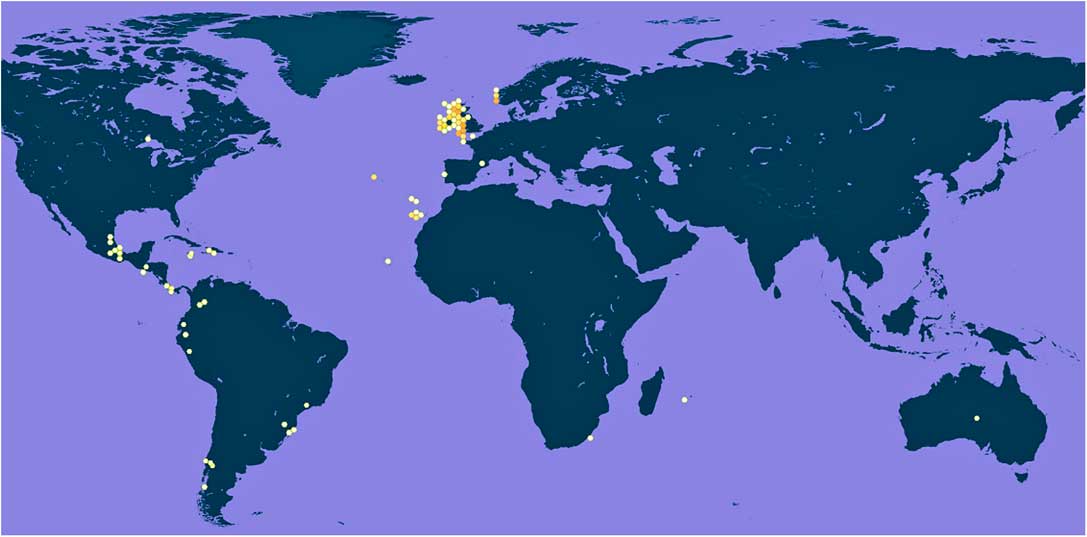
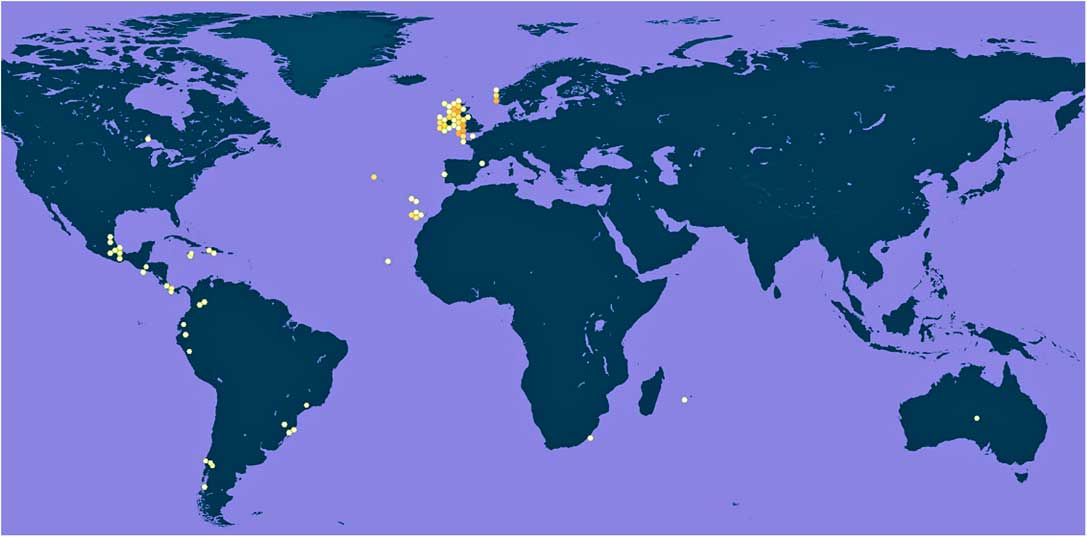
Sticta damicornis (Sw.) Ach., described as Lichen damicornis Sw. (original orthographic variant ‘damaecornis’ corrected acc. to ICN Art. 60.8, Ex. 20), is one of the most frequently used names for green-algal Sticta species; to a lesser extent, this also applies to the name S. canariensis (Ach.) Bory. Based on published records and occurrence data in public repositories (Fig. 1), both taxa are presumably subcosmopolitan. Sticta canariensis has 2144 occurrence records in GBIF (https://www.gbif.org/species/8491362), most in the Americas and Western Europe but also in southern Africa and the Mascarenes. Notably, most published records refer to Western Europe (including Macaronesia) and North America only (Tønsberg Reference Tønsberg1990; Brodo Reference Brodo1994; Coppins & Coppins Reference Coppins and Coppins2002; Gabriel & Bates Reference Gabriel and Bates2005; Arocena et al. Reference Arocena, Siddique, Thring and Kapur2007). In contrast, S. damicornis has much fewer GBIF entries (508) but exhibits an even wider inferred global distribution pattern (https://www.gbif.org/species/7790288; https://www.gbif.org/species/7250273); this name is also applied much more frequently to identify green-algal species at a global level, including in the Americas, Europe, Africa and Asia (Durand & Pittier Reference Durand and Pittier1891; Stizenberger Reference Stizenberger1895; Hitchcock Reference Hitchcock1898; Schiffner Reference Schiffner1901; Riddle Reference Riddle1912; Merrill Reference Merrill1913; Howe Reference Howe1914; Plitt Reference Plitt1921; Malme Reference Malme1934; Welch Reference Welch1950; Herre Reference Herre1951; Imshaug Reference Imshaug1956; Zahlbruckner Reference Zahlbruckner1956; Dix Reference Dix1957; Thomasson Reference Thomasson1959; Choisy Reference Choisy1960; Follmann Reference Follmann1976; Tønsberg Reference Tønsberg1990; da Silva et al. Reference da Silva, Iacomini and Gorin1990; Wolf Reference Wolf1993; Brodo Reference Brodo1994; Marcano et al. Reference Marcano, Morales-Méndez, Sipman and Calderon1996; de Oliveira et al. Reference de Oliveira-F., Doná, Marcelli, Cardoso and da Silva-C.2002; Käffer & Martins Reference Käffer and Martins2005; Nayaka & Upreti Reference Nayaka and Upreti2005; Holz Reference Holz2006; Sipman Reference Sipman2006; Spielmann Reference Spielmann2006; Käffer et al. Reference Käffer, Ganade and Marcelli2007, Reference Käffer, Ganade and Marcelli2009; Cerón & Quintero Reference Cerón and Quintero2009; Gumboski & Eliasaro Reference Gumboski and Eliasaro2011; Joshi et al. Reference Joshi, Upreti and Das2011; Martins et al. Reference Martins, Käffer, Alves and Pereira2011; Rincón-Espitia et al. Reference Rincón-Espitia, Aguirre-C and Lücking2011; Benítez et al. Reference Benítez, Prieto, González and Aragón2012; Bungartz et al. Reference Bungartz, Ziemmeck, Ayabaca, Nugra and Aptroot2013; Mishra & Upreti Reference Mishra and Upreti2014; Aptroot Reference Aptroot2016; Nelson & Sandoval Reference Nelson and Sandoval2018). At times, the concepts of the two species became rather diffuse; thus, both Flörke (Reference Flörke1809) and Acharius (Reference Acharius1814) considered S. canariensis an infraspecific entity of S. damicornis.
Presumed global distribution of Sticta damicornis based on georeferenced occurrence records in GBIF (https://www.gbif.org/species/7790288; https://www.gbif.org/species/7250273). In colour online.
Names used for presumably widespread taxa in the Lobariaceae, particularly in the genera Sticta and Pseudocyphellaria, have been shown to correspond to numerous and even unrelated species. This is the case in the frequently used names Sticta fuliginosa (Dicks.) Ach. and S. weigelii (Isert ex Ach.) Vain., but also in Pseudocyphellaria crocata (L.) Vain. (Moncada et al. Reference Moncada, Lücking and Suárez2014a, Reference Moncada, Reidy and Lückingb; Magain & Sérusiaux Reference Magain and Sérusiaux2015; Lücking et al. Reference Lücking, Moncada, McCune, Farkas, Goffinet, Parker, Chaves, Lőkös, Nelson and Spribille2017; Simon et al. Reference Simon, Goffinet, Magain and Sérusiaux2018). Morphologies corresponding to the concept of S. fuliginosa or S. weigelii evolved many times independently within the genus (Moncada et al. Reference Moncada, Lücking and Suárez2014a; Magain & Sérusiaux Reference Magain and Sérusiaux2015). Likewise, the P. crocata morphology corresponds to a large number of species (Moncada et al. Reference Moncada, Reidy and Lücking2014b ; Lücking et al. Reference Lücking, Moncada, McCune, Farkas, Goffinet, Parker, Chaves, Lőkös, Nelson and Spribille2017). In most cases, phenotypic characters separate these entities but these characters were traditionally neglected or presumed to represent infraspecific variation. The phylogeny of the genus Sticta also suggests that the number of green-algal species is much higher than accommodated by current taxonomy and that most species have restricted distributions (Moncada et al. Reference Moncada, Lücking and Suárez2014a; Simon et al. Reference Simon, Goffinet, Magain and Sérusiaux2018).
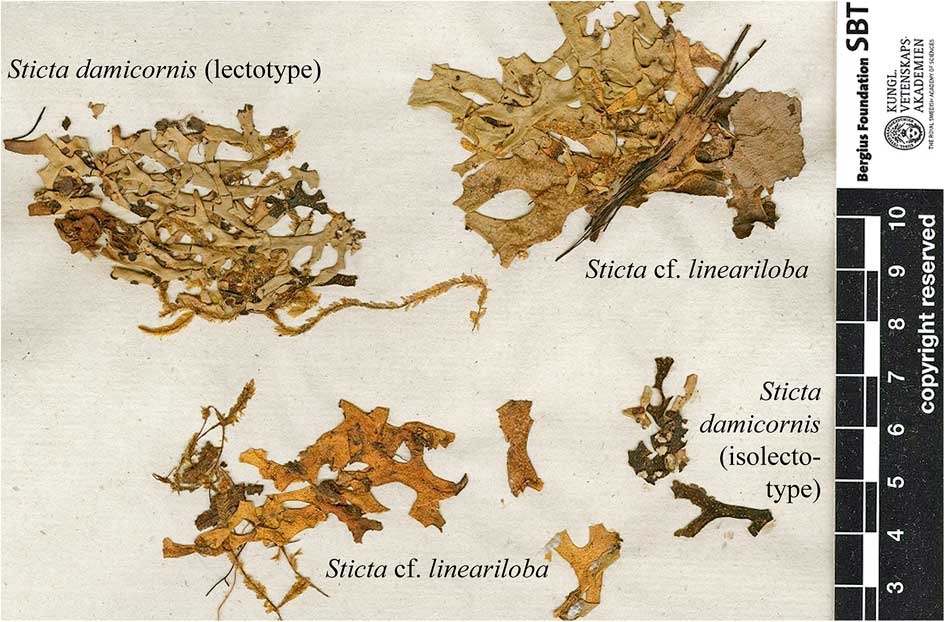
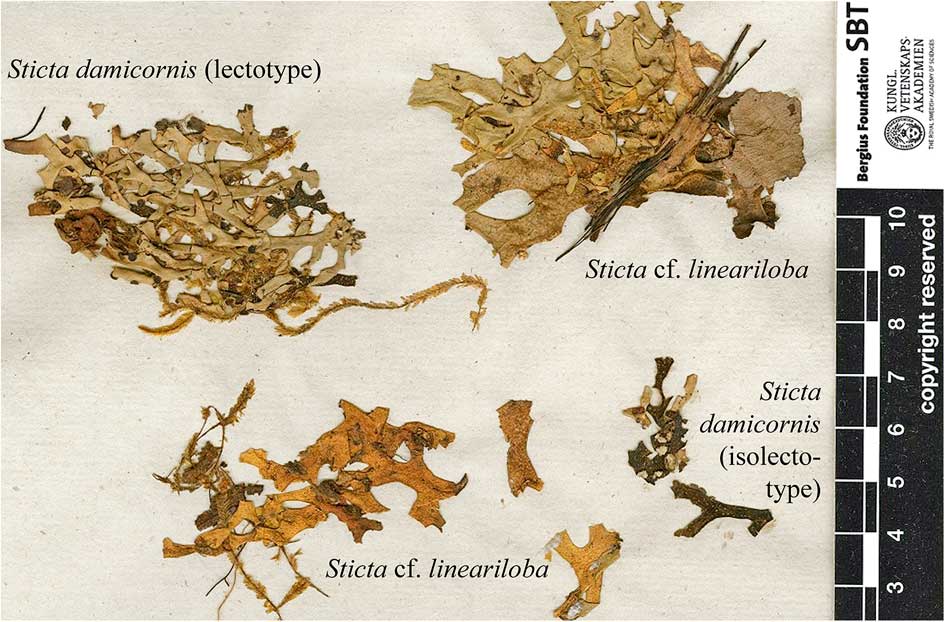
While assessing the status of described names in the genus Sticta, we came across the lectotype material of Sticta damicornis in SBT, designated by Galloway (Reference Galloway1994) and also available as a high resolution digital image in JSTOR Global Plants (https://plants.jstor.org/stable/viewer/10.5555/al.ap.specimen.sbt10382). This material consists of what would now be treated as two morphologically distinct taxa (Fig. 2): one narrow-lobed (1·5–3·0 mm broad), with numerous (sub-)marginal apothecia and with a dark brown lower tomentum towards the thallus centre (upper left and lower right of the herbarium sheet), and a second one with broader lobes (5–10 mm broad), lacking apothecia, and with a light brown lower tomentum (upper right and lower left of the herbarium sheet). In the protologue of Lichen damicornis, Swartz (Reference Swartz1788) wrote: “foliaceus; multipartito-dichotomus glaber, apicibus bifidis, subtus tomentosus; peltis marginalibus”. Apart from the observation that the narrow-lobed taxon is nicely dichotomously branched, with bifurcate terminal lobes, whereas the broad-lobed taxon is anisotomously branched, the word “peltis” in the protologue refers to the apothecia, which on the sheet are present only in the narrow-lobed taxon, indicating that the name damicornis should be applied to that material. As a consequence, the lectotypification for Lichen damicornis needs to be narrowed down, in this case to the upper left specimen on the sheet (Fig. 2):
Lectotype material of Sticta damicornis in SBT (image reproduced from JSTOR Global Plants: http://plants.jstor.org/stable/viewer/10.5555/al.ap.specimen.sbt10382); the upper left specimen is the newly designated lectotype of S. damicornis. In colour online.
Lichen damicornis Sw.
Lichen damicornis Sw. [as ‘damaecornis’], Prodr.: 146 (1788) [MB/IF 393936]; Sticta damicornis (Sw.) Ach. [as ‘damaecornis’], Methodus: 276 (1803) [MB/IF 406148]; type: Jamaica, Swartz s. n. (SBT-SBT10382—lectotype: upper left portion as indicated in Fig. 2, revised lectotype designated here; MBT382977).
Galloway (Reference Galloway1994) treated the name Platisma cornu-damae Hoffm. (Hoffmann Reference Hoffmann1790) as a nomenclatural (homotypic) synonym of Lichen damicornis Sw. However, this was based on a misconception. Platisma cornu-damae Hoffm. is based on Lichen rufescens ‘cornua damae referens’, published by Plumier (Reference Plumier1705) from the Dominican Republic prior to the starting date of botanical nomenclature; hence, Hoffmann’s name is to be considered as a post-Linnean validation of Plumier’s name and should be cited Platisma cornu-damae Plum. ex Hoffm. Since Hoffmann (Reference Hoffmann1790) cited Lichen damicornis Sw. in synonymy, the name Platisma cornu-damae Plum. ex Hoffm. is illegitimate (ICN Art. 52.1). However, it is not based on the type of Lichen damicornis Sw. but on the original material of Lichen rufescens Plum. (ICN Art. 7.5), as the latter became the type of Platisma cornu-damae Plum. ex Hoffm. upon validation. That type is an image showing a dichotomous, radiating organism growing on rock, quite different from the refined concept of Lichen damicornis Sw. and not even necessarily a lichen: in the same work, Plumier (Reference Plumier1705) described a species of Marchantia as Lichen anapodocarpos and his illustration of L. rufescens is not very different in detail from L. anapodocarpos. Vaillant (Reference Vaillant1727) also described and illustrated a Lichen cornua-damae prior to the onset of botanical nomenclature that was subsequently validated as Lichen cornua-damae Panzer (Reference Panzer1787), one year prior to Swartz’s name. However, Vaillant’s illustration probably shows a species of Evernia or Ramalina and was interpreted as a synonym of Evernia prunastri by Panzer (Reference Panzer1787). Consequently, Lichen cornua-damae Panzer appears to be unrelated to L. damicornis Sw. or Platisma cornu-damae Plum. ex Hoffm.
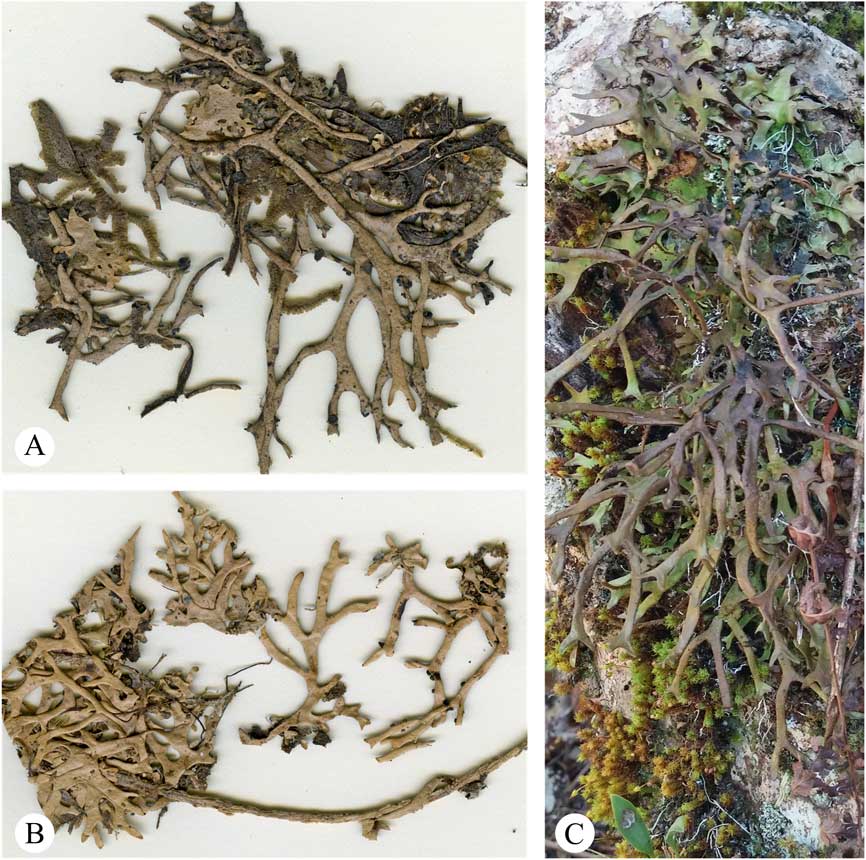
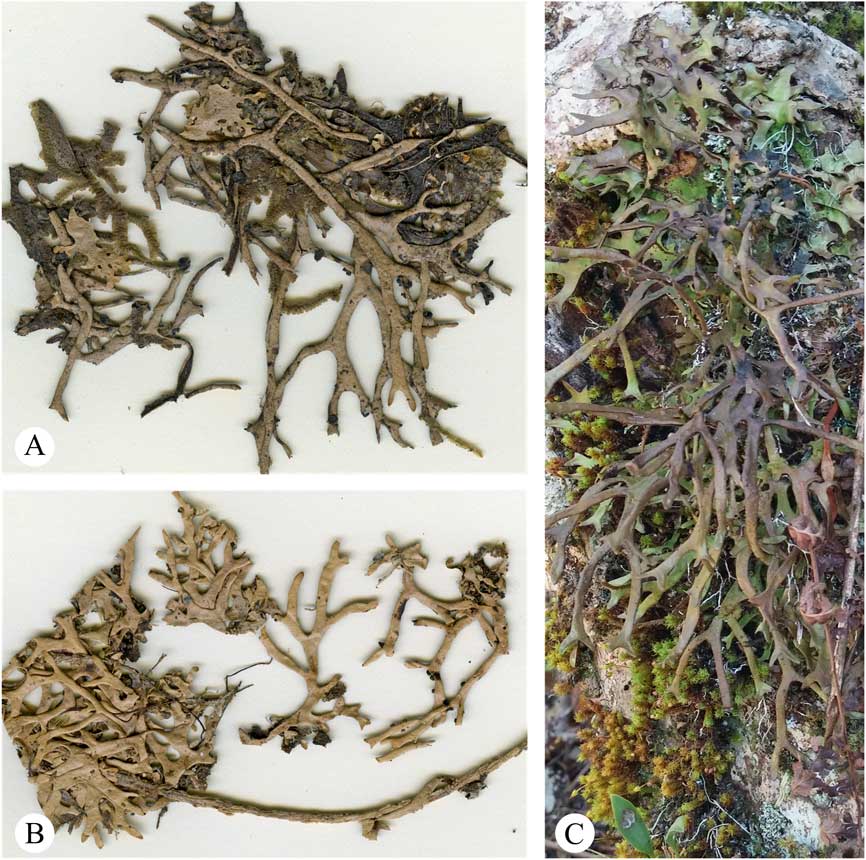
While digitizing type material of lichens at the Field Museum, Chicago, as part of the Global Plants Initiative (Lücking et al. Reference Lücking, Niezgoda, Huhtinen, McCaffrey and Lumbsch2011), we came across two collections labelled “Sticta evernioides Merrill”, a name never validly published. One collection is from Jamaica, the other from the Dominican Republic (https://www.gbif.org/species/9165305). Both are better developed but otherwise agree perfectly with the revised lectotype of S. damicornis in the narrow (1·5–3·0 mm broad), dichotomous, linear lobes with (rather sparse) submarginal apothecia (Fig. 3A & B) and are thus conspecific with the latter.
A & B, original material of “Sticta evernioides Merrill” at the Field Museum, from Jamaica (A) and the Dominican Republic (B), the latter from from original digitized images at F. C, Sticta damicornis in situ in Cuba (Mercado-Díaz 2768). In colour online.
During our survey of Lobariaceae and particularly the genus Sticta in the Neotropics, with field work in Mexico, Guatemala, El Salvador, Nicaragua, Costa Rica, Panama, Colombia, Venezuela, the Guianas, Ecuador, Peru, Bolivia, Brazil, Argentina and Chile, we never came across specimens that corresponded to the unique morphology of this rather delicate lichen. We also revised c. 70 specimens in B filed under the name S. damicornis. Specimens from Central and South America (Mexico 1, El Salvador 1, Costa Rica 18, Panama 1, Colombia 13, Ecuador 2, Peru 1, Bolivia 2, Brazil 9, Chile 2) are almost invariably broad-lobed and represent several taxa, none being even remotely similar to the lectotype of S. damicornis. The most similar specimen is a collection from Peru (Mexia 7762) which agrees in the narrow, dichotomous lobes but has a scrobiculate surface and probably represents an undescribed species. All collections from the Canary Islands and the Azores were found to be typical S. canariensis. Paleotropical material similar to that of S. damicornis corresponds to the morphological concept of S. dichotoma Bory, which has been assumed to have a broad paleotropical distribution (Galloway Reference Galloway1994) but is now known to be endemic to the Mascarenes (Simon et al. Reference Simon, Goffinet, Magain and Sérusiaux2018).
One collection from the Caribbean (Haiti) also differs from S. damicornis in the rather broad lobes while the following agree well with the lectotype: Cuba (Harris 14364, Pócs 9123 (Vězda, Lich. Sel. Exs. 1680), Wright s. n. (Lich. Cubae 59)), Jamaica (Culberson 13299, Plitt s. n. (Verseghy, Lichenoth. Parva 126)), Dominican Republic (Harris 15542), and Haiti (Buck 9393). This indicates a strictly Caribbean distribution for S. damicornis, as already suggested by Galloway (Reference Galloway1994). A search for the species during a recent field trip in Cuba by the second author in 2016 unearthed a small number of thalli growing in well-preserved forest remnants in the province of Santiago de Cuba, towards Pico Regino and Pico Joaquín (Fig. 3C).
The present reassessment of the phenotypic circumscription of S. damicornis and the geographical origin of the available material strongly support the hypothesis that it is an endemic Caribbean taxon with a unique, delicate, rather uniform morphology, probably confined to well-preserved humid forest remnants, and that this name has been misapplied to all material outside its range and probably also to some other green-algal taxa in the region. The type collection of S. damicornis and our field observations suggest the presence of at least two more green-algal species in the Caribbean but their identity remains unresolved. The possible presence of S. canariensis in the Caribbean cannot be rejected but there are some South American species, such as S. lineariloba (Mont.) Nyl., that also share the characters of the broad-lobed taxon associated with the lectotype of S. damicornis. We considered the possibility that S. damicornis might be restricted to Jamaica only, but we believe a Caribbean (or Greater Antillean) distribution more likely: for instance, in plants the level of endemism on individual islands in the Caribbean is substantially lower (between 27–51% for Jamaica, Hispaniola and Cuba) than for the entire region, at over 70% (Acevedo-Rodríguez & Strong Reference Acevedo-Rodríguez and Strong2008; Kelly Reference Kelly1988).
Funding for this study was provided by a grant from the National Science Foundation (NSF) to The Field Museum: DEB-1354884 ‘Collaborative Research: Evolution, Diversification, and Conservation of a Megadiverse Flagship Lichen Genus’ (PI: HTL, CoPI: RL). JAMD is funded through the Ford Foundation Fellowship Program. The cryptogam type digitization project at the Field Museum, during which the material of “Sticta evernioides” was digitized, was funded by the Andrew W. Mellon Foundation through the Global Plants Initiative.