Milk is one of the most important food items that contains the required nutrients for our body at every stage of our lives, and has significant cultural and economical importance. The fact that milk and dairy products are consumed by large segments of society is the reason that motivates unscrupulous producers to resort to fraudulent ways to maximise their profit with detrimental effects on product quality. Modern facilities process 18–20% of the milk produced in Turkey, whilst another 42% is sold to the consumer as raw milk in the form of street milk/open milk. The remaining 40% of the milk is processed in dairy farms that adhere to debatable hygienic conditions (Yapik, Reference Yapık2014).
The appearance of a food as having the characteristics that it does not actually possess in terms of shape, composition and quality is called counterfeit. Adulteration, on the other hand, is defined as removing the ingredients and nutrients that lend the food its main qualities, in part or in whole, against the existing legislation, altering their amounts and adding another substance, which does not have the same values, instead of the original substance as if it was the latter (Ozulku et al. Reference Ozulku, Yildirim, Toker, Karasu and Durak2017).
The advantages of Fourier Transform Infrared (FTIR) spectroscopy are that assessments can be quickly and accurately reproduced and analysed without any experimentation and without damaging the sample. It is capable of delivering results even with a minimum sample amount, and does not require any additional substances or chemicals. The method offers advantages compared to other methods in terms of cost and time saving. FTIR is one of the methods used for identifying chemical compositions and acquiring information about their properties.
The spectra obtained by FTIR spectroscopy include vibrations of molecular bonds in mid-infrared region (4000 to 400/cm). However, obtained spectra could be complex for determination of qualitative characteristics. This method allows researchers to conduct mixture analyses as well as food spoilage studies for quality control purposes. It is known that chemical compositions of milks are influenced by several factors including climatic and environmental factors, milk source, nutrition of the animals and processing and storage conditions. The conducted studies suggest that information can be obtained on the main functional groups by using FTIR (Tan et al. Reference Tan, Gan, Wei, Pan, Tang and Wang2011).
Mabood et al. (Reference Mabood, Jabeen, Ahmed, Hussain, Al Mashaykhi, Al Rubaiey, Farooq, Boqué, Ali, Hussain, Al-Harrasi, Khan, Naureen, Idrees and Manzoor2017) investigated the detection of camel milk adulterated with goat milk using NIR (Near-infrared) spectroscopy method. Jaiswal et al. (Reference Jaiswal, Jha, Borah, Gautam, Grewal and Jindal2015) worked on the detection and quantification of soymilk in cow–buffalo milk using FTIR. Laporte & Paquin (Reference Laporte and Paquin1999) conducted fat and protein analyses in cow's milk using close infrared spectroscopy. In another study conducted on cow's milk, the number of somatic cells was attempted to be identified using close infrared spectroscopy (Tsenkova et al. Reference Tsenkova, Atanassova, Kawano and Toyoda2001).
Curda & Kukackova (Reference Curda and Kukackova2004) assessed whether the use of N-IR spectroscopy was suitable for monitoring the cheese production process in a quick manner and determined correlation coefficients for the dry matter contents, fat, raw protein, pH and rheological properties (penetration value) of cheese. Another study involving Micro-FTIR spectroscopy examined the dimensional distribution of the components found in cheese. When the results obtained were compared to the findings of the literature, it was found that cheese contained a structure consisting of fat particles in various sizes and shapes distributed within the protein matrix with respect to the microstructure of cheese (Cebi, Reference Cebi2012). The aim of this study was to develop a technique based on Fourier Transform Infrared Spectroscopy (FTIR) capable of detecting adulteration of milk. A quick technique for identifying fraudulent dairy products using biochemical fingerprints will be developed in this way.
Material and methods
In this study, the milk products were collected from various milk producers in Istanbul (Catalca, Tepeoren, Akfirat, Gocbeyli) and Izmir. Also, various brands of packaged UHT or pasteurised milk were purchased from local supermarkets and included. In total, 33 types of cow's milk, 6 types of sheep's milk and 22 types of water buffalo's milk were analysed. The milks were kept at 4 °C conditions and analysed within 24 h.
Milk samples preparation and experimental design
The specimens of cow's milk, sheep's milk and water buffalo's milk obtained for analysis were placed in test tubes and kept in a fridge until they were analysed. The binary samples were prepared by increasing the mixture samples by 10% (10, 20, 30, 40, 50, 60, 70, 80 and 90%). The first mixture is that of cow's milk and sheep's milk, the second one is cow's milk and water buffalo's milk and the third one is sheep's milk and water buffalo's milk.
Of the samples thus prepared, 1 mL was taken by way of a straw to be measured in the ATR-FTIR device. The spectrums were determined to be within the range of 4000 and 600/cm. Five different measurements were applied for each milk specimen, and the results were evaluated after having calculated their mean values.
While the samples were being analysed; 165 measurements were performed on 33 different samples in 5 repetitions for the cow's milk, 30 measurements were performed on 6 different samples in 5 repetitions for the sheep's milk and 110 measurements were performed on 22 different samples in 5 repetitions for the water buffalo's milk.
FTIR spectrometric-chemometric analysis
For the analysis of milks, the Bruker Tensor 27 (Germany) FTIR, containing KBr radiator and DLaTGS detector, was used. The ATR equipment includes a diamond crystal. The spectrums were examined using the OPUS (v.7.2) software package (Bruker, Germany). Each spectrum was scanned 16 times. Five replicates of each milk samples were measured at same conditions and an average spectrum was obtained for each sample. Surface of the crystal diamond was cleaned with ethanol and distilled water after each measurements. Spectra of the clean diamond crystal surface against air were recorded and used as a background for each measurement.
FTIR spectra data were combined with suitable multivariate methods such as principal component analysis and cluster analysis. In order to successfully carry out cluster analysis, each obtained spectra was derivatised to first order with 9 smoothing points. PCA (principle component analysis) analysis was also conducted to investigate the discrimination of milk samples from adulterated milk ones by using same spectral range. Two-dimensional cluster analysis plots were achieved by using the OPUS Version 7.2 software and its identity test.
Results
The results obtained by calculating the mean values of the measurements for each sample were then subjected to a cluster analysis for identifying the similarities and differences between the samples. In this study, the range of 1700–600/cm, covering the area known as the protein, carbohydrate and fingerprint region of the infrared area was used.
According to the spectrum above, the area of approximately 2900/cm provides information regarding the fat molecules and the highest peak value is found to be in water buffalo's milk, which is followed by sheep's milk and cow's milk respectively. The areas of 1640 and 1540/cm, designated as amid-I and amid-II respectively, provide information regarding protein molecules. The fact that the highest peak in this particular area is listed as sheep's milk, water buffalo's milk and cow's milk respectively suggests that the sheep's milk has the highest protein values. The area of 1050/cm provides information about carbohydrate molecules. The highest peak here is observed to be in the water buffalo's milk, which is followed by sheep's milk and cow's milk. This result also provides information as to the carbohydrate amounts of the milk types.
Classification of the milk and mixtures of milk types
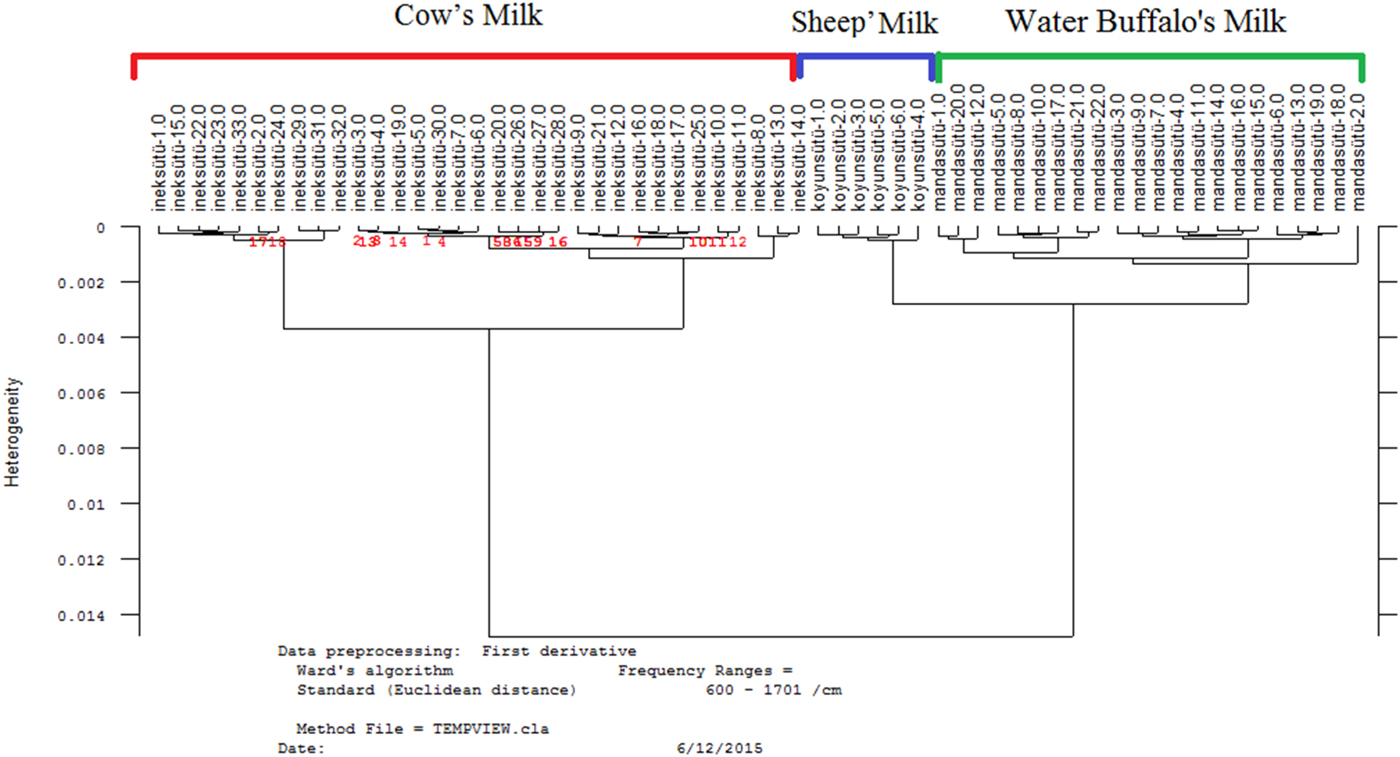
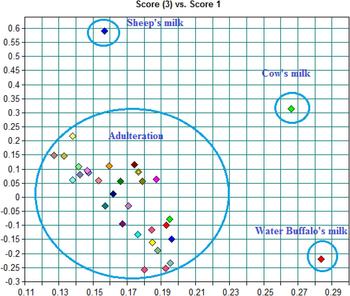
FTIR spectra of the tested milk samples were used depending on the functional group absorbance diversity resulting in variation in the spectral change. Prior to classification the spectral data, they were derivatised into first order or standardised for pre-processing. The range of 1700–600/cm was used for distinguishing between ‘cow's milk-sheep's milk’, ‘sheep's milk-water buffalo's milk’ and ‘water buffalo's milk-cow's milk’. Complete distinction was finally made through Ward's algorithm, after having calculated the initial derivate by using a standard method. The process of distinguishing the milk types is represented in Fig. 1 below. As is seen in this dendrogram, a certain clustering scheme was obtained to discriminate the pure milk samples and adulterated milks. The dendrogram shows that the three types of milks and adulterated milks are well separated. In order to show the differences among the milks spectra, the score plot using the first and the third principal components was also used (Fig. 2).
Dendrogram of a cluster analysis (Ward's Algorithm) of FT-IR spectra from total 61 different standard samples of cow's milk, sheep's milk and water buffalo's milk of different proportions.
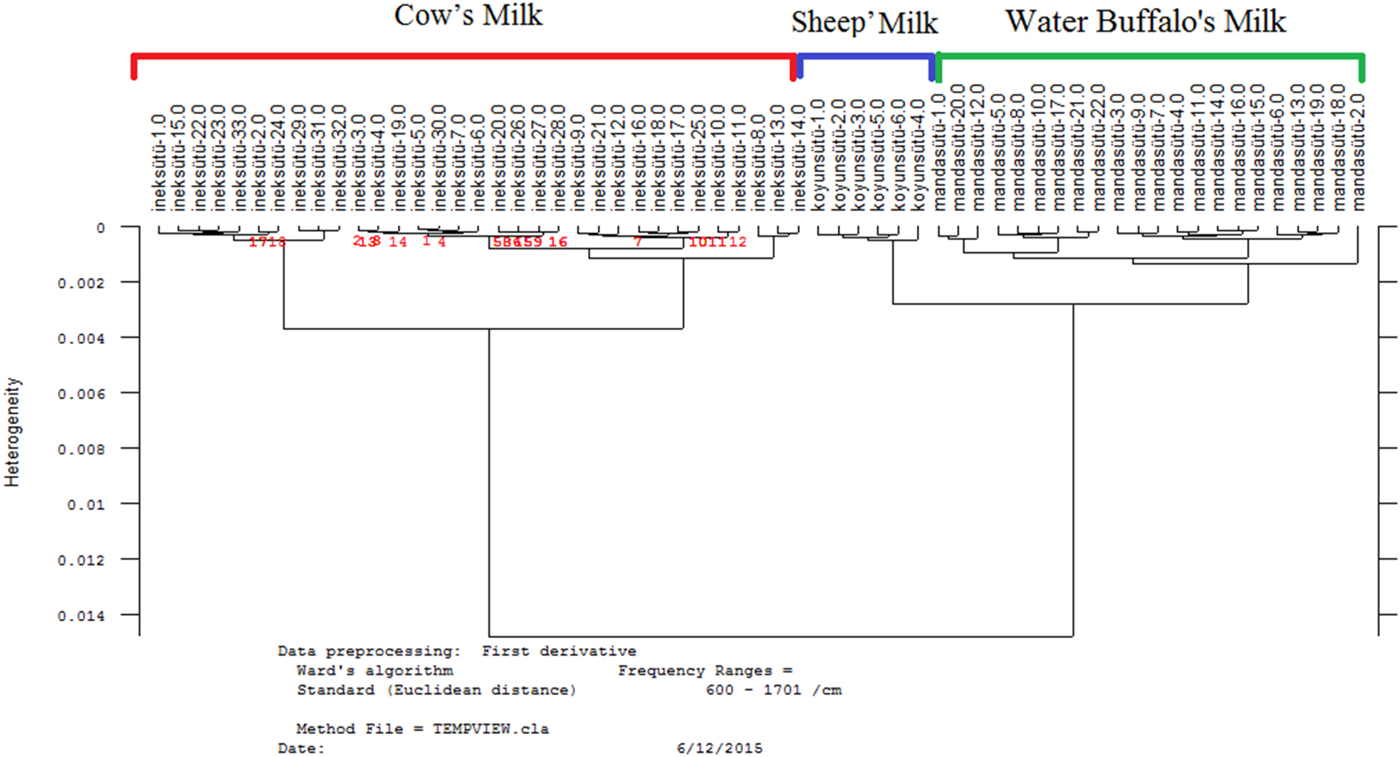
Two dimensional PCA analysis map of FT-IR spectra of pure milks and adulterated milk samples.

Discussion
Milk is a very important nutrient for humans of every age both in terms of its protective properties and contributions to the physical development. There are a number of fraudulent ways that milk producers take to maximise their profits in the face of the ever increasing milk consumption. The chief among them is the addition of illegal ingredients to the milk and mixing the milk of high economic value with the milk types of less economic value or trying to sell the milk of less value as if it was a milk type with high economic value. The fact that the current analysis methods are slow and inconvenient and require the services of expert personnel constitutes an obstacle for tackling such fraudulent acts. For this reason, this study has attempted to make a type classification in milk varieties using the FT-IR spectroscopy with a view to developing methods that can deliver quick and accurate results.
When the results of the measurements are observed, it is seen that the spectrums of cow's milk, sheep's milk and water buffalo's milk yield peak values within more or less the same areas. This particular area, too, can be used for classifying the milk types based on different peak values found for respective milk types.
There is a limit to the sensitivity of the analysis of adulteration in milk made with FT-IR spectroscopy. It has been observed that when the mixing ratios are around 10% the distinction can be made, but it can be difficult to distinguish because peaks that become close to each when the ratio drops below around 5%. During cluster analysis, selection of fingerprint wavenumber ranges is very important for accomplished separation. It could be concluded that FTIR might be used as a non-destructive, quick, effective, less time-consuming, cheap and rapid alternative tool for determination of adulteration level of milks.
The authors would like to thank Prof. Dr M. Ihsan Soysal and Mehmet Aksel from Istanbul Water Buffalo Breeders Association for providing the milk samples. We also would like to thank Nur Cebi for providing support with the analysis.