Implications
Specialisation of farming systems can lead to environmental harm: overconsumption of natural resources for synthetic-input production, nitrate pollution and greenhouse gas emissions. Crop-livestock integration may represent a model of sustainable farming according to principles of nutrient recycling and efficient use of land and resources. To cope with organisational constraints and economic viability, crop-livestock systems should be designed with local stakeholders. Implementing our participatory design methodology in different contexts could contribute to the development of pilot crop-livestock systems and the diffusion of technical practices, farm organisation and stakeholder coordination to be developed.
Introduction
Agricultural production in Europe is mainly provided by intensive, high-production farming systems using large amounts of synthetic inputs (Peyraud et al., Reference Peyraud, Taboada and Delaby2014). This agriculture is characterised by simplification and standardisation of production techniques and homogenisation of crop and livestock breeds and rural landscapes. It allowed a massive increase in agricultural production due to gains in labour productivity. The search for economy of scale and expression of comparative advantages (e.g. soil fertility, climate, labour costs) led to the specialisation of farms and regions within countries (e.g. dairy farms in Brittany for France) or between countries (e.g. European countries importing South American soya beans as animal feed). This specialisation trend has often led, in Europe, to geographical separation of cropping systems and livestock systems and development of livestock systems with little or no connection to local agricultural resources (Peyraud et al., Reference Peyraud, Taboada and Delaby2014). At the same time, negative effects of intensive agriculture on biodiversity, ecosystems (Millenium Ecosystem Assessment (MEA), 2005), climate change and water quality have become increasingly apparent (Stoate et al., Reference Stoate, Boatman, Borralho, Rio Carvalho, de Snoo and Eden2001).
Since the 1990s, many studies (e.g. Russelle et al., Reference Russelle, Entz and Franzluebbers2007; Hendrickson et al., Reference Hendrickson, Hanson, Tanaka and Sassenrath2008) have listed the benefits of crop-livestock systems of better exploiting the resources of specific biophysical conditions. Nutrient cycling and soil fertility can be improved at field and farm levels by animal-waste recycling and by including grasslands in field-crop systems (Ryschawy et al., Reference Ryschawy, Choisis, Choisis, Joannon and Gibon2012). Moreover, diversification of production may reduce economic risks (Wilkins, Reference Wilkins2008).
Nevertheless, mixed farms continue to decline (Franzluebbers et al., Reference Franzluebbers, Sawchik and Taboada2013), especially in Europe due to greater complexity in management (Peyraud et al., Reference Peyraud, Taboada and Delaby2014), workload constraints (e.g. need for daily presence for milking or calving), and economic factors such as the high price of cereals. On the other hand, it is often difficult to envision livestock returning to farms from which they have disappeared (Wilkins, Reference Wilkins2008).
Recently, three main changes occurred in the policy and technological contexts, inviting stakeholders (e.g. policy-makers) to reconsider pathways for better integration of crops and animals. The first change is the increasing pressure upon non-renewable resources (Rockström et al., Reference Rockström, Steffen, Noone, Persson, Chapin, Lambin, Lenton, Scheffer, Folke, Schellnhuber, Nykvist, de Wit, Hughes, van der Leeuw, Rodhe, Sörlin, Snyder, Costanza, Svedin, Falkenmark, Karlberg, Corell, Fabry, Hansen, Walker, Liverman, Richardson, Crutzen and Foley2009) and their consideration in public policies. The second is the emergence of new technologies for recycling nutrients or producing energy (e.g. biogas). The third is the progress of knowledge on the possibility to provide ecosystem services through management of biodiversity (e.g. biological regulation, fertility, carbon storage, water filtration) (Power, Reference Power2010). Taking these new political, technological and cognitive contexts into account, two broad approaches to design pathways for developing innovative agricultural systems have evolved. The first approach is research-led, based mainly on the use of simulation models to explore innovative practices (Martin et al., Reference Martin, Martin-Clouaire and Duru2012). The main limitation of such design approaches is that the problems and questions are most often predetermined and do not really consider social context or non-scientific knowledge (Voinov and Bousquet, Reference Voinov and Bousquet2010). To deal with this limitation, other approaches rely on the strong involvement of various stakeholders (e.g. farmers, advisors, consumers) in the design process. They consider local and specific constraints and objectives and use a collective intelligence as a source of innovative ideas (Elzen and Spoelstra, Reference Elzen and Spoelstra2010; Meynard et al., Reference Meynard, Dedieu and Bos2012).
The European FP7 CANTOGETHER project aims to design mixed farming system that will combine agronomic practices (e.g. crop rotations) and livestock practices (e.g. breed selection) into novel mixed farming systems ranging from easy-to-adopt combinations of methods to more ambitious solutions involving strategic changes at farm and district level. The two methodological pillars of the project are (i) co-design of integrated crop–livestock systems (ICLS) in case studies (CS) representing a wide range of socio-economic and environmental contexts and (ii) model-based assessment of these ICLS. In a first phase, CANTOGETHER aims to develop a participatory design methodology to be implemented in CS. Development of this methodology required clarifying the concept of innovation. ‘Exploitative’ innovations correspond to practices which can be observed and for which enough cases exist to build some references. Alternatively, ‘explorative’ innovations can be defined as practices of real pioneers or unachieved ideas (Jansen et al., Reference Jansen, Van Den Bosch and Volberda2006). Hill and MacRae (Reference Hill and MacRae1995) propose a classification of innovation according the degree of change in the farming system through their ‘efficiency-substitution-redesign’ framework. An increase in input-use efficiency or input substitution most often represents exploitative innovation. The redesign of farming systems corresponds to explorative innovation. The CANTOGETHER design methodology targets the identification of exploitative innovations and the emergence of explorative innovations.
This paper presents the design process in the CS of CANTOGETHER. After presentation of the participatory design methodology, we provide a general overview of the diversity of innovative options designed in all CS and a more detailed description of three contrasting CS. We then present the main issues that arose from the ex ante assessment of innovation ideas. Finally, we examine the methodological issues and the generality of results.
Material and method
The CANTOGETHER project is based on 24 CS investigating different types and levels of crop-livestock integration. To allow the research teams responsible for each CS to implement the design methodology, a ‘light-design methodology’ was developed. It requires low investment in time and skills for participatory design. It is equipped with a conceptual framework, to stimulate ideas and structure CS description, and operational guidelines (Moraine et al., Reference Moraine, Therond and Duru2013). The conceptual framework supports the analysis of innovative options at the different levels at which integration can occur: field, farm and territory. Here ‘territory’ corresponds to the geographical level, the rural area, at which social interactions between farmers and other stakeholders determine the spatial allocation of socio-economic activities and land uses within agricultural landscapes (Lardon et al., Reference Lardon, Moonen, Marraccini, Debolini, Galli and Loudiyi2012). The design methodology relies on three workshops (WS) in which stakeholders interact in a ‘collaborative mode’ (Barreteau et al., Reference Barreteau, Bots and Daniell2010).
Conceptual framework of crop-livestock integration
The conceptual framework developed to analyse and design ICLS explicitly distinguishes the metabolic functioning (inputs and outputs of nutrients and energy) and ecosystem services of farming systems, which are two types of improvement mechanisms, and the socio-economic coordination between stakeholders necessary to initiate or modify them (Green and Vergragt, Reference Green and Vergragt2002). Crop-livestock integration is seen as a socio-ecological system (Ostrom, Reference Ostrom2009) combining biotechnical and social innovations. The ecological system (land, soil, climate, plant and animal species and populations) is represented with three components: animals, grasslands, and crops. Animals represent groups of animals (e.g. species, breeds, age groups), while crops (cash crops, forage crops) and grasslands (cut/grazed, permanent/rotated) represent a range of species or species mixtures. The three components are interconnected to differing degrees. Direct interactions occur in space, either simultaneously (e.g. grasslands grazed by animals) or over time in the form of a sequence (e.g. grasslands in rotation with crops). Indirect interactions correspond to flows of material (e.g. manure) or energy. By varying the size and degree of overlap of the three components, it is possible to represent the structure of a wide range of crop–livestock systems. In line with Dumont et al. (Reference Dumont, Lamothe, Jouven, Thomas and Tichit2013) and Bonaudo et al. (Reference Bonaudo, Bendahan, Sabatier, Ryschawy, Bellon, Leger, Magda and Tichit2013), we consider that the development of ICLS requires a simultaneous increase in input-use efficiency and improvement of biodiversity to supply ecosystem services. To reach both objectives, farming systems should improve metabolic and ecosystem functioning. These two approaches are explored in the design process.
The metabolic approach is based on principles of industrial ecology: recycling matter and energy to decrease inputs, waste and pollution. This approach aims to increase system self-sufficiency and resource-use efficiency (e.g. using animal waste as fertiliser for grasslands or crops).
The ecosystemic approach aims to design agricultural practices that modify agroecosystem properties, which in turn improve ecological processes and ultimately the ecosystem services provided (De Groot et al., Reference De Groot, Alkemade, Braat, Hein and Willemen2010). Using the typology of Zhang et al. (Reference Zhang, Ricketts, Kremen, Carney and Swinton2007) adapted from MEA (2005), we identify three key types of ecosystem services for crop-livestock integration: (i) provisioning services, in particular production of animal (milk, meat) and plant products (grain, fibre, biomass); (ii) supporting services, in particular, soil fertility and nutrient cycling; and (iii) regulating services, in particular pest regulation at field and landscape level and carbon storage.
In our conceptual framework, the social system (human societies, economic activities, institutions and social groups) includes a variety of stakeholders, primarily farmers, but also agri-food chains, advisory services (e.g. chambers of agriculture, management consulting centres) and public policy agents, such as those in charge of natural resources.
The hypothesis underpinning our participatory design methodology is that farming practices evolve with the social dynamics of coordination and collective learning (e.g. within agri-food chains or farmer collectives), and that synergies can be found through co-building of ideas and knowledge. More specifically, the level of crop-livestock integration is influenced by positive interactions (coordination, exchanges and social networks) or negative interactions (e.g. conflicts over use) between stakeholders. ‘Organisational’ innovations are thus crucial to make crop-livestock integration effective, to deal with issues such as livestock-farm workload, commercialisation of products, or local governance. We define organisational innovation as all changes in the organisation of work, agri-food chains, information sharing and collective actions implemented to support or regulate land use and management.
Typology of ICLS
To analyse the nature and level of crop-livestock integration at farm and local levels, a generic and simplified typology of crop–livestock systems was developed. It is based on the work of Bell and Moore (Reference Bell and Moore2012), inspired by Sumberg (Reference Sumberg2003). Whereas Bell and Moore analyse the structure of crop–livestock systems and their interactions in space (co-located v. segregated) and time (synchronised v. rotated), we use the concept of ‘functional integrity’ defined and used by Bonaudo et al. (Reference Bonaudo, Bendahan, Sabatier, Ryschawy, Bellon, Leger, Magda and Tichit2013) as ‘the management of metabolic and immune functions to boost the production function with minimal external inputs’. We identify four types of crop–livestock integration based on the level of diversity and synergies between elements.
Type 1: exchange of materials (e.g. grain, forage, straw, waste as organic fertiliser) between specialised farms, regulated by the market, in a rationale of ‘coexistence’.
Type 2: exchange of materials between spheres in a rationale of ‘complementarity’ at the farm if not territorial level. Crop systems are designed to meet the needs of livestock enterprises (need for concentrates, raw forages and straw) and livestock waste to fertilise arable plots.
Type 3: increased temporal and spatial interaction among the three spheres in a rationale of ‘farm-level synergy’: stubble grazing, temporary grasslands in rotations, intercropped forages. A high level of diversity in farm components is targeted to enhance regulating services.
Type 4: increased temporal and spatial interaction among the three spheres in a rationale of ‘territory-level synergy’: organisation optimises resource allocations, knowledge sharing and cooperation, including work.
Types 1 and 2 focus on improving metabolic properties of farming systems, while types 3 and 4 focus on using ecosystem services to regulate pests and increase soil fertility.
CS characteristics
The CANTOGETHER project is based on CS supervised by researchers called ‘CS leaders’. Fifteen CS leaders agreed to implement the participatory design methodology presented in the following section.
A summary of characteristics of these CS is presented in Supplementary Table S1. Seven farm-level CS explored technical and organisational adaptations in a single farm, whereas eight territory-level CS focused on complementarities between farms and the forms of their interactions and coordination.
This 15 CS are spread over a wide diversity of European soil and climate contexts: northern areas (the Netherlands, Germany, Switzerland, north-eastern France, with contrasting seasons and cold winters), central areas (United Kingdom, north-western France, northern Italy, with good conditions for farming throughout the year and year-round water availability) and southern areas (Spain, southern France, with difficult conditions due to water scarcity and higher sensitivity to climate change).
Light-design methodology
Participatory light-design methodology based on WS with local stakeholders aims to design options for crop–livestock integration that they judge to be relevant and interesting for dealing with local issues. These WS are based on structured exchanges between local stakeholders invited by CS leaders through three steps: context setting, brainstorming of options of change, ex ante assessment.
In the first WS, a multi-stakeholder participatory approach (Hemmati, Reference Hemmati2002) was used to identify the local or regional context, challenges and issues of CS and the current dynamics of farming systems. Participants were recruited to represent four perspectives: public asset management (agents involved in rural planning, agricultural development or water-resource management); feasibility (farmers, agents of cooperatives, supply chains); landscape and environment (civil society, representatives of nature conservation associations or natural parks); and the systemic approach (farming-system experts). During WS 1, participants developed a view about the wider political and natural environment and the organisation and technical and business orientations of farms. WS 1 outputs fed into the steps 2 and 3 to allow options of change identified to be placed in the context of local challenges.
In the WS 2, a card-sorting method (Spencer, Reference Spencer2009) was used to identify options of change for mixed farming systems. Participants (up to 10, to expand ideas) were technical experts, mostly farmers and advisors. The conceptual model developed above was used to help participants design options of crop–livestock integration to improve the metabolic functioning and ecosystemic services delivered by the level investigated (farm or territory). As in classical card-sorting approaches, participant ideas were presented, sorted into operational categories, discussed and then selected or rejected as promising options. In some CS the options were articulated in scenarios of evolution of farming systems and territories in a prospective vision.
Participants of the WS 3 were the same as those in WS 2. The most promising options for change from WS2 were qualitatively assessed by stakeholders using a multicriteria assessment grid available in Moraine et al. (Reference Moraine, Therond and Duru2013). On the basis of their experience and knowledge, participants provided their expectations of the impact of the option assessed for each criterion in a qualitative way (from strong positive to strong negative effect). Participants are considered experts projecting their own vision of strengths and weaknesses of the options. Controversial points are collectively discussed to identify why the assessment of options varies and the different points of view.
Results
Implementation of the light-design methodology in fifteen voluntary CS produced information about crop–livestock systems across Europe. We first present an overview of challenges and issues defined in CS, then three CS are detailed. Finally, we present the multicriteria assessments of options.
Challenges and issues of crop–livestock integration
WS participants discussed crop–livestock integration in the context of their own country and territory and identified key constraints to the adoption of ICLS. The following were common to all participating CS.
Climate and soil/land constraints do not allow the coexistence of diverse farming activities in some areas. Distances between arable cropping and livestock production may result in too high transport costs and too much logistical organisation.
Small farms selling their products in long supply chains in globalised markets need to concentrate and specialise their production to stay competitive. Sufficient investment capacity and labour force are often not available for diversification. For these kinds of market-oriented systems, integration could occur much more at the territorial level.
Modern livestock and crop breeds have been developed for specialised systems. New selection criteria and research efforts should be made to equip ICLS (e.g. robust dairy cows capable of utilising grass, crop stubbles).
There is a perceived lack of knowledge of mixed farming systems management, benefits and costs. The enhancement of ecosystem services and their monitoring is often perceived as uncertain.
The workload in mixed farming systems was perceived to be significantly higher. With labour often the greatest cost on farms, the aim is usually to simplify farming systems.
The last two points particularly concern livestock management, for which the workload and management and observation skills are particularly demanding for farmers. Other social issues were mentioned: aging farmer populations, lack of succession in farm ownership and lack of co-operation between farmers. This outlines the need for social innovation to develop attractive systems based on exchanges and coordination between farmers and requiring low investment to allow their transmission to new farmers. Support in the form of advisory services, policies to encourage young people into farming and supply-chain support to encourage farmer co-operation have been identified as necessary developments to address these issues.
Besides the challenges in common among CS, region-specific challenges also needed to be considered in the light-design process. In several mountainous regions (Wales, northern Italy, Switzerland), topography and high rainfall reduce the possibility to cultivate crops, and therefore mixed farming would need to be confined to more adapted areas. In Spain and southern France, climatic constraints imply water-resource conservation, a key challenge to be addressed in the design of ICLS there.
WS participants also identified potential benefits from developing ICLS, such as increased soil fertility and nutrient cycling, better resilience (agronomic and economic) to external influences such as climate change and input price volatility, improved biodiversity within the landscape and conservation of natural resources, social connections and new motivations in farming (identity, community). Tourist-oriented products can benefit from a good image of environmental value, landscape preservation and local origin. Stakeholders identified agricultural policy as playing a key role in how mixed farming would develop in the future. Currently, specialised farming systems tend to be more profitable than mixed farming systems due to economies of scale that can be achieved and simpler management. In addition, according to the WS’ participants, European CAP favoured specialised farming as decoupled aid had no diversification conditionality. Policy reforms are required to acknowledge the benefits of mixed farming systems and support the transition to mixed farming practices.
Adaptation options: global view among all CS
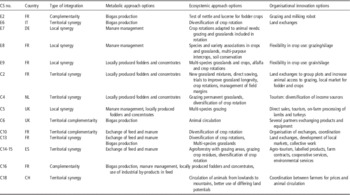
The adaptation options designed in CS explore metabolic and ecosystemic approaches. We give an overview of these options to identify generic or transversal ideas emerging from these specific cases. Some organisational options have been designed to reduce workload in livestock systems (e.g. investment in a milking robot), add value to farming activities (e.g. producing solar energy on livestock buildings), or benefitting from the landscape quality (e.g. hosting tourists). These are important points but concern all types of systems, either specialised or integrated. Thus, we distinguish between crop–livestock integration options (in metabolic or ecosystemic approaches), and organisational options (summarised in Table 1; frequency of occurrence in Supplementary Table S2).
Summary of type of integration and main adaptation options designed in each case study (CS)

FR=France; IT=Italy; DE=Germany; NL=the Netherlands; UK=United Kingdom; ES=Spain; CH=Switzerland.
Among the diversity of adaptation options designed in CS, few are purely ‘technological’, except biogas production which is cited in six CS. The stakeholders identified mainly sets of practices based on agroecological principles: diversification of crop rotations (eight CS), better use of semi-natural spaces such as landscape elements (four CS) and grasslands (six CS), and optimisation of cover crops (three CS).
The importance of organisational aspects is also outlined: local market development appears in four CS, as much as forage banks or structures for exchanging products between farmers directly. Public policies appeared to be a source of support for development of ICLS but less frequently than knowledge-sharing initiatives.
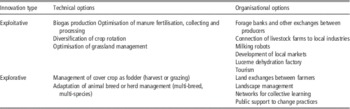
Table 2 presents the most frequently mentioned adaptation options (technical or organisational) designed in CS, representing either exploitative or explorative innovation. We observed more exploitative than explorative innovations, probably because stakeholders imagine innovative practices within the limits of their own constraints, and thus deep changes hardly emerge. However, individual adaptation options are not significant changes in farming systems. The combination of several options envisioned in many CS in scenarios of crop-livestock integration may lead to a strong reorganisation of land use and farming practices (e.g. CS C14-15). Therefore, we used the typology of crop-livestock integration to classify combinations of options.
Type of innovation encountered in adaptation options in light design

Four CS belong to a ‘complementarity’ type, corresponding to enterprises or specialised farms interacting without spatial coordination (each activity is spatially segregated). The integration is oriented to the metabolic approach (e.g. recycling). An example of the complementarity type is CS C16, a commercial pig farm where optimisation of manure management allows nitrogen inputs for crop production to be reduced. The use of local by-products also maintains the fodder supply and benefits the local integration of farming. Cropping and livestock systems coexist and interact through flows of products, but there is no specific management of land use and practices to deliver ecosystem services.
Four CS belong to a ‘synergy’ type at a farm level, seven at territorial level. The main farm-level issue is self-sufficiency, while the main territorial-level issue is coordination between crop and livestock production (e.g. mixed-use spaces, dual-purpose crops). The synergy type focuses more on the ecosystemic approach, using diversification of land use and spaces to manage ecosystem services, Examples of the synergy type are CS E7 (farm level) and C2 (territorial level). In CS E7, a high level of self-sufficiency is reached through feeding cover crops and crop residues to animals, which are otherwise fed with grassland hay or by grazing. Grasslands are rotated with crops as much as possible to increase the productivity of both. In CS C2, animal wastes regularly decrease water quality due to nitrate leaching. Their use as a resource for biogas production could decrease environmental impacts. The heat produced by anaerobic fermentation can be used to dehydrate fodder crops such as lucerne, grown locally in rotation with maize. Introducing lucerne increases soil fertility, thereby reducing the amount of manure having to be applied to maize and decreasing water pollution. Lucerne cultivation and management of the biogas plant are undertaken by a farmers’ organisation with pilot farms for experimentation and training of other farmers.
For a deeper understanding of the rationale logic of crop–livestock integration, we present a comparative analysis of four territorial-level CS: E6 in Italy, the merged C14 and C15 in Spain and C4 in the Netherlands. These CS represent three contrasting and illustrative types of crop-livestock integration at the territorial level, each with its own issues and constraints.
CS E6 (Italy): distributing crop patterns geographically to overcome agronomic constraints
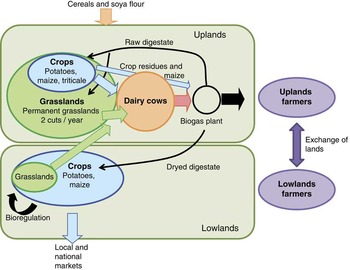
CS E6 is located in Tuscany, northern Italy, in the province of Pisa. It consists of collaboration between farmers from uplands dominated by livestock breeding on permanent grasslands and lowlands dominated by high-value crops, mainly potatoes and maize. The system described is a combination of pre-existing and new practices imagined during the light-design process. In the uplands, this CS focuses on a specific large dairy farm with confined cows. Cows are fed hay from permanent grasslands of the farm and imported cereal concentrates and soya meal. The lowland part consists of several medium-sized arable farms. Initially, the upland and lowland farms do not interact. Crop–livestock integration appears through two main changes: biogas production in the livestock farm and land exchanges between the upland and lowland farms (Figure 1).
Representation of adaptation options in case study (CS) E6 (San Giuliano, Italy). Ovals represent ecological and social components. Overlapping areas represent spatial (at farm or territorial levels) and temporal interactions between these components. Straight arrows represent material flows: orange for feedstuffs and animal products, green for grassland-based forage, blue for cash and forage field crops, red for animal manure, thick black for energy and thin black for residues from biogas production. Curved green arrows represent ecosystem services. Purple ovals represent stakeholders involved in the CS. Purple arrows represent coordination and services exchanged between stakeholders.

Biogas production in the uplands produces digestate that is dried and transported to lowland farms, reducing the risk of water pollution in the uplands due to spreading too much animal waste with high nitrogen content. The use of dried digestate as a source of fertiliser for intensively cropped fields interested the lowland arable farmers. Drying the digestate enables it to be transported up to 30 km at a lower cost than transporting liquid manure.
Crop-rotation limitations caused arable farmers to look for other land on which to grow potatoes and maize. Potatoes have a return time (i.e. the minimum period before planting the same crop) of 6 years. In contrast, maize can be cultivated with short return times and even in monoculture, but doing so will incur increasing production costs each year, with increased pesticide use likely and decreased crop quality possible. A land-exchange agreement between arable and livestock farmers was discussed to deal with these problems. Despite uplands not being ideal for arable crops, after many years under permanent grassland it is possible to achieve acceptable yields of potatoes and maize when ploughing grasslands. Additionally, introducing grasslands in lowland crop rotations increase soil fertility and bioregulation of pests, diseases and weeds (Lemaire et al., Reference Lemaire, Franzluebbers, Carvalho and Dedieu2013).
In this CS, delivery of ecosystem services is concentrated in the lowlands, whereas uplands benefit mainly from metabolic benefits: management of livestock waste and energy production. The biogas unit provides other benefits, especially the opportunity to process urban wastes. The coordination between lowland and upland farmers relies on common interests to cooperate.
To summarise, CS E6 relates how the development of biogas production creates new opportunities by connecting livestock- and crop-production areas. Farmers extended their initial cooperation for management of the digestate to land exchanges. They aim to overcome agronomic constraints and benefit from ecosystem services through diversification of crop rotations: soil fertility and pest regulation in first place, but also a better nutrient cycling in lowlands and an improved water quality in uplands.
CS C14-15 (Spain): optimising contrasting areas in a territory with many constraints
CS C14 and C15 are located in Aragon, north-eastern Spain. These two CS are merged because they consist of two different scenarios for using contrasting areas in a same territory. According to local stakeholders, the main environmental concern in the area is water quality, with irrigation and use of nitrogen fertilisers resulting in increasing water salinity and nitrate content.
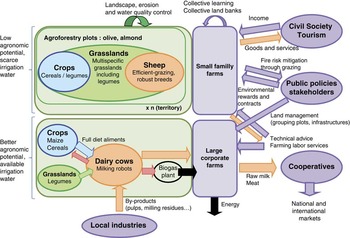
The sustainability of dairy farming there is threatened by declines in productivity and profitability, due mainly to increasing prices of feeds, electricity and fuel. These economic constraints and the hard working conditions in livestock farming discourage many farmers from staying in farming. The activity of supply chains and cooperatives is impacted by reduced farming activities. The region is thus exposed to a high risk of agricultural decline in next years. These CS present an alternative, not yet implemented, aiming to optimise resource use in two types of agricultural areas: dry hills and irrigated plains (Figure 2).
Representation of adaptation options in case study C14-15 (Aragon, Spain).

In the hilly areas of low agronomic potential and scarce irrigation water due to long and intense droughts, the challenge to maintain production is high. These areas are still managed by small family farms. The farming system envisioned is based on sheep production on grasslands with a few crop fields, associated as much as possible with fruit trees in agroforestry systems. In this scenario, fruit trees (mainly olive and almond) generate income and protect soils from erosion and grazing animals from the sun. Sheep are robust and efficient-grazing breeds. Grasslands are multi-species and include legumes such as lucerne. Crop fields are mainly coarse grains associated with legumes and are used to feed the sheep. They are rotated with temporary grasslands. The land can also be shared between farms through collective land banks to minimise transport costs and animal management. Cooperatives provide technical advice and services. Systems of experience-sharing ensure the adaptation of farmers to changing conditions through experimentation and collective training. Tourists represent income sources through direct sales of farm products (potentially with environmental labels such as organic certification) and services (facilities). Public policies support these small farms by payments for environmental services, water quality, landscape preservation and especially fire-risk mitigation ensured by grassland management.
In the plains, an area of higher agronomic potential, water for irrigation is more available, allowing intensive dairy farms. Dairy cows are fed mostly silage maize and cereal concentrates produced on large irrigated plots on the farms and grassland hay including legumes such as lucerne. In the scenario, animal wastes are spread in fields to increase fertility but also treated in a biogas unit to generate energy. Cows are also fed industrial by-products such as milling residues or pulp from local industries, which lowers the cost and stabilises the supply of animal feed. Milking robots decrease farmers’ workloads and ensure productivity in milk production. Farming systems are large corporate farms. Milk and meat are sold in conventional chains. Public policies also support this business model through investment schemes for restructuring or environmental improvements (high-efficiency equipment for pesticide spraying or irrigation) and grouping of plots.
To summarise, CS C14-15 relates how different adapted pathways of crop-livestock integration may allow use of contrasting areas to be optimised by adapting farming practices to local resources.
CS C4 (the Netherlands): preservation of ICLS faced with the need to remain competitive
CS C4 is located in Winterswijk, a region in mid-eastern Netherlands with high nature and landscape values, consisting of a mosaic of grasslands, arable fields, hedgerows and woodlots. High environmental and landscape quality is preserved by severe restrictions (e.g. Natura 2000 reserves, Water Framework Directive) but allows for tourism and recreation activities that generate significant income for farmers who host tourists. CS C4 consists of developing grazing in dairy systems and redesigning cropping systems to use fewer inputs. Such systems are already implemented in some farms, and their utility and benefits are widely acknowledged. This CS presents the coordination between stakeholders to avoid specialisation and intensification.
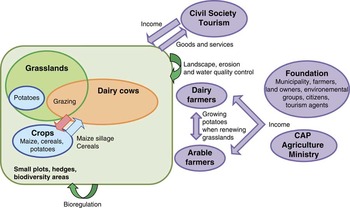
Farms are mostly dairy farms with high production levels, and cow are fed harvested grasslands, silage maize and a small amount of grazing. As in CS E6, agronomic constraints led to the development of land exchanges between arable and dairy farms to grow potatoes when grasslands are ploughed. A combination of practices and land management allows enhancement of bioregulation: crop diversity and cover crops at the field level, and small plots, landscape mosaic, scattered with hedges and woodlots at the landscape level. As a whole, the territory provides a high-quality landscape, well-protected soils and good water quality (Figure 3).
Representation of adaptation options in case study C4 (Winterswijk, Netherlands).

To encourage these types of farming systems, several stakeholders including municipalities, farmers’ organisations, land owners, environmental groups, citizens and tourism activity representatives established the Winterswijk Foundation. This foundation aims to maintain the diversified landscape, develop agricultural infrastructure and improve the environmental value of the region. To do so, an environmental reward system is under construction. Activities or ecosystem services that should be rewarded are chosen at a local level, for example replanting hedgerows along fields. The activities are allocated points depending on their importance for the landscape and the size of that activity and farmers are paid for their total of points.
The mobilisation of funds from the second pillar of the CAP could be an option for further implementation of this environmental reward system. Supply chains are active in the territory, but some factories are relegated to locations outside the area to preserve the landscape.
To summarise, CS C4 relates how a diversified territory can develop interactions between crop and livestock systems while preserving high landscape and environmental quality. A strong coordination between stakeholders, well-structured in a local foundation, makes preservation of these ‘virtuous’ systems possible through an environmental reward system and tourism development.
Transversal analysis of the three CS
The three CS presented illustrate three contrasted situations in terms of dynamics and challenges of crop–livestock integration. The design situation also differ among the three CS: in CS E6, upland-lowland coordination is just beginning, in CS C14-15, the stakeholders imagined prospective scenarios and in CS C4, many options already have been implemented.
Despite these differences, some common principles exist. First, farming systems seem bound to some level of diversity in land use: diversity of flows and cropping patterns in E6, diversity of production systems in C14-15, and diversified small-scale landscape organised in C4. Grasslands, cash crops, and forage crops are present in every CS. This diversity is the basis of farming systems delivering ecosystem services like soil fertility and bioregulation allowing reducing synthetic inputs and environmental impacts. The metabolic approach is also largely developed through practices of livestock waste management and recycling.
Social organisation is also crucial for crop–livestock integration. In the three CS, agreements between farmers from different areas are the basis for developing interactions between crops and livestock. Their collaboration also implies knowledge-sharing such as experimenting with new practices. Other stakeholders are also of major importance: customers via direct sales or labelled products (C14), tourists via diversification of income sources (C14, C4), natural-resource managers via environmental service rewards such as water-quality protection (C14, C4), and supply chains via support to farmers for changing practices and marketing new products (C14-15, C4).
Overall, either for biophysical processes providing ecosystem services or for social organisation, it seems crucial that crop–livestock integration multiply the number, diversity and intensity of interactions between entities of the socio-ecological system.
Qualitative multi-criteria assessment of adaptation options
We generalise observations by focusing on the frequency of ratings of options for 12 CS (C6 and C10 did not perform the assessment, C14 and C15 were merged). These ratings represent the opinions of participants who took part in the assessment phase of light design and are presented in Table 3. They represent their vision of impacts of implemented or envisioned changes in ICLS.
Ratings of synthetic criteria of multi-criteria assessment for the designed scenario of crop-livestock integration in case studies
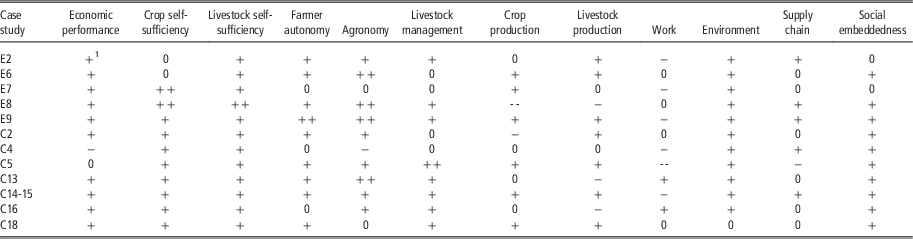
1 Strongly degraded (compared with initial situation) criteria are rated ‘- -’, significantly degraded criteria are rated ‘−’, non-impacted criteria are rated ‘0’, slightly improved criteria are rated ‘+’, and strongly improved criteria are rated ‘++’.
In 10 of the 12 CS, ICLS are compatible with economic performance, especially the stability of gross margin from year to year rather than its absolute value. Increased crop and livestock self-sufficiency (less dependence on external inputs) is expected. ICLS are considered to rely on agronomic principles and reduce their dependency on synthetic inputs and external markets. Managing an ICLS requires much knowledge and skills that farmers can develop from experience, knowledge sharing, training and advice. This ‘capacity building’ favours the autonomy of decision making. Many CS illustrate this and assume that the integration options will increase farmer autonomy both at farm (E2, E8, E9) and territory levels (C2, C13, C14-15, C18).
Supply chains play an important role in crop–livestock integration, often associated with relocation of farming activities, including the development of local markets and labelled products. This may represent an opportunity for diversification of marketed products. In some cases, however, the decrease in production volumes due to diversification and in purchased inputs due to increased self-sufficiency is identified as a difficulty for supply chains. Animal production (in three CS) and crop production (in two CS) are in some cases affected by integration, as specialisation is thought to increase yields, but overall production stability increases with integration.
The work criterion is rated lowest, participants in six CS perceiving a large increase in workload due to integration. Organisational innovations may decrease this workload in some cases. Some CS, such as C18, proposed specific adaptation options targeting more flexible work organisation for farmers.
Environmental criteria are expected to improve overall, mainly due to decreased use of synthetic inputs and increased nutrient recycling. Social embeddedness is also expected to improve, as many options are consistent with societal demands (e.g. local products, environmental protection and landscape preservation).
This overview of the assessment indicates that ICLS are promising when considering a wide range of criteria linked to the sustainable development of agriculture. It also strengthens the idea that some combinations of integration options act in synergy, allowing better performance of several criteria together instead of trade-offs. C16 is an example at the farm level, where several incremental improvements to the system have led to better overall farm performance: improvement of the composting process decreases working time, and reduction of the number of animals reduces forage requirements, which reduces irrigation, fertilisation, and ultimately, production costs. The only criterion affected is livestock production, but as economic performance is better, integration still appears to benefit farmers.
Discussion
Design of ICLS requires relevant methods and tools
The design methodology presented is based on the use of our conceptual model of crop–livestock integration. This methodology allows identification of challenges of crop–livestock integration in a harmonised manner in a wide diversity of contexts. In this way we cope with what Stirling (Reference Stirling2011) calls ‘transformative diversity’, allowing diverse and adaptive options of change rather than unidirectional or uniform innovations. CS leaders gave positive feedback about the usefulness of the light-design methodology for stimulating reflection on options of crop–livestock integration. They considered it well-structured yet adaptable and helpful for thinking about systemic interactions and combinations of options. It enabled them to set the context and stakes of crop–livestock integration and envision organisational innovations to make changes possible. In this way, our framework supports multi-level design and acts as a boundary object (Jakku and Thorburn, Reference Jakku and Thorburn2010).
About half of the innovation ideas are organisational options for change (Table 2). This reinforces the idea that implementing innovations in complex and dynamic systems raises many social and economic questions in biological and technical domains (Folke et al., Reference Folke, Carpenter, Walker, Scheffer, Chapin and Rockström2010). However, innovations relying on biologically diversified farming systems such as introducing grasslands in crop rotations for soil fertility effects (Franzluebbers and Stuedemann, Reference Franzluebbers and Stuedemann2009) or biological regulation (Ratnadass et al., Reference Ratnadass, Fernandes, Avelino and Habib2012), need to be better documented to move from general principles to locally adapted practices.
Interactions between researchers and stakeholders in the three WS allowed for broad exchanges, structured by the methodology. The ‘light’ aspect of methodology can be discussed, as it may limit the co-construction of the issues and solutions. Participants are expected to give their visions and ideas, but there is little time for debate and exploration of uncertainty. The short duration and small number of interactions in WS also limited the ability to review exploitative options, often the first ones envisioned, and to build explorative ones collectively. According to Barreteau et al. (Reference Barreteau, Bots and Daniell2010), light-design methodology encompasses consultative (WS1) as well as collaborative (WS 2 and 3) participation. Furthermore, the results rely strongly on the context of the CS and WS participants. Even though the co-running of WS by a facilitator and the CS leader was suggested, it is difficult to know how the WS were factually conducted, whether the adaptation options designed were consensual or instead reflected the opinions of dominant participants (Barnaud and Van Paassen, Reference Barnaud and Van Paassen2013).
The need to characterise and assess the systems designed
A ‘deeper’ design process would be necessary to overcome these limitations. This further work would take the shape of iterative cycles of assessment and redesign that move between participants’ ideas, scientific knowledge and stakeholders’ visions about the utility of options and quantitative assessment provided by scientists using adapted tools. For example, potential benefits of biodiversity at field, farm and landscape levels could be specified and in some cases estimated using state-of-the-art scientific knowledge: semi-natural spaces are considered beneficial for biodiversity, but the effect depends strongly on their spatial distribution and connectivity (Fahrig et al., Reference Fahrig, Baudry, Brotons, Burel, Crist, Fuller, Sirami, Siriwardena and Martin2011). This knowledge would suggest closely integrating croplands and grasslands rather than setting them apart.
Otherwise, our work focuses on a soft approach to stakeholder perceptions and ideas, whereas biophysical impacts have to be evaluated and trade-offs explained before implementing adaptation options (Kalaugher et al., Reference Kalaugher, Bornman, Clark and Beukes2013). This kind of stronger assessment process will be performed in the later stages of the CANTOGETHER project with life cycle assessment and economic assessment of several CS. The assessment will be based on collection of local data to inform quantitative assessment procedures.
Regarding socio-economic aspects, the light design framework could evolve to fit local challenges and priorities, with adaptation of proposed criteria and definition of adequate indicators and significant thresholds. This deeper assessment is required to contribute to the development of innovative farming systems (Diaz et al., Reference Diaz, Darnhofer, Darrot and Beuret2013).
Although some challenges are specific to certain types of production, questions about economic viability in the face of global markets and the quality of life for livestock farmers appear crucial for the maintenance of livestock production in many non-specialised regions. In Eastern Europe, some countries still conserve small-scale diversified farms, in which crop–livestock interactions are central. Some results of our project could help livestock production persist in non-specialised regions, particularly such small-scale systems. Four learnings are proposed below.
Broadening of viewpoints and stakeholders concerned
To design synergies between crop and livestock activities, a systemic perspective is necessary. It considers multiple aspects of integration, which broadens the analysis criteria for innovation (Lovell et al., Reference Lovell, DeSantis, Nathan, Olson, Ernesto Méndez, Kominami and Erickson2010). Criteria should be related to key attributes of the ecological system but also those of the governance system (Biggs et al., Reference Biggs, Schlüter, Biggs, Bohensky, BurnSilver, Cundill, Dakos, Daw, Evans, Kotschy, Leitch, Meek, Quinlan, Raudsepp-Hearne, Robards, Schoon, Schultz and West2012). This systemic perception may help decrease risk aversion and ease transition phases (Geels and Schot, Reference Geels and Schot2007). Indeed, it highlights systemic effects, for example one may lose in some aspects but gain in global performance. In the assessment of the light-design process, the negative impacts of adaptation options are balanced for many of the options designed. Otherwise, the options designed at the territorial level (e.g. exchange of products or land, circulation of animals, development of collective units) may broaden the types of stakeholders participating in the management of practices. Some CS show the crucial role of farmers’ associations (C10, C4), cooperatives (C15, C13) or public institutions (C2), whereas others rely almost only on farmer collaboration (C18).
These considerations also question the economic model supporting ICLS. In some cases the innovation is supposed to allow a reduction of production costs (e.g. C13, C18), others propose to shorten the commercialisation chain (C5, C14). Few CS rely on public subsidies to develop ICLS (C2, C4) and they focus on specific environmental rewards (e.g. wetlands preservation). Attention should be paid in further evaluation on the production costs and final prices of agricultural goods produced in ICLS.
Territorial synergies can change constraints into resources
Using the diversity of spaces and resources may increase the overall resilience of farming systems and allow development of new activities (Darnhoffer et al., Reference Darnhofer, Bellon, Dedieu and Milestad2010). For example, cattle grazing may allow the grasslands unsuitable for machines to be used. At the territorial level, a combination of a several types of farming systems could ensure the dynamism of the whole territory, as in CS C14-15. Complementarity may be developed between specialised farms in a mixed territory or between closely connected specialised territories. This would imply a means to exchange and manage flows of products, land or animals. This supports the idea that, in contrast to classical thinking, innovation is organisational rather than technological.
Diversification of income sources and commercialisation channels
In the CS, the production of renewable energy and other diversification activities were often conceived as a mean to improve economic viability of systems. It often meets other objectives and raises adaptation options: maintaining a livestock enterprise coupled with solar energy or biogas production. Some CS proposed preserving the landscape via tourism or recreational activities, involving the commercialisation of farm products in local markets. Other CS felt that this amount of additional work for the farmer would be undesirable. However, studies on multi-functionality show the potential in diversifying activities to benefit from the strengths and opportunities of a farming community (Lovell et al., Reference Lovell, DeSantis, Nathan, Olson, Ernesto Méndez, Kominami and Erickson2010).
Two rationales of crop–livestock integration
The identified scenarios of crop–livestock integration depend on the current farming systems, farm sizes and farmers objectives. Typically, large and specialised farms, in a corporate model, could organise their complementarity following industrial ecology concepts while maintaining economies of scale. Medium and small farms could benefit from diversity of land use and activities to deliver ecosystem services. These two archetypal models of crop–livestock integration, which may coexist and even interact at a local scale, do not have the same benefits. In the industrial ecology rationale, crop–livestock integration mainly aims to reduce disservices and negative impacts of production by optimising exchanges between components of the entire production system. One main objective is to improve the degree of recycling of material and energy and the resource-use efficiency. In the ecosystem management rationale, ecosystem services are the core objectives. The supply of ecosystem services depends crucially on maintaining a diversity of habitats for biodiversity, from soil microbes to flora and fauna and their interactions (Fahrig et al., Reference Fahrig, Baudry, Brotons, Burel, Crist, Fuller, Sirami, Siriwardena and Martin2011). The ecosystem management rationale relies more on local knowledge and organisation among farmers’ communities (e.g. for selection of adapted varieties), whereas in industrial ecology decision are made in a top-down manner that may reduce flexibility and adaption capacities of farming systems. These two rationales are close to ‘weak’ and ‘strong’ models of ecological modernisation of agricultural systems (Horlings and Marsden, Reference Horlings and Marsden2011), respectively. While both are promising, the path to crop–livestock integration depends on the local challenges defined by the stakeholders of the territory (Stirling, Reference Stirling2011).
Conclusion
The light-design process allowed us to build a portfolio of adaptation options to improve integration in crop–livestock systems, in alignment with their unique contexts. The methodology, though simple, appeared satisfying, especially the conceptual framework’s ability to help participants consider crop–livestock integration in a multi-domain and multi-level perspective. The crucial outcomes of our work are the options for reintroducing diversity in farming systems and landscapes. Among these options, grasslands have a central place for their roles in pest regulation and building of soil fertility. The diversity of livestock species and management strongly influences the balance of farming systems in terms of nutrient cycling and land use. The decline in livestock production is in this sense a huge sustainability issue. To maintain and develop ICLS, strengthening interactions between groups of stakeholders, from farmers to public-policy makers, appear crucial to achieve the challenge of developing and installing ‘green’ innovations and broad social transformation that includes consumer behaviour and lifestyles. These transformations depend on priorities and choices made at societal and territorial levels, supported by mediation initiatives for local governance of land of land use and management.
In the context of tension over the competitiveness of economic activities, agriculture should be considered as an especially sensitive sector due to the patrimonial dimension of agricultural areas and the need to preserve common assets. For this, we consider that public policies should remain flexible and territorially oriented. Ultimately, our work supports the idea that research about the ecological modernisation of agriculture should develop multi-level and multi-disciplinary approaches to understand the ability of agroecology to enhance ecological processes and of humans to shift from individual decision making to collective action.
Acknowledgements
The work presented here was carried out within the European project CANTOGETHER (FP7, Grant agreement No. 289328). The authors thank all the leaders of the case studies who contributed to the results presented and the two anonymous reviewers for their remarks and contribution to the improvement of this article.