Background
Blood cultures are necessary for identifying patients with bacteremia.Reference Weinstein, Towns and Quartey1 Poor technique may result in inoculation of blood culture bottles with skin flora, resulting in isolation of contaminants rather than pathogens.Reference Weinstein, Towns and Quartey1 Roughly one-third to one-half of all positive blood cultures are due to contamination, suggesting this is a significant problem.Reference Snyder, Favoretto and Baetz2 Diagnostic stewardship efforts around blood culture utilization have identified infectious syndromes at low risk for bacteremia, such as isolated fever or non-severe community-acquired pneumonia, for which obtaining blood cultures is unnecessary.Reference Fabre, Sharara, Salinas, Carroll, Desai and Cosgrove3 We assessed the indications and outcomes for patients with blood culture contamination (BCC) to determine if viewing this problem through the lens of diagnostic stewardship may yield solutions.
Methods
We conducted a retrospective study of patients 18 years or older who were treated at Tufts Medical Center, a 415-bed tertiary care hospital in Boston, Massachusetts, between October 1, 2022 and September 30, 2024, with positive blood cultures. Blood culture data and metadata were collected from an electronic health record (EHR) vendor generated report. We identified patients with one or both bottles of a blood culture set that grew commonly considered contaminants (coagulase-negative Staphylococci (CoNS), Corynebacterium species, Bacillus species other than Bacillus anthracis, Micrococcus species, or Cutibacterium acnes) or other rare organisms not always considered pathogenic.4
A BCC case was identified if one or more blood cultures drawn during a single calendar day grew a possible contaminant organism, and the treating clinician documented it as a contaminant in the EHR. Cases where the patient received ≥5 days of antibiotics for possible bacteremia without clear documentation of contamination were excluded from BCC cases. We used BCC cases rather than individual bottles or sets as clinicians use all blood cultures drawn over a calendar day to determine if a specific culture is a contaminant or not. We used this framework as the harms associated with contamination occur regardless of the number of bottles or sets that are positive with contaminant organisms.
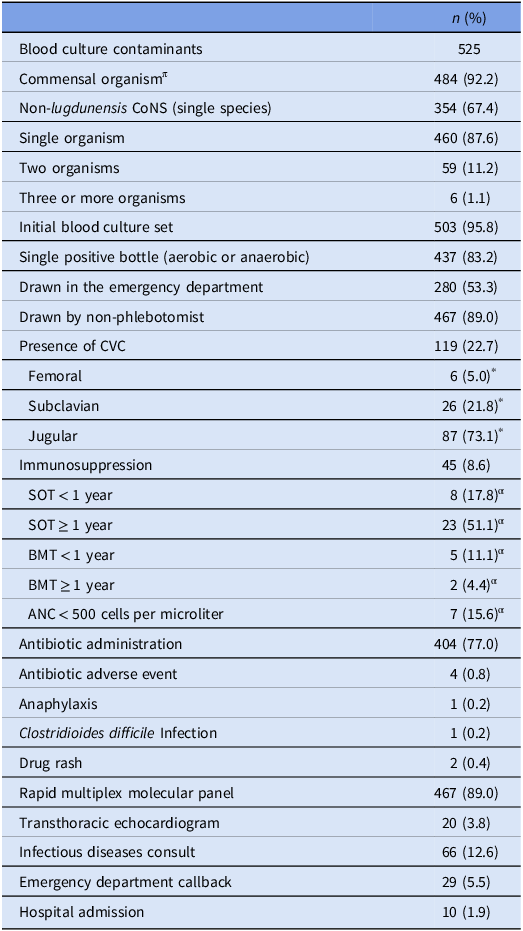
We manually reviewed the EHR record of each patient and collected clinical data using a standardized form in RedCap (Form S1).Reference Harris, Taylor, Thielke, Payne, Gonzalez and Conde5 For each case, we determined the characteristics of the blood culture case (Table 1). BCC outcomes included the administration of intravenous antibiotics within 48 hours of initial blood culture draw time, adverse events from antibiotics (allergic reaction, drug–drug interaction, or Clostridioides difficile infection), and utilization of a multiplex molecular panel for rapid organism identification (Table S1). We recorded if the patient received a transthoracic echocardiogram, infectious diseases consultation, emergency department (ED) callback (patient being called/asked to return to the ED after discharge), or inpatient admission.
Characteristics and outcomes of blood culture contaminants

Note: πNon-lugdunensis CoNS, Micrococcus, viridans group Streptococci, Cutibacterium acnes, Bacillus species, Corynebacterium species, Aerococcus species. *Percent of CVC. αPercent of immunosuppression. CoNS: coagulase negative Staphylococci. CVC: central venous catheter. SOT: solid organ transplant. BMT: autologous or allogeneic bone marrow transplant. ANC: absolute neutrophil count.
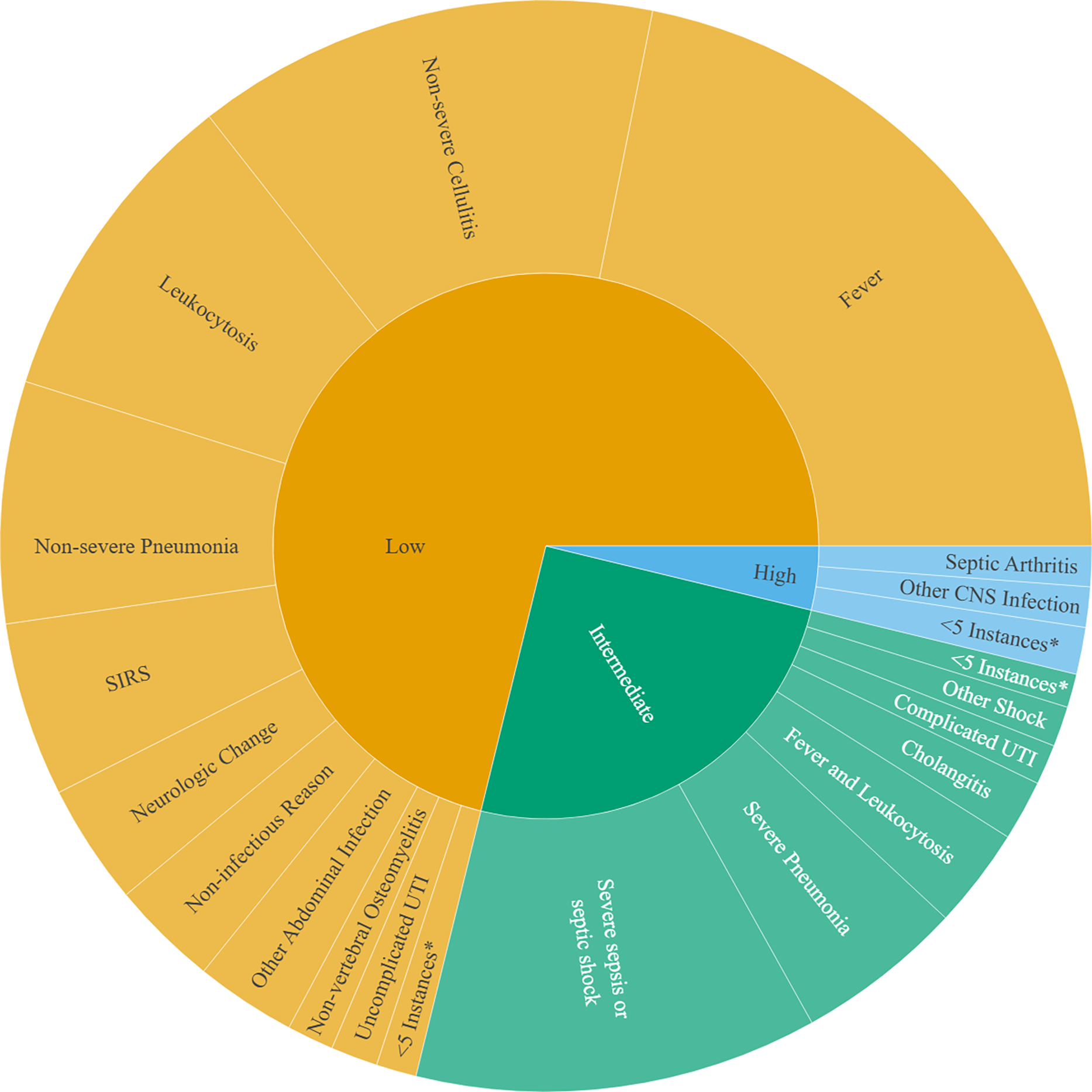
The indication for blood culture was based on documentation by the clinician for ordering blood cultures. Blood culture indications were grouped by low (<10%), intermediate (10%–50%), or high (>50%) risk for bacteremia as defined by Fabre et al.Reference Fabre, Sharara, Salinas, Carroll, Desai and Cosgrove3 Indications not classified by their framework were categorized into the risk groups on review of the treating clinicians’ documentation.
Analysis was performed in R (version 4.5.1)6 and R Studio (version 2023.12.1).7 We determined the overall rate of BCC as a percentage of total blood culture cases and of positive blood culture cases. We calculated the percentage of BCC episodes by ordering location, person drawing blood culture (phlebotomist or non-phlebotomist), indications, and outcomes. Indications were not evaluated for BCC episodes ordered for subsequent blood cultures. Figures were created in R Studio using package Plotly (version 6.1.1).8 This study protocol was approved by the Health Sciences Institutional Review Board of Tufts Medicine and Tufts University Health Sciences (STUDY00005132).
Results
We identified 525 (3.1%) episodes of BCC out of 16,687 blood culture episodes over two years (Figure S1). These BCC cases accounted for 24.7% of 2,125 cases with positive blood cultures. Most (87.6%) of BCC cases involved a single organism isolated from one bottle of a blood culture set (Table 1). A total of 58 unique organisms were isolated across these BCC cases, including some rarely reported as contaminants (Table S2). A multiplex molecular panel for rapid species identification and susceptibility testing was used in 467 cases (89.0%), which was 20.3% of all panels run during this time. Antibiotics were administered to 77.0% of patients.
The most common indications for blood culture collection identified were fever (21.9%), non-severe cellulitis (13.5%), and severe sepsis or septic shock (11.9%) (Figure 1). The majority of BCC cases (71.2%) were for patients with indications with low likelihood of bacteremia (71.2%). Noninfectious causes included hand laceration, fatigue, malaise, bleeding from CVC, anaphylaxis, non-ST elevation myocardial infarction, gastrointestinal bleed, nausea and vomiting, and sickle cell pain crisis (without other infectious signs/symptoms).
Risk stratification of ordering indications among contaminated blood cultures.
Note: *Indications with 5 instances were grouped together. UTI: urinary tract infection. SIRS: systemic inflammatory response syndrome.

Discussion
Our study demonstrated that most cases of BCC in our institution were in patients with low likelihood of bacteremia and were associated with high rates of use of rapid multiplex molecular testing and treatment with antibiotics. Using Geisler et al’s estimate that every BCC costs $6,463,Reference Geisler, Jilg, Patton and Pietzsch9 the 525 cases of BCC described in this study cost our institution approximately $3.4 million over two years. Half of BCC cases were seen in cultures collected in the ED, and nearly 90% were drawn by non-phlebotomists, suggesting that targeted interventions to reduce BCC might be necessary.
While our study evaluated BCC cases and not bottles, we found BCC rates similar to those calculated using bottles.Reference Weinstein, Towns and Quartey1 However, this percentage likely underestimates the true burden of BCC, as we observed many cases that we initially thought to be BCC were managed as true infections due to diagnostic uncertainty. Once blood cultures are positive, clinicians must balance the likelihood of contamination with the consequences of untreated bacteremia, as highlighted by the high rates of antibiotic utilization and the need for infectious diseases consultation in our study.
The strengths of our study include the large number of BCC cases, manual chart review of each case by both authors, and structured data collection. We measured the usage of multiplex molecular panels, which are becoming standard of practice for the workup of positive blood cultures, but are expensive. Our study has some limitations. It was conducted at a single academic medical center, which might not represent the diversity of practice settings. Data collection depended on documentation by the treating team and may not have accurately represented clinical thinking at the time of blood culture ordering or included the indication for antibiotics. Due to the number of blood cultures drawn over our study period, we were unable to include a comparison with true bacteremia or negative cultures. Prospective studies such as clinical trials that use clinical decision support tools are necessary to validate these findings.
In summary, our study suggests that diagnostic stewardship of blood cultures in patients presenting with conditions at low risk for bacteremia has the potential to reduce BCC, improve antimicrobial stewardship, and reduce the waste of healthcare resources.
Supplementary material
The supplementary material for this article can be found at https://doi.org/10.1017/ice.2025.10381.
Acknowledgements
The project described was supported by the National Center for Advancing Translational Sciences, National Institutes of Health, Award Number UM1TR004398 to Tufts Clinical and Translational Science Institute. The content is solely the responsibility of the authors and does not necessarily represent the official views of the NIH.
Author contribution
WA and HP both performed data collection, analysis, and manuscript preparation. Data are not publicly available.