The 2014 Ebola virus disease (EVD) outbreak was the largest in history, claiming more than 10,000 lives. 1 More than 600 healthcare workers (HCWs) died as a result of contracting EVD while caring for patients. 2 Self-contamination while doffing personal protective equipment (PPE) likely accounts for some of the HCW risk. In guidance to reduce this risk, the Centers for Disease Control and Prevention (CDC) recommends specific PPE components, steps for safe removal, and 2 new roles to assist the HCW. 3 The ‘doffing team’ consists of the HCW, a trained observer (TO) to verbalize instructions and monitor safety of the doffing procedure, and a doffing assistant (DA) to help the HCW remove PPE components.
Guidelines alone do not guarantee consistent adherence to best practices or protocols.Reference Gurses, Seidl and Vaidya 4 , Reference Gurses, Marsteller, Ozok, Xiao, Owens and Pronovost 5 To protect HCWs, a better understanding is needed of how self-contamination occurs and specific strategies that can be employed to mitigate risk. A human factors (HF) approach provides a useful framework to identify, analyze, and mitigate safety risks during PPE doffing.
Human factors (HF) is a scientific discipline concerned with understanding interactions among humans and other system elements, and the profession that applies theory, principles, data, and methods to optimize human well-being and overall system performance. 6 Human factors experts complete advanced training in engineering or psychology.Reference Sanders and McCormick 7 Human factors principles and methods are useful to improve safety and infection prevention (IP) practices.Reference Gurses, Seidl and Vaidya 4 , Reference Gurses, Marsteller, Ozok, Xiao, Owens and Pronovost 5 , Reference Sax and Clack 8 – Reference Gurses, Rosen and Pronovost 12
In this study, we aimed to conduct an HF-informed failure modes and effects analysis (FMEA)Reference DeRosier, Stalhandske, Bagian and Nudell 13 to identify self-contamination risks during PPE doffing, to prioritize areas of risk, investigate contributing factors and consequences, and to develop strategies to mitigate risks. This methodology engages key stakeholders to identify system-level factors that jeopardize safety and performance.Reference Rosen, Sampson and Jackson 14 , Reference Davis, Riley, Gurses, Miller and Hansen 15
Methods
The HF-informed FMEA involved 5 steps: (1) conducting a hierarchical task analysis (HTA) of the PPE doffing process, (2) identifying failure modes (ie, different ways a subtask can fail to accomplish its purpose), (3) prioritizing each failure mode based on a composite score of its severity, probability and detectability, (4) identifying contributing factors and potential consequences of the prioritized failure modes, and (5) designing solutions to eliminate or mitigate risks.Reference DeRosier, Stalhandske, Bagian and Nudell 13 , Reference Wetterneck, Skibinski and Roberts 16 – Reference Faye, Rivera-Rodriguez, Karsh, Hundt, Baker and Carayon 18 The Systems Engineering Initiative for Patient Safety (SEIPS) modelReference Carayon, Hundt and Karsh 19 was the conceptual framework guiding the FMEA. The SEIPS is an HF model previously used for other IP improvement initiativesReference Keller, Tamma and Cosgrove 20 – Reference Xie, Rock, Hsu, Osei, Andonian, Scheeler, Keller, Cosgrove and Gurses 23 to identify safety risks and to develop effective mitigation strategies. SEIPS examines 5 elements of the work system (ie, people, tasks, tools and technologies, physical environment, and organization) and their interactions with each other to improve processes and outcomes. Self-contamination risks during PPE doffing emerge because of characteristics of any of the 5 work-system elements or interactions between them. The Johns Hopkins University School of Medicine Institutional Review Board approved this study.
Participants and setting
Five IP experts at the Johns Hopkins Hospital in Baltimore, Maryland, all certified by the Board of Infection Control and Epidemiology, participated in 6 focus-group FMEA sessions, each ~2 hours. In addition, 3 IP experts (2 physicians board certified in infectious diseases and 1 nurse certified by the Board of Infection Control and Epidemiology), who were not part of the initial FMEA sessions, participated in a seventh focus-group FMEA validation session.
Procedure
First, 2 HF experts conducted an HTA of the PPE doffing process.Reference Lane, Stanton and Harrison 24 , Reference Stanton, Salmon, Rafferty, Walker, Baber and Jenkins 25 Hierarchical task analysis is an HF methodology used to provide a detailed understanding of tasks an actor needs to complete to achieve a certain goal. In this study, we used HTA to describe the PPE doffing task in terms of the individual steps, the sequence of these steps, and the tools used to complete each step.Reference Stanton, Salmon, Rafferty, Walker, Baber and Jenkins 25
The HF experts conducted the HTA by reviewing the CDC guidelines and web-based training for the powered air purifying respirator (PAPR) and gown PPE combination 26 and by observing 7 simulated doffing sessions. Next, findings were displayed in tabular and graphical formats and were used to facilitate discussion during the focus groups.
An HF expert (A.D.) was the facilitator in focus group sessions, and 2 others (A.P.G., L.B.) assisted and recorded data in the FMEA worksheet (Table 1). Also, 5 IP subject-matter experts viewed the documented data and asked for any corrections in real time. Based on a semistructured discussion guide, participants completed the following 5 steps:
(1) Reviewed the HTA for accuracy and completeness.
(2) Identified failure mode(s) for each doffing step.
(3) Rated each failure mode using a 10-point scale based on its severity (none to catastrophic), probability (remote to very high), and detectability (almost certain to absolutely uncertain) using a consensus approach. These 3 scores were multiplied to obtain a risk priority number (RPN) using a modified version of the scale developed by Department of Defense (Table 2). 27
(4) Identified contributing factors and potential consequences for each prioritized failure mode.
(5) Identified potential solutions to mitigate the effects of the contributing factors.
Example of Failure Modes and Effects Analysis (FMEA) WorksheetFootnote a

Note. S, severity; P, probability; D, detectability (see Table 2 for detailed description of the rating scales for S, P, D); RPN, risk priority score (S×P×D); HCW, healthcare worker; pt., patient.
a The entire data set is available in the supplementary material (online).
Risk Priority Number Rating Scales (adapted from Department of Defense) 27

A seventh focus group session with 3 IP experts not involved in the previous sessions was conducted for review and validation of the FMEA worksheet data, and any gaps or inaccuracies were corrected. We analyzed 4 newly identified failure modes using the process outlined above.
Results
Flowchart representation of the hierarchical task analysis
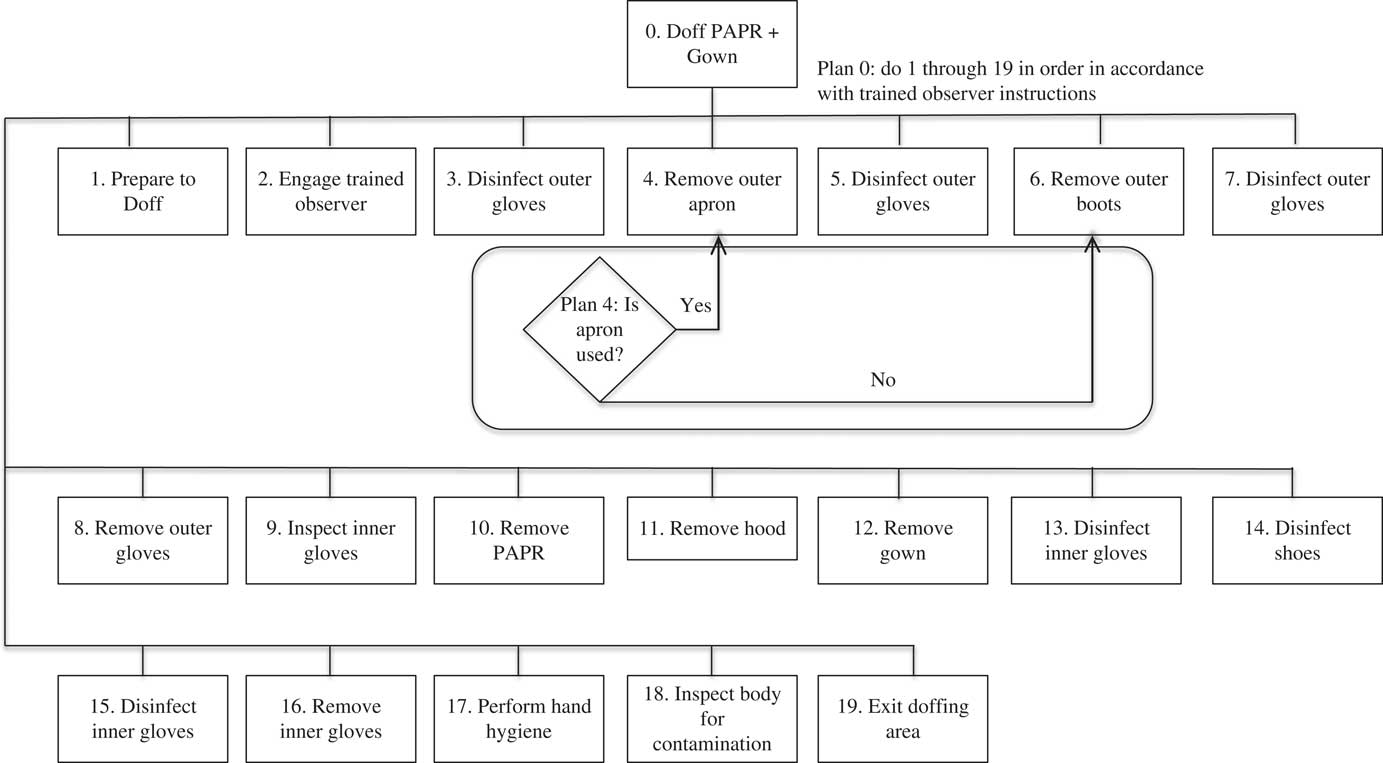
Figure 1 provides an overview of the 19 main PPE doffing tasks. A full graphical depiction of the HTA, including 82 subtasks, is available in Appendix 1 (online).
Overview of enhanced PPE doffing process depicting the 19 main steps based on hierarchical task analysis.

Failure modes and risk priority numbers
Appendix 2 (online) provides a complete listing of the 103 failure modes identified and the corresponding RPNs, contributing factors, potential consequences, and proposed risk mitigation strategies. The IP experts identified at least 1 failure mode for all, but 10 of the 82 subtasks, with RPNs ranging from 6 to 630 (mean, 115.28; median, 90; mode, 144). A failure mode with an RPN of 84 or greater was considered high priority and was further investigated. Table 3 depicts the failure modes with the 5 highest RPN values. The highest RPN (630) was associated with the DA or TO moving between clean and potentially contaminated areas. Other high-priority failure modes were associated with glove removal, apron removal, and self-inspection while preparing to doff.
Failure Modes with the Top 5 Risk Priority Number (RPN) Values

Note. TO, trained observer; HCW, healthcare worker; DA, doffing assistant; PPE, personal protective equipment; ABHR, alcohol-based hand rub.
Contributing factors
Further investigation was conducted to explore why the identified failure modes occur and to inform the development of risk mitigation strategies. Here, we briefly describe contributing factors associated with the high-priority failure modes; Appendix 2 includes a complete list.
Contributing factors were classified based on the work-system elements of the SEIPS model. Identified person (ie, HCW) factors included anthropometric and physiological characteristics, technical and teamwork-related competencies, and psycho-physiological responses of HCWs. For example, it is more difficult for HCWs with shorter arms to keep contaminated PPE away from their body during removal. Conversely, larger HCWs have a greater surface area to inspect, increasing the probability of missing a breach or contamination. The flexibility and dexterity of HCWs can impact risk when doffing PPE (eg, removing boot covers without contamination). Healthcare workers need not only technical competency but also spatial awareness of where they are relative to other team members and objects; they also need teamwork-related skills to effectively communicate, to assertively speak out if they are uncomfortable, and to stay focused to avoid complacency. Also, HCWs must be able to overcome physical and mental fatigue, anxiety, distraction, and other factors engendered by the PPE doffing task.
Tools and technology-related factors, such as the design of PPE elements, can precipitate failure modes. For instance, breaches and contamination are more likely and more difficult to detect if the PPE size is too big or too small for a particular user. The risk of PAPR hood contamination is higher if hoods are long, and aprons are of higher risk if their removal requires the HCW to lift it over their head rather than to tear it away.
Organizational contributing factors include culture (eg, discomfort speaking up), availability of various training opportunities in the organization needed to enhance skills, and organizational commitment and efforts for readiness (eg, having updated and user-friendly protocols and adequate resources).
Most environmental contributing factors concern the size and configuration of the doffing area. Small doffing areas that cannot easily accommodate 3 people with comfortable space between them and room for trash make it more likely for team members to bump into equipment or each other, potentially causing contamination. Visual cues are important to help team members identify clean versus contaminated areas of the doffing room.
Finally, the PPE doffing task itself, and the characteristics of tasks performed before doffing, contribute to failure modes. For example, more PPE contamination likely occurs following care of a patient with active diarrhea. Also, combative or anxious patients may pose a greater risk of PPE contamination. Furthermore, a small breach or PPE contamination may not be visible.
Risk mitigation strategies
We identified 86 risk mitigation strategies; Table 4 provides example strategies and Appendix 3 includes the complete list. Training and education were the primary considerations for mitigating risk. The 4 primary areas for doffing training include the correct use of tools and technology (eg, PPE, communication technologies), teamwork skills (eg, closed-loop communication),Reference King, Battles and Baker 28 IP topics (eg, gross decontamination strategies), and resiliency skills (eg, recovery from errors or task perturbations). Further, participants emphasized the importance of matching the physical characteristics of the training environment to the actual doffing environment and incorporating elements such as time pressure, stress, and patient activities to elicit similar cognitive, behavioral, and attitudinal reactions from the doffing team as they might experience in actual situations.
Example of Synthesis of Risk Mitigation Strategies WorksheetFootnote a

Note. TO, trained observer; HCW, healthcare worker; DA, doffing assistant.
a The complete list of risk mitigation strategies can be found in the supplementary material (Appendix 3 online).
b Number denotes the corresponding failure mode(s) in Appendix 2 (online).
A main organizational risk-mitigation strategy focuses on reducing guideline and protocol ambiguity. This aspect includes provision of explicit guidance for managing breaches and/or contamination, and systematically evaluating, and validating protocols and instructional materials prior to implementation. Participants suggested that the development, testing, and evaluation of institutional protocols should involve a transdisciplinary team of infection preventionists, HF experts, clinicians, laboratory technicians, and other relevant personnel.
With respect to tools and technology, a recurring theme was to employ visual cues, such as PPE elements with distinct colors, to help differentiate between the inside (clean) and outside (contaminated). Additionally, participants identified that aprons should tear away easily, allowing the HCW to pull it off themselves and reducing unnecessary risk associated with another team member helping with removal. Participants also suggested securing gloves to the gown to prevent the cuff from slipping and possibly exposing the HCW to contamination. Another identified strategy was to include technology that provides a bidirectional communication channels amongst the doffing team members and personnel outside the doffing room.
Environmental strategies centered on room configuration optimization with respect to both the room size and the relative positions of equipment and people. Participants noted the importance of (1) visual zoning to clearly demarcate clean versus contaminated areas and (2) equipping the room with mirrors to help HCW complete visual inspection to identify and address gross contamination prior to leaving the patient room.
Several strategies were identified to improve safety of the PPE doffing task itself. Participants pointed to the importance of employing all team roles as outlined by the CDC guidance; asking 1 person to perform the duties of both TO and DA hinders their ability to perform effectively. Participants also identified strategies to eliminate unnecessary steps and to improve the clarity of instructions. Improving steps involved with removing the gown (eg, folding back the gown to avoid touching outer surfaces), gloves, apron, and PAPR hood were noted as having the greatest potential impact.
Discussion
Failure modes while doffing PPE can lead to HCW contamination, and potentially severe or fatal consequences. Using HF methodology, we systematically mapped the complex PPE doffing process and identified 103 ways the doffing process can fail, leading to self-contamination. Among these failure modes, 54 were identified as priority areas. Findings from this analysis led to the following conclusions.
1. Safely doffing PPE requires knowledge, skills, and attitudes beyond the basic instructions for when and how to remove PPE elements.
The CDC guidance focuses on the correct technique and sequence of removal of each PPE element. This FMEA revealed important competencies beyond these technical aspects of PPE removal. First, exposure to high-consequence pathogens can invoke feeling of stress for team members. This stress can be exacerbated if a team member commits an error or must respond to a novel circumstance, if there are large amounts contamination, or if a PPE breach occurs. The negative effects of stress are well-known across research domains,Reference Dietz, Driskell, Sierra, Weaver, Driskell and Salas 29 – Reference Trinkoff, Johantgen, Storr, Gurses, Liang and Han 31 and managing stress is an important skill that can be gained through training.Reference Driskell, Salas, Johnston and Wollert 32 Therefore, organizations should consider integrating task perturbations and error-recovery opportunitiesReference Smith, Ford and Kozlowski 33 , Reference Keith and Frese 34 into training scenarios so team members have the opportunity to practice recognizing and recovering from these types of situations. Additionally, training should aim to provide competency in identifying and assessing risks from an infection prevention and control standpoint during doffing. Current PPE guidelines focus on the role and actions of the HCW, with less emphasis given to skills required to safely fulfill the TO and DA roles. The FMEA revealed many teamwork skills underlying safe doffing such as effective communication and information exchange, assertiveness, and role clarity. Evidence demonstrates the effectiveness of team training on improving clinical staff’s teamwork skills as well as patient and organizational outcomes (eg, safety climate).Reference Salas, DiazGranados and Klein 35 , Reference Hughes, Gregory and Joseph 36 Given the importance of teamwork in safe PPE doffing, organizations should emphasize relevant team skills during training. Beyond training, organizations can improve teamwork by incorporating prompts to encourage team skills such as closed-loop communicationReference King, Battles and Baker 28 and mutual performance monitoring.Reference King, Battles and Baker 28
2. A comprehensive competency assessment system for PPE doffing is needed to reliably and accurately measure doffing team members’ competencies.
Because competencies related to doffing, teamwork, and IP are critical for safety, organizations need to ensure that doffing team members are competent in these areas. Assessment is needed to accurately evaluate performance of doffing team members, to determine the impact of training or other improvement initiatives, to select team members correctly, and to provide structured feedback around key competency areas.Reference Dietz, Pronovost and Benson 37 , Reference Rosen and Dietz 38
3. The doffing team composition should include the HCW, TO, and DA.
Doffing PPE is complex, requiring assistance and vigilance to recognize and mitigate the self-contamination risk. Although staffing all 3 roles can stress an organization’s resources, HCWs are at greater risk if the TO and DA are combined into a single role. The likelihood is higher that the person assisting the HCW might not notice a breach or contamination, contaminate themselves, or contaminate equipment if these roles are combined. Therefore, the CDC has amended their original guidance to recommend the TO and DA to be separate roles. 39
In addition to ensuring this role structure, organizations should have contingencies in place if a TO or DA becomes contaminated or experiences an equipment breach while helping an HCW doff. Neither role should proceed to help other HCWs if they experience a breach or are exposed to contamination; this requires a contingency plan for continued support of HCW PPE doffing.
Another concern relates to staffing and the anthropomorphic differences of individuals. Doffing is a physically rigorous task that demands flexibility, balance, and constant vigilance. HCWs endure extreme heat, long periods of standing during patient care, and then remove PPE, which requires patience, attention, and some unusual movements. Selecting personnel based on their physical attributes (eg, fitness, physical endurance) is commonplace in other high-risk domains such as aviation and in the military.Reference Picano, Williams and Roland 40 Given the severity of potential risks associated with anthropometric characteristics of HCWs, organizations should consider, if feasible, the physical and other attributes of team members and their capacity to fill each role without endangering themselves or others.
4. Improved PPE designs and doffing protocols are needed to improve safety and provide additional guidance for intricate tasks.
In this study, we identified several opportunities for protocol improvement to enhance safety. Glove removal, for example, was identified as a major source of potential contamination. Current guidelines instruct the HCW to remove the first outer glove, ball it into their other hand, remove the second outer glove over the first one, and then discard them both. The safety and simplicity of this step can be improved if the HCW discards the first outer glove into a waste receptacle before removing and discarding the second one. This subtle change simplifies the second glove removal and reduces the possibility of the first outer glove touching and contaminating other PPE components. More detailed instructions for folding back the gown edges to provide the DA with an uncontaminated area to hold while helping the HCW can reduce the likelihood the DA or HCW becomes contaminated during gown removal. More explicit guidance about how to manage and respond to specific types of breaches should be undertaken to minimize ambiguity for how team members should respond.Reference Gurses, Seidl and Vaidya 4 , Reference Gurses, Marsteller, Ozok, Xiao, Owens and Pronovost 5
5. The doffing area must be optimized for team members and equipment.
Doffing areas that are too small result in the risk of team members bumping into one another or equipment. Organizations need to evaluate the extent to which their dedicated doffing space affords team members room to move around safely. Furthermore, clean and contaminated areas of the doffing room should be delineated using visual cues. Zoning clean from potentially contaminated areas reduces the likelihood that team members cross over between these areas, spreading contamination.
6. Guideline development should include human factors analyses.
Our findings also suggest the opportunity for integrating HF methods into guideline development. Similar to the US Food and Drug Administration requirement to incorporate HF evaluation prior to the approval of medical devices, HF could be integrated into infection prevention guideline development by proactively assessing potential failure modes and testing the usability of newly developed guidance.
This study has several limitations. First, focus groups were conducted at a single institution and examined only 1 specific PPE combination (PAPR and gown). Although the steps of the doffing sequence differ in terms of prescribed guidance for each type of PPE combination, many of the steps and substeps are the same, suggesting the generalizability of our findings across combination types. Institutions should evaluate the efficacy and likely breakdowns unique to manufacturer instructions for use during the development, testing, and evaluation of their doffing protocol. Finally, the IP experts study participants have developed, tested, and researched safe PPE doffing procedures but do not have direct experience caring for patients with Ebola.
Acknowledgments
We thank Dr Sallie J. Weaver for her contributions and feedback on the overall project. The views expressed in this manuscript are those of the authors and not necessarily those of the CDC, Johns Hopkins University School of Medicine, Johns Hopkins Hospital, or Johns Hopkins University.
Financial support
This work was supported by funding from the CDC Prevention Epicenter Program.
Conflicts of interest
All of the authors report no conflict of interest related to the contents of this manuscript.
Supplementary material
To view supplementary material for this article, please visit https://doi.org/10.1017/ice.2018.292