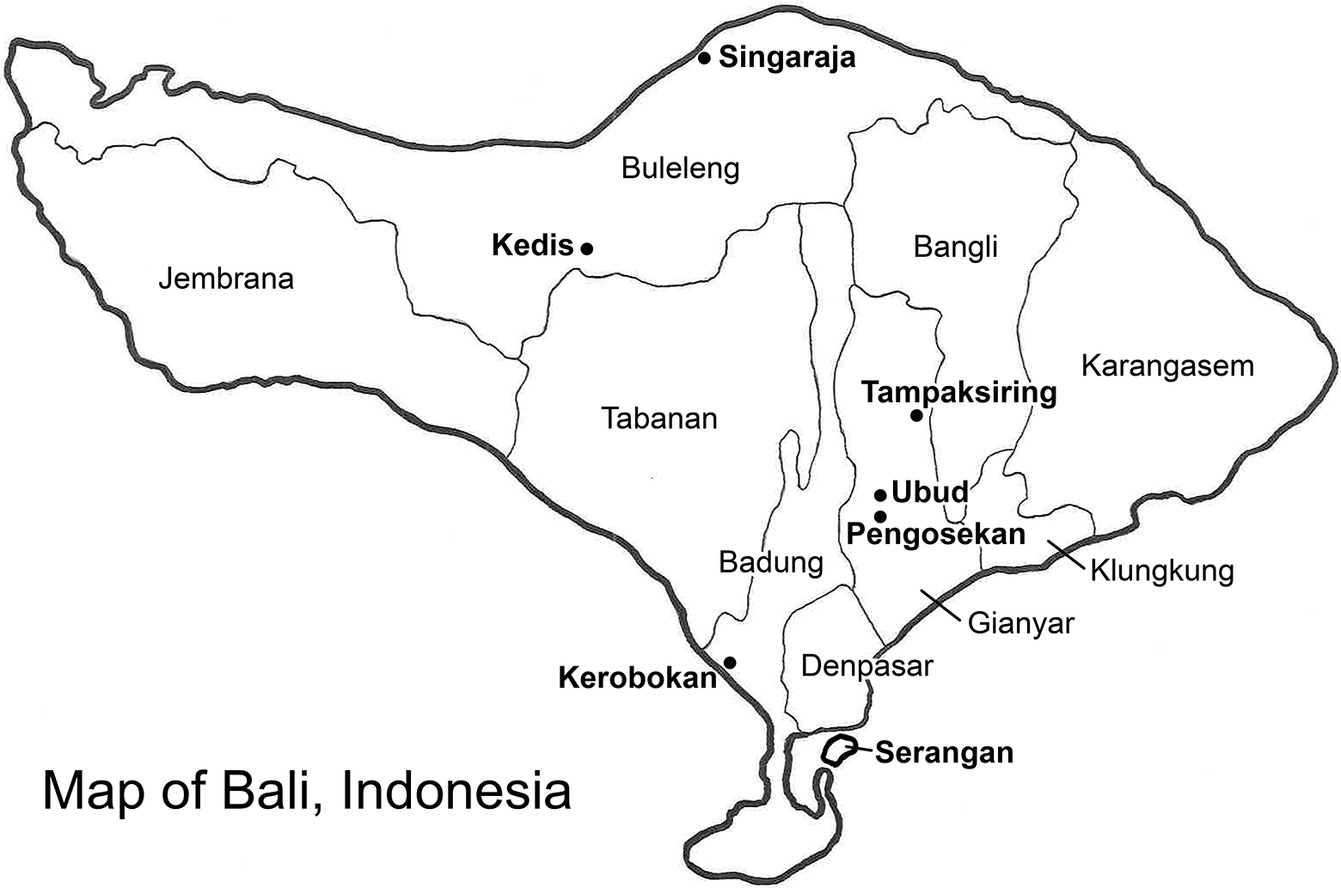
Just after the sun set on the Indian Ocean on 10 August 2024, three young dancers in ornate bright pink, yellow, and gold costumes walk tentatively over the uneven stones and shells of the beach on Pulau Serangan, known in English as Bali’s Turtle Island (Figure 1). Someone clicks play on an audio track of Balinese gamelan (traditional percussion-based) music, and the dancers begin their performance of Tari Nelayan, the Fishermen’s Dance, now stepping deliberately on the sand and striking quintessential poses of Balinese dance: knees bent, elbows raised, eyes moving sharply, and fingers quivering decoratively. Amidst these movements, they mime paddling and throwing out fishing nets, their movements synchronized to the beats of the accompanying music. Unlike typical performances of Balinese dance that take place either inside or just outside Balinese Hindu temple courtyards or on secular stages for a variety of festivals or competitions, this performance on the beach was part of an event designed to strengthen local traditions, cultural arts, and environmentally sustainable practices. The choice of this particular dance piece was topical, given that the dancers portray traditional activities that take place on Indonesian coasts; in this instance, their choreography of fishing evoked the very setting in which they were performing. This multiple layering of the symbolic and the physical was obvious. What was not likely apparent to the audience members, however, was the fraught history and buried origins of this dance piece and others like it.
Map of Bali.

Within a diverse constellation of dance performances spanning ranges from sacred to secular and traditional to contemporary, Tari Nelayan, along with Tari Tenun (Weavers’ Dance) and Tari Tani (Farmers’ Dance), are frequently performed today for odalan (Balinese Hindu temple ceremonies), cultural arts festivals, and tourist shows. They are but a small slice of dance in Bali, which comprises a vast complex of embodied knowledge containing everything from movement vocabulary, regional styles, and character portrayals to ritual enactment and sometimes spirit possession. Most Balinese dance works are notoriously ornate with highly stylized movements requiring rigorous training and costumes with endless layers and details. Many portray royalty and mythical characters from the Hindu epics Ramayana and Mahabharata or local tales of the Majapahit Empire; others portray spiritual deities and supernatural demons like the beloved barong and terrifying rangda. These dances are performed for secular entertainment (historically in the courts) or as part of odalan for specific ritual function, entertainment, or both. There are also Balinese participatory ritual and folk songs and dances, as well as lowly clown characters, but most are much older than the twentieth-century origin of the dances in question (Bandem and deBoer Reference Bandem and deBoer1995 [1981]; Herbst Reference Herbst1997; Hobart Reference Hobart2007).
Historically, dance in Bali was not a discrete category but was and often still is tightly intertwined with music, drama, and ritual (Herbst Reference Herbst1997). I am focusing on specific performance works created in the 1950s and 1960s when the category of tari lepas (free dance) was growing in popularity as departments of dance were becoming established in educational institutions (Hobart Reference Hobart2007:115). As a genre of stand-alone dance pieces, tari lepas works are separate (or “free”) from a specific ceremonial order or theatrical context. More specifically, Tari Nelayan, Tari Tani, and Tari Tenun are in the style of tari kebyar, which features quick movements and changing moods accompanied by flashy and complex rhythms in the gamelan gong kebyar musical ensemble. These three dances combine the typical stylized or abstract Balinese dance vocabulary with more transparent gestures mimicking real-life movements, from carrying hoes and baskets of seedlings (as seen in Figure 2), to working a weaving loom, to paddling a boat out to sea. An MC from a 2018 performance of Tari Nelayan stated, “Each movement is like a kind of pantomime that imitates every fishing movement so that the audience will easily be able to understand” (Gong Kebyar Wanita Duta Kabupaten Jembrana 2018), a description echoed in many statements about these pieces by dancers and cultural writers alike.
Tari Tani performed at the Bali Arts Festival. Screenshot taken from video of Gong Kebyar Legendaris Duta Kota Denpasar, 2023.

Unlike other dynamic and elaborate kebyar dances, Tari Nelayan, Tari Tani, and Tari Tenun are generally considered by Balinese audience members and performers to be relatively simple, mundane, and unremarkable, though this innocuousness belies a complex history of political intrigue, shifting political power, gendered meanings, and forced forgetting. In this article, I tell the story of these three dance pieces, and of the people involved in their creation, performance, erasure, and revivals.Footnote 1 This is a story of politicians and artists, nationalists and communists, presidents and performers. Through this story, drawn from primary and secondary sources, performances, and ethnographic material, including blog posts about cultural arts and interviews with performers involved in the dances’ origins and repurposing,Footnote 2 I aim to shine a light into the cracks of popular and enforced narratives that silence portions of Indonesian history. In so doing, I reveal remarkable ironies resonating between the dances’ origins, how they have been since repurposed, and their uses today. Through tensions between government control and individual creativity, the dances have shifted in meaning from political revolution and class struggles to cultural commodity and a medium for constraining women’s agency, to environmental activism, while assertions of local Balinese identity within a national framework remain a constant thread. Ultimately, I offer here a way to wonder about echoes of the past that might endure even while changing shape.
Political origins
Tari Nelayan, Tari Tani, and Tari Tenun were all created between 1957 and 1962, though I have found inconsistencies surrounding the exact years of creation and, in some cases, who created them and why. This is likely because there were multiple versions of each dance by 1965; it was also common for creators to borrow conceptual and musical ideas from each other. As Mark Hobart notes, “The various histories of Balinese dance are driven by diverse, often incompatible agendas” (Reference Hobart2007:111), and even amongst the scholarship I am building on, and between my interviewees’ recollections, there are contradictions; all the fuzziness in the data points to a period of intense friction. At this time, Indonesia was a young republic, and socialist realism was a part of a conglomeration of debates about revolution, nationalism, anti-feudalism, anti-colonialism, and communism—the era anthropologist Clifford Geertz described as “ideological pandemonium” (Geertz Reference Geertz1973:229). Bali was in the process of asserting its presence on the national stage as an important and ethnically, linguistically, and culturally distinct minority region in an extremely diverse nation. Communist ideas had been circulating in Indonesia and Bali since the early 1920s, spread by traveling teachers and communist writings (Putra Reference Putra and Reuter2003:56–57, 68). By the mid-1950s, the Indonesian Communist Party (Partai Komunis Indonesia, or PKI) was the third largest in the world after the USSR and China and was gaining strength in part due to intensifying land rights struggles in Indonesia (Robinson Reference Robinson1995:251–272).
Socialist realism originated in the USSR in the 1930s as a doctrine for the arts to portray and glorify the daily life and struggles of the working class. It was characterized by topics relevant to and understandable by the proletariat in a plain, realistic style. It spread through Asia among artists and intellectuals (Putra Reference Putra and Reuter2003). Njoto, a prominent leader of the PKI, promoted artists’ roles in politics and “the value of a ‘socialist realist’ style in gaining social equity” (Purnomo Reference Purnomo1995:20–21), though how exactly that was to be realized, and the relationship between politics and art, was contested (Bodden Reference Bodden, Lindsay and Liem2012:456–458; Vickers Reference Vickers2025). Because dance incorporates movement, visuals, and stories, it was an especially effective medium for advocating for political goals, and as communism spread through leftist networks in Asia, choreographers created socialist realist dance works in countries like China and Vietnam (Lindsay Reference Lindsay, Lindsay and Liem2012: 209), and in other parts of Indonesia (Bodden Reference Bodden, Lindsay and Liem2012:475–476). The styles of socialist realist arts in Indonesia, however, did not imitate that of the USSR and China, but were much more varied (Vickers Reference Vickers2025:99,105).
President Sukarno, the first president of the Republic of Indonesia, was not a communist member but leaned increasingly left through the early 1960s. He supported the creation of socialist realist dances and liked to feature them along with performances of older dances like legong to entertain dignitaries and show off Indonesian culture to foreign diplomats.Footnote 3 Indonesian cultural identity, however, was only in its nascent stages of development, with cultural leader Hamdah Mahjuddin writing in the 25 January 1956 issue of Harian Penerangan, “There is no truly national culture in Indonesia as yet” (Anonymous 1956). Throughout the messy and contested process of its development, Balinese culture was one of the main sources Indonesian officials used to build and represent the nation’s identity as a whole (Vickers Reference Vickers1989:175). Sukarno often called upon I Wayan Beratha, a composer and musician he had gotten to know during his stays in Denpasar in the mid-1940s, to fulfil his cultural aims (Lindsay Reference Lindsay2011). Beratha turned to his students, including dancer I Nyoman Wenten, to perform his new creations. Wenten recounted to me, “Pak SukarnoFootnote 4 actually had an idea to tell Pak Beratha to create Tari Tani for Indonesian Independence Day, for the 13th anniversary of Indonesia” (interview, 10 August 2023), and it was first performed on 17 August 1958, at the presidential palace in the capital of Jakarta.
The impetus for the creation of the other two dances was not quite so top-down. The version of Tari Tenun commonly performed today was created by I Nyoman Ridet and I Wayan Likes, both from near Denpasar, in 1957 (Dibia and Ballinger Reference Dibia and Ballinger2004:95). That year, Likes had gone to China to teach Balinese dance to Chinese dancers on a cultural diplomacy mission (Wilcox Reference Wilcox2017:526), and it is possible that he was inspired by Chinese socialist realist dances there to create one in the style of Balinese dance. McGraw reports on another version, however, by Ngurah Wardana in the early 1960s (Reference McGraw2013:58), which aligns with well-known master dancer Ni Ketut Arini’s statement that it was created in 1962, though she danced Ridet’s version working with him directly (pers. comm., 3 March 2022, and interview, 9 August 2022).
The Tari Nelayan version that is danced today was created by I Ketut Merdana, from the village of Kedis in Buleleng Regency, also known as North Bali (Ornstein Reference Ornstein2023). According to I Kadek Pasca Wirsutha, a composer in Singaraja who reconstructs lost twentieth-century kebyar works, Merdana was interested in left-wing politics and travelled to Java frequently to meet with other like-minded activists. Wirsutha says that Merdana’s motivation for creating Tari Nelayan was simply inspiration from what he saw around him and for use in competitions with neighbouring villages (interview, 24 July 2022). I wonder, however, if Merdana’s political interests were still a factor, especially given Wirsutha’s claim that Merdana had also created earlier versions of Tari Tani and Tari Tenun (Ibid.). Merdana did apparently accept direction from a government official, as his son stated that a minister of education and culture suggested to Merdana that he include a moment where one of the fishermen’s hands gets wounded by a fish fin and to include a song, both of which Merdana added to the piece (Andini Reference Andini2023:142).
Similar to many leftist painters who were “more concerned with the quotidian than propaganda” (Vickers Reference Vickers2025:96), it was popular for choreographers around the country to create performing arts pieces depicting workers and everyday activities (Bodden Reference Bodden, Lindsay and Liem2012; Miller Reference Miller2015:258-267). In Bali, many dances were created beyond the three of focus here, including Tari Buruh (Labourer’s Dance), Tari Gotong Royong (Working Together Dance), Tari Metik Teh (Picking Tea Leaves Dance), Tari Sopir Becak (Rickshaw Driver’s Dance), Tari Sopir Dokar (Carriage Driver’s Dance), and even Tari Bulu Tangkis (Badminton Dance) (Bandem and deBoer Reference Bandem and deBoer1995:134; Dibia and Ballinger Reference Dibia and Ballinger2004:95; McGraw Reference McGraw2013:58; Wirsutha, interview, 24 July 2022). Most of these are not commonly performed anymore, and while Wirsutha—who has worked on reconstructing Merdana’s Tari Ngalap Kopi (Coffee Harvesters’ Dance)—states that Merdana was behind most of these dances, written attribution no longer exists (interview, 24 July 2022). The musician Pany Ryandhi worked with descendants and a student of Merdana’s to reconstruct his version of Tari Tani and have it recorded by Sanggar Seni Wahana Santhi in 2023. To me, while the lyrics are very similar to Beratha’s, Merdana’s are more poetic and the tune catchier and more evocative of a (romanticized) day in the life of farmers.Footnote 5
Because the three dances portray everyday subjects specific to pre-industrial Balinese lifeways, they readily exemplify some aspects of Indonesian socialist realism’s aims of valorizing the common worker and implicitly rejecting imperialism. This value can be seen in the costuming, the lyrics that accompany two of the dances, and in the choreography. The costuming of these dances was originally designed to resemble the simple and plain clothing of peasants and workers, not the gilded and bejewelled costumes of royalty or deities. Wenten described the costuming of Tari Tani as “simpler, to represent a farmer; it’s not supposed to be a very bright colour. Pak Beratha told me: ‘Don’t wear gold painted fabric,’ at that time. So of course, the belt was also not gilded. The fabric was all tenunan (woven)” (interview, 10 August 2023). For the female costumes, Tari Tenun and Tari Tani also included lelunakan, a simple headcloth worn by village women, which was later often adopted for Tari Nelayan (see Figures 2, 9, 10, and 11).
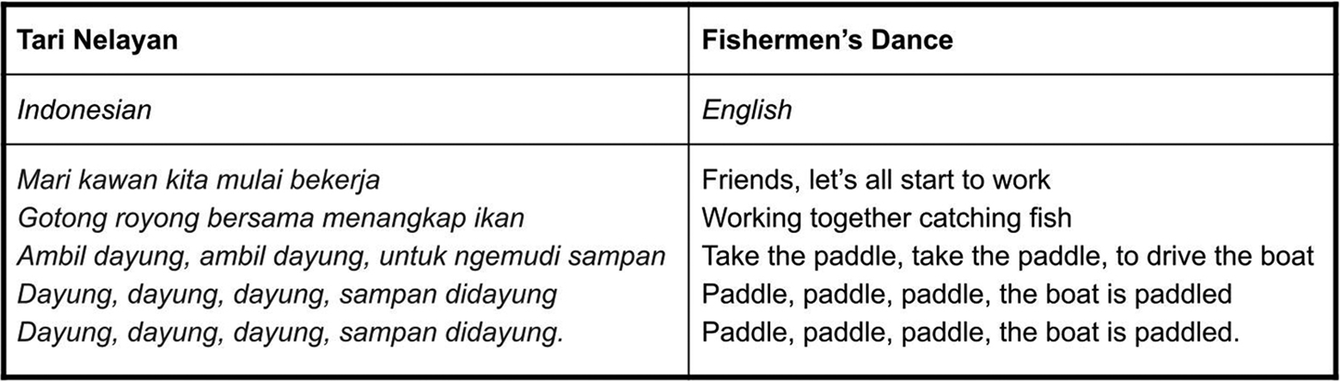
Socialist realism can also be seen in the lyrics that accompany Tari Tani and Tari Nelayan, usually sung by several singers sitting with the gamelan instrumentalists. Tari Tani’s lyrics (Figure 3) describe happily harvesting rice while singing and laughing until exhaustion in the evening. The use of the Balinese language here asserts a Balinese identity, along with, of course, the Balinese dance vocabulary, costumes, and accompanying gong kebyar music. It also grounds that identity in history as it points to older genres of traditional Balinese gamelan that incorporate sung poetry (Tenzer Reference Tenzer2000:248). In contrast, the lyrics for Tari Nelayan (Figure 4) use the national Indonesian language, indicating a broader audience and an aim to place Balinese culture squarely within national identity. Even more striking is that according to Merdana’s son, the first line was originally “Mari bekerja kawan buruh nelayan” (“Let’s work, fishermen labourer friends”) but was later changed to “mari kawan kita mulai bekerja” (Andini Reference Andini2023:142). I posit that the change was later made to remove the word buruh, which does not just mean labourer, but had connotations of the proletariat and was used to spotlight working-class struggles (pers. comm., Edmundo Luna, 30 July 2025).
Lyrics and translation for Tari Tani, by I Wayan Beratha. Translation by Edmundo Luna.

Lyrics and translation for Tari Nelayan, by I Ketut Merdana. Translation by the author.

The experience of the dancers in bringing the respective characters to life is important here. Dancers learn to not just portray but to embody the character’s spirit, so says I Made Sija (quoted in Herbst Reference Herbst1997:65). Dancer Dewa Ayu Tiara Dewi explained that the focus for these dances is to animate the characters through careful attention to the movements (interview, 17 November 2025). The elder dancers I spoke with described the pride they each found in the modern innovations involved in transferring the movements of traditional labour onto the stage. When Arini was first performing Tari Tenun at about age 20, she sought out elderly weavers to watch, noting how they worked the fibres with their fingers and how they adjusted the loom. She told me, “When I danced it, I moved directly like them, I was really serious [about it]. I was seen by Pak Djelantik [the famous prince of Karangasem], who said, ‘Wow! It’s as if I can see the thread in her hands!’” (interview, 9 August 2022). Similarly, Beratha took the teenage Wenten and his fellow dancers to the ocean to see how the fisherman rowed their boats and spread out their fishing nets for the sake of making Tari Nelayan realistic. Wenten remembered, “At that time, we had to practice in the lake or in the ocean, at the beach. Pak Beratha made us do that: ‘Oh, you have to study how to use the boat,’ we call jukung.” For Tari Tani, Wenten told me, “I used to always go to the rice fields, to experience hoeing, to cut the rice, and carry it from the fields back to the banjar [community centre]. The sheaves are quite heavy, actually. How you walk, and integrate that walk into the dance,” he said, is the challenge (interview, 10 August 2023). The subtle artistry is in the translation of everyday work movements to a dance format. According to Wenten, it is this process of giving feeling and understanding to the movement that gives the dance soul.
Appreciation of the intricate detail in socialist realist dance works seems to have been lost on many musicians and audiences, however. Ruby Ornstein describes her observations in the Ubud region in 1964, writing that many people derided the socialist realist dances. Balinese audiences wanted to see the elaborate costumes and adventures of heroes, villains, gods, and clowns, and though some leaders wanted them to find inspiration in ordinary work, audiences frequently remarked that they were ‘med’ (bored) (Reference Ornstein1971:44), and the plain costumes elicited “laughter and acid comments” (Ibid.:50fn34). Ornstein continues,
The generally placid tempers of the Peliatan musicians flared whenever these dances had to be rehearsed, and one could feel the undercurrent of annoyance that invariably resulted in an agitated discussion of the worthlessness of these three compositions and concluded with the smug remark, ‘Bukan seni’ (it isn’t art). (1971:44)
It is possible that this assessment was made because these dances did not fit the ornate styles of the mid-twentieth century, but Ornstein’s take is that it had to do with the collision of aesthetics and politics (Reference Ornstein1971:45). The question of whether art had a political role or should exist only for the sake of beauty, entertainment, and ritual efficacy (Herbst Reference Herbst1997:123–124) was hotly disputed.Footnote 6 Some critics argued that prioritizing politics over aesthetics resulted in diminished artistic value (Vickers Reference Vickers2025:93).
Despite their criticism, gamelan and dance troupes kept Tari Nelayan, Tari Tenun, and Tari Tani in their repertoire in the hopes of being invited to perform for the president and diplomatic guests at one of his presidential palaces. Wirsutha told me that gamelans from all over Buleleng, including those from Menyali, Bungukulan, and Sawan, were variously called to perform for Sukarno at the presidential palace in Tampaksiring, Bali. Sukarno knew about these small villages in Buleleng because of family connections; his mother was from Banjar Paketan, Singaraja (Wirsutha interview, 24 July 2022). Sukarno also invited performers from South Bali. Wenten performed a number of dances at Sukarno’s Presidential Palace in Jakarta and, he said, “Usually when Pak Sukarno visited Bali in the ‘60s, all the gongs—Sadmerta [Beratha’s gamelan], Gong Peliatan—performed for him in the Palace of Tampaksiring [and] they invited me to dance Baris [a warrior dance] or especially Tari Tani” (interview, 10 August 2023). Dancer I Gusti Agung Ayu Warsiki was often called to perform for Sukarno in Bali and in Jakarta (pers. comm., 28 July 2022). Arini remembers dancing for King Bumibol Adulyadej of Thailand at the Presidential Palace in Jakarta, when she was there with other performers, including Beratha, and dancers from Buleleng (interview, 9 August 2022). She was also invited to dance at the second Cultural Congress in Bogor along with dancers from a variety of Indonesian islands and ethnic groups. Additionally, she performed Tari Tenun for the 1962 ASEAN Games and Tari Nelayan at the Jakarta Palace in the latter half of 1965 (pers. comm., 4 March 2022).
Socialist realism was not solely associated with communism in Indonesia, as its ideals of promoting an easily accessible people’s culture also fit broader Indonesian goals of revolutionary and anti-imperialist nationalism. In fact, all three dances eventually became associated with arts organizations affiliated with either the PKI or the PNI (Partai Nasional Indonesia, or the Indonesian Nationalist Party), the party Sukarno had founded before independence. The arts organization aligned with communist values was LEKRA ( Le mbaga Kebudayaan Rakyat, or the Institute of People’s Culture), established in Jakarta in 1950. It was only in 1961 that a Balinese chapter was formed, but it was supported by both the governor and Sukarno and quickly became an important centre for national and international meetings. LEKRA promoted expressly political art, though it did not restrict its artist members to certain styles (Bodden Reference Bodden, Lindsay and Liem2012; Putra Reference Putra, Lindsay and Liem2012; Larasati Reference Larasati2013; Vickers Reference Vickers2025) and supported the thoughtful use of traditional forms “integrated with the revolutionary present” (Purnomo Reference Purnomo1995:23). Its leaders advocated for an Indonesian socialist realism defined not so much by a style or aesthetic but rather an attitude, commitment, and “the bind between the artists and the society and its problems through the production of their artworks” (Ibid.; see also Miller Reference Miller2015:41,184), though members pushed back against any attempts at control by the PKI (Bodden Reference Bodden, Lindsay and Liem2012:464). LEKRA Bali members in particular saw tourism as a threat to Balinese culture and used cultural arts to express an anti-Western position (Putra Reference Putra and Reuter2003:61,79).
The arts branch of the PNI was the Lembaga Kebudayaan Nasional (the Institute for National Culture or LKN); while it had a presence in Bali by 1956, it was formally established there in 1959 (Putra Reference Putra, Lindsay and Liem2012:320,323). LEKRA and LKN were mutually supportive at the national level, both with anti-feudalist and anti-colonialist aims, and holding the position that the arts should be political, educational, and support revolutionary people’s culture (Putra Reference Putra and Reuter2003:62). However, they were fierce rivals in Bali, with LKN Bali consisting of more conservative members (Putra Reference Putra and Reuter2003:73–76). Both organizations invited or hired musicians and dancers to perform for their events, though the performers often accepted these gigs without agreement necessarily with or full understanding of what the organizations advocated for (Wenten, pers. comm., 8 March 2023).
Once LEKRA and LKN had established chapters in Bali, audience members associated the socialist realist dances with one organization or the other. Notably, people did not agree which dance “belonged” to which organization, and in some cases, each organization had its own dance version. For example, Bandem and deBoer write about a version of Tari Tani that was created in Tabanan and commissioned by the PNI (Reference Bandem and deBoer1995:134), which seems to be distinct from Beratha’s version. Even Tari Nelayan, whose creator Merdana was presumed by some to be a member of LEKRA (Ornstein Reference Ornstein2023:45), is elsewhere labelled an LKN dance (Putra Reference Putra and Reuter2003:77; McGraw Reference McGraw2013:58), though it is more likely that LKN had its own competing version.Footnote 7 Although these dances were popular enough to be used for events not related to politics, including being performed at odalan, Arini told me, “Eventually the dances were considered LKN or LEKRA dances by the end of 1965 when the G30S [attempted coup] happened” (pers. comm., 3 March 2022).
The three dances were not just oriented towards domestic and visiting audiences but were included in a larger body of repertoire aiming to represent Indonesian culture abroad, specifically in cultural diplomacy projects and international tours aiming to promote Indonesian national identity. Sukarno sent several groups of performers abroad as part of what he called presidential missions (misi-kepresidenan), such as Likes’s trip to China mentioned earlier. Under Sukarno’s Non-alignment stance, groups went to both first and second world nations, as well as other post-colonial nations (see also Lindsay Reference Lindsay2011 and Reference Lindsay, Lindsay and Liem2012). For example, Beratha led a group from Belaluan, Denpasar, to China in 1956 (Dibia Reference Dibia2013: 174). He later went to New York in 1964 to perform at the Indonesian pavilion at the New York World’s Fair (Wenten, interview, 10 August 2023). Arini was sent to teach and dance in the Philippines for Indonesian Independence Day in August 1965 (pers. comm., 3 March 2022).
Especially remarkable are Wenten’s recollections of traveling through Asia dancing both Tari Tani and Tari Nelayan on a Presidential Cultural Mission, in a group of performers representing ethnic groups and regions across IndonesiaFootnote 8 (Figure 5). In June 1965, he described,
We first flew to Cambodia, to perform for Norodom Sihanouk, the King of Cambodia. Then we went to Thailand, performed for Bumibol Adulyadej. We were sent by Pak Sukarno, so about 80 people were chosen.… We performed in North Korea [Figure 6] for Kim Il Sung. I remember, we stayed for one month in North Korea. We didn’t have any idea what is a communist country or whatever, we just performed there! We were just happy to be out of Bali.
1965 Indonesian presidential cultural mission. Photograph shared by I Nyoman Wenten.

1965 Indonesian presidential cultural mission in North Korea. Photograph shared by I Nyoman Wenten.

Then we took a train from North Korea to Beijing, then performed for Mao Tse Tung, in the People’s Hall, Tiananmen Hall [Figure 7]. We stayed for a couple weeks [Figure 8]. We travelled around, and then we went to Japan to perform for Kaisar Hirohito. But at that time, we didn’t take commercial airlines. It was just a military cargo airline, with swing seats, but still we were able to go places far away! But this was a new plane from Russia, I remember. It was Russia’s plane. This was our experience during Sukarno. (interview, 10 August 2023)
In this way, these dances were an embodied aspect of the symbols, discourses, debates, and tensions at this critical time in the development of what it meant to be locally Balinese and nationally Indonesian, and what it meant to share that vision with the world.
1965 Indonesian presidential cultural mission in China. Photograph shared by I Nyoman Wenten.

1965 Indonesian presidential cultural mission participants at the Great Wall of China. Photograph shared by I Nyoman Wenten.

Just weeks after Wenten and the group returned, in September 1965, six army generals were kidnapped and murdered in Jakarta in a supposed attempted coup. Critics of Sukarno blamed the killings on the PKI, and with the covert support of the US military, launched a widespread campaign of anti-communist threats, blacklisting, arrests, disappearances, torture, and murders, during which time Sukarno was removed, and Suharto was installed as the nation’s second president (Robinson Reference Robinson1995:273–303; Bevins Reference Bevins2020). Wenten describes the fear he felt at the time, saying, “I was worried, you know, after ‘65: ‘Oh, we just came back from communist countries!’ We were a bit worried. It was very scary” (Wenten, interview, 10 August 2023). He spoke incredulously as he recounted having to move around carefully, especially at night, carrying weapons for self-defence. Many of Wenten’s dance friends at ISI Yogyakarta were involved with Ikatan Pemuda Pelajar Indonesia (Indonesian Youth Students Association), which was assumed to be affiliated with the PKI, and several of them disappeared. Many people in Wenten’s village were blacklisted. While he seemed to regard his survival due to not being a direct member of political organizations,Footnote 9 he also said,
Pak Beratha and the rest of the people are considered lucky. Even though sometimes we danced without knowing it for LEKRA, for the communist party. Sometimes LEKRA invited us to dance, for the opening of a new group, for example. So, some people went there, danced for them without knowing they’re communists. Then others associated the people and stamped them, “Oh, you’re a communist.” But we were lucky. We survived. (interview, 10 August 2023)
Not all the creators of the three dances were as lucky as Wenten, and their fates ran the spectrum. The most tragic was the murder of Merdana in 1965. Wirsutha says even though Merdana was never a member of the PKI, the murderers assumed he was, killed him, and burned his gamelan to ashes (interview, 24 July 2022; Ornstein Reference Ornstein2023:45). Merdana’s name and a great many of his contributions to gamelan gong kebyar repertoire were buried (I Made Terip, pers. comm., 1 August 2024) until recently, with Ornstein’s scholarship (2023) and the revitalization efforts of Wirsutha and Ryandhi.
The creators of the other two dances were spared. Likes (of Tari Tenun) worked at the left-leaning Indonesian state radio station (Radio Republic Indonesia, or RRI) in Denpasar before the massacres (McGraw Reference McGraw2013:57) and has led a relatively quiet life since. Beratha not only survived but thrived in the years after 1965, which is surprising given how close he was to Sukarno. Windha’s perspective is that while Sukarno was supportive of the founding of the first state-run arts conservatory in Bali ( Konservatori Karawitan, or KOKAR) and personally chose Beratha to be involved in its establishment in 1960, Suharto did not pay much attention to Balinese arts. Windha suggested it was the support of Bali’s governor at the time that helped preserve Beratha’s position at KOKAR (pers. comm., 28 July 2022). The only possible hit to his career seems to be that he was never officially hired at ASTI (Akademi Seni Tari Indonesia, or the Indonesian Dance Academy), the higher-level conservatory founded in 1966. McGraw posits that KOKAR sank in status due to its links to Sukarno’s values (Reference McGraw2013:59). Still, Beratha continued to be central to the development of gong kebyar music and dance for decades and was still involved in composing and consulting at ASTI and related organizations (Tenzer Reference Tenzer2005:115–116). Today, musicians and dancers in Bali and beyond remember him with reverence and awe.
The three dances, however, fell silent. The PKI and communism were officially banned, along with LEKRA (McGraw Reference McGraw2013:59). LKN slowly dissolved as Suharto’s government ordered the separation of the arts from politics (Putra Reference Putra, Lindsay and Liem2012:337). The trauma of the political violence and the ongoing blacklisting and discrimination created an environment where most people did not feel comfortable talking about what happened for decades (Robinson Reference Robinson1995:275; Bevins Reference Bevins2020:2). Only recently have some begun to open up, but this has been uneven (Larasati Reference Larasati2013; Weintraub Reference Weintraub2021; Anonymous 2023; Ornstein Reference Ornstein2023).
Revitalization, erasure, aestheticization, and commercialization
After 1965, artists who were still creating new works were careful to avoid topics that could be construed as political and focused instead on abstract or non-human themes in their creations because of both fear and government control (MacRae Reference MacRae and Reuter2003:48, 66). Though Beratha notably helped establish the Arts Evaluation and Cultivation Board (Majelis Pertimbangan dan Pembinaan Kebudayaan, or LISTIBIYA) in 1966, it absorbed conservative former LKN members and only supported artists who were aligned with Golkar, Suharto’s political party (Putra Reference Putra and Reuter2003:79; McGraw Reference McGraw2013:59). LISTIBIYA sponsored the gamelan gong kebyar competitions at the Bali Arts Festival in Denpasar, which started up sporadically in the late 1960s, and have been annual events since 1982. The repertoire and genres for these and other events that LISTIBIYA supported were intentionally chosen to promote a specific image of Balinese culture as a primary link to the ancient Majapahit Empire. The Majapahit was used as the historical basis for the still-developing Indonesian national identity, and as a direct rejection of communist and socialist realist emphasis on overt political meanings (Picard Reference Picard1996:137–138; Tenzer Reference Tenzer2000:102,393).
When exactly Tari Tenun, Tari Tani, and Tari Nelayan returned is difficult to pin down. Tari Tani is the only one of the three mentioned in the first edition of Bandem and deBoer’s book Balinese Dance in Transition, from 1981. The second edition from the following decade adds a paragraph on Tari Tenun but still does not mention Tari Nelayan (Reference Bandem and deBoer1995:134). While the version of Tenun associated specifically with the PKI faced some resistance to its revival in the 1990s (McGraw Reference McGraw2013:58), Arini remembers being a part of a 50-dancer performance of Ridet and Likes’s Tari Tenun in 1979 in Jakarta (pers. comm., 4 March 2022), and it was performed in the Ubud area by the 1990s (Figure 9). Tari Nelayan was the last to return, but by the 2010s was the most popular of the three (Dewi, interview, 17 November 2025).
Tari Tenun, Desa Pengosekan, 1996. Photograph by Hiroshi Ito.

Though these dances could have been banned entirely, they are now performed regularly for a variety of secular and odalan-related entertainment. Their original associations with socialist realism or politics, however, have been largely stripped away through a process of erasure, or what Rachmi Diyah Larasati calls the Indonesian New Order’s “amnesia project” (Reference Larasati2013:99). In print, from blogs to peer-reviewed scholarship, mention of “socialist realist dances” is but a sentence, with few exceptions. Looking at blogs and descriptions of videos promoting Balinese cultural arts to tourists, not necessarily as sources of accurate data but rather as evidence of discursive ideas and attitudes, we can see that these mentions are thin at most. Both Indonesian-language YouTube content and English-language media for tourists avoid mention of the origins of the dances altogether, instead describing only their movements and costumes. For example, Bayu Ardi Isnanto writes about Tari Tenun, giving more detail than many others, but the bland characterization is typical, as seen in these excerpts:
Female dancers model the process of spinning thread and weaving with a calm and happy mood.… From the culture it was in 1957, that the Balinese artists I Nyoman Ridet and I Wayan Likes were creative and produced a harmonious and dynamic dance which portrayed the movements of people weaving.… Thus, now this dance is still demonstrated and used for entertaining tourists. (Isnanto Reference Isnanto2022)
Isnanto then continues, describing the costume and movements of the dance in detail.
The only exceptions are a handful of online blogs promoting Balinese cultural arts to tourists that seem to lift passages from one anonymous blogger on BigBog Bali, who cites both Tenzer (Reference Tenzer2000) and Dibia and Ballinger (Reference Dibia and Ballinger2004). The most this writer says about the early meanings is:
During the era of the 1960s, the three dances (farming, weaving, and fishing) emerged due to the influence of socialism and become[sic] a standard at that time. Then in 1965, the political situation is[sic] unstable and… this dance immediately lost favor. After all, these three dances remain a distinct marker of a crucial time in Indonesia’s modern history and today are performed simply for their aesthetic purposes. (Anonymous 2017)
Still, many younger dancers and audience members are not aware of the political origins, and older ones do not openly talk of them (Putu Wulantari, pers. comm., 2 September 2023). Wenten observed this erasure as well in the Tari Nelayan Festival and Symposium that was held in Buleleng in 2014. He told me there was much discussion about the dance’s movements, the musical accompaniment, and many other related topics, but no one mentioned anything about the political context in which it was created, or even the life and death of its creator. Wenten said the dance was treated as “pure art” (interview, 10 August 2023). Ornstein implies that Tari Nelayan was not even openly attributed to Merdana until just after the time of that festival (Reference Ornstein2023:52). Indonesian scholarship centring on these dances, likely constrained by the authors’ institutions’ adherence to current national ideologies, focuses on their choreography, costuming, and abstract themes and does not even always mention their creators (Darmawan and Liska Reference Darmawan and De Liska2021; Andini Reference Andini2023; Budiarsa Reference Budiarsa2023; Putri, et al 2023).
This discourse is echoed in how the dances are introduced at high-profile performances, such as for gong kebyar competitions at the Bali Arts Festival. For these competitions, each competing group must programme works from a set series of categories (e.g., a ceremonial piece, a new composition, a kebyar dance, etc.). In 2018, the kebyar dance requirement for the women’s gong kebyar competition was to include either Tari Tenun, Tari Nelayan, or Tari Tani. Given LISTIBIYA’s support of the Bali Arts Festival, this signals a full reestablishment of state support for these dances, as long as they adhere to the rewritten Indonesian history, either ignoring the political tensions and violence of the 1960s or blaming it on alleged communists. Only two groups each performed Tari Tenun and Tari Tani, while six groups performed Tari Nelayan, indicating its relative popularity at the time. While introductions to pieces at the festival will often include descriptions of their creators’ inspirations, none of the 10 groups included any mention of the dances’ original contexts other than the year they were thought to have been created and their creators’ names. The introduction for Tari Nelayan performed by the troupe from Jembrana is representative in its focus on description. Note, however, how the last line implies a false continuity in the dance’s history:
Tari Nelayan…is often performed with the goal of entertainment.… It is clear in the choreography of the dance there are many movements which portray activities like paddling, spreading out nets, removing the spines of the fish, and various artistic, soft, and supple movements of the dancers’ hands. This fishermen’s dance was created in 1960 in Kedisan village, Buleleng by I Ketut Merdana and until now we can still enjoy the result of his work. (Gong Kebyar Wanita Duta Kabupaten Jembrana 2018, translation by the author.)
Given that the dances’ aesthetic value was already in question from the beginning, why revive them if their original functions were banned? They do not exactly fit LISTIBIYA’s aims, nor are they folk dances with “a valuable national heritage” like those few with leftist associations elsewhere in Indonesia that were repurposed and standardized as part of a broad cultural reconstruction project promoting an image of minority diversity (Larasati Reference Larasati2013:58). I posit that the confluence of three factors in the 1970s–1990s supported their revival with new functions. The first factor has to do with preservationist and nationalist values of the New Order under President Suharto, which were pushed to cultural leaders at the arts schools in Bali. Rather than promoting revolutionary arts as Sukarno had, the New Order encouraged the development of certain regional cultural traditions, though still in service to crafting a national culture (Picard Reference Picard1996:150), similar to the “repositioning” of the Javanese folk dance Jejer (Larasati Reference Larasati2013:78–100). Dancer-scholar I Made Bandem points to these values, writing, “This time of resurgence would not have been possible without the Indonesian government’s efforts and contributions, in accordance with national policy that cultural forms reflecting the nation’s traditional values should be preserved and developed to strengthen the understanding of the national way of life, self-respect, dignity and unity” (Reference Bandem1986:84–86). Artists, composers, and choreographers focused on aesthetics, surface beauty, entertainment, and tepid entreaties to the contribution of an idealized Balinese culture to national identity. The purpose of the arts was reversed, no longer to educate and agitate, but to “induce people to feel and behave more peacefully” (MacRae Reference MacRae and Reuter2003:57) and to “promote national stability” (Larasati Reference Larasati2013:79). And so, the political drive first connected to the dances has been warped to mean the opposite: not revolutionary, but regular, routine, and restrained (Ibid.:53). These dances have become what the government wants to promote as Balinese—quaint, innocent, and uncontaminated by the violence, politics, and internationalism that were rife during the period in which these dances were created.
Erasure of the dances’ leftist connotations can also be seen in aspects of the dances’ performances. Changes include the addition of highly rhythmic kebyar sections, interrupting the otherwise simpler musical forms (Wenten, interview, 10 August 2023). The costumes have become brightly coloured and gilded, following trends of other dance costuming (Hobart Reference Hobart2007:125), diminishing the dances’ uniqueness, hiding the deliberate plainness of the works with a romanticized picture of pre-industrial practices now symbolizing Balinese culture. Even the characteristic lelunakan are now overshadowed by crowns of gold flowers. Additionally, Wenten attributes an increase in abstraction and stylization of the dance movements to a lack of exposure to older lifeways. He told me, “At that time [1950s and 1960s], we still had a traditional fishing style, people still came out in small boats. But the younger generation, they’ve never seen that. Now it’s more abstract because the younger generation, they don’t know how to row the boats” (interview, 10 August 2023). Gone are the visible signs of the glorification of ordinary people wearing ordinary clothing, doing ordinary work; instead, the dances have become a light and decorative depiction of old-fashioned customs and a stated representation of apolitical Balinese “culture” serving the larger project of nation building. Ironically, the push for preservation has fostered changes in the actual dances and their meanings. In a reverse of McGraw’s statement about New Order impetus for preserving cultural arts (“Cultural representations went in one end of the pelestarian [preservation] machine, emerging out the other as art” [Reference McGraw2013:38]), here the dances as socialist realist art went in one end of the pelestarian machine, emerging out the other as a representation, a mere picture, of culture.
The second factor in the dances’ revival is their use in representing Balinese culture to outsiders, no longer primarily foreign diplomats, but rather the growing number of tourists since the 1970s (Picard Reference Picard1996:50–53). This can be seen by the inclusion of the dances in many tourist performances and on lists of “traditional Balinese dances” on travel and culture blogs like those referenced earlier. Because the dances portray pre-industrialized practices, they are easy to promote and romanticize as representing “traditional” Balinese culture, despite being mid-twentieth-century creations and differing in content and form from older dance works. Their mimetic and literal movements make them accessible to tourists, and they fit foreigners’ expectations that Bali is a relic of an ancient paradise (Vickers Reference Vickers1989:189–192). This second reason explains why these specific socialist realist dances were brought back and not the ones depicting aspects of modern post-colonial life, like drivers or badminton players.
Being relatively simple pieces musically and choreographically, they are also easier to put together by tourist ensembles.Footnote 10 This second factor is related to the first, as the national government supports and promotes the capitalization of Indonesian culture—especially Balinese kebyar music and dance—to tourists. Michael Tenzer explains, “Provincial leaders, operating under Jakartan mandates, do all in their power to promote the conceptual integration of traditional Balinese culture, national development, entrepreneurship, and the tourist industry into a neatly bundled, harmonious framework—an ideology of modern Bali in which art forms like kebyar have an explicitly sanctioned secular role” (Reference Tenzer2000:96). There are further striking and intertwined ironies here: the shift from the anti-capitalist origins of these dances to their use for commercial purposes, and the shift from anti-colonial inspiration to catering to foreign tourists in an economy some consider to be neo-colonial (Putra Reference Putra and Reuter2003:61,80). The dancers’ labour here is the production of culture in service to the state.
The third factor also capitalizes on the dances’ simplicity. In conversations with Windha, Warsiki, Dewi, and dancer Ni Putu Wulantari, they each pointed out that these dances are especially accessible to school and community-based children’s groups, though their original performers were adult male musicians. School groups have limited time to get works ready to perform in a semester, and more difficult twentieth-century dances like Oleg Tamulilingan or Taruna Jaya take too long to prepare. Because the movements in Tari Tenun, Tari Tani, and Tari Nelayan are more realistic and make less use of the rigorous movements from older forms such as legong, they are relatively non-technical and easy to learn quickly (Windha and Warsiki, pers. comm., 28 July 2022; Wulantari, pers. comm., 2 September 2023; Dewi, interview, 17 November 2025). Similarly, the musical accompaniment is easier, too, and in line with what many musicians and teachers now see as appropriate for women’s and children’s gamelans, groups that are not always thought able to handle tougher kebyar material or the elusive feeling of ceremonial lelambatan repertoire (Downing Reference Downing2019:84,102). In my experience, it is much more common in the twenty-first century for women’s or children’s gamelans to accompany these dances than men’s gamelans. Dibia and Ballinger also note that Nelayan is primarily performed by children’s groups (Reference Dibia and Ballinger2004:95). Tari Tenun was set as the required tari kebyar category for the 2014 Bali Arts Festival women’s gong kebyar competition, and the choice of one of the three was set for the same category in 2018, as mentioned earlier, likely because they were seen as something that even the best women’s gamelans on the island could feasibly put together.
While such reasoning hinges on logistics, it highlights the implications of continually associating easier, simpler, and even artistically mediocre pieces with women’s and children’s gamelans. These ensembles are often presumed to be artistically weaker versions of men’s groups, though this gap is shrinking. Specific discourses surrounding women’s participation in gamelan music, especially in the 1990s and early 2000s, supported their presence in a previously male-dominated realm but with a paternalistic or condescending attitude, presuming women to always be only just arriving from a lower status (Downing Reference Downing2019:86). Beta, et al. (Reference Beta, Gummay, Nisa, Tieken and Adhi2025) also observe this discursive phenomenon regarding scholarly studies of girls in Indonesia as one that appears to be supportive but in fact sees girls as “consistently lacking” in knowledge, experience, ability, or agency. This follows a long history of undermining Indonesian women’s political agency since colonial times and especially since 1965 (Suryakusuma Reference Suryakusuma2004:170). Sunardi and Larasati have documented the ways that the New Order government exerted special control over dancers suspected of having communist ties via a multitude of methods, from surveillance to violence, in order to control women’s bodies (Larasati Reference Larasati2013; Sunardi Reference Sunardi2015:40).
The contemporary use of the three dances looks to be yet another packaging of the radical (women and children participating in a formerly adult male-dominated field) in a guise of the mediocre (dances that many regard as nothing special), reinforcing an idea of women’s and children’s activities as unthreatening and apolitical (Downing Reference Downing2019:79–81). Perhaps the inverse is also true: assuming women and children lack political agency, having them be the ones to perform and accompany the dances is a way to maintain the absence of political meanings of the dances. Either way brings us to a final irony: the use of formerly politically oriented art to enforce an ostensibly apolitical appearance. A full extension of this stance is epitomized by mass performances of Tari Tenun. In 2016, a performance with 200 dancers was staged on a field in Kerobokan, Ridet’s home village. Two years later, 2000 dancers performed it on a beach nearby (Figure 10). The events were lauded for contributing to the memory of Balinese tradition, without any mention of the piece’s initial political associations (nv 2016; RLS 2018). MacRae discusses how amuk massa (mass madness) is the most dangerous threat to the enforcement of apolitical culture (Reference MacRae and Reuter2003:50), and here Tari Tenun Massa, the spectacle of keeping hundreds and thousands of Balinese women’s bodies in line—in literal lines—exemplifies the enactment of control over both women and Balinese culture.
Mass performance of Tari Tenun, Petitenget Beach, 2018. Photograph from Kanal Bali, 17 September 2018.

New activist associations
While it might be easy to become cynical about the current commercialized use of the three dances, they now have an additional and potentially more hopeful purpose. Since about 2014, the dances have been occasionally programmed in conjunction with events thematically relating to sustainability, environmental protection, and the climate crisis. Organizers of events promoting care of the environment ask for Tari Tani. Events having to do with the ocean have been programming Tari Nelayan, such as the scene in Serangan described at the beginning of this article. Even Tari Tenun points back to a time before mass production and environmentally harmful fast fashion, when textiles were crafted by hand. This recent trend is especially significant given that about two decades earlier, eco-activist performances and writings were not yet welcome in some parts of Bali (MacRae Reference MacRae and Reuter2003:58).
Since 2016, the annual theme of the Bali Arts Festival has had ties to the environment and the elements. With titles like “Loving the Birth Land” and “Honouring the Spring of Life,” these themes place elemental nature at the centre of universal life. Although the 2018 theme of “Fire, the Spirit of Creation,” seems somewhat abstract, Wenten sees the selection of the three dances forming the required kebyar dance category for the women’s gong kebyar competition that year as fitting well within the current environmentally related festival themes. Other performances are more specific, like a dance workshop Arini was invited to lead on Tari Nelayan, an event high-profile enough to be attended by the Denpasar mayor’s wife, as part of the 2023 Bali Arts Festival which had the theme of “Ocean as the Wellspring for Civilization’s Wellbeing” (mds 2023). Tari Nelayan has also been performed at a celebration of the consolidation of fisheries in Denpasar in 2014 and as part of ceremonies at the Lovina Festival in Buleleng more recently. Ryandhi’s reconstruction of Merdana’s Tari Tani was performed at a farming event in Buleleng in 2023. In these contexts that are attended variously by locals, tourists, and politicians, the dances, Wenten says, encourage people to remember the importance of less harmful practices, and maybe inspire people to think twice about allowing investors to build too many hotels in Bali’s rice fields (interview, 10 August 2023). Dewi offers a pragmatic perspective, noting that whether their message lands or not “depends on the understanding and patience of society” (pers. comm., 19 November 2025).
Beyond inspiring people to think, is there even more potential here for these dances to be recuperative and restorative? Dancer-researcher Brittany Laidlaw observes that dance is “an underutilized tool for socio-ecological regeneration and embodied eco-consciousness” and that our responsibilities within the ecosystem include dance (Reference Laidlaw2021:105). Dancing can be an act of healing and reconnecting, not just a symbolic referent—not dancing about something, but bringing a relationship into being and into practice, embodying it through movement and performance. The use of these dances in these new contexts in Bali points to this possibility. Certainly, ritual dance and performance in Bali have functioned in part in this way for generations, but the potential is ripe for dance to hold this role in secular venues and within globally positioned environmental activist networks, too. Not all performing artists identify as political actors since doing so can still feel dangerous, but some are explicit in using dance to resist and critique environmental destruction, including I Made Bayak (Reference Bayak2019), the many artists who performed in conjunction with the Tolak Reklamasi movement (Clendinning Reference Clendinning2019:208), and the experimental improvisatory duo ghOstMiSt (2024). In terms of enacting and embodying connections with place, even the mass performance of Tari Tenun was a moment when the dance itself became a part of the landscape (Figure 10).
The event in Serangan was especially exciting, given that it was part of a concert given by Arka Kinari, a band that travels the world on their sailing ship, giving concerts and environmental conservation workshops on and from their ship. Serangan Beach is a poignant location for the band to have chosen, as it is a major nesting ground for green sea turtles. Touristic overdevelopment has drastically reduced the viability of their nesting sites, though Serangan now boasts a sea turtle rehabilitation centre popular with tourists. This complex push and pull of tourism as both the cause of environmental and cultural destruction and its possible solution (when done right) is felt keenly here. Within this push and pull, Balinese dance has the potential to move from a touristic object towards an act of resistance to overdevelopment and ecological destruction. During their stays and within their performance events, Arka Kinari works to bring together opportunities and inspiration for the thoughtful preservation of both local environments and cultural practices (Moore Reference Moore and Romero2022). The inclusion of local children dancing Tari Nelayan as both representing Balinese arts and as an entreaty to repair the environment and livelihood of this fishing village turned ecotourism destination (Figure 11) is an instance of what Borderland, et al call “The strategic use of traditional artistic and expressive resources in moments of social turmoil occasioned by the ravages of environmental degradation and ecological collapse” (Reference Borderland, McDowell, Tuohy and McDowell2021:1). Rebekah Moore describes Arka Kinari’s performance events integrating local cultural arts as offerings to audiences, in this case a mix of Serangan villagers, folks from the nearby capital city of Denpasar, and tourists and expats from various countries, and as calling “on strangers for conversation” (Moore Reference Moore and Romero2022:268; Ni Kadek Simpen, pers. comm., 11 December 2024). Part of that conversation is the embodiment of a sustainable relationship with the environment in a way that is both old in its connections and actions, and new in its postmodern self-awareness.
Tari Nelayan dancers opening for Arka Kinari, Serangan, Bali, 10 August 2024. Photograph by Ni Kadek Simpen. We can read this moment when the male fisherman has hurt his hand on the sharp fin of a fish and his female companions are bandaging him up as a poignant symbol of what the event as a whole aimed to bring the audience’s attention to: pain (environmental damage) and potential healing.

Conclusion
A focus on Tari Nelayan, Tari Tenun, and Tari Tani sheds light on the trajectory of changing political and cultural ideologies in Bali. The dances’ associations and meanings have changed dramatically since their inception in the late 1950s and early 1960s, and though their display of local identity has been put to vastly different uses, it is that display and assertion of Balineseness, as both a part of and distinct from Indonesia, that has remained. Even that continuity, however, contains disruptions, as what counts as Balinese identity, and what it stands for and is used for, has also changed. From the early decades of the Indonesian Republic, which was in the process of developing a unique national identity, new dances were used to represent the new nation, assert ideals of revolution, regional identity, and party affiliation, and trigger debate over the role of the arts. Balinese choreographers and composers interacted with Sukarno and other government officials to make Balinese contributions to the national identity-building process. Performances for locals as well as foreign dignitaries were very much part of this aim, with communism and Indonesian socialist realist art as one component of a mix of ideologies. The dances were silenced and then revived after the upheaval and brutality of 1965–1966, as part of a return to “traditional” art forms and an appeal to tourists wanting to see such neatly packaged “tradition.” Calls for revolution and class struggle morphed into decoration, and simplicity was used to enforce women’s and children’s gamelan and dance groups to a status of perpetual novelty, rather than agency. This leads us to the present, where capitulations to the tourist economy leading to overdevelopment and local exacerbations of the climate crisis have forced reckonings with the twin disasters of environmental and cultural destruction (ghOstMiSt 2024), sparking artistic involvement in environmental activism.
Larasati performs Javanese dances secretly remembering dancers disappeared by anti-PKI forces and writes of these hidden memories: “our controlled movements are ever so slightly swayed by their weight within our bodies” (Reference Larasati2013:59). I am similarly inspired by Tyler Yamin’s biography of a set of gamelan instruments and his discussion of those instruments as holding memories (Reference Yamin2019) to think about the possibility for the three dances, despite their costume changes, decrease of precision in mimetic movements, and loss of overt political associations, to hold memories and to serve as moments of remembrance national pride, and assertions of activist ideals. Wenten’s view of the environmentally related uses of the three dances contradicts the consumerist and neo-imperialist uses of the dances elsewhere, and raises questions about the potential of the dances’ political impact today. Are there threads of the Balinese socialist realist dances’ origins that carry through, despite forced forgetting? Even under the veneer of a constructed nostalgia for an idyllic, pre-modern past, do they still resound with calls for revolution and resistance to oppressive power structures? Do they still reverberate with the memories of the fates of their creators? Do the pieces or their gestures contain resonances of inspiration from a connection to the environment, to place? Resonances of the power of the people to demand not just rights to land, but rights to healthy land? Are there embodied connections, passed down from teacher to student, that, despite distortion, might still echo with care for the ocean and a memory of the bounty of clean waters? As Laidlaw observes, the field of eco-somatics is still young (Reference Laidlaw2021:104), and future studies of this sort are needed. Whether these particular dances are strong enough—or their dancers and audiences brave or aware as Dewi notes, or have agency enough—to break out of their apolitical confines and truly bolster the environmental activism happening in Bali remains to be seen.
Glossary
B = Balinese. I = Indonesian.
- ASTI (I)
-
Akademi Seni Tari Indonesia, or the Indonesian Arts and Dance Academy. ASTI Denpasar was founded in 1966, renamed STSI (Sekolah Tinggi Seni Indonesia, or Academy of Indonesian Arts) in 1988, and then changed to ISI in 2003.
- Bali Arts Festival
-
Pesta Kesenian Bali (PKB), an annual month-long festival in Denpasar, of local, national, and international performances, competitions, exhibitions, and vendors
- bapak (I)
-
father
- banjar (B)
-
neighborhood organization
- barong (B)
-
protective mythic beast, danced by two coordinated people somewhat similarly to a Chinese lion dance
- buruh (I)
-
labourer, with connotations of the proletariat
- desa (I)
-
town, village
- gamelan gong kebyar (B)
-
a genre of gamelan that developed in the early twentieth century and is now the most common genre in Bali; gong kebyar repertoire is known for being loud, fast, and complex
- ibu (I)
-
mother; often used as an honorific similar to Ms. or Mrs.
- ISI (I)
-
Institute Seni Indonesia, or the Indonesian Arts Institute, which has branches in multiple Indonesian cities.
- jukung (I)
-
small, narrow boat used for fishing
- kabupaten (I)
-
regency, district; somewhat analogous to county in the US
- kebyar (B)
-
explosion; fast and complex unmetered rhythmic passage; dynamic type of twentieth-century dance; see also gamelan gong kebyar
- KOKAR
-
Konservatori Karawitan, or Conservatory of Traditional Music. The high-school level government-supported school was opened in 1960 and renamed SMKI (Sekolah Mengenah Karawitan Indonesia, or High School of Indonesian Traditional Music) in 1976, and then SMKN 3 Sukawati (Sekolah Mengenah Kejuruan Negeri 3 Sukawati, or State Vocational High School 3 of Sukawati) in 1999.
- kota (I)
-
city
- LEKRA (I)
-
Le mbaga Kebudayaan Rakyat, or the Institute of People’s Culture
- lelambatan (B)
-
genre of instrumental gamelan pieces played for temple ceremonies, traditionally on gamelan gong gede instruments, now often on gamelan gong kebyar
- lelunakan (B)
-
headcloth worn by village women
- LISTIBIYA (I)
-
Majelis Pertimbangan dan Pembinaan Kebudayaan, or Arts Evaluation and Cultivation Council
- LKN (I)
-
Lembaga Kebudayaan Nasional, or the Institute for National Culture, the arts branch of the PNI
- nelayan
-
fisherman
- odalan (B)
-
Balinese Hindu temple ceremony
- PKI (I)
-
Partai Komunis Indonesia, or Indonesian Communist Party
- PNI (I)
-
Partai Nasional Indonesia, or the Indonesian Nationalist Party
- rangda (B)
-
supernatural character who deals in black magic
- tari, tarian (I)
-
dance
- tari lepas (I)
-
free dance; dance works that are separate (or “free”) from a specific ceremonial order or a broader theatrical context
- tani (I)
-
farming, peasantry
- tenun (I)
-
weaving