INTRODUCTION
The last decade has seen a proliferation of research on pedagogic interventions intended to improve second language (L2) learners’ mastery of multiword expressions (MWEs). This line of research has gained unprecedented momentum by the recognition that MWE competence is an integral part of proficiency and is associated, for instance, with fluent language use (e.g., Boers et al., Reference Boers, Eyckmans, Kappel, Stengers and Demecheleer2006; Tavakoli & Uchihara, Reference Tavakoli and Uchihara2019). MWEs encompass a large set of expression types, such as collocations (strong wind), idioms (tie the knot), binomials (time and money), lexical bundles (one of the), proverbs (better late than never), and so on (Siyanova-Chanturia & Van Lancker Sidtis, Reference Siyanova-Chanturia, Van Lancker Sidtis, Siyanova-Chanturia and Pellicer-Sánchez2019). Unlike another commonly used term, formulaic language (or formulaic sequence; Wray, Reference Wray2002), which may refer to both single words and multiword items, the term MWE1 necessarily implies a unit longer than a single word (e.g., Siyanova-Chanturia & Omidian, Reference Siyanova-Chanturia, Omidian and Webb2020; Siyanova-Chanturia & Pellicer-Sánchez, Reference Siyanova-Chanturia, Pellicer-Sánchez, Siyanova-Chanturia and Pellicer-Sánchez2019).
It is well-established in the literature that a large proportion of language is made up of MWEs (e.g., Erman & Warren, Reference Erman and Warren2000; Hill, Reference Hill and Lewis2000). It follows that, for L2 learners to benefit from MWE knowledge on par with native speakers, they need to master a large repertoire of MWEs. Given the limited classroom time in many L2 learning contexts (such as EFL, i.e., English as a Foreign Language contexts), only a fraction of such a large MWE repertoire can realistically be acquired through explicit MWE-focused instruction. It is, therefore, unsurprising that researchers have explored ways to support incidental MWE acquisition; that is, acquisition as a by-product of activities where learners attend primarily to the content of messages rather than their linguistic packaging. This specific line of research on the development of L2 MWE knowledge, however, has focused almost exclusively on written input (see below), not audiovisual input.
A substantial number of studies have indicated that audiovisual input can be beneficial for vocabulary acquisition (e.g., Peters & Webb, Reference Peters and Webb2018). One strand of this research has furnished evidence that viewing captioned videos typically leads to superior uptake of new words compared to viewing the same videos without captions (see Montero Perez et al., Reference Montero Perez, Van Den Noortgate and Desmet2013, for a meta-analysis). Whether the benefits of L2 viewing with captions extend to incidental acquisition of MWEs remains underexplored, however. The present study aims to fill this gap and address two additional questions. One is whether the benefits of captions could be boosted if the MWEs in the captions are typographically enhanced. The other question is whether viewing the same video twice instead of once positively affects MWE uptake regardless of caption condition. Although research on incidental MWE learning has attested to the positive effects of typographic enhancement (e.g., Boers et al., Reference Boers, Demecheleer, He, Deconinck, Stengers and Eyckmans2017; Choi, Reference Choi2018), especially when combined with repetition (Szudarski & Carter, Reference Szudarski and Carter2016), these factors have been investigated almost exclusively in reading studies so far. It seems plausible that they also contribute to incidental MWE learning through L2 captioned viewing, and it is this possibility that the present study seeks to explore. At the same time, watching a captioned video is different from the self-paced reading of written texts because the processing of captions happens under time pressure (unless one pauses the video), and captions do not stay available for reexamination (unless one rewinds the video). Moreover, when watching a captioned video, more modalities than just written text invite attention. It cannot be taken for granted, therefore, that a text modification technique that has been found beneficial for MWE uptake from self-paced reading will be equally beneficial when it is applied to captioned videos. In addition to evaluating the role of typographic enhancement and repetition in MWE learning, the present study also investigates the effect of these two factors on L2 learners’ comprehension of the content of a video.
BACKGROUND
INCIDENTAL VOCABULARY LEARNING AND L2 VIEWING
The potential benefits of audiovisual input for vocabulary uptake have received increasing attention in recent years. This shift from a focus on written input is timely, as recent surveys have revealed that people now tend to spend more time watching television than reading books. In a recent survey on media consumption by Roy Morgan Research (2015), for example, data collected from 11 countries across the Asia-Pacific region showed that people spend an average of 8.2 hours to 29.5 hours a week watching television. In her survey that investigated Flemish EFL learners’ exposure to English language media, Peters (Reference Peters2018) found that more than 40% of these learners reported regular watching of English TV with or without subtitles. In addition, these learners, aged 16 and 19, reported seeking only limited exposure to written input such as books and magazines. This echoes Lindgren and Muñoz (Reference Lindgren and Muñoz2013), who found that young EFL learners relied more on subtitled movies than books for foreign-language exposure.
The potential of authentic audiovisual materials, such as movies and TV shows, for vocabulary acquisition has been pointed out through lexical analyses of large samples of such materials (Webb & Rodgers, Reference Webb and Rodgers2009a). Watching materials that are thematically related may lead to a good chance of encountering the same mid- and low-frequency words multiple times (Rodgers & Webb, Reference Rodgers and Webb2011). Clearly, there are merits in watching TV for vocabulary learning, which has prompted some researchers to advocate extensive TV viewing to bolster incidental L2 vocabulary learning (Webb, Reference Webb, Nunan and Richards2015), analogous to earlier proposals for extensive reading programs.
If authentic audiovisual input, including TV shows, is a good resource for vocabulary acquisition, then the next question is what can be done to make optimal use of this resource. A substantial body of research has gauged the benefits of captions, or on-screen text in the same language as the audio, in comparison with uncaptioned input. Two main benefits of captioned video have been reported. Firstly, most studies have shown better content comprehension for caption groups compared to no-caption groups (e.g., Gass et al., Reference Gass, Winke, Isbell and Ahn2019; Montero Perez et al., Reference Montero Perez, Van Den Noortgate and Desmet2013; see Winke et al., Reference Winke, Gass and Sydorenko2013 for a meta-analysis). Secondly, they have also almost consistently furnished evidence in favor of captioned viewing for vocabulary learning (e.g., Cintrón-Valentin et al., Reference Cintrón-Valentín, García-Amaya and Ellis2019; Markham, Reference Markham1999; Neuman & Koskinen, Reference Neuman and Koskinen1992; Winke et al., Reference Winke, Gass and Sydorenko2010; for a meta-analysis, see Montero Perez et al., Reference Montero Perez, Van Den Noortgate and Desmet2013). One explanation for the positive effect of captions on vocabulary acquisition is that the orthographic representation of the words helps learners to recognize word boundaries, which is more challenging when only aural input is available (Bird & Williams, Reference Bird and Williams2002; Winke et al., Reference Winke, Gass and Sydorenko2010). Surprisingly, whether the same benefit for vocabulary acquisition extends to the learning of MWEs has hardly been investigated. Thanks to a recent study by Puimège and Peters (Reference Puimège and Peters2019), we know incidental uptake of MWEs from uncaptioned audiovisual material is possible. The question, then, is whether adding captions harnesses its potential. For example, MWEs often contain function words (e.g., articles, prepositions) and these tend to be phonologically reduced in natural speech. Seeing these words written in the captions that accompany speech may help learners notice them in MWEs, distinguish them from the content words within MWEs, and thus aid uptake of the precise lexical composition (or form) of MWEs. The chances of learners attending to MWEs and their components in captions may be further improved through modifications to the captions that make MWEs stand out. This possibility is what we turn to in the following section.
MAKING MULTIWORD EXPRESSIONS STAND OUT
Incidental learning is usually defined as learning that takes place as a by-product of activities where learners focus primarily on content (Schmitt, Reference Schmitt2010). However, because it is hard to determine to what extent learners spontaneously turn their attention to language items or patterns as study objects during content-oriented activities, Hulstijn (Reference Hulstijn and Robinson2001) suggests that a critical operational feature that distinguishes intentional learning from incidental learning conditions is learners’ expectation of a language test. When input is processed for content, the precise wording of that content does not usually attract much attention. Yet, attention is vital for learning (Schmidt, Reference Schmidt and Robinson2001). To direct learners’ attention to certain language features or elements, researchers have proposed to use typographic enhancement, such as the use of underlining and bolding, to make these features or elements stand out (e.g., Sharwood-Smith, Reference Sharwood-Smith1993). A few studies have investigated whether this kind of modification of reading texts improves the chances of MWEs being noticed and remembered, and the results have been positive (Bishop, Reference Bishop and Schmitt2004; Boers et al., Reference Boers, Demecheleer, He, Deconinck, Stengers and Eyckmans2017; Choi, Reference Choi2018; Sonbul & Schmitt, Reference Sonbul and Schmitt2013; Toomer & Elgort, Reference Toomer and Elgort2019). In addition, a study by Szudarski and Carter (Reference Szudarski and Carter2016), which we will return to in the following text, showed that a combination of typographic enhancement and repeated encounters with the items led to better collocational knowledge compared to repetition alone.
Given that typographic enhancement promotes MWE learning in the context of written texts, it is conceivable that it is beneficial also in the case of captioned videos. However, there has been limited research on this, and the available research (see below) has examined uptake of single words rather than MWEs. Another modification to captions that has attracted some interest from researchers is to limit the captions to key words instead of including all the words present in the audio-recording. Keyword captioning is another means to make selected words stand out, because they are visually foregrounded relative to what is not included in the captions. Montero Perez et al. (Reference Montero Perez, Peters and Desmet2015, Reference Montero Perez, Peters and Desmet2018) included a comparison of vocabulary uptake from full captions and from keyword captions, and found an advantage for the latter, albeit mostly in posttests asking participants if they recognized the lexical items as ones they had encountered in the videos. Posttests about the meaning of the items yielded much poorer results overall, which is not surprising because captions (in L2) represent lexical forms, not the meanings of these forms. The target lexical items in Montero Perez et al. included both single words and MWEs, but no separate analyses were reported for the two categories. Teng (Reference Teng2019) also included a comparison of full captions and keyword captions, and his target items were all MWEs (verb–noun collocations). Rather surprisingly, the full captions were found to generate better learning gains than keyword captions.
To the best of our knowledge, there have only been two studies thus far that have examined the effect of typographically enhanced segments of full captions. In Montero Perez et al. (Reference Montero Perez, Peters, Clarebout and Desmet2014), L2 learners of French watched a video under one of four conditions: without captions, with regular captions, with keyword captions, and with regular captions in which the key items were highlighted. All three caption groups outperformed the no-caption group in a test that asked them if they recognized the items. They also did slightly better on a multiple-choice meaning-recognition test, but in this case only the keyword caption and enhanced caption groups outperformed the no-caption group at a statistically significant level. There were no significant differences between the test scores of the three caption groups. Montero Perez et al. (Reference Montero Perez, Peters, Clarebout and Desmet2014) also included tests about the content of the videos. Scores on these tests revealed no significant differences among the participant groups. It is worth mentioning that the content-related questions did not concern text portions featuring the target vocabulary. The second study that examined the effect of typographically enhanced captions is Cintrón-Valentin et al. (Reference Cintrón-Valentín, García-Amaya and Ellis2019). Animated video clips were integrated into an L2 Spanish course in three versions: uncaptioned, captioned with target vocabulary highlighted, and captioned with target grammar patterns highlighted. The captions with typographically enhanced vocabulary items generated significantly better vocabulary uptake than the other two viewing conditions, and even the caption condition where grammar patterns instead of vocabulary items were enhanced led to better vocabulary uptake than the condition without any captions. This, again, demonstrates that captions are to some extent beneficial for vocabulary uptake even without special steps to direct viewers’ attention to lexical items.
The studies reviewed in the preceding text furnish no evidence of a trade-off effect whereby typographic enhancement benefits uptake of what is enhanced but detracts attention from other elements. However, evidence of such an effect did emerge from a study by Choi (Reference Choi2018) on MWE uptake from reading. In this study, the students who read a text in which target collocations were enhanced recalled more of these target collocations compared to their peers who read the unenhanced version. However, the latter outperformed the former by 48% in the recall of content words that had been left unenhanced in both text versions. This suggests that typographically enhanced portions of a text can attract attention at the expense of the other portions of the text. This is reminiscent of the findings of some studies on typographic enhancement to assist grammar learning, which found that the use of enhancement promoted the uptake of grammar patterns, but impaired recollection of text content (e.g., Lee, Reference Lee2007). It seems plausible that this trade-off may also occur with captioned video, perhaps, especially because this type of input requires a greater distribution of attentional resources. In short, the role of typographic enhancement in fostering MWE uptake as well as content uptake from audiovisual input warrants further investigation.
THE ROLE OF REPETITION
Repetition, or frequency of occurrence, has been established to be beneficial for the learning of unknown words (see Uchihara et al., Reference Uchihara, Webb and Yanagisawa2019, for a meta-analysis). Provided there are enough encounters with the same words, learning can occur (Horst et al., Reference Horst, Cobb and Meara1998; Rott, Reference Rott1999; Webb, Reference Webb2007). While there is a substantial number of reading studies on the effects of repetition on the acquisition of single words, research investigating the effects of repetition on incidental MWE acquisition is far more limited.
An example of such a study is Pellicer-Sánchez (Reference Pellicer-Sánchez2017), who found that encountering the same collocations in a text eight times led to better posttest scores than encountering these collocations “only” four times, although the difference fell short of statistical significance. It is worth mentioning that the collocations in Pellicer-Sánchez (Reference Pellicer-Sánchez2017) were made up of adjective–pseudonoun combinations. The positive role of repetition for the learning of real collocations was shown in a study by Durrant and Schmitt (Reference Durrant and Schmitt2010). Unlike Pellicer-Sánchez’s study, repetition in Durrant and Schmitt’s study was not operationalized as repeated encounters of target items within a text. Instead, the participants were exposed to adjective–noun pairs under one of the following three conditions: (a) single exposure to the target collocations embedded in a sentence, (b) verbatim repetition, that is repeated exposure to the same sentences containing the target collocations, or (c) varied repetition, that is repeated exposure to different sentences containing the target collocations. Both repetition conditions yielded superior levels of recall compared to the single exposure. Further, verbatim repetition was found to lead to higher gains than varied repetition. In essence, Durrant and Schmitt’s study provides insight into how repetition or frequency of occurrence could be operationalized when using authentic unmodified materials, and suggests that exposure to target items in the same context rather than different contexts is useful for MWE learning (at least at an early stage of learning MWEs). This informs our design feature, in that repetition is operationalized as exposure to target MWEs twice, through repeated viewing of the same input video. This approach was also taken by Winke et al. (Reference Winke, Gass and Sydorenko2010), who found that watching a video twice with captions led to better vocabulary learning than watching it twice without captions.
Evidence of the role of repetition has been found in the context of bimodal input as well. In Webb et al. (Reference Webb, Newton and Chang2013), participants read short stories while listening to an audio-recording under four treatment conditions that varied in the number of encounters (in various contexts) with the target collocations. Depending on the text version, the collocations occurred up to 15 times over the course of approximately 30 minutes of reading. As expected, repetition led to more collocational knowledge.
The role of repetition in engendering MWE knowledge has thus far only been investigated in the context of written and bimodal input. To our knowledge, no study to date has investigated the role of repeated viewing in MWE learning. At least three viewing studies, however, have found a positive relationship between frequency of occurrence and the learning of single words. As part of a longitudinal study, Rodgers (Reference Rodgers2013) compared the effects of captioned and uncaptioned viewing on Japanese EFL learners’ incidental vocabulary learning. The learners encountered new words repeatedly through watching multiple episodes of a TV program. A positive correlation emerged between the number of encounters and learning, but, surprisingly, there was no significant difference between the relative vocabulary gains for the caption and no-caption conditions. A study that did find an effect for captions as well as frequency was conducted by Peters et al. (Reference Peters, Heynen and Puimège2016), but in this study participants watched videos with either captions or subtitles (L1 captions). The frequency of occurrence of the words and learners’ prior vocabulary knowledge were found to be positively associated with the learning gains. A study by Peters and Webb (Reference Peters and Webb2018) also found positive associations between incidental vocabulary learning and both the number of encounters with the target words and the learners’ prior vocabulary knowledge. The likelihood that more proficient learners and learners with comparatively good vocabulary knowledge pick up new words from audiovisual materials faster than less proficient learners has been demonstrated in other recent studies (e.g., Montero Perez, Reference Montero Perez2020; Pujadas & Muñoz, Reference Pujadas and Muñoz2019).
The studies reviewed here suggest that repeated viewing will improve the chances of incidental MWE acquisition from audiovisual input. Repeated viewing has also been reported to benefit text comprehension, as listening a second time enhances content comprehension (Lund, Reference Lund1991; Nguyễn, Reference Nguyễn2017; Sakai, Reference Sakai2009). This study seeks further evidence that repeated viewing benefits both MWE learning and comprehension.
RATIONALE AND RESEARCH QUESTIONS
The present study aims to investigate the effects of L2 viewing, with and without captions, on the incidental learning of MWEs. Previous research on incidental MWE learning has mostly focused on written input, and (to a much lesser extent) on bimodal input. Although such studies have attested to the positive effects of typographic enhancement, whether this is equally beneficial for MWE uptake from audiovisual input is not yet clear. On the one hand, it is conceivable that distributing their attention among three types of stimuli (i.e., text, audio, and images) may be a challenge for learners, and the presence of typographic enhancement may add to the cognitive load. On the other hand, typographic enhancement may direct learners’ attention to the target MWEs, which they might otherwise not notice due precisely to the distribution of attentional resources that multimodal input requires. If typographic enhancement achieves the latter aim, the next question, however, is whether it risks causing a trade-off between attending to the enhanced elements and fully engaging with the video content.
The present study also aims to shed light on the role of repeated viewing. It is well established in the literature on incidental MWE learning that repetition tends to lead to bigger learning gains. This study is the first to examine whether the same applies in the context of L2 viewing. Moreover, this study provides insights into the effectiveness of repeated viewing for each caption condition. This, in turn, may provide valuable information on whether repeated viewing is worth the additional investment of classroom time.
The study thus addresses the following research questions:
-
1. Is there an effect of caption condition (i.e., enhanced captions, normal captions, no captions) on incidental learning of MWEs?
-
2. Is there an effect of caption condition (i.e., enhanced captions, normal captions, no captions) on content comprehension?
-
3. Is there an effect of repeated viewing on incidental learning of MWEs under the various caption conditions?
-
4. Is there an effect of repeated viewing on content comprehension under the various caption conditions?
To answer these research questions, a pretest—posttest—delayed form-recall posttest between-participant design was adopted. Incidental learning was operationalized as learning that takes place without prior test announcement, in keeping with Hulstijn’s (Reference Hulstijn and Robinson2001) suggestion. As such, in the current study, learners were not forewarned of vocabulary tests. Instead, to ensure they engaged with the content of the video, it was announced that comprehension questions would follow immediately after viewing the video.
METHOD
PARTICIPANTS
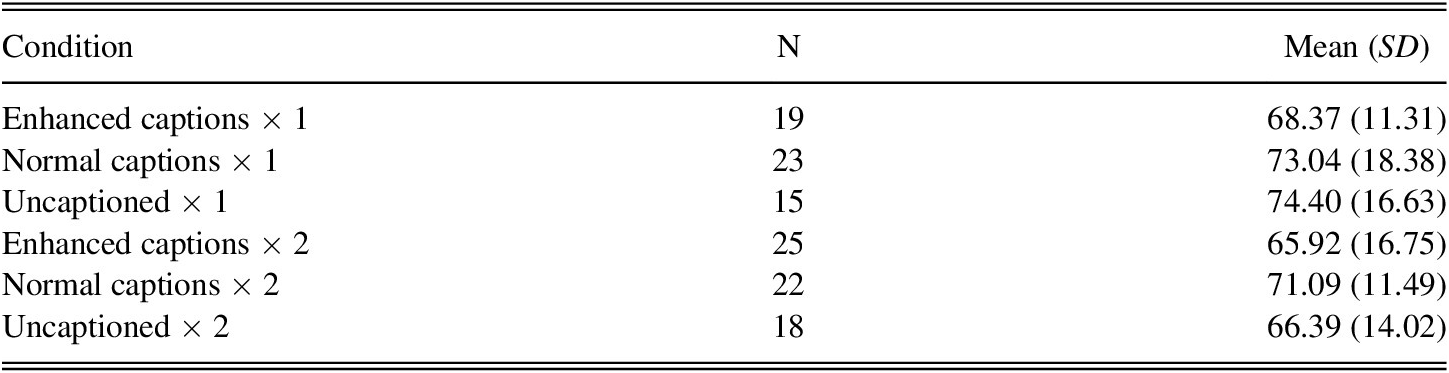
One-hundred and twenty-two Malaysian L2 English learners took part in this study. The participants were college students (i.e., pre-university) working toward their diploma in various disciplines such as hospitality management and information technology systems. They ranged in age between 17 and 23 (M = 18.7; SD = .09). The participants had either Malay (n = 10) or a Chinese dialect (n = 116) as their L1. Their mean vocabulary size test (VST) score (Nation & Beglar, Reference Nation and Beglar2007) was 66 out of 140 test items (SD = 21), and the range of scores indicated they had (receptive) knowledge of between 4,000 and 9,000 most frequent word families in English. The participants came from six intact classes, and these intact classes were randomly assigned to one of the six experimental conditions, differing in number of viewings (i.e., one or two viewings) and caption condition (i.e., no captions, normal captions, or enhanced captions). There was no significant difference between the six groups (see Table 1) in their scores on the VST (Kruskal-Wallis χ2 (5) = 4.57; p = .47).
Number of participants and the mean VST score (out of 140) under each condition

Notes: 1 = one viewing; 2 = two viewings.
Abbreviation: VST: vocabulary size test.
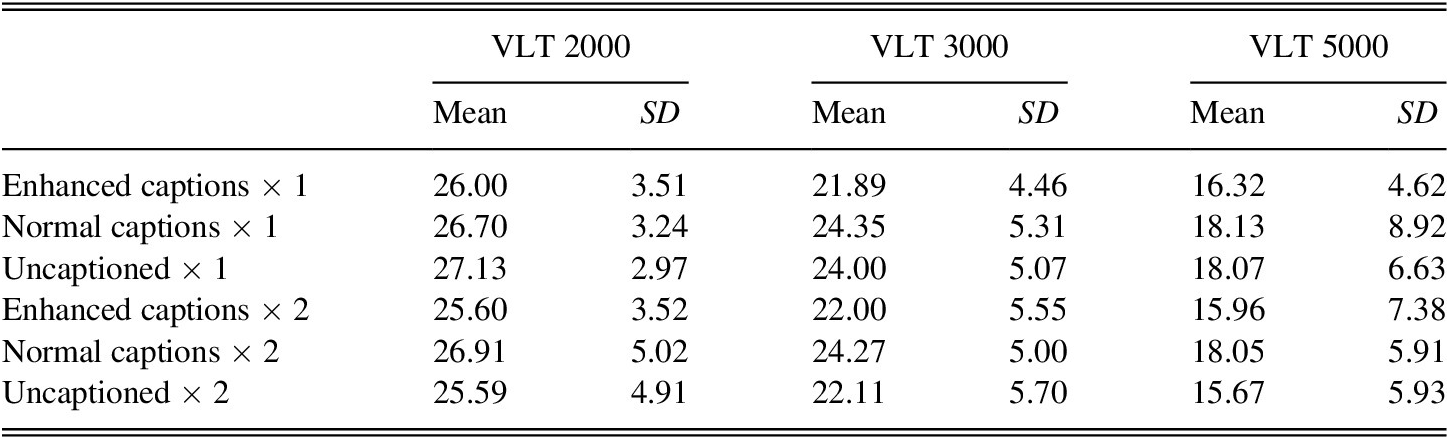
The participants were also given the Vocabulary Levels Test (Schmitt et al., Reference Schmitt, Schmitt and Clapham2001). As shown in Table 2, all six conditions had mean scores that indicate a mastery of the 2,000-word level.
The mean VLT score for each condition

Abbreviation: VLT: vocabulary size test.
MATERIALS
Audiovisual Input
When considering the input materials for this research, a few factors had to be considered. Firstly, the video had to be appealing enough for motivational purposes. As repeated viewing is one of the variables in question, it was important that the video could sustain the learners’ interest enough for them to watch the video from start to finish and for a second viewing. Another factor that influenced the choice of input material was the number of MWEs contained in the videos with which the participants were unlikely to be familiar. At the same time, the video had to be easy to follow in terms of other language dimensions, such as lexical coverage and speed of dialogue.
With these considerations in mind, an episode of an American comedy series titled Fresh off the Boat was chosen. American sitcom was chosen as the participants are more accustomed to the American accent than the British accent. Further, Lin’s (Reference Lin2014) study of internet television found that the comedy genre contains a high number of everyday spoken formulaic sequences. In addition, caption studies that used comedy series (e.g., Peters et al., Reference Peters, Heynen and Puimège2016; Sydorenko, Reference Sydorenko2010) have reported encouraging findings for single-word learning. The chosen episode (Episode 2, Season 1) is 20-minutes long. An analysis of the lexical profile of the video using RANGE (Nation & Heatley, Reference Nation and Heatley2002) showed that, together with proper nouns and marginal words, the most frequent 1,000-, 2,000-, and 3,000-word families provided 91.16%, 94.87%, and 96.37% coverage (including proper nouns and marginal words) of the script’s total running words, respectively. To understand L2 TV, Webb and Rodgers (Reference Webb and Rodgers2009b) proposed that learners are likely to need a vocabulary size of 2,000- to 4,000-word families (plus proper nouns and marginal words). Moreover, a recent study on the relationship between vocabulary and viewing comprehension by Durbahn et al. (Reference Durbahn, Rodgers and Peters2020) suggests that lexical coverage of around 90% is enough for adequate viewing comprehension. Thus, the participants’ VLT scores (see preceding text), suggest that they were able to follow the video. This video was piloted with a group of participants (n = 12) similar to those in the present study, to ascertain that the video was easy enough for the learners to follow, and interesting enough to watch a second time.
Target Items
Exposing learners to authentic material entails that they will encounter MWEs of diverse kinds. Previous studies on MWE learning focused on certain parts of speech, such as adjective + noun collocations or verb + noun collocations, but this necessitated modifying texts to include sufficient numbers of these particular MWE types. If the aim is to explore ways of improving the chances of acquisition from authentic audiovisual materials, then it seems more ecologically valid to keep those materials intact. Moreover, there are indications that the risk of interitem interference is increased when learners are presented with sets of MWEs that are syntactically similar (Boers et al., Reference Boers, Demecheleer, Coxhead and Webb2014). In any case, the phraseology of a language naturally comprises diverse kinds of MWEs and there seems to be little justification for prioritizing certain syntactic categories over others. It is, nonetheless, acknowledged that not all MWEs are “equal” in the way that they are processed (e.g., Columbus, Reference Columbus and Wood2010), or in the challenges they pose to L2 learners (e.g., Boers, Reference Boers and Webb2020). However, in the present study this interitem variability applied across all six conditions due to the between-participant design of the experiment where all groups were exposed to the same text.
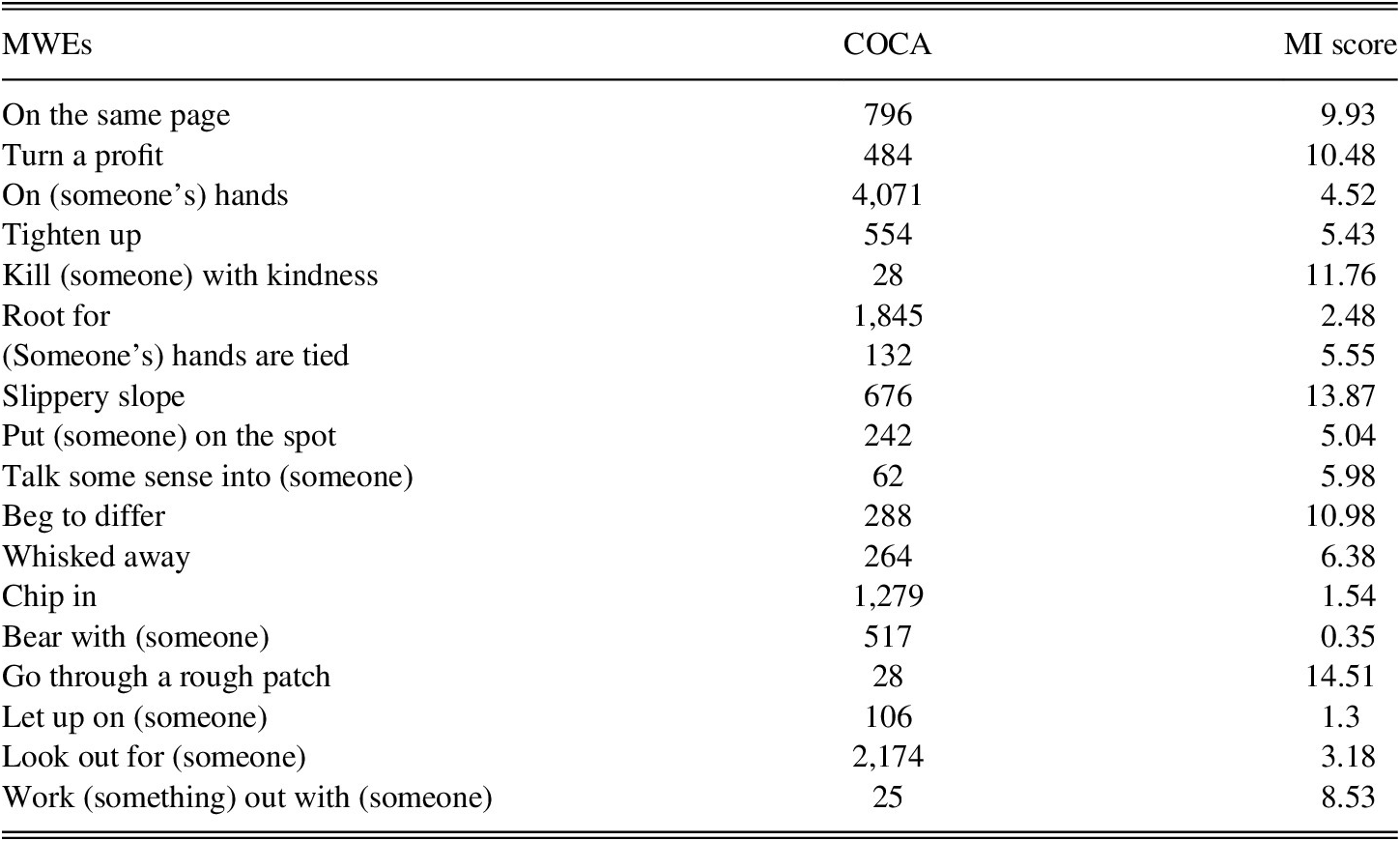
The video was first screened for MWEs likely to be as yet unfamiliar to the students in this study. To ascertain that these expressions were relatively well established in (American) English, the Corpus of Contemporary American English (COCA; Davies, Reference Davies2008) was consulted. All the potential target MWEs2 yielded at least 100 hits in this corpus and/or were found to have a mutual information (MI) score (i.e., a measure of collocational strength) of at least 3.0.
After compiling a list of potential target MWEs from the video, four teachers of the learners in question were consulted on whether they believed the learners had knowledge of these items. Guided by this information, 20 MWEs were chosen as target items to be included in the tests. Each MWE only occurred once in the video. Two items attracted more than 30% correct responses at the pretest stage. This could be because these items were highly guessable, owing to the first-letter cues. As such, these items were not included as the target items. Table 3 lists the 18 final target items and their frequencies and MI scores in COCA (at the time the study was designed).
Target items with corpus frequency and MI score

Abbreviations: MI: mutual information; MWE: multiword expression; COCA: Corpus of Contemporary American English.
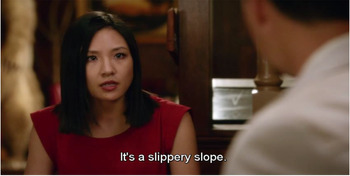
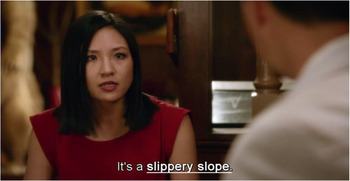
For the normal captions condition, all the target items appeared without any enhancements (Figure 1). In the enhanced captions condition, the target items appeared bolded and underlined (Figure 2).
An example of a still from the video (Fresh off the Boat) with normal captions.

An example of a still from the video (Fresh off the Boat) with enhanced captions.

Test Instruments
Of principal interest was knowledge of the lexical composition of the MWEs, that is, their “form.” The reason for this is that typographic enhancement can render language forms more salient, but it does not as such clarify the meanings of said forms. Recall of MWEs was measured using a pretest, an immediate posttest, and a delayed posttest. A gap-fill and C-test blend format was adopted to design the pretest. The test was constructed by first taking sentences containing the MWEs from dictionaries and COCA. Contextual clues ensured that the test taker would recognize what MWE was missing (if known by the test taker). The same format was also used for the delayed form-recall test, with the order of the items randomized. The following is an example of the test item for “on the same page”:
Parents should be on the s_____ p_____ about raising their children. Parents should have a similar understanding about what to expect from their children.
The conventions of C-test were initially used to guide the cutoff point. However, presenting the learners with the first half of the word could lead to successful guessing. It was then decided that only the first letter would be given, except for those words that started with consonant clusters (in which case the cluster was given, e.g., sl_____ sl_____ to elicit “slippery slope”). The instrument was piloted with three speakers of L1 American English and three L2 speakers who were postgraduate students in applied linguistics, all of whom completed the instrument 100% correctly.
Recall was also tested using an immediate posttest, but the format was different from that of the pretest and the delayed posttest. In the immediate posttest, learners were given a gap-fill transcript-based test. This format was intended to test episodic memory, that is, the participants’ recall of the MWEs in direct association with the context where the MWEs were encountered. Furthermore, congruency of learning opportunity and test condition leads to better test performance (Lotto & de Groot, Reference Lotto and de Groot1998; Schmitt, Reference Schmitt2010). The transcript was condensed to include just the main scenes, to prevent students from being demotivated by a 20-page transcript (see Supplementary Material for samples of the tests).
Apart from the MWE tests, comprehension questions in multiple-choice and true/false formats were created to ascertain that the video had been processed for content, as intended. The 22 questions tapped into skills that constitute the latent ability to perform bottom-up processing such as the ability to identify gist and supporting ideas, as well as skills such as making inferences about context and relationships, which demonstrate the ability to perform top-down processing (e.g., Buck & Tatsuoka, Reference Buck and Tatsuoka1998; Hildyard & Olson, Reference Hildyard and Olson1978). None of the target MWEs were used in the comprehension test.
Three additional delayed posttests, that is, a delayed form-recognition posttest, a delayed meaning-recall posttest, and a delayed meaning-recognition posttest were also administered. However, owing to lack of space, the results of these three supplementary posttests will not be discussed here. As they concern aspects of MWE knowledge that were not pretested, any conclusions drawn from them would need to remain very tentative at best, in any case.
PROCEDURE
The data were collected in four sessions. In the first session, the participants were briefed on the research (without disclosing its specific purpose) before they signed the consent form. In the second session, the participants took the form-recall pretest. This was immediately followed by the VLT. Two weeks later, they watched the video under their respective conditions. Prior to watching the video, the participants were informed that they would be asked some comprehension questions. The comprehension test was administered immediately after the students had finished watching the video (once or twice). Then followed the immediate MWE recall test. Two weeks later, the delayed recall posttest was administered.
SCORING AND ANALYSIS
The responses in the MWE recall tests were scored by two raters. A lenient scoring system was adopted (e.g., see Webb and Kagimoto, Reference Webb and Kagimoto2009, Reference Webb and Kagimoto2011), in which minor mistakes were marked as correct and received a full score (e.g., a word used in singular that should have been plural, or vice versa; wrongly spelled words; wrong part of speech). While the scoring procedure was relatively straightforward for a target item in which only one content word needed to be completed, it was not the case for target items in which two or three content words of the MWEs needed to be supplied. For these items, partial credit (i.e., 0.5) was awarded for two-gap responses in which one of the words supplied by the learner contained a minor mistake, while the other contained a major mistake. A major mistake is defined as spelling mistakes that constitute a new word, affect the pronounceability of the word or generate a form that does not resemble the target item.
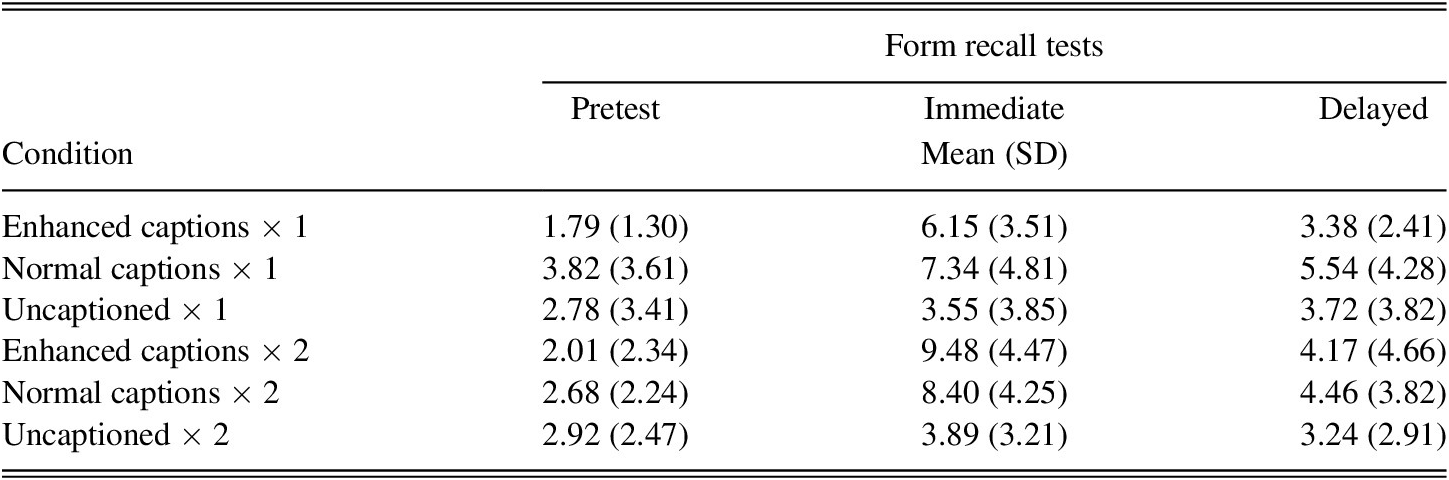
For an item that required participants to fill in three gaps, a two-over-three rule was imposed. This means that partial credit was given for responses in which two out of three gaps were correct or contained a minor mistake. Put differently, partial scores were only awarded for majorly inaccurate responses with two and three gaps (see Supplementary Materials for more details on the scoring procedure along with examples). The items with two and three gaps constituted 10 out of the 18 items. Because the interrater reliability was high (.97, .95, and .97 for the pretest, immediate posttest, and delayed posttest, respectively), the average score between the two raters was used. Each rater independently awarded 0 or .5 or 1 to a response. As the average score between two raters was taken, this resulted in five possible scores: 0, 0.25, 0.5, 0.75, or 1. Table 4 shows the descriptive statistics for all the MWE tests. As the pretest data were nonnormally distributed with unequal variance, the data were first transformed using Tukey Ladder of Powers before running a one-way nonparametric ANOVA (Kruskal–Wallis test). The Kruskal–Wallis test revealed no significant differences between groups in their scores in the pretest (Kruskal–Wallis χ2 (5) = 4.58, p = .47).
Descriptive statistics for the form recall tests

Note: The maximum score on all tests was 18.
Because the pretest and the immediate posttest were not exactly the same format, the analysis focused on the two posttests, with performance on the pretest at the item level included as one of the fixed effects in the statistical modeling. Two clmm analyses for the immediate and delayed data respectively were carried out in R (R Core Team, 2018). The clmm function in the ordinal package (Christensen, Reference Christensen2019) was used. Apart from pretest performance, the fixed effects in all analyses included caption condition, number of viewings, and VST score. VST score was included as a fixed effect because the literature has shown that learners with a larger vocabulary tend to understand reading and listening texts better than learners with a smaller vocabulary, and this gives them an advantage when it comes to acquiring new lexical items from those texts (Elgort & Warren, Reference Elgort and Warren2014; Noreillie et al., Reference Noreillie, Kestemont, Heylen, Desmet and Peters2018; Schmitt et al., Reference Schmitt, Jiang and Grabe2011; Stæhr, Reference Stæhr2009). What is not certain is whether this comparative advantage might be mitigated by input conditions such as the availability of captions. VST score was centered prior to analysis. There was no issue of multicollinearity between pretest score and VST score. The five possible pretest scores at the item level (i.e., 0, 0.25, 0.5, 0.75, and 1) were multiplied by 4 (i.e., producing 0, 1, 2, 3, and 4) before being fitted into the models. An increase in one unit of pretest score would then relate to going up one score. The model comparison procedure started with the most complex model that included all the fixed effects, as well as the two-way interactions and three-way interactions between the factors. Each term was then incrementally removed. The significance level of fixed-effect predictors for all the models was assessed through model comparison using likelihood ratio tests (i.e., comparing a full model and a reduced model). The comparison returned likelihood ratio statistics with a chi-square distribution. This is reported in the form of likelihood ratio test (LRT), i.e., (LRT χ2 (n1) = n2, p < n3), where n1 = degrees of freedom, n2 = likelihood ratio statistic and n3 = p-value. To correct for multiple testing, Bonferroni adjustment of the alpha level was applied. This means that the adjusted level of significance is p < .025 rather than p < .05. To locate the differences between the treatment groups (e.g., between the three caption conditions), multiple comparison was carried out using the emmeans function in the emmeans package (Lenth, Reference Lenth2018).
As for the comprehension test about the content of the video, because the outcome variable was binomial, the data were analyzed by means of a generalized linear mixed model with the glmer function of the lme4 package (Bates et al., Reference Bates, Maechler, Bolker and Walker2015). The fixed effects included caption condition, number of viewings, and VST score. Model comparisons were carried out in the same way as the clmm analyses.
ANALYSIS AND RESULTS
IMMEDIATE MWE POSTTEST
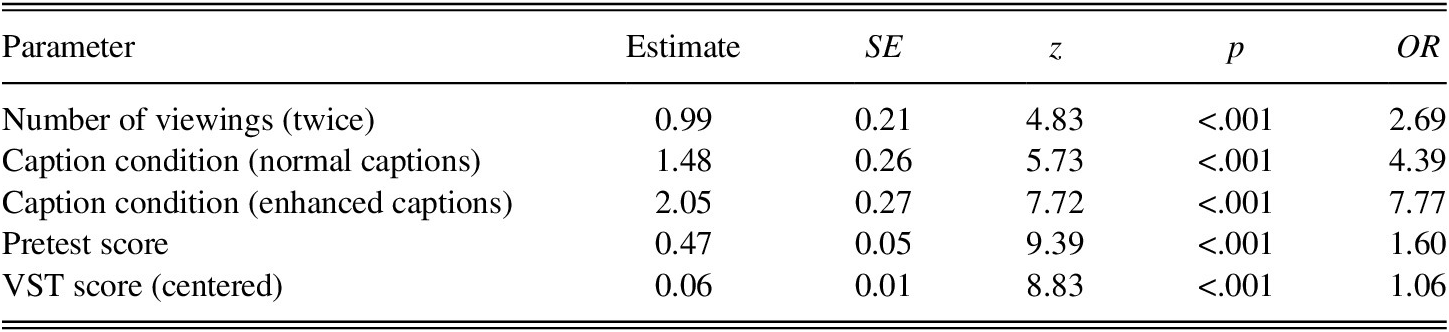
The results of the clmm analysis revealed that number of viewings (χ2 (1) = 21.9, p < .001), caption condition, (χ2 (2) = 52.5, p < .001), VST score (χ2 (1) = 66.7, p < .001), and pretest score (χ2 (1) = 92.9, p < .001) significantly predicted participants’ score on the immediate posttest. No significant interactions between the factors were found. Table 5 shows the output of the best-fit model, including the odds ratios. The odds are defined as the probability of an event occurring divided by the probability of it not occurring (Field et al., Reference Field, Miles and Field2012). As shown in the table, the odds of obtaining a score that is one level higher (e.g., 0 to .25) in the immediate posttest for participants who watched the video twice were 2.69 times the odds of those who viewed the video once. As for the effect of caption condition, multiple comparisons using the emmeans function in the emmeans package (Lenth, Reference Lenth2018) with Bonferroni adjustment applied (i.e., p < .025) revealed that the enhanced captions conditions were more likely to get a score that is one level higher compared to the uncaptioned conditions (p < .0001). Additionally, the normal captions conditions were more likely to get a score that is one level higher in the immediate posttest compared to the uncaptioned conditions (p < .0001). The difference between the enhanced and normal captions, however, failed to reach significance (p = .04) As to the effect of VST score, the odds of obtaining a score that is one level higher became greater as participants’ VST score increased. Further, a one unit-increase in the pretest score (e.g., 0.25 to 0.5) also increased the odds of obtaining a score that is one level higher in the immediate posttest.
Output of best-fit model predicting a higher score in the immediate posttest

Notes: *Intercept levels: caption condition = uncaptioned; number of viewings = once.
Abbreviations: OR: odds ratio; VST: vocabulary size test.
DELAYED MWE POSTTEST
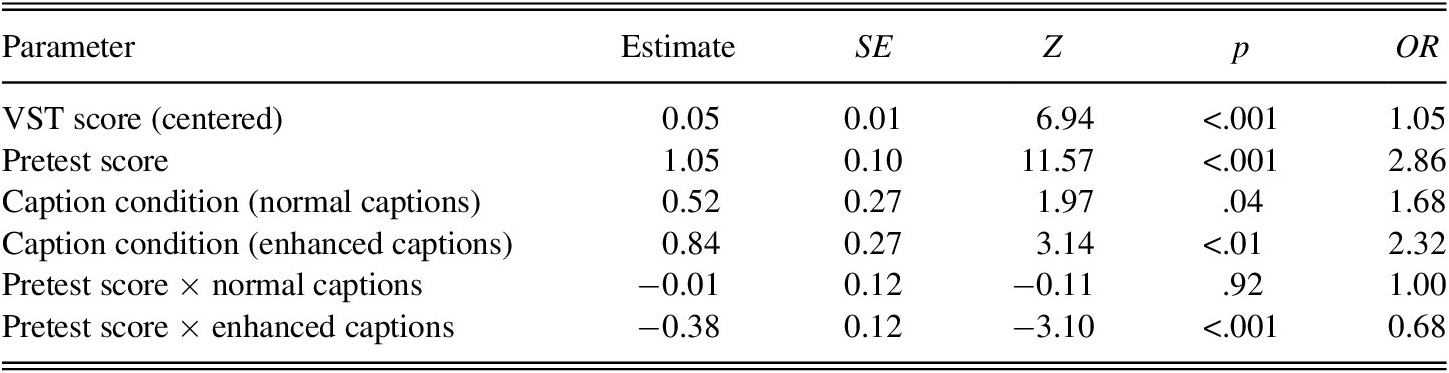
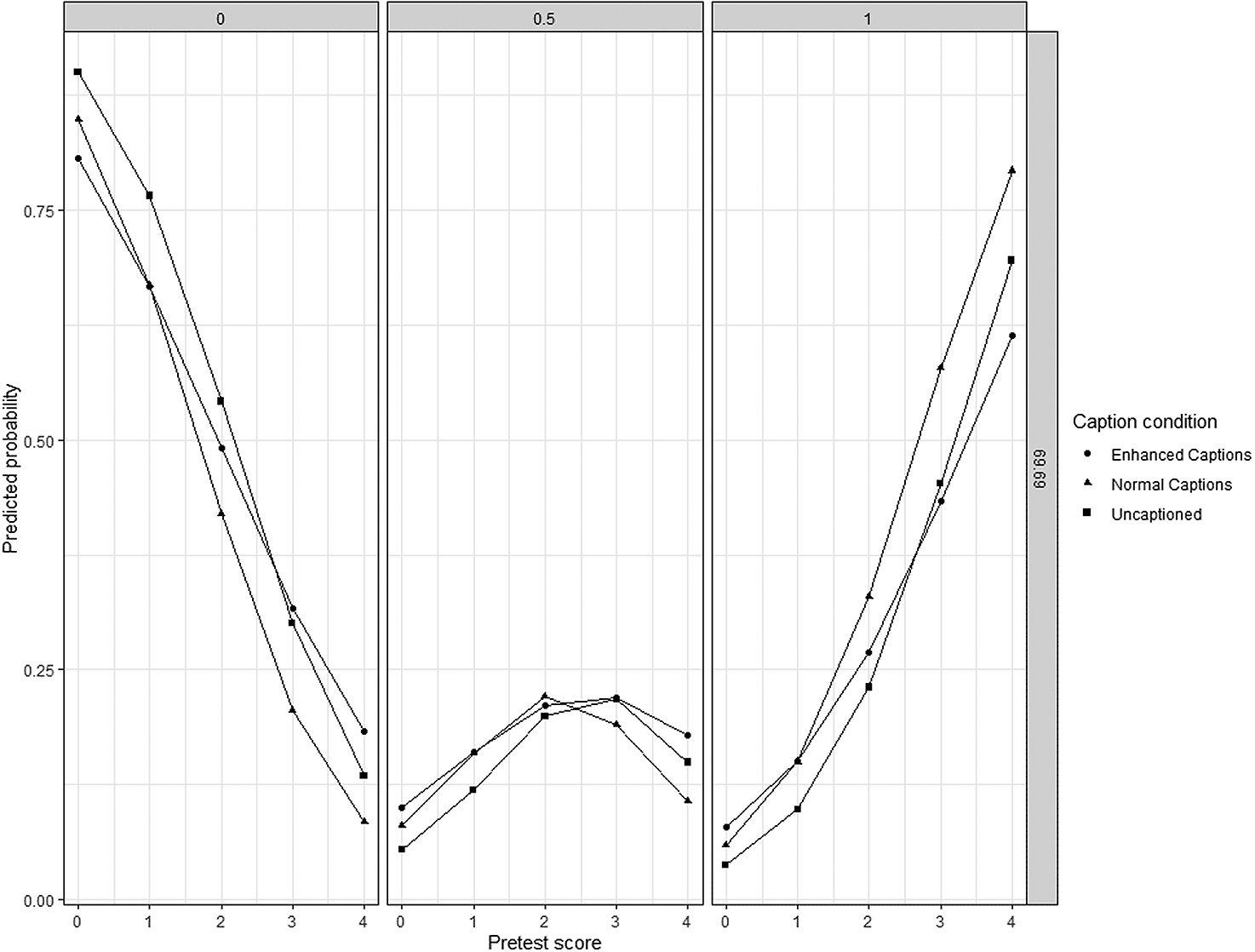
The analysis revealed that VST score significantly predicted participants’ score on the delayed posttest (χ2 (1) = 43.3, p < .001). As shown in Table 6, the odds of obtaining a better score became higher as participants’ VST score increased. The pretest score (χ2 (1) = 47.2, p < .001) and caption condition (χ2 (2) = 13.0, p < .01) were also found to be significant. A significant interaction between pretest score and caption condition was also found (χ2 (2) = 13.04, p < .01). To illustrate this interaction, the predicted probabilities of receiving the five possible delayed posttest scores on an item for all three caption conditions and all pretest scores were generated. The plot in Figure 3 shows the predicted probabilities for participants with the mean VST score (i.e., 69.69 out of 140). As there were far fewer occurrences of participants receiving a delayed posttest score of 0.25 and 0.75 than the other three scores, they were omitted from the plot. As can be seen from the plot, for participants with a pretest score of 0, the probability of receiving the same score in the delayed posttest was the lowest for the enhanced captions condition, followed by the normal captions and the uncaptioned conditions. Turning to the likelihood of receiving a full score in the delayed posttest, for participants who received 0 in the pretest, the enhanced captions had the highest likelihood of receiving a full score in the delayed posttest, followed by the normal captions and the uncaptioned condition. However, as the pretest scores became higher (e.g., 0.75 and 1), the predicted probability of getting a full score was higher for the normal captions and uncaptioned conditions, compared to the enhanced captions condition. This suggests that the effects of typographic enhancement could be stronger for participants with little or no knowledge of the target items. Put differently, participants with relatively good knowledge of the target items may not have needed typographic enhancement to pick up unknown MWEs.
Output of best-fit model predicting a higher score in the delayed posttest

Notes: Intercept levels: caption condition = uncaptioned; number of viewings = once.
Abbreviations: OR: odds ratio; VLT: vocabulary size test.
Predicted probability of receiving a 0, 0.5, and 1 in the delayed posttest.

CONTENT COMPREHENSION TEST
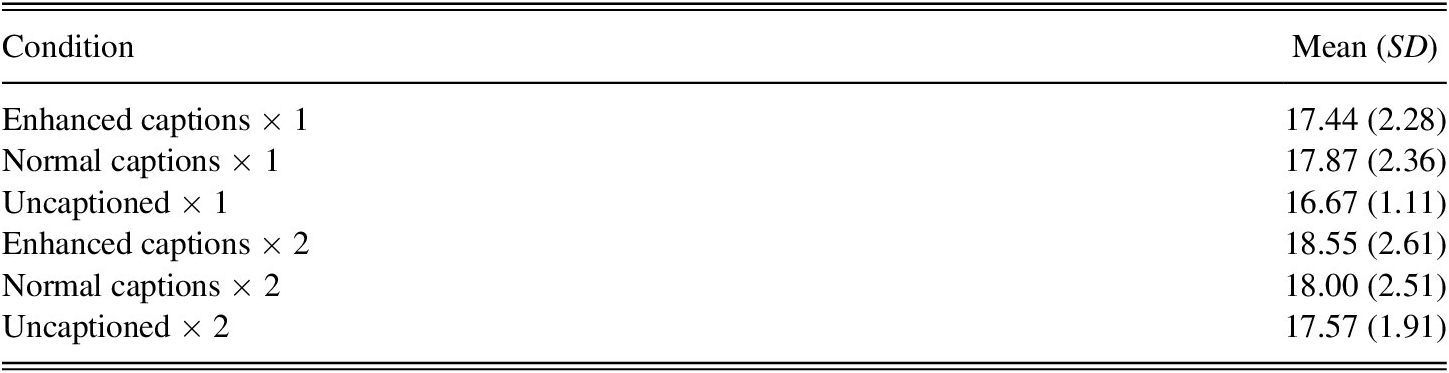
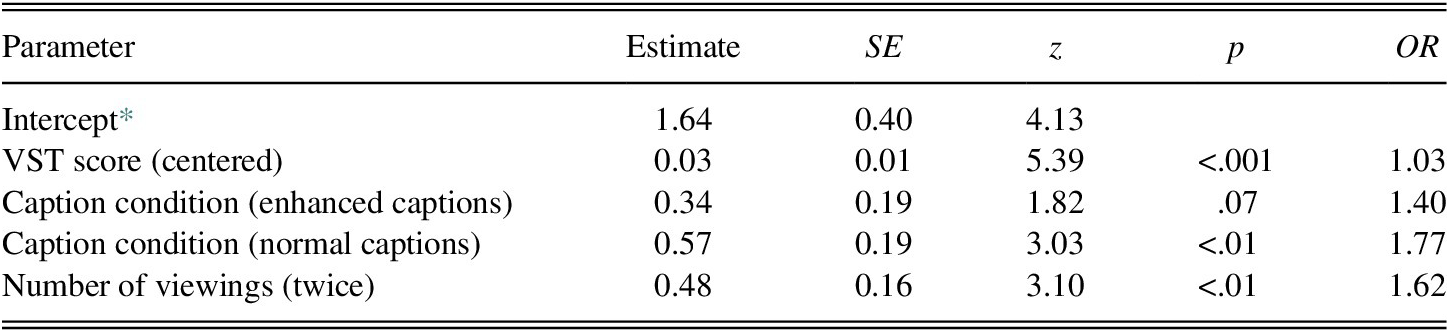
Table 7 shows the descriptive statistics for the comprehension test. The results of the glmer analysis showed that the number of viewings had a significant influence (χ2 (1) = 8.87, p < .01). That is, the odds of obtaining a correct answer on the content comprehension test were higher for those who viewed the video twice compared to those who viewed it once. Further, VST score was also a significant predictor (χ2 (1) = 25.9, p < .001), suggesting that a higher VST score led to a higher likelihood of getting an item correct. There was also a significant main effect of caption condition (χ2 (2) = 8.64, p = .01). Participants in the normal captions condition were significantly more likely to get an item correct compared to their peers in the uncaptioned condition, as the odds of a correct response in the former were 1.77 the odds in the latter (Table 8). The difference between the enhanced and normal captions conditions did not reach significance (z = 1.25, p < .20). No interactions were found significant.
Descriptive statistics for the comprehension test

Note: The maximum possible score was 22.
Output of best-fit model predicting a correct response in the comprehension test

* Intercept levels: caption condition = uncaptioned; number of viewings = once.
Abbreviations: OR: odds ratio; VST: vocabulary size test.
DISCUSSION
The first research question sought to find out whether there was an effect of caption condition on incidental MWE learning. The immediate and delayed posttest results suggest that caption condition did affect MWE recall. In the immediate posttest, both captioned conditions led to a higher likelihood of receiving a higher score compared to the uncaptioned condition. This corroborates previous viewing studies that found evidence in favor of captioned viewing over uncaptioned viewing for vocabulary learning (see Montero Perez et al., Reference Montero Perez, Van Den Noortgate and Desmet2013, for a meta-analysis). Unexpectedly, the presence of typographic enhancement did not lead to significantly better recall compared to viewing with normal captions. This finding is in contrast with previous reading studies that have demonstrated that, compared to unenhanced texts, typographically enhanced items attract more attention, and in turn promote recall (e.g., Choi, Reference Choi2018; Sonbul & Schmitt, Reference Sonbul and Schmitt2013; Szudarski & Carter, Reference Szudarski and Carter2016; Toomer & Elgort, Reference Toomer and Elgort2019). There are a few plausible explanations for this finding. The first relates to the obvious difference in input modality. Compared to written input, audiovisual input offers more to look at, such as moving images, besides the words alone. Further, compared to written input, the real-time nature of viewing entails that learners have less time to fixate anything, including typographically enhanced items. Thirdly, while previous reading studies on typographic enhancement only included collocations as the target items, the present study included MWEs that consist of up to five words. In other words, the presence of typographic enhancement may not be enough to create a significant difference in form recall when learners are presented with relatively long MWEs that appear fleetingly. Additionally, the MWEs in this study were only encountered either once or twice. In comparison, in most reading studies on typographic enhancement each target appeared between 3 (e.g., Sonbul & Schmitt, Reference Sonbul and Schmitt2013) and 12 times (e.g., Szudarski & Carter, Reference Szudarski and Carter2016). In sum, the findings of the present study suggest that where incidental learning is concerned, the use of typographic enhancement leads to better MWE uptake compared to uncaptioned viewing, but it makes little difference when compared to viewing with normal captions. While caption condition also influences participants’ scores on the delayed posttest, the effects of caption condition depended on the pretest scores. To illustrate, the presence of typographic enhancement had a positive impact for participants with low pretest scores, but for participants with higher pretest scores, typographic enhancement did not lead to a greater likelihood of receiving a better score compared to the uncaptioned condition. This suggests that the effects of typographic enhancement may not be as strong for delayed MWE recall compared to immediate recall.
The second research question, which concerned the effects of caption condition on video comprehension, can be answered positively as caption condition predicted video comprehension. Specifically, learners who watched the video with normal captions performed significantly better in the comprehension test compared to those who viewed the uncaptioned video. This is consistent with the findings of previous viewing studies such as Gass et al. (Reference Gass, Winke, Isbell and Ahn2019), Montero Perez et al. (Reference Montero Perez, Van Den Noortgate and Desmet2013), and Winke et al. (Reference Winke, Gass and Sydorenko2013). It is then rather surprising that captioned viewing with typographically enhanced items did not lead to significantly better scores on the comprehension test compared to the uncaptioned condition. Put differently, while captions without enhancements resulted in the learners taking in the video content better than those who watched the uncaptioned video, the presence of typographic enhancements appears to have reduced this advantage of captioned over uncaptioned viewing. This suggests a possible trade-off between a positive effect of typographically enhanced captions on the learning of MWEs and a negative effect on comprehension, which is reminiscent of Choi’s (Reference Choi2018) findings.
The third and fourth research questions concern the effects of repeated viewing on MWE learning and content comprehension, respectively. Repetition was found to positively affect MWE recall, at least according to the immediate recall tests. Additionally, as no interaction was found between number of viewings and caption condition, this suggests that repeated viewing is beneficial for all three caption conditions. These findings corroborate previous reading studies (Durrant & Schmitt, Reference Durrant and Schmitt2010) and reading-while-listening studies (Webb et al., Reference Webb, Newton and Chang2013) that furnished positive evidence for the role of repetition for incidental learning of MWEs. These studies, however, only employed immediate posttests, and so they reveal little about the durability of the reported gains. In the present study, repeated viewing did not emerge as a strong predictor of delayed form recall. It is worth reiterating that the immediate recall test presented the participants with excerpts from the video transcript while the delayed test used new, decontextualized, sentence prompts. Recognizing a given segment from a video (and recalling a missing MWE associated with it from episodic memory) is probably easier after repeated viewing of the video. Transferring this knowledge to a different-format test after a considerable delay is less straightforward, however, and this may then compromise the benefits of repeated viewing. It might be interesting to explore whether additional opportunities for reviewing the same video could reveal stronger long-term effects for repetition. As to comprehension, repetition also emerged as a significant predictor. That is, viewing twice led to significantly higher odds of getting an item correct in the comprehension test. This is in line with previous studies that have demonstrated that listening twice significantly enhanced content comprehension compared to listening once (Lund, Reference Lund1991; Sakai, Reference Sakai2009). Additionally, compared to other techniques that have been proposed to boost listening comprehension, such as previewing of comprehension questions and activation of background knowledge, repeated viewing has been shown to enhance understanding more (Chang & Read, Reference Chang and Read2006). Further, the present study lends support to Nguyễn (Reference Nguyễn2017), in which repeated viewing of TED talks led to better comprehension as compared to viewing once.
Though not part of the research question, vocabulary knowledge emerged as a significant predictor in both the MWE recall and content comprehension analyses. For instance, the higher the participants’ VST score, the higher the likelihood of receiving a better score in the immediate and delayed posttests. This corroborates the results of recent studies that have demonstrated that learners with good vocabulary knowledge stand a better chance of learning new lexical items from audiovisual input compared to their less proficient counterparts (e.g., Montero Perez, Reference Montero Perez2020; Pujadas & Muñoz, Reference Pujadas and Muñoz2019). Similarly, the odds of learners getting an item correct in the comprehension test increased as their VST score became higher. Our finding thus supports the “Matthew effect,” a phenomenon where weaker students learn less while stronger students learn more (e.g., Stanovich, Reference Stanovich1986). The Matthew effect has been observed in the context of vocabulary learning through reading (e.g., Elgort et al., Reference Elgort, Perfetti, Rickles and Stafura2015; Horst et al., Reference Horst, Cobb and Meara1998), as well as L2 viewing (e.g., Feng & Webb, Reference Feng and Webb2020; Montero Perez et al., Reference Montero Perez, Peters, Clarebout and Desmet2014; Peters et al., Reference Peters, Heynen and Puimège2016; Peters & Webb, Reference Peters and Webb2018; Puimège & Peters, Reference Puimège and Peters2019). Additionally, prior knowledge of target items also led to a higher likelihood of receiving a higher score in the immediate posttest. This is in line with previous viewing studies that also found a positive relationship between prior knowledge and incidental vocabulary (single words and MWEs) learning through L2 viewing (Montero Perez et al., Reference Montero Perez, Peters, Clarebout and Desmet2014; Peters et al., Reference Peters, Heynen and Puimège2016; Peters & Webb, Reference Peters and Webb2018; Puimège & Peters, Reference Puimège and Peters2019).
LIMITATIONS
Several limitations need to be acknowledged. The first concerns the number of participants within each condition. Originally, 133 participants were recruited, but some had to be excluded from the analyses due to the unavailability of their VST score. As a result, one of the conditions had 15 participants, which may be considered low. It should be noted, however, that the number of participants in each condition in the present investigation is similar to other studies that investigated vocabulary learning through L2 viewing (e.g., Feng & Webb, Reference Feng and Webb2020). The second limitation concerns the number of target MWEs (n = 18). The authentic nature of the video did not allow us to test as many MWEs as we would have liked. Repetition was then operationalized as repeated viewing. Using more extensive video input (as used in Rodgers, Reference Rodgers2013) can increase the number of target items and the likelihood of their reoccurrence in a single viewing. However, that would mean that participants in the repetition conditions would need to sit through a very long treatment (possibly several hours). To reduce the risk of fatigue, we had to settle for a shorter video, which naturally entails fewer potential targets. Still, the number of items used in the present investigation is similar to that used in earlier studies (e.g., Webb et al., Reference Webb, Newton and Chang2013). We could have increased the number of encounters with the target MWEs by playing the same video multiple times, but this would have compromised the ecological validity of the learning experience. For one thing, teachers are unlikely to spend such a substantial amount of time on L2 viewing. For another, learners are likely to lose interest if they are required to watch a video three or more times.
Another aspect of the research design that could be considered a limitation pertains to the unidentical format of the MWE recall tests. As mentioned earlier, the format of the immediate posttest probably tested the learners’ episodic recall of the MWEs, whereas in the pretest and delayed posttest, the learners had to insert the MWEs in a context not entirely the same as the video. Future studies could make use of the methodology in Peters and Webb (Reference Peters and Webb2018), in which different tests were carried out with different groups of learners. This may give us a more fine-grained picture of the extent to which MWE learning is promoted. Finally, including a control group or control items would further clarify the effects of the treatment, as including these would help to further determine how much learning resulted from the treatment as such.
CONCLUSION AND FUTURE DIRECTIONS
Our study aimed to investigate whether caption condition and repetition had an effect on incidental MWE uptake through L2 viewing. Of further interest was whether comprehension would also be enhanced with the use of captions and repetition. Given previous research findings suggesting that typographic enhancement of language items or features may distract from text content, we considered it possible that learners watching a video with enhanced captions might not take in the content of the video as well as learners watching the video with normal captions. MWE recall was tested at three different time points: 2 weeks before, immediately after, and 2 weeks after watching the video. A comprehension test was administered immediately after viewing. Our findings provide affirmative evidence that L2 viewing promotes the incidental uptake of MWEs (at least at the level of form recall). Specifically, both normal and enhanced captions led to better short-term form recall knowledge compared to uncaptioned viewing. However, enhanced captions did not hold an advantage over normal captions. The presence of captions also benefitted comprehension. Interestingly, applying typographic enhancement to captions did not lead to better comprehension. In fact, our findings suggest that the addition of typographic enhancement may cause captioned viewing to lose an advantage over uncaptioned viewing. Our findings also revealed that repetition had a positive influence, with viewing twice leading to better scores in the immediate form recall test, as well as better content comprehension, compared to viewing once. Finally, another factor that influenced both MWE recall and content comprehension was learners’ vocabulary knowledge. The Matthew effect was observed, and learners with a bigger vocabulary size obtained bigger gains in MWE knowledge and better odds of getting comprehension questions correct.
This study is a step toward gaining better understanding of the potential use of audiovisual resources as a way of enhancing MWE knowledge. More research is needed to establish the effects of caption conditions and number of viewings in other language learning contexts. Finally, the effects of these variables might be different when learners are aware of the impending tests. As posited by Webb and Nation (Reference Webb and Nation2017), “in principle, fewer repetitions are needed in deliberate learning than in incidental learning” (p. 65). Therefore, when learners are aware of forthcoming tests, it is plausible that a second viewing may not be needed. Similarly, whether the use of typographically enhanced captions makes a difference when L2 learners expect a test warrants further investigation. In sum, future studies could explore the role of repetition and captioning in the learning of MWEs under intentional learning conditions.
Supplementary Materials
To view supplementary material for this article, please visit http://dx.doi.org/10.1017/S0272263121000036.