Antibiotic-resistant infections are a public health crisis. 1 Patients with infections caused by resistant bacteria have worse clinical outcomes and utilize more healthcare resources than patients affected with a susceptible organism. 1 , Reference Belongia, Knobloch, Kieke, Davis, Janette and Besser 2 The main driver of antibiotic resistance is overuse of antibiotics, and efforts to optimize antibiotic use are essential.
Recent data suggest that 30%–50% of antibiotic use in hospitals is unnecessary or inappropriate. 3 Optimizing inpatient antibiotic prescribing practices is a major focus for curtailing the spread of antibiotic resistance. The Center for Disease Control and Prevention has called for increased emphasis on inpatient antibiotic use through its “Get Smart for Healthcare” program (www.cdc.gov/getsmart/healthcare). The Society for Healthcare Epidemiology of America (SHEA), the Infectious Diseases Society of America (IDSA), and the Pediatric Infectious Diseases Society (PIDS) developed a joint policy statement calling for more research and widespread implementation of antimicrobial stewardship programs (ASPs) in 2012. 4 , 5 In March 2015, the President of the United States released The National Action Plan for Combating Antibiotic-Resistant Bacteria, a 5-year plan to coordinate and strengthen prevention efforts and response to antibiotic resistant infections, and increase federal funding directed toward combating antibiotic resistance. 6
Antimicrobial stewardship programs are multilevel and multidisciplinary interventions to optimize antibiotic use to ensure that hospitalized patients receive the right antibiotic, at the right dose, at the right time and for the right duration. Several important benefits have been demonstrated following the implementation of ASPs, including reduced burden of resistance within the facility, shorter hospital stays, improved individual patient outcomes, and cost savings via reduced mortality and adverse outcome rates. 3 However, there has been little research to determine how patients may be able to contribute to antimicrobial stewardship efforts in the hospital setting.Reference Prey, Woollen and Wilcox 7
Patient engagement in other aspects of health care has shown benefits such as greater patient satisfaction, increased adherence, increased participation in decision making, engagement in health-improving behaviors, and improved health outcomes.Reference Prey, Woollen and Wilcox 7 Shared decision-making interventions focused on medication selection have been shown to be similarly effective in areas such as the selection of analgesics, anti-rheumatic, and antipsychotic drugs.Reference Isaacs, Kistler and Hunold 8 – Reference Mistler and Drake 10
We conducted a qualitative study to identify key themes associated with patient perceptions about antibiotic use and the patient’s role in antimicrobial stewardship.
METHODS
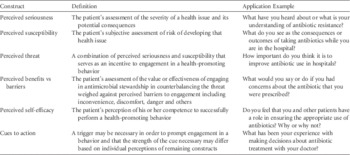
In this study, we used the Health Belief Model to provide a theoretical framework to explain how patient perceptions affect perceived role and likelihood of patient involvement in antimicrobial stewardship. The constructs of the Health Belief Model are defined for the purposes of this study in Table 1.Reference Bishop, Baker, Boyle and MacKinnon 11 , Reference Carpenter 12
-
1. Perceived seriousness: the patient’s assessment of the severity of a health issue and its potential consequences.
-
2. Perceived susceptibility: the patient’s subjective assessment of risk of developing that health issue.
-
3. Perceived threat: a combination of perceived seriousness and susceptibility that serves as an incentive to engagement in a health-promoting behavior.
-
4. Perceived benefits versus barriers: the patient’s assessment of the value or effectiveness of engaging in antimicrobial stewardship in counterbalancing the threat weighed against perceived barriers to engagement including inconvenience, discomfort, and danger to oneself and others.
-
5. Perceived self-efficacy: the patient’s perception of his or her competence to successfully perform a health-promoting behavior.
-
6. Cue to action: the Health Belief Model proposes that a trigger may be necessary to prompt engagement in a behavior and that the strength of the cue necessary may differ based on individual perceptions of remaining constructs.
Health Belief Model Constructs and Application

The Health Belief Model has been previously validated for use in describing preventive health and sick role behaviors as well as engagement in other health services initiatives such as patient safety.Reference Carpenter 12 , Reference Pope, Dellit, Owens and Hooton 13 In this study, the use of the Health Belief Model to assess patient perceptions while in the hospital represents a theoretically grounded approach to describing the potential role for patients as engaged and active participants in ASPs.
A qualitative, semi-structured, interview-based study was performed involving 30 inpatients taking antimicrobials at the University of Wisconsin (UW) Hospital, a 592-bed academic medical center in Madison, Wisconsin.
Study participants were identified from electronic medical records from general medicine units using purposive sampling to ensure diversity of gender, age, antibiotic exposure, and medical background. Inclusion criteria for participants included the following: 18 years of age and older, English speaking, conversant, and taking at least one anti-infective medication at the time of the interview. The study was considered a quality improvement activity and was exempt from institutional review board (IRB) review. A decision tool at our institutional IRB website was used to make the determination of quality improvement versus research. Verbal consent was obtained from participants.
A trained interviewer (C.H.) conducted semi-structured interviews in each patient’s room. Interviews followed an open structure based on an interview guide with optional probes to encourage dialogue and true representation of patient perceptions. The Health Belief Model was used to describe the behavior of engagement in antimicrobial stewardship using the constructs described above. Interview guide questions were structured based on the constructs of this model and were reviewed regularly for modifications by the study team.
Each interview was audio recorded and transcribed for data analysis. Line-by-line coding was performed by 1 coder (C.H.) immediately following transcription using NVivo software (version 10, QSR International, Cambridge, MA) and the code set established by Health Belief Model constructs. Thematic analysis within and across codes to identify recurrent themes was performed, and illustrative quotations were extracted from the data set. Codes assigned, recurrent themes, and rate of new theme generation were discussed between C.H. and M.J.K. after every 10 interviews were coded, with thematic saturation determined after 30 interviews.
RESULTS
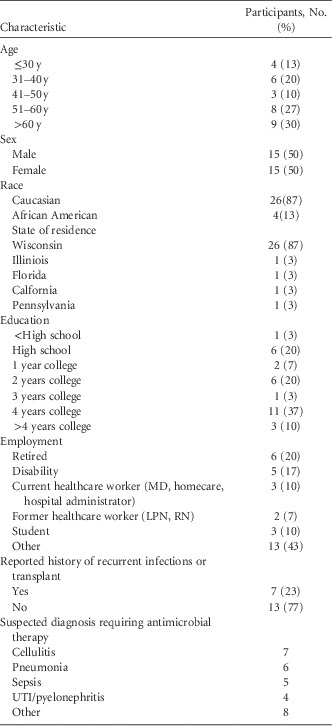
Of the 30 patients that participated, 15 (50%) were male and 15 (50%) were female, with a median age of 55 and 54 years, respectively (Table 2). The study population was highly educated, and more than 33% were retired. Patient interviews revealed 4 major themes affecting likelihood of patient engagement in antimicrobial stewardship activities: (1) a high degree of trust in physicians reduces patients’ perceived susceptibility; (2) patient understanding of the mechanism of antibiotic resistance contributes further to low perceived susceptibility; (3) patients receive few cues to engage in antimicrobial stewardship while in the hospital; and (4) patients express a high degree of self-efficacy and identify a role for themselves in ensuring the appropriate use of antibiotics.
Characteristics of 30 Patient Participants

NOTE. MD, medical doctor; LPN, licensed practical nurse; RN, registered nurse; UTI, urinary tract infection.
Theme 1: High Degree of Trust in Physicians May Reduce Patients’ Perceived Susceptibility
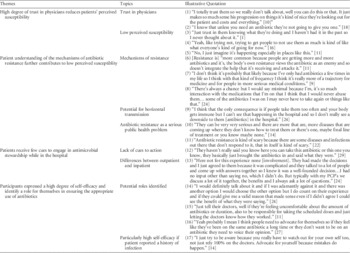
Patients almost universally expressed a high degree of confidence in physicians to prescribe the correct antibiotic and to prescribe antibiotics only when absolutely necessary (Table 3, quotations 1–3). Participants indicated no knowledge of overuse of antibiotic prescribing by physicians. This trust was upheld despite several patients acknowledging the complexity of treatment options and scenarios within which physicians make prescribing decisions. These participants described physicians as being capable of anticipating potential hurdles such as antibiotic resistance: “They’re looking out for the patient and costs and everything.”Reference Mistler and Drake 10 Several participants noted an increased level of trust as a result of prior experience with the particular physician, team, or hospital; however, even without this reported familiarity, a high degree of confidence in physicians in general to make accurate prescribing decisions was maintained.
Themes Identified and Illustrative Quotations

a Quotations end with a label indicating the participant’s study number.
Participants nearly unanimously expressed low perceived susceptibility to being affected by the inappropriate use of antibiotics, in part due to confidence placed in physicians to take the risk of generating resistance into account when prescribing antibiotics (Table 3, quotation 3). Patients interviewed also held the expectation that physicians and hospitals would monitor prescribing practices without explicit knowledge that an antimicrobial stewardship program exists (Table 3, quotations 4 and 5). No participants had heard the term ‘antimicrobial stewardship,’ but when defined, a majority had heard of general practices such as “trying to get people to not use them as much”Reference Kraetschmer, Sharpe, Urowitz and Deber 16 or had expectations that stewardship measures were being taken.
Theme 2: Patient Understanding of the Mechanisms of Antibiotic Resistance Contributes to Low Perceived Susceptibility
Misperceptions regarding the mechanisms of antibiotic resistance also allow patients to view the inappropriate use of antibiotics as unlikely to affect them. Patients described the mechanism of antibiotic resistance as the patient’s body becoming tolerant to the antibiotic rather than the organism itself becoming resistant (Table 3, quotation 6). As a result, patients who were not regularly prescribed antibiotics stated that it was unlikely that antibiotic resistance would affect them because they hadn’t taken enough antibiotics for their body to build up a resistance yet (Table 3, quotations 7 and 8). Participants also indicated no concern for resistance to 1 antibiotic affecting their chances of developing resistance to other antibiotics.
Participants demonstrated little to no concern for horizontal transmission of resistant infections within the hospital. Patients who were not on long-term antibiotic therapy were not concerned about developing antibiotic resistance themselves and were largely unaware of the risks of hospital-acquired resistant infections (Table 3, quotation 9). As a result, patients expressed very low perceived susceptibility to being affected by the inappropriate use of antibiotics during their hospital stay.
Although participants indicated a low personal perceived susceptibility, most understood antibiotic resistance itself as a serious public health threat. Most patients agreed that they considered antibiotic resistance “scary” or “very serious” on a population health scale or as a “trajectory for medicine and for people in more serious medical conditions” (Table 3, quotations 10 and 11). However, the perception was that this more global threat was unlikely to affect them personally.
Theme 3: Patients Receive Few Cues to Engage in Antimicrobial Stewardship While in the Hospital
Participants reported rarely being offered options for antibiotic treatment in the hospital (Table 3, quotation 12). Most patients interviewed described their experience as the physician explaining what their best option was and being given the opportunity to ask questions, voice concerns, or ultimately refuse medication. However, very few participants could recall being given options for antibiotic treatment with a discussion of pros and cons that resulted in a shared decision-making process. When this scenario was presented, a majority of participants said that they would feel comfortable discussing options and providing input but would not consider asking for additional options if they did not already have a specific concern with the selection made by the physician based on previous experiences.
Participants made a distinction between cues to engage between the hospital and outpatient settings (Table 3, quotation 13). Several patients noted that while they were not offered options for antibiotic treatment in the hospital, they typically do engage in discussions surrounding antibiotic choices with their outpatient physicians. Reasons offered included complexity and severity of the clinical picture, number of people involved in the decision, and urgency of treatment.
Theme 4: Patients Express a High Degree of Self-Efficacy and Identify a Role for Themselves in Ensuring the Appropriate Use of Antibiotics
Participants put great emphasis on the importance of being involved in their own care, although to the degree of involvement they preferred varied. All patients said that they would feel very comfortable speaking up about any concerns regarding the antibiotics they were prescribed. Most also said that they would feel comfortable helping their physician make a choice between antibiotic options if they were presented with pros and cons of each potential treatment, while others preferred that the physician make the selection. When asked about their expectations for the patient’s role in shared decision making to select antibiotic treatments, those participants that wanted to be involved said they would like to hear all options and be able to voice an opinion, but most would give the physician’s recommendation the greatest weight in making the final decision.
When asked whether patients have a role in helping to ensure the appropriate use of antibiotics, participants almost unanimously responded yes, with varying ideas of involvement offered as examples (Table 3, quotations 14–16). Many participants thought that patients should know what antibiotics they were being given and be able to ask questions; others believed that patients should be able to speak up about any concerns they have or refuse antibiotic treatment if they did not feel it was necessary. Another group stated that patients should be actively involved in the choice of antibiotic treatments.
Patients who reported a history of recurrent infections, immunosuppression or frequent healthcare encounters demonstrated even higher self-efficacy in general than others (Table 3, quotation 17). They were also more likely to recall being involved in shared decision making about antibiotics prior to hospitalization.
DISCUSSION
Improving antibiotic use in the hospital setting through ASPs is recommended by IDSA and SHEA national guidelines as a strategy to curb the growing problem of antibiotic resistance.Reference Pope, Dellit, Owens and Hooton 13 ASPs to date have largely focused on individual physician prescribing and surveillance of hospital-wide prescribing practices. Our findings suggest that patients may serve as an untapped resource by serving as engaged and active participants in ASPs.
Using the Health Belief Model, our study described several factors influencing patient likelihood of engaging in antimicrobial stewardship while in the hospital. These include low perceived susceptibility facilitated by trust in physicians and misperceptions of the mechanisms of resistance, insufficient cues from clinicians that may prompt patients to engage in stewardship behaviors, a high degree of self-efficacy, and the belief that patients should ultimately be involved in ensuring the appropriate use of antibiotics.
Patients expressed a high level of confidence in physicians to prescribe accurately and only prescribe antibiotics when necessary. The idea of trust in physicians has been studied extensively and has been linked to patient satisfaction and adherence to treatment.Reference Müller, Zill, Dirmaier, Härter and Scholl 14 , Reference Chawla and Arora 15 Patient–physician trust has been described as an important factor in shared decision making; however, blind trust was more often associated with patients choosing a passive role in the decision-making process.Reference Kraetschmer, Sharpe, Urowitz and Deber 16 In our study, patients were largely unaware of the problem of inappropriate antibiotic use in hospitals and expressed a high level of trust in physicians. This trust that physicians are aware of and actively monitoring for resistance may have further diminished perceptions of susceptibility to being affected by antibiotic resistance in the hospital setting.
A second factor identified affecting likelihood of engaging in antimicrobial stewardship was the misperception by patients that antibiotic resistance is related only to the body itself building up a tolerance to antibiotics if taken too frequently. This misperception of tolerance versus resistance has also been previously described.Reference Brookes-Howell, Elwyn and Hood 17 In the context of this study, participants believed it was unlikely that they were susceptible to resistant infections if they had not personally taken antibiotics regularly. As a result of this belief, antibiotic resistance was viewed more as a public health threat than a personal one. Patients were not concerned with the potential for contracting a resistant infection while in the hospital because resistance was considered a process contained within the body and not transferrable to others. Patient understanding of antibiotic resistance may therefore be a critical factor in engaging patient populations beyond those with recurrent infections in antimicrobial stewardship. If the difference between tolerance and antibiotic resistance can be further clarified, patients may begin to view antibiotic resistance as more likely to affect them, which will increase perceived susceptibility and the likelihood of engaging in antimicrobial stewardship activities in the hospital.
The lack of opportunity for shared decision making when selecting antibiotic treatments was another major theme identified. While participants felt clinicians were generally open to questions or concerns, most had not been presented with information about alternative antibiotic treatments. Previous studies of shared decision making related to medication choices have been largely focused on outpatient and long-term care situations.Reference Davey, Pagliari and Hayes 18 In this study, patients identified several factors limiting the use of this model in the hospital setting including time, increased severity and complexity of illness, and a larger team of stakeholders involved in antibiotic selection. An additional factor to consider is that decision making regarding antibiotics is often not undertaken in the presence of the patient. Due to the absence of a cue to action in the hospital setting, patients were less likely to engage in discussions that may prevent the inappropriate use of antibiotics with their physicians. Consideration of the shared decision-making model in the inpatient setting may increase patient engagement in stewardship by providing a necessary cue for patients to act on their desire to be engaged in their own treatment decisions.
Participants expressed a generally high level of self-efficacy to being involved in decision making about antibiotic treatments. Understanding the medications they were given was a priority for all patients, while some also valued hearing all options for treatment. For those who preferred to make the final decision, the recommendation made by the physician was considered extremely important. Participants agreed that patients do have a role in helping to ensure the appropriate use of antibiotics. These findings are supported by previous work describing patient engagement in infection prevention.Reference Gudnadottir, Fritz, Zerbel, Bernardo, Sethi and Safdar 19 Participants gave a wide variety of examples of what their role should be, but in general they believed that patients should be involved to some extent in working with clinicians to appropriately use antibiotics.
A key strength of this study lies in its application of the Health Belief Model to attempt to explain patient engagement in antimicrobial stewardship. Using the constructs of this model to provide a foundation for analysis allowed for a theoretically grounded, systematic approach to identifying key themes and highlighting potential opportunities to engage patients as partners in antimicrobial stewardship. The relationships between perceived susceptibility, cues to action, and self-efficacy emphasize areas for intervention that will improve the translation of a perceived role for patients into action.
Limitations of our study include the potential for participants to report a higher degree of self-efficacy to present a more informed and self-empowered persona, that is, a more socially desirable answer. This limitation may have been mitigated by employing an interviewer who was not a part of the patient’s care team. Our study population was, in general, highly educated and was selected via convenience sampling, which limits generalizability.
This study is an important initial step in understanding patient perceptions about the role of patients in antimicrobial stewardship in inpatient settings. While ASPs typically focus on healthcare providers as core antimicrobial stewards, this study demonstrates an important role for patients in assisting hospitals to increase the judicious use of antibiotics to slow the growing problem of antibiotic resistance. Further study to identify strategies to effectively engage patients in antimicrobial stewardship is needed.
ACKNOWLEDGMENTS
Financial support: N.S. is supported by a Veterans’ Affairs Merit Award, by a grant from the Agency for Healthcare Research and Quality Small Research Grant Program (AHRQ R03), and by a VA-funded patient safety center.
Potential conflicts of interest: All authors report no conflicts of interest relevant to this article.