

1. Introduction
In the run-up to the UK-EU membership referendum in 2016 a number of studies examined the potential consequences of Brexit for the UK economy. Most mainstream studies, for example Reference Dhingra, Ottaviano, Sampson and Van ReenenDhingra et al. (2016a), Reference Ebell and WarrenEbell and Warren (2016) and OECD (2016), predicted that Brexit would have a negative impact on UK GDP. Reference Dhingra, Ottaviano, Sampson and Van ReenenDhingra et al. (2016a) predicted annual costs of £850 per household with a ‘soft Brexit’ and £1,700 per household with a ‘hard Brexit’. Unsurprisingly these predicted effects are magnified in the long run (to £4,200 and £6,400, respectively). In the soft Brexit scenario these results are driven by increases in non-tariff barriers and the exclusion of the UK from further EU market integration, while allowing for some savings in the UK fiscal contribution to the EU. In the hard Brexit scenario, greater losses occur because of additional increases in non-tariff barriers, as well as the introduction of bilateral trade tariffs, but there are greater savings in the UK fiscal contribution to the EU than under the soft Brexit scenario.Footnote 1
Existing studies examine a number of additional impacts, including foreign investment (Reference Dhingra, Ottaviano, Sampson and Van ReenenDhingra et al., 2016b; OECD (2016), immigration (Reference Dhingra, Ottaviano, Van Reenen and WadsworthDhingra et al., 2016c; Reference Ebell and WarrenEbell et al., 2016) and the distributional impacts across income groups (Reference Breinlich, Dhingra, Sampson and Van ReenenBreinlich et al. 2016). But existing studies have paid very little attention to the way in which those impacts are likely to vary across different parts of the UK. To the best of our knowledge, Reference Dhingra, Huang, Ottaviano, Pessoa, Sampson and Van ReenenDhingra et al. (2017a) provides the first model-based analysis of the local welfare impacts of Brexit. They report differences in predicted effects across all Local Authority Areas and Primary Urban Areas, as well as providing some initial analysis on whether these predicted impacts are likely to exacerbate or alleviate existing disparities.
This short paper reproduces the Local Authority estimates, provides additional discussion of methodological details and highlights a number of issues that will need to be addressed to provide a more accurate description of the way in which local areas are likely to be differentially affected by Brexit. In particular, we highlight a number of methodological issues, such as the general equilibrium adjustment of the spatial economy, that need to be addressed to refine estimates of the impact of rising trade costs associated with Brexit. Predictions on the economic consequences of Brexit should be of substantive interest for both central and local government in understanding how different areas might be affected by Brexit and in designing the appropriate policy response. There has also been considerable interest in how the predicted economic impacts of Brexit correlate with voting patterns from the referendum.Footnote 2
The predictions reported in this paper are based on further developing the methodology used in the national level analysis of Reference Dhingra, Ottaviano, Sampson and Van ReenenDhingra et al. (2016a), in particular making it suitable for deriving estimates of local impact. Their multisector computable general equilibrium trade model generates sectoral impacts under different scenarios (i.e. hard and soft Brexit). This state-of-the-art model of the world economy explains trade patterns well and accounts for the interdependence across sectors through complex supply chains. Using the most comprehensive data on trade flows and trade barriers available, their model provides estimates for the impact of different Brexit scenarios on trade volumes, sectoral production and real economic activity.Footnote 3Reference Dhingra, Freeman and MavroeidiDhingra et al. (2017b) use these sectoral impacts weighted using area employment shares to estimate the overall area level effects that we use in this paper.
These comments notwithstanding, a number of important caveats and methodological challenges remain. We discuss these in detail in section 3 and consider how future work might tackle some of these issues and how they apply to these results. It is important to note that the predicted sectoral impacts are model dependent and so we would urge caution in placing strong weight on the estimated impact for any particular sector. To give just one example, the model focuses on international trade and will therefore underestimate losses in sectors, such as air transport, where foreign investment requirements are more important than trade barriers in determining market access.
It is possible to have more confidence in the area level results, where the employment share weighting helps ‘wash out’ some of the sector-specific errors. If the sector-specific errors are random, after accounting for intersectoral input-output linkages, then averaging across sectors within a region gives a more accurate prediction of the area level impacts of increased trade barriers. Even so, it must be emphasised that these area level results only predict the ‘immediate impact’ based on current employment shares. Just as with the financial crisis, there are good reasons to think that adjustment of the spatial economy will have significant implications for understanding long-run differences in the impact across areas.
The results show, as with the previous research, that the effect for all areas is negative under both scenarios and more negative under hard Brexit. This is not surprising given that the same sectoral effects that underpinned predictions of the national impact are also used to predict the area level results. Of more interest is the fact that the variability of shocks at the Local Authority level is considerably higher under hard Brexit than under soft Brexit (the estimated standard deviation of spatial shocks being 0.19 per cent for soft Brexit, 0.40 per cent for hard Brexit). This suggests that some Local Authorities are particularly specialised in sectors that are predicted to be badly hit by hard Brexit. The interaction of area level sectoral employment shares with exposure of the relevant sectors determines the predicted losses for a particular area. Contrary to previous work by Los et al. (2017), areas in London and the South East see the biggest negative impacts.
The remainder of the paper is structured as follows. Sections 2 and 3 provide further comparisons to existing studies, and outline why we think that the approach we adopt here is likely to provide better ex-ante predictions. Section 4 first reports estimates of the local economic effects of Brexit using this approach, then moves on to show that areas that were more likely to vote remain are those that are predicted to be most negatively impacted by Brexit. It also reports that negative impacts of Brexit tend to be bigger for areas with higher average wages. In the discussion of these findings, we highlight the parallel with the financial crisis, and specifically the contrast between the immediate and long-run impacts (which saw London and the South East hit hardest before recovering much more strongly than other areas of the UK). This suggests that even though the immediate negative impacts are smaller in poorer regions, households in those areas begin poorer and may experience considerably more difficulty in adjusting to those negative shocks. Finally, section 5 concludes.
2. Related literature
There is now a wealth of literature predicting the short and long-term macroeconomic effects of the United Kingdom leaving the European Union. Almost all studies predict that the effect on UK welfare will be negative for any potential deal that is negotiated between the two parties (Reference Dhingra, Huang, Ottaviano, Pessoa, Sampson and Van ReenenDhingra et al., 2017a; Reference Brakman, Garretsen and KohlBrakman et al., 2017; Reference Ebell and WarrenEbell and Warren, 2016; HM Treasury, 2016; OECD, 2016; Oxford Economics, 2016; PWC, 2017; Reference Van ReenenVan Reenen, 2016).Footnote 4
The magnitude of the effect depends on the terms under which the UK leaves the EU. Broadly, the economic impacts are predicted to be most severe under a so-called ‘hard Brexit’, whereby there are no trade agreements between the UK and the EU and trade rules are determined by the World Trade Organisation (WTO). The least costly outcome occurs when the UK remains a member of the European Economic Area (EEA). Reference Dhingra, Huang, Ottaviano, Pessoa, Sampson and Van ReenenDhingra et al. (2017a) use a state-of-the-art quantitative general equilibrium trade model to estimate the long-term costs of Brexit relative to a counterfactual situation where the UK remains in the EU. They find that UK welfare losses range from 1.3 per cent under soft Brexit to 2.7 per cent under hard Brexit. Using the National Institute Global Econometric Model (NiGEM), HM Treasury (2016) predict negative effects ranging between 3.8 per cent and 7.5 per cent, while OECD (2016) predicts a counterfactual reduction of between 2.7 per cent and 7.7 per cent. Reference Ebell and WarrenEbell and Warren (2016) use the same model, finding that GDP is expected to fall by 1.5 per cent to 3.7 per cent, wages by between 2.2 per cent and 6.3 per cent, and consumption by 2.4 per cent to 5.4 per cent. While all above estimates are based on the same NiGEM model, different assumptions are made on the magnitudes of trade, FDI and productivity losses associated with Brexit, and this drives the differences in results. When including a 5 per cent long-run decline in productivity to their baseline ‘hard’ scenario, Reference Ebell and WarrenEbell and Warren (2016) estimates that the losses are between 1.8 per cent and 7.8 per cent, while PWC (2017) predicts costs of 1.2 per cent to 3.5 per cent. Reductions in trade are the main driver of these significant long-run costs, resulting from increases in tariff and non-tariff barriers to trade. Reference Brakman, Garretsen and KohlBrakman et al. (2017) use a general equilibrium model to predict that UK value added exports will fall by 13 per cent under soft Brexit and 17 per cent under hard Brexit.
The aforementioned estimates from Reference Dhingra, Huang, Ottaviano, Pessoa, Sampson and Van ReenenDhingra et al. (2017a) are based on a long-run static model, while HM Treasury (2016), OECD (2016) and the second set of estimates from Reference Ebell and WarrenEbell and Warren (2016) include dynamic productivity impacts. Reference Dhingra, Huang, Ottaviano, Pessoa, Sampson and Van ReenenDhingra et al. (2017a) also compute a data driven dynamic model. When accounting for the dynamic effects, the overall welfare costs rise to between 6.3 per cent and 9.4 per cent of GDP. These figures concern only the UK economy; there will also be direct and indirect effects to other global economies both inside and outside the EU. These individual country effects may be positive or negative. For example, Reference Dhingra, Huang, Ottaviano, Pessoa, Sampson and Van ReenenDhingra et al. (2017a) estimate that the welfare of Ireland is predicted to decline by as much as 2.4 per cent under hard Brexit. Countries outside of the EU are expected to experience small gains from Brexit, but the overall world economy is negatively affected.
To date, there are few studies that discuss the likely spatial variation of the welfare costs that will result from Brexit and how this correlates with voting patterns. The literature that does exist makes contrasting predictions. Reference Los, Mccann, Springford and ThissenLos et al. (2017) predict that London and the South East will be less affected by Brexit than the rest of the country, while the blog by Reference WintersWinters (2016) argues the opposite. Demos (2017) argues that London will suffer most from stricter immigration rules, but the North East and Wales will experience the greatest loss of goods exports to the EU. A common theme across all reports is that the impacts on London and the rest of the country are predicted to be distinctly different.
All three of these existing papers base their predictions of the likely spatial impact on measures of ‘exposure’ to Brexit. Reference Los, Mccann, Springford and ThissenLos et al. (2017) provides the most complicated assessment of exposure. They use data from the World Input-Output Database (WIOD), merged with Eurostat's estimated regional accounts to calculate the share of local economic activity that is dependent on trade with the rest of the EU. They use historical data to construct two variables for each sector in each UK region. The first is the percentage of sectoral value-added in a region that can be attributed to consumption and investment demand in the rest of the EU, which they term ‘EU dependence’. The second variable is the percentage of regional GDP that is generated in that sector. They use these to calculate total EU dependence for each region and assume that the effect of Brexit will be proportional to EU dependence.
Their key finding is that regions that voted more strongly to leave the EU tended to be the same regions with greatest levels of dependency on European markets for their local economic activity. They find a clear positive correlation between the proportion of leave voters and the share of local GDP that is driven by investment and consumption demand in the rest of the EU. There is a similar trend when using labour income shares instead of GDP. Furthermore, London and the South East are expected to be the least affected, with just over 7 per cent of London's GDP coming from trade with the EU – lower than any other region of the UK. They therefore argue that London is the region of the UK that is least dependent on the EU.
Our findings differ from those of Reference Los, Mccann, Springford and ThissenLos et al. (2017) for two key reasons. We account for differences across industries in the extent to which they can substitute for EU imports from domestic or other sources, and for differences across sectors in the levels of trade barriers that would come into being when the UK leaves the EU. Reference Los, Mccann, Springford and ThissenLos et al. (2017) use model generated measures of the region's exposure to trade, while we use the data on national exposure to trade for each sector. The regional variation in trade exposure is small such that the differences across regions are likely to be strongly influenced by differences in sectoral shares. In our methodology, the sectoral effects would also be weighed by the different changes in trade costs and different elasticities of substitution across sources and destinations.
Our findings are more in line with the arguments put forward by Reference WintersWinters (2016), who suggests that London and the South East might be most negatively affected by Brexit. Reference Overman and WintersOverman and Winters (2005, Reference Overman and Winters2011) provide two reasons for why London and the South East might be most negatively affected. The first is that the EU is clustered around the South and East coasts of the UK so trade tends to be concentrated in these ports. As trade moves away from the EU, losses will be greater in these areas, and trade will begin to disperse to other ports. The second argument is that the composition of trade across industries will change when the UK leaves the EU. Trade barriers within and outside Europe are generally higher for services. Therefore, if the UK leaves the Single Market as expected, areas specialising in services will be more adversely affected than those specialising in goods. Export demand for manufacturing, which generates the greatest income shares in the North East, North West, East Midlands, and Wales, is expected to fall less than for services after the UK leaves the Single Market and maintains a free trade area. Barriers to trade in services are likely to increase most significantly, so that areas with high importance of manufacturing exports will benefit relative to areas with specialisation in services. Our empirical work considers these channels and helps quantify the impact of these changes.
Demos (2017) argue that London, which has nearly 17 per cent of its workforce coming from the EU, will be most affected by limitations on migration after Brexit. London and the South West however have the lowest percentage of exports going to the EU, so would lose less through trade compared to regions like Wales which exports a greater share of its gross value added to the EU. In our methodology, the share of exports to the EU is not the only factor determining how Brexit affects regional economies. We also account for the fact that sectors differ in how their trade costs would rise after Brexit and how easy it might be to substitute away from the EU.
Our paper is also related to the growing literature explaining trends and regional variation in the voting patterns of the EU referendum. Local economic conditions were an important factor in determining voting patterns (Reference Arnorsson and ZoegaArnorsson and Zoega, 2016; Reference Becker, Fetzer and NovyBecker et al. 2017; Reference Goodwin and HeathGoodwin and Heath, 2016; Joseph Rowntree Foundation, 2016; Reference ZoegaZoega, 2016). Regions with larger shares of lower-skilled or manufacturing employment, a greater historical role of manufacturing, and higher unemployment were all more likely to vote for Brexit (Reference Becker, Fetzer and NovyBecker et al., 2017). Reference Bell and MachinBell and Machin (2016) report that Local Authorities with lower median wages voted more strongly to leave the EU. Reference CoyleCoyle (2017) suggests that regions that were perceived to have benefited more from globalisation were less likely to vote leave. London and its surrounding areas, the South and Scotland voted most strongly to remain. Using individual-level data, Reference Colantone and StanigColantone and Stanig (2016) show that support for the Leave option in the referendum regarding European Union membership of the United Kingdom was systematically higher in regions hit harder by economic globalisation. Conversely however, Reference Becker, Fetzer and NovyBecker et al. (2017) find that exposure to the EU in terms of immigration and trade has little explanatory power on the referendum vote, once many of these other factors are controlled for.
3. Methodology
Modelling approach
The underlying methodology for predicting the sectoral impact of Brexit is described in Reference Dhingra, Ottaviano, Sampson and Van ReenenDhingra et al. (2016a). They estimate the effect of Brexit on the UK's trade and living standards using a modern quantitative trade model of the global economy. Quantitative trade models incorporate the channels through which trade affects consumers, firms and workers, and provide a mapping from trade data to welfare. The model provides predictions for how much real incomes change under different trade policies, using readily available data on trade volumes and potential trade barriers. A broad outline of the model is given below but readers are referred to Reference Dhingra, Ottaviano, Sampson and Van ReenenDhingra et al. (2016a) for more detail.
The representative household in country j has an infinite horizon with time discount factor ρ∊(0,1). Under constant unit elasticity of intertemporal substitution, the household's intertemporal welfare is  ln cjt where cjt is the real consumption in year t and t=0 is the year in which Brexit takes place. We compare the present value of future consumption between two counterfactuals: soft versus hard Brexit and the status quo of no Brexit. The welfare effect of Brexit,
 , can be measured in equivalent variation terms as the permanent proportional change in the level of consumption in the status quo that would make the representative household in country j indifferent between the Brexit and the status quo. This can be expressed as

where  and
 are the changes in real consumption in period t compared to period 0 for country j if the UK remains and after the UK leaves, respectively. To account for changes in fiscal transfers between the UK and the EU, the real consumption in the case of Brexit is multiplied by 1+gj where gj is the percentage change in the net fiscal transfer received by country j after Brexit. For example, if the UK made a lower transfer to the EU after Brexit, gj would be positive for the UK while for the remaining EU countries it would be negative since they would need to fill the budget hole left by the lower UK contribution.
The representative household consumes a Cobb-Douglas basket of the goods  supplied by S different sectors, indexed by s = 1,2, …, S. The Cobb-Douglas weights βj,s denote the share of sector s in household j's expenditure, where 0 < βj,s < 1 and
 . Reference Dhingra, Ottaviano, Sampson and Van ReenenDhingra et al. (2016a) model what would happen to welfare measured by changes in real consumption per capita
 when trade costs change as a result of Brexit. The bilateral trade obstacles between two countries i and j are denoted by τij which can arise due to geography and other barriers. Then the question is: what happens to
 when τij,s changes from Brexit? The trade costs τij,s between the UK and the EU rise after Brexit, and the precise numbers for each Brexit scenario can be specified through these changes in trade costs.
Lower trade costs reduce the cost of doing business internationally and increase bilateral exports. The direct impact of a rise in the trade cost of a sector after Brexit would be to reduce the value of bilateral trade with the EU in that sector. Trade models also account for the indirect impacts of trade costs on welfare through value chain linkages, competition for factors of production and other product markets. Reference Dhingra, Ottaviano, Sampson and Van ReenenDhingra et al. (2016a) builds on Reference Costinot, Rodríguez-Clare, Gopinath, Helpman and RogoffCostinot and Rodríguez-Clare (2013) who show that some popular trade models predict the same welfare changes in response to changing trade barriers and that these welfare changes can be computed using data on trade volumes and trade elasticities. The predicted elasticity of real consumption to trade costs in these models (with a hat denotes a prediction) is:

In (2), λjj,s is the share of country j's expenditures in sector s going to domestically supplied goods, πj0 and πjt are the shares of tariff revenue in country j's aggregate expenditures in the two scenarios, aj,sk is the elasticity of the price index in sector s with respect to changes in the price of sector k. The price elasticities are given by the elements of the S×S Leontief inverse matrix (I–Aj)–1 which contain the input shares of each sector. The terms εk are the ‘trade elasticities’, which measure the percentage change in imports relative to domestic demand resulting from a 1 per cent change in bilateral trade costs, holding incomes constant.Footnote 5 They are referred to as trade elasticities because this class of models gives a gravity equation of trade, from which this elasticity can be obtained using data on sector-level bilateral trade flows and trade costs. Having estimated these trade elasticities, the impact of Brexit-induced trade cost changes on welfare can be estimated with available data on initial expenditure shares, sectoral consumption shares, input-output tables and the income levels of different countries. We therefore re-estimate the model presented in Reference Dhingra, Ottaviano, Sampson and Van ReenenDhingra et al. (2016a) for the non-oil economy to get the impact of Brexit on the gross value added of each sector in the UK.
Brexit scenarios
The multisector general equilibrium trade model generates sectoral impacts under different scenarios (i.e. soft and hard Brexit). Under the soft Brexit scenario, Reference Dhingra, Ottaviano, Sampson and Van ReenenDhingra et al. (2016a) assume tariffs remain at zero and non-tariff barriers increase. Tariffs remaining at zero would happen if the UK joins a free trade area, such as EFTA, with the EU. While tariffs are important in certain sectors, they would on average be under 3 per cent for exports to the EU. Much of the costs of doing business across borders arises from border controls, differences in product regulations, legal barriers, search costs and other transaction costs for both goods and services. These costs are higher than tariffs for many businesses (Reference NovyNovy, 2013; Reference Kee, Nicita and OlarreagaKee, Nicita, and Olarreaga, 2009), and modern trade agreements are largely about reducing these non-tariff costs of international trade and investment. Reference Dhingra, Ottaviano, Sampson and Van ReenenDhingra et al. (2016a) model increases in non-tariff barriers under different Brexit scenarios. Finally, they also model continuing reductions in non-tariff barriers (NTBs) within the EU. These within EU NTBs are assumed to be smaller after Brexit to account for the observation that the rate of decline in intra-EU trade costs is approximately 20 per cent faster than the decline in trade costs between other OECD countries (Reference Mejean and SchwellnusMejean and Schwellnus, 2009). Much of the action in the national model comes from these non-tariff barriers to trade. The analysis that follows can therefore be interpreted as the opportunity cost of not being an EU member and missing out on 20 per cent faster reductions in non-tariff barriers to trade.
Even free trade areas cannot eliminate all the non-tariff barriers that businesses face when transacting across borders. Many non-tariff barriers arise because countries have different preferences over the regulations that they want to impose. As a result, trade deals can only reduce that fraction of the non-tariff barriers which can in principle be eliminated by policy action (so called ‘reducible’ non-tariff barriers). Reference Berden, Francois, Tamminen, Thelle and WymengaBerden et al. (2009, Reference Berden, Francois, Tamminen, Thelle and Wymenga2013) provide detailed calculations of the tariff equivalents of non-tariff barriers. Under the soft Brexit scenario, Reference Dhingra, Ottaviano, Sampson and Van ReenenDhingra et al. (2016a) assume that non-tariff barriers increase: they go up to one quarter of the reducible barriers faced by US exporters to the EU (a 2.77 per cent increase). Given the way in which bilateral trade costs are modelled, this increase in non-tariff barriers (combined with the assumption of no changes in tariff barriers) translates into a 2.77 per cent increase in bilateral trade costs between the UK and the EU.Footnote 6
The UK will also not fully benefit from further market integration of the EU. It is assumed that this further integration reduces within-EU non-tariff barriers 20 per cent faster than the rest of the world, which now includes the UK. Therefore, in ten years, non-tariff barriers within the EU are 5.63 per cent lower. As the UK would continue to be in the Single Market, the fiscal savings would be small. The UK is assumed to pay 17 per cent less in fiscal contributions to the EU under soft Brexit, calculated as the same proportionate saving as Norway. This is equivalent to 0.09 per cent of GDP.
Under the hard Brexit scenario, the UK and the EU are not part of a free trade agreement (at least immediately) and so they must charge each other the tariffs that they charge to other members of the World Trade Organization. This means that goods crossing the UK-EU border are faced with WTO Most-Favoured-Nation tariffs. Reference Dhingra, Ottaviano, Sampson and Van ReenenDhingra et al. (2016a) also assume that non-tariff barriers will be larger in the absence of a free trade agreement. Specifically, they are assumed to increase to three quarters of the reducible barriers faced by US exporters to the EU (an 8.31 per cent increase). In the hard Brexit case, the UK and EU are not part of any free trade agreement and therefore must apply tariffs at the same rate as to other members of the WTO. This means that goods crossing the UK-EU border are faced with the WTO Most-Favoured-Nation (MFN) tariffs. In addition to increased tariffs, non-tariff barriers rise further in the absence of a deep trade agreement to replace EU membership.
Non-tariff barriers are assumed to increase to three quarters of the reducible barriers faced by US exporters to the EU – an increase of 8.31 per cent. As in the soft Brexit case, the UK will also not fully benefit from further integration of the EU. It is assumed that these effects are larger outside of a free trade agreement and that this further integration within the EU reduces non-tariff barriers 40 per cent faster than in the rest of the world such that barriers are 12.65 per cent lower in ten years. But the UK also saves more − 0.31 per cent of GDP – on fiscal contributions to the EU under hard Brexit.
National to local numbers
With the change in bilateral trade costs specified, the model provides a way of simultaneously estimating the impact on bilateral trade volumes for each sector, taking into account all inter-sectoral linkages through supply chains and all inter-country linkages through diversion of trade to other countries. As there are multiple sectors, the model accounts for how changes in trade costs in intermediate input sectors affect the bilateral trade volumes of the final goods sector. As there are more than two countries, the model also accounts for how a rise in bilateral trade costs with one trade partner (in this case the EU) could also lead to a rise in bilateral trade for countries for whom the trade costs have not changed (i.e. among countries outside the EU). The trade model provides a logical aggregation of these different interlinkages across sectors and countries, which gives a set of predictions about what will happen to specific industries in the two different Brexit scenarios.
We use the estimates at a national and sectoral level as a basis for estimating spatial variation in the predicted trade effects of Brexit. The key principle is to use the national-level model described above to predict the impact of trade cost increases from Brexit on the gross value added (GVA) of each sector in the UK economy. Having estimated the percentage change in the sectoral GVA, we use the employment shares of different regions in the UK to predict the impact of Brexit on local economies. We weight the sector-level GVA changes from the national model by the proportion of workers in that sector in each local area. That is, to get the spatial level estimates, the predicted sector-specific changes are multiplied by the current employment share of the sectors in each area and summed across sectors. This gives the impact of Brexit on the gross value added of an area as follows:
GVAShocka EmploymentShareas × NationalGVAShocks where a stands for an area (Local Authority level in the analysis below).
We have more confidence in the area-level results than the predictions for particular sectors, because the employment share weighting will help ‘wash out’ some of the sector-specific errors and hopefully give a more accurate prediction of the area-level impacts of increased trade barriers. One concern might be that if there were local clusters of related sectors (such as financial services, legal services and accountancy) and the errors of closely related sectors were correlated, then the aggregation to the local level might exacerbate the noise in the estimates. This is unlikely because we account for the input-output linkages across sectors, so this correlation is factored into the estimated national level GVA impacts. Even so, it must be emphasised that these area-level results only predict the ‘immediate impact’ based on current employment shares. Just as with the financial crisis, there are good reasons to think that adjustment of the spatial economy will have significant implications for understanding long-run differences in the impact across areas.
4. Data and results
Data
The national-level trade flows and tariff data for each sector-country pair are taken from UN ComtradeFootnote 7 and the inter-industry linkages are taken from the World Input-Output Database (WIOD).Footnote 8 The latter dataset can be used to calculate the initial expenditure shares in each country on each sector and the income levels of different countries. The trade elasticities (which measure the percentage change in imports relative to domestic demand) that are used to translate the changes in trade costs into effects on economic activity are taken from Reference Caliendo and ParroCaliendo and Parro (2015). As their estimated trade elasticity for the coke, refined petroleum and nuclear fuel sector is the highest, we re-estimate the sectoral effects in Reference Dhingra, Ottaviano, Sampson and Van ReenenDhingra et al. (2016a) setting the changes in this sector to zero. Our results therefore focus on the non-oil sector of the UK economy. The trade elasticities are sector-specific for goods sectors, but constant for the service sector where the trade elasticity is set to be 5, the median value in the literature, following Reference Costinot, Rodríguez-Clare, Gopinath, Helpman and RogoffCostinot and Rodriguez-Clare (2013).
The hard Brexit scenario uses Most Favoured Nation (MFN) tariffs at the WIOD sector level for both UK and EU imports and exports. These are calculated as weighted averages of the MFN tariffs reported in the World Trade Organisation (WTO) Statistics database,Footnote 9 with weights taken from the WIOD and UN Comtrade databases.
Employment shares are calculated using data from the Business Register and Employment Survey (BRES) mapped from 2007 SIC 5-digit level to SIC 2003 and then aggregated to the 31 WIOD industries. Employment shares are calculated based on reported data in 2015 so as to avoid possible employment decisions undertaken by firms as adjustment to the EU Referendum result of June 2016.
Sector predictions
As per Reference Dhingra, Ottaviano, Sampson and Van ReenenDhingra et al. (2016a), under both hard and soft Brexit the estimated shocks to imports, exports and Gross Value Added (GVA) by WIOD sector are predominantly negative. The GVA impacts under the two different scenarios are reported in table 2. The table also shows that industry specific GVA shocks are on average lower under soft Brexit than under hard Brexit (the same is true for imports and exports). There is some heterogeneity in the responses of different sectors across the two different scenarios, however for each sector the sign of the impact – positive or negative – is generally consistent. While the majority of sectoral impacts are negative, positive impacts can arise. For example, if the UK were to opt for a hard Brexit (i.e. WTO tariffs), while replicating CAP transfers domestically, members of the UK agricultural industry may gain. The new highly protectionist setting would increase domestic demand and estimates from the National Farmers Union (Reference Berkum, Jongeneel, Vrolijk, Leeuwen and JagerBerkum et al., 2016) suggest that all subsectors (field crops, horticulture, milk, sheep/goats, cattle, pigs and poultry) would gain from such a setting.


As discussed above, we would urge caution in placing strong weight on the estimated impact for any particular sector. We have more confidence in the area-level results, where the employment share weighting will help ‘wash out’ some of the sector-specific prediction errors and it is to these that we now turn.
Impact across local authorities
Basic summary statistics for the impacts across Local Authorities are reported in table 3. In line with the national estimates, the average Local Authority level effect is negative under both scenarios, and more negative under hard Brexit. As discussed above, this is not particularly surprising given that the same sectoral effects that underpinned predictions of the national impact are also used to predict the Local Authority level results. The average Local Authority decrease in GVA is predicted to be 1 percentage point larger under hard Brexit than under soft Brexit (–2.12 per cent compared to −1.14 per cent, respectively). These figures are essentially unchanged if we use the median instead of the mean, suggesting that there are no particularly extreme predictions that drive the average effect. The figures for the 10th and 90th percentile are also consistent with this interpretation.

Table 3 also reports the variance and 90th to 10th percentile difference to summarise the extent to which the negative effect of Brexit varies across Local Authorities under the two different scenarios. This highlights a more interesting finding: the variation in Local Authority level shocks is considerably higher under hard Brexit than under soft Brexit. This suggests that some Local Authority areas are particularly specialised in sectors that are badly hit by hard Brexit.
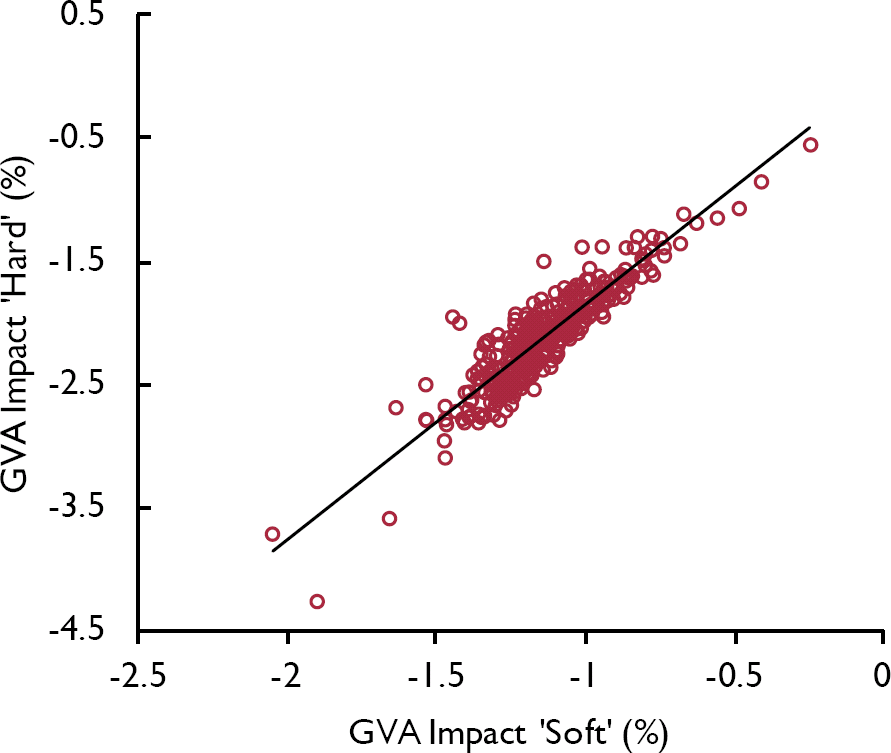
Although the variation in impact across Local Authorities is higher in the hard Brexit scenario, the correlation between the two scenarios is strong and positive (the correlation coefficient is 0.91). Figure 1, which plots Local Authority impacts under both hard and soft Brexit illustrates this clearly.
Impact of Brexit under the two different scenarios

Impact on specific local authorities
We now turn to the impact on specific Local Authorities. Table 4 provides a list of the top ten most and least affected Local Authorities under the hard Brexit scenario. The results for all Local Authorities are provided in table A1 in Appendix A2. Three of the most negatively affected Local Authorities are within the Greater London area (City of London, Tower Hamlets and Islington). With the exception of Aberdeen, all the most negatively affected Local Authorities are in the South of England. Most of these areas have high employment shares (according to workplace-based estimates from the BRES) in Business Activities or Financial Intermediation (or both) and so are particularly badly hit by the large negative effects predicted for those sectors under hard Brexit. For example, the City of London, which is predicted to see the largest decrease in GVA under a hard Brexit (–4.3 per cent) had close to 80 per cent of its employed population working in these two sectors as of 2015.

The ten least negatively affected regions show somewhat more geographical variation, although it is striking that the South of England is now somewhat under-represented. Hounslow and Crawley do relatively well because their proximity to Heathrow means a high share of employment in the Air Transport Industry, which sees only small losses even under hard Brexit.
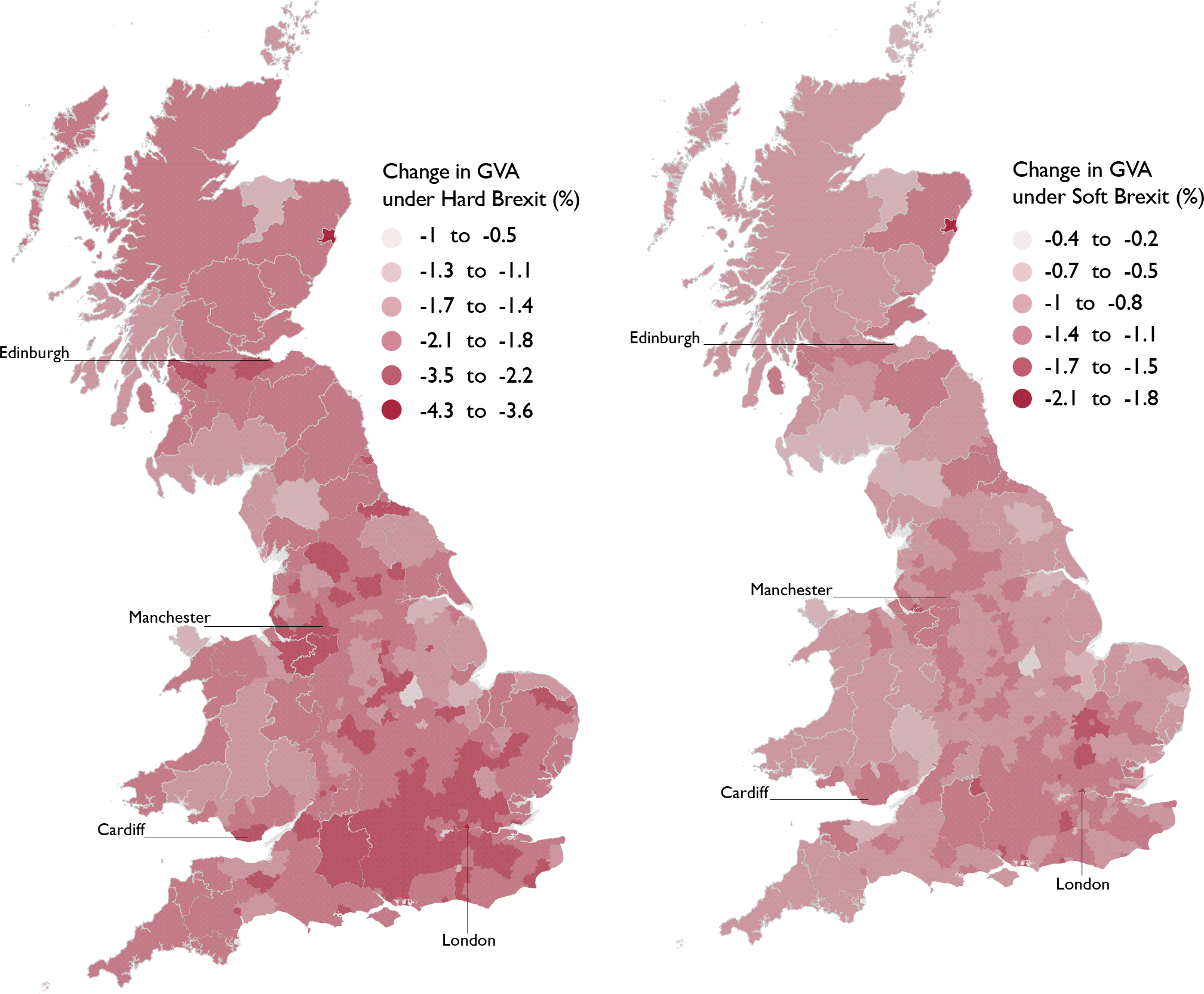
Figure 2 shows that these findings generalise when we look at the effect across all Local Authorities. The figure maps the percentage change in GVA by Local Authority under both soft and hard Brexit. The general geographical patterns are highly similar across both scenarios. A broad north-south pattern is visible, especially in terms of the concentration of areas most negatively affected. The pattern for those less badly affected is more dispersed. The map also suggests that urban Local Authorities tend to be more negatively affected (consistent with their employment concentration in the most negatively affected sectors). Areas in London and the South East which stand to experience a bigger negative impact from Brexit are notably those which tend to be more service industry intensive. A brief analysis of the employment shares in the top five LAs affected under a hard Brexit reveal that the most prominent industry in all five is Renting of Machinery and Equipment and Business Activities, while Financial Intermediation also features prominently.
Maps of percentage decreases in local authority GVA

Bigger negative effects for these areas reflect these sectoral shares and the interplay between pre-existing sectoral trade volumes (and thus exposure) and the sector-specific trade elasticites. The UK runs a trade surplus in services with the EU (over $68bn in 2011) and Renting of Machinery and Equipment and Business Activities along with Financial Intermediation account for more than two thirds of the UK's services trade with the EU. The UK's trade surplus in services with the rest of the world is considerably smaller ($28.1bn). In short, these sectors are very exposed to the EU market. In addition, in line with the evidence discussed above, the trade elasticities for all services is set to 5, meaning that a 1 per cent increase in trade costs would result in a 5 per cent decrease in imports relative to domestic demand. Pulling this together: large employment shares, combined with high exposure and trade elasticities make for bigger predicted impacts.
These results are consistent with studies that focus more specifically on the service sector. Under a hard Brexit the UK's services trade would be subject to WTO rules, and compared to the EU (and to goods trade) the WTO has made considerably less progress liberalising trade in services. A review of studies by Reference Berden and FrancoisBerden and Francois (2015) found that the trade cost equivalent (TCE) (i.e. the synthetic ad-valorem tariff equivalent) on services trade between the EU and US range between 8.5 per cent and 47.3 per cent, with specific sectors such as business services and financial services facing on average around 30 per cent TCE. All studies reviewed conclude that NTBs matter more for trade, and more so than tariffs which apply to goods (Reference Datta, Dhingra and BownDatta and Dhingra, 2017). In the presence of a dominant services sector and complex global supply chains, deep trade deals raise trade volumes by reducing the divergence in standards and rights to operate across countries. The EU's Single Market is the deepest trade agreement that limits the regulatory discontinuities across countries, leading to lower costs of doing business across borders. Using goods and services trade data, Reference Dhingra, Freeman and MavroeidiDhingra et al. (2017b) estimate that the non-tariff clauses regarding services and investment in deep trade deals have almost three times bigger impacts on raising trade volumes in the services sector, compared to goods trade. Moreover, the trade expansion effects of deep trade agreements are driven by these clauses, rather than shallow clauses such as tariff reductions. Research by London First (2016)Footnote 11 reaches similar conclusions, suggesting that EU services liberalisation has increased UK trade by between £212 billion and £400 billion a year. In short, the fact that the most negative area effects arise from large negative shocks predicted for some services is consistent with a wider empirical and policy literature.
Brexit vote correlations
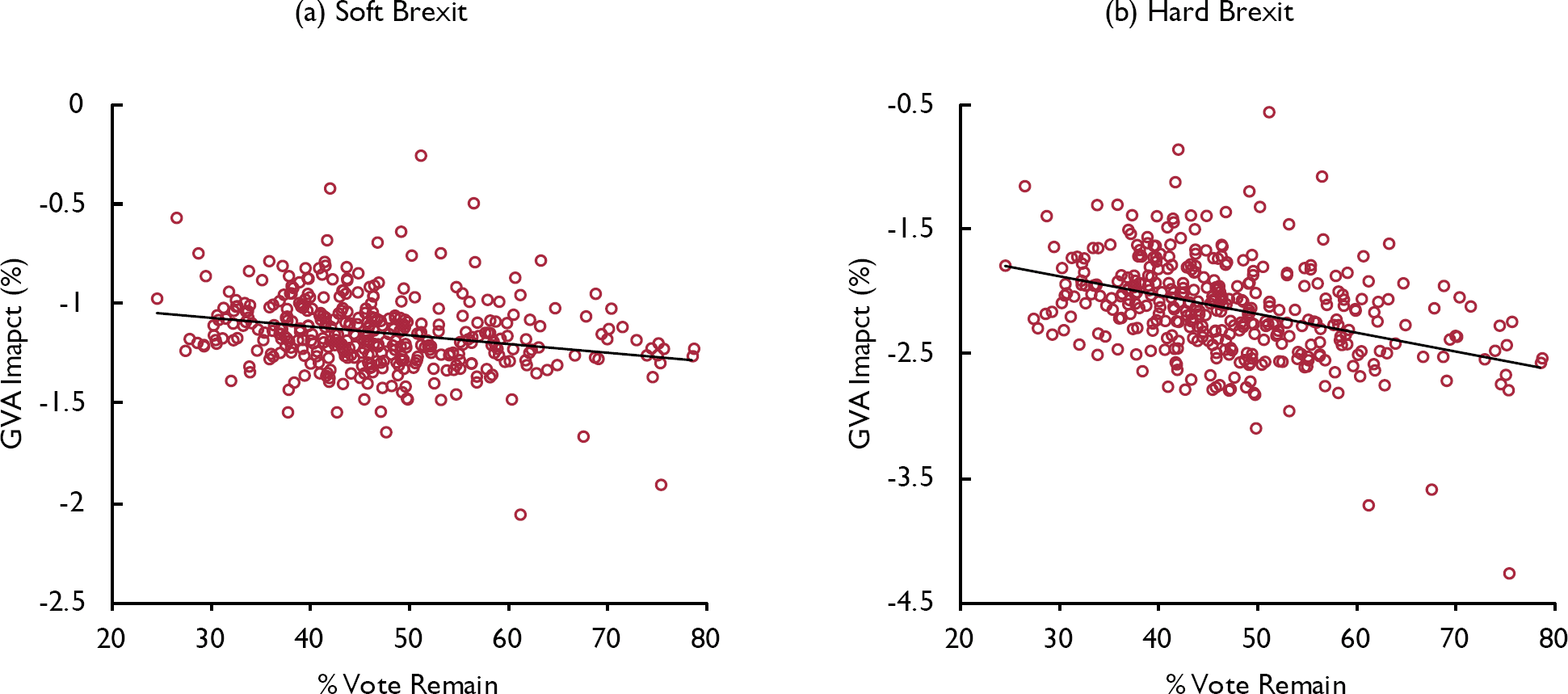
One obvious question arising from the overall patterns discussed above is how predicted impacts relate to vote shares in the referendum. Figure 3 provides an answer: areas that are predicted to be most negatively affected by Brexit were more likely to vote remain. The correlation is particularly striking for the predicted impacts under hard Brexit (correlation of −0.39 for hard Brexit as opposed to −0.24 for soft Brexit). Again, this finding differs from some existing studies because of the different geographical pattern for the places that are predicted to experience the most negative impacts from hard Brexit. As discussed above, these differences arise because mechanically extrapolating from existing trade exposure, ignoring differential changes in sectoral costs and different behavioural responses, provides significantly different area-level predictions. As discussed earlier, this is a reason why our estimated regional effects differ from Reference Los, Mccann, Springford and ThissenLos et al. (2017).
Brexit GVA impact and referendum vote share

Area initial conditions
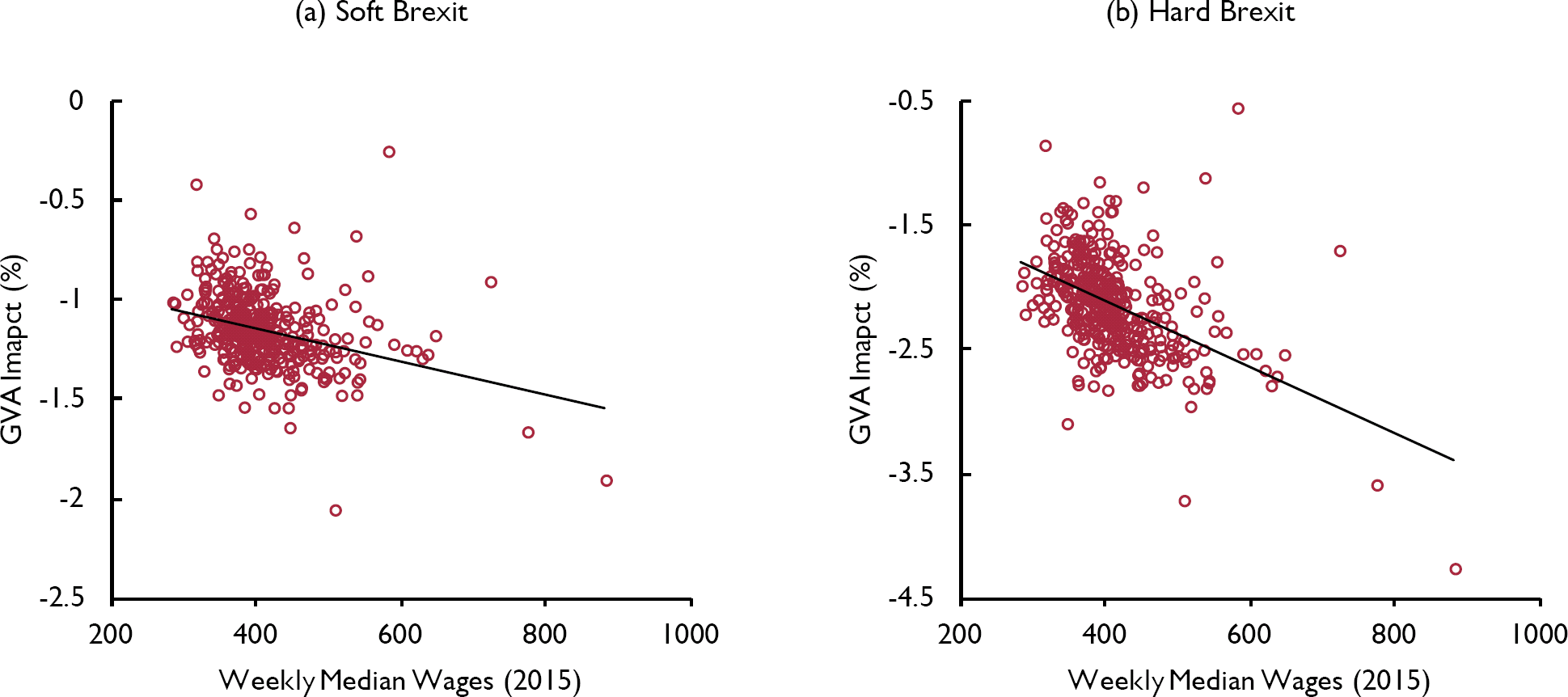
While the results so far imply a somewhat different narrative in terms of who is likely to lose most from Brexit, and how this relates to voting behaviour in the referendum, it is important to remember that the differences in expected impacts are swamped by existing disparities. Even though the immediate negative impacts are predicted to be smaller in poorer regions, households in those areas start off poorer and may experience considerably more difficulty in adjusting to those negative shocks. This is shown for the example of one initial condition, median wage levels, in figure 4 (the correlation is −0.23 for soft Brexit, −0.37 for hard Brexit).
Correlation of Brexit GVA impact with pre-referendum median wage

Finally, it is also important to appreciate that the places experiencing the biggest initial shock are not necessarily those that will experience the most negative effects once the economy has adjusted. As discussed in the introduction, we would highlight the parallel with the financial crisis and specifically the contrast between the immediate and long-run impacts (which saw London and the South East hit hardest before recovering much more strongly than other areas of the UK).
5. Conclusions
This paper has provided predictions of the local economic impact of Brexit under two different scenarios. Average effects are predicted to be negative under both scenarios and more negative under hard Brexit. The variation in shocks across Local Authorities is somewhat higher under hard Brexit because some Local Authorities are particularly specialised in sectors that are predicted to be badly hit by hard Brexit.
Local Authorities in the South of England, and those in urban areas, are predicted to be harder hit by Brexit under both scenarios. Again, this pattern is explained by the fact that those areas are specialised by sectors that are predicted to be badly hit by Brexit. The analysis shows that areas that were most likely to vote remain are those that are predicted to be most negatively impacted by Brexit. Negative impacts of Brexit tend to be bigger for areas with higher average wages.
The spatial estimates presented in this paper offer a first attempt to look at local economic impacts of the increases in trade barriers that will be associated with Brexit. Subsequent study of the effects of differential negative local shocks from whichever Brexit scenario ultimately occurs will form an important research agenda. Future wage, price and labour market dynamics are likely to be central to this, especially with respect to migration and skill shortages, but also with respect to automation and the adoption of new technologies and on employer and employee adjustment more generally. In short, these local estimates are far from the last word, but they do provide an initial clear indication that the economic impact of Brexit is likely to be felt differentially across the country.